• 검색 결과가 없습니다.

Research on criminal policy measures for the prevention and management of infectious diseases: Focusing on Mers

N/A
N/A
Protected

Academic year: 2021

Share "Research on criminal policy measures for the prevention and management of infectious diseases: Focusing on Mers"

Copied!
9
0
0

로드 중.... (전체 텍스트 보기)

전체 글

(1)

1. Introduction

A 68-year-old man who had been to Bahrain was found to be the first confirmed case of MERS(Middle East Respiratory Syndrome), a viral respiratory infection mostly found in the Middle

East including Saudi Arabia, on the 20th of May, 2015. About 100 days later, by the 28th of July, 2015 (when the end of MERS outbreak was actually declared by the government), 186 cases had been confirmed including hospital discharges and 36 deaths, which were equivalent to the

Research on criminal policy measures for the prevention and management of infectious diseases: Focusing on Mers

Kyung-Do Suh 1 *, Jung-Il, Choi 2 , Pan-Am Choi 3

1

Professor, Industry-Academic Collaboration Foundation, Kumoh National Institute of Technology

2

Professor, Police & Security Administration, Taegu Science University

3

Director, Jeju International University

감염병 예방관리를 위한 형사정책적 대응에 관한 연구: 메르스를 중심으로

서경도 1* , 최정일 2 , 최판암 3

1
금오공과대학교 교수,

2

대구과학대학교 경찰행정학과 교수,

3

제주국제대학교 이사

Abstract COVID19 is causing many fundamental phenomena all over the world. Since January 2020, the number of confirmed medical examinations has increased significantly worldwide, and the medical systems in each country have become paralyzed. South Korea has taken a proactive approach and is doing well, befitting the name K-Peace Prevention. However, it can be said that there is still a lack of awareness of legal and administrative limits. In this study examines the shortcomings and limitations of the laws relevant to the current infectious disease prevention and management systems from the perspective of criminal policy based on the “Infectious Disease Control and Prevention Act,” and comparatively analyzes the laws in advanced countries to propose effective and practical criminal policy response measures for the prevention and control of infectious diseases.

Key Words : Infectious Diseases, Future Infectious Diseases, Criminal Policy Countermeasures, Mers, COVID19

요 약 COVID 19로 인해 전세계적으로 많은 팬데믹 현상이 일어나고 있다. 2020년 1월 이후 전세계적으로 확진자가 큰 폭으로 상승을 하고 잇으며, 각국의 의료시스템이 마비가 되고 있다. 한국은 선제적으로 잘 대응을 하여 K-방역이라는 명칭에 걸맞게 잘 대처를 하고 있다. 그러나 아직까지 법률과 행정적인 한계점에 대한 인식이 부족하다고 할 수 있다. 이에 본 연구에서는 현행 감염병 예방 및 관리체계에 대하여 형사정책적인 관점에서“감염병의 예방 및 관리에 관한 법률”을 중 심으로 우리 법제의 문제점 및 한계를 검토하고, 주요 국가에서의 제도와의 비교・분석을 통해, 감염병 예방 및 관리를 위한 효과적이고 실효적인 형사정책적 대응방안을 제시하고자 한다.

키워드 : 감염병, 미래감영병, 형사정책적 대응방안, 메르스, COVID 19

*Corresponding Author : Kyung-Do Suh ([email protected]) Received December 2, 2020

Accepted December 20, 2020

Revised December 18, 2020

Published December 31, 2020

(2)

fatality rate of 19.4%.

The public anxiety over the MERS outbreak exerted substantially negative impacts on people’s daily life and national economy. The rapid spread of MERS resulted from the government’s incompetent response, the lack of rapid sharing of information about confirmed cases, the government’s information access restriction, the absence of a control tower, and other issues associated with hospitals and healthcare systems. Particularly, infected patients refusing to self-isolate or healthcare providers failing to report the suspected cases were blamed as the major causes of the spread of MERS. A patient getting tested for suspected MERS left the hospital ignoring the isolation order. A person ordered to self-isolate used public transport to sit the test to become a public servant. Some refused isolation at hospitals. Some doctors failed to fulfil their duty to report[1-3].

Some called for tightening the isolation order given the risks of infectious disease outbreaks causing the whole nation to panic, while others asserted a prison sentence for refusing the isolation order would be an excessive infringement of human rights. A few infectious diseases newly emerging or re-emerging around the world, e.g. A/H1N1, Ebola and MERS, pose a threat to humanity even in modern society[1-4].

As proved by the MERS outbreak in Korea, imported infectious diseases claimed lives and had devastating effects on economy on individual, social and national levels. This study examines the shortcomings and limitations of the laws relevant to the current infectious disease prevention and management systems from the perspective of criminal policy based on the “Infectious Disease Control and Prevention Act,” and comparatively analyzes the laws in advanced countries to propose effective and practical criminal policy response measures

for the prevention and control of infectious diseases.

2. Background

2.1 MERS outbreak and its impacts in Korea The 2015 MERS outbreak in Korea had tangible and intangible impacts on the country’s education due to the temporary school shutdown, economy, exports and foreign investment, as well as the stigma of being internationally disparaged as a country afflicted by an outbreak. Infectious diseases newly emerging or re-emerging around the world claimed lives and caused damage to economy on individual, social and national levels[5,6].

The MERS started in April, 2012 on the Arabian Peninsular in the Middle East. From the 20th of May, 2015 when the first confirmed case was reported in Korea to the 28th of July 2015 when the government declared the outbreak had ended, a total of 186 cases were confirmed including 36 deaths, or the fatality rate of 19.4%. 138 out of 186 recovered and were discharged from hospitals. Mostly, patients with confirmed MERS were inpatients and their carers, families and visitors, who had been in close contacts with them[7,8].

2.2 Potential outbreaks of future infectious diseases and healthcare policy

Newly emerging infectious diseases among

the future infectious diseases have sharply

increased and are expected to continually break

out around the world, although they have

hardly been detected in Korea. Also, other

infectious diseases which have broken out and

are expected to increase in the future or those

whose public health issues are likely to persist

in the future may well have substantial impacts

on future society and national economy.

(3)

Advanced countries have already developed government-led measures to protect their citizens from infectious diseases, while focusing their efforts on extensive strategic response to threats even from newly emerging infectious diseases. By contrast, Korea’s national response to pandemic crises is considered to be insufficient. In 2015, the government’s inappropriate response to MERS outbreak became the subject of much criticism.

2.3 Related work on future infectious diseases Most research on newly emerging infectious diseases concerns the crisis response measures, focused on the roles and response systems of public hospitals in the event of infectious disease outbreaks[9-13]. Jeong(2017) articulated in “Public Health Emergency Preparedness and Response in Korea” that to respond to any public health crisis resulting from newly emerging infectious diseases, the government needs to strengthen its public healthcare capacity and enhance the national healthcare systems’ capacity for infection control[13].

Jang(2017) identified the policy priorities for school infection prevention activities in crises caused by newly emerging infectious diseases in

“A Study on the National Crisis Management System in the Case of the New Infection Diseases[14].” In “Lessons from the Comparison of Responses to MERS Outbreak in Korea and WNV Outbreak in the US,” Kwon(2017) sought some implications for national crisis management and response systems to infectious diseases focused on inter-government and inter-organizational collaborations[15].

3. Criminal policy response to infectious diseases under current laws

3.1 Infectious Disease Control and Prevention Act The “Infectious Disease Control and Prevention Act” (“Infectious Disease Prevention Act” hereinafter) for preventing and controling infectious diseases in humans and the

“Quarantine Act” for keeping at bay and managing foreign infectious diseases have been enforced to control infectious disease outbreaks. The Infectious Disease Prevention Act stipulates the requirements for preventing and controling infectious disease outbreaks and pandemics, and has been revised 28 times.

The “Quarantine Act” was enacted in 1954, setting forth the quarantine process for those entering or leaving Korea and the measures for preventing infectious diseases with intent to prevent infectious diseases from spreading at home and abroad. In the same vein, the

“Immigration Control Act” bans patients with infectious diseases from entering Korea.

3.2 History of Infectious Disease Prevention Act in Korea

The surveillance of infectious diseases in Korea has revolved around reporting the officially designated infectious diseases. The report of infectious diseases has been aligned with the change in officially designated infectious diseases. The「Infectious Disease Prevention Act」

was enacted on the 2nd of February 1954 (No.

308), and partially amended 8 times, before being fully revised in January 2000.

3.3 Criminal policy response under Infectious Disease Prevention Act

Those who flout or breach restrictions are

punished under the Infectious Disease

Prevention Act, the Quarantine Act, the

Tuberculosis Prevention Act and the AIDS

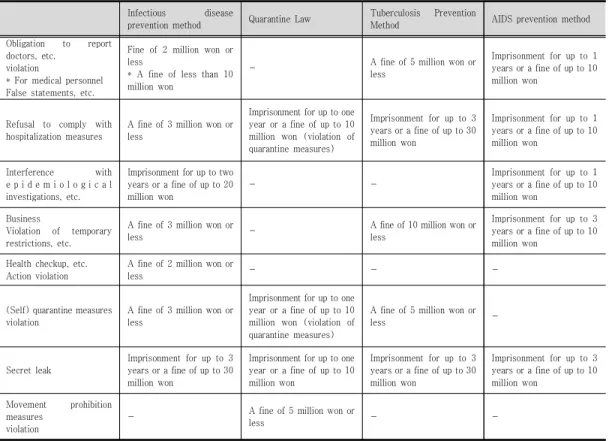
Prevention Act as outlined in Table 1.

(4)

Table 1. Violation and sanctions

Infectious disease

prevention method Quarantine Law Tuberculosis Prevention

Method AIDS prevention method

Obligation to report doctors, etc.

violation

* For medical personnel False statements, etc.

Fine of 2 million won or less

* A fine of less than 10 million won

- A fine of 5 million won or

less

Imprisonment for up to 1 years or a fine of up to 10 million won

Refusal to comply with hospitalization measures

A fine of 3 million won or less

Imprisonment for up to one year or a fine of up to 10 million won (violation of quarantine measures)

Imprisonment for up to 3 years or a fine of up to 30 million won

Imprisonment for up to 1 years or a fine of up to 10 million won

Interference with e p i d e m i o l o g i c a l investigations, etc.

Imprisonment for up to two years or a fine of up to 20 million won

- -

Imprisonment for up to 1 years or a fine of up to 10 million won

Business

Violation of temporary restrictions, etc.

A fine of 3 million won or

less - A fine of 10 million won or

less

Imprisonment for up to 3 years or a fine of up to 10 million won

Health checkup, etc.

Action violation

A fine of 2 million won or

less - - -

(Self) quarantine measures violation

A fine of 3 million won or less

Imprisonment for up to one year or a fine of up to 10 million won (violation of quarantine measures)

A fine of 5 million won or

less -

Secret leak

Imprisonment for up to 3 years or a fine of up to 30 million won

Imprisonment for up to one year or a fine of up to 10 million won

Imprisonment for up to 3 years or a fine of up to 30 million won

Imprisonment for up to 3 years or a fine of up to 10 million won

Movement prohibition measures

violation

- A fine of 5 million won or

less - -

* Violation of the Occupational Safety and Health Act: A fine of 10 million won or less

4. Results

4.1 Shortcomings in criminal policy response systems and suggestions

The head of KCDC and authorized officials shall initiate epidemiological investigations in case concerns are raised over infectious disease outbreaks and pandemics (Infectious Disease Prevention Act Article 18–1).

Restrictions are imposed on those who refuse to cooperate for epidemiological investigations.

As shown in <Table 4>, the Infectious Disease Prevention Act specified only the obligations not to refuse, interrupt and avoid the epidemiological investigations (Infectious Disease Prevention Act Article 18-3), and imposed a fine of ‘up to KRW 2 million’

(Infectious Disease Prevention Act Article 81-5).

By contrast, the revised Infectious Disease Prevention Act (No. 200) enforced in July 2015 after the MERS outbreak extended the penalties to the following in addition to the existing “acts of refusing, interrupting and avoiding epidemiological investigations”: ① acts of false statements or submission of false data and ② deliberate omission and concealment of facts.

Also, the revised Act toughened the penalties for breaches ‘up to a 2-year jail time or a KRW 20-million fine’ (Infectious Disease Prevention Act Articles 18-3 & 79-1).

However, the tougher penalties enforced in 2015 have two shortcomings. First, they caused concerns over excessive punishment. The Infectious Disease Prevention Act stipulates

“anyone” shall be obliged to cooperate for

epidemiological investigations, instead of

(5)

stating some specific people (the Infectious Disease Prevention Act Article 18-3). Also, without specifying who should fulfill the obligations, the provisions impose the obligation to cooperate on the general public and the penalties of ‘a up to 2-year jail time or a fine of up to KRW 20 million,’ which seems excessive in comparison to the fine of up to KRW 3 million imposed on infectious disease patients who disobey the hospitalization or self-isolation orders.

Therefore, the word “anyone” in the Infectious Disease Prevention Act should better be rephrased as “infectious diseases patients” to justify the penalties(Table 2).

Table 2. Changes in behavior and punishment regulations, such as obstruction of epidemiological investigations in the infectious disease prevention method

Behavior type Before the 2015

revision After revision in 2015 R e j e c t i n g ,

obstructing, or

evading an

e p i d e m i o l o g i c a l investigation without justifiable grounds

A fine of 2 million won or less

Imprisonment for up to two years, or Fine of not more than 20 million won

Making false

statements or submitting false data

×

Deliberate omission or concealment of facts

×

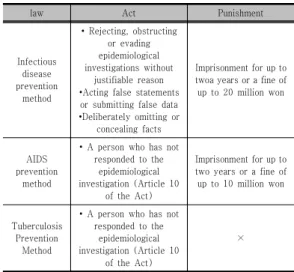
Also, the pre-2015 fine of up to KRW 2 million for such acts as simple refusal to take the epidemiological investigation should be maintained, whereas heavier penalties should be imposed on those who refuse the investigation and thereby cause the spread of infectious diseases. In addition, given it is hard to find the reason for no penalties for refusing the epidemiological investigation in the Tuberculosis Prevention Act, it is necessary to adopt some penalties for such acts. Moreover, as in the Infectious Disease Prevention Act, the AIDS Prevention Act and the Tuberculosis Prevention Act need to specify the acts of neglecting or

breaching the duty of cooperation for epidemiological investigations and equalize the statutory penalties(Table 3).

Table 3. Acts and punishments such as obstruction of epidemiological investigations

law Act Punishment

Infectious disease prevention

method

∙ Rejecting, obstructing or evading epidemiological investigations without

justifiable reason

∙Acting false statements or submitting false data

∙Deliberately omitting or concealing facts

Imprisonment for up to twoa years or a fine of up to 20 million won

AIDS prevention

method

∙ A person who has not responded to the

epidemiological investigation (Article 10

of the Act)

Imprisonment for up to two years or a fine of up to 10 million won

Tuberculosis Prevention

Method

∙ A person who has not responded to the

epidemiological investigation (Article 10

of the Act)

×

4.2 Healthcare providers’ breach of obligation to report

Healthcare providers are obliged to report infectious diseases and subject to a “fine of up to KRW 2 million” for breaches (Infectious Disease Prevention Act Article 81). The Infectious Disease Prevention Act (207) revised in July 2015 did not alter the legal penalties for healthcare providers who fail to report. Still, the revised Act stipulated “the healthcare providers obliged to report shall neither present false statements and data nor omit and conceal any facts necessary for confirming infections such as the history of visiting and consultation,” and imposed a ‘fine of up to KRW 10 million’ for breaches of the regulation (Infectious Disease Prevention Act Article 35-2 & 83-1).

The foregoing provisions need to be revised

on the following two grounds. First, the

statutory penalties need to be increased

reasonably.

(6)

Currently, the general public (including patients with infectious diseases) and healthcare providers are required to fulfil the obligations for the prevention and control of infectious diseases.

It is hard to deny that the fine of up to KRW 2 million for the violation of the duty to report is a slap on the wrist, compared to the fine of up to KRW 3 million levied on the general public (including patients with infectious diseases) for breaching the restrictions such as isolation. It cannot be said that healthcare providers’ failure to fulfil their obligation to

report suspected cases of infectious diseases found in the process of consultation is less unlawful than the violation of obligations to prevent infectious diseases or the spread thereof by patients with suspected or confirmed infectious diseases. As evidenced by the MERS outbreak, healthcare providers’ breaches of the obligation to report did lead to more grave results than the general public’s (including patients with infectious diseases) refusal to obey the restrictions.

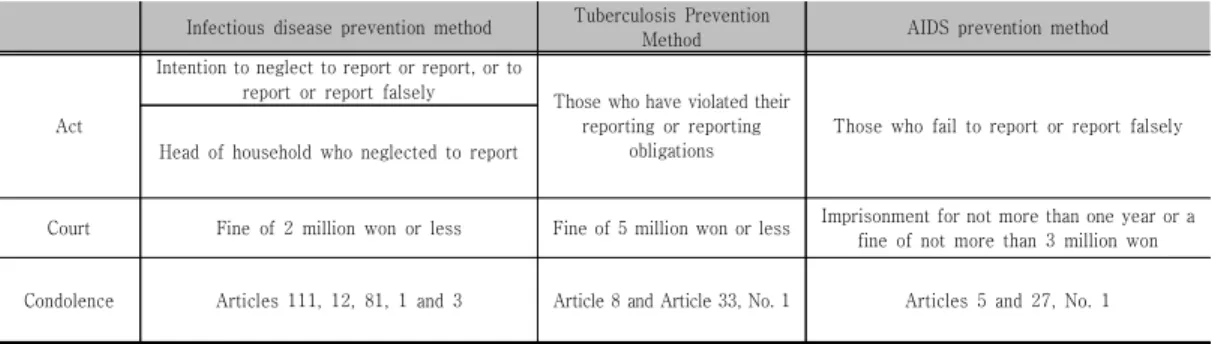
Table 4. Violation of reporting obligations and punishment

Infectious disease prevention method Tuberculosis Prevention

Method AIDS prevention method

Act

Intention to neglect to report or report, or to

report or report falsely Those who have violated their reporting or reporting

obligations

Those who fail to report or report falsely Head of household who neglected to report

Court Fine of 2 million won or less Fine of 5 million won or less Imprisonment for not more than one year or a fine of not more than 3 million won

Condolence Articles 111, 12, 81, 1 and 3 Article 8 and Article 33, No. 1 Articles 5 and 27, No. 1

Second, it is necessary to achieve consistency in the types of breaches subject to penalties and in legal penalties across applicable laws. The banned acts relevant to the obligation to report and associated penalties for breaches vary across the Infectious Disease Prevention Act, Tuberculosis Prevention Act and AIDS Prevention Act as shown in <Table 4>. Particularly, the penalties under the AIDS Prevention Act are implausible.

The unsubstantiated variance in breaches of restrictions and penalties across the 3 Acts need be overhauled.

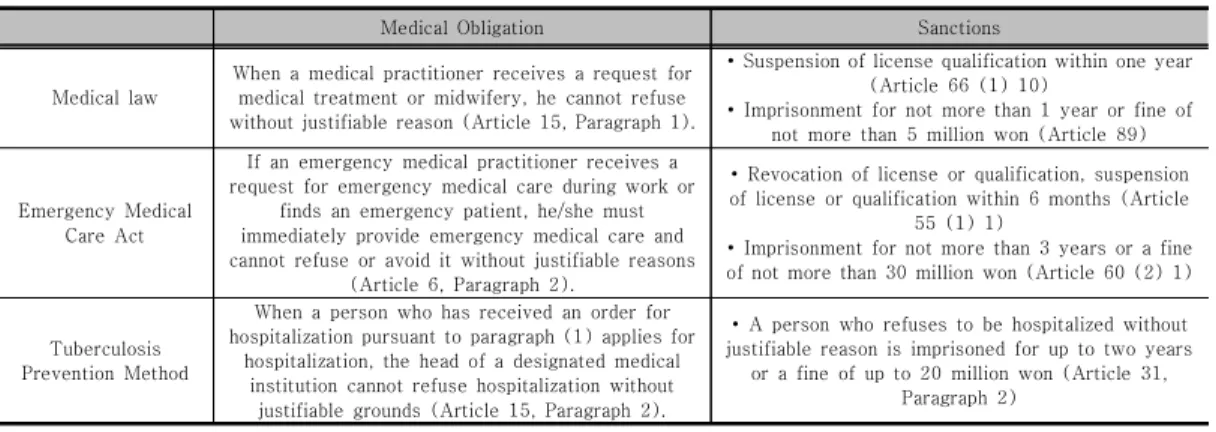
4.3 Healthcare providers’ refusal to see patients Mayors and governors are authorized to designate healthcare institutions under the Healthcare Act as

‘infectious disease control centers’ to control infectious diseases(Table 5), whilst the designated infectious disease control centers should install

the facilities for preventing infectious diseases

and consulting patients with infectious diseases

(Infectious Disease Prevention Act Article 36-1

and 36–2). Also, authorities including the Minister

of Health and Welfare are authorized to designate

other healthcare institutions as temporary

infectious disease control centers, in case

infectious diseases break out and the foregoing

infectious disease control centers lack in their

capacity to accommodate patients with infectious

diseases (see Infectious Disease Prevention Act

Article 37). The heads of the designated infectious

disease control centers should install the infectious

disease control facilities in compliance with the

order of the Ministry of Health and Welfare(Infectious

Disease Prevention Act Article 37-2 & 37-4). Such

designated centers must not refuse to admit

patients with infectious diseases without good

cause(Infectious Disease Prevention Act Article 38).

(7)

Table 5. Penalties across the 3 Acts overhauled

Medical Obligation Sanctions

Medical law

When a medical practitioner receives a request for medical treatment or midwifery, he cannot refuse without justifiable reason (Article 15, Paragraph 1).

∙ Suspension of license qualification within one year (Article 66 (1) 10)

∙ Imprisonment for not more than 1 year or fine of not more than 5 million won (Article 89)

Emergency Medical Care Act

If an emergency medical practitioner receives a request for emergency medical care during work or

finds an emergency patient, he/she must immediately provide emergency medical care and cannot refuse or avoid it without justifiable reasons

(Article 6, Paragraph 2).

∙ Revocation of license or qualification, suspension of license or qualification within 6 months (Article

55 (1) 1)

∙ Imprisonment for not more than 3 years or a fine of not more than 30 million won (Article 60 (2) 1)

Tuberculosis Prevention Method

When a person who has received an order for hospitalization pursuant to paragraph (1) applies for

hospitalization, the head of a designated medical institution cannot refuse hospitalization without

justifiable grounds (Article 15, Paragraph 2).

∙ A person who refuses to be hospitalized without justifiable reason is imprisoned for up to two years or a fine of up to 20 million won (Article 31,

Paragraph 2)

5. Conclusion

An array of newly emerging or re-emerging infectious diseases such as MERS pose a substantial threat to humanity now. Korea has learned a lot of lessons from the imported 2015 MERS outbreak, which spread throughout the country and left fatalities and property damage, causing huge national socio-economic losses.

This study illuminated the shortcomings in current laws and regulations and comparatively analyzed the advanced systems to elicit some suggestions for securing the practically effective criminal policy response for the infectious disease prevention and control.

Excessive regulations and penalties compromise the practical effects of given provisions. Simultaneously, too lenient regulations can hardly guarantee the practical effects of those provisions. Thus, it is essential to mete out proper penalties for breaches, and to ensure consistency in such penalties across applicable laws and regulations. To that end, the following specific measures need be taken.

First, the tougher penalties under the revised 2015 Infectious Disease Prevention Act concerning the refusal to take epidemiological investigations border on excessive punishment.

It is necessary to delineate the breaches by

“patients with infectious diseases”, and to lower

the penalties. Moreover, it is critical to ensure consistency in the penalties for identical or comparable breaches, which currently vary across the Infectious Disease Prevention Act and the AIDS Prevention Act. Furthermore, a new provision on penalties should be inserted in the Tuberculosis Prevention Act.

Second, the penalties for healthcare providers’ breaches of the obligation to report should be reasonably toughened, since it is hard to deny the penalties imposed on healthcare providers failing to report are too lenient compared to those levied on the general public(including patients with infectious diseases) for breaching restrictions such as isolation orders. Also, it is crucial to ensure consistency in the types of breaches of obligations to report subject to punishments and penalties across the Infectious Disease Prevention Act, Tuberculosis Prevention Act and AIDS Prevention Act.

Third, new penalties should be meted out to healthcare providers who refuse to see patients.

The refusal to see patients may be subject to penalties under the ‘Medical Service Act’ or the

‘Emergency Medical Service Act,’ where the

applicable provisions limit the scope to ‘medical

service providers’ and ‘emergency medical

service providers,’ which is far from the specific

purpose of infection control or management

(8)

and the proper function in response to national crises caused by infectious diseases.

Fourth, given the provisions on penalties for the breaches of healthcare service duties and confidentiality vary across the Infectious Disease Prevention Act, Tuberculosis Prevention Act and AIDS Prevention Act, it is necessary to reasonably adjust those provisions across applicable laws and regulations.

Fifth, despite the increasing potential terror attacks using high-risk pathogens, the penalties for abusing high-risk pathogens under the Infectious Disease Prevention Act are too unsophisticated. The current penalties for unauthorized imports and false declaration of high-risk pathogens (including the failure to declare) as well as the refusal to take safety checks are insufficient to proactively deter

‘bio-terrorism’ attempts. Hence, it is imperative to specify the types of offenses or breaches such as incurring public risks by spreading high-risk pathogens(including attempts and conspiracies), importing pathogens to commit crime, and unlawfully transferring and possessing pathogens, as well as applicable restrictions and penalties.

ACKNOWLEDGMENTS

This work was supported by the Ministry of Education of the Republic of Korea and the National Research Foundation of Korea (NRF-2019S1A5A2A03052761).

REFERENCES

[1] E. S. Kim. (2015). A Social Analysis of the Limitation of Governmental MERS Risk Communication. Crisisonomy, 11(10), 91-109.

DOI: 10.14251/krcem.2015.11.10.91

[2] J. T. Yoon. (2015). The Study of Effectiveness of MERS on the Law and Remaining Task. The Korean Society Of Law and Medicine, 16(2),

263-291.

[3] J. H. Kim. (2011). A Study on Legislation Modification to Develop National Abilities to Cope with Epidemics. Korea Legislation Research Institute.

[4] J. H. Bae. (2017). A Study on Improvement of National Disaster Management System through the MERS Outbreak in Korea. Journal of Governance Studies, 11(3), 27-53.

DOI : 10.16973/jgs.2016.11.3.002

[5] Korea Centers for Disease Control and Prevention. (2011). 2011 Infectious Disease Monitoring and Reporting Guidelines.

[6] Korea Centers for Disease Control and Prevention. (2015). (3-5th edition) For the procedure for supporting 2015 MERS.

[7] Korea Centers for Disease Control and Prevention. (2015). (5th edition), 2015 Ebola virus disease response guidelines.

[8] Korea Centers for Disease Control and Prevention. (2014). 2014 Legal infectious disease diagnosis / notification criteria.

[9] S. Y. Yoon. (2012). Deriving the Effective Improvement Elements of the Emergency Room in Large General Hospitals. Journal of Korean Critical Care Nursing, 8(2), 66-79.

[10] W. J. Kim. (2016). Epidemic prospects and response strategies for new-type zoonotic diseases. founding general meeting and academic conference, 12(1), 13-14.

[11] J. Y. Kim & J. S. Bang. (2016). Developing Prevention System of Overseas Infectious Disease Based on MERS and Zika Virus Outbreak. Korean Journal of Clinical Pharmacy, 26(4), 330-340.

[12] H. S. Seo et al. (2017). Relighting the role of public hospitals by analyzing patterns of suspected patients; focusing on infectious disease response at Seihoku Hospital.

Tuberculosis & Respiratory Diseases, 120.

[13] B. Y. Jang. (2017). A Study on the National Crisis Management System in the Case of the New Infection Diseases : Focusing on School Infection Prevention Activities. Korean Journal of Political Science, 25(3), 69-89.

[14] E. K. Jeong. (2017). Public health emergency preparedness and response in Korea. Journal of the Korean Medical Association, 60(4), 296-299.

[15] H. B. Kwon. (2017). Lessons from the comparison

of responses to MERS outbreak in Korea and

(9)

WNV outbreak in the United States : Focused on interorganizational collaboration and information sharing. Korean Security Journal, 52, 143-162.

서 경 도(Kyung-Do Suh) [종신회원]

․ August, 2012 : Kumoh National Institute of Technology, Department of Management (Ph.D.)

․ March, 2019 ~ Present : Kumoh National Institute of Technology Industry-Academic Collaboration

Foundation

․ Research Interests : Infectious, Management

․ E-Mail : [email protected]

최 정 일(Jung-Il Choi) [정회원]

․ Feb., 2017 : Yeungnam University Department of Law (Ph.D.)

․ March, 2017 ~ Present : Taegu Science University, Police &

Security Administration

․ Research Interests : Infectious, Law, Criminal Act.

․ E-Mail : [email protected]

최 판 암(Pan-Am Choi) [정회원]

․ Feb., 2012 : Kyonggi University Security Management (Ph.D.)

․ November, 2019 ~ Present : Jeju International University director

․ Taegu Science University Defense Security Institute

․ Research Interests : Infectious, Security Management

․ E-Mail : [email protected]

수치

Table  1.  Violation  and  sanctions
Table  2.  Changes  in  behavior  and  punishment  regulations,  such as obstruction of epidemiological investigations  in the infectious disease prevention method
Table  4.  Violation  of  reporting  obligations  and  punishment
Table  5.  Penalties  across  the  3  Acts  overhauled

참조

관련 문서

Antimicrobial therapy of unexplained fever in neutropenic patients--guidelines of the Infectious Diseases Working Party (AGIHO) of the German Society of Hematology

DNA-based testing includes pre- and postnatal genetic testing for the diagnosis of genetic diseases, carrier testing for genetic diseases, susceptibility genetic testing

management of community-acquired pneumonia: an evidence- based update by the Canadian Infectious Diseases Society and the Canadian Thoracic Society. The

European journal of clinical microbiology &amp; infectious diseases : official publication of the European Society of Clinical Microbiology.. Luchi M, Morrison DC, Opal S,

1) Global Initiative for Chronic Obstructive Lung Disease (GOLD). Global strategy for the diagnosis, management and prevention of COPD. Yates, B.S., Jørgen Vestbo, M.D.,

surveillance study of patients with Emergency Department injuries under the control of the Korea Centers for Disease Control and Prevention (KCDC).Statistical

For improvement measures, this study proposes the enactment of the provisional Framework Act on Crisis Management and exemplary provi- sions thereof. This study concentrates

Second, because the Act provide for the same control scope of Specific Foreign Corpora- tions in spite of difference on the object of transfer pricing