• 검색 결과가 없습니다.

Factors Affecting Real Estate Prices During the COVID-19 Pandemic: An Empirical Study in Vietnam

N/A
N/A
Protected

Academic year: 2021

Share "Factors Affecting Real Estate Prices During the COVID-19 Pandemic: An Empirical Study in Vietnam"

Copied!
6
0
0

로드 중.... (전체 텍스트 보기)

전체 글

(1)

Print ISSN: 2288-4637 / Online ISSN 2288-4645 doi:10.13106/jafeb.2021.vol8.no10.0159

Factors Affecting Real Estate Prices During the COVID–19 Pandemic:

An Empirical Study in Vietnam

Nguyen Ho Phi HA

1

Received: April 30, 2021 Revised: August 08, 2021 Accepted: September 06, 2021

Abstract

The COVID-19 pandemic has widely spread and has become a global problem. The pandemic has had a negative impact on most countries and on the global economic growth. In the real estate and housing market, the impact of the pandemic has directly disrupted the supply of raw materials and human resources. In case of Vietnam, the real estate and housing markets are increasingly becoming important contributors to Vietnam’s economy, with a combined contribution of approximately 6% to the GDP of the country. Also, the pandemic has negatively affected the real estate in Vietnam. Using a sample data of 220 home, apartment and real estate buyers in the period of April 2020 to Apr 2021 in Nam Tu Liem and Cau Giay districts, Hanoi, the research results demonstrate that the area of the house, the number of beds, and the location of the land show a positive influence on the real estate price. Meanwhile, the distance from the land to the center of the district has a negative effect on the price, which means that the further away a land is from the center, lower is its price.

Keywords: COVID-19 Pandemic, Real Estate Prices, Hanoi, Vietnam JEL Classification Code: J24, M13, M55

pandemic has negatively affected the growth of the world economy. In addition, the economies of major powers such as China, Japan, Singapore, the United States and Europe fell into a short-term recession with negative growth. At the same time, the impact of the pandemic led to a decrease in the flow of the FDI and affected investment, business, and economic growth in most countries worldwide.

The real estate market also suffered certain impacts during the COVID-19 pandemic due to the prolonged pandemic, it led to many investors becoming hesitant to invest in the market, which led to a sharp decrease in demand in the housing market. Simultaneously, the market supply also decreased because the market developers were not willing to increase supply, leading to a sharp decline in the market. Similar to the past, the 2008 global financial crisis stemmed from the real estate mortgage lending policy in the United States, which was the fundamental cause of the economic recession in most countries of the world. This proves that the real estate market has a great effect on the economy. Therefore, most countries think that the real estate market can significantly promote the positive impacts on the economy.

With the above discussion, research on the factors affecting the real estate prices during the COVID-19 pandemic has become an urgent issue, not only in Vietnam but also in many parts of the world. Many studies have shown that the value of a property depends a lot on the area, location of the real estate, utilities, number of bedrooms and transport

1

First Author and Corresponding Author. Academy of Finance, Hanoi, Vietnam [Postal Address: No. 58, Le Van Hien, Dong Ngac, Bac Tu Liem, Hanoi, 100000, Vietnam] Email: [email protected]

© Copyright: The Author(s)

This is an Open Access article distributed under the terms of the Creative Commons Attribution Non-Commercial License (https://creativecommons.org/licenses/by-nc/4.0/) which permits unrestricted non-commercial use, distribution, and reproduction in any medium, provided the original work is properly cited.
1. Introduction

In recent years, Vietnam’s economy has transformed and has become the most dynamic economy in the region, with a high growth rate, the per capita income of the country has increased to over 3000 USD/person/year. People’s lives have changed and people’s wealth accumulation has increased.

Along with the development of the country, the construction and real estate industry has played a huge role in the economic structure of the country, accounting for 6% of the country’s GDP (Nguyen & Nguyen, 2021). The role of the real estate market includes promoting economic growth and creating jobs.

The real estate market along with the construction industry also improves the quality of accommodation and living conditions of the Vietnamese people, and further stimulates domestic and foreign investment in the housing market.

In 2020, the COVID-19 pandemic that started in Wuhan,

China, has become a global epidemic. The impact of this

(2)

connections. This study will help countries, governments and researchers gain a more holistic view of the impact of the pandemic. In addition to the introduction, the remainder of this study consists of: part 2 which is an introduction to the literature review, part 3 is an introduction to the data and research methods. The research results and discussion of the research results is presented in section 4. The final part presents the conclusion and some policy implications.

2. Literature Review

The real estate market in general and the construction industry in particular is always one of the key industries, especially in the developing countries. Starting from a low foundation, developing countries always in need of building infrastructure, develop housing and improve the quality of life and other similar things. Therefore, the real estate industry has always played an extremely important role in the economic life of these countries. Many of the recent studies have confirmed the interactive relationship between housing prices and the economic growth as in the study by Miller et al. (2000). Filotto et al. (2018) argued that, changes in the housing mortgage policy, and house prices have an impact on the GDP growth.

Research on the real estate market has always attracted the attention of many scholars and researchers in the past.

According to previous research, there are many factors that affect the price of real estate or apartments. This has been shown in the study of Aliyev et al. (2019) which was done in the context of fast economic growth in the capital Baku of the Republic of Azerbaijan. This is also the most developed city in this country. In addition, a period of slow economic growth in the past had decreased the housing demand but the economic growth in the recent years has stimulated the housing demand. Therefore, housing supply and housing demand are both increasing rapidly. Aliyev et al. (2019) conducted a study on 497 apartment and 443 house owners in Baku. It studied the factors that affect real estate prices such as: location, width, level of repair and ease of sale. A limitation is found in this study, which is that it only evaluates on the basis of the seller’s price and does not take into account the buyer’s bid, and has not analyzed the information asymmetry in the housing market. In fact, information asymmetry always exists in transactions, when one party has more information than the other, specifically the seller always have more information about the goods than the buyer. It leads to decisions in the transaction that often sellers benefit and buyers lose. Bidding in real estate transactions can be made more balanced between the two parties in this transaction.

Another similar study was conducted in Indonesia which is a country with a GDP of over 1 trillion USD and among the top 20 countries with the largest economic scale in the

world. The reason for this is that the real estate market in Indonesia is large, and it is also more competitive. According to research by Rahadi et al. (2015), which was conducted in Jakarta, and was based on 220 surveys, of which 127 people were male and 75 were female, the survey age ranged from 18 to 56. The study indicated that the age and location of real estate affects the house prices in Jakarta.

Saudi Arabia’s housing market is considered to be relatively competitive in the Middle East. A research by Assaf et al. (2010) shows that the construction cost is one of the factors which affects the housing prices. Assaf et al.

(2010) conducted a survey on 14 consultants, 16 contractors and 5 real estate development companies, analyzing through 34 different factors that are likely to affect house prices.

In the study, factors such as construction material standards, design quality, and design changes are considered to be the most important factors affecting the product cost.

Another factor which also affects the housing prices is the maintenance costs when the building is put into use.

If a property has a good value, it means low maintenance costs, and vice versa, a property with a poor value requires a lot of annual maintenance costs. Research by El-Haram et al. (2002) argued that the maintenance of the house and the maintenance costs of the house are the main components which greatly affect the value of the house.

Another study was conducted in Hong Kong, where house prices are rated as the highest in Asia, owning a property in Hong Kong is an urgent but extremely difficult need, especially for the younger generation. Jayantha and Oladinrin (2019) conducted a survey of 502 people, assessing through 4 main factors including household economy, cost of living and housing, general real estate costs, readiness and uncertainty of the housing market. The study confirmed that factors affecting home ownership include high house prices, pressure on cost of living, and high prepaid deposits.

Similarly, Wu and Guo (2011) in their study in China revealed that the factors affecting house prices include market supply and demand, one-side conditions and population size.

Indeed, population size is one of the important factors that shape market demand, and therefore has an impact on the supply of the real estate market.

It has been observed in the Vietnam’s real estate market

that the property prices especially house prices tend to

increase. According to research by Ha (2021), the reason

for the increase in house prices despite the impact of the

pandemic is the shortage of supply. While under the pressure

of urbanization, housing demand remains very high, the

shortage of supply causes house prices to rise. Another

reason is that during the pandemic, macroeconomic condition

become unstable especially because of the interruption in

logistics and supply chain activities that lead to an increase

in the price of raw materials, and the price per square

meter. This eventually leads to an increase in house prices.

(3)

More specifically, steel prices have increased by 30–40%

since the end of 2020, indicating that it is difficult for real estate developers to reduce product costs.

3. Data and Methodology 3.1. Data

This study was conducted in a case study in Hanoi, Vietnam by a survey of 220 house buyers in Cau Giay district, and Nam Tu Liem district. To do this research, stratified random sampling process is selected. In addition, the sample of the study covers the transactions with certificates of land use rights, ownership of houses and other assets attached to land; registration fee records, current status drawings.

This study was conducted during the period of April 2020 to April 2021. We have six explanatory variables in the model.

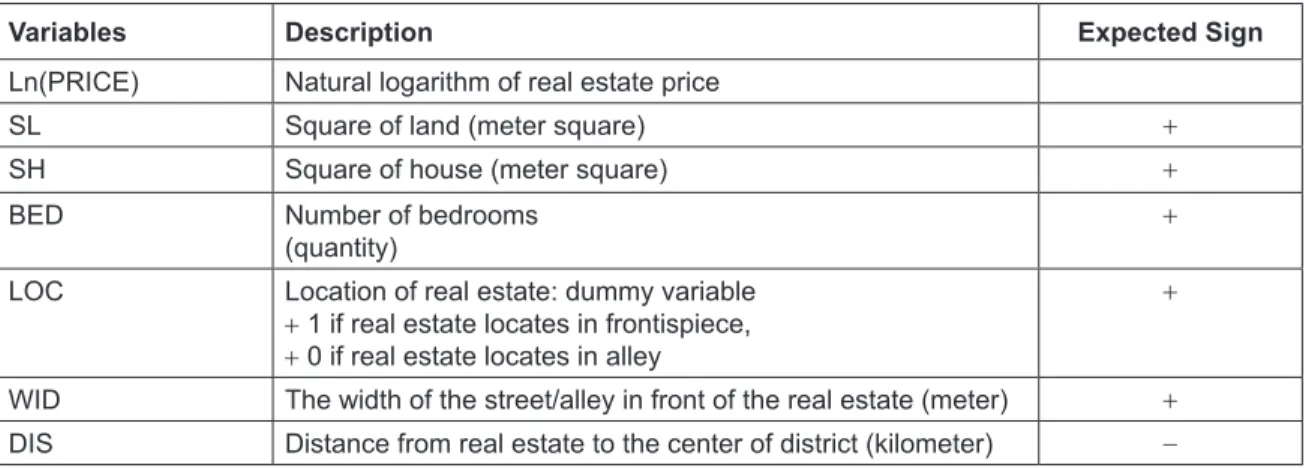
The specific explanations of all variables will be shown in the Table 1 as follows:

3.2. Research Methodology

In recent times, many studies have been carried out on the subject of the relationship of factors and real estate prices in the world. However, the research on the real estate market is still quite new in Vietnam. Based on the previous studies of Wu and Guo (2011), Jayantha and Oladinrin (2019), we have the estimation equation as follows:

ln (PRICE) = β

0

+ β

1

× SL + β

2

× SH + β

3

× BED + β

4

× LOC + β

5

× WID + β

6

× DIS + u

i

In which,

Ln (PRICE), is the natural logarithm of real estate price, this is the dependent variable

Explanatory variables include (1) the quality of real estate: SL, SH, and BED; (2) the position of real estate:

LOC, WID, DIS.

β

0

, is the intercept

β

i

, is the estimation coefficient of SL, SH, BED, LOC, WID, and DIS

u

i

is the error term

4. Results and Discussion

Analysis of the correlation matrix between the independent variables to evaluate the possible multicollinearity in the regression model, the evaluation aims to eliminate the variables that may cause the multicollinearity phenomenon, in order to choose the best research results. Theoretically, when the correlation coefficient between pairs of independent variables is less than 0.8, multicollinearity will not occur (Nguyen, 2021a;

Nguyen, 2021b). Looking at the results of Table 2, there are no pair of variables with a correlation coefficient greater than 0.7534, so the model does not have multicollinearity.

In the analysis, when VIF is more than 10, it meant that the multi-collinearity may be present. Here is the formula for calculating the VIF for X

i

VIF 

 1 1 R

2

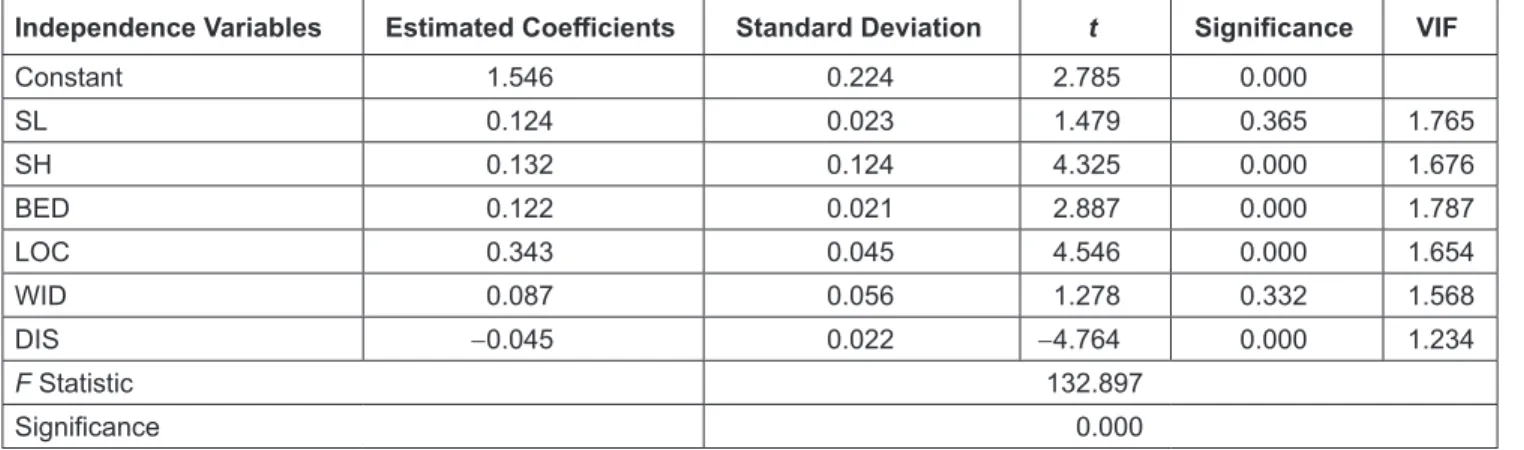
Table 3 indicates that VIF has a range of 1.234 and 1.787 and is not more than 10. It is evident that the multi- collinearity is not present.

Except WID, and SH, other the independent variables are statistically significant as well as the signs of the coefficients are in agreement with the expectations as shown in Table 1.

The estimation result is written as follows:

Table 1: Explanation of Variables

Variables Description Expected Sign

Ln(PRICE) Natural logarithm of real estate price

SL Square of land (meter square) +

SH Square of house (meter square) +

BED Number of bedrooms

(quantity) +

LOC Location of real estate: dummy variable + 1 if real estate locates in frontispiece, + 0 if real estate locates in alley

+

WID The width of the street/alley in front of the real estate (meter) +

DIS Distance from real estate to the center of district (kilometer) -

(4)

ln (PRICE) = 1.546 + 0.124 × SL + 0.132 × SH

+ 0.122

× BED + 0.343 × LOC + 0.087 × WID + 0.245 × DIS + u

i

In the results, we conclude that a greater SH, BED, LOC, and DIS will lead to a higher price of real estate.

More specifically, when the house area increases by 1 meter square, the real estate price will significantly increase on an average by 13.2%. In addition, when the area of the bed rooms increases by 1 square meter, the price of real estate will also increase on an average by 12.2%.

It is evident that a property with a street frontage location will entirely have a higher price than the property located in an alley or in a less convenient location. In addition, the property has a street frontage location, the price of that property will be higher than a property with less convenient location is approximately 34.3%. In addition, the real estate prices are also affected by the width of the road in front of the real estate, in this case, the distance from the real estate to the center increases/decreases by 1 meter, the price of real estate in Hanoi will decrease/increase by 4.5% on an average.

The most important factors that affecting the price of real estate can be shown in Table 4.

Table 4 indicates that the most important factors affecting the price of real estate are, respectively, Location of the real estate, Square of house (meter square), Number of bedrooms, and distance from real estate to the center of district (kilometer).

R

2

in this formula is the coefficient of determination from the linear regression model with independent and independent variables. In this study, changes in independent variables can explain 65.6% changes of real estate prices (Table 5).

Checking the robustness of the estimated model is important, it is necessary to evaluate the quality of the regression model. In this study, the re-estimation study Table 2: Correlation Matrix

Variables SL SH BED LOC WID DIS

SL 1.0000

SH 0.2231 1.0000

BED 0.3231 0.1347 1.0000

LOC 0.2452 0.2790 0.7534 1.0000

WID 0.3241 0.0381 0.3221 0.5643 1.0000

DIS 0.1320 0.2415 0.3431 0.1003 0.4321 1.0000

Table 3: Results of Regression Model

Independence Variables Estimated Coefficients Standard Deviation t Significance VIF

Constant 1.546 0.224 2.785 0.000

SL 0.124 0.023 1.479 0.365 1.765

SH 0.132 0.124 4.325 0.000 1.676

BED 0.122 0.021 2.887 0.000 1.787

LOC 0.343 0.045 4.546 0.000 1.654

WID 0.087 0.056 1.278 0.332 1.568

DIS -0.045 0.022 -4.764 0.000 1.234

F Statistic 132.897

Significance 0.000

Table 4: Main Factors

Independence Variables Absolute Value

LOC 0.343

SH 0.132

BED 0.122

DIS 0.045

Source: Calculation of the author.

(5)

will perform the second regression with the removal of the WID variable that is not statistically significant (Table 6).

The research results still confirm that the variables SH, BED, LOC, DIS are still statistically significant, which shows that the regression results are solid and reliable (Table 6).

5. Conclusion and Recommendations

The real estate and housing markets are becoming increasingly important contributors to Vietnam’s economy, with a combined contribution of around 6% of the GDP.

Despite the impact of the pandemic, the real estate market still grew, typically real estate prices continued to increase.

In order to assess the factors affecting the real estate prices, the study conducted a survey of 220 home, apartment and real estate buyers in Nam Tu Liem and Cau Giay districts, Hanoi. Research results show that the area of the house, the number of beds, and the location of the land has a positive influence on the real estate price. Meanwhile, the distance from the land to the center of the district has a negative effect on the price, which means that further away a land is from the center, lower is its price.

Even during the COVID-19 pandemic, it was still marked by an increase in the real estate prices in Hanoi. Investors are still interested in the information about the building, such as the area of the house and the number of rooms in the house. In addition, the location of the house and the width of the road at the house are still a matter of interest for the investors. In order for the real estate market to continue to develop, especially in the context of COVID-19, the study has the following solutions:

Firstly, the government continues to have suitable policies to support real estate developers so that businesses feel secure in their production and business activities. During the pandemic, real estate prices continued to increase, as explained by Ha (2021) due to a shortage of real estate supply, leading to inequality in the market supply-demand relationship.

Meanwhile, people’s demand for accommodation is still very high as well as the urbanization process in Vietnam in general and the Hanoi area in particular is still going strong. However, the effects of the pandemic have disrupted the logistics chain and therefore has increased the price of raw materials. In addition, the government support policies can come from support in loan interest rates for real estate developers, interest rate support for homebuyers, as well as debt rescheduling policies for homebuyers and other businesses.

Second, the government should create convenient conditions for real estate developers to access clean land at a reasonable cost. According to Phuong (2007), in the first stages of real estate development, it is always difficult for businesses to access land to be able to develop projects and supply products to the market, especially provide the low-cost housing or affordable housing for low-income people. Currently, house prices are rising much higher than people’s incomes. In the context of the COVID-19 pandemic, it has caused people’s incomes to decrease and fluctuate, it is difficult for young people with unstable incomes to access the real estate market, which has affected the development of society.

Third, the government continues to implement vaccination policies for real estate businesses and workers in the construction industry. Currently, the construction Table 5: Results of Testing Research Model

Paradigm Correlation

Coefficients Coefficient of Determination Determination Coefficient has Corrected Correlation (R

2

)

1 0.675 0.467 0.656

Source: Calculation of the author.

Table 6: Results of Regression Model Independence

Variables Estimated

Coefficients t Significance VIF

Constant 1.563 2.898 0.000

SL 0.126 1.472 0.365 1.676

SH 0.156 4.655 0.000 1.890

BED 0.154 2.981 0.000 1.651

LOC 0.321 4.676 0.000 1.450

DIS -0.041 -4.430 0.000 1.241

(6)

and real estate industries are contributing up to 6% of the country’s GDP, and has played an important role in ensuring the housing needs of all individuals and families and also upgrading the face of the country. Moreover, the construction industry has the characteristics of workers working in a highly polluted environment, and the COVID-19 pandemic has also increased the risks for workers in the industry. In addition, most of the workers in the real estate industry are from rural areas, with limited educational conditions and low income, who are very vulnerable to shocks caused by the pandemic, which may affect the state’s social security policy.

Fourth, the government continues to implement legal reforms related to the real estate market, especially in the context of the pandemic, which will create momentum for the market. Currently, the access to land in the real estate market is not really transparent, and the land access mechanism is still complicated. At the same time, the tax and fee policies related to the market have not been completed, making it difficult for both market developers and home buyers.

Reforms need to be towards market transparency, in which tax and fee policies need to be stable, creating a platform for fair competition among businesses in the housing market.

Fifth, the government needs to create a fund to stabilize the real estate market during the COVID-19 pandemic or in the context of market-related shocks. In the period 2012 - 2016, the government implemented a policy to support low- income people to buy cheap houses with an interest rate of 6%, this policy had created a motivation to help low-income people access the real estate market in stabilizing housing and ensuring social security. Although the COVID-19 pandemic has been around for nearly 1.5 years, the policies to support the market are not really clear, so the stabilization fund or appropriate interest rate and tax policies can be a stimulus solution for markets to operate stably and overcome difficulties during the pandemic.

References

Aliyev, K., Amiraslanova, M., Bakirova, N. & Eynizada, N.

(2019). Determinants of housing prices in Baku: empirical analyses. International Journal of Housing Markets and Analysis, 12(2), 281–297. https://doi.org/10.1108/

IJHMA-08-2018-0062

Assaf, S. A., Bubshaitr, A. A. & Al‐Muwasheer, F. (2010).

Factors affecting affordable housing cost in Saudi Arabia. International Journal of Housing Markets and Analysis, 3(4), 290–307. https://doi.org/10.1108/17538271011080628

El‐Haram, A. M., & Horner, W. M. (2002). Factors affecting housing maintenance cost. Journal of Quality in Maintenance Engineering, 8(2), 115–123.

Filotto, U., Giannotti, C., Mattarocci, G. & Scimone, X. (2018).

Residential mortgages, the real estate market, and economic growth: evidence from Europe. Journal of Property Investment

& Finance, 36(6), 552–577. https://doi.org/10.1108/JPIF-09- 2017-0060

Ha, N. (2021). Factors that increase house prices despite the impact of the COVID-19 epidemic. Available at https://tapchitaichinh.

vn/thi-truong-tai-chinh/cac-yeu-to-lam-tang-gia-nha-bat-chap- tac-dong-cua-dich-covid19-335788.html

Jayantha, W. M., Oladinrin, O. T. (2020). An analysis of factors affecting homeownership: A survey of Hong Kong households. The Journal of Housing and the Built Environment, 35, 939–956.

https://doi.org/10.1007/s10901-019-09723-6

Miller, N., Peng, L. & Sklarz, M. (2011). House Prices and Economic Growth. The Journal of Real Estate Finance and Economics, 42, 522–541. https://doi.org/10.1007/s11146-009- 9197-8

Nguyen, C., & Nguyen, L. (2021). The Relationship between Corporate Social Responsibility and Financial Performance:

Empirical Evidence from Vietnam. The Journal of Asian Finance, Economics and Business, 8(8), 75–83. https://doi.org/

10.13106/jafeb.2021.vol8.no8.0075

Nguyen, H. N. (2021a). Antecedents and Consequences of Brand Hate Among Netizens: Empirical Evidence from Vietnam.

The Journal of Asian Finance, Economics and Business, 8(7), 579–589. https://doi.org/10.13106/jafeb.2021.vol8.no7.0579 Nguyen, L. T. C. (2021b). Corporate Social Responsibility and

Consumer-Company Identification in Vietnamese Project- Based Organizations. The Journal of Asian Finance, Economics and Business, 8(8), 157–166. https://doi.org/10.13106/

jafeb.2021.vol8.no8.0157

Phuong, T. (2007). Clean lands for investors. Available at https://cafef.vn/bat-dong-san/dat-sach-cho-nha-dau-tu-2007 1112104020757.chn

Rahadi, R. A., Wiryono, S. K., Koesrindartoto, D. P. & Syamwil, I. B. (2015). Factors influencing the price of housing in Indonesia. International Journal of Housing Markets and Analysis, 8(2), 169–188. https://doi.org/10.1108/IJHMA- 04-2014-0008

Wu, Y. X., & Guo R. (2011). Analysis of Influence Factors of Real

Estate Price Based on DEMATEL Approach. In: Zhou, M. (Ed.),

Education and Management. ISAEBD 2011. Communications

in Computer and Information Science, vol 210. Springer, Berlin,

Heidelberg. https://doi.org/10.1007/978-3-642-23065-3_15

수치

Table 1:  Explanation of Variables
Table 3:  Results of Regression Model

참조

관련 문서

While the Ministry of Finance recommended implementing mortgage and real estate developer laws in order to increase the private sector’s contribution in

• 이명의 치료에 대한 매커니즘과 디지털 음향 기술에 대한 상업적으로의 급속한 발전으로 인해 치료 옵션은 증가했 지만, 선택 가이드 라인은 거의 없음.. •

At the beginning of the Moon's presidency, the tax burdens of income taxes(both personal income and corporate income) and comprehensive real estate holding

The index is calculated with the latest 5-year auction data of 400 selected Classic, Modern, and Contemporary Chinese painting artists from major auction houses..

GDP impact of COVID-19 spread, public health response, and economic policies. Virus spread and public

 Absorption of industrial and warehousing space is expected to grow by 83% to 47.7 million square feet in 2021, driven by strong growth in the e-commerce and manufacturing as

1 John Owen, Justification by Faith Alone, in The Works of John Owen, ed. John Bolt, trans. Scott Clark, "Do This and Live: Christ's Active Obedience as the

Its reputation as the priciest real estate market in the world has guaranteed Hong Kong a place in the lower half of our investment rankings survey almost every year since