883
Copyright © 2015 The Korean Society of Fisheries and Aquatic Science pISSN:0374-8111, eISSN:2287-8815
서 론
우리나라의대표적인수산발효식품인액젓은어류
,
갑각류,
연체류,
극피류등의전체또는일부분을주원료로하여식염을 가하여발효숙성한후여과하거나분리한액또는이에젓갈을 여과하거나분리하고남은것을재발효및숙성시킨후여과하 거나분리한액을혼합한것을말한다(KMFDS, 2015).
액젓의 원료어종으로는멸치,
까나리,
정어리,
갈치,
밴댕이,
참치,
새 우등이쓰이며어체에20-30%
정도의식염을가하여15-25℃
의상온에서
1~2
년이상장기간숙성후여과한다.
식품공전에 따른액젓품질에관한규격은총질소(
액젓1.0%
이상,
조미액 젓0.5%
이상),
대장균군음성및타르색소불검출로규정되어 있다(KMFDS, 2015).
또한수산전통식품품목별품질기준은 액젓의품질기준으로색택(
고유의색깔을띠고변색이없어야 한다),
향미(
고유의향미를가지고이취가없어야한다),
협잡 물(
토사및기타협잡물이없어야한다),
수분(70%
이하),
염분(23%
이하),
전질소(1.0%
이상)
등에관한규정이설정되어있 다(NFQS, 2013).
액젓은어류
,
패류,
어류의내장등에고농도의염을가하여부 패균의증식을억제하고어패류자체의효소와미생물작용으 로발효숙성한후여과하여만든식품으로독특한맛과풍미가 있으나비위생적인환경에노출되어유해미생물이증식할우려 가있어액젓발효에부정적인영향을미칠수있다.
가장대표 적인화학적위해요인인biogenic amines
은단백질을함유한 식품이부패하거나발효과정에서유리아미노산이미생물의탈 탄산작용으로생성되는물질로체내에서직·
간접적으로신경 전달물질로작용하고혈압조절및혈류등의심혈관에도영향 을미치며(Lovenberg, 1973), biogenic amines
이함유된식품 을다량섭취하였을경우신진대사에이상이생기고,
두통,
메 스꺼움,
오한,
경련등건강에해를끼칠우려가있다(Joosten and olieman, 1986; Shalaby, 1996).
국내유통발효식품에서 가장 빈번하게 검출되는biogenic amines
의종류로는hista-
시판 까나리(Ammodytes personatus) 액젓의 biogenic amines 함량
엄인선·박권삼*
군산대학교 식품생명공학과
Biogenic Amine Contents of Commercial Salted and Fermented Sand Lance Ammodytes personatus Sauces
In-Seon Um and Kwon-Sam Park*
Department of Food Science and Biotechnology, Kunsan National University, Gunsan 54150, Korea
This study investigated the quality of seven commercial salted and fermented sand lance Ammodytes personatus sauces by measuring their chemical compositions, bacteria concentrations, and biogenic amine contents. The sauces had a 63.97-67.32% (mean: 65.72%) moisture content, 23.16-24.03% (mean: 23.60%) salinity, 5.51-6.14 (mean:
5.81) pH, 164.76-217.98 mg/100 g (mean: 182.97 mg/100 g) volatile basic nitrogen, 0.94-1.42% (mean: 1.24%) total nitrogen, and 673.77-791.86 mg/100 g (mean: 720.76 mg/100 g) amino nitrogen content. Viable cell counts ranged from 1.2×10
1to 2.9×10
2CFU/mL, and number of biogenic amine-forming bacteria was very low or not detected.
Overall, the tested samples had average levels of histamine of 301.02 mg/kg, cadaverine of 29.78 mg/kg, tyramine of 199.21 mg/kg, putrescine of 183.00 mg/kg, and tyramine of 13.01 mg/kg. This strongly suggests that it is necessary to monitor the biogenic amine contents of commercial salted and fermented sand lance sauces carefully to ensure consumer health.
Key words: Ammodytes personatus, Fish sauces, Biogenic amines, Histamine, Fermented fish food
This is an Open Access article distributed under the terms of the Creative Commons Attribution Non-Commercial Licens (http://creativecommons.org/licenses/by-nc/3.0/) which permits unrestricted non-commercial use, distribution, and reproduction in any medium, provided the original work is properly cited.
http://dx.doi.org/10.5657/KFAS.2015.0883
Korean J Fish Aquat Sci 48(6) 883-887, December 2015
Received 14 October 2015; Revised 17 November 2015; Accepted 14 December 2015
*Corresponding author: Tel: +82. 63. 469. 1822 Fax: +82. 63. 469. 7448
E-mail address: [email protected]
mine, putrescine, cadaverine, tyramine, spermine, spermidine
및tryptamine
등이다(Cho et al., 2006). Biogenic amines
중가 장널리알려져있는histamine
은고등어,
꽁치,
정어리,
다랑어 류등의어종을비위생적으로처리하여부패가발생하면‘
고등 어중독증’
이유발하게된다(Taylor, 1986).
그러나histamine
에 의한식중독은일반적인식품단백질알레르기와비슷하여그 발생빈도가잘알려져있지는않다(Hungerford, 2010).
식품의 안전성측면에서biogenic amines
의분포및함량조사는매우 중요하나우리나라에서는냉동어류,
염장어류,
통조림,
건조/
절 단등단순처리한식품의경우histamine
함량은200 mg/kg
이하로설정되어있다(KMFDS, 2015).
또한식품중tyramine
과phenylethylamine
의경우각각100-800 mg/kg
및30 mg/
kg
이하로권고하고있지만(Ten Brink et al., 1990),
우리나라 는이들아민에대한기준또는규격은설정되어있지않다.
따 라서본논문은시판용까나리액젓의이화학적,
미생물학적및biogenic amines
함량분석을통하여국내까나리액젓의품질 평가를위한기초자료로제공하고자한다.
재료 및 방법
재료 및 시약
실험에사용한까나리액젓은대형마트및도매시장등에서판 매하고있는까나리액젓
7
종[B
사(
경기인천), C
사(
경기안성), D
사(
충남천안), G
사(
전북부안), H
사(
충남논산), K
사(
충남홍 성), N
사(
충남논산)]
제품을구입하여냉장고에보관하면서분 석에사용하였다. Biogenic amine
표준품인cadaverine, hista- mine (97%), putrescine, spermidine (98%), spermine (97%), tryptamine (98%), tyramine (99%)
과내부표준물질로사용되 는1,7-diaminoheptane (I.S.)
및유도체시약dansyl chloride
는Sigma-Aldrich (Switzerland)
제품을, acetonitrile
은HPLC
급 을사용하였으며, ether
등은특급시약을사용하였다. 이화학성분분석
수분함량은
105℃
에서상압가열건조법(AOAC, 1995),
휘 발성염기질소의 함량은Conway unit
를 사용하는 미량확산 법(Ministry of Social Welfare of Japan, 1960),
식염함량은Mohr
법(AOAC, 1995),
총질소함량은semi-micro Kjeldahl
법(AOAC, 1995),
아미노산성질소함량은Formol
적정법(Ko- hara, 1982), pH
는pH meter (UB-10, Denver Instrument Co., Germany)
로상온에서측정하였다.
색도 측정
색도는색차계
(JC 801, Color Technosystem Co., Ltd., To- kyo, Japan)
로측정하여Hunter color system
에의한L
값(
명 도), a
값(
적색도), b
값(
황색도)
으로나타내었다.
이때사용한 표준백판의L
값은92.017, a
값은0.032, b
값은3.134
이었다.
생균수, 대장균군 및 biogenic amines 생성균의 측정
생균수는Standard Methods for the Examination of Water and Wastewater (APHA, 1984)
의방법에따라Standard plate count agar (Difco, USA)
를사용하여35±0.5℃
에서48
시간 배양 후형성된집락수로계산하였다.
대장균군측정은대장 균군건조필름배지(3M™ Petrifilm™ Coliform Count plates;
3M, St. Paul, MN)
를이용하였다.
시료를연속적으로희석한후희석액
1 mL
를각각의건조필름배지중앙에접종한뒤건조필름배지를
35±0.5℃
의배양기에서24
시간배양후액화현상 이없고붉은색colony
의gas
가생성된집락수를측정하였다. Biogenic amines
생성균수는biogenic amine
의전구체인아미 노산을최종농도2%
가되도록첨가하여제조한배지[tryptone (0.5%), yeast extract (0.5%), sodium chloride (0.5%), glucose (0.1%), tween 80 (0.05%), MgSO
4·7H
2O (0.02%), CaCO
3(0.01%), MnSO
4·4H
2O (0.005%), FeSO
4·7H
2O (0.004%), bromocresol purple (0.006%), amino acid (2%) and agar (2%)]
를사용하여35±0.5℃
에서48
시간배양후보라색환을 띄는집락을계수하였다(Zaman et al., 2011).
Biogenic amines 함량 측정
시료중
biogenic amines
함량측정은일본위생시험법의불 휘발성부패아민분석법을바탕으로하는식품공전의수산물에 대한규격(KMFDS, 2015)
에준하여실시하였다.
시료1.0 mL
에0.1N HCl
을가하여50 mL
로정용하여시험용액으로사용 하였다.
시료용액1.0 mL
를시험관에취한후100 μg/mL
의 내부표준물질(1,7-diaminoheptane) 100 μL
를 가하고포화탄 산나트륨용액0.5 mL
와1% dansyl chloride acetone
용액0.8 mL
를가하여혼합한후마개를하여45℃
에서1
시간유도체 Table 1. Instrument condition for HPLC analysis of biogenic amine in commercial salted and fermented sand lance sauces Am- modytes personatusParameter Conditions
Detector UV
Column Carbamate Column,
C18 (4.6×250 mm×5 μm)
Column Temp 40℃
Flow rate 1 mL/min
Run time 35 min
Gradient elution (min) ACN1 (%) H2O (%)
0 55 45
15 65 35
25 80 20
35 90 10
Wavelength 254 nm
1ACN, acetonitrile.
화하였다
.
유도체화한표준용액및시험용액에10% proline
용액0.5 mL
및ether 5 mL
를가하여10
분간진탕하고상층액 을취하여질소농축한뒤acetonitrile 1 mL
를가하여녹이고0.45 μm
로여과한것을HPLC system (YL 9100, YoungLin Instrument Co., Ltd., Korea)
으로분석하였으며,
분석조건은Table 1
과같다.
결과 및 고찰
이화학성분
실험에사용한
7
종까나리액젓의수분,
염도, pH, VBN,
총 질소,
및아미노산성질소함량은시료당3
회측정하여그평균 값을Table 2
에나타내었다. 7
종까나리액젓의수분은63.97- 67.32% (
평균65.72%),
염도는23.16-24.03% (
평균23.60%), pH
는5.51-6.14 (
평균5.81), VBN
은164.76-217.98 mg/100 g (
평균182.97 mg/100 g),
총질소는0.94-1.42% (
평균1.24%)
및아미노산성질소는673.77-791.86 mg/100 g (
평균720.76
mg/100 g)
수준으로측정되었으며제품에따른이화학성분의차이는전체적으로크지않았다
.
수분함량은수산전통식품품목별품질기준인
70%
이하를모든시료에서만족하는 수준인반면염도는기준치인
23%
이하를모두초과하는것으로측정되었으며
,
아미노산성질소함량은KS
산업규격기준인600
mg/100 g
이상의조건에모든시료가적합한것으로측정되었다
.
또한총질소는1
종을제외한나머지6
종은식품공전및수 산전통식품품목별품질기준인1%
을초과하는것으로측정되 었다.
최근에보고된Kim et al. (2011)
의10
종까나리액젓이 화학성분은수분67.87-69.93%, VBN 105.50-258.93 mg/100 g,
염도22.46-26.11%,
총질소0.98-2.05%,
아미노산성질소878.20-1, 430.09 mg/100 g, pH 4.85-5.68
이였다고보고하였 는바본실험결과와비교해보면7
종까나리액젓은수분,
염도,
총질소및아미노산성질소함량은조금낮은반면pH
및VBN
함량은조금높은것으로파악되었다.
까나리액젓의 색도
액젓의색도는발효과정에서생성되는유리아미노산과환원
당에의한
Maillard
반응의중간산물인melanoidin
이생성되 어갈색이증가하며,
액젓은질소화합물의대부분이유리아미노산과펩티드로구성되어있어갈색이증가하게된다
(Lee et
al., 1997; Van Boekel, 1998; Wanakhachornkrai and Lertsiri,
2003). 7
종까나리액젓의색도는육안으로도구별할수있을정도로제품에따라차이가있기에색도차이를측정할필요 성이대두되었으며측정한결과는
Table 3
에제시하였다. 7
종 까나리액젓의명도(L)
는44.86-67.22 (
평균55.87),
황색도(a)
는12.62-29.64 (
평균22.55),
적색도(b)
는83.70-123.81 (
평균99.04), ΔE
값은85.88-116.77 (
평균106.76)
로측정되었으며 이는기존의국내산시판까나리액젓의색도에관한연구결과(ΔE
값이83.30-89.33)
보다다소높게측정되었다(Cho et al.,
1999).
제품에따라색도에차이가있는이유는주원료인까나리이외에곤쟁이등의기타어류를혼합하여발효하기때문에 기타어류종류및함량차이
,
발효기간및발효조건차이등의 원인으로melanoidin
생성량이달라짐에따라제품의색도차 이가발생한것으로판단되므로추후색도와melanoidin
함량 과의상관관계에대한규명은필요하다고판단된다.
생균수, 대장균군 및 biogenic amines 생성균
까나리액젓의생균수,
대장균군및biogenic amines
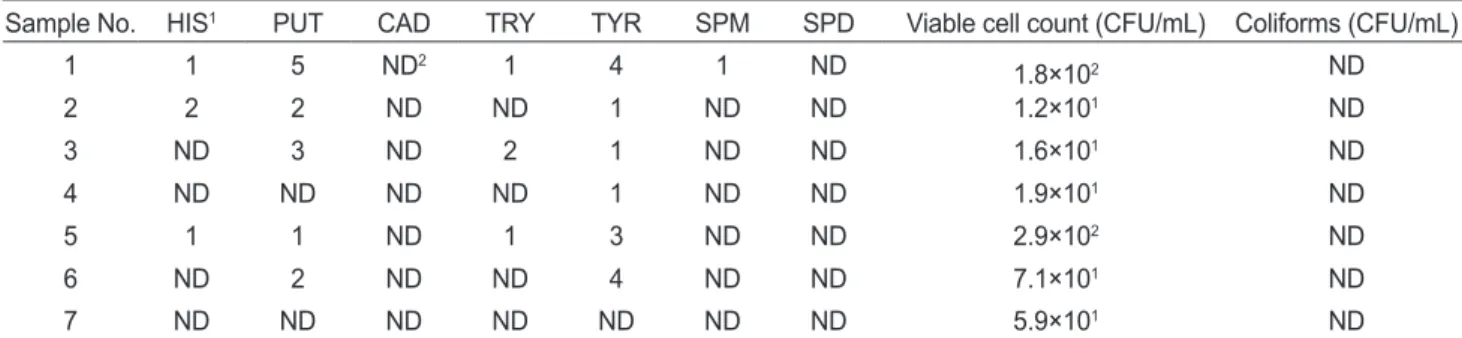
생성균 을측정한결과는Table 4
에나타내었다.
까나리액젓에존재하 Table 2. The contents of moisture, salinity, pH, VBN, total nitrogen and amino nitrogen in commercial salted and fermented sand lance sauces Ammodytes personatusSample No. Moisture (%) Salinity (%) pH VBN(mg/100 g) Total nitrogen (%) NH2-N (mg/100 g)
1 66.64 23.16 5.51 188.92 0.94 673.77
2 67.32 23.24 5.86 174.28 1.36 732.16
3 66.12 23.87 5.68 164.76 1.19 698.28
4 65.81 23.55 6.14 178.11 1.37 721.77
5 64.42 24.02 5.82 189.64 1.05 684.26
6 65.78 23.31 5.67 167.12 1.42 791.86
7 63.97 24.03 6.02 217.98 1.38 743.23
Table 3. Color values of commercial salted and fermented sand lance sauces Ammodytes personatus
Sample
No. Hunter's color values1
L a b ΔE
1 45.65 29.08 106.28 116.77
2 44.86 28.33 94.75 105.28
3 52.95 29.64 88.24 112.35
4 59.51 18.24 83.84 91.33
5 67.22 20.32 112.65 108.24
6 65.12 12.62 83.70 85.88
7 55.81 19.62 123.81 127.50
1L, lightness; a, redness; b, yellowness; ΔE, color difference.
는생균수는
1.2×10
1~ 2.9×10
2CFU/mL
수준으로매우낮 은균수이며,
대장균군은모든시료에서 검출되지않았다.
시 료및아민종류에관계없이biogenic amines
생성균은검출되 지않거나존재하더라도매우낮은수준인것으로파악되었다.
생균수와biogenic amines
생성균이매우낮은수준인것은까 나리액젓제조공정중의살균및여과과정에서의사멸가능성 보다는고농도의염상태에서장기간숙성하는과정에서초내 염성균을제외한세균은삼투압에의한사멸이원인이되어결 과적으로까나리액젓중의미생물농도는매우낮은것으로판 단된다.
실험에사용한7
종의까나리액젓은HACCP
기준에의 해살균처리한제품과살균하지않은제품의생균수차이가크 지않다는점에서고농도염에의한미생물사멸가능성은높다 고판단된다.
따라서추후시판까나리액젓에존재하는미생물 의동정및다양성분석은까나리액젓의발효과정중의미생물 상변화및발효에관여하는미생물을이해하는데도움이될것 으로판단된다.
Biogenic amines 함량
까나리액젓의
biogenic amines
함량을측정한결과는Table 5
에나타내었다.
기존의까나리액젓의연구에서많이검출된 아민인cadaverine, histamine, putrescine, spermidine, sperm- ine, tryptamine
및tyramine
등7
종의아민을정량하였다(Cho
et al., 2006; Moon et al., 2010; Kim et al., 2011). 7
종의시 판까나리액젓에존재하는histamine
은240.8-410.4 mg/kg (
평균301.02 mg/kg), putrescine
은73.61-500.23 mg/kg (
평균183.00 mg/kg), cadaverine
은10.97-65.67 mg/kg (29.78 mg/
kg), tryptamine
은9.42-18.19 mg/kg (
평균13.01 mg/kg), ty- ramine
은88.26-348.92 mg/kg (
평균199.21 mg/kg)
인것으로 분석되었으나spermidine
과spermine
은모든시료에서검출되 지않았다. 7
종까나리액젓의histamine
농도는EU
와국제식 품규격위원회(CODEX)
의기준인200 mg/kg
을초과하였으며, 400 mg/kg
을초과하는시료도1
건검출되었으나이결과는기 존보고보다는낮은농도에해당된다(Moon et al., 2010; Kim et al., 2011). Putrescine
은시료에따라최대6.8
배차이가있 어다른아민에비해농도차가가장심한편이나평균값은기존 의연구결과와유사하였다(Cho et al., 2006; Kim et al., 2011).
Cadaverine
은시료에따라최대약6
배정도의차이를보이며,
기존의결과와비교해보면평균약1.4
배높거나(Kim et al., 2011), 5.6
배낮은것으로(Cho et al., 2006)
파악되었는데이 는원료,
발효조건및발효기간등의차이에의한결과라고판 단될뿐정확한원인에대해서는추후분석이필요하다고판단 된다. Tryptamine
은2
개시료에서만검출되고나머지5
개시료 에서는검출되지않았는데기존연구결과(Cho et al., 2006)
에 비해약9
배이상낮은농도인것으로파악되었다.
또한tyra-
Table 4. Biogenic amines formation bacteria, viable cell and coliform bacteria in commercial salted and fermented sand lance sauces Am-modytes personatus (unit : colony)
Sample No. HIS1 PUT CAD TRY TYR SPM SPD Viable cell count (CFU/mL) Coliforms (CFU/mL)
1 1 5 ND2 1 4 1 ND 1.8×10² ND
2 2 2 ND ND 1 ND ND 1.2×101 ND
3 ND 3 ND 2 1 ND ND 1.6×101 ND
4 ND ND ND ND 1 ND ND 1.9×101 ND
5 1 1 ND 1 3 ND ND 2.9×10² ND
6 ND 2 ND ND 4 ND ND 7.1×101 ND
7 ND ND ND ND ND ND ND 5.9×101 ND
1HIS, histamine; PUT, putrescine; CAD, cadaverine; TRY, tryptamine; TYR, tyramine; SPM, spermine; SPD, spermidine. 2ND, not detected.
Table 5. Biogenic amine contents in commercial salted and fermented sand lance sauces Ammodytes personatus Sample
No. Biogenic amines1 (mg/kg)
HIS PUT CAD TRY TYR SPM SPD
1 246.27 500.23 31.16 ND 332.33 ND2 ND
2 332.61 316.85 20.51 ND 142.45 ND ND
3 266.33 115.27 20.05 ND 261.71 ND ND
4 362.14 106.33 28.64 ND 88.26 ND ND
5 248.50 89.46 31.48 ND 110.54 ND ND
6 410.48 73.61 10.97 18.19 348.92 ND ND
7 240.84 79.22 65.67 9.42 110.28 ND ND
1HIS, histamine; PUT, putrescine; CAD, cadaverine; TRY, tryptamine; TYR, tyramine; SPM, spermine; SPD, spermidine. 2ND, not detected.
mine
은기존결과에비해낮은결과로측정되었다(Moon et al., 2010; Kim et al., 2011).
본연구에서검출되지않은spermidine
과spermine
은기존의보고에서도검출되지않았거나(Moon et al., 2010), spermine
은3.32-8.35 mg/kg
의낮은수준으로검출 되었다는보고가있다(Kim et al., 2011).
본연구에서국내시판용
7
종까나리액젓의이화학적성분및 미생물을분석한결과제품에따라차이는다소있었으나식 품공전의액젓품질규격및수산전통식품의액젓품질기준에 는대체로만족하는수준으로파악되었다.
안전성지표인bio- genic amines
함량은제품및아민종류에따라차이가컸으며,
특히histamine, putrescine, tryptamine
함량은대체로높은것 으로파악되었다.
업계의자구노력,
학회,
포럼및분석법교육 등을통하여발효식품중biogenic amines
의저감화를위해노 력은하고있지만아직뚜렷한개선점은부족한실정이다.
따라 서우리나라발효식품및액젓의안전성확보,
선진화및세계화 를위해서는위생적인환경에서제조해야함과동시에품질개 선을위한노력과연구도활발히이루어져야한다고사료된다.
References
A
OAC. 1995. Official Methods of Analysis. 16th ed. Asso- ciation of Official Analytical Chemists, Washington DC., U.S.A., 69-74.APHA (American Public Health Association). 1984. Laboratory Procedures for the Examination of Sea Water and Shellfish.
5th ed. APHA, Washington DC, U.S.A.
Cho TY, Han GH, Bahn KN, Son YW, Jang MR, Lee CH, Kim SH, Kim DB and Kim SB. 2006. Evaluation of biogenic amines in Korea commercial fermented foods. Korean J Food Sci Technol 38, 730-737.
Cho YJ, Im YS, Lee KW, Kim GB and Chol YJ. 1999. Qual- ity investigation of commercial northern sand lance, Am
modytes personatus sauces. J Korean Fish Soc 32, 612-617.
Hungerford JM. 2010. Scombroid poisoning: a review.
Toxicon 56, 231-243. http://dx.doi.org/10.1016/j.toxi- con.2010.02.006.
Joosten HM and Olieman C. 1986. Determination of biogenic amines in cheese and some other food products by high- performance liquid chromatography in combination with thermo-sensitized reaction detection. J Chromatogr 356, 311-319.
KMFDS (Korea Ministry of Food and Drug Safety). 2015.
2015 Korean Food Code. KMFDS, Cheongju, Korea.
Retrieved from http://fse.foodnara.go.kr/residue/RS/jsp/
menu_02_01_01.jsp on 23 September.
Kim BK, Kim YH, Lee HH, Cho YJ, Kim DS, Oh SM and Shim KB. 2011. Comparison of the chemical compositions and biogenic amine contents of salt fermented fish sauces pro- duced in Korea to evaluate the quality characteristics. J Fish Mar Edu 23, 607-614.
Kohara T. 1982. Handbook of food analysis. Kenpakusha, To- kyo, Japan, 51-55.
LeeYS, Homma S and Aida K. 1997. Characterization of mela- noidin in soy sauce and fish sauce by electrofocusing and high performance gel permeation chromatography. Nippon Shokuhin Kogyo Gakkaishi 34, 313-319.
Lovenberg W. 1973. Some vaso- and psychoactive substances in food: amines stimulates depressants and hallucinogens. In Toxicants Occurring Naturally in Foods. National Academy of Science. Washington. DC, U.S.A.
Ministry of Social Welfare of Japan. 1960. Guide to Experiment of Sanitary Infection. III. Volatile basic nitrogen. Kenpaku- sha, Tokyo, Japan, 30-32.
Moon JS, Kim YJ, Jang KI, Cho KJ, Yang SJ, Yoon GM, Kim SY and Han NS. 2010. Analysis of biogenic amines in fer- mented fish products consumed in Korea. Food Sci Biotech- nol 19, 1689-1692. http://dx.doi.org/10.1007/s10068-010- 0240-6.
NFQS (National Fishery Products Quality Management Ser- vice). 2013. Retrieved from http://www.nfqs.go.kr/2013/
contents.asp?m=4&s=1&s2=2 on 23 September.
Shalaby AR. 1996. Significance of biogenic amines to food safety and human health. Food Res Int 29, 675-690.
Son KT, Lach T, Jung Y, Kang SK, Eom SH, Lee DS, Lee MS and Kim YM. 2014. Food hazard analysis during dried- laver processing. Fish Aquat Sci 17, 197-201. http://dx.doi.
org/10.5657/FAS.2014.0197.
Taylor SL. 1986. Histamine food poisoning: toxicology and clinical aspects. Crit Rev Toxicol 17, 91-128. http://dx.doi.
org/10.3109/10408448609023767.
Ten Brink B, Damink C, Joosten HMLJ, Huis in’t Veld JHJ.
1990. Occurrence and formation of biologically active amines in foods. Int J Food Microbiol 11, 73-84. http://
dx.doi.org/10.1016/0168-1605(90)90040-C.
Van Boekel MAJS. 1998. Developments in technologies for food production. In: Innovation of food production systems.
W.M.F. Jongen and M.T.G. Meulenberg (Eds.). Wageningen Academic Publishers. Wageningen, Netherlands, 87-116.
Wanakhachornkrai, P. and Lertsiri, S. 2003. Comparison of determination method for volatile compounds in Thai soy sauce. Food Chem 83, 619-629. http://dx.doi.org/10.1016/
S0308-8146(03)00256-5.
Zaman MZ, Abu Baker F, Jinap S and Bakar J. 2011. Novel starter cultures to inhibit biogenic amines accumulation dur- ing fish sauce fermentation. Int J Food Microbiol 145, 84- 91. http://dx.doi.org/ 10.1016/j.ijfoodmicro.2010.11.031.