2017. The Korean Astronomical Society. All rights reserved. c https://doi.org/10.5303/PKAS.2017.32.1.299
LOCAL ULTRALUMINOUS INFRARED GALAXIES IDENTIFIED IN THE AKARI ALL SKY SURVEY E. Kilerci Eser 1 , T. Goto 2 , and Y. Doi 3
1 Dark Cosmology Centre, Niels Bohr Institute, University of Copenhagen, Juliane Maries Vej 30, DK-2100 Copenhagen Ø, Denmark
2 National Tsing Hua University, No. 101, Section 2, Kuang-Fu Road, Hsinchu, Taiwan 30013
3 The University of Tokyo, Komaba 3-8-1, Meguro, Tokyo, 153-8902, Japan E-mail: [email protected]
(Received July 31, 2015; Revised October 20, 2016; Accepted October 20, 2016)
ABSTRACT
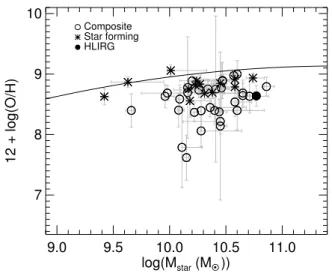
We crossmatch AKARI all-sky survey with the Sloan Digital Sky Survey Data Release 10 (SDSS DR10) and the Final Data Release of the Two-Degree Field Galaxy Redshift Survey (2dFGRS) and identify 118 Ultraluminous Infrared Galaxies (ULIRGs) and one Hyperluminous Infrared Galaxy (HLIRG). We find 40 new ULIRGs and one new HLIRG. ULIRGs in our sample are interacting galaxies or ongoing/post mergers. This is consistent with the fact that ULIRGs are major mergers of disk galaxies. We find that compared to local star forming SDSS galaxies of similar mass, local ULIRGs have lower oxygen abundances and this is consistent with the previous studies.
Key words: astronomy — astrophysics — journals: individual: PKAS
1. INTRODUCTION
Ultraluminous infrared galaxies (ULIRGs) and hyperlu- minous infrared galaxies (HLIRGs) are defined by their IR luminosities (see the reviews by Sanders & Mirabel, 1996; Lonsdale et al., 2006). ULIRGs have infrared lu- minosities in the 10 12 L ≤ L IR < 10 13 L range and HLIRGs have infrared luminosities 10 13 L ≤ L IR . The IR luminosity of these sources is produced by dust that absorbs and re-emits the radiation from star formation and active galactic nuclei (AGN). Local ULIRGs are mostly interacting galaxies and major mergers (Veilleux et al.,, 2002). ULIRGs are considered to be an impor- tant phase in the formation of quasars Sanders et al.
(1988); Veilleux et al., (2002). In this scenario, dur- ing the major merger the molecular gas clouds channel towards the nucleus and trigger nuclear starbursts and the accretion of the matter on to the central super mas- sive black hole (SMBH) starts the AGN activity. The merger evolves to a dust-enshrouded AGN phase, after the gas and dust are consumed the system becomes a bright QSO.
http://pkas.kas.org
ULIRGs are rare sources in the local (z <0.2) Uni- verse (e.g., Soifer et al., 1987). ULIRGs are more com- mon sources at high redshifts (z ≥ 2), (e.g., Chapman et al., 2005) and they represent the most rapidly star forming and highly obscured galaxies. High-z ULIRGs and local ULIRGs have different morphological proper- ties, high−z ULIRGs are also non-interacting galaxies (Kartaltepe et al., 2012). Observations show that the properties of ULIRGs change with redshift (e.g Farrah et al., 2008; Takagi et al., 2010; Rujopakarn et al., 2011).
Comparison of local and high-z ULIRGs is essential to obtain a complete picture of their evolution across cos- mic time. Local ULIRGs are key to study the origin of high IR luminosities and the role of the AGN activity and star formation in nearby mergers. Therefore, local ULIRGa are important.
In this work we identify ULIRGs and HLIRGs in the
AKARI all-sky survey (Murakami et al., 2007). We
cross-correlate AKARI all-sky survey with Two-Degree
Field Galaxy Redshift Survey (2dFGRS) (Colless et al.,
2001) and Sloan Digital Sky Survey (SDSS) DR 10 spec-
troscopic redshift catalogue (Ahn et al., 2014). We use
299
12.0 12.2 12.4 12.6 12.8 13.0 log(L IR /L O • )
0 20 40 60 80 100 120
Fraction (%)
LINER AGN Composite Star forming
Figure 1. Spectral class fraction versus IR luminosity bins for 89 ULIRGs.
the available optical images, spectra, provided by SDSS D10 catalogs and investigate the he morphologies, stel- lar mass and metallicities of the ULIRGs identified in the AKARI all-sky survey.
This paper is organized in the following structure. We introduce our sample in §2. We present our results in
§3. We give our conclusions in § 4. In this work, we use a cosmology with H 0 = 70 km s −1 Mpc −1 , Ω Λ = 0.7 and Ω m = 0.3.
2. SAMPLE
We cross-match the AKARI /IRC all-sky survey point source catalog version 1 1 and the AKARI /FIS all- sky survey bright source catalog version 1 2 (Yamamura et al., 2010). This gives us a single AKARI /FIS/IRC catalog of 24701 sources with both FIR and mid-IR fluxes.
We cross-correlate the AKARI /FIS/IRC catalog with SDSS DR 10 (Ahn et al., 2014) and spectroscopic red- shift catalog the Final Data Release of the 2dFGRS , the catalog of best spectroscopic observations 3 . We se- lect matching radii as 20 00 and allow each IR source to match only with one optical galaxy.
We perform a SED-fitting using the LePhare 4 (Photo- metric Analysis for Redshift Estimations) code (Arnouts et al., 1999; Ilbert et al., 2006) and estimate the total
1 http://www.ir.isas.jaxa.jp/AKARI/Observation/PSC/Public /RN/AKARI-IRC PSC V1 RN.pdf.
2 http://www.ir.isas.jaxa.jp/AKARI/Observation/PSC/Public /RN/AKARI-FIS BSC V1 RN.pdf.
3 http://www2.aao.gov.au/∼TDFgg/.
4 http://www.cfht.hawaii.edu/∼arnouts/lephare.html.
9.5 10.0 10.5 11.0 11.5 12.0 log(M star (M O
•))
1 10 100 1000 10000
SFR(IR) (M
O •year
-1)
10 11 10 12 10 13
L
IR/L
O •z=0 MS z=1 MS z=2 MS z=2 MS- x4
z=2 MS- x10 LINER AGN Composite Star forming HLIRG Unclassified