Publications of the Korean Astronomical Society pISSN: 1225-1534
30: 385 ∼ 387, 2015 September eISSN: 2287-6936
2015. The Korean Astronomical Society. All rights reserved. c http://dx.doi.org/10.5303/PKAS.2015.30.2.385
THE EVOLUTION OF BARYONIC MASS OF ELLIPTICAL GALAXIES IN THE SLOAN DIGITAL SKY SURVEY Ting-Hung Peng
1, Chung-Ming Ko
†2, Yong Tian
1, and Chen-Hung Chen
31
Institute of Astronomy, National Central University, Taiwan (R.O.C.)
2
Institute of Astronomy, Department of Physics and Center for Complex Systems, National Central University, Taiwan (R.O.C.)
3
Department of Mathematics, National Central University, Taiwan (R.O.C.) E-mail: [email protected]
(Received November 30, 2014; Reviced May 31, 2015; Aaccepted June 30, 2015)
ABSTRACT
Stellar mass is an important parameter of galaxies. We estimate the dynamical mass of an elliptical galaxy by its velocity dispersion and effective radius using the Hernquist model in the framework of MOdified Newtonian Dynamics (MOND). MOND is an alternative theory to the dark matter paradigm.
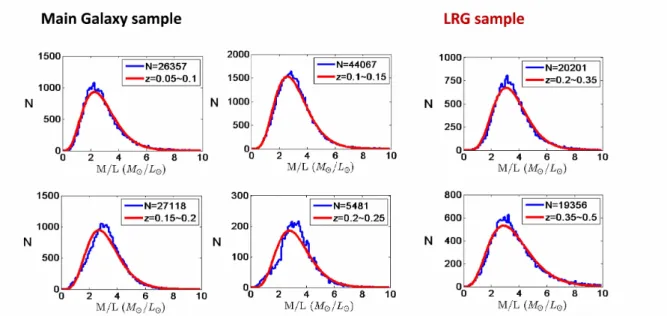
In MOND the dynamical mass is the same as the baryonic mass or luminous mass, and in elliptical galaxies most of the baryons reside in stars. We select elliptical galaxies between redshift 0.05 and 0.5 from the main galaxy sample and the luminous red galaxy sample in the Sloan Digital Sky Survey. We find that the stellar mass-to-light ratio at different redshift epochs can be fitted by a gamma distribution, and its mean is smaller at smaller redshifts.
Key words: Elliptical galaxies - Velocity Dispersion - MOND - SDSS - Mass-to-Light Ratio
1. BACKGROUND
Stars are the most conspicuous component of a galaxy.
It is easy to conceive that many physical properties of a galaxy, such as luminosity, colour, size, structure, metal- licity, star formation activity, etc., are well correlated to the stellar mass (see e.g., Kauffmann et al., 2003a,b;
Shen et al., 2003; Blanton et al., 2005; Gallazzi et al., 2005; Gallazzi & Bell, 2009; Cappellari et al., 2012).
Stellar mass is a crucial parameter in understanding galaxy evolution.
MOdified Newtonian Dynamics (MOND) is a theory proposed as an alternative to the dark matter hypothe- sis, to explain the mismatch between the observed lumi- nous mass and the dynamics of galaxies (see e.g., Mil- grom, 1983; Bekenstein & Milgrom, 1984). In essence, one can deduce the baryonic mass of a galaxy by MON- Dian dynamics. Even if MOND is not a fundamental theory, we deem that it is an effective way to estimate the baryonic mass of a galaxy. Since most of the bary- onic mass in elliptical galaxies resides in stars, MOND may serve as a straightforward method to find their stel- lar mass.
2. DYNAMICS AND MASS MODEL
Interpreted as a theory of modified gravity, MOND can be expressed as a nonlinear Poisson equation (Beken-
†
Correspanding author: Chung-Ming Ko
http://pkas.kas.org
stein & Milgrom, 1984),
∇ · [˜ µ(|g|/a
0)g] = ∇ · g
N= −4πGρ . (1) Here g and g
Nare the gravitational acceleration in MOND and in Newtonian dynamics, respectively. ˜ µ(x) is called the interpolation function with ˜ µ(x) ≈ 1 for x 1 (Newtonian regime) and ˜ µ(x) ≈ x for x 1 (deep MOND regime). a
0≈ 1.2 × 10
−10m s
−2is the acceleration scale of MOND.
We adopt a (spherical) Hernquist model for the stellar mass distribution of elliptical galaxies
ρ(r) = M r
h2πr(r + r
h)
3, g
N(r) = − GM ˆ r
(r + r
h)
2, (2) where M is the total mass, r
h≈ 0.55 r
eff(r
effis the ef- fective radius or half light radius). With a local stellar mass-to-light ratio Υ, the surface brightness and cumu- lative surface brightness are
I(R) = 2 Z
∞R
ρ(r) Υ
√ r dr r
2− R
2, S(R) =
Z
R 0I(R
0)2πR
0dR
0, (3) where R is the projected radius from the centre of the spherical system.
The velocity dispersion of a spherically symmetric stellar system is given by
dρσ
r2dr + 2β
r ρσ
r2= −ρ|g| = −ρg , (4)
385
386 PENG, KO, TIAN & CHEN
Figure 1. The stellar mass-to-light ratio distribution of elliptical galaxies in the Main Galaxy sample and the Luminous Red Galaxy sample of SDSS. The red lines are the best-fit gamma functions.
and for an isotropic system (i.e., β = 0), ρσ
2r= R
∞r
ρ g dr
0. The velocity dispersions projected along the line of sight of the system weighted by surface brightness and cumulative surface brightness are (for β = 0)
σ
I2(R) = 2 I(R)
Z
∞ Rρσ
r2Υ
√ r dr r
2− R
2, σ
2S(R) = 1
S(R) Z
R0