• 검색 결과가 없습니다.

INFRARED SPECTRAL ENERGY DISTRIBUTION OF GALAXIES IN THE AKARI ALL SKY SURVEY: CORRELATIONS WITH GALAXY PROPERTIES AND THEIR PHYSICAL ORIGIN

N/A
N/A
Protected

Academic year: 2021

Share "INFRARED SPECTRAL ENERGY DISTRIBUTION OF GALAXIES IN THE AKARI ALL SKY SURVEY: CORRELATIONS WITH GALAXY PROPERTIES AND THEIR PHYSICAL ORIGIN"

Copied!
5
0
0

로드 중.... (전체 텍스트 보기)

전체 글

(1)

° 2012. The Korean Astronomical Society. All Rights Reserved. c

INFRARED SPECTRAL ENERGY DISTRIBUTION OF GALAXIES IN THE AKARI ALL SKY SURVEY: CORRELATIONS WITH GALAXY PROPERTIES AND THEIR

PHYSICAL ORIGIN

R. Makiya

1

, T. Totani

1

, T. T. Takeuchi

2

, M. Nagashima

3

, and M. A. R. Kobayashi

4

1

Department of Astronomy, School of Science, Kyoto University, Sakyo-ku, Kyoto 606-8502

2

Institute for Advanced Research, Nagoya University, Furo-cho, Chikusa-ku, Nagoya 464–8601

3

Faculty of Education, Nagasaki University, Nagasaki, Nagasaki 852-8521

4

Optical and Infrared Astronomy Division, National Astronomical Observatory, Mitaka, Tokyo 181-8588 E-mail: [email protected]

(Received July 03, 2012; Accepted August 22,2012)

ABSTRACT

We will report our recent study on the properties of more than 1,600 galaxies detected by the AKARI All-Sky Survey with physical quantities based on optical and 21-cm observations, to un- derstand the physics determining the infrared spectral energy distribution (Totani et al., 2011).

We discover a tight linear correlation for normal star-forming galaxies between the radiation field strength of dust heating (corresponding to dust temperature) and the galactic-scale infrared ra- diation field, L

TIR

/R

2

. This is the tightest correlation of dust temperature ever known, and the dispersion along the mean relation is 13% in dust temperature. This relation can be explained physically by a thin layer of heating sources embedded in a thicker, optically-thick dust screen. We also find that the number of galaxies sharply drops when galaxies become optically thin against dust-heating radiation, indicating that a feedback process to galaxy formation (e.g., by the photo- electric heating) is working when dust-heating radiation is not self-shielded on a galactic scale. We discuss implications from these findings for the M

HI

-size relation, the Kennicutt-Schmidt relation, and galaxy formation in the cosmological context.

Key words: infrared: telescope; conferences: proceedings

1. INTRODUCTION

Dust grains in the interstellar medium (ISM) absorb ultraviolet and optical photons emitted from stars, and re-emitted it in infrared and submillimeter wave- lengths. The intensity of the cosmic infrared back- ground radiation indicates that about half of the en- ergy originally radiated from stars is eventually re- emitted from dust grains (Hauser & Dwek, 2001).

Heavily obscured star formation activity is difficult to detect by observations in the ultraviolet/optical, and infrared/submillimeter observations should be crucially important to get the full picture of the formation and evolution of galaxies. In the last decade, our observa- tional knowledge of the hidden side of galaxy evolution

has significantly improved thanks to the advanced in- frared/submillimeter facilities such as JCMT/SCUBA, Spitzer, AKARI, and Herschel. Moreover, the Ata- cama Large Millimeter/submillimeter Array (ALMA) will revolutionize our understanding of galaxy evolu- tion in the near future. In order to extract useful in- formation from these data, we need good theoretical understanding and models of galactic dust emission to be compared.

However, it is not straightforward to predict global (i.e., galactic-scale) SEDs of dust emission for a theoret- ical model galaxy, in contrast to direct stellar emission that can be calculated by the method of stellar popula- tion synthesis. This is because the physics determining

http://pkas.kas.org 325

(2)

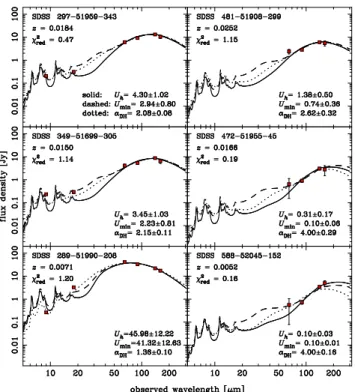
Fig. 1. Examples of the SED fittings to the galax- ies in the AKARI-SDSS sample. The squares are AKARI data points. The solid line represents the DL07 model with the parameter U

h

. The unique identification set of plate number, MJD, and fiber number of the SDSS spectroscopic database is also shown in each panel. The dotted and dashes lines represent other SED models than DL07 model with the parameters U

min

and α

DH

. Please see Totani et al. (2011) for more details.

the global SED of dust emission and its relations to other physical properties have remained highly elusive (see Walcher et al., 2011 for a review). An approach often taken in the literature (e.g., Guiderdoni et al., 1998; Takeuchi et al., 2001; Chary & Elbaz, 2001; La- gache, Dole, & Puget, 2003; Valiante et al., 2009) is to relate the SED parameters (e.g., the dust tempera- ture T

d

) to the total infrared luminosity, L

TIR

(defined as the bolometric luminosity of dust emission), based on the observed correlation between the two (higher T

d

for larger L

TIR

; Soifer et al., 1987a; Soifer & Neuge- bauer, 1991; Chapin et al., 2009). However, there is a large scatter along the mean L

TIR

-T

d

relation (see, e.g., Hwang et al., 2010 for recent data), and it is physically unreasonable to relate an extensive quantity L

TIR

that scales with the system size to an intensive quantity T

d

that does not (Totani & Takeuchi, 2002). Extension of this relation including another parameter has also been

In this work we perform SED fittings of physical dust models to the AKARI data of more than 1,600 low- redshift (0.005 ∼ < z ∼ < 0.1, the mean redshift is z ∼ 0.03) galaxies, and compare the SED parameters with other physical properties of galaxies obtained by optical and 21-cm observations. The goal of this paper is to find the key physical quantities and laws to determine the global SEDs of dust emission (especially around the thermal peak), and give physical interpretations to them.

2. SAMPLE SELECTION

We use the AKARI/IRC All-Sky Survey Point Source Catalog (PSC, ver. 1.0) and the AKARI/FIS All-Sky Survey Bright Source Catalog (BSC, ver. 1.0), which were released in March 2010 including 870,973 and 427,071 sources, respectively.

We construct the following three samples by cross- matching the AKARI catalogs with the existing cat- alogs of nearby galaxies selected in other wavelengths.

The first sample is the cross-match with the galaxies de- tected by the Sloan Degital Sky Survey (SDSS), and the second with the H

I

Parkes All-Sky Survey (HIPASS) selected in 21-cm. We regard these as the two main samples in this paper, and we can check the depen- dence on the sample selection using these. In addi- tion, we construct a third sample to extend the dy- namic range of the surface density of star formation rate (SFR), which is the cross-match with the Kenni- cutt (1998, hereafter K98) sample of nearby circumnu- clear starburst (SB) galaxies.

3. SED FITTING

We mainly use the physical dust model of Draine &

Li (2007, hereafter DL07) to derive physical quantities about dust emission.

The basic parameter of infrared emission in the phys-

ical dust model is the heating radiation field strength,

U , which is the dimensionless energy density of the

dust-heating radiation normalized by the local value

of the interstellar radiation field (ISRF) around the so-

lar neighbourhood. In reality, the field strength can be

different at different locations in a galaxy. However,

here we assumed that infrared emission from a galaxy

(3)

Fig. 2. Dust-heating radiation field strength (U

h

, estimated by infrared SED fittings) versus total infrared surface brightness (Σ

TIR

), for the AKARI-SDSS (left) and AKARI-HIPASS (right) samples. The parameter U

TIR

is Σ

TIR

normalized by the bolometric strength of the local (solar neighborhood) ISRF in the Milky Way, which can directly be compared with U

h

. The solid and dashed lines are the best-fit linear (U

h

∝ U

TIR

) and power-law (U

h

∝ U

TIRb

) relations, respectively.

Fig. 3. Velocity-integrated flux density of the 21-cm emission (S

int

) versus angular size (θ

P 90

), for the AKARI-SDSS (left) and AKARI-HIPASS (right) samples. The grey dots are for galaxies whose infrared emission was not detected by AKARI. The solid lines correspond to several values of H

I

column density Σ

HI

, as indicated in the panels (S

int

∝ M

HI

/d

2L

, θ

P 90

= R/d

A

, and hence Σ

HI

∝ S

int

2P 90

, where d

L

and d

A

are the luminosity and angular diameter distance, respectively).

For solid lines we assumed a redshift z = 0.02 that is typical for the samples here, though the dependence on z is very small, only proportional to the cosmological effect (1 + z).

can be described by a single characteristic heating ra- diation strength, U

h

, for simplicity.

We show examples of the SED fittiings for galaxies in the AKARI-SDSS sample in Fig. 1.

4. RESULTS

4.1. Infrared SED versus Global Infrared Radiation Field Strength

Fig. 2 shows the correlation between U

h

and U

TIR

, i.e.,

the total infrared surface brightness Σ

TIR

normalized

(4)

sion along the mean relation is 13% in dust tempera- ture

This result strongly indicates that (1) the integrated infrared SED of a galaxy is mostly determined by the general ISRF on the global scale of a galaxy, and (2) dust-heating sources are deeply embedded in an optically-thick dust disk, i.e., the scale height of heat- ing sources being smaller than one optical depth of the dust disk.

4.2. Radiative Feedback in Optically Thin Galaxies?

We plot in Fig. 3 the velocity-integrated 21-cm flux density (S

int

) versus angular size (θ

P 90

) for the SDSS- H

I

and HIPASS samples, in comparison with the AKARI-SDSS and AKARI-HIPASS galaxies. It can be seen that there is a paucity of galaxies in the region of Σ

HI

< 10 M

¯

pc

−2

, roughly corresponding to τ

tot

< 1, where τ

tot

is the effective dust opacity averaged over wavelength.

We consider that there is a physical process reduc- ing the efficiency of galaxy formation when τ

tot

< 1.

Because the opacity is with regard to the dust-heating radiation, it is most likely the radiative feedback by the dust photoelectric heating of the ISM. A part (typically 1–10%) of the radiation energy absorbed by dust grains is converted to photoelectrons that subsequently heat the ISM. This effect is large enough to be the dominant heating process in many phases of the ISM in galaxies (see, e.g., Bakes & Tielens, 1994; Wolfire et al., 1995;

Rubin et al., 2009). Then, in τ

tot

< 1 galaxies, it is expected that the lack of self-shielding of dust-heating radiation leads to the suppression of star formation ac- tivity and reduction of neutral gas in ISM on a galactic scale.

Now we may interpret the overall trend of the galaxy distribution on the Σ

SFR

H

plane by the strong de- pendence of SFE on the dust opacity, as follows. There are very few galaxies having τ

tot

¿ 1, because the feed- back suppresses efficient star formation. Galaxies ap- pear in the region of τ

tot

> 1 with a large dispersion in the Kennicutt-Schmidt law, because SFE rapidly in- creases around τ

tot

∼ 1. Then SFE continues to in- crease and asymptotically reaches the maximum value of ψ

e,max

∼ 10 Gyr

−1

at τ

tot

À 1. We expect many

REFERENCES

Chanial, P., Flores, H., Guiderdoni, B., Elbaz, D., Hammer, F., & Vigroux, L., 2007, The Infrared Compactness-Temperature Relation for Quies- cent and Starburst Galaxies, A&A, 462, 81 (C07) Chapin, E. L., Hughes, D. H., & Aretxaga, I., 2009, The Local Far-Infrared Galaxy Colour- Luminosity Distribution: a Reference for BLAST and Herschel/SPIRE Submillimetre Surveys, MNRAS, 393, 653

Chary, R. & Elbaz, D., 2001, Multicolor Optical Imag- ing of Infrared-Warm Seyfert Galaxies. III. Sur- face Photometry: Light Profile Decomposition, ApJ, 556, 562

Devereux, N., 1987, The Spatial Distribution of 10 Micron Luminosity in Spiral Galaxies, ApJ, 323, 91

Draine, B. T. & Li, A., 2007, Infrared Emission from Interstellar Dust. IV. The Silicate-Graphite-PAH Model in the Post-Spitzer Era, ApJ, 657, 810 (DL07)

Guiderdoni, B., Hivon, E., Bouchet, F. R., & Maf- fei, B., 1998, Semi-Analytic Modelling of Galaxy Evolution in the IR/Submm Range, MNRAS, 295, 877

Hauser, M. G. & Dwek, E., 2001, The Cosmic In- frared Background: Measurements and Implica- tions, ARA&A, 39, 249

Hwang, H. S., et al., 2010, Evolution of Dust Temper- ature of Galaxies Through Cosmic Time as Seen by Herschel, MNRAS, 409, 75

Kennicutt, R. C., Jr., 1998, The Global Schmidt Law in Star-forming Galaxies, ApJ, 498, 541 (K98) Lagache, G., Dole, H., & Puget, J. -L., 2003, Mod-

elling Infrared Galaxy Evolution Using a Phe- nomenological Approach, MNRAS, 338, 555 Lehnert, M. D. & Heckman, T. M., 1996, The Nature

of Starburst Galaxies, ApJ, 472, 546 (LH96) Phillipps, S. & Disney, M., 1988, The Surface Bright-

ness of Spiral Galaxies. IV - Correlations with Far-Infrared Emission, MNRAS, 231, 359 Rujopakarn, W., Rieke, G. H., Eisenstein, D. J., &

Juneau, S., 2011a, Morphology and Size Differ-

ences Between Local and High-redshift Luminous

Infrared Galaxies, ApJ, 726, 93

(5)

Rujopakarn, W., Rieke, G. H., Weiner, B. J., et al., 2011b, A Mid-Infrared Indicator for Total Infrared Luminosity and Star Forma- tion Rate of Local and High-Redshift Galaxies, arXiv:1107.2921

Soifer, B. T., Sanders, D. B., Madore, B. F., Neuge- bauer, G., Danielson, G. E., Elias, J. H., Lons- dale, C. J., & Rice, W. L., 1987a, The IRAS Bright Galaxy Sample. II - The Sample and Lu- minosity Function, ApJ, 320, 238

Soifer, B. T. & Neugebauer, G., 1991, The Properties of Infrared Galaxies in the Local Universe, AJ, 101, 354

Takeuchi, T. T., Ishii, T. T., Hirashita, H., Yoshikawa, K., Matsuhara, H., Kawara, K., & Okuda, H., 2001, Exploring Galaxy Evolution from Infrared Number Counts and Cosmic Infrared Back- ground, PASJ, 53, 37

Totani, T. & Takeuchi, T. T., 2002, A Bridge from Optical to Infrared Galaxies: Explaining Local Properties and Predicting Galaxy Counts and the Cosmic Background Radiation, ApJ, 570, 470 Totani, T., Takeuchi, T. T., Nagashima, M.,

Kobayashi, M. A. R., & Makiya, R., 2011, In- frared Spectral Energy Distribution of Galaxies in the AKARI All Sky Survey: Correlations with Galaxy Properties, and Their Physical Origin, PASJ, 63, 1181

Valiante, E., Lutz, D., Sturm, E., Genzel, R., &

Chapin, E. L., 2009, A Backward Evolution Model for Infrared Surveys: The Role of AGN- and Color-L

T IR

Distributions, ApJ, 701, 1814 Walcher, J., Groves, B., Budav´ari, T., & Dale, D.,

2011, Fitting the Integrated Spectral Energy Dis-

tributions of Galaxies, Ap&SS, 331, 1

수치

Fig. 1. Examples of the SED fittings to the galax- galax-ies in the AKARI-SDSS sample
Fig. 2. Dust-heating radiation field strength (U h , estimated by infrared SED fittings) versus total infrared surface brightness (Σ TIR ), for the AKARI-SDSS (left) and AKARI-HIPASS (right) samples

참조

관련 문서

In this regard, this study analyzes the effect of the job characteristics and work environment of workers with physical disabilities on job satisfaction

Fabrication and Optical Properties of Polysiloxane Hybrimer Resin Using Oligohydrosiloxane 1 (OPH 1).. Fabrication and Optical Properties of Polysiloxane Hybrimer

On the basis of the detailed professional studies on the topic of reconciliation for all times and places, I will vision the unified Korea in peace with

This study aims for investigating the relationship between the satisfaction based on one’s participation in physical education class and a physical self-concept

The purpose of this study was to investigate the change of body composition and physical fitness after 12 weeks of practice with middle-aged women centered

• Tradeoff: For all the nice properties of Cascode, the “stacking” of M 2 on top of M 1 1 reduces the swing.. V out

In the present study, the behavior of Mg sheet with strain rates will be observed and the effect of microstructure, texture and PB treatment on high rate tensile

Based on the results of survey, this study analyzed the Arban’s trumpet and comparatively analyzed its original version with its translated version.. The