Joint Transmission 기반의 LTE-Advanced 시스템에 대한 호 수락 제어의 성능 분석
김 승 연 , 이 형 우*, 류 승 완°
Analysis of Call Admission Control for Joint Transmission-Based LTE-Advanced Systems
Seung-Yeon Kim , Hyong-Yoo Lee*, Seung-Wan Ryu°
ABSTRACT
Coordinated multi-point transmission (CoMP) is considered to be a promising technique to improve the throughput for LTE-Advanced systems. One important approach for CoMP is Joint Transmission (JT). However, the analytical model of JT has not been fully studied, as user equipments (UEs) receiving the desired signals from an adjacent base station (BS) as well as serving BS, or only serving BS were not distinguished. We derive a new analytical model to describe the call admission control in JT based systems. The performance measures of interest are the call blocking probability, and resource utilization. Furthermore, we compare the performance of JT-based systems and non-JT- based systems. The analytical results are in reasonable agreement with the simulation results.
Key Words : LTE-Advanced, call admission control, coordinated multi-point transmission (CoMP), joint transmission (JT), Markov chain.
※ 이 논문은 2011년도 정부(교육과학기술부)의 재원으로 한국연구재단의 지원을 받아 수행된 연구임(KRF-2011-0012971) 주저자:고려대학교 전자정보공학과, [email protected], 정회원
° 교신저자:중앙대학교 정보시스템학과, [email protected], 종신회원
* 고려대학교 전자정보공학과, [email protected], 정회원
논문번호:KICS2013-05-220, 접수일자:2013년 5월 24일, 최종논문접수일자:2013년 7월 17일
Ⅰ. Introduction
Long Term Evolution (LTE) -Advanced, as the evolved version of LTE to further improve the performance of the system, adopts advanced techniques such as carrier aggregation, enhanced MIMO techniques, wireless relays, and enhanced inter-cell interference coordination (eICIC). In particular, coordinated multi-point transmission (CoMP) can utilize multiple base stations (BSs) to achieve the spectral efficiency requirements for LTE-Advanced system[1].
In traditional wireless communication
systems, each user equipment (UE) is basically served by just one BS. In this case, signals coming from other BSs interfere with the UE. CoMP techniques can coordinate other BSs in such a way that the transmission signals from/to other BSs do not incur serious interference, or can even be exploited as a meaningful signal[2,3].
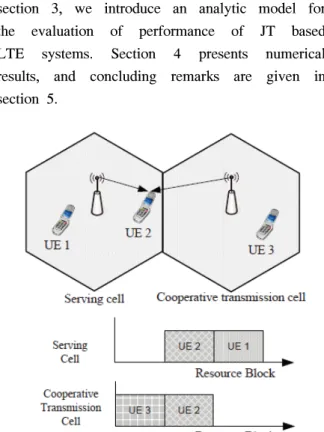
One important approach for CoMP is the Joint Transmission (JT) scheme. JT can be broadly described as a simultaneous transmission of data to a UE from cooperating transmission BS (CTBS) by converting the interfering signal to a desired
signal, as shown in Fig. 1. The JT scheme uses techniques like single frequency network or cyclic delay diversity schemes, which target diversity gains and also enable increased transmission power to the UE. To enable JT, the UEs estimate the channel state information (CSI) for neighboring BSs in downlink (DL) using a CSI reference signal (CRS), and deliver CSI feedback to their serving BS. Based on the measurement report, the serving BS determines the CTBS, and conveys the information, including the same resources and radio configuration in terms of time, frequency, modulation and coding to CTBS. A UE sends a channel quality indicator (CQI) to the CTBS which contains the co-phasing information for CTBS, and then it can receive the desired signal from CTBS as well as from its serving BS[4].
In the literature, the performance of the JT scheme has been reported in [5, 6, 7]. In one study, for DL, JT was reported to improve cell edge performance as well as total cell throughput[5]. In the study of Kim et al. the JT scheme was applied to an enterprise femtocell network systems and showed similar results to [5]. However, earlier investigations of the JT scheme heuristically addressed, showing the performance of the JT scheme only in simulations. Even though an analytical model was developed in [7], JT based systems are still not fully studied as UEs either simultaneously receiving the desired signal from an adjacent BS as well as a serving BS, or only a serving BS.
In this paper, we derive an analytical method to calculate the performance measures of interest, i.e., new call blocking probability and resource utilization. Specifically, we give a 2-dimensional Markov chain analysis.
Additionally, we compare the performances of JT and non-JT schemes.
This paper is organized as follows. In section 2, we present the system model. In
section 3, we introduce an analytic model for the evaluation of performance of JT based LTE systems. Section 4 presents numerical results, and concluding remarks are given in section 5.
Fig. 1. A scenario for the cooperative transmission technique.
Ⅱ. System Model 2.1. Model Descriptions
A cell in a JT-based LTE-Advanced system is considered. There is one BS in the center of the cell. A number of UEs can initiate multiple calls, occupying radio resources, where the basic unit of radio resources is referred to as a Physical Resource Block (PRB). For the sake of simplicity, we assume that the BS has C PRBs, and it can only assign one PRB to a UE at the time it initiates a call, and the data rate of each call with one PRB is fixed, regardless of its location within the cell via a signal power improvement by JT.
2.2. New Call Arrival Process and Call Holding Time
We assume that the new call arrival process within a cell is a Poisson process
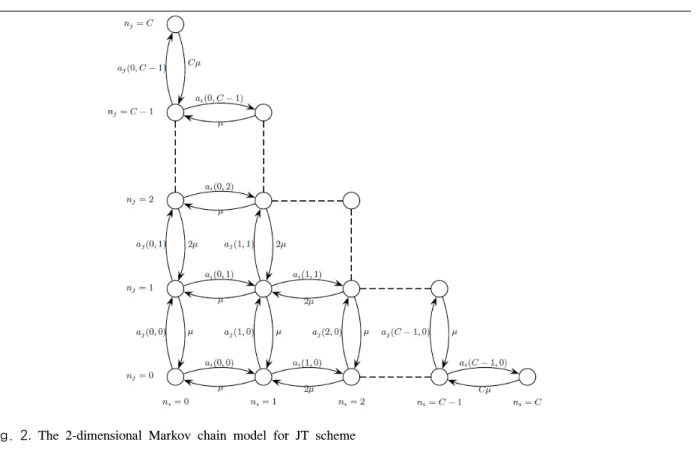
Fig. 2. The 2-dimensional Markov chain model for JT scheme
(1)
with a mean request rate of calls/sec, and the UEs are uniformly distributed over a cell. We also assume that the holding time of a call is exponentially distributed with mean sec[9].
2.3. Call Admission Control
When a new call is originated, it will attempt to occupy a PRB from the serving BS. If all PRBs are in use by ongoing calls, it will be blocked, called initial call block. If at least one PRB is available, it will be admitted in the serving BS. In order to use JT, then, this call with PRB i (i = 1, ..., C) will also attempt to occupy a PRB i in CTBS. If a PRB i is in use by ongoing call in CTBS, the call will be blocked, called JT call block. Hence, the calls in each cell are distinguished in two types: The one for the JT call (UE 2 in Fig. 1.) which uses not
only the PRB assigned from the serving BS but also the PRB assigned from CTBS, and the other for the non-JT call (UE 1 and UE 3 in Fig. 1.) which uses the only PRB assigned from the serving BS.
Ⅲ. Traffic Analysis for Joint Transmission 3.1. Traffic Analysis
For CAC of JT, the state transition diagram is described by an integer pair (Ni, Nj) as shown in Fig. 2, where Ni and Nj
denote the number of PRBs used for own calls in serving cell and the number of PRBs used for neighboring calls in the neighboring cell, respectively. Suppose that ak(ni, nj) is the state transition rate of the two dimensional Markov chain for the arrival process dependent on Ni = ni and Nj = nj .
Throughout our analysis subscriptions i and j are used for own UE and neighboring UE, respectively. As shown in Fig. 2, transition rates due to call arrival for the own calls and the neighboring calls are defined, respectively, as (1). In (1), denotes the initial call blocking probability in the serving cell, and
is the probability that PRB i of the serving cell is assigned for call in a neighboring cell which is using PRB i of its cell.
Let P(ni, nj) be the steady state probability.
From Fig.2, the following set of balance equations can be obtained:
(i) Three extreme points :
(ii) ni=0, 0 < nj < C :
(iii) nj = 0, 0 < ni < C :
(iv) 0 < ni < C, 0 < nj < C, ni+nj < C:
(v) 0 < ni < C, 0 < nj < C, ni+nj = C:
(2) By solving the balance equations together with the normalization condition,
, (3)
we can get the steady state probability.
3.2. Performance Measure
As performance measure, we consider the resource utilization and the call blocking probability.
From P(ni, nj), the mean occupied number of PRBs used for own UEs, , and used for neighboring UEs, , are respectively obtained,
, (4)
. (5)
And the mean occupied number of total PRBs,
, is
. (6)
It is also given by . Then, the resource utilization for its own UEs, , and that for neighboring UEs, , which is also the PRB occupancy rate, and the overall resource utilization of JT based system, , are respectively obtained,
,
,
, (7)
where is also given by . For a given resource utilizations, in the cell, the resource utilization of the non-JT call UEs, , and that of the JT call UEs, , are derived in the appendix, and the results show that
∙ , ∙ , (8) where is also given by .
The call blocking probabilities of initial call and JT call are respectively obtained as follows
, . (9)
Ⅳ. Numerical Results
In this section, we present the simulation results and compare them with our analysis. For the performance measures, these are obtained by an iterative process of Eq. (2), (3) and (9).
For all results, it is assumed that C = 12.
Fig. 3 shows the call blocking probability and the resource utilization according to the offered load from 0.0 to 1.0. In this figure, the curves are numerically obtained from the equations given in the preceding analysis, whereas the symbols indicate the corresponding simulation results. From this figure, we can observe that the analytical results match the simulation results very well. We can also observe that the JT-calls suffer higher call blocking probability than initial-calls. Since the JT calls have to select the same PRB, with PRB number assigned in serving BS from CTBS, these have the greater call blocking probabilities. For resource utilization, we can see that the resource utilizations of JT calls and non-JT-calls are not balanced. When the offered load is low, the resource utilization of JT calls is higher than that of non-JT-calls, and when the offered load is high, the resource utilization of non-JT calls is higher than that of JT-calls. The reason is that the increased call blocking probabilities of JT calls lead to low resource utilization.
Additionally, we compare the performance of JT and Fractional Reuse Partitioning (FRP). Since the FRP scheme, which has been proposed for LTE systems as an inter-cell interference coordination technique, increases the spectral efficiency of a cell compared with conventional frequency reuse [8], we adopt FRP as a non-JT scheme. In order to
obtain the maximum system throughput, we consider that the ratio of the number of cell-edge PRBs to the total number of PRBs is 1/3 and the ratio of the area of cell-edge region to the total area of a cell is 0.64[8].
Fig. 3. Call blocking probabilities and resource utilizations versus offered load
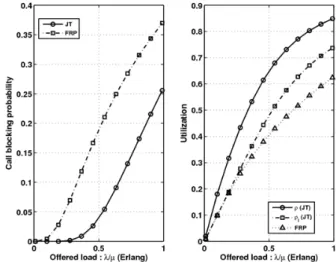
Fig. 4. Initial call blocking probabilities and resource utilizations versus offered load with various schemes.
Fig. 4 shows the initial call blocking probabilities and the utilizations of JT and FRP schemes with respect to the offered load from 0.0 to 1.0. From this figure, we can observe that the initial call blocking probability of the JT scheme is lower than that of the FRP scheme. Then, for
, it is higher than the utilization of the FRP scheme. From the user perspective, the JT scheme
offers the improved call level quality of service.
For the overall resource utilizations of two schemes, we can see that the utilization of JT is higher than that of the FRP scheme. As offered load increases, the difference between utilizations of JT and FRP increases. The reason is that, for the JT scheme, the additional PRBs in serving BS are shared by the UE that belong to CTBS. From the point of view of inter-cell interference[8], the increased resource utilization can lead to a higher interference than FRP.
Ⅴ. Conclusion
In this paper, we have derived the call blocking probability, and the resource utilization for the JT scheme using a Markov chain analysis. The analytical results are in good agreement with the simulations. We have shown that the performances of JT-calls and non-JT-calls are not balanced.
Numerical comparisons among JT and FRP schemes have shown that, for a lightly loaded system, JT would provide more benefit than FRP.
One of the possible research topics is to consider a JT-based cellular system in the interference scenario. In reality, the system throughput may be calculated by the signal to interference ratio, depending on the level of interference power received from neighboring cell. Therefore, it is worthwhile to study the cases where one UE or BS may have interference signals from neighboring BSs or other UEs.
Appendix
In order to find the resource utilizations of non-JT and JT calls, let N is the number of PRB used for their own UEs in the serving cell, where N = Nnon−JT + NJT , and Nnon−JT
and NJT are number of PRBs used for non-JT and JT calls, respectively. From P(ni, nj), we can obtain the marginal steady state
probability, P(ni),
. A-(1)
For N = i, the probability that Nnon-JT=k is
A-(2) where
Then, using the total probability law, A-(2) can be written as
. A-(3)From A-(3), the expectation of Nnon-JT can be obtained by
A-(4) where
.Then, we can obtain
. A-(5)
Finally, by the definition of the resource utilization of non-JT call,
∙
A-(6) Similarly, for the resource utilization of JT call, it is obtained as below
∙ A-(7) References
[1] M. Sawahashi, Y. Kishiyama, A. Morimoto, D. Nishkawa, and M. Tanno, “Coordinated multipoint transmission/reception techniques for LTE-Advanced,” IEEE Trans. Wireless Commun., vol. 17, no. 3, pp. 26–34, June 2010.
[2] J. Zhang, R. Chen, J. G. Andrews, A. Ghosh, and R. W. Heath, “Networked MIMO with clustered linear precoding,” IEEE Trans.
Wireless Commun., vol. 8, no. 4, pp. 1910–
1921, Apr. 2009.
[3] H. Dahrouj and W. Yu, “Coordinated beamforming for the multicell multiantenna wireless system,” IEEE Trans. Wireless Commun., vol. 9, no. 5, pp. 1748–1759, May 2010.
[4] D. Lee, B. Clerckx, E. Hardouin, D.
Mazzarese, S. Nagata, K. Sayana, and H. Seo,
“Coordinated multipoint transmission and reception in LTE-advanced: deployment scenarios and operational challenges,” IEEE Commun. Mag., vol. 50, no. 2, pp. 148–155, Feb. 2012.
[5] L. Thiele, V. Jungnickel, and T. Haustein,
“Interference management for future cellular OFDMA systems using coordinated multi-point transmission,” IEICE Trans.
Commun., vol. E93-B, no. 12, pp. 3228-3237, Dec. 2010.
[6] S. Y. Kim, C. H. Cho, H. W. Lee, N. H.
Park, B. H. Ryu, and S. Ryu, “Performance analysis of LTE enterprise femtocell using cooperative downlink transmission scheme,” in Proc. ICTC. pp. 188-193, Seoul, Korea, Sep.
2011.
[7] S. Y. Kim, S. S. Ahn, S. Ryu, C. H. Cho, and H. W. Lee, “Cooperative transmission scheme
using transmission timing control in LTE enterprise femtocell networks,” IEICE Trans.
Commun. Lett., vol. E95-B, no. 03, pp.
987-990, Mar. 2012.
[8] S.-Y. Kim, S. Ryu, C-H. Cho, and H-W. Lee,
“Performance analysis of a cellular network using frequency reuse partitioning,”
Performance Evaluation, vol. 70, no. 2, pp.
77-89, Feb. 2013.
[9] S.-Y. Kim, S.-J. Lee, S. Ryu, C.-H. Cho, and H.-W. Lee, “Cooperative transmission scheme for OFDMA based enterprise femtocell networks,” J. KICS, vol. 37. no. 5, pp.
338-347, May 2012.
김 승 연(Seung-Yeon Kim)
2005년 2월 고려대학교 전자 및 정보공학부 졸업
2007년 2월 고려대학교 전자 정보공학과 석사
2012년 8월 고려대학교 전자 정보공학과 박사
2012년 8월~현재 고려대학교 전자정보공학과 연구교수
<관심분야> 통신망 설계 및 성능 분석, MAC 프 로토콜
이 형 우(Hyong-Woo Lee)
1979년 University of British Columbia Electrical Engineering (학사)
1983년 University of Waterloo, Electrical Engineering (박사)
1 9 8 3 ~1 9 9 1 년 C a r l e t o n University, System and Computer Engineering 조교수
1992~1995년 University of Waterloo, Electrical and Computer Engineering 조교수 1995~현재 고려대학교 전자정보공학과 교수
<관심분야> 통신망 설계 및 성능 분석, 트래픽 제 어, MAC 프로토콜
류 승 완 (Seung-Wan Ryu)
1988년 고려대학교 산업 공학 과 학사
1991년 고려대학교 산업 공학 과 석사
2003년 뉴욕주립대 (SUNY at Buffalo) 산업공학과 박사 1991~1993년 LG전자 영상미 디어연구소 (주임연구원)
1993~2004년 한국전자통신연구원 이동통신연구단 (선임연구원)
2004년~현재 중앙대학교 정보시스템학과 교수
<관심분야> 이동통신시스템 설계 및 성능 분석, 무 선 MAC 프로토콜, 컴퓨터 네트워크