pISSN 1598-2033 eISSN 2233-5706 Journal of the Korea Institute of Building Construction, Vol. 11, No. 5
http://dx.doi.org/10.5345/JKIBC.2011.11.5.482
www.jkibc.org
Improvement of the PVC Window Frame Installation Method Integrated with Gangform and Field Applicability Analysis
1)Choi, Hyo-Sung
1Lee, Jeong-Ho
2Yoo, Huyn-Seok
3Kim, Young-Suk
3*Han, Seung-Woo
3Gyeryong Construction Company, Seo-Gu, Daejeon, 302-717, Korea
1Cost Engineering Research Center, Inha University, Nam-Gu, Incheon, 402-751, Korea
2Department of Architectural Engineering, Inha University, Nam-Gu, Incheon, 402-751, Korea
3Abstract
In apartment housing construction, window frame installation work, which is conducted after the structural framework, is very important, because its completion time directly affects the starting time of successive interior finishing works, as well as the overall construction period. Construction delays in interior finishing works might occur due to problems inherent to the conventional window frame installation method, such as the poor verticality of window frames, and the water leakage around them. The primary objective of this study is to analyze the problems of a 'Gangform integrated PVC window frame pre-installation method' based on its pilot test results. Next, this study proposes an improved conceptual model that enables the end‐users to enhance the field applicability of this method in terms of productivity, time, and cost. The field applicability of the proposed 'Gangform integrated PVC window frame pre-installation method' was also verified through a survey.
Keywords : gangform, window frame, pre‐installation, field applicability
1. Introduction
1.1 Background and Purpose
The window is one of the main members that comprises the outer envelope of a building, and provides diverse functions such as energy saving, ventilation and natural lighting[1]. Window work is the finishing work that is commenced first, and has a great influence on the overall construction period of a project, since the start time of subsequent finishing works is determined depending on the execution of window work. In addition, the cost of window work was found to be about 5.93 %
Received : April 28, 2011 Revision received : July 18, 2011 Accepted : July 20, 2011
Corresponding author : Kim, Young-Suk
[Tel: 82-32-872-9757, E-mail: [email protected]]
ⓒ2011 The Korea Institute of Building Construction, All rights reserved.
of total construction cost, making it the most costly of all the finishing works[2].
However, window work is vulnerable to several problems, including poor verticality/horizontality of window frame due to damage of the bracket/anchor that fixes window frame to the structures, leakage around the window frame, and poor finishing quality of window frame[3].
In an analysis of the most common defects of
apartment houses, the most common building type in
Korea, about 13 households out of 100 were found to
have window‐related defects. An investigation of types
of consumer damages related to windows found that
leakage around the window frame was the most
common source of damage, at 67 %[4]. Various
approaches to this problem have been pursued,
including change of bracket structure, development
of window pre‐installation method and development
of assembly window frame, but their field
applicability was analyzed to be very low. Among these approaches, the ‘Gangform integrated PVC window frame pre‐installation method’ was developed to shorten the overall construction period through the early start of successive finishing works, and to solve problems related to window frame leakage and poor waterproofing, but it was determined to have shortcomings such as low economic feasibility and delay in construction period.
This study aims to present an improved model based on the required improvements identified through the survey and results of the pilot field application of the "Gangform integrated PVC window frame pre‐installation method," the most advanced of the existing window frame construction methods, and to present plans to improve the field applicability of the Gangform integrated PVC window frame pre‐installation method. If the proposed improved model of the PVC window frame pre‐installation method is applied on a construction site, it is expected to shorten the construction period, improve productivity, obtain economic feasibility and enhance the efficiency of window‐related works.
1.2 Scope and Method
PVC windows hold a market share of approximately 75 % due to their excellent insulation, their water‐
tightness, their high soundproof effects and their flexibility in opening and closing. This study was restricted to the installation of PVC windows, which are most commonly used in apartment houses, and the improvement of the related installation methods.
The approaches pursued in this study were as follows:
1) Analyze Existing Window Construction Process and Problems
The problems related to existing window constructions were analyzed through interviews
with managers and workers in the field, as well as through an analysis of the literature and site visits, through which the need to improve the construction method was derived.
2) Analyze Existing Study Trends
This research analyzed technologies derived to solve problems related to window works, such as the Gangform integrated PVC window frame pre‐installation method, assembly‐type window frames and change of bracket structure. In particular, this research also analyzed the construction process, economic feasibility and construction period of the Gangform integrated PVC window frame pre‐installation method developed for shortening the construction period and securing the quality of window frame works.
3) Present Improved Model of Gangform Integrated PVC Window Frame Pre‐installation Method Through survey and analysis, this research derived the main problems of the Gangform integrated PVC window frame pre‐installation method and the required improvements, and presented a model for improving the Gangform integrated PVC window frame pre‐installation method that can improve work convenience, shorten construction period, improve quality and secure economic feasibility.
4) Analyze Field Applicability and Technical /Economic Feasibility of Improved Model of the Gangform integrated PVC Window Frame Pre‐installation Method
This research presented the effects of shortening
the construction period through an analysis of the
proposed improvements to the Gangform integrated
PVC window frame pre‐installation method. In
addition, this research examined the economic
feasibility of the development method through an
analysis of the cost of materials used, and
examined the field applicability of the proposed
improved model through a survey of construction
site managers.
2. Current Status of Window Frame Construction Methods, and Consideration of Existing Research Trends
2.1 Analysis of Existing Window Frame Construction Process and Problems
1) Analysis of Existing Window Frame Construction Process
Window frame installation methods can be classified into the Later Erection Method and the First Erection Method. Most construction sites use the Later Erection Method, which allows the precise adjustment of the installation position and verticality/horizontality of the window frame within the tolerance of 3~5 mm at the time of window frame installation and construction. In the Later Erection Method, the window frame is installed after concrete curing while leaving the opening areas on walls.
The installation process is as shown in Figure 1.
(a) Preparing window frames (b) Leveling concrete surface
(c) Fixing window frames
temporarily (d) Installing angles
(e) Installing window frames (f) Installing windows
(g) Filling interior plaster (h) Filling interior urethane
(i) Caulking interior silicon (j) Caulking external silicon
Figure 1. Work process of the window frame installation
That is, window‐related work is performed in the order of 1) carry in and transport the window materials, 2) level the concrete surface to be connected to the window frame, 3) fix the window frame temporarily, 4) install the bracket for fixing the structure and window frame (in general, L‐
shaped and T‐shaped bracket are installed at intervals of 620~650 mm), 5) fix the window frame using the anchor (install), 6) fill mortar between window frame and structure, 7) urethane filling on the upper and side of window frame, 8) silicon caulking inside the window frame, 9) silicon caulking outside the window frame. While internal silicon caulking is performed for each floor, external caulking is performed on all building windows at once after the completion of the window frame on all floors due to the nature of the work[5]. In most sites, it was found that window frame installation was performed by separating 1 building into 2 sections for convenience of works and the early execution of finishing works. Window frames from the 1
stfloor to the middle floor were pre‐installed, and those from the middle floor to the top floor were post‐
installed.
2) Analysis of Problems in Existing Window Frame
Installation and Construction
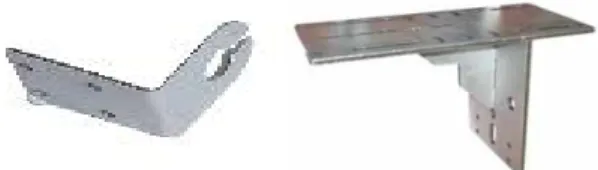
With regard to existing window frame installation, the window frame support type using the bracket is preferred, and L‐shaped bracket and T‐shaped bracket are used (Figure 2).
Figure 2. L and T type brackets for fixing window frame to concrete structures
When the window frame is fixed using the L‐
shaped and T‐shaped bracket, the bracket cannot endure the weight of the window frame, resulting in faulty location and sagging of window frame installation due to the transformation of window frame. While the construction method of fixing the bracket to the structure using the anchor has been used, many cases have been reported in which the anchor did not become completely embedded in the structure due to interference with the arranged rebar in the structure. In addition, cases of bending or damaged brackets were also found due to problems of the bracket itself that made it vulnerable to impact (Figure 3).
Figure 3. Window frame deflection and bracket distortion problems
While a wooden support is installed on the window frame to improve the problem of the bracket support type, it was found to cause deformation of the window frame, since members
such as broken brick or rubber left at the site are used to support the window frame, rather than the installation of a standardized wooden support.
While filling work using mortar or urethane as well as caulking work using silicon are conducted to prevent the leakage around the window frame, they were found to have many defects related to water leakage and waterproofness due to damage and deformation of the window frame. In addition, if workers install the lower bracket in a narrow space, workability is reduced. In addition, as all works are executed on‐site, from the installation of the window frame and bracket to assembly and installation, the method is found to have low work productivity.
2.2 Current Status of Main Research on the Construction of Window Frames
1) Analysis on Current Status of Research and Development
An analysis of previous research related to window construction showed that research and development have been focused on improving the components of the existing window frame installation system, developing auxiliary equipment, and improving the bracket structure for the fixing of window frames and the vertical/horizontal control device of the window frame. The analysis found, however, that the research showed limitations in terms of solving problems of window works such as poor waterproofness and water leakage around the window frame (Table 1).
Company L (2010) developed the Gangform
integrated PVC window frame pre‐installation
method with the goal of shortening the
construction period through the early start of
successive finishing works, achieving a
simplification of the process, promoting the
convenience of construction and preventing leakage.
Author/
Inventor Title of paper/
Patent Main Content
Kim KD (1995)
A Study on the Development of the Systems for Apartment Doors and
Windows
The new window component system is composed of temporary and prefabricated door frames. The frames, which are manufactured in simplified standard sizes, are made with aluminum or PVC
material.
P company (2005)
A horizontal and vertical control device for a
door frame[6]
A Horizontal and vertical control device is a mechanism that controls the fitting of the door frames by correctly erecting and lining up the support components.
P company (2001)
Installation method for window frame and
temporary frame structure[7]
A structure assembly procedure during which a temporary frame is installed prior to the installation of window frames to facilitate subsequent finishing and touch‐up work, and then window frames
are installed after conducting finishing and touch‐up work
L company (2010)
The PVC Window
Frame Installation Integrated with
Gangform[8]
This system is able to achieve the maximum effectiveness in terms of leakage prevention and waterproofness, because the installation of Gangform and the installation of window frames is completed before placing concrete, which means that concrete curing and installation of window
frames are completed at the same time
Table 1. Major research related to window frames
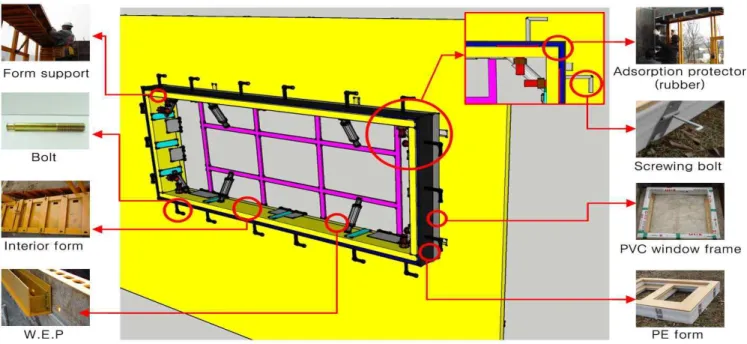
Figure 4. Major components of the PVC window frame installation method integrated with Gangform
However, if this method is applied, it is found to have problems such as low economic feasibility and extension of construction period. Accordingly, this study aims to analyze the problems of the Gangform integrated PVC window frame pre‐
installation method, which is evaluated to be the
most technically advanced of the current window frame construction methods, and to develop a model for its improvement.
2) Composition and Installation Principle of Gangform
Integrated PVC Window Frame Pre‐Installation
Method
The Gangform integrated PVC window frame pre‐
installation method is a method of placing concrete and installing a window frame at the same time, unlike the previous methods, in which the window frame was installed after placing the concrete. This method requires members such as rubber protectors, PE form, window frame mount and WEP (Figure 4). This method is designed to solve waterproofness‐related problems and leakage around the window frame, since it enables the adhesion of the structure and window frame through the simultaneous construction of the concrete and the window frame. In addition, since the structure directly supports a window frame that is not the bracket support type, it can solve problems of window frame deformation. The Gangform integrated PVC window frame pre‐installation method requires the installation of rubber protectors on 4 sides of the window frame to prevent damage to the window frame due to the movement of workers and the impact of falling of slab and wall form. PE form is installed around the window frame to prevent external water from penetrating inside, through close adhesion between window frame and window.
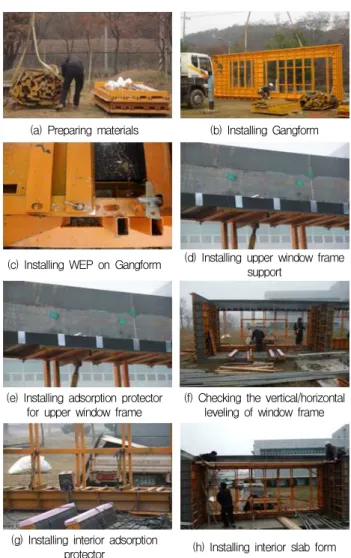
Figure 5 shows the work process of the Gangform integrated PVC window frame pre‐installation method. Similarly to the existing window frame construction method, the work starts with the installation of Gangform ((b) in Figure 5) after carrying in the materials ((a) in Figure 5).
Then, WEP is installed to maintain a certain distance between window frame and Gangform on the window frame installation area of Gangform ((c) in Figure 5). The upper window frame support is installed ((d) in Figure 5) and the protector is installed on the upper part of the window frame ((e) in Figure 5). The window frame is mounted on the upper mount, and its verticality/horizontality ((f) in
Figure 5) is checked and adjusted. When the vertical/horizontal status of window frame is confirmed, install protector and mount on the window frame in the remaining area ((g) in Figure 5) and install the internal slab form ((h) in Figure 5).
(a) Preparing materials (b) Installing Gangform
(c) Installing WEP on Gangform (d) Installing upper window frame support
(e) Installing adsorption protector
for upper window frame (f) Checking the vertical/horizontal leveling of window frame
(g) Installing interior adsorption
protector (h) Installing interior slab form
Figure 5. The process of the PVC window frame installation
method integrated with Gangform
3) Problems of the Gangform Integrated PVC Window Frame Pre‐installation Method and Analysis of Improvements
Technical feasibility, economic feasibility and field
feasibility of this method were analyzed through a
survey of site managers, site visits and a pilot
experiment of the Gangform integrated PVC window
frame pre‐installation method. The survey was
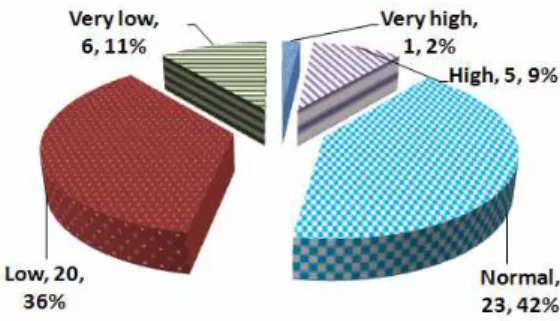
conducted on a total of 55 construction site managers and hands‐on workers. In the survey, about 51 % of respondents stated that the technical feasibility of the Gangform integrated PVC window frame pre‐installation method is low, while 47 % of respondents stated that the economic feasibility of the Gangform integrated PVC window frame pre‐
installation method is low. This shows that the survey respondents were concerned about economic loss due to the extension of the structure work construction period in the critical path and extremely high unit cost of additional materials such as rubber protectors and PE form.
In terms of the field applicability of the Gangform integrated PVC window frame pre‐
installation method based on technical and economic feasibility, 65 % of respondents answered that field applicability was low, which might lead to the possibility of increased construction cost, difficulty of work management and extension of construction period compared to the existing work process (Figure 6, 7, 8).
Figure 6.The assessment of technical feasibility
Figure 7. The assessment of economic feasibility
Figure 8. The assessment of field applicability
For this study, a total of 50 construction site managers and specialized contractors were surveyed regarding the problems that should be corrected to improve the site applicability of the Gangform integrated PVC window frame pre‐installation method. Table 2 below shows the contents of the survey that was prepared based on the opinions of site managers and the results of pilot field analysis.
Table 2. Enhancements for field application
A. There should be no extension of structure work duration due tointerference between works during structure work
B. Window frames should not be damaged when treating interior wastes C. Window frames should not be damaged by form dismantling and
other works
D. The wallpaper and finishing materials should not be damaged by hitting the window frame when window is opened and closed.
E. There should be no probability of re‐work due to vertical/ horizontal failure of window frame after concrete curing
F. There should be no difficulty in window frame replacement work caused by inserted anchor bolt for fixing window frame, including demolishment work.
G. It should be more economical than the conventional method.
H. Waterproof performance should be equal to or superior to conventional methods
I. Flexibility of window frame work should be secured, even when the decision on balcony expansion is delayed.
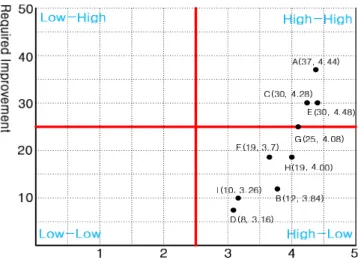
This study prepared a matrix based on the
importance of survey questions and required
improvement scores on two axes in order to derive
the main required improvements to the Gangform
integrated PVC window frame pre‐installation method
based on the results of the survey (Figure 9).
Figure 9. X Y Matrix results on the survey
By evaluating the matrix of importance and required improvements, problems corresponding to A (extension of structure work construction period due to interference between works during structure work), C (damage to window frame pre‐installed due to the dismantling of forms and other work), E (generation and difficulty of rework due to poor verticality/horizontality of window frame after concrete curing), G (low economic feasibility compared to the existing method) were found to have high importance in terms of field applicability, and should be addressed. Accordingly, this study addressed the problems of the Gangform integrated PVC window frame pre‐installation method that were derived based on site visits and the results of the survey, and proposed an improved model with improved field applicability.
3. Presentation of Improved Model of Gangform Integrated PVC Window Frame Pre-installation Methods
Through the survey and pilot field visits to test the Gangform integrated PVC window frame pre‐
installation method, the Gangform integrated PVC window frame pre‐installation method was
determined to have a number of main problems, including 1) low economic performance due to the high unit cost of protectors required to prevent damage to the window frame due to the pre‐
installation of window frame, 2) extension of the construction period due to the mixing of the process of structure work and window frame construction, 3) difficulties in the vertical/horizontal adjustment of window frame. Accordingly, this study plans to present plans to install the protectors on the areas where protection is required only, by identifying the areas and causes of damages on the window frame through an analysis of pilot field experiment results rather than installing protectors on all 4 sides of window frames, in order to solve problems related to low economic performance due to the high unit cost of protectors to prevent damage to the window frame due to the pre‐installation of the window frame. In addition, this study will present a Gangform integrated and pre‐installed model that can minimize the time required to install the window frame in order to solve the problems related to the extension of construction period due to the mixing of structure work construction and window frame construction process, while devising the fine vertical/horizontal control device that can adjust the verticality/horizontality of the window frame at the same time.
3.1 Suggestions for Improved Model of Gangform Integrated PVC Window Frame Pre-Installation Method
3.1.1 Improvements of Economy from a Management Perspective
Among the problems of the Gangform integrated
PVC window frame pre‐installation method, field
applicability was found to decline due to low
economy and inefficiency in the field installation of protectors. Protectors are installed to protect the window frame when treating the wastes, dismantling the form and placing the concrete, and are installed on all 4 sides of the window frames in the Gangform integrated PVC window frame pre‐
installation method. By analyzing the cause of damage to window frames through field observations of the Gangform integrated PVC window frame pre‐installation method, however, most damages to the bottom area of the window frame were found to be attributable to careless movement by workers at the time of waste treatment or form dismantling. Accordingly, the installation of protectors on all 4 sides of the window frame has low effects compared to the input costs. An examination of 34 Pyeong apartment houses found that the window frames installed outside mostly consisted of 5 windows, such as big window and middle‐sized window on the balcony area, and 3 small windows. It was necessary to take care to protect the lower part of the frame of the big window and middle‐sized window to be used at waste treatment and form dismantling. That is, it is considered to raise the economy by installing high‐cost protectors on the points of the window frame that need to be provided with continuous protection.
In addition, our pilot field analysis showed that it took about 70 minutes (for big window and middle‐
sized window) to install protectors, and the mixing with structure work was found to contribute to the extension of the construction period. To solve this, a pre‐installation and dedicated use plan of protectors should be presented. In addition, the design of an improved model of window frame pre‐
installation Gangform should be performed to shorten the time required to install WEP and the window frame mount installation time.
3.1.2 Suggestion of Integrated Gangform
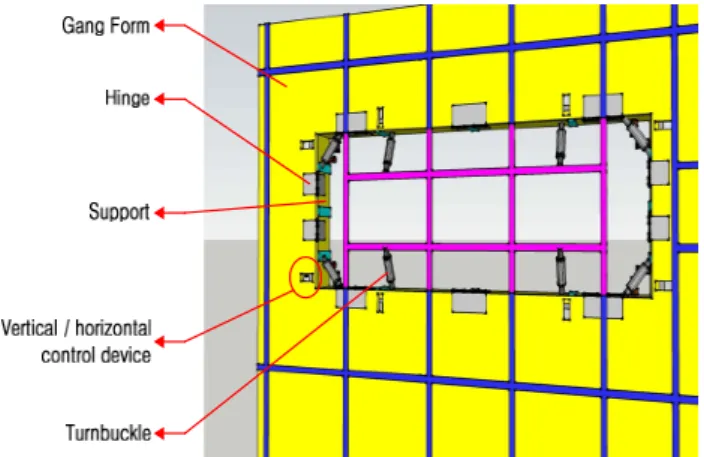
This study designed a Gangform system integrating Gangform, mount and protector in order to minimize the interference (mixing) with structure work construction and window frame installation (Figure 10).
Figure 10. Major components of the new method
The design of an integrated Gangform proposed
in this study connected the Gangform to the mount
hinge rather than installing the mount at the
Gangform. Protector and WEP were also designed
to be integrated as one unit. Accordingly, a 7‐day
cycle structure work construction system was
designed by simplifying the installation of mount,
WEP and protectors that are required for window
frame installation, thus minimizing the mixing with
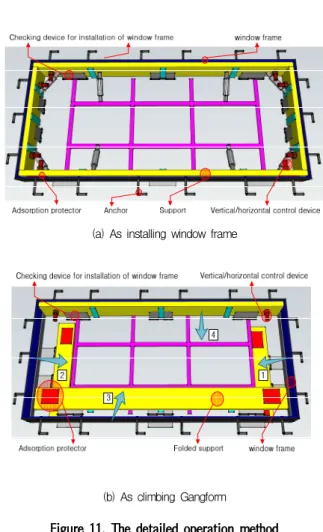
the structure work process. In addition, an
integrated Gangform was proposed to prevent
damage to the Gangform due to collision with
structures and neighboring structures by unfolding
the mount in order to prevent damage to the
mount at the hoist of Gangform after completion of
concrete placement, and to mount the window
frame immediately by folding the mount when
installing the window frame (Figure 11).
(a) As installing window frame
(b) As climbing Gangform
Figure 11. The detailed operation method
3.1.3 Design of Minute Vertical/Horizontal Control Device
Gangform integrated PVC window frame pre‐
installation method could solve the problem of window frame fixation owing to close adhesion of structure and window frame, but it was found to be difficult to check or adjust the verticality/horizontality of window frames that were deformed due to the lateral pressure of concrete after pre‐installation. Since the tolerance of structure work construction is 15 mm, which is significantly higher than 3 mm, the tolerance for window work, verticality/horizontality of the window frame should be adjusted precisely in the window frame installation work. That is, the verticality/horizontality of the window frame should be adjusted after the installation of the form,
before and after placing concrete, and before the start of curing. Accordingly, this study proposed a plan to easily check the window frame installation status outside the Gangform in order to secure the quality and workability of window frame installation work, and applied it to the improved model of the Gangform integrated PVC window frame pre‐
installation method (Figure 12).
Figure 12. Checking devices for window frame installation
As shown in Figure 12, a hole was punched in
the Gangform and WEP was installed inside
Gangform to check the installation status of the
window frame, so that the verticality/horizontality
of the window frame could be checked through
vertical/horizontal gradation confirmation indicated
on the Gangform. In addition, changes to the
installation position of the window frame caused by
the lateral pressure of concrete could be checked
through vertical·horizontal confirmation
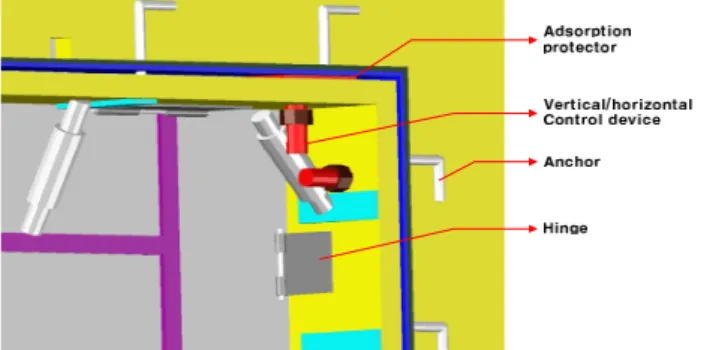
graduation. The minute vertical/horizontal control
device consists of a control board for adjusting the
position of the window frame and a nut for the up
and down movement of the control board. It was
devised to finely adjust the position of the window
frame vertically and horizontally, as the control
board of the vertical/horizontal control device
moved up and down whenever the nut was loosened
or fastened (Figure 13).
Figure 13. Window frame vertical/horizontal control devices
Precision of window frame installation and construction could be improved by adjusting the bending of the mount through fine vertical/horizontal control.
Precision of window frame installation and construction could be improved by adjusting the bending of mount with the fine vertical/horizontal control device, even if the mount is bent due to the weight of the concrete after concrete placement (Figure 14).
Figure 14. Control devices for preventing deflection of window frame
4. Analysis of the Validity of the Improved Model of the Gangform Integrated PVC Window Frame Method
4.1 Analysis of Construction Period through an Analysis of Productivity for Each Method
4.1.1 Analysis of Productivity and Construction Period of Existing Method
This study analyzed the construction period for each method in order to assess the effects of improved models of the presented Gangform integrated PVC window frame pre‐installation method. Construction period was analyzed for 20 floors of 34 Pyeong apartment houses (80 households) (Figure 15).
Since the start time of subsequent finishing works is determined depending on the window frame installation period, precedent and subsequent processes related to window frame installation were considered. In typical window frame installation work, external window frame and internal window frame are installed at the same time after masonry works are completed following concrete curing.
After window frame installation, subsequent finishing works are conducted, such as wallpaper work, floor plaster and tile work, and plaster work, in that order.
Figure 15. The implement parts of window frame works
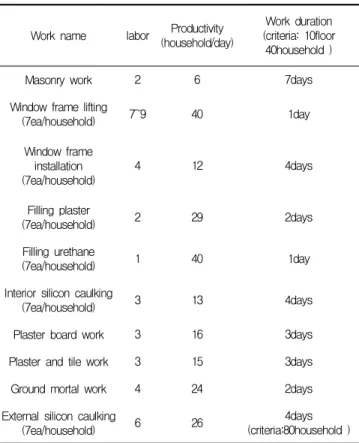
This study analyzed the productivity of the
existing window frame installation method per work
section through interviews with workers and a field
survey at 5 apartment sites. The arithmetic mean
of data calculated at each site was adopted for
productivity data, and workers arranged for the
work at 1 building on average were calculated for
work personnel. Since work was conducted at 1 building for external caulking work, productivity was derived based on 80 households (Table 3).
Table 3. The productivity of conventional window frame installation works
Work name labor Productivity (household/day)
Work duration (criteria: 10floor 40household )
Masonry work 2 6 7days
Window frame lifting
(7ea/household) 7~9 40 1day
Window frame installation
(7ea/household) 4 12 4days
Filling plaster
(7ea/household) 2 29 2days
Filling urethane
(7ea/household) 1 40 1day
Interior silicon caulking
(7ea/household) 3 13 4days
Plaster board work 3 16 3days
Plaster and tile work 3 15 3days
Ground mortal work 4 24 2days
External silicon caulking
(7ea/household) 6 26 4days
(criteria:80household )
This study derived the construction period related to window frame and structure work based on 80 households in a single apartment house building based on the derived productivity data. The 7‐day cycle process of existing structure work construction was reflected, and the construction period was predicted in consideration of the curing period of each material as well as the concrete age of 28 days.
Existing structure work construction was conducted in the order of Gangform installation for each floor, installation of wall rebar and electricity/facility piping, installation of wall and slab rack, installation of slab rebar, electricity/facility piping, concrete placing and curing in a 7‐day cycle in total (Figure 16).
Figure 16. Structure work cycles in the conventional method
There are various construction standards related to window frame and interior works of apartment houses, but for this study interior works and the window frame were planned for 4 households of 34‐
pyeong complex in a 20‐story apartment building (on the basis of 10 stories as one cycle). Process plan was prepared based on precedent and subsequent works that are directly related to window frame construction (structure work and masonry, wallpaper and plaster work) when calculating the construction period of existing window frame installation work. Weather and other environmental conditions were not considered.
Calculating the total construction period of works related to structure work and window frame based on 80 households, it took about 196 days (Figure 17).
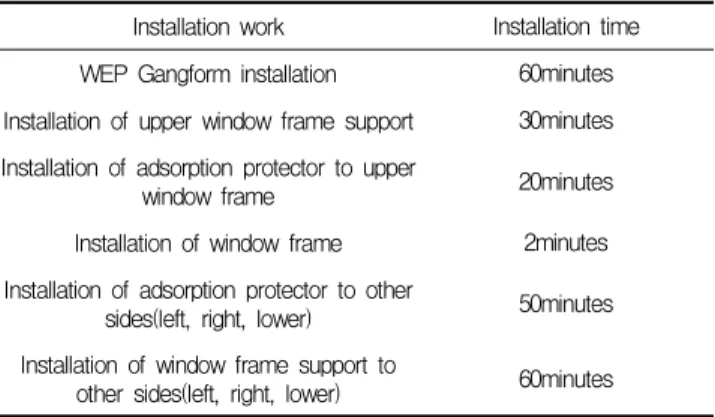
4.1.2 Analysis of Productivity and Construction Period of Gangform integrated PVC window frame pre-installation method This study predicted the construction period of the Gangform integrated PVC window frame pre‐
installation method in consideration of the extension of structure work as well as the survey through pilot field visits to actually measure the productivity of the place to which the Gangform integrated PVC window frame pre‐installation method is applied.
Derived productivity data was set as the
arithmetic mean of the results of measuring the
installation time through a total of 4 rounds of
field visits. Table 4 shows the result of measuring
Figure 17. The overall work durations as using conventional method for structure and window frame works
the work time (based on 1 big window, 1 small window) of Gangform integrated PVC window frame pre‐installation method.
Installation work Installation time
WEP Gangform installation 60minutes
Installation of upper window frame support 30minutes Installation of adsorption protector to upper
window frame 20minutes
Installation of window frame 2minutes Installation of adsorption protector to other
sides(left, right, lower) 50minutes Installation of window frame support to
other sides(left, right, lower) 60minutes
Table 4. Work duration of each task
Since structure work construction and window frame installation are conducted at the same time in the Gangform integrated PVC window frame pre‐
installation method, an extra window frame installation period of 1 day is required in addition to the existing 7‐day structure work cycle (Figure 18).
Based on the results of an analysis on the
productivity of the Gangform integrated PVC window frame pre‐installation method and frame work cycle, the number of construction days was drawn on 80 34‐Pyeong houses using the same method as the existing window frame installation and construction method.
Figure 18. Structure work cycles of the PVC window frame integrated with Gangform
The number of days required for the construction
of lamination board related to the installation and
construction of window frame, floor plastering, tile,
Figure 19. The overall work duration using PVC window frame installation method integrated with Gangform
plaster work, masonry work and the construction of internal and external windows was included in the calculation. External window frame installation work was included in the structure work. Precedent and follow‐up works (structure work, masonry, lamination board, plaster works, etc.) directly related to the structure work and window frame construction were considered for process plan. Due to the unification of the concrete and external window frame, external window frame mortar and urethane filling work time were excluded. By calculating the total period of construction related to structure work and windows of 80 households, it was estimated to take about 210 days (Figure 19).
4.1.3 Analysis of Construction Period of Improved Model of Gangform Integrated PVC Window Frame Pre-installation Method
If the improved model of Gangform integrated PVC window frame pre‐installation method is applied, a 7‐
day cycle for structure work construction was found to be feasible by minimizing mixing with the
structure work process due to the simplification of the installation work of mount, WEP and protectors (Figure 20).
Figure 20. The structure work cycle as using new method
To calculate the construction period of the improved model, construction period of 80 34‐
Pyeong apartment houses was analyzed with the same condition as Gangform integrated PVC window frame pre‐installation method and the existing window frame construction method.
Figure 21 predicted the construction period
Figure 21. The overall work duration using the new method
related to structure work and window frame through an analysis of the new method process applied with Gangform dedicated for PVC window frame pre‐installation. By analyzing the construction period of the improved model of Gangform integrated PVC window frame pre‐
installation method, the total construction period for structure and window frame works of 80 households in 34‐Pyeong units was found to be 190 days. Accordingly, it was analyzed that construction period could be reduced from 6 to 20 days compared not only to the total construction period of 196 days spent when the existing window frame construction method is applied but also to the total construction period of 210 days spent when the Gangform integrated PVC window frame pre‐installation method is applied.
4.2 Analysis of Economic Feasibility of Improved Model of Gangform Integrated PVC Window Frame Pre-Installation Method
This study examined and analyzed the required number of workers and material costs to analyze the economic feasibility of the improved model of the Gangform integrated PVC window frame pre‐
installation method. Economic feasibility was analyzed based on 80 units of 34‐Pyeong apartment houses. For labor cost and material cost, the average value obtained through interviews conducted in field visits was used, and the workers were calculated based on the results of an analysis of productivity. Saving of quantities due to the dedicated use of rubber protectors was considered when analyzing the economy of the improved model of the Gangform integrated PVC window frame pre‐
installation method, in addition to the the cost needed to remove the protectors installed on the upper, left and right part of window frame.
Table 5 shows the analysis of the economy of the
improved model of the Gangform integrated PVC
window frame pre‐installation method, and excludes
the work sections overlapping with the existing
method as well as the Gangform integrated PVC window frame installation method. Construction cost was derived by multiplying unit cost by each work quantity and quantity of labor. As a result, it was found to require a construction cost of about 34,418,960 for 80 units of 34 Pyeong apartment houses. It is analyzed to reduce construction costs by about 1,000,000 won ~ 90,000,000 won compared to the existing method and the Gangform integrated PVC window installation method if the proposed improved model is applied.
In addition, since the construction period is shortened by 6 to 20 days, the construction cost saving effect is expected to be much higher, in consideration of the labor cost and indirect cost required for the same period.
Table 5. Economic feasibility of the new method
Type of work Unit cost Construction cost Window frame salvage 100,000won·day 800,000won Installation of window frame 110,000won·day 7,480,000wonFilling interior plaster and
urethane (Sliding Windows ) 700won·m 380,800won Filling interior plaster and
urethane(double windows ) 1000won·m 496,000won Interior silicon caulking 5T 600won·m 624,000won External silicon caulking 5T 600won·m 2,460,000won
P.E form 200won·m 720,000won
Rubber adsorption protector 30,000won·m 13,122,000won
Plate pin 1,800won·EA 10,800,000won
Bracket 2,300won·EA 1,729,600won
Angle 2,000won·EA 880,000won
Anchor 120won·EA 10,6560won
Window work cost 110,000won·day ‐880,000won Window frame work cost 16,000,000won ‐1,600,000won Not installed safety rail (labor
cost) 70,000won·day ‐1,400,000won
Not installed safety rail (material
cost) 10,000·EA ‐1,000,000won
Overall cost 34,418,960won
Table 6 compares and analyzes methods in terms of the economy and shows that the economy of the improved model of Gangform integrated PVC window frame pre‐installation method is the highest.
Table 6. Comparative analysis of economic feasibility
Type of work Conventional method
PVC window frame pre-installation method integrated
with Gangform
Improved model
Window frame lifting 1,600,000won 800,000won 800,000won Installation of window
frame 3,080,000won 7,480,000won 7,480,000won Filling interior plaster
and urethane (Sliding
Windows ) 817,600won 380,800won 380,800won Filling interior plaster
and urethane(double
windows ) 3,472,000won 496,000won 496,000won Interior silicon caulking 1,560,000won 624,000won 624,000won
External silicon caulking 9,000,000won 2,460,000won 2,460,000won
P.E form ‐ 720,000won 720,000won
Rubber adsorption
protector ‐ 108,000,000won 13,122,000won
Plate pin ‐ 10,800,000won 10,800,000won
Bracket 11,628,800won 1,729,600won 1,729,600won Angle 3,776,000won 880,000won 880,000won
Anchor 222,720won 10,6560won 10,6560won
Window frame work
cost ‐ ‐880,000won ‐880,000won
Window work cost ‐ ‐1,600,000won ‐1,600,000won Not installed safety rail
(labor cost) ‐ ‐1,400,000won ‐1,400,000won Not installed safety rail
(material cost) ‐ ‐1,000,000won ‐1,000,000won Amount 35,157,120 129,296,960won 34,418,960won
4.3 Analysis of Field Applicability of Improved Model of Gangform Integrated PVC Window Frame Pre-installation Method
This study conducted a survey on 28 site
managers to examine the field applicability of the
improved model of the Gangform integrated PVC window frame pre‐installation method. The survey was organized to analyze the economic feasibility and quality of the improved model of the Gangform integrated PVC window frame pre‐installation method, as well as potential solutions to problems generated in the field application of the Gangform integrated PVC window frame pre‐installation method. Regarding the possibility of shortening the construction period compared to the existing construction method, the easy adjustment of verticality/horizontality, and the possibility of securing more economic construction, 71 %, 61 % and 79 % of survey respondents rated the proposed method ‘high’(Figure 22).
Figure 22. Possibility of solving problems of the PVC window frame installation method integrated with Gangform
In addition, in the examination and analysis of the field applicability of the improved model of Gangform integrated PVC window frame pre‐
installation method from the aspect of quality/economy compared to the existing method, 82 % of respondents answered 'normal' for the quality aspect, and 89 % of respondents answered
‘normal’ for the economy aspect. Accordingly, the improved model of the Gangform integrated
PVC window frame pre‐installation method proposed in this study was found to be excellent in terms of the possibility of problem‐solving as well as quality/economy compared to the existing method (Figure 23).
(a) The assessment of field applicability in terms of quality
(b) The assessment of field applicability in terms of economy