≪연구논문≫
Journal of the Korean Magnetics Society, Volume 19, Number 3, June 2009
−
81
−덩어리, 단층 및 사슬 구조 철의 전자구조와 자성에 대한 LDA+U 효과
Kalpana K. Landge·Beata Bialek·이재일
*
인하대학교 물리학과, 인천시 남구 용현동 253
(2009년 4월 3일 받음, 2009년 6월 4일 최종수정본 받음, 2009년 6월 4일 게재확정)
상관효과
U
가전자구조와자성에미치는 영향을검토하기위하여대표적자성물질인 철의덩어리,
단층및사슬구조에대해연구하였다
.
이를위하여U = 3 eV
로택하여,
총퍼텐셜보강 평면파동에너지 띠방법을 이용하여LDA+U
및GGA+U
근사하에전자구조계산을수행하였다.
비교를위하여LDA
및GGA
를이용한 계산도수행하였다.
그결과U
의효과를포함시켰을때덩어리철의경우자기모멘트가
0.3
µB 증가하여실험값이나LDA
및GGA
계산에비해과다하 게계산되는 것으로나타났으나,
단층이나 사슬의 경우는그렇게 큰차이를보이지 않았다.
이로부터 전자구조계산 시대상 계에따라
U
의효과를적절히고려하여야 함을알았다.
주제어 : 철
,
결함,
전자구조,
자성The LDA+U Effect on the Electronic Structure and Magnetism of Bulk, Monolayer, and Linear Chain of Iron
Kalpana K. Landge, Beata Bialek, and Jae Il Lee
* Department of Physics, Inha University, Incheon 402-751, Korea
(Received 3 April 2009, Received in final form 4 June 2009, Accepted 4 June 2009)
We examine the effect of U term (U = 3 eV) describing the Coulomb interactions between electrons on the results of electronic band structure calculations carried out for bcc Fe bulk, monolayer, and chain. We investi- gated the properties of the three Fe structures by using the all-electron total-energy full-potential linearized augmented plane wave method. The U term was included in the exchange - correlation functionals constructed on the basis of local density approximation (LDA) and general gradient approximation (GGA). We found that in the case of bcc Fe bulk structure inclusion of the U term leads to the overestimated values of magnetic moment on Fe atom. The values of magnetic moment calculated for Fe in monolayer and chain are in accor- dance with calculations in which the U term was not included. In general, for each system the calculated values of magnetic moment on Fe sites were larger when the U term was incorporated in the energy functional. In Fe bulk, the value of magnetic moment 2.54 µB for LDA+U larger than 2.25 µB for LDA.
for LDA.
Keywords : Fe, defect, electronic structure, magnetism
I. Introduction
An improvement of computational ab-initio methods accuracy in description of the electronic properties of solids has been an issue ever since the first theories of solids were developed. Technological progress made it possible to calculate the microscopic properties of existing materials with periodic structure, even such that contain
many types of atoms in a unit cell. Possibility to obtain reliable results for real structures let the scientists count on correct prediction of the properties of newly computer- aided designed materials. After so many years of develop- ment of first-principles methods, there is still a huge effort to implement the best possible approaches for description of specific groups of compounds. Especially challenging task is to calculate electronic structure of strongly correlated systems with the use of the methods based on density functional theory (DFT).
*Tel: (032) 860-7654, E-mail: [email protected]
−
82
− 한국자기학회지제19
권3
호, 2009
년6
월The main problem in DFT-based ab initio calculations is the choice of exchange-correlation energy term in energy functional. At the early stage of the development of DFT-based methods, the most popular choice was such that the exchange-correlation (E
XC) term in the energy functional depended on electronic density in a local fashion, and so it was called the local density approximation (LDA). It is a much more difficult task to develop non- local exchange-correlation functionals. More recently, so called generalized gradient approximation (GGA) was developed to produce E
XCthat depends not only on the electron density, but also on its gradients. This approxi- mation works better for some systems, but still fails when strong correlation effects play important role for tailoring the electronic properties of solids. Such effects are important in systems with 3d or 4f electrons, and especially in the systems of reduced dimensionality, such as mono- layers or chains. Including correlation effects in a realistic manner is difficult. A strong correlation effect between localized electrons may however be included in DFT calculations through introduction of a U term describing the effective Coulomb interactions between the electrons.
With the U term added to the energy functional so-called LDA+U and GGA+U approaches are obtained. LDA+U was introduced first time by Anisimov et al. [1] and it was proved to produce very accurate results in situations when LDA failed, like in predicting an energy gap in Mott insulators [1].
Electron correlation effects are very important in magnetic materials. A best example of such a material is iron. Pure iron has a body-centered cubic (bcc) crystal structure at room temperature and is ferromagnetic. Its magnetism is not due to the any inherent magnetic properties of the atoms, but to the structure of the metal. Therefore, surface magnetism of iron may be much different from that of the bulk.
In this paper we present the results of a first-principles calculation of the electronic and magnetic properties of bcc Fe bulk, monolayer and chain as the examples of 3-, 2-, and 1-dimensional systems with strong electron cor- relation. We discuss how a chosen exchange-correlation energy functional approximation necessary to solve Kohn- Sham equations influences the calculated values of certain parameters that characterize the electronic and magnetic properties of the investigated systems. We compare the properties of the three systems calculated with LDA, GGA, LDA+U, and GGA+U approaches.
II. Model and Computational Method
The reported calculations were carried out for bcc Fe bulk, monolayer, and linear chain. The distance between
Fe atoms in the three systems was set to 2.485 Å, regardless the reduced dimensionality. The distance is identical with the nearest neighbors distance in bcc Fe crystal. Hence, the Fe monolayer represented a single layer of Fe (001) surface.
The Kohn-Sham equation was solved self-consistently in terms of the full-potential linearized augmented plane wave (FLAPW) method [2, 3] as embodied in the QMD- FLAPW code with LDA [4], GGA [5], as well as with the LDA+U and GGA+U approaches, in which an addi- tional Hubbard-U term was added [1, 6] for the treatment of strong on-site 3d electron - electron interactions on Fe, which we used as U = 3 eV. Lattice harmonics with l ≤ 8 were employed to expand the charge density, potential, and wave functions inside the muffin-tin (MT) radii of 2.348 atomic unit (a.u.) for the Fe atom. A plane wave cut-off of 16 Ry was employed, and so more than 100 basis functions per atom were used to expand the wave functions. Integration was performed by summation over 84, 36, and 11 k-points for the bulk, the monolayer, and the chain inside the irreducible Brillouin zone. All core electrons were treated fully relativistically, while valence states were treated scalar relativistically. Self-consistency was assumed when the difference between input and output charge (spin) density was less than 1.0 × 10
−5electrons/(a.u.)
3.
III. Result and Discussion
There have been continuous experimental and theoretical studies to examine the magnetic properties of iron surfaces and thin films [1]. Many studies have been also devoted to the investigations of the properties of systems with reduced dimensionality, such as monolayers, nanowires and chains. Especially accurate studies of iron low-di- mensional structures (thin films, monolayers, and chains) have been carried out with the use of FLAPW [1, 6-12].
The early theoretical works devoted to the magnetism of iron surfaces, monolayers and chains reported the use of local (spin) density approximation (L(S)DA) for the energy functional. With that approach, Weinert and Freeman [10]
predicted a large magnetic moment (MM) of 3.3 µB for an
Fe chain, in which the atoms were separated by 2.488 Å,
that is by the distance equal to the nearest neighbors
distance in bcc bulk. As it comes to a Fe monolayer cut
from Fe (001) surface, Fu et al . [11] calculated the value
of MM on Fe atom in the monolayer equal to 3.20 µB.
Hence, it was found that the values obtained for both the
chain and the monolayer are much larger than that on Fe
atom in the bcc bulk. Later, Ying et al. [12] discussed the
properties of Fe chains in different environment with the
.
Hence, it was found that the values obtained for both the
chain and the monolayer are much larger than that on Fe
atom in the bcc bulk. Later, Ying et al. [12] discussed the
properties of Fe chains in different environment with the
≪연구논문≫ 덩어리, 단층 및 사슬 구조 철의 전자구조와 자성에 …… − Kalpana K. Landge·Beata Bialek·이재일 − 83 −
use of the same FLAPW method within GGA. They calculated MM on Fe atom in an isolated chain to be 2.99 µB. Even though the distance in the chain was by 0.068 Å larger than in the chain investigated by Weinert and Freeman, such a big discrepancy between the obtained values of MM on Fe atom must have resulted from another factor, which in that case was a different approxi- mation to the energy functional. This comparison shows that it is important to choose an appropriate functional that will predict the accurate ground-state magnetic properties of low-dimensional iron systems.
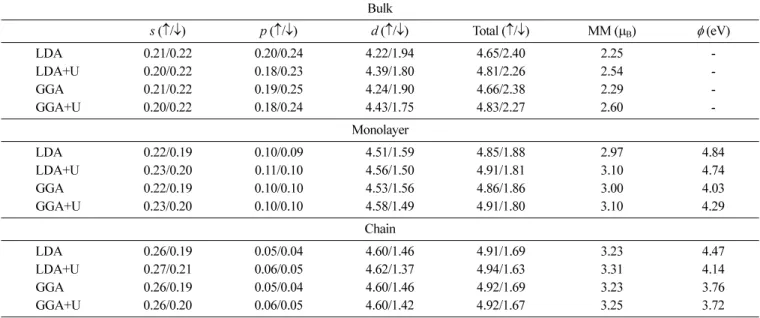
The values of MM on Fe atom in the investigated bulk, the monolayer and the linear chain calculated with different approaches (LDA, LDA+U, GGA, and GGA+U) are collected in Table I together with the calculated values of work function for the monolayer and the chain. The l - decomposed majority ( ↑ ) and minority ( ↓ ) spin charges (in electrons) inside Fe MT sphere are also given.
As it is seen from the Table, the value of MM on Fe atom increases with the reduced dimensionality of the Fe structure, and the overall tendency does not depend on the chosen approach. However, there are considerable dif- ferences between the results obtained with and without the U term included in the energy functional. For the Fe bulk structure, using the LDA (GGA), we obtained the value of MM equal to 2.25 (2.29) µB, which is close to the experimental value. Insertion of the U term in the energy functional caused that the calculated value of MM are overestimated: 2.54 µB for LDA+U and 2.60 µB for GGA+U, respectively. The tendency for LDA+U and GGA+U to give larger values of MM on Fe atom is also
for LDA+U and 2.60 µB for GGA+U, respectively. The tendency for LDA+U and GGA+U to give larger values of MM on Fe atom is also
observed in the case of the monolayer and the chain.
However, in the low-dimensional structures, the differences between the values of MM obtained with LDA and LDA+U and GGA and GGA+U approaches are much smaller than those calculated for the bulk. Using LDA, we calculated the MM on Fe atom in the monolayer to be equal 2.97 µB, which is much smaller than the value reported by Fu et al . (3.20 µB) obtained with the same method [11]. However, in their model monolayer the distance between atoms was exactly equal to the bcc Fe lattice constant, while in our calculations the atoms are separated only by the distance between the nearest neighbors in bcc Fe.
) obtained with the same method [11]. However, in their model monolayer the distance between atoms was exactly equal to the bcc Fe lattice constant, while in our calculations the atoms are separated only by the distance between the nearest neighbors in bcc Fe.
It is easier to compare our results obtained for the chain with the available data in the literature. With LDA we obtained the value of MM on Fe atom in the chain equal to 3.23 µB, which is only slightly smaller than that reported by Weinert and Freeman [4]. The result obtained with GGA (3.23 µB) differs by 8 % from that presented by Ying et al . [12]. However, the distance between Fe atoms in the chain investigated by our group was smaller, which may be the cause for the difference. The values of the MM calculated with LDA+U or GGA+U approach in the case of the chain are merely larger than those obtained with just LDA or GGA. Hence, with the reduced dimen- sionality of Fe system the differences between the values of MMs obtained with or without the U term included in the energy functional become smaller and less meaningful.
) differs by 8 % from that presented by Ying et al . [12]. However, the distance between Fe atoms in the chain investigated by our group was smaller, which may be the cause for the difference. The values of the MM calculated with LDA+U or GGA+U approach in the case of the chain are merely larger than those obtained with just LDA or GGA. Hence, with the reduced dimen- sionality of Fe system the differences between the values of MMs obtained with or without the U term included in the energy functional become smaller and less meaningful.
The MM on atoms is the measure of a difference between the numbers of electrons with spin up and spin down localized within the MTs of the atoms. In Table I,
Table I. The magnetic moment, and l -decomposed majority ( ↑ ) and minority ( ↓ ) spin charges (in electrons) inside the MT spheres for bulk, monolayer and linear chain of Fe, and work functions ( φ ) for monolayer and linear chain.
Bulk
s
(
↑/
↓)
p(
↑/
↓)
d(
↑/
↓) Total (
↑/
↓) MM (
µB)
φ(eV) LDA LDA+U
GGA GGA+U
0.21/0.22 0.20/0.22 0.21/0.22 0.20/0.22
0.20/0.24 0.18/0.23 0.19/0.25 0.18/0.24
4.22/1.94 4.39/1.80 4.24/1.90 4.43/1.75
4.65/2.40 4.81/2.26 4.66/2.38 4.83/2.27
2.25 2.54 2.29 2.60
- - - - Monolayer
LDA LDA+U GGA GGA+U
0.22/0.19 0.23/0.20 0.22/0.19 0.23/0.20
0.10/0.09 0.11/0.10 0.10/0.10 0.10/0.10
4.51/1.59 4.56/1.50 4.53/1.56 4.58/1.49
4.85/1.88 4.91/1.81 4.86/1.86 4.91/1.80
2.97 3.10 3.00 3.10
4.84 4.74 4.03 4.29 Chain
LDA LDA+U GGA GGA+U
0.26/0.19 0.27/0.21 0.26/0.19 0.26/0.20
0.05/0.04 0.06/0.05 0.05/0.04 0.06/0.05
4.60/1.46 4.62/1.37 4.60/1.46 4.60/1.42
4.91/1.69 4.94/1.63 4.92/1.69 4.92/1.67
3.23 3.31 3.23 3.25
4.47 4.14
3.76 3.72
−