• 검색 결과가 없습니다.

Effect of Application Timing of Deastringency and 1-Methylcyclopropene Treatments on Fruit Quality Attributes and Physiological Disorders of Two Astringent Persimmon Cultivars during Cold Storage

N/A
N/A
Protected

Academic year: 2021

Share "Effect of Application Timing of Deastringency and 1-Methylcyclopropene Treatments on Fruit Quality Attributes and Physiological Disorders of Two Astringent Persimmon Cultivars during Cold Storage"

Copied!
11
0
0

로드 중.... (전체 텍스트 보기)

전체 글

(1)

Received: October 23, 2018 Revised: February 17, 2019 Accepted:March 4, 2019

OPEN ACCESS

HORTICULTURAL SCIENCE and TECHNOLOGY 37(3):384-394, 2019

URL: http://www.kjhst.org pISSN : 1226-8763 eISSN : 2465-8588

This is an Open Access article distributed under the terms of the Creative Commons Attribution Non-Commercial License which permits unrestricted non-commercial use, distribution, and reproduction in any medium, provided the original work is properly cited.

Copyrightⓒ2019 Korean Society for Horticultural Science.

This study was financially supported by a grant from 2016 Research Fund (PJ01164001) of Rural Development Administration, Republic of Korea.

Effect of Application Timing of Deastringency and 1-Methylcyclopropene Treatments on Fruit Quality Attributes and Physiological Disorders of Two

Astringent Persimmon Cultivars during Cold Storage

Jingi Yoo 1† , In-Kyu Kang 1† , Seulgi Ryu 1 , Nay Myo Win 1 , and Jinwook Lee 2*

1

Department of Horticulture, Kyungpook National University, Daegu 41566, Korea

2

Department of Plant Science and Technology, Chung-Ang University, Anseong 17546, Korea

*Corresponding author: [email protected]

These authors contributed equally to this work.

Abstract

Astringent persimmon ( Diospyros kaki Thunb.) fruit are treated with high levels of CO

2

or alcohol treatments to remove bitterness, but additional treatments are needed to maintain fruit firmness for long-term cold storage. Currently, 1-methylcyclopropene (1-MCP) is widely employed to maintain fruit firmness during cold storage. The objective of this study was to evaluate the effects of application timing of a combination of deastringency and 1-MCP treatments on fruit quality attributes and the incidence of physiological disorders in the cold-stored astringent persimmon fruit of two cultivars, ‘Tonewase’ and ‘Sangjudungsi’. Fresh weight loss gradually increased in

‘Tonewase’, regardless of the timing of the deastringency and 1-MCP treatment. However, the 1-MCP treatment alone resulted in the smallest loss of fresh weight compared with the other treatments in ‘Sangjudungsi’. Fruit firmness was highly maintained by the 1-MCP treatment, regardless of cultivar and application timing. Furthermore, the soluble solids content (SSC) was not affected by the 1-MCP treatment, but was significantly reduced by the deastringency treatment. The SSC was highly retained in ‘Sangjudungsi’. The variation in various color variables was greater in

‘Sangjudungsi’ fruit than in ‘Tonewase’ fruit. Compared with the other treatments, the combination of 1-MCP and deastringency treatments significantly reduced all color variables at both of the peel regions of ‘Tonewase’ fruit. Fruit softening, decay, and wilting rates were highest in the combined 1-MCP and deastringency treatments in ‘Tonewase’ fruit. On the other hand, ‘Sangjudungsi’ was relatively less susceptible to physiological disorders during cold storage. Overall, our results show that astringent persimmon cultivars require individually-tailored management techniques immediately before cold storage to retain fruit quality.

Additional key words: flesh firmness, fresh weight loss, fruit decay, fruit peel color variables, peel

blackening, soluble solids content

(2)

Introduction

In addition to sweet persimmon fruit, such as the cultivar ‘Fuyu’ (Itamura et al., 2005), astringent persimmon ( Diospyros kaki Thunb.) fruit are also widely used in the production of processed persimmon commodities. While sweet persimmon fruit can be consumed fresh, astringent persimmon fruit cannot be consumed directly due to their bitter flavor. Thus, the astringent persimmon cultivars, such as ‘Tonewase’, ‘Rojo Brillante’, ‘Sangjudungsi’, and ‘Triumph’, are generally used in the production of a wide range of processed products, such as dried persimmon, semi-dried persimmon, ripe persimmon, ice-soft persimmon, and spreadable products (Yamada et al., 2009; Castelló et al., 2011; Li, 2013; Choi et al., 2017; Chung et al., 2017). After harvest, it is strongly recommended that the astringent persimmon fruit are stored at low temperature to preserve freshness (Wei et al., 2015; Yoo et al., 2016). During cold storage, astringent persimmon fruit ripen faster, but also develop chilling injury such as peel blackening and flesh browning (Grant et al., 1992; Collins and Tisdell, 1995; Salvador et al., 2005).

The astringent persimmon fruit should be processed to remove astringency by employing several commercial techniques, including high levels of CO

2

gas, warm water, and ethanol vapor treatments (Khademi et al., 2010; Novillo et al., 2014; Chung et al., 2015; Chung et al., 2017; Min et al., 2018). These deastringency techniques reduce the soluble tannin content (Khademi et al., 2010; Novillo et al., 2014; Chung et al., 2015; Min et al., 2018). Among these techniques, the application of high levels of CO

2

gas is widely employed to retain fruit quality during cold storage without causing physiological damage (Khademi et al., 2010). However, this deastringency treatment might contribute to an additional reduction in fruit firmness before (Novillo et al., 2013; Khademi et al., 2014; Wang et al., 2017) and after cold storage, and during shelf life (Khademi et al., 2014). The reduction in flesh firmness is highly associated with heightened activity of pectin methylesterase (Khademi et al., 2014), indicating that deastringency treatments might be strongly associated with fruit softening during and after cold storage, but the relationship between deastringency treatments and fruit softening is cultivar dependent (Wang et al., 2017).

It is important to retain the firmness of astringent persimmon fruit to maintain a steady and reliable supply of fresh fruit for processing. Since its introduction into the tree fruit industry, the 1-methylcyclopropene (1-MCP) treatment technique has been widely employed for retaining the firmness of persimmon fruit during cold storage and throughout its shelf life (Tsviling et al., 2003; Salvador et al., 2004b; Win et al., 2018). Furthermore, fruit softening during cold storage can be delayed by 1-MCP treatment (Win et al., 2018). The maintenance of fruit firmness and the delay of fruit softening induced by 1-MCP treatment might be associated with the alleviation of chilling injury in cold-stored ‘Rojo Brillante’ persimmon fruit (Salvador et al., 2004a; Pérez-Munuera et al., 2009; Novillo et al., 2015). In addition, the fruit decay rate is highly reduced by 1-MCP treatment in astringent persimmon cultivars during cold and controlled atmosphere storage (Besada et al., 2014).

The combined application of deastringency and 1-MCP treatments is believed to retain fruit quality by lowering the soluble tannin content and by retaining fruit firmness or by delaying fruit softening during cold storage and throughout its shelf life.

Numerous applications of this combination treatment, comprising high levels of CO

2

gas and 1-MCP treatments, have been

evaluated in ‘Rojo Brillante’ (Pérez-Munuera et al., 2009; Khademi et al., 2014) and ‘Niuxin’ (Min et al., 2018) cultivars

during storage. Thus, it is important to elucidate the effects of a combination of deastringency and 1-MCP treatments on fruit

quality attributes and the incidence of fruit physiological disorders in cold-stored astringent persimmon fruit. In this study, we

aimed to test the hypothesis that the combined application of deastringency and 1-MCP treatments would be highly effective

in retaining fruit quality and controlling the incidence of physiological disorders during cold storage. Therefore, the

objectives of this study were to evaluate (1) the effects of a combination of these two treatments on the quality attributes and

(3)

storage disorders of fruit of two different astringent persimmon cultivars during cold storage and (2) how long fruit storability can be extended by these treatments during cold storage.

Materials and Methods

Plant Materials and Treatments

‘Tonewase’ and ‘Sangjudungsi’ persimmon ( Diospyros kaki Thunb.) fruit were harvested from a commercial orchard in Sangju, the Republic of Korea. In 2017, ‘Tonewase’ fruit were collected on September 24 and ‘Sangjudungsi’ fruit were collected on October 13. The fruit were transported immediately to the Laboratory of Horticultural Crop Quality Management at Kyungpook National University in Daegu, the Republic of Korea. Persimmon fruit without visible deformities, injuries, or disease were selected. The treatments were as follows: (1) untreated control, (2) fumigation with 1 µL·L

-1

1-MCP (SmartFresh

SM

, AgroFresh Co., Seoul, Korea) for 18 h in a sealed container, (3) deastringency treatment of ‘Tonewase’ and

‘Sangjudungsi’ fruit treated with 90% CO

2

gas for 3 d and 7 d, respectively, in a sealed plastic container, (4) deastringency treatment followed by 1-MCP, and (5) 1-MCP followed by deastringency treatment. All the treatments were carried out at ambient temperature. Subsequently, all fruit were stored at -1°C with 90% relative humidity for up to 4 months. The efficacy of the deastringency treatment was confirmed by the blue print (FeCl

3

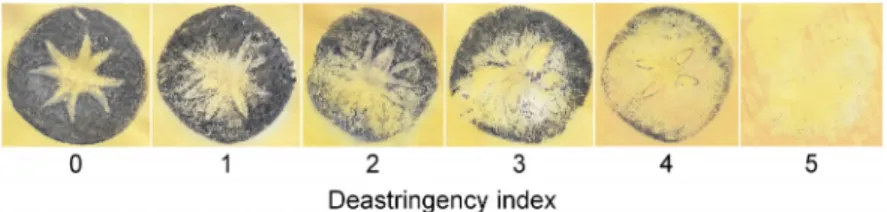
) approach (Eaks, 1967) as shown in Fig. 1. The deastringency index was subjectively assigned on a 0 to 5 scale based on the absence of soluble tannins in horizontal cross sections of persimmon fruit treated with 90% CO

2

gas, where 0: 0% deastringency; 1: 20% deastringency; 2: 40%

deastringency; 3: 60% deastringency; 4: 80% deastringency; and 5: 100% deastringency (Guan et al., 2017; Munera et al., 2017).

Assessments of Fruit Quality Attributes

The fruit quality attributes were assessed at monthly intervals for 4 months. The fruit quality attributes evaluated were:

fresh weight loss, flesh firmness, soluble solids content (SSC), peel color variables [ L*(lightness; 0-100), a*(redness), and b*(yellowness)] at the calyx-end and equator regions of the fruit, and incidence of physiological disorders. Fruit fresh weight ( n = 9) was measured with an analytical balance using the same fruit at harvest and 1 d after cold storage. There was difference in the fresh weight of fruit between these two time points. Flesh firmness was determined using a digital penetrometer (Fruit Pressure Tester, FT-327, Alfonsine, Italy). Three measurements were obtained around the equator of each fruit ( n = 9) and the results are expressed in newton (N) unit. Expressed juice from the penetrometer readings was used for SSC measurement with a refractometer (Model PR-201 α ; Atago Co., Ltd., Tokyo, Japan).

Fig. 1. Deastringency index of astringent ‘Tonewase’ persimmon fruit treated with 90% CO

2

gas. 0: 0% deastringency; 1:

20% deastringency; 2: 40% deastringency; 3: 60% deastringency; 4: 80% deastringency; 5: 100% deastringency.

(4)

To measure ethylene production and respiration rate, three fruit were incubated in 1.6 L containers for 2 h. Then, 1 mL of the headspace gas sample was withdrawn from the containers. The sample was injected into a gas chromatograph (GC2010;

Shimadzu Co., Tokyo, Japan) equipped with a flame ionization detector (FID) and fitted with a Porapak Q column (80/100 mesh, 1 m long; Young In Frontier Co., Seoul, Korea). Analyses were run isothermally with an oven temperature of 90°C, injector temperature of 100°C, and detector temperature of 200°C. The flow rate of helium was 25 mL·min

-1

. Ethylene was quantified by peak area using an external standard for calibration. Carbon dioxide was injected into a gas chromatograph equipped with a thermal conductivity detector (TCD) and fitted with a Porapak Q column (80/100 mesh, 1 m long; Young In Frontier Co., Seoul, Korea). The injector and detector temperatures were 100°C and the oven temperature was 90°C. The flow rate of helium was 15 mL·min

-1

. Carbon dioxide was quantified by peak area with an external standard used for calibration.

The rate and severity of peel blackening, fruit softening, decay, and wilting ( n = 9) were subjectively evaluated throughout the storage period. The severity rate of peel blackening, fruit softening, decay, and wilting was scored as 0 = 0%, 1 = 1 - 10%, 2 = 11 - 25%, 3 = 26 - 50%, 4 = 51 - 75%, and 5 = 76 - 100% of total peel or flesh coverage (Lee et al., 2019).

Statistical Analyses

The data were subjected to analysis of variance (ANOVA) to determine the effects of main factors and interactions (Version 9.3; SAS Institute Inc., Carry, NC, USA). The least significant difference (LSD) test was applied for analysis of mean difference at p ≤ 0.05.

Results

Fruit fresh weight loss gradually increased during cold storage ( p < 0.0001). However, the response pattern of fresh weight loss was highly different between cultivars, depending on the deastringency and 1-MCP treatments ( p < 0.001). However, the deastringency treatment might be strongly associated with fresh weight loss in ‘Sangjudungsi’ persimmon fruit compared with that in control fruit. Furthermore, with respect to the timing of the deastringency treatment, deastringency after 1-MCP treatment resulted in relatively higher fresh weight loss than that with 1-MCP treatment after deastringency or deastringency treatment alone. This difference was apparent at the start of cold storage, based on deastringency. The duration of the deastringency treatment in ‘Sangjudungsi’ fruit was longer than that in ‘Tonewase’ fruit. Therefore, the difference in fresh weight loss was significantly higher in ‘Sangjudungsi’ fruit than in ‘Tonewase’ fruit ( p < 0.0001, Fig. 2).

Fruit flesh firmness was highly reduced by the deastringency treatment compared with that by the 1-MCP treatment, regardless of the cultivar ( p < 0.0001). Nevertheless, irrespective of the deastringency treatment, flesh firmness was higher with 1-MCP treatment than that of control fruit during cold storage. In general, the deastringency treatment reduced flesh firmness compared with the 1-MCP treatment alone, regardless of the timing of deastringency. Similar to its effect on fresh weight loss, the deastringency treatment reduced flesh firmness at the start of cold storage. Furthermore, the reduction in flesh firmness was considerably higher in ‘Sangjudungsi’ fruit than in ‘Tonewase’ fruit (Fig. 2).

The deastringency treatment reduced the SSC compared with that of the control and 1-MCP treatment alone ( p < 0.0001).

The SSC response was significantly different between the two cultivars ( p < 0.0001). The SSC decreased marginally in

‘Tonewase’ during cold storage and remained unchanged in ‘Sangjudungsi’ only in the control and 1-MCP treatment (Fig. 2).

(5)

Ethylene production was not affected by deastringency or 1-MCP treatment in ‘Tonewase’ and ‘Sangjudungsi’ fruit during cold storage (Fig. 3). Furthermore, the respiration rate of fruit was only enhanced by the deastringency treatment right before cold storage. The respiration rate was higher in ‘Tonewase’ than in ‘Sangjudungsi’ during cold storage (Fig. 3).

The fruit peel color variables, lightness ( L*), redness (a*), and yellowness (b*), gradually decreased during cold storage (p

< 0.0001). The reduction in these color variables at the calyx-end and equator peel regions was significantly higher in

‘Sangjudungsi’ than in ‘Tonewase’ ( p < 0.0001). Specifically, 1-MCP treatment after the deastringency treatment caused a higher reduction in peel color variables at both the calyx-end and equator regions of fruit of ‘Tonewase’ during cold storage than in those of ‘Sangjudungsi’. The difference in peel redness between the two peel regions was higher in ‘Sangjudungsi’

than in ‘Tonewase’ during cold storage (Fig. 4).

The peel blackening rate was significantly higher in ‘Tonewase’ than in ‘Sangjudungsi’ during cold storage ( p < 0.001).

Furthermore, the fruit softening rate was significantly higher in ‘Tonewase’ than in ‘Sangjudungsi’ ( p < 0.0001).

Interestingly, the combination of deastringency and 1-MCP treatments enhanced fruit softening in ‘Tonewase’ at the end of cold storage. However, this effect was not observed in ‘Sangjudungsi’. The fruit decay rate was significantly higher in

‘Tonewase’ than in ‘Sangjudungsi’ during cold storage ( p < 0.0001). Furthermore, the fruit wilting rate was also significantly higher in ‘Tonewase’ than in ‘Sangjudungsi’ fruit during cold storage ( p < 0.0001). Fruit wilting was highest in the combination of 1-MCP and deastringency treatments during cold storage ( p < 0.0001). Similar to the fruit decay rate, the fruit wilting rate was not affected by 1-MCP treatment or by deastringency in ‘Sangjudungsi’ during cold storage (Fig. 5).

Fig. 2. Fresh weight loss, flesh firmness, and soluble solids content (SSC) of ‘Tonewase’ and ‘Sangjudungsi’ fruit subjected to 1 µL·L

-1

1-methylcyclopropene (1-MCP) treatment before or after the deastringency treatment with 90% CO

2

for 3 d and 7 d, respectively, at

ambient temperature during harvest, and then stored at -1°C for up to 4 months.

(6)

Fig. 3. Ethylene production and respiration rate of 1-methylcyclopropene (1-MCP) treatment before or after the deastringency treatment at harvest in ‘Tonewase’ and ‘Sangjudungsi’ persimmon fruit stored at -1°C for up to 4 months.

Fig. 4. Peel color variables [lightness (L*), redness (a*), and yellowness (b*)] of ‘Tonewase’ and ‘Sangjudungsi’ fruit subjected to 1 µL·L

-1

1-methylcyclopropene (1-MCP) treatment before or after the deastringency treatment with 90% CO

2

for 3 d and 7 d, respectively, at

ambient temperature during harvest, and then stored at -1°C for up to 4 months.

(7)

Discussion

After harvest, astringent persimmon fruit are generally stored under cold conditions before their use in the production of processed persimmon products. However, the astringent taste would still persist (Kim et al., 2017). Thus, several commercial techniques for deastringency are used in the persimmon fruit industry (Kato, 1990; Oshida et al., 1996; Yamada et al., 2002;

Chung et al., 2017; Zhu et al., 2018). These techniques are associated with reducing the soluble tannin content in persimmon fruit (Tanaka et al., 1994; Chung et al., 2015; Fang et al., 2016). In this study, a 90% CO

2

gas treatment was applied for deastringency in both persimmon cultivars, although the response to high levels of CO

2

gas differed by cultivar. Complete removal of fruit astringency by CO

2

gas treatment required 3 d for ‘Tonewase’ and 7 d for ‘Sangjudungsi’. This difference in effectiveness of the CO

2

gas treatment indicates different physiological responses of persimmon cultivars. As a consequence, these astringency removal techniques can reduce fruit firmness, thereby enhancing fruit softening (Pesis and Ben-Arie, 1984;

Kato, 1990; Chung et al., 2015). As shown in Fig. 2, flesh firmness was significantly decreased by the deastringency Fig. 5. Physiological disorders and decay rate of ‘Tonewase’ and ‘Sangjudungsi’ fruit subjected to 1 µL·L

-1

1-methylcyclopropene (1-MCP)

treatment before or after the deastringency treatment with 90% CO

2

for 3 d and 7 d, respectively, at ambient temperature during

harvest, and then stored at -1°C for up to 4 months. The severity of peel blackening, fruit softening, decay, and wilting was scored as

0 = 0%, 1 = 1% - 10%, 2 = 11% - 25%, 3 = 26% - 50%, 4 = 51% - 75%, and 5 = 76% - 100% of total peel or flesh coverage.

(8)

treatments, irrespective of the cultivar. This might occur because deastringency techniques result in the up-regulation of certain fermentative metabolites, such as ethanol and acetaldehyde (Pesis and Ben-Arie, 1984; Fang et al., 2016). Thus, we assumed that the reduction in flesh firmness by deastringency treatments might be indirectly or directly associated with fresh weight loss during cold storage. Regardless of the timing of the 1-MCP treatment, the deastringency treatment enhanced fresh weight loss in ‘Sangjudungsi’, but the effect was relatively less in ‘Tonewase’. Furthermore, the deastringency treatments decreased the SSC during cold storage. In ‘Niuxin’ persimmon fruit, the combination treatment with CO

2

and 1-MCP significantly delayed the reduction in SSC compared with that by CO

2

treatment alone (Min et al., 2018).

Along with the deastringency treatment, the 1-MCP treatment was also applied to retain fruit quality during cold storage.

Flesh firmness was retained during cold storage by the deastringency treatment, regardless of the cultivar, but fruit firmness was not affected by the 1-MCP treatment alone. Furthermore, the combination of the 1-MCP treatment with the deastringency treatment reduced the SSC and enhanced fruit softening and decay in ‘Tonewase’ compared with ‘Sangjudungsi’, irrespective of the timing of 1-MCP and deastringency. This indicates that the responsiveness of fruit to the combined treatment with 1-MCP and CO

2

might be cultivar specific. However, the combined application of CO

2

and 1-MCP treatments retained fruit firmness, SSC, and titratable acidity, when compared with those by deastringency treatment alone after 30 d of cold storage and 5 d after removal from cold storage in the persimmon cultivar ‘Rojo Brillante’ (Khademi et al., 2014). In ‘Niuxin’, the application timing of 1-MCP and deastringency treatments significantly affected soluble tannin content, firmness, and SSC during cold storage (Min et al., 2018). Thus, it was considered that the difference in responses to the combined application of 1-MCP and deastringency treatments is highly dependent on the cultivar.

Ethylene production and respiration were not affected by 1-MCP treatment. However, the deastrigency treatment caused an increase in the respiration rate right before cold storage, irrespective of whether or not the 1-MCP treatment was included.

However, the 1-MCP followed by deastringency treatment did not enhance fruit respiration. Ethylene production and respiration rates were not affected by 1-MCP treatment in ‘Fuyu’ persimmon at ambient temperature (Choi, 2010), ‘Rendaiji’

persimmons (Ortiz et al., 2005), and cold-stored ‘Tonewase’ astringent persimmons (Win et al., 2018). Also, 1-MCP and deastringency treatments did not affect fruit respiration and ethylene production in cold-stored ‘Rojo Brillante’ persimmons (Khademi et al., 2014). A wide range of 1-MCP levels did not affect fruit respiration and ethylene production during storage of ‘Fuyu’ persimmon fruit (Kim and Lee, 2005). However, fruit respiration and ethylene production in the cultivar

‘Qiandaowuhe’ were delayed by 1-MCP treatment at ambient temperature (Luo, 2007). The fruit harvest time was much earlier in this study than the typical commercial harvest window, which occurs at the end of October (Yoo et al., 2016). Win et al. (2017) also reported an effect of harvest time on the different responses of ethylene production and respiration rates in cold-stored ‘Sangjudungsi’ persimmon fruit. Based on the results of two different harvest times, ethylene production and respiration rates were highly responsive during cold storage, irrespective of any postharvest treatments (Win et al., 2018).

Nevertheless, ethylene production and respiration rates were more responsive in ‘Tonewase’ than in ‘Sangjudungsi’ during

cold storage. It was assumed that ‘Tonewase’ fruit would be relatively less affected by fruit maturity. Otherwise, the

sensitivity or responsiveness of fruit ripening would be much higher in ‘Tonewase’ than in ‘Sangjudungsi’. This would be due

to differences in the types of astringent persimmon fruit (Yonemori et al., 2010), in which ‘Tonewase’ is a pollination variant

astringent (PVA) type (Hamada et al., 2009) but ‘Sangjudungsi’ is a pollination constant astringent (PCA) type (Kim et al.,

2018). Therefore, we considered that the different responses of ethylene production and respiration rates would be fruit-type

dependent.

(9)

The combined application of the 1-MCP and deastringency treatments reduced the incidence of peel blackening compared with that of untreated fruit (Fig. 4). However, fruit decay and wilting were highest with the combination treatments, especially in ‘Tonewase’, during cold storage. This might be attributed to the difference in susceptibility of persimmon cultivars to chilling injury during cold storage. Collins and Tisdell (1995) reported that ‘Fuyu’ was more susceptible to chilling injury than ‘Suruga’ after cold storage, although the SSC was higher in ‘Fuyu’ than in ‘Suruga’, regardless of the incidence of chilling injury. The fruit decay index of ‘Rojo Brillante’ persimmon was marginally lower than that of ‘Triumph’ due to the single or combined application of a controlled atmosphere (CA) storage system or 1-MCP treatment during and after cold storage (Besada et al., 2014). The incidence of peel blackening and fruit softening during cold storage presented annual variation, regardless of treatments with 1-MCP and aminoethoxyvinylglycine in ‘Tonewase’ and ‘Sangjudungsi’ persimmons (Win et al., 2017; Win et al., 2018). Based on the different responses to the incidence of numerous physiological disorders, certain astringent persimmon cultivars, such as ‘Tonewase’, could be more susceptible to chilling injury than other cultivars.

In conclusion, deastringency treatments can be used to remove bitterness in astringent persimmon cultivars ‘Tonewase’ and

‘Sangjudungsi’. The time needed for complete removal of astringency differed by cultivar. In terms of retaining fruit quality during and after cold storage, the 1-MCP treatment alone was highly effective in maintaining fruit firmness in both cultivars during cold storage compared with that of the combined application of 1-MCP and deastringency treatments. However, the combined treatments would be more beneficial due to the depletion of tannin content during cold storage. Nonetheless, this combined treatment would be more beneficial in ‘Sangjudungsi’ than in ‘Tonewase’ in terms of reducing the incidence of physiological disorders, such as peel blackening, fruit decay, and wilting. Overall, the results indicate that each astringent persimmon cultivar should be treated with individually-tailored management techniques before cold storage to retain fruit quality.

Literature Cited

Besada C, Novillo P, Navarro P, Salvador A (2014) Effect of a low oxygen atmosphere combined with 1-MCP pretreatment on preserving the quality of ‘Rojo Brillante’ and ‘Triumph’ persimmon during cold storage. Sci Hortic 179:51-58. doi:10.1016/j.scienta.2014.09.015 Castelló ML, Heredia A, Domínguez E, Ortolá MD, Tarrazó J (2011) Influence of thermal treatment and storage on astringency and

quality of a spreadable product from persimmon fruit. Food Chem 128:323-329. doi:10.1016/j.foodchem.2011.03.023

Choi JY, Lee HJ, Cho JS, Lee YM, Woo JH, Moon KD (2017) Prediction of shelf-life and changes in the quality characteristics of semidried persimmons stored at different temperatures. Food Sci Biotechnol 26:1255-1262. doi:10.1007/s10068-017-0173-4

Choi SJ (2010) The change of ethylene production, respiration, and flesh firmness as influenced by treatment with aminoethoxyvinylglycine and 1-methylcyclopropene in ‘Fuyu’ persimmon fruits stored at low temperature. Korean J Hortic Sci Technol 28:242-247 Chung HS, Kim DH, Kim HS, Lee YG, Seong JH, Youn KS, Moon KD (2017) Quality comparison of dried slices processed from whole

persimmons treated with different deastringency methods. Food Sci Biotechnol 26:401-407. doi:10.1007/s10068-017-0055-9 Chung HS, Kim HS, Lee YG, Seong JH (2015) Effect of deastringency treatment of intact persimmon fruits on the quality of fresh-cut

persimmons. Food Chem 166:192-197. doi:10.1016/j.foodchem.2014.06.015

Collins RJ, Tisdell JS (1995) The influence of storage time and temperature on chilling injury in Fuyu and Suruga persimmon (Diospyros kaki L.) grown in subtropical Australia. Postharv Biol Technol 6:149-157. doi:10.1016/0925-5214(94)00046-U

Eaks I (1967) Ripening and astringency removal in persimmon fruits. Proc Amer Soc Hortic Sci 91:868-875

Fang F, Wang MM, Zhu QG, Min T, Grierson D, Yin XR, Chen KS (2016) DkMYB6 is involved in persimmon fruit deastringency, via transcriptional activation on both DkPDC and DkERF. Postharv Biol Technol 111:161-167. doi:10.1016/j.postharvbio.2015.08.012 Grant TM, Macrae EA, Redgwell RJ (1992) Effect of chilling injury on physicochemical properties of persimmon cell walls. Phytochemistry

31:3739-3744. doi:10.1016/S0031-9422(00)97519-8

Guan C, Du X, Zhang Q, Ma F, Luo Z, Yang Y (2017) DkPK genes promote natural deastringency in C-PCNA persimmon by up-regulating DkPDC and DkADH expression. Front Plant Sci 8:149. doi:10.3389/fpls.2017.00149

Hamada K, Hasegawa K, Ogata T (2009) The growth of tannin cells from before flowering to fruit maturity and astringency in Japanese

(10)

persimmons. J Hortic Sci Biotechnol 84:72-76. doi:10.1080/14620316.2009.11512482

Itamura H, Zheng Q, Akaura K (2005) Industry and research on persimmon in Japan. Acta Hortic 685:37-44. doi:10.17660/ActaHortic.

2005.685.3

Kato K (1990) Astringency removal and ripening in persimmons treated with ethanol and ethylene. HortScience 25:205-207.

doi:10.21273/HORTSCI.25.2.205

Khademi O, Besada C, Mostofi Y, Salvador A (2014) Changes in pectin methylesterase, polygalacturonase, catalase and peroxidase activities associated with alleviation of chilling injury in persimmon by hot water and 1-MCP treatments. Sci Hortic 179:191-197.

doi:10.1016/j.scienta.2014.09.028

Khademi O, Mostofi Y, Zamani Z, Fatahi R (2010) The effect of deastringency treatments on increasing the marketability of persimmon fruit. Acta Hortic 877:687-691. doi:10.17660/ActaHortic.2010.877.90

Kim EG, Choi ST, Son JY, Ahn GH, Kim SC, Hong KP (2018) Breeding of the Gamnuri (Diospyros kaki Thunb.) cultivar for astringent persimmon with large-sized quality fruits. Korean J Breed Sci 50:340-343. doi:10.9787/KJBS.2018.50.3.340

Kim IH, Kim JY, Nam HJ, Lee KU, Cho DH, Lee YJ (2017) Effect of PE film thickness and storage temperature in MAP deastringency of

‘Sanggamdungsi’ astringent persimmon. Korean J Food Preser 24:727-733. doi:10.11002/kjfp.2017.24.6.727

Kim YK, Lee JM (2005) Extension of storage and shelf-life of sweet persimmon with 1-MCP. Acta Hortic 685:165-174. doi:10.17660/

ActaHortic.2005.685.19

Lee J, Mattheis JP, Rudell DR (2019) High storage humidity affects fruit quality attributes and incidence of fruit cracking in cold-stored

‘Royal Gala’ apples. HortScience 54:149-154. doi:10.21273/HORTSCI13406-18

Li B (2013) A brief introduction to postharvest research and utilization of persimmon (Diospyros kaki) in China: Ancient time to today.

Acta Hortic 996:373-378. doi:10.17660/ActaHortic.2013.996.53

Luo Z (2007) Effect of 1-methylcyclopropene on ripening of postharvest persimmon (Diospyros kaki L.) fruit. LWT-Food Sci Technol 40:285-291. doi:10.1016/j.lwt.2005.10.010

Min D, Dong L, Shu P, Cui X, Zhang X, Li F (2018) The application of carbon dioxide and 1-methylcyclopropene to maintain fruit quality of ‘Niuxin’ persimmon during storage. Sci Hortic 229:201-206. doi:10.1016/j.scienta.2017.11.012

Munera S, Besada C, Blasco J, Cubero S, Salvador A, Talens P, Aleixos N (2017) Astringency assessment of persimmon by hyperspectral imaging. Postharv Biol Technol 125:35-41. doi:10.1016/j.postharvbio.2016.11.006

Novillo P, Besada C, Gil R, Salvador A (2013) Fruit quality and response to deastringency treatment of eight persimmon varieties cultivated under spanish growing conditions. Acta Hortic 996:437-442. doi:10.17660/ActaHortic.2013.996.63

Novillo P, Salvador A, Magalhaes T, Besada C (2014) Deastringency treatment with CO

2

induces oxidative stress in persimmon fruit.

Postharv Biol Technol 92:16-22. doi:10.1016/j.postharvbio.2013.12.019

Novillo P, Salvador A, Navarro P, Besada C (2015) Involvement of the redox system in chilling injury and its alleviation by 1-methylcyclopropene in ‘Rojo Brillante’ persimmon. HortScience 50:570-576. doi:10.21273/HORTSCI.50.4.570

Ortiz GI, Sugaya S, Sekozawa Y, Ito H, Wada K, Gemma H (2005) Efficacy of 1-methylcyclopropene (1-MCP) in prolonging the shelf-life of ‘Rendaiji’ persimmon fruits previously subjected to astringency removal treatment. J Jpn Soc Hortic Sci 74:248-254.

doi:10.2503/jjshs.74.248

Oshida M, Yonemori K, Sugiura A (1996) On the nature of coagulated tannins in astringent-type persimmon fruit after an artificial treatment of astringency removal. Postharv Biol Technol 8:317-327. doi:10.1016/0925-5214(96)00016-6

Pérez-Munuera I, Hernando I, Larrea V, Besada C, Arnal L, Salvador A (2009) Microstructural study of chilling injury alleviation by 1-methylcyclopropene in persimmon. HortScience 44:742-745. doi:10.21273/HORTSCI.44.3.742

Pesis E, Ben-Arie R (1984) Involvement of acetaldehyde and ethanol accumulation during induced deastringency of persimmon fruits. J Food Sci 49:896-899. doi:10.1111/j.1365-2621.1984.tb13236.x

Salvador A, Arnal L, Monterde A, Cuquerella J (2004a) Reduction of chilling injury symptoms in persimmon fruit cv. ‘Rojo Brillante’ by 1-MCP. Postharv Biol Technol 33:285-291. doi:10.1016/j.postharvbio.2004.03.005

Salvador A, Arnal L, Monterde A, Cuquerella J (2005) Chilling-injury sensitiveness of ‘Rojo Brillante’ persimmon. Acta Hortic 682:1109- 1116. doi:10.17660/ActaHortic.2005.682.146

Salvador A, Cuquerella J, Martinez-Javega JM, Monterde A, Navarro P (2004b) 1-MCP preserves the firmness of stored persimmon ‘Rojo Brillante’. J Food Sci 69:S69-S73. doi:10.1111/j.1365-2621.2004.tb15516.x

Tanaka T, Takahashi R, Kouno I, Nonaka G-I (1994) Chemical evidence for the de-astringency (insolubilization of tannins) of persimmon fruit. J Chem Soc Perkin Trans 1:3013-3022. doi:10.1039/p19940003013

Tsviling A, Nerya O, Gizis A, Sharabi-Nov A, Ben-Arie R (2003) Extending the shelf-life of ‘Triumph’ persimmons after storage, with 1-MCP. Acta Hortic 599:53-58. doi:10.17660/ActaHortic.2003.599.4

Wang MM, Zhu QG, Deng CL, Luo ZR, Sun NJ, Grierson D, Yin XR, Chen KS (2017) Hypoxia-responsive ERFs involved in postdeastringency softening of persimmon fruit. Plant Biotechnol J 15:1409-1419. doi:10.1111/pbi.12725

Wei P, Yang Y, Wang F, Chen H (2015) Effects of drought stress on the antioxidant systems in three species of Diospyros L. Hortic Environ Biotechnol 56:597-605. doi:10.1007/s13580-015-0074-5.

Win NM, Lee J, Yoo J, Ryu S, Kim KO, Kim DH, Jung HY, Choung MG, Park KI, Cho YJ, Kang IK (2018) Effects of polyethylene film liner,

1-methylcyclopropene, and aminoethoxyvinylglycine treatments on fruit quality attributes of ‘Tonewase’ persimmon fruits during

cold storage. Hortic Sci Technol 36:256-265. doi:10.12972/kjhst.20180026

(11)

Win NM, Yoo J, Ryu S, Lee J, Jung H-Y, Choung M-G, Park K-i, Cho Y-J, Kang S-J, Kang I-K (2017) Effects of harvest times with polyethylene (PE) film liner, 1-methylcyclopropene (1-MCP) and aminoethoxyvinylglycine (AVG) treatments on fruit quality in ‘Sangjudungsi’

persimmon during cold storage. Kor J Food Preserv 24:898-907. doi:10.11002/kjfp.2017.24.7.898

Yamada H, Ando T, Tsutani K, Amano S, Yamamoto Y (2009) Mechanism of browning occurring during the processing of semi-dried persimmons. J Jpn Soc Hortic Sci 78:124-130. doi:10.2503/jjshs1.78.124

Yamada M, Taira S, Ohtsuki M, Sato A, Iwanami H, Yakushiji H, Wang R, Yang Y, Li G (2002) Varietal differences in the ease of astringency removal by carbon dioxide gas and ethanol vapor treatments among Oriental astringent persimmons of Japanese and Chinese origin. Sci Hortic 94:63-72. doi:10.1016/S0304-4238(01)00367-3

Yonemori K, Siugiura A, Yamada M (2010) Persimmon genetics and breeding. Plant Breeding Rev 19:191-225. doi:10.1002/9780470650172.ch6 Yoo J, Kang IK, Park JY, Kim KO, Win NM, Ryu S, Kim DH, Choung MG, Lee J (2016) Effect of storage temperature and fruit quality attributes and storage disorders in cold-stored ‘Sangjudungsi’ persimmon fruit. Protected Hortic Plant Fac 25:262-269. doi:

10.12791/KSBEC.2016.25.4.262

Zhu QG, Gong ZY, Wang MM, Li X, Grierson D, Yin XR, Chen KS (2018) A transcription factor network responsive to high CO

2

/hypoxia

is involved in deastringency in persimmon fruit. J Exp Bot 69:2061-2070. doi:10.1093/jxb/ery028

수치

Fig. 1. Deastringency index of astringent ‘Tonewase’ persimmon fruit treated with 90% CO 2  gas
Fig. 2. Fresh weight loss, flesh firmness, and soluble solids content (SSC) of ‘Tonewase’ and ‘Sangjudungsi’ fruit subjected to 1 µL·L -1 1-methylcyclopropene (1-MCP) treatment before or after the deastringency treatment with 90% CO 2  for 3 d and 7 d, res
Fig. 4. Peel color variables [lightness (L*), redness (a*), and yellowness (b*)] of ‘Tonewase’ and ‘Sangjudungsi’ fruit subjected to 1 µL·L -1 1-methylcyclopropene (1-MCP) treatment before or after the deastringency treatment with 90% CO 2  for 3 d and 7 d

참조

관련 문서

“ Sheikh Nasser has a written message from HH the Amir, Sheikh Sabah Al-Ahmad Al-Jaber Al-Sabah to the Chinese President, Chi Gen Beng related to enhancing mutual

On his part, CEO of Express Roads Authority, Saud Al-Naqqi said that the heavy rains of the previous day led to clogging parts of the express

Kuwait will celebrate on Sunday the fourth anniversary of the UN honoring and proclamation of His Highness the Amir, Sheikh Sabah Al-Ahmad Al-Jaber Al-Sabah as

• 이명의 치료에 대한 매커니즘과 디지털 음향 기술에 대한 상업적으로의 급속한 발전으로 인해 치료 옵션은 증가했 지만, 선택 가이드 라인은 거의 없음.. •

The proposal of the cell theory as the birth of contemporary cell biology Microscopic studies of plant tissues by Schleiden and of animal tissues by Microscopic studies of

_____ culture appears to be attractive (도시의) to the

It considers the energy use of the different components that are involved in the distribution and viewing of video content: data centres and content delivery networks

After first field tests, we expect electric passenger drones or eVTOL aircraft (short for electric vertical take-off and landing) to start providing commercial mobility