Vol. 30, No. 2, pp. 226-232, May, 2014 http://dx.doi.org/10.7747/JFS.2014.30.2.226
Environmental Science
Dimensional Change of Carbonized Woods at Low Temperatures
Sung-Min Kwon, Jae-Hyuk Jang and Nam-Hun Kim*
Department of Forest Biomateirals Engineering, College of Forest and Environmental Sciences, Kangwon National University, Chuncheon 200-701, Republic of Korea
Abstract
To understand transition characteristics from wood to charcoal the dimensional changes of carbonized woods at low temperature from 300°C to 350°C at the intervals of 10°C were investigated. Three species of hardwoods and two species of softwoods were used in this study. Measurements of dimensional changes of cells were observed by stereoscopic microscope and an image analyzer. The apparent volume of each specimen decreased greatly with increasing temperature.
Severe cracks and collapse were observed frequently in hardwoods and hardly in softwoods. Vessel diameter and tracheid cell wall thickness of the wood samples were decreased with increasing carbonization temperature. Contraction of vessel diameter in tangential direction was greater than that in radial direction. Cell wall thickness of tracheids decreased with increasing carbonization temperature. Consequently, even though it was small range of carbonization temperature, dimensions of wood components were changed considerably.
Key Words: charcoal, carbonized wood, carbonization, cell wall thickness, dimensional change, vessel diameter
Received: August 6, 2013. Revised: December 31, 2013. Accepted: January 1, 2014.
Corresponding author: Nam-Hun Kim
Department of Forest Biomateirals Engineering, College of Forest and Environmental Sciences, Kangwon National University, Chuncheon 200-701, Republic of Korea
Tel: 82-33-250-8327, Fax: 82-33-259-5621, E-mail: [email protected]
Introduction
Recently, the renewable biomass utilization has been in- creased because of the growing concern over the depletion of fossil fuels and global warming caused by the greenhouse gas production from fossil fuel combustion. Especially wood and agricultural residues are widely distributed and easily accessible at relatively low costs. Of these lignocellu- losic materials, wood is favorably used because of its higher energy content per volume, lower amount of ash, and very low nitrogen content.
In recent years, charcoal has turned out to be the biomass materials with the high energy potential and porosity.
Charcoal can be made when wood is heated under the con- dition that there is insufficient air for complete combustion.
Wood pyrolysis is a complex combination from the in- dividual pyrolysis of cellulose, hemicellulose, lignin and ex- tractives, each of them has its own characteristics.
In the pyrolysis process of wood constituents with heat- ing rate of 5oCmin-1, hemicellulose is decomposed at the temperatures ranging 170-240oC, cellulose 240-310oC and lignin 320-400oC (Zeriouh and Belkbir 1995). In all these cases, the knowledge of the transition mechanism from wood to charcoal is essential because pyrolysis is the first step in any wood-based biomass utilization. Beall et al.
(1974) employed SEM to study the morphological changes during the carbonization of white oak and yellow poplar.
Kumar et al. (1992, 1995) investigated the yield of chars and graphitization behavior with different carbonization temperatures, heating-cooling rates, and soaking times us-
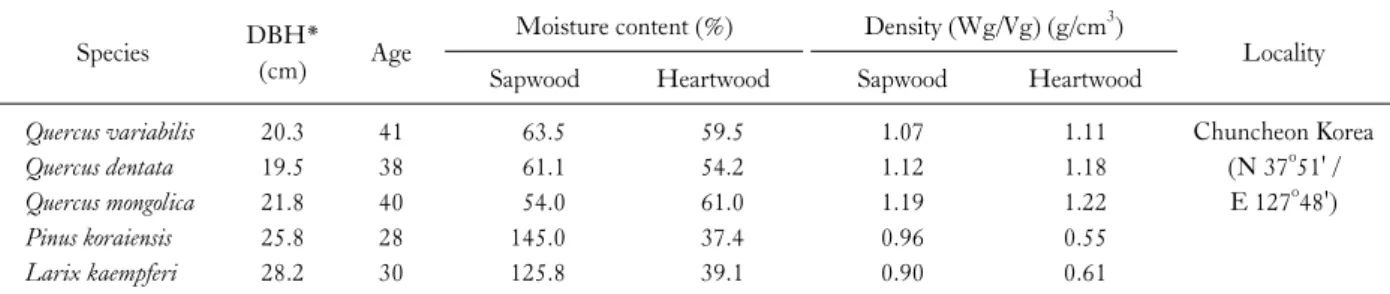
Table 1. The characteristics of the sample trees
Species DBH*
(cm) Age Moisture content (%) Density (Wg/Vg) (g/cm3)
Locality
Sapwood Heartwood Sapwood Heartwood
Quercus variabilis Quercus dentata Quercus mongolica Pinus koraiensis Larix kaempferi
20.3 19.5 21.8 25.8 28.2
41 38 40 28 30
63.5 61.1 54.0 145.0 125.8
59.5 54.2 61.0 37.4 39.1
1.07 1.12 1.19 0.96 0.90
1.11 1.18 1.22 0.55 0.61
Chuncheon Korea (N 37o51' / E 127o48')
*Diameter at breast height.
ing Acacia and Eucalyptus. Prior and Gasson (1993) exam- ined the anatomical differences of the six different tropical charred woods. Ishimaru et al. (2007b) reported a trans- mission electron microscopic research result of the micro- structure of nongraphitizable carbon, and many papers have discussed the microstructure in wood charcoal (Ishimaru et al. 2007a; Hata et al. 1998, 2000; Saito and Arima 2007).
However, the mechanisms for wood carbonization are not fully understood because of the complexity caused by the varying physical and chemical properties of wood.
In our previous studies (Kwon and Kim 2006, 2007;
Kwon et al. 2009, 2012) to clarify the transformation char- acteristics from wood to charcoal, we reported anatomical and physical characteristics of carbonized woods at differ- ent temperatures. From the results of SEM and X-ray dif- fraction analysis, it was revealed that in the carbonized woods at 350oC cell wall layers were changed drastically in- to armorphous shape and cellulose crystalline disappeared.
In this study, for knowing more on transition character- istics from wood to charcoal we examined the change of vol- ume, vessel diameter and tracheid cell wall thickness of car- bonized woods at the range of 300 to 350oC in the interval of 10oC.
Materials and Methods
Materials
Three species of hardwoods (Quercus variabilis, Quercus dentata and Quercus mongolica) and two species of softwoods (Pinus koraiensis and Larix kaempferi) obtained from the re- search forest of Kangwon National University in
Chuncheon (N 37o51' / E 127o48'), Korea were used for this study. Air-dried wood samples were cut into small blocks with the dimensions of 10 mm in thickness and width and 20 mm in length. The characteristics of sample trees are shown in Table 1.
Carbonization process
Wood samples were carbonized in an electric furnace un- der the nitrogen gas atmosphere (1 kg cm-2) at 300, 310, 320, 330, 340, and 350oC. The carbonization was carried out by heating the wood samples from room temperature to the final carbonization temperature. The samples were heated for 30 minutes to reach each targeted temperature.
After reaching the targeted carbonization temperature, the samples were kept for 10 minutes at constant temperature and then rapidly soaked into the sand for cooling.
Measurement of the change of cell dimensions Photographs were taken with a stereoscopic microscope (Nikon, MM-40). Tangential and radial diameters of ear- lywood vessels and cell wall thickness were measured using an image analyzer (IMT, i-Solution Lite). Vessel diameter was examined with the same methods of our earlier work (Kwon et al. 2009). Cell wall thickness of wood samples was calculated using the following equation;
100 (%)
1 2
1− ×
= T
T shrinkage T
thickness wall
Cell
where T1 is the cell wall thickness of original wood; T2 is the cell wall thickness of carbonized wood.
Fig. 1. The carbonized wood blocks of Quercus variabilis at different tem- peratures (cited from Kwon and Kim 2007).
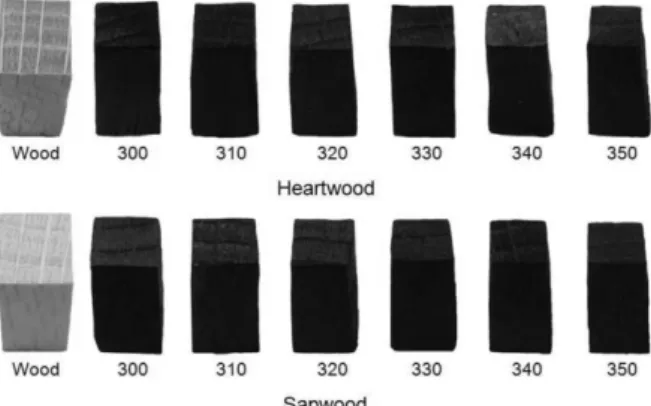
Fig. 2. The carbonized wood blocks of Quercus dentata at different temperatures.
Fig. 5. The carbonized wood blocks of Larix kaempferi at different temperatures.
Fig. 4. The carbonized wood blocks of Pinus koraiensis at different temperatures.
Fig. 3. The carbonized wood blocks of Quercus mongolica at different temperatures.
Results and Discussion
Visual observation
Fig. 1 to 5 show the charred samples of Quercus varia- bilis, Quercus dentata, Quercus mongolica, Pinus koraiensis and Larix kaempferi woods at the various targeted temperatures.
The volume of wood samples decreased with increasing the charring temperature. In hardwoods, the splits and collapse along the board rays frequently as the temperature increased. However, they were hardly observed in softwoods. In our previous report (Kwon and Kim 2007), the volume of Quercus variabilis wood was changed into 14% at 310oC and 18% at 350oC. McGinnes et al. (1971) found that commercial white oak charcoal shrank 25.7% in the tangential direction, 15.5% radial direction and 11.4%
longitudinal direction. Kim and Hanna (2006) examined
the cell wall morphology of Quercus variabilis wood charred at 400-1,000oC and reported that volumetric contraction and radial splitting were increased with increasing charring
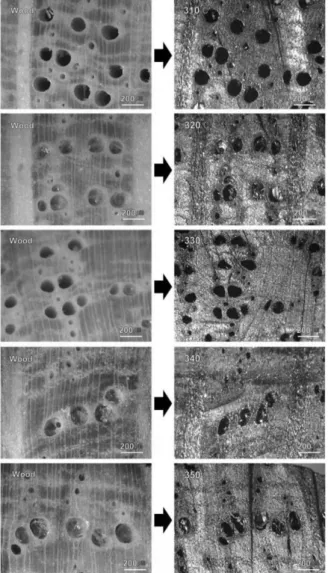
Fig. 7. Quercus variabilis woods (left) and their carbonized woods (right) at different temperatures (cited from Kwon and Kim 2006).
Fig. 8. Quercus dentata woods (left) and their carbonized woods (right) at different temperatures.
Fig. 6. The change of the vessel diameter contraction of three species during carbonization at different temperatures (Data of Q. variabilis were from Kwon and Kim 2007).
temperature.
Change of earlywood vessel diameter
Fig. 6 shows the changes of earlywood vessel diameter of Quercus variabilis, Quercus dentata and Quercus mongolica woods carbonized at various temperatures. The vessel con- traction in the tangential direction was greater than that in radial direction in all species. The vessel contraction in the tangential direction was less than 5% at 300oC and rapidly increased until 30% at 350oC. However the contraction in radial direction was below 5% at all temperatures.
The morphological changes of vessels in cross section of
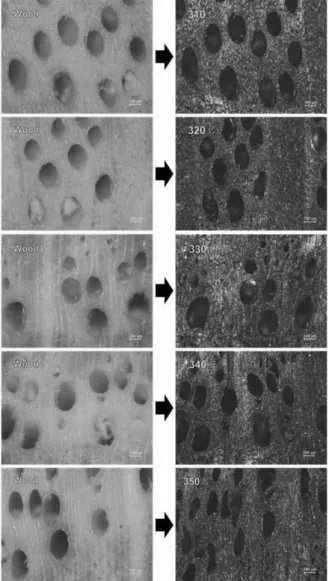
Fig. 9. Quercus mongolica woods (left) and their carbonized woods (right) at different temperatures.
Fig. 11. Pinus koraiensis woods (left) and their carbonized woods (right) at different temperatures.
Fig. 10. The change of cell wall thickness of two species during carbon- ization at different temperatures.
hardwoods during carbonization at different temperatures are shown in Figs. 7 to 9. The vessels were similar in ap- pearance between wood and carbonized wood at 300oC to 340oC. However, the vessels in wood samples carbonized at 350oC showed severely collapsed shapes along tangential direction. Slocum et al. (1978) reported that 58% of the to- tal tangential contraction and 44% of the total radial con- traction occurred at 300oC in their experiment with oak.
Pulido-Novicio et al. (2001) measured the dimensional contraction of carbonized Sugi wood powders heated to 1600oC at a heating rate of 4oC/min. and reported that the contraction in the tangential and radial directions was ob-
Fig. 12. Larix kaempferi woods (left) and their carbonized woods (right) at different temperatures.
served to be increased abruptly at a temperature of 400oC.
Change of cell wall thickness
The change of tracheid cell wall thickness of Pinus kor- aiensis and Larix kaempferi during carbonization at low tem- peratures is shown in Fig. 10. In this study, cell wall con- traction of tracheids increased principally with increasing carbonization temperatures. Radial cell wall thickness of earlywood tracheid decreased with increasing carbonization temperatures (26% at 300oC, 37% 330oC and 49% at 350oC), but not as much as the tangential values in Pinus koraiensis wood. The cell wall thickness of latewood trache-
ids also seemed to decrease in the radial and tangential cell wall with increasing carbonization temperatures.
The morphological changes of tracheids in cross section of softwoods during carbonization at different temperatures are shown in Fig. 11 and 12. The softwood tracheids in wood samples carbonized at 350oC showed severely col- lapsed shapes along tangential direction. Cutter et al.
(1980) studied the changes of tracheid and lumen diame- ters of tangential and radial direction with the aid of a scan- ning electron microscope. They reported that tracheid di- ameters decreased in response to increasing charring temperature.
References
Beall FC, Blankenhorn PR, Moore GR. 1974. Carbonized wood--physical properties and use as an SEM preparation.
Wood Sci 6: 212-219.
Cutter BE, Cumbie BG, McGinnes EA Jr. 1980. SEM and shrinkage analyses of Southern Pine wood following pyrolysis.
Wood Sci Technol 14: 115-130.
Hata T, Imamura Y, Kobayashi E, Yamane K, Kikuchi K. 2000.
Onion-like graphitic particles observed in wood charcoal. J Wood Sci 46: 89-92.
Hata T, Yamane K, Emiko Kobayashi, Yuji Imamura, Shigehisa Ishihara. 1998. Microstructural investigation of wood charcoal made by spark plasma sintering. J Wood Sci 44: 332-334.
Ishimaru K, Hata T, Bronsveld P, Imamura Y. 2007a. Microstruc- tural study of carbonized wood after cell wall sectioning. J Mater Sci 42: 2662-2668.
Ishimaru K, Hata T, Bronsveld P, Nishizawa T, Imamura Y.
2007b. Characterization of sp2- and sp3-bonded carbon in wood charcoal. J Wood Sci 53: 442-448.
Kim NH, Hanna RB. 2006. Morphological characteristics of Quercus variabilis charcoal prepared at different temperatures.
Wood Sci Technol 40: 392-401.
Kumar M, Gupta RC, Sharma T. 1992. Effects of carbonisation conditions on the yield and chemical composition of Acacia and Eucalyptus wood chars. Biomass Bioenerg 3: 411-417.
Kumar M, Gupta RC. 1995. Scanning electron microscopic study of acacia and eucalyptus wood chars. J Mater Sci 15: 544-551.
Kwon SM, Kim NH, Cha DS. 2009. An investigation on the tran- sition characteristics of the wood cell walls during carbonization.
Wood Sci Technol 43: 487-498.
Kwon SM, Kim NH. 2006. Investigation of carbonization mecha- nism of wood(I). J Korean Wood Sci Technol 34: 8-14.
Kim NH, Kwon SM. 2007. Investigation of carbonization mecha- nism of wood (II). J Korean Wood Sci Technol 35: 45-52.
Kwon SM, Kwon GJ, Jang JH, Kim NH. 2012. Characteristics of
charcoal in different carbonization temperatures. J For Sci 28:
263-267.
McGinnes EA Jr., Kandeel SA, Szopa PS. 1971. Some structural changes observed in the transformation of wood into charcoal.
Wood Fiber Sci 3: 77-83.
Prior J, Gasson P. 1993. Anatomical changes on charring six african hardwoods. IAWA Journal 14: 77-86.
Pulido-Novicio L, Hata T, Kurimoto Y, Doi S, Ishihara S, Imamura Y. 2001. Adsorption capacities and related character- istics of wood charcoals carbonized using a one-step or two-step
process. J Wood Sci 47: 48-57.
Saito Y, Arima T. 2007. Features of vapor-grown cone-shaped graphitic whiskers deposited in the cavities of wood cells.
Carbon 45: 248-255.
Slocum DH, McGinnes EA Jr, Beall FC. 1978. Charcoal yield, shrinkage, and density changes during carbonization of oak and hickory woods. Wood Sci 11: 42-47.
Zeriouh A, Belkbir L. 1995. Thermal decomposition of a Moroccan wood under a nitrogen atmosphere. Thermochimica Acta 258: 243-248.