pISSN 1229-3008 eISSN 2287-6251
Progress in Superconductivity and Cryogenics
Vol.17, No.3, (2015), pp.47~50 http://dx.doi.org/10.9714/psac.2015.17.3.047
```
1. INTRODUCTION
High temperature superconducting (HTS) field coil for linear motor rail way system has been developed to produce high traction force with high electric efficiency, light weight, compactness and high current density [1, 2].
A conceptual design of the HTS field coil is in progress.
2G (2nd generation) HTS tapes will be used and race-track type is considered as a proper shape of HTS magnet for the arrangement of many modular coils on the train.
First and essential step in the designing process of the field coil is estimating the critical current (Ic) of HTS magnet.
However, recently developed 2G HTS tapes have different critical current characteristics with that of conventional 2G HTS tape due to the introduction of artificial pinning center (APC) for improving its magnetic field performance.
For the precise estimation of critical current of magnet, the critical current of HTS tapes depending on the incidence angle and strength of the applied magnetic field has to be measured.
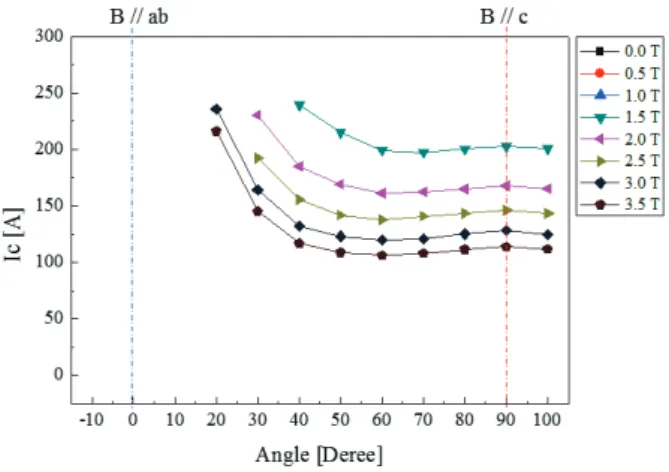
SuNAM HTS tapes has the minimum critical current at the incidence angle of 50~70 degree, not on 90 degree.
The method for critical current estimation reflecting this angular dependency of 2G HTS tape should be developed to provide more reliable expectation on the electric performance of HTS magnet.
In this paper, a method for estimating the critical current of HTS magnet considering the angular dependency of 2G HTS tapes is introduced. And the estimation results will be compared with that of previous one in which only the perpendicular magnetic field is considered.
2. SPECIFICATION OF RACE-TRACK HTS MAGNET
2.1. Specifications of race-track type HTS magnet
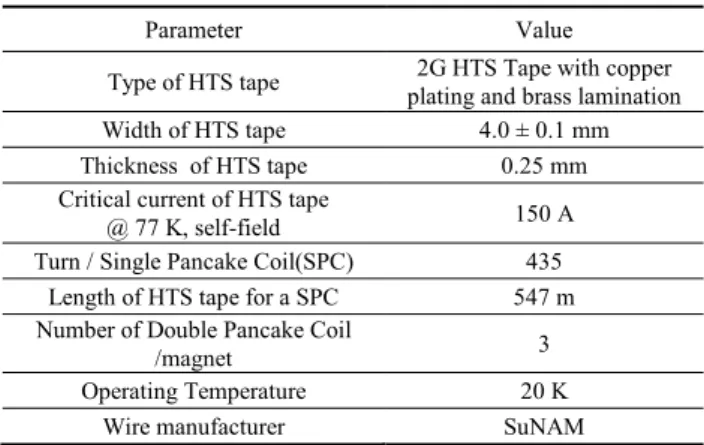
Table 1 shows the specifications of the HTS magnet related on this study. The HTS magnet was designed to satisfy the performance requirements of a field coil for linear motor rail way system. Nevertheless, the detail requirement of the field coil is not referred in accordance with the purpose of this study - the estimation of critical current of HTS magnet.
Fig. 1 shows the outline of the race track type HTS magnet. The inner width and inner height are 200 mm and 300 mm, respectively. The width of winding is 108.75 mm (435 turn x 0.25 mm thickness). It is composed of three double pancake coils (6 single pancake coils).
TABLEI SPECIFICATIONSOF MAGNET.
Parameter Value
Type of HTS tape 2G HTS Tape with copper plating and brass lamination
Width of HTS tape 4.0 ± 0.1 mm
Thickness of HTS tape 0.25 mm
Critical current of HTS tape
@ 77 K, self-field 150 A
Turn / Single Pancake Coil(SPC) 435
Length of HTS tape for a SPC 547 m
Number of Double Pancake Coil
/magnet 3
Operating Temperature 20 K
Wire manufacturer SuNAM
Estimation of the critical current of race-track HTS magnet considering angular dependency
Kyubong Leea, Kideok Simb, Changyoung Leec, and Seokho Kima,*
a Changwon National University, Changwon, Korea
b Korea Electrotechnology Research Institute, Changwon, Korea
c Korea Railroad Research Institute, Uiwang, Korea
(Received 20 August 2015; revised or reviewed 20 September 2015; accepted 21 September 2015)
Abstract
The high temperature superconducting (HTS) magnet has been developed for the high magnetic field applications such as NMR, MRI and other industrial machinery. In designing process of these HTS magnets, the accurate estimation on the critical current (Ic) is essential to predict and secure the electromagnetic performance. The critical current of 2G HTS tape has anisotropic Ic degradation characteristics with the application of magnetic field – angular dependency of critical current. It is known that the perpendicular magnetic field to the face of HTS tape makes dominant degradation on the critical current for conventional 2G HTS tape. However, recently developed 2G HTS tape has more complex characteristics due to the artificial pinning center. Therefore, the method for Ic estimation reflecting such characteristics of 2G HTS tape needs to be devised. The method considering the angular dependency is introduced in this paper. And the result of newly devised method is compared with that of previous method.
Keywords: HTS magnet, Critical current, Angular dependency
* Corresponding author: [email protected]
Estimation of the critical current of race-track HTS magnet considering angular dependency
Fig. 1. Dimension of HTS magnet.
3. METHOD FOR CRITICAL CURRENT ESTIMATION
3.1. Estimation of critical current by perpendicular magnetic field (Ic-B//c method)
The critical current (Ic) of HTS magnet has been estimated only according to the perpendicular magnetic field applied to the face of HTS tapes (B//c). This method generally follows the procedure as follows. And Fig. 2 shows the procedure taken to estimate the critical current of a magnet as an example.
① Draw a curve representing the magnetic field dependent Ic at operating temperature (‘Ic-B curve
@ 20K’ in Fig. 2).
② Draw a load line of HTS magnet whose inclination is the ratio of maximum perpendicular magnetic field to current (‘HTS magnet load line’ in Fig. 2).
③ The intersection of two curves designates the critical current of the HTS magnet
④ The operating current is determined considering some operational margin to prepare abnormal operating condition.
Fig. 2. Procedure of Ic estimation.
Fig. 3. Measured critical current of HTS tape at 20 K.
3.2. Angular dependency of critical current of recent 2G HTS tapes
It is known that 2G HTS tapes have minimum critical current with the application of perpendicular magnetic field.
However, recently developed 2G HTS tapes have different characteristics due to the introduction of artificial pinning center (APC) for improving its magnetic field performance.
Fig. 3 shows a measured critical current of SuNAM HTS tapes at 20 K. The minimum critical current is in the range of 50~70 degree, not on 90 degree.
This means that the conventional method (considering only B//c) is not sufficient for providing accurate critical current estimation.
Therefore, another method reflecting the angular dependency of HTS tape should be developed.
3.3. Estimation of critical current considering the angular dependency (Ic-Bθ method)
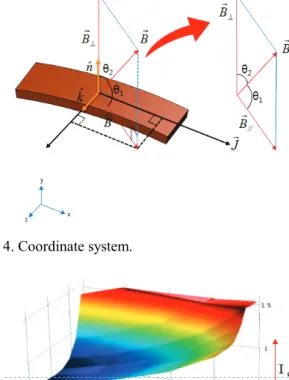
We assume that the HTS tapes are wound around Z axis and the unit vector kˆ (the direction along the width of tape) is parallel to Z axis (equation 1). And then the direction of current density J
is defined by only x and y components (equation 2). Direction of arbitrary magnetic field is expressed as equation (3).
The unit vector perpendicular to the surface of HTS tape is derived by the outer product of kˆ and J
(equation 4). And the projection of magnetic field to the unit vector
nˆ is the perpendicular magnetic field.
The angle between unit vector nˆ and magnetic field B is given by equation (6) and finally we get the applying angle of magnetic field to the HTS tape (θ1) as equation (7).
(0,01,)
kˆ = (1)
(
Jx,Jy,0)
J =
(2) )
, , (
Bx By Bz
B =
(3) J j
J i J J J
J J
k J n k
x y
x x
y
y ˆ ˆ
ˆ ˆ ˆ ˆ ˆ
2 2 2
2 + +
− +
× =
= × (4)
n B n B (ˆ )ˆ
⋅
⊥= (5) cos 2
ˆ B B θ
n
=
⋅ (6)
2
1 π2 θ
θ = − (7) 48
Kyubong Lee, Kideok Sim, Changyoung Lee, and Seokho Kim
Fig. 4. Coordinate system.
Fig.5. Interpolated Ic(B,θ) of HTS tape at 20 K.
4. CRITICAL CURRENT OF HTS MAGNET 4.1. Interpolation of critical current of HTS tape
The critical current of HTS tapes depending on the incidence angle of magnetic field was measured at 20 K as shown in Fig. 3. And the Ic(B,θ) was interpolated by 2D interpolation method for the use of FEM analysis. Fig. 5 shows the interpolated Ic(B,θ) normalized by the critical current at 77.4 K and self-field.
4.2. Model for finite element method An FEM model was set up with COMSOL multi-physicsTM for calculating the magnetic field and estimating the critical current of the race track magnet. The operating current of 136A was applied.
Fig. 6 shows the 1/8 FEM model and the applied current density.
4.3. Critical current estimation with FEM The purpose of FEM analysis is to calculate the magnetic field and its incidence angle which are the input parameters of Ic estimation procedure.
Equations (1) ~ (7) are solved in the FEM analysis and the critical current of magnet at each finite element nod is calculated with the reference of the interpolated Ic(B,θ) properties of HTS tape.
Fig. 6. 1/8 FEM model and current density.
And then the ratio of the operating current to the critical current is evaluated. The ratio (Io/Ic) is related to the current margin that is ‘1.0 - Io/Ic’. The values are mapped on the FEM grid with colored map for visualization.
Fig.7 shows the Io/Ic distribution which is estimated by the Ic-B method. The maximum Io/Ic ratio is 0.68 (margin is 0.32) for the operating current of 136 A. And the positon representing the minimum margin is on the center of long leg of SPC 1 coil. Fig. 8 shows the cross-sectional view of Io/Ic distribution.
Fig. 7. Distribution of Io/Ic on SPC1 (by Ic-B//c method).
Fig. 8. Cross sectional view of distribution of Io/Ic (by Ic-B//c method).
49
Estimation of the critical current of race-track HTS magnet considering angular dependency
(a) on SPC 1
(b) on SPC 2 (c) on SPC 3 Fig. 9. Distribution of Io/Ic (Ic-Bθ method).
However, the Ic-Bθ method gives different results. The position of minimum margin is moved to the round section of the magnet as in the Fig. 9. And Io/Ic is increased to 0.78 (current margin is decreased by 10% compared with the results of Ic-B//c method).
This is because the magnetic field of which angle is 50~70 degree is more distributed on the round section of race track HTS magnet.
5. CONCLUSION
A method for estimating the critical current of HTS magnet reflecting the angular dependent Ic properties of HTS tape was devised and presented.
An FEM model to implement the method was set up with COMSOL multi-physicsTM including the mathematical procedure for calculating the incidence angle of magnetic field.
For an example of race-track magnet, the critical current was evaluated. And the results from Ic-B//c and Ic-Bθ
methods were compared. The newly devised method provides the results closer to the physical sense that the race track HTS coil has minimum Ic at its round section.
As a result, we developed a more reliable method for the estimation of critical current of HTS magnet and it will be applied our designing of race track HTS magnet with the more improvement.
ACKNOWLEDGMENT
This research was supported by Korea Railroad Research Institute through “core technology development for wheel-type high-speed railway” project.
REFERENCES
[1] Chang Young Lee et al., “Conceptual Design of Superconducting Linear Synchronous Motor for 600-km/h Wheel-Type Railway,”
IEEE transactions on applied superconductivity : a publication of the IEEE Superconductivity Committee, vol. 24, no. 3, pp. 1-4, 2014.
[2] J. Kluhspies, “Prospects and limitations of high-speed Maglev systems: Aspects of an interdisciplinary approach,” in Proc. 20th Conf. Magnet. Levitated Syst. Linear Drives, San Diego, no. 139, 2008.
50