122 Copyright © 2014 The Korean Society of Cardiology Korean Circulation Journal
Introduction
Pilsicainide is a pure sodium channel blocker with slow recovery kinetics, and it is known to be effective in converting recent-onset atrial fibrillation to sinus rhythm.
1)2)On the other hand, high plasma concentrations of class IC antiarrhythmic drugs, including pilsic- ainide, have been known to induce life-threatening tachyarrhyth- mias, such as ventricular tachycardia, torsades de pointes (TdP) and ventricular fibrillation.
3)We report a case of sudden cardiac death; the patient received only three low oral doses of pilsicainide (100 mg/day) to convert par- oxysmal atrial fibrillation to sinus rhythm and developed TdP only two days later during Holter electrocardiogram (ECG) monitoring. This
Case Report
http://dx.doi.org/10.4070/kcj.2014.44.2.122 Print ISSN 1738-5520 • On-line ISSN 1738-5555
A Case of Sudden Cardiac Death due to Pilsicainide-Induced Torsades de Pointes
Shimpei Nakatani, MD, Masayuki Taniike, MD, Nobuhiko Makino, MD, Yasuyuki Egami, MD, Ryu Shutta, MD, Jun Tanouchi, MD, and Masami Nishino, MD
Division of Cardiology, Osaka Rosai Hospital, Osaka, Japan
An 84-year-old male received oral pilsicainide, a pure sodium channel blocker with slow recovery kinetics, to convert his paroxysmal atrial fibrillation to a sinus rhythm; the patient developed sudden cardiac death two days later. The Holter electrocardiogram, which was worn by chance, revealed torsade de pointes with gradually prolonged QT intervals. This drug is rapidly absorbed from the gastrointestinal tract, and most of it is excreted from the kidney. Although the patient’s renal function was not highly impaired and the dose of pilsicainide was low, the plasma concentration of pilsicainide may have been high, which can produce torsades de pointes in the octogenarian. Although the oral administration of class IC drugs, including pilsicainide, is effective to terminate atrial fibrillation, careful consideration must be taken before giving these drugs to octogenarians. (Korean Circ J 2014;44(2):122-124)
KEY WORDS: Pilsicainide; Torsades de pointes; Sudden cardiac death.
Received: July 20, 2013
Revision Received: September 3, 2013 Accepted: October 15, 2013
Correspondence: Masami Nishino, MD, Division of Cardiology, Osaka Ro- sai Hospital, 1179-3, Nagasone-cho, Sakai-city, Osaka 591-8025, Japan Tel: 81-72-252-3561, Fax: 81-72-250-5492
E-mail: [email protected]
• The authors have no financial conflicts of interest.
This is an Open Access article distributed under the terms of the Creative Commons Attribution Non-Commercial License (http://creativecommons.
org/licenses/by-nc/3.0) which permits unrestricted non-commercial use, distribution, and reproduction in any medium, provided the original work is properly cited.
case may present a concern about the proarrhythmic effects of an oral pilsicainide for treatment of atrial fibrillation in octogenarian patients.
Case
An 84-year-old male visited our hospital due to palpitations and
shortness of breath that began two days previously. He underwent
physical examination, 12-lead ECG, chest X-ray, and blood tests. The
patient’s heart rate was 150 beats/min, and his blood pressure was
126/76 mm Hg. Chest X-ray revealed no cardiomegaly (cardiotho-
racic index=46%) and no congestion. An ECG examination showed
atrial fibrillation, which was considered to be of recent onset (with-
in 48 hours). Although ECG showed a tendency for poor progression
of R in V 1-3, the patient had no chest pain and no history of coro-
nary artery disease. In addition, an echocardiography, which was
performed in a private clinic two months before the patient visited
our hospital, showed normal left ventricular wall motion; during the
past two months, there were no significant differences of ST-T
changes in ECG. Routine laboratory tests revealed serum sodium of
142 mEq/L, potassium of 4.8 mEq/L (no hypokalemia and hyperkale-
mia) and creatinine of 1.0 mg/dL, which were indicative of mild re-
nal dysfunction. Thus, oral low-dose pilsicainide at 50 mg twice daily
was prescribed to convert atrial fibrillation to a sinus rhythm, and a
Holter ECG was ordered in the outpatient clinic. In addition, he start-
123 Shimpei Nakatani, et al.
http://dx.doi.org/10.4070/kcj.2014.44.2.122 www.e-kcj.org
ed anticoagulant treatment with warfarin but did not receive any other drugs, including any other antiarrhythmic drugs.
One day after receiving an oral administration of pilsicainide, he visited our hospital again, and a Holter monitor was fitted to eval- uate the efficacy of pilsicainide and initiated at 13:30 in the after- noon. At this time, he felt no palpitations and showed a sinus rhythm with normal QT and QTc intervals (320 msec and 400 msec, respectively) in the CM5 lead of the Holter ECG (Fig. 1). However, the patient died during his sleep 18 hours after the Holter ECG was start- ed. He reported no discomfort during the day or before his sudden death.
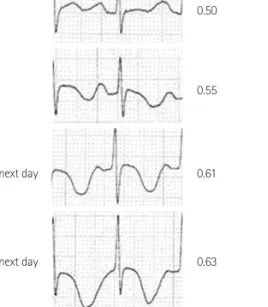
The analysis of the Holter ECG recording revealed that the cause of sudden death was an episode of TdP (Fig. 2). The Holter ECG showed that the patient developed atrial fibrillation followed by re- petitive non-sustained and sustained TdP (Figs. 2 and 3). As shown in Fig. 4, the QTc interval in the Holter ECG showed gradual elonga- tion from 13:30 at the start until 6:00 the next day. At 7:00 the next
day, TdP was observed, and it continued for approximately one hour;
at 8:00, cardiac arrest was detected in the Holter ECG. The electro- physiological parameters, QRS complexes, RR, and QTc interval were measured. The segments with excessive noise, ectopic activity and atrial fibrillation were excluded from the analysis. Fig. 5 illustrates the trend of the electrophysiological parameters. The QTc interval was clearly prolonged compared with that of initial Holter ECG. At the same time, the width of the QRS complexes was slightly pro- longed compared with that of the initial Holter ECG.
Discussion
Pilsicainide, one of the class IC antiarrhythmic drugs, is very popu- lar in Japan and is also available in Korea for terminating paroxysmal atrial fibrillation partially due to the favorable effects reported in the Pilsicainide Suppression Trial on Atrial Fibrillation clinical study.
2)An increase in the rate of sudden death in patients taking a class IC Fig. 1. CM5 lead of Holter electrocardiogram showed sinus rhythm with normal QT and QTc interval (320 msec and 400 msec, respectively) at the start of the recording.
Fig. 2. The Holter electrocardiogram showed mutual findings of atrial fibrillation and torsades de pointes.
Fig. 3. Magnified Holter electrocardiogram recordings showed torsades de pointes, which was initiated by the R-on-T ectopic beat (CM5 lead).
124 Sudden Death by Pilsicainide
http://dx.doi.org/10.4070/kcj.2014.44.2.122 www.e-kcj.org
drug after myocardial infarction was reported in the Cardiac Arrhyth- mia Suppression Trial study;
4)however, it is unknown whether pilsi- cainide also increases the rate of sudden death for patients with atri- al fibrillation.
Pilsicainide is rapidly absorbed from the gastrointestinal tract, and most of it is excreted from the kidney; therefore, the half-life of elimination is prolonged in patients with severe renal failure. In fact, previous studies reported arrhythmic events in patients after taking pilsicainide, and almost all these patients had renal function failure.
In our case, the level of serum creatinine was in the normal range, but the patient was 84 years old, and his body weight was 65 kg.
Thus, the estimated creatinine clearance was 46 mL/min, and the es- timated glomerular filtration rate was 54.4 mL/min/1.73 m
2, which were considered to represent mild renal dysfunction even though the serum creatinine was 1.0 mg/dL. Although the terminal electrical events leading to sudden cardiac death are rarely recorded on Holter ECG monitoring, in this case the patient happened to be wearing the Holter ECG by chance during the cardiac event. The Holter ECG monitor revealed a gradually prolonged QTc interval just before TdP, which was considered to indicate an elevated plasma concentra- tion of pilsicainide, although the actual level was not measured.
While orally administered pilsicainide is an effective drug for ter- minating atrial fibrillation, the dose should be adjusted cautiously in octogenarian patients even if their serum creatinine levels are within normal ranges. In addition, when pilsicainide is prescribed for the octogenarian, the patient should be admitted to the hospital for monitoring.
References
1. Alboni P, Botto GL, Baldi N, et al. Outpatient treatment of recent-onset atrial fibrillation with the “pill-in-the-pocket” approach. N Engl J Med 2004;351:2384-91.
2. Atarashi H, Inoue H, Hiejima K, Hayakawa H. Conversion of recent-on- set Atrial Fibrillation by a single oral dose of Pilsicainide (Pilsicainide Suppression Trial on atrial fibrillation). The PSTAF Investigators. Am J Cardiol 1996;78:694-7.
3. Kaneko Y, Nakajima T, Kato T, Kurabayashi M. Pilsicainide-induced poly- morphic ventricular tachycardia. Intern Med 2012;51:443-4.
4. Preliminary report: effect of encainide and flecainide on mortality in a randomized trial of arrhythmia suppression after myocardial infarc- tion. The Cardiac Arrhythmia Suppression Trial (CAST) Investigators.
N Engl J Med 1989;321:406-12.
Fig. 4. The changes of QTc intervals in the Holter ECG. The QTc interval was gradually prolonged during the Holter ECG monitoring. ECG: electrocardio- gram.
19:50
21:30
1:30 on next day
6:00 on next day
0.50
0.55
0.61
0.63
Time Holter ECG QTc (msec)
Fig. 5. The QTc interval was clearly prolonged compared with that of the initial Holter ECG, and the width of the QRS complexes was slightly pro- longed compared with that of the initial Holter ECG. The RR interval was similar during the Holter ECG monitoring. ECG: electrocardiogram.
900 800 700 600 500 400
200
150
100
50 RR interval
QTc interval QRS complex
Time
RR interval (msec) QTc (msec) QRS complex (msec)
14:00 16:00 18:00 20:00 22:00 24:00 2:00 4:00 6:00