329
Econ. Environ. Geol., 46(4), 329-338, 2013http://dx.doi.org/10.9719/EEG.2013.46.4.329
폐금속광산 주변 논토양 및 벼작물의 비소함량과 계절적 변화
권지철1·정명채1*·강만희2
1
세종대학교 에너지자원공학과,
2한국광해관리공단 광해기술연구소
Contents and Seasonal Variations of Arsenic in Paddy Soils and Rice Crops around the Abandoned Metal Mines
Ji Cheol Kwon1, Myung Chae Jung1* and Man Hee Kang2
1
Department of Energy and Mineral Resources Engineering, Sejong University, Seoul 143-747, Korea
2
Institute of Mine Reclamation Technology, Mine Reclamation Corporation, Cheonan 331-803, Korea
The objective of this study is to investigate the contents and seasonal variation of arsenic in soils and crop plant(rice) in paddy fields around the abandoned metal mines in Korea. The soils were extracted by various meth- ods including aqua regia, 1 M MgCl
2, 0.01 M CaCl
2and 0.05 M EDTA to evaluate the relationships between soils and crop plants(rice). According to correlation analysis, statistically significant correlation with the four meth- ods(p<0.01) were found in soils extracted by various chemical solutions and arsenic contents in soils were decreased in the order of 1 M MgCl
2> 0.01 M CaCl
2> 0.05 M EDTA. Biological accumulation coefficients(BACs) of rice stalks were higher than those of rice grain, and the coefficients under reducing(August) environment were higher than those under oxidizing conditions(October). Assuming the rice consumption of 315 g/day by farm house- holds in Korea, the amount of daily intake of arsenic were estimated to be 77.8 µg/day. The daily intake of arsenic from the rice estimates up to 65% of ADI(acceptable daily intake) that the FAO/WHO Joint Food Additive and Contaminants Committee has set to evaluate their safeties.
Key words : chemical extractions, paddy field, crop plant(rice), seasonal variation, daily intake
이 연구는 국내 휴폐금속광산 주변의 논토양과 식물(벼)의 비소 오염과 계절적 변화를 고찰하고, 토양과 식물의 유 기적 관계규명을 위해 토양시료를 왕수, 1 M MgCl
2, 0.01 M CaCl
2및 0.05 M EDTA 등 다양한 추출제로 전처리하 여 비소를 분석하였다. 화학분해 방법에 따른 함량 변화는 통계적으로 유의한 양의 상관관계를 보이며(p<0.01), 1 M MgCl
2>0.01 M CaCl
2>0.05 M EDTA 순으로 나타났다. 벼줄기의 생물학적 농축계수는 산화환경보다 환원환경에서 높았으며, 백미시료에서는 농축계수가 0.02로 낮게 나타났다. 농가의 1일 평균 쌀소비량인 315 g을 적용하여 세계보 건기구의 미량원소 1일 섭취 최대허용량과 비교한 결과 농가에서는 65%의 높은 섭취량을 보여, 이들 쌀 소비에 의한 비소의 인체섭취도에 중요한 역할을 하고 있음을 확인하였다.
주요어 : 화학적 추출법, 농경지토양, 작물(벼), 계절적 변화, 1일 섭취량
1. 서 론
비소는 지구 지각의 20번째로 풍부하며, 토양, 수질 및 대기에 매우 흔한 원소중 하나이다(Tamaki and Frankenberger, 1992). 비소는 암석과 광물의 분해와
침전을 통하여 토양과 물에 분산되며(Luong et al., 2007), 또한 제련과 광산활동, 농업활동, 목재방부재 소 비 및 식품 첨가물로부터 증가된다(Aldrich et al., 2007). 비소의 이동도와 용해도는 화학적 형태와 종류 에 따라 의존하며, 비소 3가는 이동도는 적은 반면, 비
*Corresponding author: [email protected]
소 5가보다 독성이 높은 것으로 알려져 있다(Caruso et al., 2001). 방글라데시, 중국, 헝가리 그리고 인도 등 다양한 국가에서 지하수와 토양에서 높은 비소 농 도가 검출되었으며(Chen et al., 2006), 동남아시아의 여러 국가에서 광범위하게 물과 작물의 오염을 통해 비소의 독성으로 인한 만성효과에 대해 연구된 바 있 다(Kohnhorst, 2005; Mukherjee et al., 2006).
현재 국내에는 휴·폐금속광산 2,089개, 비금속광산 2,198 개, 석탄광 394개 및 가행광산 593개 등 총 5,274 개가 전국에 분포되어 있다(MIRECO, 2011). 이 들 중에서 많은 광산들은 적절한 환경관리가 시행되고 있지만 일부 광산의 경우는 적절한 정화 또는 복원이 이루어지지 않고 있다. 특히 이들은 집중강우나 강풍 시 광산폐기물이 포함된 오염물질이 하류로 이동 또는 분산되어 농경지나 수계의 주요한 환경오염 원인이 되 고 있으며, 이렇게 오염된 토양은 농작물에 영향을 미 쳐 이를 섭취한 주민의 건강에 심각한 문제를 발생시 킬 수 있다(Jung and Jung, 2006). 특히 이들 지역에 서 생산된 쌀에 함유된 유해성 금속에 대한 연구는 미 미한 수준이며, 일부 백미의 자연함유량의 연구가 이 루진 바 있지만(Jung, 2003), 전반적으로 매우 미미한 수준이다(Jung, 1995). 한편, 국외의 경우 광산지역에서 의 자란 쌀에 대한 연구가 수행된 바 있다(Liu et al, 2005; Yang et al, 2006; Pal et al, 2009).
토양과 식물의 상관성 연구를 위해 주요 선진국에서 는 단일 용출법을 통해 중금속 오염토양으로부터 식물 로의 중금속 전이 가능성 평가에 활용하고 있다(Van Ranst et al., 1999; Boisson et al., 1999; Tessier et al., 1979; Rauret et al., 1999; Quevauviller et al., 1997; DIN, 1997). 국내에서는 폐광산 주변 토양 과 식물의 중금속 오염에 관한 유기적 상관성 연구가 다양하게 진행된 바가 있지만(Jung and Chon, 1998;
Lee et al., 2000), 총량에 따른 농도에 기반을 두고 상호관계를 규명하고자 하여 유용한 상관성 평가가 미 흡한 수준이었다.
그러므로 이 연구에서는 폐금속광산 주변 농경지 토 양과 식물에 축적된 비소 함량을 계절별 특성에 따라 비교, 분석하기 위하여 토양과 식물을 건기(6월), 우기 (8 월) 및 추수시기(10월)에 맞추어 총 3회 채취하여 오 염상태를 확인하였으며, 단일 용출제인 1 M MgCl
2(Tessier et al., 1979), 0.01 M CaCl
2(Van Ranst et al., 1999) 및 유기용제인 EDTA(Quevauviller et al., 1997) 등으로 토양을 추출하여, 토양과 식물간의 상관 관계를 효과적으로 규명하고자 하였다.
2. 실험방법
2.1. 시료채취 및 분석방법
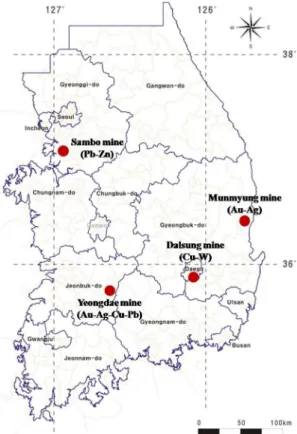
연구대상 지역은 국내 휴·폐광산에서 광종별로 Au- Ag 광산 2개소, Cu-W 광산 1개소 및 Pb-Zn 광산 1 개소 등 총 4개소를 선정하였다(Fig. 1). 토양시료의 경우 광산 주오염원(갱구, 폐석 및 광물찌꺼기적치장 등)을 기점으로 하부 2 km 이내에서 벼가 재배되는 경작지의 표토(0~15 cm)를 대상으로 토양오염공정시 험기준에 따라 광산마다 10개 지점을 선정하였으며, 계 절적 변화를 조사하기 위해 동일지점에서 6월(1차), 8 월(2차) 및 10월(3차) 등 총 3회 채취하였다.
식물(벼) 시료의 경우 토양시료 채취 위치와 동일한 지점에서 채취하였으며, 모종삽을 이용하여 뿌리까지 채취 한 후 바로 흐르는 물에 세척을 하였다. 계절적 특성을 비교하기 위해 토양과 동일하게 6월, 8월 및 10 월 등 총 3회 채취하였으며, 벼(백미)시료는 10월에 1 회 채취하였다.
Fig. 1. Map showing the location of study areas in Korea.
토양시료의 경우 -100 mesh로 체질한 건조시료 3.0 g 을 정량적으로 잰 후, 시험관에 넣어 질산(7.0 mL) 과 염산(21 mL)을 넣고 Heating Block에서 70
oC 를 유지하면서 약 1시간 동안 용출한 용액(Ure, 1995)을 국제기준 ISO/DIS 20280의 방법으로 예비환원을 한 후 비화수소발생장치(hydride generation)를 이용하여 비화시킨 후 원자흡광분광광도계(Varian AA240, 호주) 를 활용하여 분석하였다. 흐르는 물에 1차 세척한 식 물시료는 이온순수로 3회 이상 세척한 후 상온에서 7 일 이상 자연건조 시킨 후, 식물용 믹서기를 이용하여 미분쇄하였다. 천칭으로 시료 1.0 g을 정량적으로 잰 후, 유리관에 콘덴서를 부착하고 휘발성 질산 10 mL를 넣 고 완전 건조 될 때까지 Heating Block에서 가열한 후 왕수로 다시 한번 전처리한 후 증류수를 채워 최종 부피 20 mL로 정량한 시료를 원자흡광분광광도계로 분 석하였다. 분석에서 자료의 정확도와 정밀도를 확인하기 위하여 독일의 BAM-U110(토양)와 중국 NCS(National Analysis Center for Iron and Steel) 의 국제표준시료 (ZC73008, 백미)를 사용하였으며, 분석결과를 Table 1 에 요약하였다. 표에서 보는 바와 같이 정확도 95%
이상으로 유의한 수준(표 1에 제시함)으로 분석되었다.
2.2. 단일용출법
이 연구에서는 토양에 존재하는 비소의 존재형태 비 교를 위해 다양한 추출 방법이 적용하였다. 우선 1 M MgCl
2(Tessier et al., 1979)의 경우 기존 연구결과 연속추출 fraction 1(exchangeable)과 fraction 2(bound to carbonates) 에 해당되는 농도가 생물학적 이용성이 높은 것으로 보고되었기 때문에(Li et al., 2007; Hong et al., 2009) 이를 적용하였다. 즉, 시약 95.21 g에 증 류수 800 mL 첨가 후 NH
4OH 또는 Acetic Acid로 pH 7 로 조절한 후 증류수로 채워 1,000 mL를 제조한 용액을 이용하여 토양 5 g에 1 M MgCl
2용액 40 mL 를 가한 후 1시간 동안 진탕하였다. 두 번째로 0.01 M CaCl
2의 경우 시약 1.1 g에 증류수 800 mL 첨가 후 NH
4OH 또는 Acetic Acid로 pH 7로 조절한 후 증류
수로 1,000 mL 제조한 후 토양 5 g에 0.01 M CaCl
2용액 25 mL를 가한 후 2시간 동안 진탕하였다 Van Ranst, 1999). 마지막으로 식물흡수 가능성 파악에 가 장 많이 사용되는 유기용제인 0.05 M EDTA는 토양 10 g 에 EDTA용액 50 mL을 가한 후 1시간 진탕한 후 분석시료로 사용하였다(Quevauviller et al., 1997). 용 출된 모든 시료는 비화수소발생장치가 장착된 원자흡 광분광광도계로 비소를 분석하였다.
3. 결 과
3.1. 토양의 비소 함량
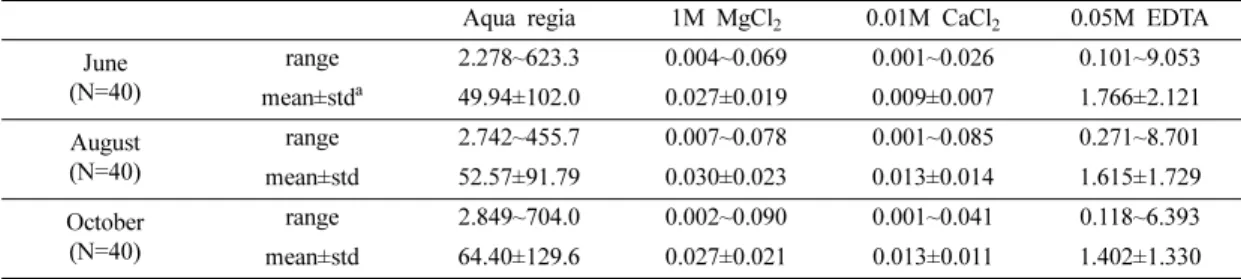
토양시료에 대한 비소의 함량을 계절별로 정리하여 Table 2 에 제시하였으며, 국외의 농경지 토양 환경기준 값을 조사하여 Table 3에 정리하였다. 왕수로 분해한 경우 6월, 8월 및 10월의 평균함량(mg/kg)은 각각 49.94, 52.57, 64.40 로서 국내 토양환경보전법의 토양오 염기준을 초과하였으며, 국외의 기준과 비교한 결과 독 일(German Federal Soil Protection Act(1998)의 기 준과는 유사한 함량을 보였지만, 아르헨티나(Tarvainen et al., 2013)와 캐나다(CCME, 2001)의 기준보다는 약 3배 정도 높은 함량을 나타냈다. 또한 2010년도 우 리나라의 토양 측정망 및 토양오염실태조사(KMOE, 2011b) 결과와 비교하면 약 10배 이상 높은 비소 농 도를 보였다. 이는 광산에 의해 발생된 오염물질이 주 변 농경지에 영향을 주고 있음이 시사해 주는 것이다.
1 M MgCl
2추출한 토양의 비소 농도 함량 범위(평 균, mg/kg)를 살펴보면, 6월에는0.004~0.026(0.027), 8 월에는 0.007~0.078(0.030) 및 10월에는 0.002~0.090 (0.027) 로 나타났다. 또한, 0.01 M CaCl
2로 추출한 토 양 비소의 농도 함량 범위(평균, mg/kg)는 6월 0.001
~0.026(0.009), 0.001~0.085(0.013) 및 10월 0.001~
0.041(0.013) 로 나타났다. 0.05 M EDTA 추출한 농도 함량 범위(평균, mg/kg)는 6월 0.101~9.053(1.766), 8 월 0.271~8.701(1.615) 및 10월 0.118~6.393(1.402) 의 함량을 보였다.
Table 1. Summary of measured and certified arsenic concentrations in BAM-U110(soil) and ZC73008(rice, China) analyzed by AAS with hydride generation equipment(unit in mg/kg, dry weight)
Certified value(A) Measured value(B)(N
a=3) Accuracy(B/A)(%)
BAM-U110 13.0±1.1 12.5±0.78 96
ZC73008 0.102±0.008 0.117±0.021 115
a
number of samples
b
arithmetic mean±standard deviation
3.2. 식물(벼)의 중금속 함량
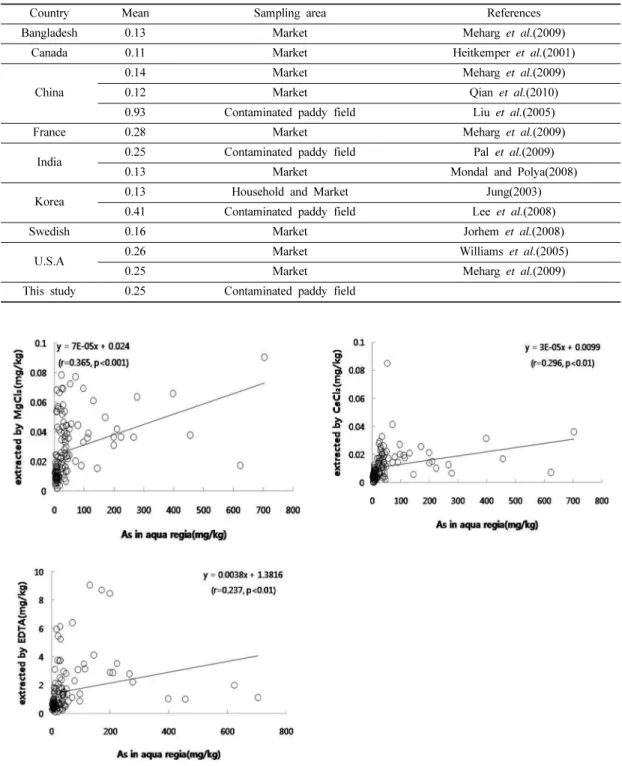
식물시료에 대한 As함량을 계절별로 정리하여 Table 4 에 제시하였다. 표에서 보는 바와 같이 벼줄기의 비소 농도(건조중량 기준)에 대한 함량 범위(평균, mg/kg)는 6 월 0.34~12.56(3.91), 8월 0.57~11.51(5.19) 및 10 월 0.55~14.87(5.31)로 조사되었으며, 추수기에 채취한 백미시료는 0.10~0.77(0.25)의 비소가 검출되었다. 다 양한 국가에서 백미에 대한 연구가 진행되어 왔으며 (Table 5), 오염된 지역에서의 백미의 농도는 중국의 Liu et al.(2005) 조사에 의하면 0.93 mg/kg, 인도는 0.25 mg/kg(Pal et al., 2009), 국내의 경우는 0.41 mg/kg (Lee et al., 2008)의 함량을 보여 연구지역보다 약 2배 정도 높은 농도를 보였다. 연구지역의 백미의 평균함량 은 0.25 mg/kg으로 인도와 비슷한 함량을 보이고 있으
며, 중국보다는 낮은 함량을 나타내었다. 또한 Jung (2003) 의 자연배경값 보다는 2배 높은 함량으로 조사되 었으며, 대부분 국가들의 백미 자연함유량은 0.11~0.16 으로 국내의 자연배경값과 동일한 결과로 나타났다.
4. 고 찰
4.1. 화학분해 방법에 따른 비소의 함량변화 4 개의 광산(각 30개 시료)에 대한 총 120개 시료를 왕수분해법과 1 M MgCl
2, 0.01 M CaCl
2및 0.05M EDTA 등을 활용한 화학분해에 따른 As의 원소함량 변 화를 Fig. 2에 정리하였다. 1 M MgCl
2의 경우 상관계 수가 0.365로 통계적으로 유의한 수준(p<0.001)이며, 0.01 M CaCl
2및 0.05 M EDTA에서는 각각 상관계수 Table 2. Range, mean and standard deviation of arsenic in paddy soils sampled from 4 representative abandoned mines(unit in mg/kg, dry weight)
Aqua regia 1M MgCl
20.01M CaCl
20.05M EDTA June
(N=40)
range 2.278~623.3 0.004~0.069 0.001~0.026 0.101~9.053
mean±std
a49.94±102.0 0.027±0.019 0.009±0.007 1.766±2.121 August
(N=40)
range 2.742~455.7 0.007~0.078 0.001~0.085 0.271~8.701
mean±std 52.57±91.79 0.030±0.023 0.013±0.014 1.615±1.729 October
(N=40)
range 2.849~704.0 0.002~0.090 0.001~0.041 0.118~6.393
mean±std 64.40±129.6 0.027±0.021 0.013±0.011 1.402±1.330 N=number of samples
a
arithmetic mean±standard deviation
Table 3. Guideline for arsenic in paddy soils from various countries
Country Guide value(mg/kg) References
Argentina 20 Tarvainen et al.(2013)
Belgium 45 Soil Remediation Act(1995)
Canada 20 CCME(2001)
Germany 50 German Federal Soil Protection Act(1998)
Korea 25 KMOE(2011a)
New Jersey, USA 20 Tarvainen et al.(2013)
Table 4. Range, mean and standard deviation of arsenic in rice sampled from 4 representative abandoned mines(unit in mg/kg, dry weight)
Rice stalk Rice grain
June(N=40) August(N=40) October(N=40) October(N=40)
range 0.340~12.56 0.573~11.51 0.548~14.87 0.104~0.774
mean±std
a3.909±2.979 5.185±3.170 5.312±3.886 0.247±0.120
N=Number of samples
a
arithmetic mean±standard deviation
0.296 및 0.237로 역시 통계적으로 유의한 양의 상관 관계를 보였다(p<0.01). Son과 Jung(2011)이 제안한 왕수에 대한 개별 추출제의 상대적인 추출률(relative
extraction ratio, RER) 을 아래의 식 (1)을 활용하여 연구지역에서 채취한 120개의 논토양에서의 용출제별 로 비소의 추출률을 살펴본 결과, 1 M MgCl
2,0.01 M Table 5. Arsenic concentrations in rice from various countries(unit in mg/kg)
Country Mean Sampling area References
Bangladesh 0.13 Market Meharg et al.(2009)
Canada 0.11 Market Heitkemper et al.(2001)
China
0.14 Market Meharg et al.(2009)
0.12 Market Qian et al.(2010)
0.93 Contaminated paddy field Liu et al.(2005)
France 0.28 Market Meharg et al.(2009)
India 0.25 Contaminated paddy field Pal et al.(2009)
0.13 Market Mondal and Polya(2008)
Korea 0.13 Household and Market Jung(2003)
0.41 Contaminated paddy field Lee et al.(2008)
Swedish 0.16 Market Jorhem et al.(2008)
U.S.A 0.26 Market Williams et al.(2005)
0.25 Market Meharg et al.(2009)
This study 0.25 Contaminated paddy field
Fig. 2. Relationships of arsenic in soils extracted by aqua regia and various extraction methods.
CaCl
2및 0.05 M EDTA에서 각각 0.15%, 0.05% 및 7.38% 의 추출률을 보이며, EDTA에서 가장 높은 것으 로 나타났다.
× 100
( 식 1) 4.2. 비소의 계절적 변화
농경지 토양과 벼줄기의 계절적 변화를 Table 6에 정리하였다. 6월, 8월 및 10월에 채취한 논토양 내 비 소의 함량을 비교하면 6월과 8월에 비해 10월에 채취 한 시료에서 다소 높은 함량을 보이며 통계적으로 유 의한 차이를 보인다(p<0.05). 이는 벼 이삭 성장을 위 해서 물을 뺀 시기인 산화환경인 10월에 채취한 토양 내 비소가 물로 채워진 상태에서 재배하는 환원환경인 8 월에 채취한 토양 내 비소보다 용출되기 쉬운 형태로 존재한다는 것을 의미하며 Jung and Thornton(1997)와 Kwon et al.(2013)의 연구내용과도 일치하는 결과이다.
벼줄기에서는 6월에 채취한 시료에 비해 8월에 비소 의 함량이 증가하였으며, 10월에는 8월과 비슷한 평균 함량을 나타내었으며, Lee et al.(2000)의 연구와도 일 치하는 결과이다. 계절에 따른 토양 중 비소의 평균함 량을 비교하기 위하여 t-test를 수행한 결과, 계절별 평 균 함량이 통계적으로 유의한 차이를 보였다(p<0.05).
이러한 결과는 기존에 조사된 바와 같이 환원환경에서 는 대부분 중금속이 안정된 황화물과 결합된 형태로 존재하고 있어 식물이 유용하게 흡수하기 어려워 상대 적으로 낮은 원소함량을 보이지만, 산화환경으로 변화 되면서 황화물에서 분리된 토양중의 중금속을 식물이 쉽게 흡수하지만(Jung and Chon, 1998), 비소의 경우 환원환경인 8월과 산화환경인 10월에 채취한 벼줄기의 함량이 비슷한 값을 보이는 것은 환원상태의 토양에서 생물학적 이용성이 높기 때문으로 판단된다(Marin et al., 1993).
4.3. 추출방법에 따른 토양과 식물의 상관성 평가 토양에서의 금속 농도는 식물이 금속 농도를 흡수하 는데 영향을 주는 매우 중요한 요소이다. 비록 식물에 의한 금속 흡수의 양과 정도는 생물학적 요소들에 의 존하지만 많은 연구자들은 식물안의 금속 농도는 토양 과의 양의 상관성이 있다고 보고한 바 있다(Kim and Thornton, 1993). 왕수분해법은 오염된 토양과 퇴적토 의 잠재적인 위험도를 결정하는 방법으로 금속의 이동 도와 생물학적 이용성을 평가하는 방법으로는 적합하 지 않은 방법이다(Rieuwerts et al., 1998). 따라서 현 재 다양한 국가에서는 토양에서 중금속의 형태와 이동 도를 평가하기 위해 다양한 단일용출제를 사용하고 있 다(Van Ranst et al., 1999; Boisson et al., 1999;
Tessier et al., 1979; Rauret et al., 1999; Quevauviller
Relative extraction ratio %( ) =
concentration extracted by individual extractant mg kg( ⁄ ) concentration extracted by aqua regia mg kg( ⁄ ) ---
Table 6. Mean concentration of arsenic in soils and rice stalk sampled from 4 representative abandoned mines
Paddy Soil(mg/kg) Rice stalk(mg/kg, DW)
June(N=40) August(N=40) October(N=40) June(N=40) August(N=40) October(N=40)
49.9
a52.6
b64.4
c3.91
a5.19
b5.31
cN=number of sample
Where mean values share the same letter suffix for a given soil property, there is no statistically significant difference between the sampling time at p<0.05
Where mean values have the difference letter suffix for a given soil property, a statistically significant difference between the sampling time occurs at p<0.05
Table 7. Correlation coefficients of arsenic in soils and plants sampled from 4 representative abandoned mines
Metal content in soil June August October
stalk(N=40) stalk(N=40) stalk(N=40) grain(N=40)
Aqua regia(N=40) 0.193 0.445** 0.185 0.125
1 M MgCl
2(N=40) 0.314* 0.309* 0.097 0.249
0.01 M CaCl
2(N=40) 0.491** 0.242 0.255 0.158
0.05 M EDTA(N=40) 0.393* 0.017 0.299 0.100
N=mumber of sample
*Statistically significant at p<0.05, **Statistically significant at p<0.01, ***Statistically significant at p<0.001
et al., 1997). 이 연구에서 농경지 토양시료와 동일지 점에서 채취한 벼줄기와 백미 내 비소 함량의 상관관 계를 규명하기 위해 왕수분해법, 1 M MgCl
2, 0.01 M CaCl
2및 0.05 M EDTA를 활용하였으며, 상관계수를 Table 7 에 정리하였다. 왕수로 분해한 농경지 토양과 벼줄기 함량 사이에 통계적으로 유의한 상관관계가 미 약하지만, 토양 내 함량이 증가할수록 벼줄기의 함량 이 증가하는 경향을 보인다. 0.01 M CaCl
2및 0.05 M EDTA 를 이용한 용출법으로 분석한 토양 내 비소 함 량과 벼줄기의 비소 함량 사이에서도 유의한 상관관계 가 나타나지 않았다. 이런 결과가 나타나는 이유는 상 대적으로 낮은 함량에서는 토양 함량의 증가에 따라 벼줄기에서도 증가하는 경향을 보이는 반면, 고농도의 비소를 함유한 토양의 경우 생명체의 유지기능으로 말 미암아 벼줄기의 함량이 일정한 수준으로 유지되거나 감소되기 때문이다. 반면에 1 M MgCl
2에서는 통계적 으로 유의한 상관관계를 보이며(p<0.05), 이는 기존 연구결과 연속추출 fraction 1(exchangeable)에서 생물 학적 이용성이 높은 것으로 조사되었으며(Li et al., 2007; Hong et al., 2009), 이번 연구와 일치하는 결 과이다. 쌀(벼)시료에서는 토양 내 함량과 상관관계가 낮은 편이었으며, 이는 토양의 농도보다는 식물의 줄기 나 잎에 비해 이삭과 같은 열매의 중금속 원소의 흡수가 현저하게 저하되기 때문으로 해석된다(Adriano, 1986).
4.4. 비소의 식물학적 흡수비
식물학적 흡수계수(BAC : Biological Accumulation Coefficient) 는 토양으로부터 식물로 이동되는 원소의 함량을 토양 내 원소함량으로 나눈 값으로 토양으로부 터 식물로 이동되는 중금속 원소들의 흡수비를 나타낸 다(Brooks, 1983). 식물 부위와 계절에 따른 식물학적 흡수계수를 Fig. 3에 도시하였다. 각 자료에 대한 흡수 계수를 살펴보면 벼줄기의 경우 6월, 8월 및 10월에 각각 0.18, 0.33 및 0.32의 흡수비를 나타냈으며, 환원 환경인 8월에 흡수계수가 높게 나타났다. 이러한 결과 는 Marin et al.(1993)이 제시한 바와 같이 비소의 경 우 환원환경 상태의 토양에서 생물학적 이용성이 높다 는 결과와도 일치한다. 백미의 경우는 토양의 농도가 높은 반면 0.02로 흡수가 거의 이루어지지 않는데, 이 는 식물이 금속 흡수에 미치는 여러 가지 요인 중 식 물의 부위와 종류가 영향을 주었기 때문으로 판단되며, Kwon et al.(2013)의 연구내용과도 일치하는 결과이다.
즉, Adriano(1986)에 의하면 주로 넓은 잎을 가진 식물 인 상추, 배추 등에 비해 옥수수, 쌀 등이 금속 원소의
흡수가 현저하게 저하된다고 알려져 있기 때문에 벼줄 기에 비해 백미에서 흡수계수가 낮은 것으로 판단된다.
4.5. 비소의 1일 인체섭취도
비소 노출의 여러 가지 경로중 주로 흡입(Pal et al., 2007), 섭취 그리고 피부접촉 등이 있으며(Mondal and Polya, 2008), 그 중에서 섭취가 가장 큰 역할을 한다. 비소 섭취의 다양한 경로 중에서(Mondal and Polya, 2008), 지난 2년 동안 게재된 역학조사 결과 동남아시아의 많은 국가들의 주요 비소섭취는 오염된 음용수로 밝혀졌다. 또한 최근의 많은 연구들에서 쌀, 채소 그리고 생선 같은 음식과 오염된 음용수가 비소 섭취의 원인으로 조사되었다(Bhattacharya et al., 2010;
Lin et al., 2004; Ohno et al., 2007; Roychowdhury et al., 2003; Schoof et al., 1999; Signes-Pastor et al., 2009). 특히 쌀은 음용수 다음으로 비소 노출의 주 요한 원인 중의 하나로 조사되었으며(Mondal and Polya, 2008; Stone, 2008), 국외의 연구결과에서 보는 바와 같이 쌀은 비소 섭취의 중요한 경로 중의 하나이 다. 이 연구에서 오염된 토양에서 재배된 쌀의 비소의 함량이 높게 나타났으며, 특히 쌀은 우리나라의 주식 이기 때문에 비소 노출의 주요한 요인으로 판단된다.
한편, 지난 10년간의 쌀 생산량을 조사한 결과 2001년
551 만 톤에서 2011년 422만 톤으로 130만 톤이 감소
되었으며, 이는 서구적인 식사형태에 의해 상대적으로
감소한 것으로 판단되며, 특히 2003년에 큰 폭으로 감
Fig. 3. Biological accumulation coefficient(BAC=Cp/ARCs)
of rice stalks and grain.
소하였는데, 태풍 매미의 영향 때문인 것으로 판단된 다(Fig. 4). 또한 1인당 쌀 소비량을 조사한 결과, 전 국적으로 195 g/day을 섭취하며, 농가는 315 g/day, 비 농가는 187 g/day으로 조사되었다(National Statistical Office, 2012).
식품 중 유독성 오염물질에서 유래되는 건강피해를 예측하기 위해 해당성분의 실제적인 식이섭취량이 독 성학적으로 설정된 PTWI(provisional tolerable weekly intake; 주간섭취 잠정허용량)나(FAO, 1994), ADI (acceptable daily intake for man; 인체허용 1일 섭취 량)을 이용하여 독성기준치에 대한 노출량 비율인 위 해지수를 계산할 필요가 있다. 따라서 이 연구에서는 각 광산별 백미 시료 분석 결과를 기준으로 쌀 소비에 의한 비소의 섭취도를 다음과 같이 계산하였다.
쌀 소비에 의한 비소의 1일 섭취량(µg/day)
= 1 일 쌀소비량(g/day) × 원소의 함량(µg/g) 식(2) 위의 (2)식을 이용하여 농가, 비농가 및 전체에 대한 1 일 인체섭취도를 Table 8에 정리하였다. 계산한 결과 농가, 비농가 및 전체의 비소 섭취도(g/day)는 각각 77.8, 46.2 그리고 48.2로 나타났다. 세계보건기구 (WHO) 에서는 60 kg 성인을 기준으로 1일 비소섭취량 을 120 µg 이하로 규정하고 있다(WHO, 2011). 세계 보건기구와 비교한 결과 농가의 경우 WHO 허용량의
64.8% 의 섭취량을 보였으며, 비농가는 38.5%로 나타 났다. 전체 섭취량을 비교한 결과 40.1%로 나타나 전 반적으로 높은 섭취량을 보이고 있으며, 특히 농가에 서는 60%이상의 섭취량을 보이고 있어 쌀의 소비가 비소의 인체섭취도에 중요한 역할을 하고 있음을 확인 하였으며, 이는 국외의 결과와도 일치한다. 또한 국내 백미의 자연함유량(Jung, 2003)과 비교한 결과 모두 다 높게 나타났으며, 이는 광산에 의해 발생된 오염물질 이 주변 농경지에 영향을 주고 있음을 확인하였다.
5. 결 론
토양시료의 경우 국외의 농경지토양 기준함량과 비 교한 결과 연구지역이 3배정도 높은 함량을 보여 주변 환경에 오염원으로 작용할 수 있을 것으로 판단되며, 벼식물의 경우 특히 백미에서 국내외의 자연함유량보 다 2배 이상 높은 농도를 보이고 있다. 왕수분해법과 다양한 용출제를 활용한 화학분해에 따른 비소 함량변 화를 보면 모든 용출제에서 통계적으로 유의한 양의 상관관계를 보이고 있다(p<0.01). 계절적인 변화의 경 우 토양과 벼줄기 모두 평균함량은 큰 차이를 보이지 않지만 t-test 결과 모두 통계적으로 유의한 차이를 나 타내 계절적인 변화가 있는 것으로 확인되었다 (p<0.05). 벼줄기의 경우 환원환경인 8월과 산화환경 인 10월에 비슷한 함량을 보이며, 이는 환원상태의 토 양에서 생물학적 이용성이 좋은 것으로 밝혀졌다. 다 양한 용출제를 사용하여 토양과 식물의 상관성을 조사 한 결과 벼줄기의 경우 1 M MgCl
2에서만 통계적으로 유의한 상관성을 보이고 있으며(p<0.01), 그 외는 통 계적으로 유의한 상관성을 보이지 않았다. 백미시료에 서도 토양 내 함량과 상관관계가 없는 것으로 나타났 으며, 이는 토양 농도보다는 식물의 부위와 종류에 따 른 흡수도 차이 때문인 것으로 판단된다. 흡수계수를 확인 한 결과, 벼줄기에서는 환원환경인 8월에 0.33으 로 가장 높은 흡수비를 나타내었으며, 백미 시료는 0.02 로 거의 흡수가 이루어지지 않았다. 1일 인체섭취 도를 농가, 비농가 및 전국으로 구한 결과, 세계보건기 Fig. 4. Annual rice productions in Korea(National Statistical
Office, 2012).
Table 8. Computed daily intake of arsenic by rice consumption for farm and nonfarm areas in Korea
farm area nonfarm area overall
This study
mean(ug/g) 0.25
daily consumption(g/day) 187 195
daily intake(ug/day) 46.2 48.2
Jung(2003) 47.3 30.7 32.3
구(WHO) 허용량의 각각 64.8%, 38.5% 그리고 40.1%
로 전반적으로 높은 섭취량을 보이고 있어 쌀의 소비 가 비소의 인체섭취도에 중요한 역할을 하고 있음을 확인하였다.
참고문헌