폐금속광산 주변 농경지 토양의 비소 및 중금속에 대한 용출특성 평가
권지철1)· 정명채1)* · 이명규2)
Characteristics of Arsenic and Heavy Metal Leaching for Paddy Soils Around Abandoned Metal Mines
Ji Cheol Kwon, Myung Chae Jung* and Myung-Gyu Lee (Received 5 March 2014; Final version Received 27 May 2014; Accepted 19 June 2014)
Abstract : This study evaluated extraction rates of As and heavy metals in soils using representative three soil extraction procedures. The three chemical leaching methods by aqua regia, 1M MgCl2 and 0.01M CaCl2 were examined to evaluate metal mobility for 120 paddy soils from abandoned metal mines. As results of chemical analysis, relative extraction ratio(RER) defined as elements extracted by extractant divided by those by aqua regia for As and heavy metals in the samples increased in the order of 0.01M CaCl2 < 1M MgCl2. The RER values for Cd were relatively higher than those for As, Cu and Pb due to their differences in geochemical mobilities.
According to statistical analysis, significant correlation was found between those three methods(p<0.001). This study also established a stepwise multiple linear regression analysis for identification of dominant factors influencing metal extraction rates of contaminated paddy soils from mining sites.
Key words : Paddy soil, Relative extraction ratio(RER), Stepwise multiple linear regression, Chemical extraction 요 약 : 이 연구에서는 국내 휴・폐금속광산 주변의 논토양 120개의 시료를 채취하여 비소 및 중금속 함량을 왕수분해법을 통해 확인하고 1M MgCl2과 0.01M CaCl2을 활용하여 금속의 이동도를 평가하고자 하였다. 화학적 용출법을 이용하여 분석한 결과, 용출제로 용출한 비소와 중금속 농도에 대한 왕수 추출 농도의 비로 정의되는 상대적인 추출비(RER)는 1M MgCl2 > 0.01M CaCl2 순으로 나타났다. 원소별로 비교하면 Cd은 다른 원소에 비해 상대적으로 높은 추출율을 보이며, 이는 지구화학적 이동도가 높은 원소이기 때문으로 판단된다. 화학분해 방법에 따른 함량 변화는 통계적으로 유의한 양의 상관관계를 보이며(p<0.001), 1M MgCl2이 0.01M CaCl2보다 통계적으로 유의한 결과를 얻었다. 이 연구에서는 토양의 용출율에 영향을 주는 토양의 원소 함량과 물리화학적 특성을 이용하여 다중선형회귀분석을 수행하였으며, 그 결과는 비소 및 중금속의 농도 예측에 유용하게 사용할 수 있을 것으로 판단된다.
주요어 : 논토양, 상대적인 추출비(RER), 다중선형회귀분석, 화학적 용출법
1) 세종대학교 공과대학 에너지자원공학과 2) 한국세라믹기술원 기업지원본부 시험표준센터
*Corresponding Author(정명채) E-mail; [email protected]
Address; Department of Energy and Mineral Resources Engineering, Sejong University, Seoul, Korea
ISSN 2288-2790(online) Vol. 51, No. 3 (2014) pp. 395-403, http://dx.doi.org/10.12972/ksmer.2014.51.3.395
서 론
국내에는 금속광산 2,166개, 비금속광산 2,830 및 석 탄광 400개 등 총 5,396개 광산이 전국에 분포되어 있다 (MIRECO, 2012). 폐광된 이후, 광물찌꺼기를 포함한 많은 광산폐기물들이 적절한 복원없이 방치되어 있어, 오염물질이 하류로 이동 또는 분산되어 광산주변 농경지
토양을 오염시키는 주요한 환경오염원이 되고 있다(Jung et al., 2002). 이러한 환경오염의 심각성이 부각되면서 정부는 국내 휴・폐광산에 대한 개황 및 정밀조사를 수행 한 바 있으며, 현재는 한국광해관리공단 등을 통하여 토 양 및 수질오염 등 다양한 광해 현상에 대한 조사 및 관 리를 수행하고 있다(Ko et al., 2009).
현재 국내의 광해방지사업에서 농경지 오염토양의 경 우 비교적 비용이 저렴하며 처리기간이 짧은 복토공법이 주로 적용되고 있다. 특히, 오염토양으로부터 중금속의 생물유효도(bioavailability)을 감소시키기 위한 방법으 로서 화학적 안정화제를 투입하여 토양에 포함된 미량중 금속의 이동성 및 용출성을 감소시키는 연구가 진행되었 연구논문
Table 1. Geology and site description of the study mines Mine Type of ore
deposits
Major target elements
Main geology
Main pollution
sources Reference
Dalsung breccia pipe Cu, W rhyolite, volcanic
ash, tuff tailings, aAMD Jung(1995) Yeongdae hydrothermal vein Au, Ag, Cu, Pb granite tailings, AMD KMOE(2007) Munmyung hydrothermal vein Au, Ag sandstone, shale tailings KMOE(2007) Sambo hydrothermal vein Pb, Zn schist, gneiss, granite tailings Jung(1995)
a AMD; Acid Mine Drainage
Fig. 1. Map showing the location of study areas in Korea.
다(Janos et al., 2010; Park et al., 2010; Jeon et al., 2012). 하지만 국내에는 중금속의 토양 내 존재형태와 거동 특성을 고려하지 않은 전함량 분석을 사용하고 있 어 중금속의 이동, 확산 및 위해성을 감소시키는 안정화 공법 평가에는 어려움이 있다.
농경지 토양의 경우 토양의 특성, 금속의 화학종 및 지화 학적 거동은 토양 내에 함유된 금속의 생물학적 이용성에 의해 결정된다(Ehlken and Kirchner, 2002). 특히, 식물내 의 금속함량을 결정하는 가장 중요한 요소는 토양내의 금 속함량이지만(Alloway et al., 1990), 토양-식물간의 상호 관계는 토양 내 금속의 존재형태가 매우 중요한 요인이다 (Filgueiras et al., 2002). 이러한 중금속의 화학적 존재형 태를 알아보기 위한 연구방법중 식물흡수 가능성 평가는 대표적으로 0.005 M DTPA (diethylenetriaminepentaacetic acid)(Haq et al., 1980; Norvell, 1984; Brun et al., 2001), 0.005~1 M EDTA(ethylenediamine tetraacetic acid) (Hammer and Keller, 2002; Chaignon et al., 2003)의 연구방법이 제시되었다. 또한 생물학적 이용가능성 평가 에 0.01CaCl2(Van Ranst et al., 1999), 0.1 M NaNO3
(VSBo, 1986), 1 M NH4NO3(DIN, 1997), 0.5 M HNO3
(Tipping et al., 2003) 및 폐기물 유해성 평가에 TCLP (US EPA, 1992)를 이용한 다양한 연구가 수행되었다.
국내의 경우 폐광산 주변 토양과 식물의 중금속 오염에 관한 상관관계의 규명을 위해 단일용출제를 사용한 연구 가 다양하게 진행된 바가 있다(Jung et al., 2000; Jeong et al., 2011; Kwon et al., 2013).
따라서 이 연구에서는 비소 및 중금속과 토양간의 상 호관계를 밝히는데 기초 자료를 제공하고자 국내의 대표 적인 4개 광산에서 광산별로 30개 시료를 채취하여 오 염상태를 확인하고, 단일 용출제인 1 M MgCl2 (Tessier et al., 1979) 및 0.01 M CaCl2(Van Ranst et al., 1999) 을 활용하여 상관분석을 수행하였으며, 최종적으로 각 용출제에 따른 토양 내 비소 및 중금속 용출 양상을 비 교하였다. 또한 토양 용출에 영향을 미치는 여러 요인을 확인하기 위해 다중회귀분석을 수행하였다.
연구 방법
연구대상 지역
연구 대상지역인 4개의 금속광산에 대한 위치를 Fig. 1 에 도시하였으며, 각 광산에 대한 자원지질학적 특성을 Table 1에 나타내었다. 대구광역시 달성군 가창면에 위 치한 달성광산은 구리와 중석을 대상으로 개발된 대표적 인 각력파이프형 광상으로서 지질은 안산암, 유문암 및 집괴암 등이 분포한다. 금, 은, 구리, 납을 대상으로 개발 된 영대광산은 전북 장수군 산서면에 위치하며, 대표적 인 열수맥광상으로서 주로 화강암이 분포한다. 문명광산 은 경북 영덕군 지품면에 위치하며 금, 은을 대상으로 개 발되었으며, 광산부근의 주 지질은 역암, 사암 및 셰일로
Table 2. Mean and range of surface soils and their physical and chemical properties
Mine name pH CEC (meq/100 g) LOI (%)
Dalsung (N=30) range 4.91~5.89 12.7~23.0 4.04~9.07
mean±stda 5.37±0.24 17.5±2.46 6.58±1.00
Yeongdae (N=30) range 4.76~6.23 5.71~14.7 2.46~7.34
mean±std 5.57±0.31 10.6±2.13 4.92±1.05
Munmyung (N=30) range 5.36~6.41 4.67~22.9 2.86~5.31
mean±std 6.10±0.22 11.8±4.25 3.88±0.60
Sambo (N=30) range 5.42~8.25 1.09~27.9 2.27~5.56
mean±std 6.40±0.71 9.64±4.63 3.85±0.80
Total (N=120) range 4.76~8.25 1.09~27.9 2.27~9.07
mean±std 5.86±0.58 12.4±4.65 4.81±1.41
CEC, cation exchange capacity (meq/100g); LOI, loss-on-ignition (%); N, number of samples
aarithmetic mean±standard deviation
분포하고 있다. 경기도 화성에 위치한 삼보광산은 납, 아 연 및 중석 등을 대상으로 개발되었으며, 광산부근의 지 질은 화강암, 편암 및 편마암이 분포한다.
시료채취 및 분석방법
광산의 주 갱구를 기점으로 하부 2.0 km 이내의 농경 지 토양의 표토(0~15 cm)를 대상으로 토양오염공정시 험기준에 따라 광산당 30개 필지 총 120개의 토양 시료 를 채취하였다. 채취한 시료는 상온에서 7일 동안 풍건 한 후 10 mesh(<2 mm)로 체질한 시료를 이용하여 토양 의 pH, 작열감량(LOI : Loss-on-ignition)(Ball, 1964), 양이온교환능력(CEC : cation exchange capacity)을 측정 하였다. 또한 토양 내 존재하는 비소 및 중금속의 총 함 량을 확인하고자 왕수분해를 수행하였다. pH측정방법은 토양 5 g을 50 mL 비커에 취하고 증류수 25 mL를 넣어 유리막대로 저어주면서 1시간 방치후 측정하며(KMOE, 2011), CEC의 경우 Smith와 Atkinson(1975)가 제안한 방법으로 전처리를 수행하였다. 왕수분해법은 -100 mesh 로 체질한 건조시료 3.0 g을 칭량하여, 시험관에 넣고 질 산(7.0 mL)과 염산(21 mL)을 넣은 후 Heating Block에 서 70℃을 유지하면서 1시간동안 용출시킨 후, 용액을 원자흡광분광광도계(Varian AA240, 호주)를 이용하여 Cd, Cu 및 Pb을 분석하였다(Ure, 1995). 비소는 국제기 준 ISO/DIS 20280(2007)에서 제시한 예비환원을 한 후 hydride generation 방법을 이용하여 원자흡광분광광도 계로 분석하였다. 기기의 검출한계는 As 0.05 μg/L, Cd 0.0004 mg/L, Cu 0.001 mg/L 및 Pb 0.005 mg/L의 값을 나타내었다.
단일 용출법
이 연구에서는 토양에 존재하는 비소 및 중금속의 유 효도를 파악하기 위해 다양한 용출 방법을 적용하였다.
대표적인 선행 연구로서 1 M MgCl2(Tessier et al., 1979) 를 활용하여 오염된 토양에서 생물유효도를 예측하는 연 구 결과, 단계추출법의 이온교환성인 fraction 1(exchange- able)과 탄산염결합인 fraction 2(bound to carbonates)에 해당되는 농도가 생물학적 이용 가능한 형태로 보고되었 으며(Li et al., 2007; Hong et al., 2009), 이에 따라 본 연구에서도 1M MgCl2를 활용한 용출법을 적용하였다.
즉, MgCl2 시약 95.21 g를 천칭으로 정량적으로 잰 후, 1,000 mL 플라스크에 증류수 800 mL 첨가하여 용해한 후 NH4OH 또는 Acetic Acid로 pH 7로 조절한 후 증류 수를 채워 최종 1,000 mL로 제조한 용액(최종적으로 1 M MgCl2)을 토양 5 g에 용액 40 mL를 가한 후 1시간 동안 진탕하였다. 한편, MgCl2와 동일한 양이온 치환적 용에 의해 양이온성 증굼속을 용출시키는 방법중 하나인 CaCl2 용출의 경우 시약 1.1 g에 1 M MgCl2과 동일하게 pH 7로 조절한 용액(최종적으로 0.01 M CaCl2)을 토양 5g에 용액 25mL를 가한 후 2시간 동안 진탕하였다. 용 출한 용액은 원자흡광분광광도계(Varian AA240, 호주) 를 이용하여 분석하였다.
연구결과
토양의 물리화학적 특성
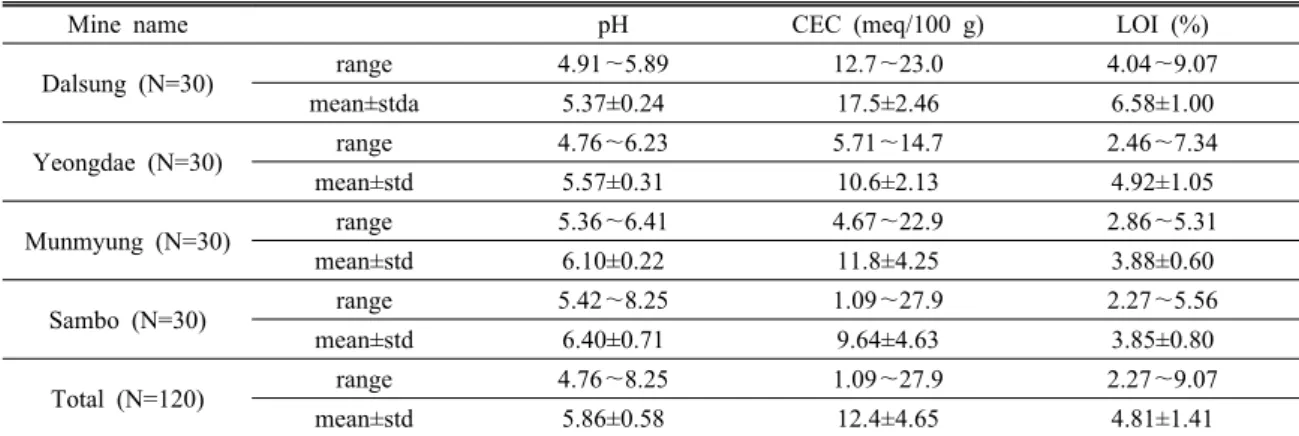
연구대상지역 농경지 토양의 pH, CEC 및 LOI 측정 결과를 Table 2에 정리하였다. 토양의 pH는 중금속들의 화학적 거동과 오염 이동을 결정하는 중요한 요소이며
Table 3. Mean and range of As and heavy metals in soils extracted by aqua regia and various extraction methods (unit in mg/kg, dry weight)
As Cd Cu Pb
Aqua regia (N=40)
range 2.280~704.1 N.D~12.82 10.03~291.4 21.76~885.2
mean±stda 55.64±108.2 1.970±2.470 56.71±59.15 123.9±135.8 1M MgCl2
(N=40)
range 0.002~0.090 0.076~5.572 0.008~2.184 0.160~58.40
mean±std 0.030±0.020 0.670±0.920 0.200±0.340 3.360±7.060 0.01M CaCl2
(N=40)
range N.D~0.085 0.010~2.035 0.005~0.630 N.D~0.450
mean±std 0.010±0.010 0.240±0.380 0.070±0.100 0.060±0.070
Bowen(1979) range 0.1~40 0.01~2 2~250 2~300
mean 6 0.35 30 35
Shacklette and Boerngen(1984)
range 0.1~97 - 1~700 10~700
mean 7.2 - 25 19
N, number of samples, N.D, not detected
aarithmetic mean±standard deviation
(Alloway, 1990), 대부분의 금속은 산성 산화환경에서 이동도가 크고, 알칼리성 환원환경에서는 이동도가 제한 되어 광물 상태로 침전되거나 음이온들과 착화합물을 형성하여 생물유효도(bioavailability)가 감소하게 된다 (Schreiber et al., 1999). 비소는 산화음이온 형태로 존재 하므로 pH가 높을수록 높은 용해도를 보이는 반면, 중금 속은 pH가 낮을수록 높은 용해도를 보인다. 조사지역을 광산별로 pH를 확인한 결과 전반적으로 6이하의 낮은 pH 값을 보여 상대적으로 중금속의 유출이 쉬운 환경에 놓여있으며, 2012년도 환경부 토양측정망의 논토양(평 균 6.4)에 비해 다소 낮은 경향을 보이고 있다. Jung 등 (2002)이 연구한 달성광산 직하부 토양과 비교한 결과 이번 조사에서는 상대적으로 높은 pH가 확인되었다.
CEC의 경우 달성광산에서 평균 17.5 meq/100 g으로 나 타났으며, 나머지 광산은 비슷한 평균함량 값을 보이고 있다. 전체 광산에 대한 함량 범위(평균, meq/100g)는 1.09~27.9(12.4)로 조사되었으며, Jung 등(2002)와 유 사한 평균값을 나타내었다. LOI는 이온교환성 형태의 토양에서 중금속을 고정하는 중요한 역할을 한다 (McCauley et al., 2009). LOI의 젼체 광산에 대한 함량 범위(평균, %)는 2.27~9.07(4.81)의 값을 보이며, 다른 광산에 비해 달성광산에서 높은 값을 보이고 있다.
토양의 중금속 함량
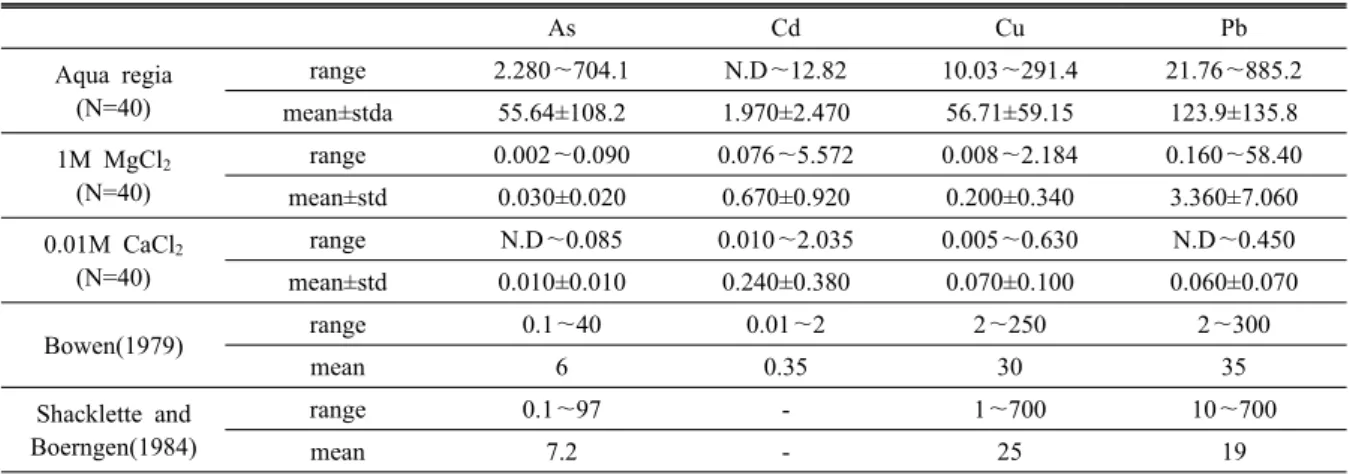
토양시료에 대한 비소 및 중금속 함량을 파악하기 위 해 왕수와 단일용출제를 이용하여 원소들의 용출량을 조 사하였다(Table 3). 왕수로 추출한 토양의 As, Cd, Cu
및 Pb 농도 함량 범위(평균, mg/kg)는 각각 2.280~
704.1(55.64), 불검출~12.82(1.970), 10.03~291.4(56.71) 및 21.76~885.2(123.9)로 나타났다. 토양의 오염정도를 원소별로 비교하기 위해 Bowen(1979)이 제시한 세계 평균값과 비교한 결과 As 9배, Cd 5배, Cu 2배 및 Pb 4배 정도 높은 함량을 보이고 있으며, 2012년도 우리나 라 토양측정망 및 토양오염실태조사(KMOE, 2012)와 비교한 결과 As 10배, Cd 2배, Cu 3배 및 Pb 5배 이상 높은 함량을 나타냈다. 이는 광산에 의해 발생된 오염물 질이 주변 농경지 토양에 영향을 주고 있음을 시사해 주 는 것이다. 1 M MgCl2로용출한 토양의 중금속 농도 (mg/kg)의 범위(평균)는 As 0.002~0.09(0.03), Cd 0.076~5.572(0.67), Cu 0.008~2.184(0.2) 및 Pb 0.16~
58.4(3.36)로 나타났다. 그리고 0.01 M CaCl2로용출한 토양의 중금속 농도(mg/kg)의 범위(평균)는 As 불검 출~0.085(0.01), Cd 0.01~2.035(0.24), Cu 0.005~
0.63(0.07) 및 불검출~0.45(0.06)의 함량을 보였다.
고 찰
상대적인 추출비
비소 및 중금속의 함량은 토양의 화학적 형태와 시료 분해 방법들에 따라 다양하게 나타난다. Alloway(1990) 에 의하면 왕수분해법(aqua regia extraction)은 원소의 총 농도에 70~90% 정도 검출된다고 알려져 있다. 이에 따라 Son과 Jung(2011)이 제안한 왕수에 대한 개별 추 출제의 상대적인 추출율(relative extraction ratio, RER)을
Fig. 2. Variations in calculated relative extractions ratio (RER) for As and heavy metals in paddy soil samples extracted by various extraction methods.
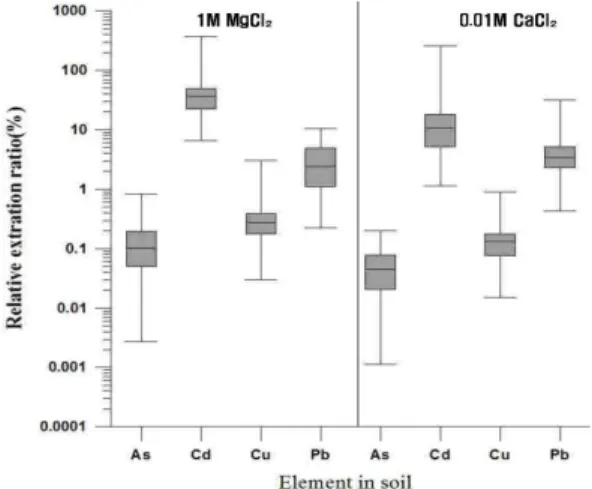
아래의 식 (1)을 활용하여 구하였으며, 비소와 중금속의 추출율을 Fig. 2에 도시하였다.
Relative extraction ratio(%)
= concentration extracted by individual extractant(mg/kg) concentration extracted by aqua regia(mg/kg)
× 100 (1)
식 (1)을 이용하여 비소 및 중금속 원소들의 추출율을 살 펴본 결과, 1M MgCl2에서 As는 0.15%, Cd 58%, Cu 0.3% 및 Pb 3.0%의 추출율을 보였다. 이 연구와 동일한 추출법을 사용한 Kwon 등(2013)이 조사한 추출율 결과 와 비교하면 As와 Cu는 비슷한 추출율을 보이고 있지만 Cd는 다소 높게 나타났다. 또한 Meers 등(2007)이 제시 한 Cd의 추출율과는 유사한 값으로 나타났다.
0.01M CaCl2를 적용한 토양의 원소 추출율은 As 0.05%, Cd 21.2%, Cu 0.14% 및 Pb 5.1%로 조사되었다.
이는 Sahuquillo 등(2003)의 결과와 비교한 결과, Cd과 Cu에서는 낮은 추출율을 보였고, Pb에서만 높은 추출율 을 나타냈다. 단, As의 경우 1M MgCl2와 비슷하게 매우 낮은 추출율을 보였다. 전반적으로 As를 제외하고는 1M MgCl2가 0.01M CaCl2보다 높은 추출율을 보였다. 특히 다른 원소에 비해 Cd의 용출율이 높은 이유는 지구화 학적으로 이동성이 높은 원소이며, 또한 pH가 6미만의 산성토양이므로 pH에 따른 토양에서 중금속의 용해도 와 이동도에 영향을 미친 것으로 판단된다(Burgos et al., 2006). 반면에 As에서는 모든 용출제에서 낮은 추출율을 보이는데, 이는 원소의 특성상 염기성 상태의 토양에서
용해도가 높기 때문으로 판단된다(Marin et al., 1993).
또한 납과 구리는 지구화학적으로 이동도가 낮은 원소이 며, 또한 유기물함량에 따라 구리의 이동성이 제한되는 경향이 있기 때문으로 판단된다. 두 용출법이 용출률이 차이가 나는 이유는 두 용출액의 농도 차이에 의해 낮은 함량을 보이거나 또는 기기검출한계 이하의 농도를 보여 통계적으로 유의성이 낮을수도 있지만 전반적으로는 1M MgCl2가 높게 나온 것을 확인하였다.
용출방법에 따른 비소 및 중금속의 함량변화
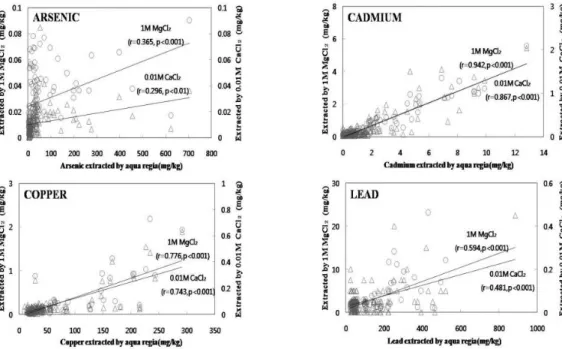
총 120개 시료를 왕수분해법과 1M MgCl2, 0.01M CaCl2을 용출법으로 분석한 As 및 중금속의 원소함량 상관관계를 Fig. 3에 도시하였다. 왕수분해와 단일 용출 제와의 상관관계는 엑셀 프로그램의 회귀분석 방법을 활 용하였다. 1M MgCl2용출법에서 As, Cd, Cu 및 Pb의 상 관계수는 각각 0.365, 0.942, 0.776 및 0.594로 통계적으 로 유의한 상관관계를 보였다(p<0.001). 모든 원소에서 통계적으로 유의한 양의 상관관계를 보이지만, 상관계수 를 비교한 결과 Cd에서 가장 높은 상관계수 값을 보였으 며, 이는 원소의 지구화학적으로 이동성이 높은 점과 잘 부합되며, As에서 가장 낮은 값을 보였다.
0.01M CaCl2로 용출한 결과에 대한 Cd, Cu 및 Pb의 상관계수는 각각 0.867, 0.743 및 0.481로 이들 역시 통 계적으로 매우 유의한 상관성를 보였으며(p<0.001), As 도 0.296으로 양의 상관관계를 보였다(p<0.01). 전반적 으로는 1M MgCl2 용출법이 0.01M CaCl2 용출법 보다 상대적으로 높은 상관성을 보이고 있으며, 특히 Cd에서 는 두가지 용출법에서 매우 높은 상관계수를 나타냈지만 비소에서는 모두 낮은 상관계수를 나타냈다. 즉 현재 국 내에서 사용하는 왕수분해법은 토양 내 존재하는 금속의 총 함량을 확인하는 방법으로 위해성 평가에는 좋은 방 법이나 생물유효도를 측정하는데는 좋은 방법은 아니다. 따라서 생물유효도를 측정하는 용출제를 알아보기 위해 왕수와 상관성 분석을 통해 최적의 용출제를 확인 한 결 과 전반적으로 높은 상관성을 보여 생물유효도 측정시 왕수분해를 대체하는 방법으로 적합할 것으로 판단된다.
다중회귀분석
중금속은 토양의 여러 가지 요소들에 의해 발생되며, 다중회귀분석을 이용하여 금속 농도를 예측하는 연구가 수행되었다(Browne et al., 1984; Meer et al., 2007; Jung, 2008). 토양의 농도에 영향을 미치는 여러 요인을 확인 하기 위해 대표적인 토양특성인 pH, CEC, LOI 등과 토 양의 왕수분해값을 변수로 하였다. 즉 어떤 요인이 토양 용출에 주요한 인자인지 보기 위해서 다중회귀분석을
Fig. 3. Linear regression of As and heavy metal concentrations in soils extracted by aqua regia versus various extraction methods (○: 1M MgCl2, △: 0.01 CaCl2).
Table 4. Results of stepwise linear multiple regression analysis(N=120)
Extraction Multiple regression equation r2
1 M MgCl2
Asextraction = 0.002pH – 0.003LOI + 0.02 17%
Cdextraction = 0.34AR + 0.11pH + 0.02CEC – 0.03LOI – 0.73 89%
Cuextraction = 0.005AR + 0.01pH – 0.01CEC + 0.02LOI – 0.11 61%
Pbextraction = 0.04AR + 1.5pH + 0.28CEC – 0.71LOI – 9.85 53%
0.01 M CaCl2
Asextraction = 0.004pH – 0.013 14%
Cdextraction = 0.13AR + 0.03pH + 0.02CEC – 0.02LOI – 0.3 79%
Cuextraction = 0.001AR + 0.002pH – 0.003CEC + 0.008LOI – 0.02 56%
Pbextraction = 0.02pH + 0.001CEC – 0.0011LOI – 0.1 28%
수행하였으며, 이에 대한 결과를 Table 4에 정리하였다.
R값은 상관성을 설명하기 위해 사용된 값이며, R2은 회 귀식의 설명에 사용하는 값이므로 본 식에는 R2를 제시 하였다. 다중회귀분석은 아래의 평형식을 사용하였으며, 표에 제시된 모든 식은 유의수준 5% 이내의 결과만을 표기하였다. As에서는 모든 용출제에서 20% 이하의 낮 은 결정계수를 보였으며, 또한 토양의 물리화학적 요소 중에서 pH에 가장 많은 영향을 받는 것을 확인 할 수 있었다. Cd의 경우 1M MgCl2, 0.01M CaCl2는 각각 결 정계수 89%, 79%로 높은 값을 보이고 있으며, Cu는 비 슷한 값을 나타냈다. Pb에서는 1M MgCl2에 비해
0.01M CaCl2는 낮은 결정계수 값을 보여 상관성이 낮은 것으로 확인하였다.
YExtraction = αAR + βpH + γCEC + δLOI + ε (2)
YExtraction = extracted As, Cd, Cu and Pb
AR = Aqua regia(mg/kg) pH = soil pH
CEC = soil cation exchange capacity(meq/100g) α, β, γ, δ and ε = constants
결 론
이 연구에서는 금속의 이동성평가와 생물학적 이용 성을 확인하기 위해 용출제를 활용하여 농경지 토양의 As, Cd, Cu 및 Pb 농도의 함량변화와 추출율을 비교한 결과는 다음과 같다.
왕수를 이용하여 용출한 토양의 중금속 평균 함량 (mg/kg)은 As 55.64, Cd 1.970, Cu 56.71 및 Pb 123.9 로서 세계 평균값과 비교한 결과 모두 높은 함량을 보여 광산에 의해 발생된 오염물질이 주변 농경지에 직접 영 향을 주고 있음을 확인하였다. 상대적인 추출비를 확인 한 결과 Cd에서 가장 높은 추출율을 보이며, As에서 가 장 낮은 값을 보였다. 또한 1M MgCl2가 모든 원소에서 0.01M CaCl2보다 높은 추출율을 보였다. 왕수분해법과 다양한 용출제의 화학분해 방법에 따른 원소함량을 비교 해 본 결과 1M MgCl2에서는 모든 원소에서 통계적으로 유의한 상관성을 보이고 있으며(p<0.001), 0.01M CaCl2
에서는 Cd, Cu 및 Pb에서는 높은 상관관계를 나타내었 다(p<0.001). As도 0.296으로 양의 상관관계를 보이고 있으며(p<0.01), 상관계수를 원소별로 비교한 결과 2개 의 용출제 모두 Cd > Cu > Pb > As 순으로 나타났다.
어떤 요인이 토양 용출에 주요한 인자인지 확인하기 위 해 토양의 왕수분해, 토양 pH, CEC 및 LOI을 변수로 하 여 다중회귀분석을 수행한 결과 통게적으로 유의한 회귀 식을 얻었다. 이러한 결과는 토양 용출에 영향을 미치는 요인을 확인 할 수 있었다.
References
Alloway, B.J., 1990, “Heavy metal in soil,” Blackie&Son, Glasgow.
Alloway, B.J., Jackson, A.P. and Morgan, H., 1990, “The accumulation of cadmium by vegetables grown on soils contaminated from a variety of sources,” Sci. Tot. Environ., Vol. 91, pp. 223-236.
Ball, D.F., 1964, “Loss-on-ignition as an estimate of organic matter and organic carbon in non-calcareous soil,” Soil Sci., Vol. 15, pp. 84-92.
Bowen, H.J.M., 1979, “Environmental Chemistry of the Elements,” Academic Press.
Browne, C.L., Wong, Y.M. and Buhler, D.R., 1984, “A predictive model for taw accumulation of cadmium by container-grown plants,” J. Environ. Qual., Vol. 13, pp.
184-188.
Brun, L.A., Mailler, J., Hinsinger, P. and Pepin, M., 2001,
“Evaluation of copper availability to plants in copper-
contaminated vineyard soils,” Environ. Pollut., Vol. 111, No. 2, pp. 293-302.
Burgos, P., Madejon, E., Prez-de-Mora, A. and Cabrera, F., 2006, “Spatial variability of the chemical characteristics of a trace-element-contaminated soil before and after remediation,” Geoderma, Vol. 130, pp. 157-175.
Chaignon, V., Sanchez-Neira, I., Herrmann, P., Jaillard, B.
and Hinsinger, P., 2003, “Copper bioavailability and extractability as related to chemical properties of contaminated soils from a vine growing area,” Environ.
Pollut., Vol. 123, No. 2, pp. 229-238.
DIN, Deutsches Institut fur Normung., 1997, “Boden- beschaffenheit-Extraktion von Spurenelementemit Ammonium- mitratlosung. Vornorm DINV 19730, DIN Boden-Chemische Bodenuntersuchungs-Chemische Bodemuntersuchungs-verfahren,”
Beuth Verlag, Berlin, Germany.
Ehlken, S. and Kirchner, G., 2002, “Environmental processes affection plant root uptake of radioactiove trace elements and variability of transfer factor data. A review,” J. of Environ. Radioactivity., Vol 58, No. 2-3, pp. 97-112.
Filgueiras, A.V., Lavilla, I. and Bendicho, C., 2002,
“Chemical sequential extraction for metal partitioning in environmental solid samples,” J. of Environmental Monitoring, Vol. 4, No. 6, pp. 823-857.
Hammer, D. and Keller, C., 2002, “Changes in the rhizosphere of metal accumulation plants evidenced by chemical extractants,” J. of Environmental Quality., Vol. 31, No.
5, pp. 1561-1569.
Haq, A.U., Bates, T.E. and Soon, Y.K., 1980, “Comparison of extractants for plant-available zinc, cadmium, nickel, and copper in contaminated soils,” J. of Soil Science Society of America., Vol. 44, pp. 772-777.
Hong, C.O., Gutierrez, J., Yun, S.W., Lee, Y.B. and Yu, C., 2009, “Heavy metal contamination of arable soil and corn plant in the vicinity of a zinc smelting factory and stabilization by liming,” Arch. Environ. Contam. Toxicol., Vol. 56, No. 2, pp. 190-200.
Janos, P., Vavrova, L., Herzogova, L. and Pilarova, V., 2010, “Effects of inorganic and organic amendments on the mobility (leachability) of heavy metals in contaminated soil. A sequential extraction study,” Geoderma., Vol. 159, No. 3-4, pp. 335-341.
Jeon, J.W., Bae, B.H. and Kim, Y.H., 2012, “Feasibility Test for Phytoremediation of Heavy Metals-Contaminated Soils using Various Stabilizers,” J. of Geoenvironmental Society., Vol. 13, No. 3, pp. 59-70.
Jeong, S.K., An, J.S., Kim, Y.J., Kim, G.H., Choi, S.I. and Nam, K.P., 2011, “Study on Heavy Metal Contamination Characteristics and Plant Bioavailability for Soils in the
Janghang Smelter Area,” J. of Soil and Groundwater Environment, Vol. 16, No. 1, pp. 42-50.
Jung, M.C., 1995, “Heavy metal contamination of soils, plants, waters and sediments in the vicinity of metalliferous mines in Korea,” Unpublished PhD thesis, University of London.
Jung, G.B., Kim, W.I. and Ryu, I.S., 2000, “Fractionation and Availability of Heavy Metals in Paddy Soils near Abandoned Mining Areas,” J. of Environmental Agriculture., Vol. 19, pp. 319-323.
Jung, M.C., Thornton, I. and Chon, H.T., 2002, “Arsenic, Sb and Bi contamination of soils, plants, waters and sediments in the vicinity of the Dalsung Cu-W mine in Korea,” Sci Tot Environ., Vol. 295, pp. 81-89.
Jung, M.C., 2008, “Heavy Metal Concentrations in Soils and Factors Affecting Metal Uptake by Plants in the Vicinity of a Korean Cu-W Mine,” Sensors., Vol. 8, pp.
2413-2423.
KMOE (Korea Ministry of Environment), 2007, “Detailed survey for soil and water contamination in abandoned metal mines in Korea,” Korea Ministry of Environment, Sejong.
KMOE (Korea Ministry of Environment), 2011, “Soil Environment Conservation Act,” Korea Ministry of Environment, Sejong.
KMOE (Korea Ministry of Environment), 2012, “Soil monitoring system and soil pollution survey in 2012,”
Korea Ministry of Environment, Sejong.
Ko, M.S., Pakr, H.S. and Lee, J.U., 2009, “Bioleaching of heavy metals from tailings in abandoned Au-Ag mines using sulfur-oxidizing bacterium Acidithiobacillus thiooxidans,”
J. Kor. Soc. Geosystem Eng., Vol. 46, No. 2, pp. 239-251.
Kwon, J.C., Jeong, S.H., Jung, M.C. and Kim T.S., 2013,
“Seasonal Variation and Correlation between Soil and Crop Plant of Arsenic and Heavy Metal Concentrations in Paddy Fields around the Yeongdae Au-Ag Mine, Korea,” J. of the Korean Society of Mineral and Energy Resources Engineers, Vol. 50, No. 2, pp. 212-226.
Li, J.X., Yang, X.E., He, Z.L., Jilani, G., Sun, C.Y. and Chen, S.M., 2007, “Fractionation of lead in paddy soils and its bioavailability to rice plants,” Geoderma, Vol.
141, No. 3, pp. 174-180.
Marin, A.R., Masscheleyn, P.H. and Patrick, W.H., 1993,
“Soil erdox-pH stability of arsenic species and its influence on arsenic uptake by rice,” Plant Soil., Vol.
152, No. 2, pp. 245-253.
McCauley, A., Jones, C. and Jacobsen, J., 2009, “Soil pH AND Organic Matter,” Nutrient management modules 8,
#4449-8. MontanaState University Extenxion Service,
Bozeman, Montana, pp. 1-12.
Meers, E., Du Laing, G., Unamuno, V., Ruttens, A., Vangronsveld, J., Samson, R., Tack, F.M.G. and Verloo, M.G., 2007, “Comparison of Cd Extractability from Soils and Sediments by Commonly Used Single Extraction Protocols,” Geoderma, Vol. 141, pp. 247-259.
MIRECO (Korea Mine Reclamation Corporation), 2012,
“Mine Reclamation Statistical Yearbook,” Korea Mine Reclamation Corporation, Seoul.
Norvell, W.A., 1984, “Comparison of chelationg agents as extractants for metals in diverse soil materials,” J. of Soil Science Society of America., Vol. 48, pp. 1285-1292.
Park, D.H., Cho, Y.C. and Choi, S.I., 2010, “The laboratory column examination of stabilization for agricultural land contaminated by heavy metals using sequential extraction,”
J. Soil&Groundwater Env., Vol. 15, No. 4, pp. 39-45.
Sahuquillo, A., Rigol, A. and Rauret, G., 2003, “Overview of the use of leaching/extraction tests for risk assessment of trace metals in contaminated soils and sediments,”
Trends in Analytical Chemistry., Vol. 22, No. 3, pp.
152-159.
Schreiber, M.E., Simo, J.A. and Freiberg, P.G., 1999,
“Stratigraphic and geochemical controls on naturally occurring arsenic in groundwater, eastern Wisconsin, USA,” Hydrogeology Journal., Vol. 8, pp. 161-176.
Shacklette, H.T. and Boerngen, J.G., 1984, “Element Concentrations in Soils and Other Surficial Materials of the Conterminous United Stater,” USGS Paper 1270, U.S.
Geological Survey, Washington, DC.
Smith, R.T. and Atkinson, K., 1975, “Technique of Pedology,”
Elek Sci. Pub.: London, pp. 125-137.
Son, H.O. and Jung, M.C., 2011, “Relative extraction ratio(RER) for arsenic and heavy metals in soils and tailings from various metal mines, Korea,” Environ.
Geochem. Health., Vol. 33, pp. 121-132.
Tessier, A., Campbell, P.G.C. and Bisson, M., 1979,
“Sequential extraction procedure for the speciation of particulate trace metals,” Anal. Chem., Vol. 51, pp. 844-851.
Tipping, E., Rieuwerts, J., Pan, G., Ashmore, M.R., Lofts, S., Hill, M.T.R., Farago, M.E. and Thornton, I., 2003,
“The solid-solution partitioning of heavy metals (Cu, Zn, Cd, Pb) in upland soils of England and Wales,” Environ.
Pollut., Vol. 125, No. 2, pp. 213-225.
US EPA, 1992, “Toxicity Characteristic Leaching Procedure,”
US Environmental Protection Agency, Method 1311, Test Methods for Evaluating Solid Waste: Physical/Chemical Methods (SW-846), p. 35.
Ure, A.M., 1995, “Methods of analysis for heavy metals in soils,” Blackie and Son, Glasgow, pp. 58-102.
권 지 철
현재 서울대학교 농업생명과학대학 농생명과학공동기기원 선임 연구원
(本 學會誌 第50券 第6号 參照)
이 명 규
2010년 인하대학교 환경공학과 공학석사
현재 한국세라믹기술원 시험표준센터 연구원 (E-mail; [email protected])
정 명 채
1989년 서울대학교 공과대학 자원공학 과 학사
1991년 서울대학교 대학원 자원공학과 석사
1995년 영국 런던대학교 임페리얼대학 박사
현재 세종대학교 에너지자원공학과 교수 (E-mail; [email protected])
Van Ranst, E., Verloo, M., Demeyer, A. and Pauwels, J.M., 1999, “Manual for the soil chemistry and fertility laboratory:
analytical methods for soils and plants equipment, and management of consumables,” International Training Centre for Post-Graduate Soil Scientists, Universiteit Gent, Gent,
Belgium.
VSBo, V.S., 1986, “Verordnung uber Schadstoffgehalt im Boden, Swiss ordinance on polluttants in soils,” Nr.
814.12, Publ. Eidg. Drucksachen und Materialzentrale (EDMZ), 3000 Bren, Switzerland.