Background : BK virus-associated hemorrhagic cystitis (BKV-HC) is a common complication after allogeneic hematopoietic stem cell transplantation. Supportive measures, including painkillers, hyper-hydration, continuous bladder irrigation, transfusion, have been the standard of care for many years. Recently, clinicians have used intravenous or intravesical cidofovir for severe cases of BKV-HC. Cidofovir provides clinical improvement but has a risk of renal failure. To raise effect of remedy without increasing renal toxicity, intravenous and intravesical cidofovir combination therapy may be proposed.
Methods : We retrospectively reviewed the electronic medical records of 12 pediatric and adolescent cancer patients with BKV-HC treated with 5 mg/kg intravenous and 3-5 mg/kg intravesical cidofovir weekly at an institution January 2012-June 2016. Data for hematuria and other urinary symptoms,
BK 바이러스로 인한 출혈성 방광염이 발생한
소아청소년 암환자에서 cidofovir 정맥 및 방광 내 병용요법의 임상적 유효성과 안전성
김민경
a, 이윤선
a, 김재송
a, 손은선
a,�, 유철주
b연세대학교의료원 세브란스병원 약무국
a, 소아혈액종양과
bIntravenous and Intravesical Cidofovir for BK Virus-Associated Hemorrhagic Cystitis in Pediatric and Adolescent Cancer Patients
Min Kyeong Kim
a, Yoon Sun Ree
a, Jae Song Kim
a, Eun Sun Son
a,�and Chuhl Joo Lyu
bDepartment of Pharmacy
a, Department of Pediatric Hematology and Oncology
b, Severance Hospital, Yon-sei University Health System, 50-1 Yonsei-ro, Seodeamun-gu,
Seoul, 03722, Republic of Korea
투고일자 2017.1.26; 심사완료일자 2017.2.27; 게재확정일자 2017.12.28
�교신저자 손은선 Tel:02-2228-6888 E-mail:[email protected]
Original Article
연구배경
출혈성 방광염은 cyclophosphamide 등의 항암제, 이식편대숙주병, 혈소판 감소증, 응고장애로 인하여 발 생할 수 있으나, 이외에도 동종 조혈모세포이식 후에 발생하는 흔한 합병증으로 알려져 있다.
1),2)이식 초기의 출혈성 방광염은 cyclophosphamide, busulfan 등 전 처치 약물요법의 독성으로 인해 발생하며, 이식 후기에 는 면역억제로 인해 BK 바이러스(BK virus, 이하 BKV)가 재활성화되어 비뇨기 상피세포에 직접적으로 손상을 주거나 면역반응을 유도하여 간접적으로 발생 하게 된다.
3)이러한 BKV로 인한 출혈성 방광염(BK virus-associated hemorrhagic cystitis, 이하 BKV-HC)은 조혈모세포이식 환자 군에서 7-70% 까 지도 발생한다고 보고되었으며, 발생할 경우 동종 조혈 모세포이식 후 환자의 재원일수를 증가시키고 생명까 지도 위협할 수 있다.
4)-6)BKV-HC의 치료는 주로 진통제, 수액공급, 이뇨제, 방광관류, 수혈 등의 대증적 방법뿐이었으나,
7)최근에 는 심각한 출혈성 방광염에 cidofovir의 정맥 또는 방 광 내 투여를 사용하고 있다.
8),9)Cidofovir는 광범위한 DNA 바이러스에 작용하는 약제로, BKV-HC 치료에 는 용법과 용량에 대한 가이드라인이 명확하지 않지만, 보통 3가지 방법으로 사용된다. 첫 번째로 가장 많이
사용되는 방법은 신독성을 예방하기 위해 probenecid 와 병용하여 3-5 mg/kg cidofovir 를 정맥 내 투여하 는 방법이다.
1),7),10),11)두 번째는 0.25-1.5 mg/kg의 저용 량 cidofovir를 정맥 내 투여하는 방법이고,
1),7),8)세 번 째는 5 mg/kg cidofovir를 60 mL 생리식염수에 섞어 방광 내 주입하는 방법이다.
12)-16)Cidofovir 정맥주사는 BKV의 증식을 억제하는데 효과적이나,
8)부작용으로 신독성이 발생할 수 있다. 반면에 cidofovir의 방광 내 투여로 인한 심각한 부작용은 아직 보고된 바가 없으 나, 효과에 대해서는 논란의 여지가 있다.
15),16)따라서 cidofovir를 정맥 및 방광 내로 병용 투여한다면, 신독 성은 높이지 않으면서 방광 내 약물 농도를 높여 치료 효과를 증대시킬 것으로 기대해 볼 수 있다.
그러나 선행연구를 살펴보면 BKV-HC 치료에 대한 cidofovir는 그 연구 수가 적고 주로 소규모 환자를 대 상으로 하였으며,
16),17)장기간의 추적 연구나 소아를 대 상으로 보고된 증례도 부족한 실정이다.
7),16)현재까지 cidofovir의 정맥 및 방광 내 투여의 비교 연구는 이뤄 지지 않았으며, 병용 투여는 각 연구마다 1-2명의 사 례 보고 외에는 거의 없다.
10)이에 본 연구에서는 선행 연구 결과를 바탕으로 단일 기관에서 소아에게 cido- fovir를 정맥 및 방광 내로 병용 투여한 사례를 후향적 으로 분석하여 효과 및 안전성을 평가해보고자 한다.
urine and plasma BK virus titers, and serum creatinine were collected. Clinical response was defined as improvement in symptoms or reduction in cystitis grade. Microbiological response was defined as at least a 1 log reduction in urinary and blood BK viral load. Nephrotoxicity was defined as a 0.3 mg/dL or greater increase in serum creatinine at any time up to 2 weeks after treatment with cidofovir.
Results : Clinical response was achieved in 8 patients (66.7%). Urinary microbiological response was recorded in 4 patients (33.3%) and blood microbiological response was in 2 patients (16.7%). Four patients presented nephrotoxicity, but 2 of them were combined with sepsis and the others represent- ed mild symptoms.
Conclusion : Intravenous and intravesical cidofovir may be a useful option to provide symptomatic relief in patients with BKV-HC, but the close monitoring about renal function should be required.
[Key words] BK virus-associated hemorrhagic cystitis, Cidofovir, Intravesical cidofovir
연구방법
1. 대상 환자
1) 연구대상
2012년 1월 1일부터 2016년 6월 30일까지, 세브란스 병원 소아혈액종양과에서 치료를 받은 소아청소년(만 1-18세) 암환자 중 BKV-HC가 발생하여 cidofovir를 정맥 및 방광 내 병용 투여한 환자를 대상으로 하였다.
2) 제외대상
임상증상 평가와 BKV-polymerase chain reaction (이하 BKV-PCR) 정량 검사 기록이 없는 환자, 의무기 록상 serum creatinine (이하 SCr) 수치 변화를 파악 할 수 없는 환자 및 cidofovir 첫 투여 당시 신부전 환 자는 제외하였다. 단, cidofovir 첫 투여 이후 신 대체 요법을 시행하게 된 환자는 배제하지 않았다.
또한 조사기간 중 cidofovir를 정맥 또는 방광 내 단 독 투여한 경우에는 병용투여 횟수에서 제외하였다.
2. 자료 수집
전자의무기록을 이용해 후향적으로 연구를 진행하였 으며, 다음 항목에 대해 정보를 수집하였다. 환자군 개 별 정보 항목으로 성별, 나이, 진단명, 재발 여부를 조 사하였으며, 조혈모세포이식 관련 정보로 조혈모세포 이식 여부, 시행날짜, human leukocyte antigen (HLA)-match 여부, stem cell source를 수집하였다.
항암화학요법 중인 경우에는 투여 항암제 및 용량을 수 집하였다. Cidofovir 투여 관련 항목으로는 투여경로, 용량, 횟수, 신독성 감소를 위한 보조약제 투여 여부를 포함하였다. Cidofovir 효과를 평가하기 위해 증상, 뇨 검사 수치, 뇨 및 혈액 내 BKV-PCR 정량 검사 수치 를 확인하였으며, 부작용 관련 항목으로써 SCr에 대한 데이터를 수집하고, 신기능에 영향을 주는 약물 (ibuprofen 등 NSAID, furosemide, amphotericin B, gentamicin, amikacin, meropenem, ampi- cillin/sulbactam, tazobactam/piperacillin, clar-
ithromycin 등)의 병용 투여 여부를 확인하였다.
3. 대상 약물
연구에 사용된 cidofovir는 비스타이드주 (Vistide inj
�, 한국희귀의약품센터)로 1 vial은 cidofovir 375 mg을 포함한다.
세브란스병원 소아혈액종양과에서 cidofovir 사용 시, 증상이 호전 될 때까지 적어도 1주일 이상의 간격 으로 이틀에 걸쳐 투여한다. 우선 probenecid 2,000 mg과 생리식염수 1 L를 투여한 후, cidofovir 5 mg/kg를 생리식염수 100 mL에 섞어 정맥 내 주사한 다. 2시간, 8시간 후 각각 probenecid 1,000 mg을 투 여하고, 24시간 이내에 cidofovir를 60 mL 생리식염 수에 섞어 방광 내 주입한다. 단, 정맥 및 방광 내 투여 하는 cidofovir의 용량은 총 375 mg을 넘지 않으며, 15세 미만이면서 50 kg 미만일 경우에는 probenecid 와 수액공급을 소아 체격에 맞춰 조절하여 사용한다.
20)
4. 자료 분석
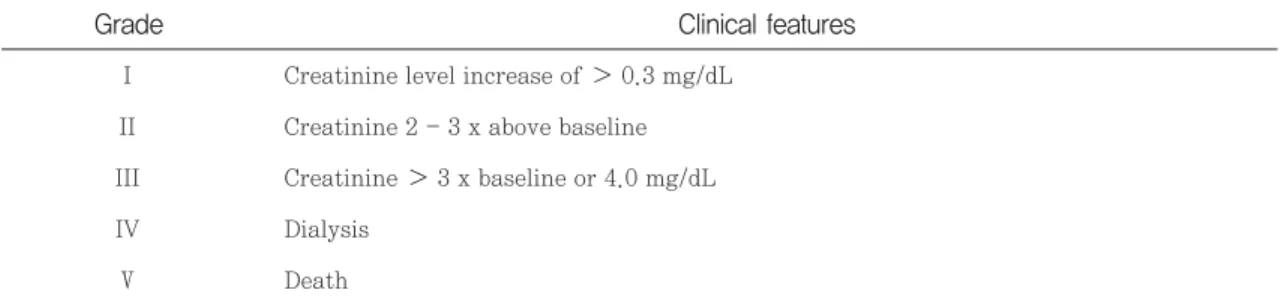
출혈성 방광염의 임상증상으로 혈뇨, 핍뇨, 빈뇨, 긴 박뇨, 배뇨통 등의 비뇨기계 증상을 분석하였고, 심각 도는 Grade Ⅰ-Ⅳ로 분류하였다(Table 1).
9)대상 환자 들은 주 1회 real time PCR로 요 및 혈액 내 BKV 정 량 측정하였으며, SCr은 적어도 3일에 한 번 모니터링 하였다.
Cidofovir의 유효성을 평가하기 위해 임상반응과 미
생물학적 반응을 분석하였다. 임상반응은 모든 증상이
해소되었을 때 complete response, 비뇨기계 증상이
감소하였거나 출혈성 방광염 Grade가 감소하였을 때
partial response라고 정의하였다. 미생물학적 반응은
마지막 cidofovir 투여 전에 비해 투여 1주일 후에 BK
viral load가 최소 1 log 감소한 때로 정의하였다.
6)신
독성은 투여 전 및 투여 1주, 2주 후에 평가하였는데,
Common Terminology Criteria for Adverse
Events (CTCAE), version 4.03 기준에 따라 SCr 수
치가 0.3 mg/dL 이상 증가한 때와 투석을 시행하게
된 경우로 정의하였다(Table 2).
5. 연구 대상자 보호
본 연구는 연구대상자의 안전 및 보호에 관한 사항 등 을 포함한 연구 계획을 본 연구가 실시된 병원의 기관 윤리심의위원회(Institutional Review Board, IRB)로 부터 승인(IRB No. 2016-2528-001)을 받았다.
연구결과
1. 환자군 특성
BKV-HC로 cidofovir 정맥 및 방광 내 병용 요법을 투여 받은 12명의 환자 중 남자는 8명, 여자는 4명 이 었고, 평균 8.83±4.97세였다. 기저 혈액질환은 acute lymphoblastic leukemia (ALL) 8명, acute myeloid leukemia (AML) 3명, 그리고 burkitt lymphoma 1 명이었다. 12명 중 조혈모세포 이식 후 발생한 환자가 6명, 항암화학요법 중 발생한 환자 5명이었고, 나머지 1명은 항암화학요법 중 발생하여 치료 후 호전되었다 가 이후 조혈모세포이식을 받고 BKV-HC가 재발된
환자였다. 조혈모세포이식 후 BKV-HC가 발생한 환 자 6명 중 2명은 조혈모세포이식 후 기저 혈액 질환이 재발되어 시행한 항암화학요법 중 발생한 경우였다. 조 혈모세포이식 후 BKV-HC 발생한 환자들은 모두 면 역억제제를 복용 중이었다. 항암화학요법 중 발생한 환자 5명 중 4명은 clofarabine, etoposide, cyclophos- phamide 요법을 사용 중이었다(Table 3).
2. Dosing 및 probenecid 병용 분석
1인당 3.75±2.45회 병용 투여 받았으며, 정맥투여 1 회 용량은 4.51±0.96 mg/kg, 방광 내 투여 1회 용량 은 4.17±2.07 mg/kg 이었다. 12명 중 6명의 환자에 서는 병용 투여 외에도 정맥으로만 투여한 경우가 1-7 회 있었고, 이는 당일 외래진료로 하루만 방문했거나, 도뇨관 삽입 부위의 통증 등으로 방광 내 투여를 하지 못한 경우였다. 위의 6명 중 1명의 환자에서는 정맥 외 에도 방광 내로 1회 투여하기도 하였는데, 환자의 일시 적인 기저질환 악화로 신독성이 우려되어 정맥 투여를 시행하지 않은 경우였다. Probenecid를 항상 사용한
Grade Clinical features
Table 1 Clinical grading of hemorrhagic cystitis
9)I Microscopic hematuria II Macroscopic hematuria III II + blood clots
IV III + urinary obstruction, renal impairment, bladder impairment
Grade Clinical features
Table 2 Renal toxicity grade (CTCAE v 4.03)
I Creatinine level increase of 0.3 mg/dL II Creatinine 2 - 3 x above baseline III Creatinine 3 x baseline or 4.0 mg/dL
IV Dialysis
Ⅴ Death
CTCAE = Common terminology criteria for adverse events
환자는 7명으로 나머지 5명의 환자에서는 오심, 구토 등으로 인해 복용이 힘들어 사용하지 않거나 환자의 상 황 및 여건에 따라 사용하지 않은 경우가 있었다(Table 4).
3. 효과 분석
사망으로 평가가 불가능한 2명을 제외하고, 임상증상 의 변화에 대해 평가가 가능했던 환자 10명 중 com-
ALL = Acute lymphoblastic leukemia; AML = Acute myeloid leukemia; BL = Burkitt lymphoma; HSCT = Hematopoietic stem cell transplant; HLA = Human leucocyte antigen; GVHD = Graft-versus-host disease; BKV-HC = BK virus associated hemorrhagic cystitis; bBKV= blood BK virus; uBKV = urine BK virus; BMT = Bone marrow transplant; PBSCT = Peripheral blood stem cell transplant; Haplo-BMT = haploidentical BMT; CPM = Cyclophosphamide; MTX
= Methotrexate ; Bu-Cy = busulfan-cyclophosphamide; IT= Intrathecal; VP-16 = Etoposide; VCR = Vincristine; Ara-C = Cytarabine ; CsA= Cyclosporine;
MMF = Mycophenolate mofetil; TCR = Tacrolimus
* copies/mL
No Age Sex Dia- gnosis
HSCT source
HLA
Disparity Severity bBKV* uBKV*
BKV-HC GVHD Prophylaxis Conditioning regimen or
recently chemotherapy Table 3 Patient characteristics
1 13 M ALL Sibling
BMT Matched Clofarabine CsA (-) (-) 7.38x10⁶
2 5 M ALL,
Ph(+)
Unrelated
PBSCT Matched Clofarabine, VP-16, CPM MMF, TCR (-) (-) 2.5x10⁸
3 17 M ALL Unrelated
PBSCT Matched RE-CNS-consolidation or
RE-CNS-intensification TCR (-) (-) 570,000
4 3 M AML Auto-
PBSCT Matched (-) TCR Ⅰ 27,200 2.5x10⁸
5 5 F ALL Unrelated
PBSCT Matched (-) CsA, TCR Ⅰ (-) 235,000
6 10 M AML Haplo-
BMT Matched Fludarabine, CPM,
MTX IT MMF, TCR Ⅰ 15,400 2.5x10⁸
7 15 M AML Unrelated
PBSCT Matched Bu-Cy, MTX IT TCR Ⅰ 72,200 2.5x10⁸
8 6 F ALL (-) (-) Clofarabine, VP-16, CPM (-) Ⅱ 5,700 2.5x10⁸
9 8 M ALL (-) (-) Clofarabine, VP-16, CPM (-) Ⅰ (-) 2.5x10⁸
10 15 F ALL (-) (-)
Clofarabine, VP-16, CPM or VCR, MTX, L-asparagi-
nase or Nelarabine
(-) Ⅰ 3,590 2.5x10⁸
11 4 F ALL (-) (-)
Clofarabine, VP-16, CPM or VCR, Ara-C, MTX,
L-asparaginase
(-) Ⅰ 43,400 2.5x10⁸
12 5 M BL (-) (-) VCR, MTX, CPM
or Ara-C, VP-16 (-) Ⅱ 7,520 2.5x10⁸
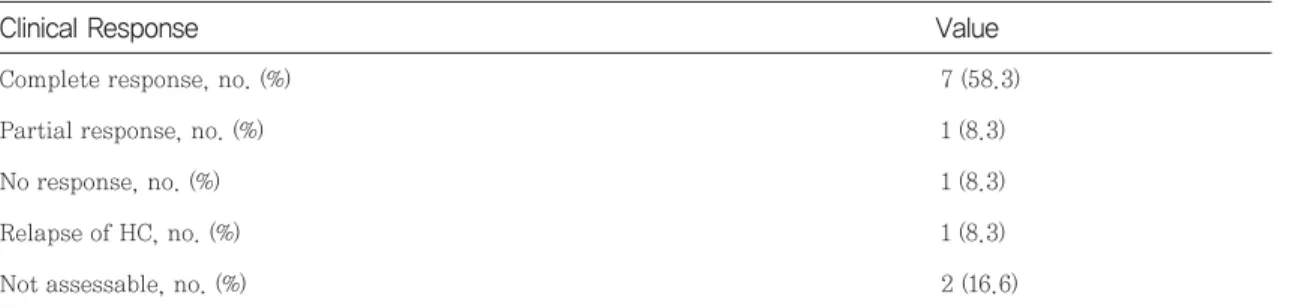
plete response가 7명, partial response가 1명으로 8 명에서 임상증상 개선을 보였다. 임상증상의 변화가 없 었던 환자는 1명, 악화된 환자는 1명이었다(Table 5).
미생물학적 반응은 소변에서 4명이 유의미한 감소를 보였고, 1명에서 오히려 증가, 5명에서는 측정 가능한 값을 초과한 수치가 지속 되었다. 혈액에서는 2명이 유 의미한 감소를 보였고, 2명은 오히려 증가하였다
(Table 6).
4. 부작용 분석
치료 전 SCr은 평균 0.33 mg/dL이었다. 2주 이내 사망한 환자 1명은 신독성을 평가할 수 없어 이를 제외 하고, 총 11명에 대해 신독성 유무를 평가하였다. 각각
Variable Value
Table 4 Clinical characteristics
Route of cidofovir administration
Both* only, no. (%) 6 (50)
Both and additional IV, no. (%) 5 (40.7)
Both and additional BI, no. (%) 0
Both, additional IV and additional BI, no. (%) 1 (8.3) Dose of cidofovir, median (mg/kg)
Intravenous 4.51±0.96
Intravesical 4.17±2.07
No. of cidofovir injections per patient, median doses
3.75±2.45 Probenecid use
Always use, no. (%) 7 (58.3)
Use adjustment, no. (%) 5 (41.7)
BKV-HC = BK virus associated hemorrhagic cystitis
*Both = intravenous and intravesical cidofovir combination therapy
BKV-HC = BK virus associated hemorrhagic cystitis; HC = hemorrhagic cystitis
Clinical Response Value
Table 5 Clinical response after cidofovir treatment
Complete response, no. (%) 7 (58.3)
Partial response, no. (%) 1 (8.3)
No response, no. (%) 1 (8.3)
Relapse of HC, no. (%) 1 (8.3)
Not assessable, no. (%) 2 (16.6)
의 병용투여 전과 투여 1주, 2주 후의 SCr을 비교해 보 았을 때, 신독성 부작용을 나타내지 않은 환자가 7명, 일시적으로 GradeⅠ의 신독성을 보인 환자가 2명, Grade Ⅳ의 신독성을 보인 환자가 2명 이었다 (Table 7). 신기능에 영향을 주는 병용약제로 Grade Ⅰ의 신
독성을 나타냈던 환자 1명은 tacrolimus 및 ampho- tericin B를 투여 중이었고, 다른 1명은 tacrolimus와 trimethoprim-sulfamethoxazole을 투여 중이었다.
또한 Grade Ⅳ의 신독성을 나타냈던 환자 1명은 tacrolimus 등을 병용 중이었고, 다른 1명은 cyclo-
BKV-HC = BK virus associated hemorrhagic cystitis; CDV = cidofovir; N/A = not assessable; BKV = BK virus
BKV-HC = BK virus associated hemorrhagic cystitis
No Urine BKV, copies/mL, log
Pre-CDV Post-CDV Pre-CDV Post-CDV Urine Blood Blood BKV, copies/mL, log Microbiological response Table 6 Microbiological response after cidofovir treatment
1 8.397 6.839 3.4 3.4 Y N/A
2 8.397 8.397 3.4 4.212 N N
3 5.755 7.620 3.4 4.170 N N
4 8.397 8.397 4.434 6.376 N N
5 5.371 6.008 3.4 3.4 N N/A
6 8.397 8.397 4.187 4.390 N N
7 8.397 5.491 4.858 3.492 Y Y
8 8.397 8.397 3.755 4.110 N N
9 8.397 8.397 3.4 3.813 N N
10 8.397 8.313 3.555 4.056 N N
11 8.397 6.824 4.637 3.4 Y Y
12 8.397 5.836 3.876 3.4 Y N
Variable Value
Table 7 Renal toxicity after cidofovir treatment
Serum creatinine pre-cidofovir, median
(mg/dL) [range] 0.33 [0.17-0.44]
Renal toxicity
No toxicity, no.(%) 7 (58.3)
Grade Ⅰ, no.(%) 2 (16.7)
Grade Ⅳ, no.(%) 2 (16.7)
Not assessable, no.(%) 1 (8.3)