509 http://dx.doi.org/10.9713/kcer.2015.53.4.509
PISSN 0304-128X, EISSN 2233-9558
Reduction Leaching of Manganese Dioxide Ore Using Black Locust as Reductant in Sulfuric Acid Solution
Jianrong Xue*,**, Hong Zhong*,†, Shuai Wang*,†, Changxin Li*, Jinzhong Li* and Fangfang Wu*
*College of Chemistry and Chemical Engineering, Central South University, Changsha 410083, China
**School of Chemistry and Chemical Engineering, Hunan University of Science and Technology, Xiangtan 411201, China (Received 14 October 2014; Received in revised form 8 January 2015; accepted 12 February 2015)
Abstract − We investigated the reduction leaching process of manganese dioxide ore using black locust as reductant in sulfuric acid solution. The effect of parameters on the leaching efficiency of manganese was the primary focus. Exper- imental results indicate that manganese leaching efficiency of 97.57% was achieved under the optimal conditions: weight ratio of black locust to manganese dioxide ore (WT) of 4:10, ore particle size of 63 μm, 1.7 mol·L-1 H2SO4, liquid to solid ratio (L/S) of 5:1, leaching time of 8 h, leaching temperature of 368 K and agitation rate of 400 r·min-1. The leaching rate of manganese, based on the shrinking core model, was found to be controlled by inner diffusion through the ash/inert layer com- posed of associated minerals. The activation energy of reductive leaching is 17.81 kJ·mol-1. To conclude the reaction mechanism, XRD analysis of leached ore residue indicates manganese compounds disappear; FTIR characterization of leached residue of black locust sawdust shows hemicellulose and cellulose disappear after the leaching process.
Key words: Manganese Dioxide Ore, Black Locust Sawdust, Reduction Leaching, Reaction Mechanism
1. Introduction
Manganese is a strategic element that is utilized primarily in the steel industry, for fabrication with non-ferrous metallurgy and batter- ies, and many other applications. Rhodochrosite (MnCO3) and pyrolu- site (MnO2) are the two most common forms of manganese ores.
With the growing demand for manganese, once-rich manganese ores are being overexploited at an alarming rate. This has caused the grade of rhodochrosite to decrease from 18-20% to 13-15% in several manganese-concentrated areas [1]. Leaching of manganese dioxide ore is usually performed under reducing conditions, due to its stabil- ity in both acidic and alkaline oxidizing conditions. Generally, a reduction roasting process has been used to convert Mn4+ to Mn2+
first by carbon at about 1100 K when manganese dioxide ore is used for electrolytic manganese production [2]. However, the reduction roasting process leads to a highly complex system, high investment and operating cost.
Hydrometallurgical techniques have grown increasingly popular over more conventional reduction roasting in recent years, favored for their low energy consumption, mild reaction conditions, and environmental benignity. Numerous types of reductants have been applied to leaching manganese from manganese dioxide ore, including aqueous sulfur oxide [3,4], pyrite [5], iron(II) sulfate [6], iron metal [7], oxalic acid [8] and hydrogen peroxide [9]. A wealth of studies have been published recently regarding the use of biomass as reduc-
tants for reductive leaching of manganese dioxide ore, such as waste tea [10], molasses [11,12], molasses alcohol wastewater [13], corn- stalk [14] and corncob [15]. The use of biomass as reductant to leach manganese dioxide ore has been shown to be efficient and simple.
At present, nearly million acres of black locust is cultivated each year in China, with the primary cultivation areas concentrated in temperate regions of western and central of China, the manganese- concentrated areas.
Black locust (Robinia pseudoacacia L.), with its excellent proper- ties (strong adaptability, fast growth, good quality, wide purpose), was introduced from its native range in North America to other con- tinents and currently is cultivated in many places throughout the world [16]. Black locust grows well in metalliferous fields and piled residue sites, due to black locust belonging to nitrogen-fixing plants [16,17]. At present, nearly a million acres of black locust are culti- vated each year in China. And the primary cultivation areas are con- centrated in temperate regions of western and central of China, the manganese-concentrated areas. Besides, massive discarded black locust sawdust is typically processed into semi-finished coal and compres- sion board in black locust wood processing plants. Black locust is a low cost, extensively distributed and easily available resource, con- taining renewable and non-hazardous reducing agent compared to other raw materials that can be used for manganese leaching under mild acidic conditions. In aqueous acid solution, numerous potential reductive components in black locust, such as cellulose and hemicel- lulose, can be hydrolyzed into reductive carbohydrates [18]. There- fore, black locust could be applied to leach manganese dioxide ore in sulfuric acid solution. It may be a promising green process in reduc- tive leaching manganese dioxide ore and efficient renewability of black locust.
†To whom correspondence should be addressed.
E-mail: [email protected] or [email protected]
This is an Open-Access article distributed under the terms of the Creative Com- mons Attribution Non-Commercial License (http://creativecommons.org/licenses/by- nc/3.0) which permits unrestricted non-commercial use, distribution, and reproduc- tion in any medium, provided the original work is properly cited.
In this study, black locust was used as reductant in sulfuric acid solution for reduction leaching of manganese dioxide ore. Effects of specific parameters on the reductive leaching efficiency of manga- nese were investigated, respectively. A kinetic model of the leaching process was studied and ore and black locust materials before and after leaching were also analyzed.
2. Experimental
2-1. Materials
Manganese dioxide ore was obtained from an electrolytic manga- nese company situated in western of Hunan Province, China. The ores were crushed, ground and screened to obtain raw material. The samples were then sieved into four separate fractions. Average parti- cle size (expressed as volume mean diameter) is 63, 76, 122, and 204 µm as-measured by laser particle sizer (Mastersizer 2000, Mal- vern, United Kingdom). The ore material was chemically analyzed for its major and minor elements as shown in Table 1. To increase the contact area with the reactants, black locust branch was crushed by a pulverizer to form powder with a particle size of -150 μm. The proxi- mate analysis of black locust powder is shown in Table 2.
2-2. Leaching procedure
The leaching experiment was conducted in a 250 mL three-neck flask fitted with a reflux condenser, kept over a mechanical stirring system and immersed in a thermostatically controlled water bath. In a typical experiment, 10 g manganese dioxide ore and 4 g black locust powder were added to 100 mL aqueous sulfuric acid solution (1.7 mol·L-1) under agitation (400 r·min-1) at constant temperature for a specified period of time.
2-3. Analytical method
At periodic intervals, solution samples were withdrawn from the flask and manganese in filtrate was analyzed by using an ultraviolet- visible (UV-Vis) spectroscope (UV-2700, Shimadzu, Japan) at 525 nm [19]. The leaching efficiency is calculated by formula (1).
(1)
where C is the manganese concentration obtained from the stan- dard working curve (mg/ml); V0 is the volume of total leachate (mL);
V1 is the volume of absorbed leachate (mL); V2 is the volume of
absorbed leachate after diluted (mL); G is the weight of manganese ore sample (mg); ω is the weight ratio of manganese in ore sam- ple (wt.%).
The hydrolysis ratio of each composition in black locust was calcu- lated by referring to the loss amount to its original content quantity.
Ore samples before and after leaching treatment were characterized by powder X-ray diffraction (XRD) (diffractometer LA5X, Shimadzu, Japan). To investigate the change of black locust before and after the leaching reaction, black locust was wrapped by using a double fabric diaphragm tightly into a small packet and then put into the reaction pulp. Accordingly, black locust and its leached residue were ana- lyzed by Fourier transform infrared spectroscopy (FTIR).
2-4. Overall reaction mechanism
Leaching of manganese from manganese dioxide ore with black locust in an acidic medium is considered as a redox reaction in nature.
The main leaching reactions could be described as follows [20]:
↑
(2)
(C6H10O5)n indicates that the cellulosic part of black locust is com- posed of a-D-glucose units. Acid hydrolysis of black locust releases sugars like glucose, galactose, and mannose from the cellulose. These released sugars act as reductant, especially glucose.
2-5. Kinetic analysis
To determine the kinetic parameters and rate-controlling step for the leaching of manganese dioxide ore, the experimental data were analyzed on the basis of the shrinking core model [13,21]. If the reac- tion rate is controlled by inner diffusion, its rate equation is as fol- lows:
(3) If the reaction is controlled by the surface reaction, the rate equa- tion can be the following equation:
(4) where X is the leaching efficiency; kd and kr are rate constants, respectively; t is the reaction time.
The temperature dependence of the reaction rate constant can be calculated by the Arrhenius equation:
X CV2V0 ωGV1
--- 100%×
=
C6H10O5
( )n+12nMnO2+12nH2SO4→12nMnSO4+6nCO2 + 17nH2O
1 2 3---X
– –(1 X– )2/3=kdt
1–(1 X– )1/3=krt
Table 1. Major chemical composition of manganese dioxide ore
Composition Mn Fe SiO2 Al2O3 K2O CaO MgO
Content (wt.%) 20.34 10.46 37.22 8.38 1.09 0.73 0.78
Table 2. Proximate analysis of black locust powder
Proximate analysis (wt.%) Methods for determination Biomass constituent (wt.%) Methods for determination Moisture 20.45 GB/T 2677.2-1993 Cellulose 14.52 Hydrolysis of 72% (wt.%) H2SO4 solution Volatiles 63.57 YB/T 5189-2007 Hemicellulose 14.76 Hydrolysis of 2 mol/L HCl solution
(5)
where A is the frequency factor, and Ea is the activation energy of the reaction; R is the universal gas constant; T is absolute tempera- ture.
3. Results and Discussion
3-1. Effect of agitation rate
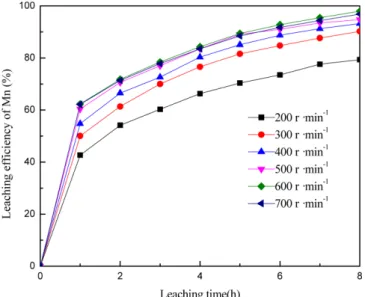
The effect of agitation rate on the leaching efficiency of manganese was controlled in the range of 200 r·min-1-700 r·min-1 in the pres- ence of weight ratio of manganese dioxide ore to black locust (WT) of 4:10, 63 μm, 1.7 mol·L-1 H2SO4, liquid to solid mass ratio (L/S) of 5:1, 8 h and 368 K. The results shown in Fig. 1 indicate that leaching efficiency increases to 97.57% when agitation rate increases to 400 r·min-1, due to enhanced diffusion of liquid reactants. Agitation rate has less effect on the leaching rate of manganese while agitation rate continues increasing. And the rational application of devices as well as efficient energy are taken into consideration. Therefore, subsequent experiments were performed at agitation rate of 400 r·min-1 to ensure that the influence of external mass transfer is negligible.
3-2. Effect of weight ratio of manganese dioxide ore to black locust The effect of WT on the leaching efficiency of manganese was investigated by changing WT from 0:10 to 6:10 under the conditions of 63 μm, 1.7 mol·L-1 H2SO4, L/S of 5:1, 8 h, 368 K and 400 r·min-1. Fig. 2 shows that black locust plays a critical role in the leaching pro- cess of manganese. In the absence of black locust, the leaching effi- ciency of manganese is only about 8.06%. The leaching efficiency of manganese increases with WT increasing when WT is below 4:10.
However, beyond 4:10, WT had less effect on leaching efficiency of manganese. Therefore, WT of 4:10 was used in all subsequent tests.
The increase of WT in fact leads more reducing substances to gener-
ate from black locust, which causes higher manganese extraction.
These results can also be explained by the fact that manganese diox- ide ore is insoluble in H2SO4 solution when reductant is not present [22], but when black locust is added, Mn+4 can be converted to Mn+2, which is easily leached in sulfuric acid solution, as demonstrated by Eq. (2).
3-3. Effect of initial ore particle size
The effect of ore particle size on leaching efficiency was studied by testing initial ore particle size from 63 μm to 204 μm under the conditions: WT of 4:10, 1.7 mol·L-1 H2SO4, L/S of 5:1, 8 h , 368 K and 400 r·min-1. The results are summarized in Fig. 3, which shows that leaching efficiency of manganese decreases from 97.74% to 78.85%
with average diameter increase from 63 μm to 204 μm. The decrease of leaching efficiency for larger-size particles is caused by the decreased contact area of manganese ore and reductive regent [23,24]. Hence, a particle size of 63 μm was used for the following reduction trials.
k Aexp –Ea ---RT
⎝ ⎠
⎛ ⎞
=
Fig. 1. Effect of agitation rate on the leaching efficiency of Mn.
Fig. 2. Effect of weight ratio of black locust to manganese dioxide ore on the leaching efficiency of Mn.
Fig. 3. Effect of average particle size on the leaching efficiency of Mn.
3-4. Effect of sulfuric acid concentration
These experiments were performed by varying H2SO4 concentration variation from 1.01 mol·L-1 to 2.31 mol·L-1 under the conditions:
WT of 4:10, 63 μm, L/S of 5:1, 8 h, 368 K and 400 r·min-1. Fig. 4 indi- cates that the leaching efficiency of manganese increases from 79.54%
to 96.59% as H2SO4 concentration increases from 1.01 mol·L-1 to 1.71 mol·L-1. The leaching efficiency of manganese remains more or less constant with any further increase in H2SO4 concentration. More- over, as shown in Eq. (2), the reduction of Mn4+to Mn2+ was enhanced when more hydrogen ions were present, subsequently releasing Mn+2 more easily into the solution.
3-5. Effect of liquid to solid ratio
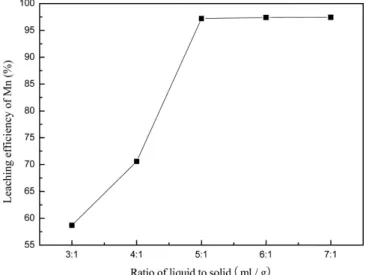
To study the influence of liquid to solid ratio on manganese leaching efficiency, the leaching efficiency of manganese was tested by varying L/S from 3:1 to 7:1 under similar conditions previously mentioned:
WT of 4:10, 63 μm, 1.7 mol·L-1 H2SO4, 8 h, 368 K and 400 r·min-1. The results are presented in Fig. 5. The leaching efficiency of man- ganese increases rapidly from 59.73% to 97.2% with increase of L/S from 3:1 to 5:1. There is no significant difference in leaching efficiency when L/S is above 5:1. At L/S of 3:1, manganese extraction is low because the sulfuric acid concentration does not sufficiently break glycosidic bond cleavage to obtain any significant manganese disso- lution [13,25].
3-6. Effect of leaching temperature and leaching time The experiments were performed by varying leaching tempera- ture from 333 K to 368 K and varying leaching time from 1 h to 8 h to evaluate the effects of these parameters on the reductive leaching efficiency of manganese under above-mentioned optimum conditions.
The results, illustrated in Fig. 6, indicate that the temperature and time have significant influence on the reduction ratio of manganese dioxide ore. It is observed that the leaching efficiency of manganese increases from 80.25% at 333 K to 96.5% at 368 K after 8.0 h, due to
increased temperature accelerates reaction rate of MnO2 with H2SO4 in terms of Eq. (2). However, further increasing leaching temperature or time does not efficiently improve the leaching efficiency. The rea- son for this is likely due to reduction in the final concentration of reagents when leaching reactions proceed with increase of leaching time. The appropriate leaching temperature is 368 K, because exces- sive higher temperature may lead to high evaporation speed and energy consumption. Therefore, 368 K and 8 h were chosen as opti- mized leaching temperature and time.
To obtain the kinetic equation and apparent activation energy for manganese dioxide ore leaching by H2SO4 in the presence of black locust, the experimental data shown in Fig. 6 were processed and correlated to kinetic models for solid/liquid reactions. The leaching rate of manganese was analyzed in terms of the shrinking core model for reaction control under the assumption that the manganese diox- ide ore was in homogeneous spherical solid phase. Eqs. (3) and (4) were applied to the results obtained from each temperature value, respec- Fig. 4. Effect of sulfuric acid concentration on the leaching efficiency of
Mn.
Fig. 5. Effect of liquid to solid ratio on the leaching efficiency of Mn.
Fig. 6. Effect of time and temperature on the leaching efficiency of Mn.
tively. Eq. (3) was found to fit the data well with a correlation coeffi- cient (R2) greater than 0.99 as shown in Fig. 7. The linear relationship between Eq. (3)and leaching time (t) suggests that the leaching rate of manganese is controlled by diffusion through the ash/inert layer of the associated minerals. This conclusion is supported by the fact that the leaching rate of manganese from manganese dioxide ore by H2SO4 in the presence of black locust is controlled by inner diffusion when the temperature is above 40oC [7]. Corresponding kinetic equations are shown in Table 3. The apparent rate constants (kd) were calcu- lated as slopes of the straight lines. Using the apparent rate constants obtained by the application of Eq. (5), as shown in Fig. 8, the Arrhe- nius plot (lnk versus 1/T) was obtained and the activation energy (Ea) was calculated as 17.81 kJ·mol-1. This value further confirms that reduction leaching process is controlled by the inner diffusion.
The leaching efficiency of manganese is 97.57% under above- mentioned optimum conditions: WT of 4:10, 63 μm, 1.7 mol·L-1H2- SO4, L/S of 5:1, 8 h, 368 K and 400 r·min-1.
3-7. Effect of manganese dioxide ore on hydrolysis ratio of black locust
To investigate the hydrolysis ratio of primary components in black locust during the leaching process, the following experiments were
performed under the above-mentioned optimum leaching conditions, except weight ratio of WT of 4:10 inverse WT of 4:0. The results are summarized in Fig. 9. A comparative study was performed on the hydrolysis rate of black locust with leaching time under different hydrolysis conditions. The hydrolysis rate of hemicellulose increases to 82.29% rapidly after leaching time increases to 5 h when WT is 4:10, and then increases gradually to 71.67% once leaching time increases to 6 h; the hydrolysis rate of cellulose reaches 40.2% after 6 h. However, in the case of WT of 4:0, the hydrolysis rate of cellulose increases to 28.64% within reaction time of 6 h. This phenomenon occurs because the amorphous region of cellulose is easily hydrolyzed first, but its crystalline region is not easily hydrolyzed. The reason that manga- nese dioxide ore promotes the hydrolysis rate of cellulose is that the oxidizing ability of manganese dioxide ore gets stronger in the acidic medium, which contributes to breaking apart the crystalline region of Fig. 7. Variation of with leaching time at various
temperatures.
1 2–3---X–(1 X– )2/3
Table 3. Regression coefficients calculated for the different kinetic models
Leaching
temperature (K) Kinetic equations kd Regression coefficients (R2)
333 0.01629 0.9978
343 0.01942 0.9983
353 0.02329 0.9977
363 0.0278 0.9983
368 0.0325 0.9992
1 2 3---X
– –(1 X– )2/3 1 2
3---X
– –(1 X– )2/3 1 2
3---X
– –(1 X– )2/3 1 2
3---X
– –(1 X– )2/3 1 2
3---X
– –(1 X– )2/3
Fig. 8. Arrhenius plot of reaction rate against reciprocal temperature.
Fig. 9. Effect of time on hydrolysis rate of cellulose, hemicellulose and lignin.
cellulose. In addition, hemicellulose is easily hydrolyzed, due to its low degree of polymerization and degradable crystal structure in acidic medium [26,27]. The hydrolysis rate of lignin increases slightly, because lignin is not hydrolyzed in leaching condition. In short, the hydrolysis rate of black locust is successfully promoted by manga- nese dioxide ore.
3-8. Characterization of ore samples and leached residues by XRD Ore samples before and after leaching treatment were character- ized by XRD to define the transformation of their mineralogical composition. The XRD pattern, in Fig. 10(a), shows the presence of variety of metallic minerals, including pyrolusite (MnO2), manganosite (MnO) and manganomanganic oxide (Mn3O4). Its gangue minerals primarily consist of quartz (SiO2), kyanite (Al2SiO5), bauxite (Al2O3) and hematite (Fe2O3). As displayed in Fig. 10(b), manganese com- pounds disappear after the leaching process. Leached ore residues are primarily comprised of silicon dioxide.
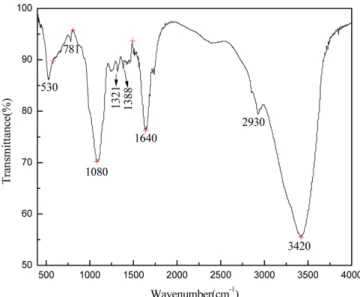
3-9. Characterization of black locust and leached residues by FTIR FTIR is often used to analyze biomass structures and monitor changes caused by physical or chemical treatments [28,29]. The FTIR Fig. 10. XRD pattern of manganese dioxide ores (a) and leached residues (b).
Fig. 11. FTIR spectra of raw black locust.
Fig. 12. FTIR spectra of black locust residue under optimal condi- tions of Mn leaching process.
Table 4. FTIR band assignments of group Peak/c-1 Absorption peak spectral classification 3400 OH stretching vibration(cellulose) 2920 CH and CH2 stretching vibration
1740 C=O stretching vibration of acetyl or carbonyl group (xylan/hemicellulose)
1640 C=C stretching vibration(lignin)
1380 CH banding vibration(cellulose/ hemicellulose) 1320 OH plane banding vibration(cellulose)
1250 C-O-C stretching vibration of ether linkage contained in alkyl and aryl group
1060 C-O stretching vibration(cellulose/ lignin) 829 CH plane banding vibration(lignin) 781 OH stretching vibration of aryl group
spectra of black locust and its leached residues under the above-men- tioned optimum leaching condition are provided in Figs. 11 and 12.
FTIR analysis of black locust is correspondingly shown in Table 4 [30-32]. Comparative study between Figs. 11 and 12 shows that the absorption peak at 1740 cm-1 disappears, which indicates that hemi- cellulose was hydrolyzed in the leached residues. The absorption peak at 1060 cm-1 alsodisappears, and weak absorption peaks at 1321 cm-1 and 1388 cm-1 appear, which indicates that most cellulose was hydrolyzed. However, 1640 cm-1 and 1080 cm-1 absorption peaks yet exist, further indicating that lignin was not hydrolyzed under the leaching condition.
4. Conclusions
A novel leaching process for manganese oxide ore was success- fully demonstrated using black locust as reductant in sulfuric acid solution in this study. The leaching efficiency of manganese reached 97.57% under the optimal conditions: weight ratio of black locust to manganese dioxide ores of 4:10, ore particle size of 63 μm, 1.7 mol·L-1 H2SO4, liquid to solid ratio of 5:1 for 8 h at 368 K with the stirring rate of 400 r·min-1. Kinetics model of leaching is controlled by inner diffusion through the ash/inert layer composed of the associated miner- als with activation energy of 17.81 kJ·mol-1. The hydrolysis rate of black locust sawdust was promoted by manganese dioxide ores. To investigate the reaction mechanism, XRD analysis indicated manganese com- pounds in leached ore residues disappear after the leaching process.
Additionally, FTIR characterization confirms that hemicellulose and cellulose in leached residues of black locust were hydrolyzed during the leaching process.
Acknowledgments
The authors would like to thank the Project of National Natural Science Foundation of China (No. 21376273) and the Major Project of Science and Technology of Hunan Province (No. 2010FJ1011) for offering the research funds.
Nomenclature
A : Frequency factor [h-1]
C : Manganese concentration obtained from the standard working curve [mg/ml]
Ea : Activation energy [kJ·mol-1]
FTIR : Fourier transform infrared spectroscopy
GB/T 2677.2-93 : Fibrous raw material-Determination of holocellulose (State Standard of the People’s Republic of China)
h : Reaction time [h]
k : Rate constant [h-1]
kd : Rate constant of reaction rate controlled by inner diffusion [h-1]
kr : Rate constant of reaction rate controlled by surface
reaction [h-1]
K : Kelvin temperature [K]
L/S : Liquid to solid ratio [mL/g]
nm : Nanometer [nm]
R : Universal gas constant [8.314J/K]
t : Reaction time [minute]
T : Temperature of reaction [K]
UV-Vis : Ultraviolet-visible spectroscopy V0 : Volume of total leachate [mL]
V1 : Volume of absorbed leachate [mL]
V2 : Volume of absorbed leachate after diluted [mL]
G : Weight of manganese ore sample [mg]
WT : Weight ratio of black locust sawdust to manganese dioxide ore [g/g]
X : Leaching efficiency [%]
XRD : X-ray Diffraction
YB/T 5189-2007 : The determination of the volatile matter content in carbon material (Metallurgical industry standard of the People’s Republic of China)
Greek Letters
μm : Micron
ω : Weight ratio of metal in ore sample (wt.%)
References
1. Liu, Y. C., Lin, Q. Q., Li, L. F., Fu, J. G., Zhu, Z. S., Wang, C. Q.
and Qian, D., Int. J. Min. Sci. Technol., 24, 567(2014).
2. Welham, N. J., Int. J. Miner. Process., 67, 187(2002).
3. Abbruzzese, C., Duarte, M. Y., Paponetti, B. and Toro, L., Miner.
Eng., 3, 307(1990).
4. Naik, P. K., Sukla, L. B. and Das, S. C., Hydrometallurgy, 54, 217 (2000).
5. Kanungo, S. B., Hydrometallurgy, 52, 313(1999).
6. Vu, H., Jandová, J., Lisá, K. and Vranka, F., Hydrometallurgy, 77, 147(2005).
7. Bafghi, M. S., Zakeri, A., Ghasemi, Z. and Adeli, M., Hydrome- tallurgy, 90, 207(2008).
8. Sahoo, R. N., Naik, P. K. and Das, C., Hydrometallurgy, 62, 157 (2001).
9. Nayl, A. A., Ismai, I. M. and Aly, H. F., Int. J. Miner. Process., 100, 116(2011).
10. Tang, Q., Zhong, H., Wang, S., Li, J. Z. and Liu, G. Y., Trans.
Nonferrous Met. Soc. China, 24, 861(2014).
11. Lasheen, T. A., Ei-Hazek, M. N., Helal, A. S. and Ei-Nagar, W., Int. J. Miner. Process., 92, 109(2009).
12. Su, H. F., Wen, Y. X., Wang, F., Sun, Y. Y. and Tong, Z. F., Hydro- metallurgy, 93, 136(2008).
13. Su, H. F., Liu, H. K., Wang, F., Lv, X. Y. and Wen, Y. X., Chin.
J. Chem. Eng., 18, 730(2010).
14. Cheng, Z., Zhu, G. C. and Zhao, Y. N., Hydrometallurgy, 96, 176 (2009).
15. Tian, X. K., Wen, X. X., Yang, C., Liang, Y. J., Pi, Z. B. and Wang, Y. X., Hydrometallurgy, 100, 157(2010).
16. Yuksek, T., Catena, 90, 18(2012).
17. Tabari, M. and Salehi, A., J. Environ. Sci., 21, 1438(2009).
18. Mirko, G., Piero, O., Marco, C. C., Simone, F., Paolo, T., Francesco, C. and Andrea, B., US Patent, 20120104313A1(2012).
19. Zhou, C., Wang, J. and Wang, N., Korean J. Chem. Eng., 30, 2037(2013).
20. Hariprasad, D., Dash, B., Ghosh, M. K. and Anand, S., Miner.
Eng., 20, 1293(2007).
21. Baba, A. A. and Adekola, F. A., J. Saudi Chem. Soc., 16, 377 (2012).
22. Ismail, A. A., Alie, E. A., Ibrahim, I. A. and Ahmed, M. S., Can.
J. Chem. Eng., 82, 1296(2004).
23. Senanayake, G., Hydrometallurgy, 73, 215(2004).
24. Park, K. H., Mohapatra, D., Nam, C. W. and Kim, H. I., Korean
J. Chem. Eng., 24, 835(2007).
25. Tekin, T. and Bayramo lu, M., Hydrometallurgy, 32, 9(1993).
26. Chimentão, R. J., Lorente, E., Gispert-Guirado, F., Medina, F.
and López, F., Carbohydr. Polym., 111, 116(2014).
27. Sannigrahi, P., Ragauskas, A. J. and Miller, S. J., Bioenerg. Res., 1, 205(2008).
28. Pandey, K. K., J. Appl. Polym. Sci., 71, 1969(1999).
29. Abidi, N., Cabrales, L. and Haigler, C. H., Carbohydr. Polym., 100, 9(2014).
30. Stehfest, K., Toepel, J. and Wilhelm, Plant Physiol. Bioch., 43, 717(2005).
31. Satyamurthy, P. and Vigneshwaran, N., Enzyme. Microb. Tech., 52, 20(2013).
32. Qian, Y. J., Zuo, C. J., Tan, J. and He, J. H., Energy, 32, 196(2007).
g ê