46 PISSN 0304-128X, EISSN 2233-9558
Leaching Kinetics of Praseodymium in Sulfuric Acid of Rare Earth Elements (REE) Slag Concentrated by Pyrometallurgy from Magnetite Ore
Chul-Joo Kim*, Ho-Sung Yoon*, Kyung Woo Chung*, Jin-Young Lee*, Sung-Don Kim*, Shun Myung Shin*, Hyung-Seop Kim**, Jong-Tae Cho**, Ji-Hye Kim**, Eun-Ji Lee**, Se-Il Lee** and Seung-Joon Yoo**,†
*Korea Institute of Geoscience and Mineral Resources, 124 Gwahang-no, Yuseong-gu, Daejeon 305-350, Korea
**Department of Environmental and Chemical Engineering, Seonam University, 7-111 Pyeongchon-gil, Songak, Asan 336-922, Korea (Received 25 June 2014; Received in revised form 20 July 2014; accepted 23 July 2014)
Abstract − A leaching kinetics was conducted for the purpose of recovery of praseodymium in sulfuric acid (H2SO4) from REE slag concentrated by the smelting reduction process in an arc furnace as a reactant. The concentration of H2SO4 was fixed at an excess ratio under the condition of slurry density of 1.500 g slag/L, 0.3 mol H2SO4, and the effect of tem- peratures was investigated under the condition of 30 to 80oC. As a result, praseodymium oxide (Pr6O11) existing in the slag was completely converted into praseodymium sulfate (Pr2(SO4)3·8H2O) after the leaching of 5 h. On the basis of the shrinking core model with a shape of sphere, the first leaching reaction was determined by chemical reaction mechanism. Gen- erally, the solubility of pure REEs decreases with the increase of leaching temperatures in sulfuric acid, but REE slag was oppositely increased with increasing temperatures. It occurs because the ash layer included in the slag is affected as a resistance against the leaching. By using the Arrhenius expression, the apparent activation energy of the first chemical reaction was determined to be 9.195 kJmol-1. In the second stage, the leaching rate is determined by the ash layer dif- fusion mechanism. The apparent activation energy of the second ash layer diffusion was determined to be 19.106 kJmol-1. These relative low activation energy values were obtained by the existence of unreacted ash layer in the REE slag.
Key words: Leaching, REE Slag, Shrinking Core Model, Praseodymium Oxide, Praseodymium Sulfate, Sulfuric Acid
1. Introduction
REEs (rare earth elements), according to the IUPAC definition, is a group of chemical elements with lanthanides plus scandium and yttrium. Based on their location in the periodic table and their atomic weights, it is possible to classify these elements into light REEs or LREEs (lanthanum, cerium, praseodymium, neodymium, prome- thium and samarium, with atomic numbers 57-62) and heavy REEs or HREEs (europium, gadolinium, terbium, dysprosium, holmium, erbium, thulium, ytterbium, lutetium atomic number 63-71) [1].
The lanthanides among the REEs are the filling of the 4f outer-shell electrons. The electronic structure of the lanthanide elements has [Xe]5d16s24fn with minor exceptions. These 4f orbitals are buried inside atom and are shielded from the atom’s environment by the 4d and 5p electrons. The 4f orbitals in the lanthanides are sufficiently low in energy that the electrons are seldom ionized or shared [2,3].
REEs are broadly used to the high-tech industry like high strength permanent magnets, lasers, automotive catalytic converters, fiber optics/superconductors, and electronic devices. Because of the ongo- ing development of new advanced technologies, an ever-increasing
demand on REEs will persist in the international markets. China dominates the world market of REEs with over 95% recently [4].
The demand for REE metals has rapidly been increasing, but China has steadily increased export taxes on REEs and has nationally been restricting the export quotas of them. Therefore, REE resources- free countries, such as South Korea and Japan, have to develop the new raw material resources like low-grade REE sources. It is well- known that hydrometallurgy is the most effective method for the leaching of low-grade raw materials because of the selective leach- ing by solvent, low process cost and occurrence of relatively small pollutants [5-17].
This study was also conducted to recover REE metals from low- grade monazite-type REE raw material and selected praseodymium as a research objective among the components in REE slag because praseodymium cost increased as highest growth rate of price from 14 US$/kg to now 175 US$/kg recently [4].
The leaching mechanism of slag was hypothesized by a shrinking core model with a constant size and a two-stage model with a chem- ical reaction and ash layer diffusion because some part of the REE slag was partly oxidized by arc furnace even though it is reduced through the smelting reduction process. Finally, the REE slag remains in the ash layers after the completion of leaching as shown in Fig. 1.
1-1. Surface reaction control
Assuming the first-order chemical reaction rate model based on the shrinking core model with the same particle size before and after
†To whom correspondence should be addressed.
E-mail: [email protected]
‡This article is dedicated to Prof. Kyun Young Park on the occasion of his retirement from Kongju National University.
This is an Open-Access article distributed under the terms of the Creative Com- mons Attribution Non-Commercial License (http://creativecommons.org/licenses/by- nc/3.0) which permits unrestricted non-commercial use, distribution, and reproduc- tion in any medium, provided the original work is properly cited.
the leaching [18,19] that has a shape of a spherical particle, the chemical reaction may be expressed in the following Eq. (2).
(2)
However, the variation of CA can be neglected during the chem- ical reaction because the H2SO4 is added into the reactor more excessively than the stoichiometric ratio.
Since CA can be accepted as a constant in Eq. (2), this model is modified as follows:
(3)
(4)
This can be written in terms of fractional conversion by noting that
Therefore
(5) The variation of H2SO4 (XA) can be neglected because it is added excessively.
kc,chem is the apparent rate constant for chemical reaction and inverse of the time required for complete conversion is given when rc= 0.
(6)
1-2. Ash layer diffusion control
During the chemical reaction, the praseodymium component on the surface of REE slag is first leached out. Then the ash layers remaining after the initial chemical reaction become thicker and act as a resistance for H2SO4 solution to go inner from the surface.
Therefore, the ash layer diffusion can be considered as a second step for the rate determining stage. In diffusion controlled reaction mod- els, there are many kinetic equations [20,21]. The reaction rate can be expressed in terms of the diffusion rate of H2SO4 through the ash layers as follows:
(7) where kc,ash is the apparent rate constant for ash layer diffusion and inverse of the time required for complete conversion of a par- ticle, rc= 0.
(8)
2. Materials and Methods
The raw material was mined from Hongcheongun in Korea and concentrated by the smelting reduction process in an arc furnace.
The REE slag obtained after the smelting reduction process was milled and washed with water to remove impurities on the REE slag. Finally, particle size had a size range of 100 to 200 μm.
The concentrations of H2SO4 were added into reactor as the excess ratios of 0.1 to 0.3 M over the stoichiometric ratio, but the leaching rate was not significantly affected by the excess ratio of H2SO4 concentration. Nevertheless, the H2SO4 concentration was fixed at 0.3 M higher than the stoichiometric ratio in this experiment for the concentration of H2SO4 to be constant during reaction.
Accordingly, the concentration of H2SO4 was assumed to be con- stant. All the solutions indicated the scale of pH 1.0.
3. Analysis
Metal compositions included in the REE slag were analyzed under the condition of 1,300 W RF Power, 27.12 MHz RF frequency, 13 L/min Coolant gas flow and 0.9 L/min Nebulizer gas flow by inductively coupled plasma-mass spectrometry (ICP-MS, X-series (X5), Thermo Elemental, UK). ICP-MS was found to be the most suitable technique for the determination of REE content because it exhibits high sensitivity and accuracy, with high sample through- put. ICP-MS also allows rapid simultaneous multi-element determi- nation [22].
The crystal structure and crystallinity of the REE slag were analyzed under the following analytical conditions (CuKα source, scanning speed 1°/min, 40 kV, 40 mA, 0°≤2θ≤90° scanning range) by X-ray dif- fraction spectroscopy (D8 ADVANCE, BRUKER AXS).
The pH values were measured by pH electrode in Advanced Electrochemistry Meter [Orion VERSASTAR, Thermo Scientific].
1 Sex ---dNB
---dt
– ρB
Sex --- Sex drc
---dt
⋅ ⋅
– ρB drc
---dt
⋅
– 1
3---ksCA
= = =
ρB – drc
R rc
∫
⋅ 1
3---ksCA0(1 X– A)t
= 3ρBR
ks --- 1 rc
R----
⎝ ⎠⎛ ⎞
– =CA0(1 X– A)t
1 X– B 4 3---πrc3 4 3---πR3 --- rc
R----
⎝ ⎠⎛ ⎞3
= =
rc R----
⎝ ⎠⎛ ⎞=(1 X– B)1/3
1–(1 X– B)1/3=kc chem, t
kc chem, CA0ks 3ρBR ---
=
1 3 1 X– ( – B)2/3+2 1 X( – B)=kc ash, t
kc ash, 2DeCA0 ρBR2 --- Fig. 1. Schematic diagram for leaching behavior of reacting REE =
slag particles.
Praseodymium ion concentration was analyzed by inductively cou- pled plasma-atomic emission spectrometry (ICP-AES, iCAP6000, Thermo Fisher, UK) during the leaching. When viscous silicate solu- tion is injected into the plasma and nebulizer is blocked, the accuracy and detection limits of the ICP-AES are usually degraded. This problem can be avoided by limiting the input of viscous solution and frequent washing of the nebulizer.
4. Results and Discussion
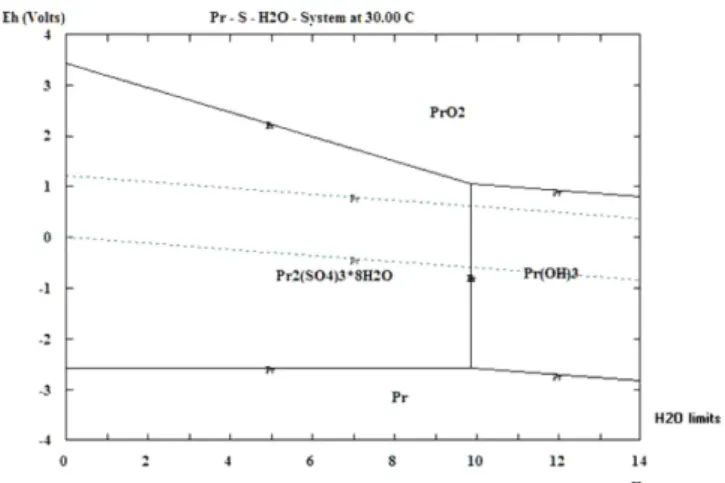
Pr6O11 existing in the REE slag is converted into Pr2(SO4)3 phase under H2SO4 solution as in the following eq. (1). The reaction has a stoichiometric ratio of 3 mol H2SO4 per 1 mol Pr6O11. As shown in Eh-pH diagram of Fig. 2, Pr6O11 is reduced into Pr2(SO4)3 under the condition below pH 9.8 and is precipitated by Pr(OH)3 over the pH.
Accordingly, the leaching is desirable to keep below the pH 9.8 for the sake of efficient leaching of praseodymium.
(1) There are many chemical components in the REE slag [23], and the slag exists as various metal compounds as oxides, phosphates,
or silicates as shown in Fig. 3 because it is treated under the reduc- tion atmosphere of high temperature [24].
If the metals existing in the slag consist of simple metal oxide forms, they can easily be converted into metal sulfate forms thermo- dynamically as follows; Gibb’s free energy was calculated at 30oC.
The following thermodynamic data are about the metal oxides exist- ing more than 0.4% in the REE slag.
At this time, most of the data were taken from HSC 5.11 software database [25].
1) La2O3 + 3H2SO4 → La2(SO4) 3 + 3H2O ∆G= -126.343kcal 2) Ce2O3 + 3H2SO4 → Ce2(SO4)3 + 3H2O ∆G= -124.371kcal 3) Nd2O3 + 3H2SO4 → Nd2(SO4)3 + 3H2O ∆G= -111.602kcal 4) MgO + H2SO4 → MgSO4 + H2O ∆G= -36.396kcal 5) Fe2O3 + 3H2SO4 → Fe2(SO4)3 + 3H2O ∆G= -38.997kcal 6) CaO + H2SO4 → CaSO4 + H2O ∆G= -64.287kcal
7) SrO + H2SO4 → SrSO4 + H2O ∆G= -79.186kcal 8) BaO + H2SO4 → BaSO4 + H2O ∆G= -89.555kcal
Table 1 is an elemental composition of REE slag analyzed by ICP-MS. As shown in Table 1, praseodymium component in is included 0.41% in the REE slag. Praseodymium is a LREE (light rare earth element) component to be able to leach in acidic solution next to lanthanum component, cerium and neodymium. Therefore, we selected the praseodymium as a leaching objective.
The leaching experiment was conducted under the condition of a 1.500 g slag/L H2SO4, with agitation at a temperature range of 30 to 80oC. If it is assumed that REE components exist as the forms of the simple metal oxide, the stoichiometric ratio of H2SO4 (Merck, 98%) required to be converted into sulfate forms is about 0.0018 mol/L per 1.500 g slag.
Using the pure Pr6O11 reagent (99%, Alfa Aesar, black and dark- green powders), the effect of H2SO4 concentrations was investi- gated. A leaching experiment was conducted at two different H2SO4 concentrations of a stoichiometric ratio (3 mol H2SO4/mol Pr6O11) and an excess ratio (4 mol H2SO4/mol Pr6O11). As the results, Pr(OH)3 precipitate was not produced at all the two conditions as the shown in Fig. 4. In the experiment of pure Pr6O11 reagent, the final pHs of leached solution were found to 2.991 at the H2SO4 concentration of stoichiometric ratio and 1.712 at the excess ratio. As described before, it depends on the final pH whether the solution is Pr2(SO4)3 phase or Pr(OH)3 precipitate phase.
Pr6O11+24H2SO4→3Pr2(SO4)3⋅8H2O+15SO2+8.5O2
Fig. 2. Eh-pH diagram of Pr chemical species in H2SO4 solution.
Fig. 3. XRD pattern of REE Slag reactant.
Table 1. Elemental composition of REE slag analyzed by ICP-MS Element Conc. Element Conc. Element Conc.
La 2.76% Tb 23.5 ppm U 1.8 ppm
Ce 4.60% Dy 53.6 ppm Fe 0.7%
Pr 0.41% Ho 5.4 ppm Ca 13.9%
Nd 1.14% Er 16.8 ppm Mg 7.1%
Sm 830.7 ppm Tm 0.8ppm Ba 2.16%
Eu 158.5 ppm Yb 9.0 ppm Sr 9.84%
Gd 278.1 ppm Lu 1.6 ppm Y 122 ppm
REE slag is composed of metal oxide, silicate, and ash layers. It has a black color and a size range of 100 to 200 μm. The right side of Fig. 5 shows a leached solution.
Although there was no noticeable change in size of the slag before and after the leaching, the praseodymium content in the slag was completely leached into the solution after the leaching reaction.
Pr(OH)3 precipitate was never produced at the concentration of H2SO4 as shown in Fig. 6 because the acidic concentration was excessively added to the reactor and final pHs of all the leached solutions were kept at pH 1.0.
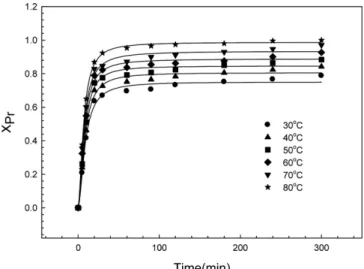
Fig. 6 presents the fractional conversion of praseodymium during the leaching. As shown in Fig. 6, Pr6O11 existing in the REE slag was completely leached out to Pr2(SO4)3 solution after 5 h under the condition of slurry density of 1.500 g slag/L, 0.3 mol/L H2SO4 at 80oC. During the leaching, the praseodymium concentrations were analyzed by ICP-AES. Initial leaching reaction was fast accom- plished within 20 min or below as soon as raw material poured into the reactor. After that time, the leaching rate rapidly decreased. There- fore, this leaching reaction was suggested as a two-step model.
The conversion rate of REE slag could be divided into two stages on the basis of reaction time of 20 min: a rapid chemical reaction and a slow reaction stage.
Particle size of slag raw material had a range of 100-200 μm and it kept the same size approximately after the leaching reaction as shown in Fig. 7. From the result, we could know that the slag has Fig. 4. Pr reached solutions of stoichiometric ratio and excess ratio.
Fig. 5. Photograph of REE slag and REE leached solution.
Fig. 6. Evolution of praseodymium fractional conversion.
Fig. 7. SEM photographs of slag at leaching times: (a) 0 min (b) 30 min, and (c) 300 min.
unreacted layers and these layers act as a resistance over leaching reaction. The reaction introduced a shrinking core model with a constant particle size. Reaction rate was measured by the analysis of praseodymium concentration by ICP-AES.
In the experiment it was assumed that there was no change of concentration during the leaching reaction because the H2SO4 was excessively added than the stoichiometric ratio necessary in the reaction. This experiment was fixed at the condition of 0.3 mol/L H2SO4 concentration to neglect the change of H2SO4 concentration during the leaching. As described before, the chemical species stable in the solution was determined by Pr2(SO4)3 solution phase because the final leached solution indicated the scale of pH 1.0.
4-1. Chemical reaction control
If REEs included in the slag exist as a form of oxide, the stoichio- metric ratio of H2SO4 based on the result of ICP-MS is 0.018 mol H2SO4 per 1.500 g. In the present experiment, H2SO4 was added 0.3 mol over the stoichiometric ratio. Therefore, it can be assumed that CA is constant during the leaching.
The rate equation can be summarized as in Eq. (5) using the shrinking core model [20,21] that has the shape of a spherical parti- cle. On the basis of Eq. (5), the apparent rate constant (kc,chem) can be calculated by the least square method at reaction temperatures as shown in Fig. 8.
Table 2 shows kinetic constants (kc,chem) at the chemical reaction stage calculated by the least square method from the slopes of each graphs in Fig. 8.
To examine the effect of reaction temperatures, the apparent acti- vation energy was calculated from rate constants according to the temperatures as shown in Table 2. In the case of the chemical reac-
tion control, the apparent activation energy was calculated at 9.195 kJmol-1 from the slope of the graph in the range of 30 to 80oC as shown in Fig. 9.
4-2. Ash layer diffusion
Chemical reaction is a rate determining step before 20 min. How- ever, as shown in Fig. 8, REE components on the surface the slag are reacted with H2SO4 and leached out by chemical reaction. After all the slag surface becomes rough and remains only ash layer after REE leaching. The ash layer will act as a resistance for H2SO4 to go into inner layer to be REE components. Accordingly, the ash layer diffusion was assumed as a second stage after a chemical reaction.
The rate equation can be summarized as in Eq. (7) for ash layer
Table 2. Parameter searching data obtained from the regression by y = ax+b for chemical reaction determining step
Parameter 30oC 40oC 50oC 60oC 70oC 80oC
a 1.437×10⁻² 1.660×10⁻² 1.843×10⁻² 2.006×10⁻² 2.202×10⁻² 2.454×10⁻²
b 5.582×10⁻³ 6.184×10⁻³ 7.414×10⁻³ 1.468×10⁻² 1.805×10⁻² 1.873×10⁻³
R2 0.9936 0.9950 0.9925 0.9919 0.9886 0.9879
Fig. 8. Relationship between 1-3(1-XB)1/3 and reaction time during chemical reaction stage.
Fig. 9. Arrhenius plot of chemical reaction stage.
Fig. 10. Relationship between 1-3(1-XB)2/3+2(1-XB) and reaction time during ash layer diffusion stage.
diffusion rate determining step using the shrinking core model that has the shape of a spherical particle. On the basis of Eq. (7), the apparent rate constant (kc,ash) can be calculated by the least square method at various reaction temperatures as shown in Fig. 10.
Table 3 shows kinetic constants (kc,ash) of the ash layer diffusion stage calculated by the least square method from the slopes of Fig. 10.
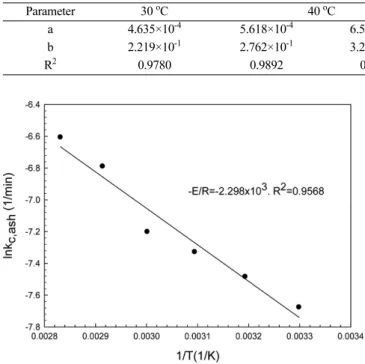
To examine the effect of reaction temperatures, the apparent acti- vation energy was calculated from rate constants according to the temperatures as shown in Table 3. In the case of the ash layer diffusion control, the apparent activation energy was calculated at 19.106 kJmo-1 from the slope of the graph in the range of 30 to 80oC as shown in Fig. 11.
5. Conclusions
The leaching mechanism of praseodymium in the H2SO4 from REE slag was proposed by a two-stage shrinking core model as the leaching rate determining stages, chemical reaction and ash layer diffusion.
Leaching efficiency of pure praseodymium oxide in acidic condi- tion generally decreases with increasing temperatures, but this REE slag was oppositely increased because ash layer included in the slag acted a resistance against the leaching and the increase of tempera- ture brings active molecular motion of H2SO4. In this experiment, the REE leaching could attain a 100% yield after the leaching of 5 h, 80oC.
From the result of kinetic study, the first reaction was determined by rapid chemical reaction stage and the next reaction was deter- mined by ash layer diffusion stage as the following results:
(1) In the initial chemical reaction control stage, leaching kinetics followed a shrinking core model with chemical reaction as the first rate-controlling step. The initial chemical reaction was completed within 20 min or below. The reaction rate and yield were increased according to the increase of temperature during the reaction. In the initial chemical reaction control stage, the activation energy was found to be 9.195 kJmol-1 between 30 and 80oC. The postulated reaction was well confirmed by both the linear relationship of the rate constant and the apparent activation energy.
(2) Irrespective of initial rapid chemical reaction, the ash layer diffusion rate slowly proceeded because the ash layer acted as a resistance to block penetration of H2SO4. In the second ash layer diffusion stage, the apparent activation energy was determined by 19.106 kJmol-1 higher than the chemical reaction stage. Temperature dependence in the ash layer diffusion was relatively more tempera- ture-sensitive than the chemical reaction control stage.
(3) Optimum condition for the recovery of praseodymium from the REE slag was given to the condition of slurry density of 1.500 g/L, 0.3 mol/L H2SO4, temperature of 80oC, leaching time of 5 h. The leaching yield was proportional to the leaching temperature under the condition of excess H2SO4 over the stoichiometric ratio.
(4) In general, in the case of pure REEs, the more leaching tem- perature increases, the less solubility decreases, but the REE slag showed an opposite result because unreacted ash layer included in the slag acted as a resistance against the leaching.
In conclusion, the leaching rate and yield are proportional to the leaching temperature in the case of low-grade raw materials with unreacted ash layers.
Nomenclature
CA : concentration of slag reactant (molL-1) CA : concentration of H2SO4 reactant (molL-1) CA0 : initial concentration of H2SO4 reactant (molL-1) CB : concentration of REE slag reactant (molL-1) CB0 : initial concentration of REE slag reactant (molL-1) EChem : apparent activation energy for chemical reaction (kJmol-1) EAsh : apparent activation energy for ash layer diffusion (kJmol-1) ks : first-order rate constant for the chemical reaction (s-1) kc,chem : apparent rate constant for chemical reaction (s-1) kc,ash : apparent rate constant for ash layer diffusion (s-1) NA : moles of H2SO4 reactant (mol)
NB : moles of REE slag reactant (mol) NB0 : initial moles of REE slag reactant (mol) rc : radius of unreacted slag (m)
Table 3. Parameter searching data obtained from the regression by y=ax+b for ash layer diffusion determining step
Parameter 30oC 40oC 50oC 60oC
a 4.635×10⁻⁴ 5.618×10⁻⁴ 6.566×10⁻⁴ 7.452×10⁻³ 1.125×10⁻³ 1.351×10⁻³
b 2.219×10⁻¹ 2.762×10⁻¹ 3.259×10⁻¹ 3.851×10⁻¹ 4.298×10⁻¹ 6.086×10⁻¹
R2 0.9780 0.9892 0.9923 0.9816 0.9819 0.9688
Fig. 11. Arrhenius plot of ash layer diffusion stage.
R : radius of initial slag (m) Sex : external surface area (m2) t : time (s)
T : temperature (K)
XA : fraction of converted H2SO4
XB : fraction of converted praceodymium in REE slag
Greek Letter
ρB : molar density of praseodymium component included in slag (molL-1)
Acknowledgments
The research was supported by the Basic Research Project of the Korea Institute of Geoscience and Mineral Resources(KIGAM) funded by the Minister of Science, ICT and Future Planning of Korea. In addition, we would like to extend our sincere congratula- tions on the honorable retirement of professor Kyun Young Park of Kongju National University.
References
1. IUPAC, Nomenclature of Inorganic Chemistry, IUPAC Recom- mendations 2005(“Red book”), RSC Publishing, Cambridge (UK), ISBN: 0-85404-438-8(2005).
2. Antolini, E. and Perez, J., “The Use of Rare Earth-based Mate- rials in Low-temperature Fuel Cells,” Int. J. Hydrog. Energy, 36, 15752-15765(2011).
3. Yu, Z. and Chen, M., Rare Earth Elements and Their Applica- tions, Metallurgical Industry Press(1995).
4. Massari, S. and Ruberti, M., “Rare Earth Elements as Critical Raw Materials: Focus on International Markets and Future Strat- egies,” Resources Policy, 38, 36-43(2013).
5. Aarabi-Karasgani, M., Rashchi, F., Mostoufi, N. and Vahidi, E.,
“Leaching of Vanadium from LD Converter Slag Using Sulfuric Acid,” Hydrometallurgy, 102, 14-21(2010).
6. Dehghan, R., Noaparast, M. and Kolahdoozan, M., “Leaching and Kinetic Modelling of Low-grade Calcareous Sphalerite in Acidic Ferric Chloride Solution,” Hydrometallurgy, 96, 275-282(2009).
7. El-Nadi, Y. A., “Lanthanum and Neodymium from Egyptian Monazite: Synergistic Extractive Separation Using Organophos- phorus Reagents,” Hydrometallurgy, 119-120, 23-29(2012).
8. Kim, C.-J., Yoon, H.-S., Chung, K. W., Lee, J.-Y., Kim, S.-D., Shin, S. M., Lee, S.-J., Joe, A.-R., Lee, S.-I., Yoo, S.-J. and Kim, S.-H., “Leaching Kinetics of Lanthanum in Sulfuric Acid from Rare Earth Element (REE) Slag,” Hydrometallurgy, 146, 133-137 (2014).
9. Kim C.-J., Yoon H,-S,, Chung K.W., Lee J.-Y., Kim S.-D., Shin S. M., Lee S.-J., Joe A.-R., Lee S.-I., Yoo S.-J. and Kim J.-G.,
“Leaching Kinetics of Neodymium in Sulfuric Acid from E-scrap of NdFeB Permanent Magnet,” Korean J. Chem. Eng., 31, 706- 711(2014).
10. Kostova, I., “Lanthanides as Anticancer Agents,” Curr. Med. Chem., 5, 591-602(2005).
11. Kul, M., Topkaya, Y. and Karakaya, I., “Rare Earth Double Sulfates from Pre-concentrated Bastnasite,” Hydrometallurgy, 93, 129-135 (2008).
12. Liu, K., Chen, Q., Yin, Z., Hu, H. and Ding, Z., “Kinetics of Leaching of a Chinese Laterite Containing Maghemite and Magne- tite in Sulfuric Acid Solutions,” Hydrometallurgy, 125-126, 125- 136(2012).
13. Manhique, A. J., Focke, W. W. and Carvalho, M., “Titania Recovery from Low-grage Titanoferrous Minerals,” Hydrometallurgy, 109, 230-236(2011).
14. Minting, L., Chang, W., Shuang, Q., Xuejiao, Z., Cunxiong, L.
and Zhigan, D., “Kinetics of Vanadium Dissolution from Black Shale in Pressure Acid Leaching,” Hydrometallurgy, 104, 193-200(2010).
15. Moldoveanu, G. A. and Papangelakis, V. G., “Recovery of Rare Earth Elements Adsorbed on Clay Minerals: I. Desorption Mecha- nism,” Hydrometallurgy, 117-118, 71-78(2012).
16. Yoo, S.-J., Yoon, H.-S., Jang, H. D., Lee, M.-J., Lee, S.-I., Park, S.-T. and Hong, H. S., “Dissolution Kinetics of Aluminum Can in Isopropyl Alcohol for Aluminum Isopropoxide,” Chem. Eng.
J., 133, 79-84(2007).
17. Yoo, S.-J., Kwak, D.-H., Lee, J.-W., Hwang, U.-Y. and Jang, H.-D.,
“Kinetics of Aluminum Can Dissolution in Sec-butyl Alcohol for Aluminum Sec-butoxide,” Hydrometallurgy, 96, 223-229(2009).
18. Levenspiel, O., Chemical Reaction Engineering, 3rd ed., Wiley, New York(1999).
19. Schmidt, L.D., The Engineering of Chemical Reactions, 2nd ed., Oxford University Press(2005).
20. Dickinson, C. F. and Heal, G. R., “Solid-liquid Diffusion Controlled Rate Equations,” Thermochim. Acta, 340-341, 89-103(1999).
21. Órfão, J. J. M. and Martins, F. G., “Kinetic Analysis of Thermo- gravimetric Data Obtained Under Linear Temperature Program- ming-a Method Based on Calculations of the Temperature Integral by Interpolation,” Thermochim. Acta, 390, 195-211(2002).
22. Akinlua, T. N. and Ajayi, T. R., “Determination of Rare Earth Elements in Niger Delta Crude Oils by Imductively Coupled Plasma-mass Spectrometry,” Fuel, 87, 1469-1477(2008).
23. Lichtfouse, E. (ed.), Organic Farming, Pest Control and Reme- diation of Soil Pollutants, Sustainable Agriculture Review 1, Springer Science+Business Media B.V(2009).
24. Clavier, N., Podor, R. and Dacheux, N., “Crystal Chemistry of the Monazite Structure,” J. European Ceram. Soc., 31, 941-976(2011).
25. HSC Chemistry 5.0 Chemical Reaction and Equilibrium Software with Extensive Thermochemical Database. Ver 5.11, Outokumpu Research, Finland.