Review Article
Present status and future direction of clinical trials in advanced endometrial carcinoma
Howard D. Homesley
Division of Gynecologic Oncology, Brody School of Medicine at East Carolina University, Greenville, NC, USA
Endometrial adenocarcinoma is staged surgically, and advanced endometrial carcinoma is considered to be FIGO stage III and IV. The Gynecologic Oncology Group (GOG) has come a long way in developing new strategies in the management of advanced endometrial carcinoma. Combining surgery, radiation, and chemotherapy, the 5-year survival has improved to between 40-60% in newly diagnosed advanced endometrial carcinoma. Recent findings in GOG184 indicate that multiple risk factors noted at the time of surgical staging could lead to concurrent clinical trials that could be completed expeditiously rather than a subsequent ten year long phase III trial including all the various risk subgroups of patients. This review is a focus on the accomplishments of the GOG in advanced endometrial carcinoma with an emphasis on future challenges.
Key Words: Endometrial cancer, Therapy, Chemotherapy, Radiotherapy, Clinical trial
Received August 5, 2008, Accepted August 14, 2008 Address reprint requests to Howard D. Homesley
Clinical Professor, Director, Division of Gynecologic Oncology, Brody School of Medicine at East Carolina University, Brody Sciences Bldg., Room 2S-12, Greenville, N. C. 27834
Tel: 252-744-3587, Fax: 252-744-3582 E-mail: [email protected]
INTRODUCTION
Endometrial adenocarcinoma is staged surgically, and advanced endometrial carcinoma is considered to be FIGO Stage III and FIGO Stage IV. Stage III patients include those with tumor invading the adnexa, uterine serosa, or pelvic and/or para-aortic nodes, as well as malignancy found in pelvic washings or upper vagina. Low risk endometrial carcinoma (FIGO Stage I) has high acceptable cure rates by surgery alone except in higher risk (FIGO Stage IC, II and early III) patients. Adjunctive trials are currently underway to establish the role of radiation and chemotherapy in such higher risk patients.
By taking advantage of discoveries made in treatment of recurrence after prior therapy, advances have been made by the Gynecologic Oncology Group (GOG) in treatment of advanced endometrial carcinoma. Combining surgery, radia- tion and chemotherapy, the five year survival has improved to between 40-60% in newly diagnosed advanced endometrial carcinoma. Yet, recent findings in GOG184 indicate that multiple risk factors noted at the time of surgical staging could lead to concurrent clinical trials that could be completed
expeditiously rather than a subsequent ten year long phase III trial including all the various risk subgroups of patients.1 This review is a focus on the accomplishments of the Gynecologic Oncology Group (GOG) in advanced endo- metrial carcinoma with an emphasis on future challenges. Is it time for a different clinical trial approach?
CHEMOTHERAPY
The GOG (www.gog.org) over the past twenty years has performed prospective phase II and phase III clinical trials to identify more active regimens for advanced endometrial carcinoma treatment. Undoubtedly, progress has been made with use of radiation in combination with new, more effective chemotherapy.
Doxorubicin was the first highly active drug for endometrial carcinoma to be identified in the 1970's, but it has taken twenty years to conduct clinical trials in advanced endo- metrial carcinoma to assess the impact of other chemo- therapy. Initially, these clinical trials were slow-going because of the reluctance to treat recurrent patients primarily with chemotherapy rather than progestin therapy. Comprehensive testing of potential chemotherapeutic agents has since been evaluated in both first and second line settings (Table 1, 2).
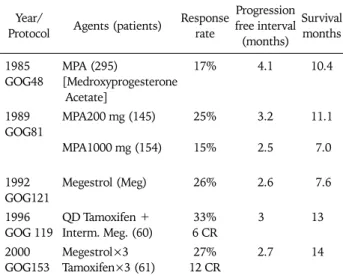
Recommendations for primary chemotherapy treatment changed when survival of patients with grade 1 lesions treated with progestin therapy was no higher than 5-10%, despite an approximate 25% overall response (Table 3).
For example, in GOG 153, the alternating dose of megestrol acetate and tamoxifen achieved a response rate of 27% and
Table 1. Second line GOG phase II trials in endometrial carcinoma
Year Drug Response CR PR Response rate
1984 1994 1995 1996 1998 1998 1999 2005 2006 2008
Cisplatin Etoposide Paclitaxel Actinomycin Lip doxorubicin Pyrazoloaridin Topotecan Docetaxel Pemetrexed Ixabepilone
1/25 0/22 12/44 3/25 4/42 1/23 2/22 1/27 1/26 6/50
0 0 3 1 0 0 1 0
− 1
1 0 9 2 4 1 1 1 1 5
4%
0%
28%
12%
10%
4%
9%
4%
3.8%
12%
Table 2. First line GOG chemotherapy of advanced endometrial car- cinoma
Year Agent Response CR PR Response rate
1986 1987 1989 1989 1993 1994 2004
Hexamethylmelamine Methotrexate Vincristine Cisplatin Paclitaxel Ifosfamide
Liposomal. Doxorubicin 2/25 2/33 6/33 10/50 10/28 9/34 6/52
0 1 1 2 4 2 2
2 1 5 8 6 7 4
8%
6%
18%
20%
35%
26%
11.5%
Table 3. First line GOG trials of advanced endometrial carcinoma with progestins
Year/
Protocol Agents (patients) Response rate
Progression free interval (months)
Survival months
1985 GOG48
1989 GOG81
1992 GOG121 1996 GOG 119 2000 GOG153
MPA (295)
[Medroxyprogesterone Acetate]
MPA200 mg (145)
MPA1000 mg (154)
Megestrol (Meg)
QD Tamoxifen + Interm. Meg. (60) Megestrol×3 Tamoxifen×3 (61)
17%
25%
15%
26%
33%
6 CR 27%
12 CR
4.1
3.2
2.5
2.6
3
2.7
10.4
11.1
7.0
7.6
13
14
had the highest number of complete responders. Since the response rate was lower than that achieved by chemotherapy, hormonal therapy has been abandoned for GOG trials in advanced endometrial carcinoma. Exceptions for possible use of hormonal therapy in GOG trials are in purported endometrial complex hyperplasia with atypia or evaluation of new agents such as FaslodexR in GOG188.
A response rate of 30-40% can be expected with first line
treatment using doxorubicin, but the survival remains low.
Even so, first line testing of chemotherapy agents remains acceptable to best assess activity of new agents where survival remains low even with current three drug combination therapy.
First line GOG testing has led to subsequent trials using drug combinations that have achieved improved results. In addition, first line testing has avoided use of drugs such as liposomal doxorubicin which would appear as an ideal agent with markedly reduced toxicity. Yet, in both first and second line trials, liposomal doxorubicin had low activity in the range of 10-12% for recurrent endometrial carcinoma.
RADIATION AND CHEMOTHERAPY
In the 1990's, the GOG began to explore the utility of whole abdominal radiation combined with chemotherapy for advanced endometrial carcinoma2-4 (Table 4). GOG 094 was successful in establishing the role of whole abdominal radiation especially for the high risk types of clear cell and papillary serous carcinoma.5 Concurrently, in GOG 107 the combination of cisplatin and doxorubicin in a phase III trial was proven superior to doxorubicin alone in recurrent endometrial carcinoma.6 In 1996, GOG 129C results indi- cated that paclitaxel was highly active as second line treat- ment in advanced endometrial carcinoma with a 28% overall response rate.7 By the year 2000, in GOG 122 chemotherapy alone was noted to be superior to whole abdominal radiation.8 Shortly thereafter, the three drug combination of doxorubi- cin, cisplatin and paclitaxel was noted to be superior to doxorubicin and cisplatin.9
The GOG Final Statistical Report in January 2007 (www.gog.
org) for GOG184 indicated that the addition of paclitaxel to doxorubicin and cisplatin following surgery and volume directed radiation did not increase survival. There has been no replacement yet activated for GOG184 largely because the control chemotherapy arm is unclear, and the question of how radiation and chemotherapy should be combined remains unanswered. In GOG 209, the current phase III protocol for recurrence, the combination of doxorubicin, cisplatin and
Table 4. GOG trials in advanced endometrial carcinoma
GOG 094: Whole abdomen radiation (WAI) tolerable in endometrial carcinoma (1995) GOG 107: Cisplatin (Cis)+doxorubicin higher response than doxorubicin alone (1988-1992) GOG 129C: Paclitaxel (Pac) phase II 28% response (1997)
GOG 122: Cisplatin+doxorubicin (Doxo) superior to WAI (1992-2002)
GOG 177: Cis/Doxo/Pac superior to Cis/Doxo in advanced endometrial carcinoma (1998-2002) GOG 184: Surgery+radiation followed by doxorubicin and cisplatin w/without paclitaxel (2000-2004) GOG 209: Doxorubicin, cisplatin and paclitaxel vs carboplatin and paclitaxel (2000 to Present)
paclitaxel (control arm) is being compared to carboplatin and paclitaxel. If the GOG 209 arms are similar, then the GOG 184 replacement would likely be carboplatin and paclitaxel vs radiation.
Since the year 2000, in advanced endometrial carcinoma, the GOG has conducted phase II trials with several molecular targeting agents including imatinib (Gleevec), trastuzumab (Herceptin), and gefitinib (Iressa) as single agents with negligible evidence of activity. The GOG does have active trials of chemotherapy with a molecular targeting agent such as bevacizumab (Avastin) in GOG 218, but there are no randomized molecular targeting agent trials in advanced endometrial carcinoma.
CHALLENGES DERIVED FROM GOG184 FOR FUTURE CONSIDERATION?
Since GOG184 is the most recently concluded GOG clinical trial in advanced endometrial carcinoma, specific challenges for the future can be based on the findings of this trial.1 The GOG Corpus Committee is charged with the respon- sibility of protocol development for advanced endometrial carcinoma. The statistical updates contained in the six month statistical reports, now readily available on the GOG web site, are reviewed at each six month meeting. The statistical abstracts of the study chairs that summarize the analyses of completed clinical trials are regularly reviewed by the committee members who also attend the presentation of the analyses. All of this information is used to craft a replacement protocol by the Corpus Committee which then requires approval by the GOG committee in charge of development of all GOG protocols. There must be final approval for activation by the National Cancer Institute.
Unfortunately the timeline for the last phase III protocol for advanced endometrial carcinoma (GOG 184) took 10 years.
• Development 1 Year (1999-2000) • Enrollment 4 Years (2000-2004) • Follow-Up (62% Survival) 3 Years (2004-2007) • Analysis 1 Year (2007-2008) • Presentation of Abstract of Trial Findings 1 Year (2008) • Final Publication 2009?
The ultimate goal in managing a large phase III trial of
several hundred patients would be to have instant replace- ments activated as soon as the prior study closes for patient entry. The minimal desirable goal would be to have as short a development phase as possible. Unfortunately, there is no GOG184 Replacement (184R) protocol active yet even though GOG 184 was closed to patient entry in 2004. The endpoint for GOG184 was Recurrence Free Survival (RFS), but if the endpoint of survival had been used, GOG184 would not be closed for analysis yet. The population of patients did have a high survival of 62 and 64% for each arm which delayed the initiation of the statistical analysis for three years from the date of last patient entry. The Stage IV patients (66 patients) were barred from further entry once GOG122 was analyzed to reveal that chemotherapy was superior to radiation in advanced endometrial carcinoma. No prospective rando- mized trial is perfect but several questions arise when it takes so long to answer clinical questions.
During the four years of patient accrual in GOG184, 659 patients with 2 cm or less of residual endometrial carcinoma following TAH/BSO with or without node dissection received volume directed (to site of the tumor) radiation, then 552 were randomized to doxorubicin and cisplatin with or without paclitaxel. At the conclusion of the study, there was no difference in Recurrence Free Survival (RFS) with 62 and 64% survival for each arm.
FUTURE CHALLENGES
1. Should there be statistical carve outs of subgroups of the GOG184 552 eligible patients to develop the replacements of GOG184 or GOG184R's? The new GOG184R's would be modeled on the prior study with the primary objectives being to achieve results in 2-3 years rather than one result in 10 years. For example, should a GOG184R contain any low risk patients that were clearly identified in GOG184 such as most grade 1 and 2 patients who had survivals in the 90% and 70%
range, respectively (Fig. 1)?1 Should successive randomized phase II trials be designed and activated before the final results of the first trial are known?
2. Should statistical carve outs of GOG184 lead to Stage III high risk designed protocols where only grade 3, clear cell and papillary serous, gross residual disease patients, and patients with positive para-aortic nodes are included with a projected 30-60% survival range? Should high risk patients within
Fig. 1. GOG 184: Recurrence-free survival by tumor histology and grade. Fig. 2. GOG 184: Recurrence-free survival by residual tumor status.
CD: cisplatin+doxorubicin, CDP: cisplatin+doxorubicin+paclitax- el, GRD: gross residual disease.
advanced endometrial cancer patients not be the target for separate protocol development? The patients at high risk in GOG 184 included 55% (309/552) of patients in which 41%
had anaplastic or grade 3 with a RFS Hazard Ratio (HR) of 3.12, 13% had serous histology with a RFS HR of 4.43, and 2%
had clear cell (2%) histology with a RFS HR of 3.45 (Fig. 1).
3. Should patients with gross disease be given the three drug combination although overall the survival between the two arms was similar? There is high likelihood although the numbers are small that the addition of paclitaxel increased survival for patients with gross residual disease in GOG184 (Fig. 2).1 Yet, should gross disease patients even be included in GOG184R?
4. Should full dose chemotherapy beginning with cycle one be administered with filgrastim or pegfilgrastim in all protocols as was done in GOG184, as the use of growth factor would likely be necessary to assure equidosing of chemo- therapeutic agents? By making growth factor use mandatory in both arms of GOG184, there was no question that all patients received maximum dosing and afforded the use of full dose paclitaxel (160 mg/m2) which clearly had no influence on overall outcome.
5. Should dose reduction of chemotherapeutic agents be based primarily on grade 1-3 neutrophil toxicity? Clinically inconsequential grade 3 neutrophil toxicity prompting auto- matic dose reductions was first noted early in GOG184 when the protocol was amended to include growth factor manda- torily in both arms.
6. Should extensive pelvic node dissections, as done electively in GOG184, be done since, in the 552 randomized patients, pelvic node status was not significant? Aortic node status was predictive of outcome but not pelvic node status.
Rather than recommending "node dissection," should only para-aortic node sampling be encouraged or should extensive imaging of the para-aortic nodes be used to direct extended
field radiation if node positive?
7. How should radiation and chemotherapy be sequenced?
From GOG184, it was determined that older patients can tolerate full dose doxorubicin and cisplatin with or without paclitaxel after receiving volume directed radiation with one half receiving vaginal brachytherapy after full staging surgery.
So, how should these modalities is used to maximize the most optimal outcome?
8. Is there a role for extended field radiation or vaginal bra- chytherapy in advanced endometrial cancer? Within GOG184, no patients were randomized to receive radiation volume di- rected treatment to tumor sites and the specific details of the radiation within the constraints of the protocol varied at the election of the radiation oncologist, therefore no conclusions can be reached about the effectiveness of radiation. It is possi- ble that GOG184R may offer evaluation of radiation vs che- motherapy to finally address the need for what form of radia- tion in advanced endometrial carcinoma is useful.
9. Should other treatment approaches for advanced endometrial carcinoma be considered such as IP therapy, chemoradiation, or molecular targeting agents combined with chemotherapy?
10. Should clinical trials of the future for advanced endo- metrial carcinoma be primarily based upon the statistically sig- nificant (Hazards Regression Model) eight factors from GOG184? Stage (IV vs III), residual disease (gross vs micro- scopic), extended field radiation (yes vs no), histology/grade (serous vs adenocarcinoma), positive para- aortic node (yes vs no), positive cytology (yes vs no), pelvic metastases (ser- osa/adnexa yes or no) and age (risk increases with age) were significantly associated with RFS with the most high risk cate- gories of clear cell/papillary serous histology and grade 3 adenocarcinoma.1 Or should GOG184R be a duplicate ten year trial with different chemotherapy in the exact same population?
11. Is it time for a change in the huge multi-year phase III
clinical trials approach for advanced endometrial carcinoma as the RFS has increased, and should replacement protocols be based on comprehensive statistical analyses and not primarily treatment outcome? Should those significant factors that clearly had impact on the outcome be the basis for several phase II and phase III trials?
CONCLUSION
The GOG has come a long way in developing new strat- egies in the management of advanced endometrial carcinoma.
Surgery, chemotherapy and radiation have made the pri- mary contributions to progress. Sophisticated statistical analyses are key to the understanding of the results and the basis for design of future trials. Upon reflection of all the findings of GOG184, the last trial completed by the Gyneco- logic Oncology Group in advanced endometrial carcinoma, a number of challenges for the future are noted in the ten questions presented here. Basically, is it worth ten years to perform one trial to answer one clinical question in ad- vanced endometrial carcinoma which can be a widely heter- ogeneous group of patients?
REFERENCES
1. Homesley HD, Filiaci V, Gibbons SK, Long HJ, Spirtos NM, Morris RT, et al. Randomized phase III trial in advanced endometrial carci- noma of surgery and volume-directed radiation followed by cispla- tin and doxorubicin with or without paclitaxel: a Gynecologic Oncology Group study. Gynecol Oncol 2008; 108: S2.
2. Gibbons S, Martinez A, Schray M, Podratz K, Stanhope R,
Garton G, et al. Adjuvant whole abdominopelvic irradiation for high risk endometrial carcinoma. Int J Radiat Oncol Biol Phys 1991; 21: 1019-25.
3. Reisinger SA, Asbury R, Liao SY, Homesley HD. A phase I study of weekly cisplatin and whole abdominal radiation for the treat- ment of stage III and IV endometrial carcinoma: a Gynecologic Oncology Group study. Gynecol Oncol 1996; 63: 299-303.
4. Soper JT, Reisinger SA, Ashbury R, Jones E, Clarke-Pearson DL.
Feasibility study of concurrent weekly cisplatin and whole abdom- inopelvic irradiation followed by doxorubicin/cisplatin chemo- therapy for advanced stage endometrial carcinoma: a Gynecologic Oncology Group trial. Gynecol Oncol 2004; 95: 95-100.
5. Sutton G, Axelrod JH, Bundy BN, Roy T, Homesley H, Lee RB, et al. Adjuvant whole abdominal irradiation in clinical stages I and II papillary serous or clear cell carcinoma of the endome- trium: a Gynecologic Oncology Group study. Gynecol Oncol 2006; 100: 349-54.
6. Thigpen JT, Brady MF, Homesley HD, Malfetano J, DuBeshter B, Burger RA, et al. Phase III trial of doxorubicin with or with- out cisplatin in advanced endometrial carcinoma: a Gynecologic Oncology Group study. J Clin Oncol 2004; 22: 3902-8.
7. Lincoln S, Blessing JA, Lee RB, Rocereto TF. Activity of pacli- taxel as second-line chemotherapy in endometrial carcinoma: a Gynecologic Oncology Group study. Gynecol Oncol 2003; 88:
277-81.
8. Randall ME, Filiaci VL, Muss H, Spirtos NM, Mannel RS, Fowler J, et al. Randomized phase III trial of whole-abdominal irradi- ation versus doxorubicin and cisplatin chemotherapy in ad- vanced endometrial carcinoma: a Gynecologic Oncology Group Study. J Clin Oncol 2006; 24: 36-44.
9. Fleming GF, Brunetto VL, Cella D, Look KY, Reid GC, Munkarah AR, et al. Phase III trial of doxorubicin plus cisplatin with or without paclitaxel plus filgrastim in advanced endo- metrial carcinoma: a Gynecologic Oncology Group Study. J Clin Oncol 2004; 22: 2159-66.