Optimal effective-site concentration of remifentanil for sedation during plate removal of maxilla
Jeong-Hoon Park
1, Ji-Young Yoon
1, Eun-Jung Kim
1, Ji-Uk Yoon
2, Byung-Moon Choi
3, Ji-Hye Ahn
11Department of Dental Anesthesia and Pain Medicine, School of Dentistry, Pusan National University, Dental Research Institute, Yangsan, Korea
2Department of Anesthesia and Pain Medicine, School of Medicine, Pusan National University, Yangsan, Korea
3Department of Anesthesiology and Pain Medicine, Asan Medical Centre, University of Ulsan College of Medicine, Seoul, Korea
Background: Removal of the plate following Le Fort I osteotomy and BSSO (bilateral sagittal split osteotomy) is a common procedure. However, patients who undergo plate removal experience intense pain and discomfort.
This study investigated the half-maximal effective concentration (Ce50) of remifentanil in the prevention of plate removal pain under sedation using dexmedetomidine.
Methods: The study evaluated 18 patients, between 18 and 35 years of age, scheduled for elective surgery.
Remifentanil infusion was initiated after sedation using dexmedetomidine, and started at a dose of 1.5 ng/mL on the first patient via target-controlled infusion (TCI). Patients received a loading dose of 1.0 μg/kg dexme- detomidine over 10 min, followed by a maintenance dose of 0.7 μg/kg/h. When the surgeon removed the plate, the patient Modified Observer’s Assessment of Alertness/Sedation (MOAA/S) score was observed.
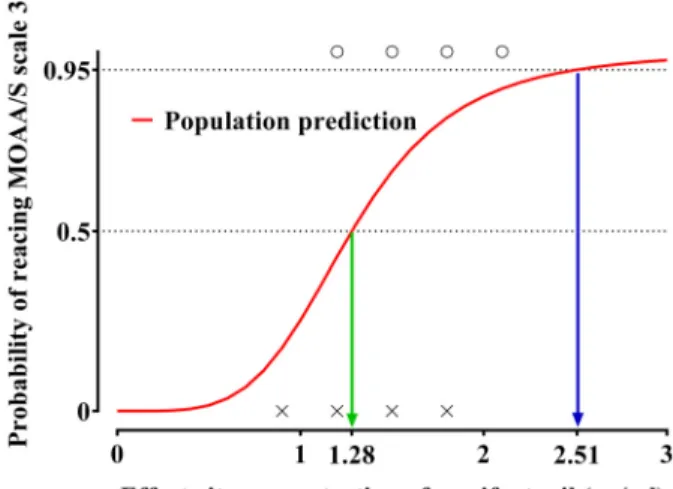
Results: The Ce of remifentanil ranged from 0.9 to 2.1 ng/mL for the patients evaluated. The estimated effect-site concentrations of remifentanil associated with a 50% and 95% probability of reaching MOAA/S score of 3 were 1.28 and 2.51 ng/mL, respectively.
Conclusion: Plate removal of maxilla can be successfully performed without any pain or adverse effects by using the optimal remifentanil effect-site concentration (Ce50, 1.28 ng/mL; Ce95, 2.51 ng/mL) combined with sedation using dexmedetomidine.
Keywords: Conscious Sedation, Dexmedetomidine; Plate Removal; Remifentanil.
This is an Open Access article distributed under the terms of the Creative Commons Attribution Non-Commercial License (http://creativecommons.org/licenses/by-nc/4.0/) which permits unrestricted non-commercial use, distribution, and reproduction in any medium, provided the original work is properly cited.
Received: October 3, 2018•Revised: October 14•Accepted: October 17, 2018
Corresponding Author:Ji-Hye Ahn, Department of Dental Anesthesia and Pain Medicine, Pusan National University Dental Hospital, Geumo-ro 20, Yangsan, Gyeongnam, 626-787, Korea
Phone: +82-55-360-5370 Fax: +82-55-360-5369 Email: [email protected] Copyrightⓒ 2018 Journal of Dental Anesthesia and Pain Medicine
INTRODUCTION
Various complications may occur after miniplate and screw fixation, such as infection, plate fracture, nonunion, and mental nerve paralysis or dysesthesia [1]. Plate removal after orthognathic surgery is performed in 1.0%–
18.6% of patients [2]. Approximately 80% of the plates are removed within the first year. One of the advantages of the early removal of the plate is that all plates are
technically easy to remove and the procedure has low morbidity [2]. However, patients who undergo plate removal procedures without general anesthesia suffer severe pain and anxiety during the surgery. Therefore, there is a need for methods that can reduce the pain, anxiety, and fear experienced by patients.
MAC (monitored anesthesia care) may be useful in minimally invasive surgical procedures such as plate removal. It provides suitable intraoperative conditions for the patient to be comfortable and pain-free. Propofol and
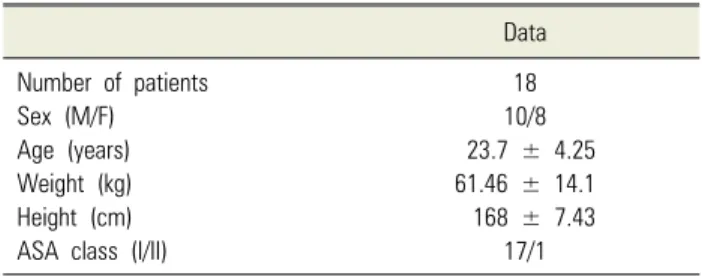
Table 1. Demographic Data
Data Number of patients
Sex (M/F) Age (years) Weight (kg) Height (cm) ASA class (I/II)
18 10/8 23.7 ± 4.25 61.46 ± 14.1 168 ± 7.43
17/1
The values are number of patients or the mean ± SD. ASA: American Society of Anesthesiologists.
midazolam are frequently used sedative drugs, and fentanyl, alfentanil, and remifentanil are frequently used analgesics; sometimes, severe respiratory depression occurs when sedatives and analgesics are used together.
Dexmedetomidine has a high specificity for the α 2-receptor and is therefore a complete α2-agonist. It provides outstanding sedation and analgesic effects, with minimal respiratory depression [3-5]. A recent study showed that dexmedetomidine was an effective sedative drug for patients undergoing a broad range of surgical procedures performed under MAC. As a result, patients were more satisfied after surgery, experienced milder respiratory depression, and opioid use was reduced [6].
However, the sole use of dexmedetomidine was not as effective as propofol with analgesics for the provision of adequate sedation during the procedure; moreover, dexmedetomidine was associated with significant hemo- dynamic instability and longer recovery times [7].
Remifentanil is an ultra-short acting opioid that is quickly hydrolyzed by nonspecific esterases in the plasma and multiple organs [8]. Owing to the fast reaction, short working time, and characteristic of rapid decay, the injection rate can be easily adjusted to suit individual patient needs or surgical situations. For example, an increased dose of remifentanil before skin incision or before the insertion of a Trocar can reduce the hemodynamic stress reaction. The need for remifentanil can be predicted at the action time and the time at which the action ends can be expected. In addition, the use of a high dose of remifentanil just before the skin suture does not affect recovery, because it does not accumulate, regardless of injection time or amount of injection.
Previous studies have reported that when dexmedeto- midine and remifentanil were used together, safe and satisfactory sedation was provided [9,10]. However, the appropriate concentration of remifentanil during plate removal of maxilla was not suggested. The Ce50 and the Ce95 are the effective remifentanil effect-site concen- trations (Ce) in 50% and 95% of patients for the prevention of emergence of pain or anxiety. Therefore, the goal of our study was to evaluate the Ce50 of
remifentanil for sedation.
MATERIALS AND METHOD
1. Patient population
After obtaining approval from the Pusan National University Dental Hospital Institutional Review Board (IRB No. PNUDH-2018-022), written informed consent was obtained from all patients. The enrolled patients were between 18 and 35 years of age, with an American Society of Anesthesiologists (ASA) physical status classification of I or II; patients with cardiovascular, pulmonary, renal, or hepatic diseases were excluded from this study (Table 1).
The change between consecutive response and no response was termed a “crossover” with a midpoint concentration between the response and no response concentrations. This study was ended after eight crossovers had occurred. The eight crossovers were averaged to find the Ce50 of remifentanil.
2. Study procedure
No medications were administered prior to the surgery.
A 20- or 22-gauge angiocatheter was inserted into the patient’s forearm or the dorsum of the hand for drug injection. When the patient arrived into the operating room, they were connected to the standard monitoring equipment, such as electrocardiography monitor, non- invasive blood pressure measurement devices, and pulse oximetry. Pulse rate and oxygen saturation were conti-
Table 3. Hemodynamic changes
T0 T1 T2
MBP (mmHg) HR (beats/min) SpO2 (%)
90.78 ± 13.43 80.95 ± 16.1 99.84 ± 0.5
88.78 ± 13.93 63.84 ± 15.61 98.84 ± 2.31
90.78 ± 17.71 79.53 ± 13.62 99.16 ± 1.42
The values are the mean ± SD. MBP, mean blood pressure; HR, heart rate; SpO2, oxygen saturation; T0, baseline; T1, after the loading dose of dexmedetomidine was applied and the remifentanil infusion was started; T2, immediately after the plate was removed.
Table 2. Modified observer’s assessment of the alertness/sedation scale
Responsiveness Score
Agitated
Responds readily to name spoken in normal tone (alert) Lethargic response to name spoken in normal tone Responds only after name is called loudly and/or repeatedly
Responds only after mild prodding or shaking Does not respond to mild prodding or shaking
Does not respond to deep stimulus
6 5 4 3 2 1 0
nuously monitored from when the patient entered the operating room to discharge from the recovery room.
Non-invasive blood pressure measurements were collected at 5 min intervals during the surgery [11]. After preoxygenation with 5 L/min of 100% oxygen, dexme- detomidine infusion was initiated with a loading dose of 1.0 μg/kg over 10 min, and a maintenance dose of 0.7 μg/kg/h. The remifentanil infusion was started together with dexmedetomidine at a dose of 1.5 ng/ml via target-controlled infusion (TCI) to the first patient. The degree of sedation was determined by using the MOAA/S (Modified Observer’s Assessment of Alertness/Sedation) scale (Table 2) [12].
Remifentanil infusion was based on Minto’s model, using a TCI device (OrchestraⓇ Base Primea, Fresenius- Vial, France) [13].
MOAA/S scores of 3 were considered to indicate a
“response”, and scores of 4, 5, or 6 were regarded as
“no response”. The Ce of remifentanil for the next patient was determined by the previous patient’s response. If a patient’s score indicated a response, the Ce of remi- fentanil for the next patient was increased by 0.3 ng/mL.
If a patient’s score indicated no response, the Ce of remifentanil for the next patient was decreased by 0.3 ng/ml [14].
3. Determination of the remifentanil concentration required to reach appropriate sedation using logistic regression
Using the observations of appropriate and inappropriate sedation level, every effect-site concentration of remi- fentanil was assigned as 0 (inappropriate sedation) or 1 (appropriate sedation). The relationship between the probability of reaching MOAA/S score of 3 [P (MOAA/S
= 3)] and the effect-site concentration of remifentanil was analyzed by using a sigmoid Emax model:
where Ce is the effect-site concentration of remifen- tanil, Ce50 is the effect-site concentration of remifentanil associated with a 50% probability of reaching an MOAA/S score of 3, and g is the steepness of the concentration-response relationship. The likelihood, L, of the observed response of 3 on the MOAA/S scale, R, is described by the following equation:
Likelihood = R × Prob + (1 – R) × (1 – Prob) where Prob is the probability of reaching an MOAA/S score of 3 [15].
Fig. 1. Predicted probability of reaching a Modified Observer’s Alertness/
Sedation (MOAA/S) score of 3 plotted against the effect-site concent- rations of remifentanil. X: Effect-site concentration of remifentanil when an MOAA/S score of 3 was not reached; O: effect-site concentration of remifentanil of that reached an MOAA/S score of 3. The red solid line indicates the population prediction.
4. Statistics
The logistic regression was performed by using NONMEMⓇ7 level 4 (ICON Development Solutions, Dublin, Ireland). Inter-individual variations could not be successfully estimated with only one point per individual.
Therefore, a naïve-pooled data approach was used. Model parameters were estimated by using the option
“LIKELIHOOD LAPLACE METHOD=conditional” in NONMEM [15].
RESULTS
The 18 patients who underwent plate removal surgery were treated dexmedetomidine and remifentanil simultaneously. Each patient’s heart rate, mean blood pressure, and oxygen saturation were checked before the remifentanil and dexmedetomidine infusion (baseline, T0), after the loading dose of dexmedetomidine was applied and remifentanil infusion was started (T1), and immediately after the plate was removed (T2) (Table 3).
The results of our study showed that there were no complications such as hypotension (decrease in MBP to
< 55 mmHg), bradycardia (HR slower than 40 beats/min), oxygen desaturation (SpO2 below 90%), or respiratory distress.
We found the Ce of remifentanil required to minimize pain during the plate removal procedure. The estimated effect-site concentration of remifentanil associated with a 50% and 95% probability of reaching an MOAA/S score of 3 was 1.28 and 2.51 ng/mL, respectively (Fig.
1).
DISCUSSION
Traditionally, the midazolam-remifentanil regimen has been used for procedures that require sedation. Previous reports have shown that both midazolam-remifentanil and dexmedetomidine-remifentanil ensured the safety of
HIFU treatment for uterine fibroids. However, dexme- detomidine-remifentanil provided more stable sedation in patients than the traditional regimen [9]. Another study showed that the dexmedetomidine-remifentanil protocol improved respiratory sparing effects to a greater extent than midazolam-remifentanil. Therefore, the dexmedeto- midine-remifentanil regimen can be used safely as a sedation method during endoscopic retrograde cholangio- pancreatography (ERCP) [10].
Our study indicated that the values of MBP, HR, and SpO2 were 90.78 ± 17.71, 79.53 ± 13.62, and 99.16 ± 1.42, respectively, when the surgeon removed the plate;
moreover, no complications, such as hypotension, bradycardia, or hypoxemia, occurred.
Many studies have reported a Ce50 of remifentanil that could prevent hemodynamic changes caused by nasotracheal intubation or lidocaine injection pain; for example, 2.0–5.0 ng/mL of remifentanil did not induce significant hypotension, bradycardia, chest pain, or hypoxemia [16-19].
Heo et al. [14] showed that the Ce50 and Ce95 values of remifentanil during cystoscopy when dexmedeto- midine was infused at a clinical dose were 1.33 and 1.58 ng/ml, respectively.
In our study, we infused the loading dose of dexme- detomidine for 10 min and remifentanil was started at a dose of 1.5 ng/ml. The dose of remifentanil for the subsequent patient was controlled by the MOAA/S score of the previous patient. The patient’s MOAA/S score was observed when the surgeon removed the plate. Using a sigmoid Emax model, every effect-site concentration of remifentanil was allocated to 0 (inappropriate sedation) or 1 (appropriate sedation).
However, our research has limitations. As a person ages, increased body fat and decreased muscle mass result in a general decrease in total body water. As a result, water-soluble drugs have lower plasma concentrations and lipid-soluble drugs have higher plasma concentrations in the body. In addition, the duration of action in several anesthetics increases because of the decline of glomerular filtration rate and hepatic function.
The requirement for fentanyl is reduced by as much as 50%. Clearance is a factor for remifentanil; thus, dose requirements for remifentanil may be reduced even further. However, as the patients enrolled in this study were between 18 and 35 years of age, further study is required to determine the proper concentration of remifentanil in elderly people.
In conclusion, we determined that the Ce50 and Ce95
values of remifentanil, resulting in almost complete abolition of pain during plate removal when using dexmedetomidine at a clinical dose, were 1.28 ng/mL and 2.51 ng/mL, respectively. Therefore, plate removal proce- dures can be successfully implemented without any pain or adverse effects by using an optimal concentration of remifentanil combined with sedation using dexmedeto- midine.
AUTHOR ORCIDs
Jeong-Hoon Park: http://orcid.org/0000-0001-5835-2197 Ji-Young Yoon: http://orcid.org/0000-0002-9097-0531 Eun-Jung Kim: http://orcid.org/0000-0003-4982-9517 Ji-Uk Yoon: http://orcid.org/0000-0002-3971-2502 Byung-Moon Choi: http://orcid.org/0000-0002-6561-8851 Ji-Hye Ahn: http://orcid.org/0000-0001-8811-8465
ACKNOWLEDGEMENTS: This work was supported by a 2-Year Research Grant from Pusan National University.
NOTE: There are no financial or other issues that might lead to conflict of interest.
REFERENCES
1. Matthew IR, Frame JW. Policy of consultant oral and maxillofacial surgeons towards removal of miniplate components after jaw fracture fixation: pilot study. Br J Oral Maxillofac Surg 1999; 37: 110-2.
2. Falter B, Schepers S, Vrielinck L, Lambrichts I, Politis C. Plate removal following orthognathic surgery. Oral Surg Oral Med Oral Pathol Oral Radiol Endod 2011; 112:
737-43.
3. Hall JE, Uhrich TD, Barney JA, Arain SR, Ebert TJ.
Sedative, amnestic, and analgesic properties of small-dose dexmedetomidine infusions. Anesth Analg 2000; 90: 699- 705.
4. Ebert TJ, Hall JE, Barney JA, Uhrich TD, Colinco MD.
The effects of increasing plasma concentrations of dexme- detomidine in humans. Anesthesiology 2000; 93: 382-94.
5. Herr DL, Sum-Ping ST, England M. ICU sedation after coronary artery bypass graft surgery: dexmedetomidine- based versus propofol-based sedation regimens. J Cardiothorac Vasc Anesth 2003; 17: 576-84.
6. Candiotti KA, Bergese SD, Bokesch PM, Feldman MA, Wisemandle W, Bekker AY, MAC Study Group. Monitored anesthesia care with dexmedetomidine: a prospective, randomized, double-blind, multicenter trial. Anesth Analg 2010; 110: 47-56.
7. Muller S, Borowics SM, Fortis EA, Stefani LC, Soares G, Maguilnik I, et al. Clinical efficacy of dexmedetomidine alone is less than propofol for conscious sedation during ERCP. Gastrointest Endosc 2008; 67: 651-9.
8. Glass PS, Hardman D, Kamiyama Y, Quill TJ, Marton G, Donn KH, et al. Preliminary pharmacokinetics and pharmacodynamics of an ultra- short-acting opioid:
remifentanil (GI87084B). Anesth Analg 1993; 77: 1031-40.
9. Fu X, Huang F, Chen Y, Deng Y, Wang Z. Application of dexmedetomidine-remifentanil in high-intensity ultra- sound ablation of uterine fibroids: a randomised study.
BJOG 2017; 124 Suppl 3: 23-9.
10. Lu Z, Li W, Chen H, Qian Y. Efficacy of a Dexmedeto- midine-Remifentanil Combination Compared with a Mida- zolam-Remifentanil Combination for Conscious Sedation During Therapeutic Endoscopic Retrograde Cholangio- Pancreatography: A Prospective, Randomized, Single- Blinded Preliminary Trial. Dig Dis Sci 2018; 63: 1633-40.
11. Sachar H, Pichetshote N, Nandigam K, Vaidya K, Laine L. Continued midazolam versus diphenhydramine in difficult-to-sedate patients: a randomized double-blind trial.
Gastrointest Endosc 2018; 87: 1297-303.
12. Shin S, Park CH, Kim HJ, Park SH, Lee SK, Yoo YC.
Patient satisfaction after endoscopic submucosal dissection under propofol-based sedation: a small premedication makes all the difference. Surg Endosc 2017; 31: 2636-44.
13. Minto CF, Schnider TW, Egan TD, Youngs E, Lemmens HJ, Gambus PL, et al. Influence of age and gender on the pharmacokinetics and pharmacodynamics of remifen- tanil. I Model development. Anesthesiology 1997; 86:
10-23.
14. Heo B, Kim M, Lee H, Park S, Jeong S. Optimal effect-site
concentration of remifentanil when combined with dexmedetomidine in patients undergoing cystoscopy.
Korean J Anesthesiol 2014;66:39-43.
15. Choi BM, Lee YH, An SM, Lee SH, Lee EK, Noh GJ.
Population pharmacokinetics and analgesic potency of oxycodone. Br J Clin Pharmacol 2017;83:314-25.
16. Lee B, Lee JR, Na S. Targeting smooth emergence: the effect site concentration of remifentanil for preventing cough during emergence during propofol-remifentanil anaesthesia for thyroid surgery. Br J Anaesth 2009; 102:
775-8.
17. Kim JS, Kim DH, Min SK, Kim KM, Kim JY. Comparison of effect-site concentration of remifentanil for tracheal intubation with the lightwand and laryngoscopy during propofol target-controlled infusion. Korean J Anesthesiol 2011; 60: 393-7.
18. Kim SH, Choi EM, Chang CH, Kim HK, Chung MH, Choi YR. Comparison of the effect-site concentrations of remifentanil for Streamlined Liner of the Pharynx Airway (SLIPA) versus laryngeal mask airway SoftSealTM insertion during target-controlled infusion of propofol. Anaesth Intensive Care 2011; 39: 611-7.
19. Lee BW, Kim SH, So KY. The effect of gender on EC(50) of remifentanil to prevent pain during injection of micro- emulsion propofol. Korean J Anesthesiol 2012; 63: 504-9.