• 검색 결과가 없습니다.

Age-Related Fecal Calprotectin Concentrations in Healthy Adults

N/A
N/A
Protected

Academic year: 2021

Share "Age-Related Fecal Calprotectin Concentrations in Healthy Adults"

Copied!
7
0
0

로드 중.... (전체 텍스트 보기)

전체 글

(1)

Corresponding author:

Shin Young Park

Department of Clinical Laboratory Science, Cheju Halla University, 38 Halladaehak-ro, Jeju 63092, Korea

E-mail:

[email protected]

ORCID:

https://orcid.org/0000-0002-2330-5638

ORIGINAL ARTICLE

Age-Related Fecal Calprotectin Concentrations in Healthy Adults

Shin Young Park

Department of Clinical Laboratory Science, Cheju Halla University, Jeju, Korea

건강한 성인의 연령별 분변 칼프로텍틴의 농도

박신영

제주한라대학교 임상병리과

ARTICLE INFO ABSTRACT

Received

August 24, 2020

Revised 1

st August 30, 2020

Revised 2

nd August 30, 2020

Accepted

August 31, 2020

Fecal calprotectin (FC) is a marker used for the differential diagnosis of inflammatory bowel disease (IBD). FC is also used to determine the effects of treatment and recurrence prediction because of its non-decomposition by bacteria, relative week stability at room temperature, and its uniform distribution within feces. Healthy male and female adults between the age of 30 and 80 living in Jeju were selected for this study. The FC concentration in the healthy control group (N=45) was distributed widely as 0∼545.9 μg/g and showed a significant difference with age in healthy adults.

The FC concentration in adults over 70 years old (80.6 years on average) was 160.3 μg/g. The result is approximately 10 times higher than in adults below 50 years (44 years on average), with FC concentrations at 15.88 μg/g. Moreover, adults over 50 years, with an average age of 59.6, had FC concentrations of 35.46 μg/g, which were two times higher than the below 50-year-old group, confirming the significant correlation between age and FC concentration. As the FC test is a non-invasive and cost-effective objective marker in IBD tests, a suitable cut-off value is required for different ages. This study provides the baseline data for differential diagnoses.

Copyright Ⓒ 2020 The Korean Society for Clinical Laboratory Science. All rights reserved.

Key words Fecal calprotectin Healthy volunteer Inflammatory bowel disease Marker

INTRODUCTION

Inflammatory bowel disease (IBD) usually affects adults in North America and Northern Europe. However, IBD’s prevalence recently expanded to ulcerative colitis and Crohn’s disease in Korea, according to recent epidemiology studies [1, 2]. IBD can be characterized by the chronic inflammation of the gastrointestinal system, requiring lifetime management and affecting

the patient’s quality of life. Diagnosis and bowel inflammation monitoring are vital in IDB diagnosis and follow up. Although diagnosis and follow-up manage- ment are closely related to its long term prognosis, the most effective monitoring methods until now are limited to colonoscopy and biopsy, which are invasive, time-consuming, and costly [3, 4]. Thus, a simpler, faster, and less invasive fecal calprotectin (FC) test has been recently reported in various studies. The chronic inflammatory disease, with its cycles of improvement and aggravation, requires a lifetime of disease activity evaluation. As a functional disease of no specific symptom and sign, it is difficult for differential diagnoses from other disorders, especially without standard diagnostic

Korean Society for Clinical Laboratory Science

(2)

Table 1. Demographic characteristics of the study’s healthy volunteers (N=45)

Variable Age (yr) Sex (M/F) BMI (kg/m

2

)

Value 63.1±15.6 29/16 23.3±3.3

Values are presented as mean±SD.

Abbreviations: BMI, body mass index; M, male; F, female.

criteria. Thus, to monitor and detect IBD, the method of using FC as a biomarker was used for being simple, rapid, sensitive, inexpensive, and noninvasive. FC detection minimizes false-positive results and de- creases unnecessary biopsies. Moreover, as the FC level is six times higher compared to the serum level, it also allows a highly sensitive test [5, 6].

Calprotectin was first identified and reported in 1980 as an L1 protein [7]. It was separated and quantified from the stool and reported in 1992 by Røseth et al [8].

Calprotectin is a calcium- and zinc-bound protein usually found in damaged neutrophil, taking up to 60%

of the neutrophil cytoplasm. With bowel inflammation, it is destroyed during the transepithelial migration of the neutrophil through the intestinal mucosa and excreted in stool after secretion within the bowel from cell necrosis [8]. Early studies showed calprotectin to be raised in patients with inflammatory bowel disease3 and to be correlated with endoscopic and histological evidence of inflammation. It has since been shown to be useful sensitive non-invasive biomarker for the diagnosis of inflammatory bowel disease, to predict its severity in adults6 and children, to predict relapse8 and to monitor response to treatment [3, 9]. Calprotectin has one of the most critical roles in gut immunity, which is not only related to IBD but also to obesity. FC levels in obese and overweight adults were observed to be significantly higher compared to obese and over- weight children in age-obesity studies [10]. Calprotectin in the stool is not easily decomposed by bacteria and is stable for approximately one week at room temperature.

As it is uniformly distributed within the stool, detection is possible with a minimum amount, allowing an active study as a marker for treatment effect determination and recurrence prediction for IBD differential diagnosis [11, 12]. Normal FC levels per age were mostly on infants or children below 12 years old [13-15]. with hardly any studies on healthy adults or elders. The purpose of this study is to measure FC levels in healthy male and female adults between the ages 30 and 80 residing in Jeju, understand the normal range concen-

tration, and to evaluate the usual diagnosis standard on FC tests for intestinal disease patients and IBD patients.

MATERIALS AND METHODS

1. Subjects

A healthy control group was recruited from the hospital staff, families and friends of Cheju Halla General Hospital for this study. From a total of 50 participants, 45 health adults between the age of 40 and 90 without a history of colorectal or systemic inflam- mation were selected as subjects for fecal sample collection. There were 13 health adults under the age of 50, 16 health adults between 51 and 69 years, and 16 health adults over the age of 70. The healthy control group was classified per age group, gender, and body mass index (BMI; Table 1). The study was approved by the Ethical Committee of Cheju Halla University, Jeju City (1044348-20190304-HR-001-01).

2. Fecal calprotectin

Fecal samples of the normal adult volunteers were collected once using a sterile rod in a sterile box, following the precautions for calprotectin measurement.

The provided stool samples were subdivided and stored at −80°C, until use. The measurement used for FC detection followed Park and Kim’s [10]. measurements.

Afterward, the samples were pulled from refrigerated

storage to room temperature for natural defrosting for

approximately 30 min. Then, a single 100 mg aliquot

was suspended in 1 mL of fecal extraction buffer

consisting of 0.1 M Tris-buffered saline with Tween 20,

pH 8.0 (MBCell, Kisanbio Tech Co. Ltd, Seoul, Republic

of Korea), 0.5% bovine serum albumin, and 0.15 M

(3)

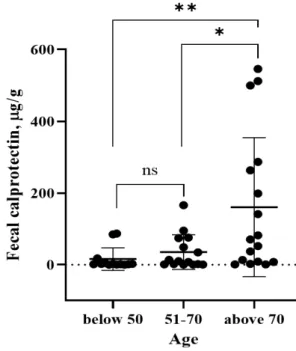
Figure 1. Scatter plots of fecal calprotectin (FC) levels in three age groups. The data were presented as mean±standard deviation of mean. Mann Whitney U-test was used for statistical analysis.

Significance level was * P <0.05, ** P <0.001.

NaCl, 10 mM CaCl2. The sample was homogenized for 5 min with a vortex mixer (Scientific Industries, Bo- hemia, NY, USA). The homogenates were centrifuged for 5 min at 10,000 × g at room temperature. The top portion of the supernatants was removed and kept at

−80°C until quantitated by enzyme-linked immuno- sorbent assay (ELISA).

FC was quantitatively measured using a Legend Max- Human MRP8/14 (calprotectin) ELISA Kit (BioLegend, San Diego, CA, USA). The frozen fecal extracts were defrosted and diluted 1:1000 in an assay buffer.

Standards and diluted samples (50 μL) were put into the ELISA plates, which were then shielded and incubated at RT for 1 hr while agitating at 200 rpm. Then, 100 μL of human MRP8/14 detection antibody solution was added to each well after washing the wells 4 times with a wash buffer. The plates were shielded and incubated at RT for 30 min while agitating. After incubation with the detection antibody solution, the wells were washed five times with a wash buffer, and 100 μL of substrate solution was added. Then, 100 μL of stop solution was added, and the absorbance was read at both 450 nm and 570 nm using a PowerWave XS2 Microplate Spec- trophotometer (BioTek Winooski, VT, USA). The readings at 570 nm were subtracted from those at 450 nm.

Calprotectin values of the fecal sample were expressed as μg/g.

3. Statistical analysis

Data were analyzed using the GraphPad Prism statistical software package (GraphPad Software Inc., La Jolla, CA, USA). Calprotectin values were presented as the mean±standard deviation. A student’s t-test was performed to compare FC concentrations according to age and gender.

RESULTS

1. FC concentration per age and BMI

The average age of the healthy control group (N=45) was 64±15.6, with an average FC concentration of

64.98 μg/g, showing a large variation between the age groups. Thus, the age groups were subdivided into 3 groups of below 50, 50∼69, and over the age of 70 (Figure 1). The average FC concentration below the age of 50 years was 15.88 μg/g (range, 0.0∼86.9 μg/g), then 35.46 μg/g (range, 0.43∼166.1 μg/g) between the age of 50∼69 years, and 160.3 μg/g (range, 0.93∼545.9 μg/g) over the age of 70 years, showing a significant difference between the age groups. There were a total of 13 health adults for the below-50 group, 11 males and 2 females, with an average age of 44 years.

The average age for the 51∼69 group was 59.6, with 11 male and 5 female health adults. The average age for the over-70 group was 80.6 years, with a balanced gender ratio of 8 females and 8 males. As the average FC concentration showed a 5∼10 times higher concen- tration in the over-70 age group, significance between the concentration and age could be identified.

Pearson coefficient showed significant correlations

between FC concentration and age (Pearson r=0.3779,

P=0.0096). Linear regression analysis showed a positive

relation between FC concentration and age (slope:

(4)

Figure 2. Linear regression analysis of FC concentration by age in healthy volunteers (N=45).

Figure 3. Scatter plots of fecal calprotectin (FC) levels between gender groups. The data were presented as mean±standard deviation of the mean. Mann Whitney U-test was used for statistical analysis.

Significance level * P <0.05, ** P <0.001.

0.0471, Y intercept: 58.36) (Figure 2).

Unlike the FC concentration, which showed a signi- ficant difference between the age groups, no sig- nificance was observed between BMI index and FC concentration. Moreover, the average BMI of the total participants were measured at 23.3±3.3, with most participants of the healthy control group showing a normal BMI index.

2. FC concentration per gender

Of the 45 healthy control group participants, 29 were male (64%) and 16 were female (36%). The average FC concentration in the male and female participants were 545.9 and 511.83 each, showing a significant difference between the genders after the analysis, excluding the highest concentration (Figure 3). The average FC con- centration in males was 62.43 μg/g (range, 0.14∼

286.76 μg/g), and 12.21 μg/g (range, 0.25∼82.01 μg/g) in females, 6 times lower than males.

DISCUSSION

Despite the active FC-related studies reported abroad, it is a new study area in Korea, with its recent report on infants in 2014 [16]. Most of the reported

articles had been about IBD patients, infant diarrhea, and meta-analysis results of the IBD patient group [17]

as well as review articles [18-20]. Studies on FC are

actively ongoing for use in the differential diagnosis of

IBD and as an effective marker that predicts recurrence

and determines treatment effects. Moreover, increased

FC concentration in children (3∼18 years) had been

reported to be significant in atopic dermatitis (AD)

severity evaluation from the relatedness between FC

concentration and AD. The relatedness study between

obesity and FC [10, 21] suggested a different patho-

physiological mechanism between adult and childhood

obesity as a result of significantly higher FC concen-

tration in adults than in children [10]. According to a

recent domestic study report on causality between FC

and IBD [22], FC had been proven to be a reliable

noninvasive differentiating marker in the differential

diagnosis for eosinophilic gastrointestinal disorder and

functional abdominal pain disorder. As most studies

until now had been on the effectiveness of FC as a

noninvasive marker for IBD diagnosis, with study

subjects composed mainly of IBD patients, there has

been a relative lack of data for comparison on healthy

adults and elders. Thus, we conducted this study on

(5)

healthy male and female adults residing in Jeju, between the age of 30 and 90, to understand the normal range of FC concentration.

From meta analysis and large review article, 50 μg/g was the most commonly adopted cut-off FC value both in literature and by commercially available ELISA kits, as a screening cut-off value for further endoscopy examination in clinical practice, with specificity of 60% and pooled sensitivity of 92% [17, 23]. When the cut-off value at 100 μg/g, it showed 91% specificity and 98% sensitivity that indicating the cut-off value increases, sensitivity becomes lower and specificity higher. A negative test result at the lowest cut-off level (30 to 50 μg/g) suggests a diagnosis of a non-inflam- matory condition, such as irritable bowel syndrome (IBS). A positive result at the cut-off of 100 μg/g may indicate IBS, with the recommendation to repeat the test in 6 week to confirm the initial result [24].

This study’s results show that a significant difference was observed in FC concentration in healthy adults per age group. FC concentration in the over-70 age group (average of 80.6 years) was 160.3 μg/g; approximately 10 times higher compared to the below-50 age group’s (average of 44 years) 15.88 μg/g. Moreover, adults over 50 years, with an average of 59.6, had FC concen- trations at 35.46 μg/g, two times higher than the below-50 group, confirming a significant correlation between age and FC concentration. For appropriate clinical applications, a standardized cut-off value of FC is important. Zhu et al [25] conducted a study on healthy children below the age of 4, subdividing the age group as 1∼2 years, 2∼3 years, and 3∼4 years for FC concentration, and reported a significant difference between the different age groups as 96.1 μg/g for the 1

∼2 age group, and 65.36 μg/g for the 3∼4 age group. A statistical difference was found between FC in healthy children aged 1∼3 months and those aged 3∼6 months (375.2 μg/g vs 217.9 μg/g, P<0.001), as well as between 1∼6 months and 6∼18 months (median: 282.7 μg/g vs 114.9 μg/g; P<0.001) [26, 27]. From the present study’s results, the age groups suitable for the standardization

was below 70 years. As the FC concentration detected over-70 age group (average of 80.6 years) was too high despite the healthy adult selection unrelated to IBD, thus the cut-off concentration setting for each age group is necessary. No previous study has collected samples from healthy over-70 age subjects and provided age-related references ranges determined from sta- tistical principles. Joshi et al [28] also indicated that significant differences between age groups for cal- protectin resulted in the following age-related reference ranges: 2∼9 years, <166 μg/g, 10∼59 years, <51 μg/g, over 60 years, <112 μg/g, which results very similar with our age-related results. Our results from age-related healthy adults suggested that fecal marker in clinical practice has led to their application to a wide spectrum of patients in many age groups and separate reference ranges are required for calprotectin in children aged 2∼

9 years and over-70 years.

The ageing and the “inflammaging” act at different levels of complexity involving several tissues and organs as well as the immune system and our associated ecosystems (gutmicrobiota). The aging process is accompanied by a chronic, smoldering background of inflammation that researchers call “inflammaging”. All of these factors are thought to contribute to the systemic inflammatory state, through the imbalance of pro-inflammatory and/or anti-inflammatory mediators [29]. Poullos et al [30] reported that FC levels are associated with lifestyle risk factors for colorectal cancer. Low-level asymptomatic bowel inflammation may be the link between lifestyle and the pathogenesis of circulating proinflammatory cytokines (CRC), which may be part of the mechanism for this link. Thus, a study on the various reasons for high FC concentrations in IBD patients and elders, as well as confirming the difference in FC concentration between genders, is necessary. Furthermore, various lifestyle factors such as drinking, smoking, exercise, and stress score, need to be included as well for a more detailed study on its relatedness with hematological factors.

Another notable finding in the present study’s results

(6)

is that FC showed a statistically significant difference between males and females. The average FC concen- tration in males was 62.43 μg/g (range, 0.14∼286.76 μg/g) and 12.21 μg/g (range, 0.25∼82.01 μg/g) in females, 5 times higher than females. To understand the higher FC concentration observed in males than in females, the average age and average BMI were studies.

The average age in male and female subjects was 57±13.9 and 69±14.8, respectively. Meanwhile, the average BMI in male and female subjects were 23.9

±3.4 and 22.4±3.11, respectively. The results showed no other significant factors other than the females have a slightly lower BMI by 1.6. Other than several inter- national study reports on no significant difference in FC concentration per gender in healthy children under the age of 12, there are hardly any study reports on gender difference on FC concentration in healthy adults [24].

Most of the study reports on FC concentration in healthy persons were mostly for infants below 1 year old or on children below 12 years old, with a lack of results on adults, especially in elders over 70. The vast amount of studies on infants under the age of 1 is assumed from the fact that feces sample collection in infants is easier [27].

In conclusion, calprotectin, a relatively stable protein secreted from damaged neutrophil, had been presented in various study reports to be a useful test method for IBD diagnosis. However, as no definite cut-off value has been defined for health adults, especially over-70 years, the fact that the cut-off value could be an important factor for different age groups was presented in this study.

요 약

분변 칼프로텍틴(fecal calprotectin, FC)은 염증성 장질환 의(inflammatory bowl disease, IBD)의 감별진단을 위한 표 지자(marker)로 이용되고 있다. 또한 FC는 세균에 의한 분해가 어려워 실온에서도 1주일 정도 안정적으로 유지되며 대변 내에 균일하게 분포한다는 장점으로 치료효과의 판정과 재발을 에측 하는 표지자로 활발히 연구되고 있다. 본 연구는 30~80대까지

의 제주 거주 건강한 성인 남녀를 대상으로 하였다. 전체 건강대 상군(N=45)의 FC 농도 범위는 0~545.9 μg/g로 아주 넓게 분 포하였다. 건강한 성인들의 FC농도는 연령에 따라 유의한 차이 를 보임을 알 수 있었으며 3개의 연령군 중에서 평균연령이 80.6세인 70세 이상의 연령군의 FC농도는 평균연령이 44세인 50세 미만의 연령군의 FC농도인 15.88 μg/g에 비해 약 10배 이상의 농도인 160.3 μg/g을 보였고 평균연령이 59.6세의 경 우에도 50세 미만 연령층에 비해 2배 이상 농도인 35.46 μg/g 보여 연령과 FC 농도 간에는 유의한 상관관계를 보였다. 결론적 으로 FC검사가 비침습적이며 비용 효과적이고 객관적인 IBD검 사의 marker로 이용되기 위해서는 연령에 따른 정교한 cut-off 값이 필요하며 본 연구 결과가 IBD의 감별진단을 위한 기초자료 를 제공할 수 있을 것으로 생각된다.

Acknowledgements: This research was supported by Basic Science Research Program through the National Research Foundation of Korea (NRF) funded by th Ministry of Education, Science and Technology, Korea (grant number: NRF-2018R1D1A1B07041747).

Conflict of interest: None

Author’s information (Position): Park SY, Professor.

REFERENCES

1. Molodecky NA, Soon IS, Rabi DM, William A. Ghali WA, Ferris M, et al. Increasing incidence and prevalence of the inflammatory bowel diseases with time, based on systematic review. Gastro.

2012;142:46-54. https://doi.org/10.1053/j.gastro.2011.10.001 2. Yang SK, Yun SC, Kim JH, Park JY, Kim HY, Kim YH, et al.

Epidemiology of inflammatory bowel disease in the Songpa- Kangdong district, Seoul, Korea, 1986-2005: a KASID study. Inflamm Bowel Dis. 2008;14:542-549. https://doi.org/10.1002/ibd.20310 3. Lee J. Fecal calprotectin in inflammatory bowel disease. Korean J Gastroenterol. 2016;67:233-237. http://doi.org/10.4166/kjg.2016.

67.5.233

4. Stange EF, Travis SP, Vermeire S, Beglinger C, Kupcinskas L, Geboes K, et al. European evidence based consensus on the diag- nosis and management of Crohn's disease: definitions and diagnosis. Gut. 2006;55:1-15. https://doi.org/10.1136/gut.2005.

081950a

5. Cobb WS, Heniford BT, Sigmon LB, Hasan R, Simms C, Kercher KW, et al. Colonoscopic perforations: incidence, management, and outcomes. Am Surg. 2004;70:750-757; discussion 757-758.

6. Sutherland AD, Gearry RB, Frizelle FA. Review of fecal bio- markers in inflammatory bowel disease. Dis Colon Rectum.

2008;51:1283-1291. https://doi.org/10.1007/s10350-008-9310-8

7. Fagerhol MK, Dale I, Andersson T. A radioimmunoassay for a

(7)

granulocyte protein as a marker in studies on the turnover of such cells. Bull Eur Physiopathol Respir 1980;16:273-282. https://

doi.org/10.1016/B978-0-08-027379-2.50028-4

8. Røseth A, Fagerhol MK, Aadland E, Schjønsby H. Assessment of the neutrophil dominating protein calprotectin in feces. A meth- odologic study. Scand J Gastroenterol. 1992;27:793-798. https://

doi.org/10.3109/00365529209011186

9. Vermeire S, Van Assche G, Rutgeerts P. Laboratory markers in IBD: useful, magic, or unnecessary toys? Gut. 2006;55:426-431.

https://doi.org/doi:10.1136/gut.2005.069476

10. Park SH, Kim WJ. A study of fecal calprotectin in obese children and adults. J Obes Metab Syndr. 2018;27:233-237. https://doi.

org/10.7570/jomes.2018.27.4.233

11. Røseth A, Schmidt PN, Fagerhol MK. Correlation between faecal excretion of indium-111-labelled granulocytes and calprotectin, a granulocyte marker protein, in patients with inflammatory bowel disease. Scand J Gastroenterol. 1999;34:50-54. https://doi.

org/10.1080/00365529950172835

12. Lee YW, Lee KM, Lee JM, Chung YY, Kim DB, Kim YJ et al. The usefulness of fecal calprotectin in assessing inflammatory bowel disease activity. Korean J Intern Med. 2019;34:72-80. https://doi.

org/10.3904/kjim.2016.324

13. Olafsdottir E, Aksnes L, Fluge G, Berstad A: Faecal calprotectin levels in infants with infantile colic, healthy infants, children with inflammatory bowel disease, children with recurrent abdominal pain and healthy children. Acta Paediatr. 2002;91:45-50. https://

doi.org/10.1080/080352502753457932

14. Josefsson S, Bunn SK, Domellof M. Fecal calprotectin in very low birth weight infants. J Pediatr Gastroenterol Nutr. 2007;44:407- 413. https://doi.org/10.1097/mpg.0b013e3180320643

15. Yang Q, Smith PB, Goldberg RN, Cotten CM: Dynamic change of fecal calprotectin in very low birth weight infants during the first month of life. Neonatology. 2008;94:267-271. https://doi.org/

10.1159%2F000151645

16. Yoon JM, Park JY, Ko KO, Lim JW, Cheon EJ, Kim HJ. Fecal cal- protectin concentration in neonatal necrotizing enterocolitis.

Korean J Pediatr. 2014;57:351-356. http:/doi.org/10.3345/kjp.2014.

57.8.351

17. Van Rheenen PF, Vijver E, Fidler V. Faecal calprotectin for screening of patients with suspected inflammatory bowel disease:

diagnostic meta-analysis. BMJ. 2010;341:c3369. https://doi.org/

10.1136/bmj.c3369

18. Kostas A, Siakavellas SI, Kosmidis C, Takou A, Nikou J, Maropou- los G et al. Fecal calprotectin measurement is a marker of short- term clinical outcome and presence of mucosal healing in pa- tients with inflammatory bowel disease. World Gastroenterol.

2017;23:7387-7396. https://doi.org/10.3748/wjg.v23.i41. 7387 19. Lee YW, Lee KM, Lee JM, Chung YY, Kim DB, Kim YJ, et al. The

usefulness of fecal calprotectin in assessing inflammatory bowel disease activity. Korean J Intern Med. 2019;34;72-80. https://doi.

org/10.3904/kjim.2016.324

20. Yoo IH, Cho JM, Joo JY, Yang H. Fecal calprotectin as a useful non-invasive screening marker for eosinophilic gastrointestinal disorder in Korean children. J Korean Med Sci. 2020;35:e120.

https://doi.org/ 10.3346/jkms.2020.35.e120

21. Gisbert JP, McNicholl AG. Questions and answers on the role of faecal calprotectin as a biological marker in inflammatory bowel disease. Inflamm Bowl Dis. 2009;15:1746-1754. https://doi.org/

10.1002/ibd.20920

22. Seo SC, Ahn SH, Ri SH, Yoon YS, Byeon JH, Kim SH et al. Elevated fecal calprotectin levels are associated with severity of atopic dermatitis in children. Asian Pac J Allergy Immunol. 2018;36:

82-87. https://doi.org/10.12932/ap-100317-0044

23. Mumolo MG, Bertani L, Ceccarelli L, Laino G, Di Fluri G, Albano E, et al. From bench to bedside: fecal calprotectin in inflam- matory bowel diseases clinical setting. World J Gastroenterol.

2018;24:3681-3694. http://doi.org/10.3748/wjg.v24.i33.3681 24. Rogler G, Aldeguer X, Kruis W, Lasson A, Mittmann U, Nally K, et

al. Concept for a rapid point-of-care calprotectin diagnostic test for diagnosis and disease activity monitoring in patients with in- flammatory bowel disease: expert clinical opinion. J Crohns Colitis. 2013;7:670-677. https://doi.org/10.1016/j.crohns.2013.

02.014

25. Zhu Q, Li F, Wang J, Shen L, Sheng X. Fecal calprotectin in healthy children aged 1-4 years. PLoS One. 2016;11:1-10. https://

doi.org/10.1371/journal.pone.0150725

26. Elin H, James KT, Thorkild T, Lena G, Grace N, Deogratias HKM, et al. Fecal calprotectin concentrations in apparently healthy children aged 0-12 years in urban kampala, Uganda: a commun- ity-based survey. BMC Pediatrics. 2011;11;9-16. http://doi.org/

10.1186/1471-2431-11-9

27. Li F, Ma J, Geng S, Wang J, Liu J, Zhang J, et al. Fecal calprotectin concentrations in healthy children aged 1–18 months. PLoS One.

2015;10:e0119574. http://doi.org/10.1371/journal.pone.0119574 28. Joshi S, Lewis SJ, Creanor S, Ayling RM. Age-related faecal cal- protectin, lactoferrin and tumour M2-PK concentrations in healthy volunteers. Ann Clin Biochem. 2010;47:259–263. http://

doi.org/10.1258/acb.2009.009061

29. Leonardil GC, Accardi G, Monastero R, Nicoletti F, Libra M.

Ageing: from inflammation to cancer. Immun Ageing. 2018;15:1.

https://doi.org/10.1186/s12979-017-0112-5

30. Poullis A, Foster R. Shetty A, Fagerhol MK, Mendall MA. Bowel in-

flammation as measured by fecal calprotectin. Cancer Epidemiol

Biomarkers Prev. 2004;13;279-284. https://doi.org/10.1158/1055-

9965.epi- 03-0160

수치

Table  1.  Demographic  characteristics  of  the  study’s  healthy  volunteers  (N=45)
Figure  1. Scatter plots of fecal calprotectin (FC) levels in three age  groups.  The  data  were  presented  as  mean±standard  deviation  of  mean
Figure  2.  Linear  regression  analysis  of  FC  concentration  by  age  in  healthy  volunteers  (N=45).

참조

관련 문서

First, in the difference in Taekwondo image, Taekwondo loyalty, and memorial intention according to the general characteristics (gender, nationality,

The Relationship between Physical Activities and Health-related Quality of Life in Korean Adults with Diabetes

Age-related changes in the prevalence of osteoporosis according to gender and skeletal site: The Korea National Health and Nutrition Examination Survey 2008-2010..

It was disclosed from the results that the color extracted from eucalyptus leaves was reddish yellow tone that could be manifested in a wide spectrum of

The analysis by age makes no meaningful difference, which proves that employees' job satisfaction by age is not related with wage level, social cognition,

When comparing substandard housing conditions for young adults with other age groups, the proportion of young renters living in the substandard housing conditions in Korea

One notable and important finding of the present study was that the physical function of frail older adults at baseline, with number of medications, was

The aim of this paper is to study the features of interactive art in the age of digital reproduction. In the age of mechanical reproduction, cameras and movies mediated by