Optimal Anticoagulation during Off Pump Coronary Artery
Bypass in Patients Recently Exposed to Clopidogrel
Young Song,
1,2Jong Wook Song,
1,2Jae Kwang Shim,
1,2and Young Lan Kwak
1,2,31Department of Anesthesiology and Pain Medicine, 2Anesthesia and Pain Research Institute,
and 3Severance Biomedical Science Institute, Yonsei University College of Medicine, Seoul, Korea.
Received: October 15, 2012 Revised: December 11, 2012 Accepted: December 20, 2012
Corresponding author: Dr. Young Lan Kwak, Department of Anesthesiology and Pain Medicine, Anesthesia and Pain Research Institute,
and Severance Biomedical Science Institute, Yonsei University College of Medicine, 50 Yonsei-ro, Seodaemun-gu, Seoul 120-752, Korea.
Tel: 82-2-2228-8513, Fax: 82-2-364-2951 E-mail: [email protected]
∙ The authors have no financial conflicts of interest.
© Copyright:
Yonsei University College of Medicine 2013 This is an Open Access article distributed under the terms of the Creative Commons Attribution Non-Commercial License (http://creativecommons.org/ licenses/by-nc/3.0) which permits unrestricted non-commercial use, distribution, and reproduction in any medium, provided the original work is properly cited.
Purpose: The aim of this study was to find an optimal range of activated clotting time (ACT) during off-pump coronary artery bypass surgery (OPCAB) yielding ischemic protection without the risk of hemorrhagic complications in patients with recent exposure to dual antiplatelet therapy. Materials and Methods: Three hun-dred and five patients who received aspirin and clopidogrel within 7 days of isolat-ed multi-vessel OPCAB were retrospectively studiisolat-ed. Combinisolat-ed hemorrhagic and ischemic outcome was defined as the occurrence of 1 of the following: significant perioperative bleeding (>30% of estimated blood volume), transfusion of packed red blood cell (pRBC) ≥2 U, or myocardial infarction (MI). This was compared in relation to the tertile distribution of the time-weighted average ACT-212-291 sec (first tertile), 292-334 sec (second tertile), 335-485 sec (third tertile). Results: The amount of perioperative blood loss was 937±313 mL, 1014±340 mL, and 1076± 383 mL, respectively (p=0.022). Significantly more patients in the third tertile de-veloped MI (4%, 4%, and 12%, respectively, p=0.034). The incidence of signifi-cant perioperative blood loss and transfusion of pRBC ≥2 U were lower in the first tertile than those of other tertiles without statistical significance. In the multivariate analysis, the first tertile was associated with a 52% risk reduction of combined hemorrhagic and ischemic outcomes (95% confidence interval: 0.25-0.92, p= 0.027). Conclusion: A lower degree of anticoagulation with a reduced initial hepa-rin loading dose should be carefully considered for patients undergoing OPCAB who have recently been exposed to clopidogrel.
Key Words: Clopidogrel, heparin, time weighted average activated clotting time, off-pump coronary artery bypass surgery
INTRODUCTION
In the context of surgical revascularization, off-pump coronary artery bypass sur-gery (OPCAB) is gaining renewed appreciation as studies report improved out-come in high-risk patients compared with the on-pump procedure.1,2 Despite
avoiding cardiopulmonary bypass (CPB), OPCAB still requires systemic heparin-ization due to the obligatory period of coronary hemostasis during grafting. In ad-dition, concerns have been raised regarding a hypercoagulable state associated
emergent conversion to on-pump coronary artery bypass grafting (CABG), or excessive postoperative bleeding due to any obvious surgical bleeder.
All patients received standardized anesthetic and surgical care. General anesthesia was induced with intravenous mid-azolam and sufentanil. Anesthesia was maintained with sevo-flurane and continuous infusion of sufentanil. Neuromuscu-lar blockade was achieved by administering rocuronium bromide and maintained with continuous infusion of ve-curonium bromide. Intravascular volume replacement was managed with crystalloid and colloid solutions to maintain the pulmonary capillary wedge pressure as measured by pulmo-nary arterial catheter (Swan-Ganz CCombo CCO/SvO2;
Ed-wards Lifesciences, Irvine, CA, USA) between 8-16 mm Hg according to the baseline values. Pulmonary arterial blood temperature was maintained at 36-37°C with a warm mat-tress, forced warm air blanket and fluid warmer as neces-sary. All surgical procedures were performed through a me-dian sternotomy. The heart was displaced with a deep pericardial traction sutures, large gauze (12×70 cm), and a tis-sue stabilizer (Octopus Tistis-sue stabilization System; Medtron-ic Inc., Minneapolis, MN, USA). Revascularization was carried out using a left internal mammary artery connected with an additional graft using radial artery, great saphenous vein, or both in a Y-configuration. All patients were trans-ferred to the intensive care unit after the operation, and standardized protocol for immediate postoperative care was followed. Aspirin (100 mg) and clopidogrel (75 mg) were given orally starting from 24 hr after the surgery, and sup-plemental 100 mg of cilostazol was added for the patients whose vein was grafted or arterial conduit was calcified in a measure.
Heparinization and ACT measurements during anastomoses
Baseline ACT was determined immediately before the in-duction of anesthesia. In the preference and discretion of the surgeon and attending anesthesiologist, initial 80-150 U/kg dose of unfractionated heparin was given to achieve a target ACT of 200, 250, or >300 sec just prior to Y graft for-mation. Five min after the initial dose of heparin, the ACT was measured and follow-up measurements during graft anastomoses were performed every 30 min as long as it re-mained within the target range. Otherwise, 1000-2000 U of additional heparin was given according to the remaining number of distal anastomoses, and ACT was re-measured after 5 min. At the end of the anastomoses, the ACT was with surgery-related systemic inflammatory response and
warm regional myocardial ischemia/reperfusion, jeopardiz-ing the early graft patency.3-5 Accordingly, an aggressive
an-ticoagulation strategy maintaining a target activated clotting time (ACT) of >300 s has been advocated.6,7
Due to the conflicting demands of prevention from isch-emic and hemorrhagic complications,8,9 it is crucial to
de-fine the optimal level of anticoagulation with heparin dur-ing OPCAB. Contrary to surgical revascularization usdur-ing CPB, a generally accepted uniform anticoagulation strategy for OPCAB is currently lacking. Surveys of different coun-tries report achievement of systemic anticoagulation using heparin to maintain a target ACT from 200 s to even >480 s requiring full heparinization during OPCAB.10,11
In the era of dual antiplatelet therapy, many patients pres-ent to surgery with continued clopidogrel therapy because of its ischemic benefit.12-14 Although OPCAB has been
safe-ly performed in these patients,15-17 clopidogrel therapy in
proximity to surgery carries a considerable risk of hemor-rhagic complications.18,19 Thus, it is reasonable to assume
that these patients may benefit from a lower target range of ACT without being exposed to an increased risk of ischemic complications; however, no comprehensive studies exist.
The aim of this retrospective study is to assess an opti-mum target range of ACT yielding ischemic protection without the increased risk of hemorrhagic complications in patients on continued dual antiplatelet therapy within 7 days of OPCAB.
MATERIALS AND METHODS
Patients and perioperative management
After obtaining Institutional Review Board approval, we re-viewed electronic medical charts of 867 patients who under-went isolated multi-vessel OPCAB between April 2007 and May 2011. Patients who had received oral aspirin and clopi-dogrel within 7 days of operation were selected. The daily dose of clopidogrel was 75 mg in all patients, and a single 300 mg loading dose was administered in patients with un-stable angina upon coronary angiography before starting the daily dose. Exclusion criteria included any emergency sur-gery, history of previous cardiac sursur-gery, myocardial infarc-tion (MI) within 1 week from surgery, known preoperative coagulopathy, preoperative intravenous heparinization, use of any other antiplatelet or anticoagulant agents, history of chronic renal failure/previous renal transplantation surgery,
n=time interval number;
N=total number of time intervals;
c=ACT measured at each end of time interval (sec) Endpoints
The primary end point of the current study was to compare combined hemorrhagic and ischemic outcomes in relation to the tertile distribution of TWA ACT. The hemorrhagic out-come endpoint included the incidence of significant blood loss and transfusion of two or more units of pRBC during the perioperative (intraoperative and postoperative 24 hr) peri-od. We defined the significant blood loss as profuse bleed-ing of more than 30% of the estimated blood volume. The ischemic outcome endpoint was MI occurring within post-operative 7 days. MI was defined as the occurrence of in-crease in creatine kinase-MB (five times above the upper normal limit) and/or development of new pathologic Q wave on electrocardiogram.20 CK-MB was evaluated 1 day
prior to surgery and daily for 1 week after surgery. Second-ary endpoints included evaluation of the risk factors for composite of hemorrhagic and ischemic outcome endpoints including the TWA ACT tertile. The predictive role of TWA ACT tertile on the each individual endpoint was also inves-tigated.
Additionally, thirty-day angiographic patency of bypass grafts was compared among the tertiles. It was determined by reviewing computed tomography (CT) angiogram find-ings, which were performed using a 16-slice CT scanner (Sensation 16, Siemens, Forchheim, Germany) with 100 mL to 120 mL of nonionic contrast agents (370 mg/mL iodine, Iopamiro; Bracco, Milano, Italy) at our institution. The graft was defined as occluded if a stump was seen or if there was no contrast in a grafted area known by operative report. Statistical analysis
Statistical analyses were performed using SPSS 18.0 (SPSS Inc., Chicago, IL, USA). Continuous variables among the tertiles were compared by one-way analysis of variance with a Bonferroni post-hoc test. Continuous variables were com-pared between patients who were transfused or not by t-test for normally distributed values; otherwise, Mann-Whitney U tests were used. Proportions were compared by Fisher exact test or chi-square test as appropriate. The odds ratios and 95% confidence intervals (CI) investigating the inde-pendent predictive role of TWA ACT on the hemorrhagic and ischemic endpoints were assessed by logistic regres-sion. Variables with p<0.2 between patients who were asso-measured again and heparin activity was neutralized with
20-50 mg of intravenous protamine sulfate to achieve the baseline ACT. A follow-up measurement of ACT was per-formed after 10 min. ACTs were measured by blood sam-pling from an arterial line, with a standardized Hemochrone device (International Technidyne Corp, Edison, NJ, USA) using Hemochron HRFTCA510 celite ACT tubes. Admin-istration of heparin and protamine, measured ACT levels, and time intervals between the measurements were pro-spectively recorded to an institutional database.
Blood loss and transfusion management
In all cases, intraoperative blood loss was recorded as the amount of blood collected by a cell salvage device, which was processed and re-infused to the patients. Postoperative blood loss was recorded as the volume of chest and medias-tinal tube drainage up to 24 h after the operation. Drained blood was not re-infused into patients. Allogeneic packed red blood cells (pRBC) were transfused when the hemato-crit level was <24% throughout the study period. Fresh fro-zen plasma (FFP) was transfused when the postoperative international normalized ratio was >1.5 with excessive bleeding of >200 mL/h for 2 consecutive hours. The criteria for the transfusion of platelets were postoperative platelet count <50000/mm3 with excessive bleeding >200 mL/h for
two consecutive hours. The total number of units of pRBC, FFP and platelets concentrates given during the operation and the postoperative period were recorded. Surgical re-ex-ploration was indicated when chest tube drainage was greater than 200 mL/h for 6 consecutive hours or greater than 400 mL during the first hour despite normalized ACT and global coagulation status. All data regarding blood loss and transfusion requirement were also prospectively re-corded to an institutional database.
Outcome analyses
Time weighted average ACT
We calculated time weighted average (TWA) ACT level as area under the curve for the duration of the ACT measurements
divided by duration, according to the following equation. Where TWA=time weighted average ACT (sec); △t=time interval between each measurement (min); TWA= N ∑ n=1(△tn cn-1+cn) 2 N ∑ n=1(△tn)
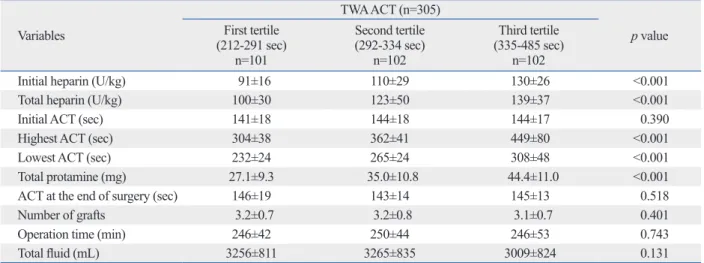
levels (Table 1). Intraoperative characteristics of the tertiles were also comparable except for ACT values and dose of weight-adjusted heparin and protamine administered, as ex-pected. Total heparin doses were 100±30 U/kg, 123±50 U/ kg, and 139±37 U/kg, respectively (p<0.001) (Table 2). The overall percentage of patients who achieved target ACT levels by the first heparin dose was 93%, and 25% of pa-tients needed extra heparin during the whole grafting peri-od. This was distributed similarly among the tertiles.
The amount of perioperative blood loss was 937±313 mL, 1014±340 mL, and 1076±383 mL, respectively (p=0.022). The incidences of significant perioperative blood loss and transfusion of pRBC ≥2 U were lower in the first tertile compared to the other tertiles, but without statistical signifi-cance. A significantly greater number of patients in the third tertile developed postoperative MI compared with those in the first and second tertiles (p=0.034). The composite of ciated with the outcome endpoint or not were first
evaluat-ed in the univariate model. Only variables with p<0.1 were then entered into the final model of the multivariable logis-tic regression analysis. Categorical variables are expressed as the number of patients (%) and continuous variables are expressed as mean±standard deviation.
A p<0.05 was considered significant.
RESULTS
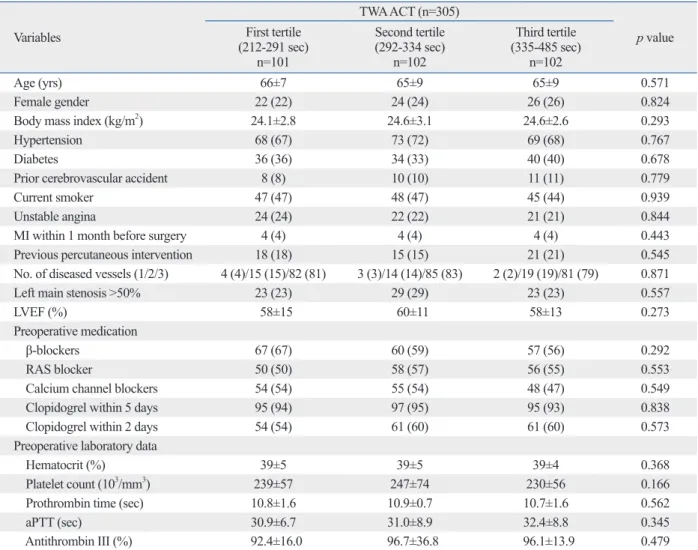
Three hundred and five patients were enrolled in this study. The overall mean TWA ACT was 320±56 sec, and the me-dian value was 311 sec. The ranges of TWA ACT levels ac-cording to the tertile distribution were 212 to 291 sec, 292 to 334 sec, and 335 to 485 sec. Patient characteristics were similar in relation to tertile distribution of the TWA ACT
Table 1. Baseline Characteristics According to Time Weighted Average ACT during Grafting
Variables TWA ACT (n=305) p value First tertile (212-291 sec) n=101 Second tertile (292-334 sec) n=102 Third tertile (335-485 sec) n=102 Age (yrs) 66±7 65±9 65±9 0.571 Female gender 22 (22) 24 (24) 26 (26) 0.824
Body mass index (kg/m2) 24.1±2.8 24.6±3.1 24.6±2.6 0.293
Hypertension 68 (67) 73 (72) 69 (68) 0.767
Diabetes 36 (36) 34 (33) 40 (40) 0.678
Prior cerebrovascular accident 8 (8) 10 (10) 11 (11) 0.779
Current smoker 47 (47) 48 (47) 45 (44) 0.939
Unstable angina 24 (24) 22 (22) 21 (21) 0.844
MI within 1 month before surgery 4 (4) 4 (4) 4 (4) 0.443
Previous percutaneous intervention 18 (18) 15 (15) 21 (21) 0.545
No. of diseased vessels (1/2/3) 4 (4)/15 (15)/82 (81) 3 (3)/14 (14)/85 (83) 2 (2)/19 (19)/81 (79) 0.871
Left main stenosis >50% 23 (23) 29 (29) 23 (23) 0.557
LVEF (%) 58±15 60±11 58±13 0.273
Preoperative medication
β-blockers 67 (67) 60 (59) 57 (56) 0.292
RAS blocker 50 (50) 58 (57) 56 (55) 0.553
Calcium channel blockers 54 (54) 55 (54) 48 (47) 0.549
Clopidogrel within 5 days 95 (94) 97 (95) 95 (93) 0.838
Clopidogrel within 2 days 54 (54) 61 (60) 61 (60) 0.573
Preoperative laboratory data
Hematocrit (%) 39±5 39±5 39±4 0.368
Platelet count (103/mm3) 239±57 247±74 230±56 0.166
Prothrombin time (sec) 10.8±1.6 10.9±0.7 10.7±1.6 0.562
aPTT (sec) 30.9±6.7 31.0±8.9 32.4±8.8 0.345
Antithrombin III (%) 92.4±16.0 96.7±36.8 96.1±13.9 0.479
TWA ACT, time-weighted average activated clotting time; MI, myocardial infarction; LVEF, left ventricular ejection fraction; RAS blocker, rennin-angiotensin system blocker; aPTT, activated partial thromboplastin time.
246 patients (90%, 76%, and 75% in each tertile, respec-tively). The remainder did not undergo CT for various rea-sons such as follow-up loss, cost, or the patient refusal. The incidence of impaired graft patency was comparable (8%, 14%, and 8%, respectively, p=0.294).
DISCUSSION
The current study demonstrated that a lower degree of anti-coagulation, represented by the first tertile of TWA ACT (212-291 sec) may provide net clinical benefit of hemor-rhagic and ischemic outcomes following OPCAB in pa-tients with recent exposure to clopidogrel, compared with those in the higher tertiles. The first tertile of TWA ACT was associated with 77% risk reduction of significant peri-significant blood loss, transfusion of pRBC ≥2 U, or
post-operative MI occurred in 20%, 28%, and 30% of the pa-tients for each tertile, respectively (p=0.190) (Table 3).
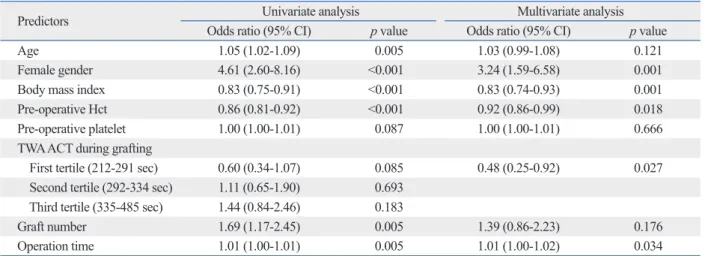
In the univariate analysis of predictors for adverse com-bined hemorrhagic and ischemic outcomes (a composite of significant perioperative blood loss, transfusion of pRBC ≥2 U, or postoperative MI), age, female gender, body mass index (BMI), preoperative hematocrit level and platelet count, TWA ACT tertile, the number of grafts, and the oper-ation time had a p<0.1. In the multivariate analysis, female gender, lower BMI, lower level of hematocrit, TWA ACT tertile, and longer operation time remained independent risk factors. The first tertile was associated with a 52% risk re-duction of combined hemorrhagic and ischemic outcomes (95% CI: 0.25-0.92, p=0.027) (Table 4).
Thirty-day follow-up CT angiograms were available in
Table 2. Intraoperative Data According to Time Weighted Average ACT during Grafting
Variables TWA ACT (n=305) p value First tertile (212-291 sec) n=101 Second tertile (292-334 sec) n=102 Third tertile (335-485 sec) n=102
Initial heparin (U/kg) 91±16 110±29 130±26 <0.001
Total heparin (U/kg) 100±30 123±50 139±37 <0.001
Initial ACT (sec) 141±18 144±18 144±17 0.390
Highest ACT (sec) 304±38 362±41 449±80 <0.001
Lowest ACT (sec) 232±24 265±24 308±48 <0.001
Total protamine (mg) 27.1±9.3 35.0±10.8 44.4±11.0 <0.001
ACT at the end of surgery (sec) 146±19 143±14 145±13 0.518
Number of grafts 3.2±0.7 3.2±0.8 3.1±0.7 0.401
Operation time (min) 246±42 250±44 246±53 0.743
Total fluid (mL) 3256±811 3265±835 3009±824 0.131
TWA ACT, time-weighted average activated clotting time. Values are the mean±SD.
Table 3. Hemorrhagic and Ischemic Outcomes According to Time Weighted Average ACT during Grafting
Variables TWA ACT (n=305) p value First tertile (212-291 sec) n=101 Second tertile (292-334 sec) n=102 Third tertile (335-485 sec) n=102 Perioperative hemorrhagic outcomes
Blood loss (mL) 937±313 1014±340 1076±383 0.022
Significant blood loss (>30% of EBV) 7 (7) 18 (18) 16 (17) 0.063
Transfusion of RBC ≥2 U 12 (12) 20 (20) 23 (23) 0.125
Transfusion of FFP 15 (17) 21 (23) 15 (17) 0.420
Postoperative MI within 7 days 4 (4) 4 (4) 12 (12) 0.034
Combined incidence of significant blood
loss, transfusion of pRBC ≥2 U, or MI 20 (20) 29 (28) 31 (30) 0.190
TWA ACT, time-weighted average activated clotting time; perioperative, intraoperative period combined with the postoperative period for 24 hr; EBV, esti-mated blood volume; pRBC, packed red blood cells; FFP, fresh frozen plasma; MI, myocardial infarction.
tions is of critical importance. Yet, the clinical effect of the anticoagulation levels on the outcomes following OPCAB in such patient populations has not been addressed. Numer-ous studies reported the impact of the degree of hepariniza-tion on clinical outcomes in the setting of percutaneous cor-onary intervention (PCI), during which antiplatelet agents are loaded.29-34
In the current study, a lower degree of anticoagulation during OPCAB (TWA ACT <290 sec) was associated with a reduction in significant perioperative bleeding without in-creasing postoperative MI in the patients with recent expo-sure to clopidogrel. This is in agreement with the finding of the Precursor to EPILOG (PROLOG) study that demon-strated a diminished risk of bleeding without compromising the peri-PCI ischemic outcomes, by reducing the heparin dosing for patients treated with platelet glycoprotein IIb/IIIa inhibitors.35
In contrast to the PCI setting, during which anticoagula-tion is obtained with one-off bolus of heparin, repeated ad-ministration of heparin to maintain the target ACT for multi-vessel OPCAB is common. We, therefore, evaluated the effect of anticoagulation on the outcomes in terms of TWA ACT that contain an element of time rather than a simple heparin dose. A significantly reduced risk of perioperative bleeding in the first tertile of TWA ACT is due, in part, to a smaller dose of total heparin compared to the higher ter-tiles. A total heparin dose should be greatly influenced by initial heparin administered to achieve target ACT. The ac-tual initial doses given to achieve a target of >250 sec and >300 sec were 100±5 and 149±6 U/kg, respectively. On the contrary, the initial dose administered in the first tertile of TWA ACT was 91±16 U/kg, while overall 88% of the total operative blood loss. Moreover, for composite blood loss,
pRBC transfusion ≥2 U, postoperative MI, and the first ter-tile of TWA ACT was associated with a 52% reduced risk.
As dual antiplatelet therapy has become the cornerstone of the management strategies for coronary artery disease, an increasing number of patients referred for surgical revas-cularization are brought to surgery with recent exposure to clopidogrel for the ischemic benefit.13 Despite concerns for
consequent excess of hemorrhagic complications, several re-ports have suggested that platelet inhibition, to a certain ex-tent, may improve postoperative outcomes.12,14 OPCAB has
been especially proposed as a safe surgical technique that can be performed without increasing the risk of bleeding in pa-tients under a sustained influence of clopidogrel.15-17 On the
contrary, concerns have been raised about the procoagulant activity associated with OPCAB that increases the risk of ve-nous thrombosis and potentially endangers the patency of coronary anastomoses.21-25 These aspects have led to the use
of an aggressive perioperative anticoagulation strategies in-corporating systemic heparinization to maintain a target ACT of >300 s during surgery with early-resumed postoperative dual antiplatelet therapy.26,27 While a uniform standardized
heparinization protocol is lacking for OPCAB, a European survey revealed that 41% of surgeons consider the lower lim-it of the target ACT >300 s and 16% of surgeons even con-sider full heparinization despite avoiding CPB.28
In patients with a recent exposure to dual antiplatelet therapy to OPCAB, maintaining a target ACT of >300 s may put patients at an unnecessary risk of periprocedural bleeding without the added ischemic benefit. Thus, optimal intraoperative anticoagulation that can minimize the proco-agulant activity while avoiding the hemostatic
deteriora-Table 4. Risk Factors for Combined Hemorrhagic and Ischemic Endpoints
Predictors Univariate analysis Multivariate analysis
Odds ratio (95% CI) p value Odds ratio (95% CI) p value
Age 1.05 (1.02-1.09) 0.005 1.03 (0.99-1.08) 0.121
Female gender 4.61 (2.60-8.16) <0.001 3.24 (1.59-6.58) 0.001
Body mass index 0.83 (0.75-0.91) <0.001 0.83 (0.74-0.93) 0.001
Pre-operative Hct 0.86 (0.81-0.92) <0.001 0.92 (0.86-0.99) 0.018
Pre-operative platelet 1.00 (1.00-1.01) 0.087 1.00 (1.00-1.01) 0.666
TWA ACT during grafting
First tertile (212-291 sec) 0.60 (0.34-1.07) 0.085 0.48 (0.25-0.92) 0.027 Second tertile (292-334 sec) 1.11 (0.65-1.90) 0.693
Third tertile (335-485 sec) 1.44 (0.84-2.46) 0.183
Graft number 1.69 (1.17-2.45) 0.005 1.39 (0.86-2.23) 0.176
Operation time 1.01 (1.00-1.01) 0.005 1.01 (1.00-1.02) 0.034
As cumulating evidence supports its beneficial role in the PCI setting, further clinical experience and research regard-ing the optimal intraoperative anticoagulation management in patients treated by ticagrelor are warranted.
The current study suggests that for the patients with re-cent exposure to clopidogrel, a lower degree of anticoagu-lation during multi-vessel OPCAB appears to be beneficial in terms of surgery related ischemic and hemorrhagic com-plications. Based on this analysis, decreased initial heparin dosing targeting a lower ACT, just greater than 200 sec, should be considered for this subset of patients. Additional prospective randomized controlled trials are needed to es-tablish the optimal anticoagulation management during OPCAB in an era of aggressive dual-antiplatelet treatment.
REFERENCES
1. Puskas JD, Thourani VH, Kilgo P, Cooper W, Vassiliades T, Vega JD, et al. Off-pump coronary artery bypass disproportionately benefits high-risk patients. Ann Thorac Surg 2009;88:1142-7. 2. Kerendi F, Morris CD, Puskas JD. Off-pump coronary bypass
sur-gery for high-risk patients: only in expert centers? Curr Opin Car-diol 2008;23:573-8.
3. Diegeler A, Doll N, Rauch T, Haberer D, Walther T, Falk V, et al. Humoral immune response during coronary artery bypass graft-ing: a comparison of limited approach, “off-pump” technique, and conventional cardiopulmonary bypass. Circulation 2000;102(19 Suppl 3):III95-100.
4. MacGillivray TE, Vlahakes GJ. Patency and the pump--the risks and benefits of off-pump CABG. N Engl J Med 2004;350:3-4. 5. Czerny M, Baumer H, Kilo J, Lassnigg A, Hamwi A, Vukovich T,
et al. Inflammatory response and myocardial injury following cor-onary artery bypass grafting with or without cardiopulmcor-onary by-pass. Eur J Cardiothorac Surg 2000;17:737-42.
6. D’Ancona G, Donias HW, Karamanoukian RL, Bergsland J, Karamanoukian HL. OPCAB therapy survey: off-pump clopido-grel, aspirin or both therapy survey. Heart Surg Forum 2001;4: 354-8.
7. Donias HW, D’Ancona G, Pande RU, Schimpf D, Kawaguchi AT, Karamanoukian HL. Heparin dose, transfusion rates, and intraop-erative graft patency in minimally invasive direct coronary artery bypass. Heart Surg Forum 2003;6:176-80.
8. Nader ND, Khadra WZ, Reich NT, Bacon DR, Salerno TA, Panos AL. Blood product use in cardiac revascularization: comparison of on- and off-pump techniques. Ann Thorac Surg 1999;68:1640-3. 9. Khan NE, De Souza A, Mister R, Flather M, Clague J, Davies S, et
al. A randomized comparison of off-pump and on-pump multives-sel coronary-artery bypass surgery. N Engl J Med 2004;350:21-8. 10. Rasoli S, Zeinah M, Athanasiou T, Kourliouros A. Optimal
intra-operative anticoagulation strategy in patients undergoing off-pump coronary artery bypass. Interact Cardiovasc Thorac Surg 2012;14: 629-33.
11. Hansen KH, Hughes P, Steinbrüchel DA. Antithrombotic- and an-ticoagulation regimens in OPCAB surgery. A Nordic survey.
study population exceeded their goal ACT by more than 10 % on the first heparin dose. Therefore, it can be inferred that the initial dose reduction can decrease perioperative bleeding without sacrificing the efficacy in patients with re-cent exposure to dual antiplatelet therapy close to surgery.
Regarding the ischemic endpoint, the incidence of MI was greater in the third tertile than compared with the lower two tertiles. This is in accordance with the analysis derived from six randomized controlled trials of antithrombotic reg-imens for PCI that demonstrated U-shaped curve for a rela-tionship between ACT and ischemic events.29 ACT values
greater than 350 sec at activation of devices were associat-ed with a greater rate of MI or urgent revascularization for 7 days after procedure than those of lower levels. One sug-gested explanation for this greater thrombotic risk observed at higher ACTs was the platelet activation by high doses of heparin. Indeed, heparin activates platelets, forces them to express many of their GP binding sites, and consequently enhances their aggregation even at its therapeutic concen-trations.36,37 Moreover, bleeding and subsequent transfusion
of blood products have been reported to aggravate the oc-currence of ischemic events.38 Another analysis of four
large clinical PCI trials demonstrated that higher ACTs did not protect against ischemic events.13 The lack of an inverse
relationship between ACT and ischemic complications was explained on account of concurrent GP IIb/IIIa inhibitors or clopidogrel therapy of their study populations (89% and 81%, respectively). Consistent findings from our study that the highest incidence of MI was in patients with the highest TWA ACT tertile, indicate that a higher-dosing heparin reg-imen during OPCAB is no longer need but rather detrreg-imen- detrimen-tal for the patients with recent exposure to dual antiplatelet agents.
The main limitation of this study is its retrospective de-sign. Although all patients were managed according to an institutional standardized protocol and all data was collect-ed prospectively, targetcollect-ed ACT was not determincollect-ed by ran-domization. Another limitation of this study is that we did not assess individual responses to clopidogrel. However, there is currently no generally accepted platelet function as-say with enough clinical evidence to support its influence on ischemic or hemorrhagic outcome. Advances over clopi-dogrel in terms of less interpatient variability in plasma concentrations and antiplatelet effects have been reported with a newer antiplatelet agent, ticagrelor. Of note, ticagre-lor has a reversible action on the P2Y12 receptor with faster
coronary artery bypass grafting: comparison between on-pump and off-pump techniques. J Thorac Cardiovasc Surg 2006;131: 290-7.
26. Halkos ME, Cooper WA, Petersen R, Puskas JD, Lattouf OM, Craver JM, et al. Early administration of clopidogrel is safe after off-pump coronary artery bypass surgery. Ann Thorac Surg 2006; 81:815-9.
27. Gurbuz AT, Zia AA, Vuran AC, Cui H, Aytac A. Postoperative clopidogrel improves mid-term outcome after off-pump coronary artery bypass graft surgery: a prospective study. Eur J Cardiotho-rac Surg 2006;29:190-5.
28. Englberger L, Streich M, Tevaearai H, Carrel TP. Different antico-agulation strategies in off-pump coronary artery bypass opera-tions: a European survey. Interact Cardiovasc Thorac Surg 2008; 7:378-82.
29. Chew DP, Bhatt DL, Lincoff AM, Moliterno DJ, Brener SJ, Wols-ki KE, et al. Defining the optimal activated clotting time during percutaneous coronary intervention: aggregate results from 6 ran-domized, controlled trials. Circulation 2001;103:961-6.
30. Tolleson TR, O’Shea JC, Bittl JA, Hillegass WB, Williams KA, Levine G, et al. Relationship between heparin anticoagulation and clinical outcomes in coronary stent intervention: observations from the ESPRIT trial. J Am Coll Cardiol 2003;41:386-93. 31. Brener SJ, Moliterno DJ, Lincoff AM, Steinhubl SR, Wolski KE,
Topol EJ. Relationship between activated clotting time and isch-emic or hemorrhagic complications: analysis of 4 recent random-ized clinical trials of percutaneous coronary intervention. Circula-tion 2004;110:994-8.
32. Bertrand OF, Rodés-Cabau J, Rinfret S, Larose E, Bagur R, Proulx G, et al. Impact of final activated clotting time after tran-sradial coronary stenting with maximal antiplatelet therapy. Am J Cardiol 2009;104:1235-40.
33. Montalescot G, Cohen M, Salette G, Desmet WJ, Macaya C, Ayl-ward PE, et al. Impact of anticoagulation levels on outcomes in patients undergoing elective percutaneous coronary intervention: insights from the STEEPLE trial. Eur Heart J 2008;29:462-71. 34. Schulz S, Mehilli J, Neumann FJ, Schuster T, Massberg S, Valina
C, et al. ISAR-REACT 3A: a study of reduced dose of unfraction-ated heparin in biomarker negative patients undergoing percutane-ous coronary intervention. Eur Heart J 2010;31:2482-91. 35. Lincoff AM, Tcheng JE, Califf RM, Bass T, Popma JJ, Teirstein
PS, et al. Standard versus low-dose weight-adjusted heparin in pa-tients treated with the platelet glycoprotein IIb/IIIa receptor anti-body fragment abciximab (c7E3 Fab) during percutaneous coro-nary revascularization. PROLOG Investigators. Am J Cardiol 1997;79:286-91.
36. Xiao Z, Théroux P. Platelet activation with unfractionated heparin at therapeutic concentrations and comparisons with a low-molecu-lar-weight heparin and with a direct thrombin inhibitor. Circula-tion 1998;97:251-6.
37. Mascelli MA, Kleiman NS, Marciniak SJ Jr, Damaraju L, Weis-man HF, Jordan RE. Therapeutic heparin concentrations augment platelet reactivity: implications for the pharmacologic assessment of the glycoprotein IIb/IIIa antagonist abciximab. Am Heart J 2000;139:696-703.
38. Murphy GJ, Reeves BC, Rogers CA, Rizvi SI, Culliford L, Ange-lini GD. Increased mortality, postoperative morbidity, and cost af-ter red blood cell transfusion in patients having cardiac surgery. Circulation 2007;116:2544-52.
Scand Cardiovasc J 2005;39:369-74.
12. Ebrahimi R, Dyke C, Mehran R, Manoukian SV, Feit F, Cox DA, et al. Outcomes following pre-operative clopidogrel administra-tion in patients with acute coronary syndromes undergoing coro-nary artery bypass surgery: the ACUITY (Acute Catheterization and Urgent Intervention Triage strategY) trial. J Am Coll Cardiol 2009;53:1965-72.
13. Nijjer SS, Watson G, Athanasiou T, Malik IS. Safety of clopido-grel being continued until the time of coronary artery bypass graft-ing in patients with acute coronary syndrome: a meta-analysis of 34 studies. Eur Heart J 2011;32:2970-88.
14. Fox KA, Mehta SR, Peters R, Zhao F, Lakkis N, Gersh BJ, et al. Benefits and risks of the combination of clopidogrel and aspirin in patients undergoing surgical revascularization for non-ST-eleva-tion acute coronary syndrome: the Clopidogrel in Unstable angina to prevent Recurrent ischemic Events (CURE) Trial. Circulation 2004;110:1202-8.
15. Woo YJ, Grand T, Valettas N. Off-pump coronary artery bypass grafting attenuates postoperative bleeding associated with preoper-ative clopidogrel administration. Heart Surg Forum 2003;6:282-5. 16. Shim JK, Choi YS, Oh YJ, Bang SO, Yoo KJ, Kwak YL. Effects
of preoperative aspirin and clopidogrel therapy on perioperative blood loss and blood transfusion requirements in patients undergo-ing off-pump coronary artery bypass graft surgery. J Thorac Car-diovasc Surg 2007;134:59-64.
17. Song SW, Youn YN, Yi G, Lee S, Yoo KJ. Effects of continuous administration of clopidogrel before off-pump coronary artery by-pass grafting in patients with acute coronary syndrome. Circ J 2008;72:626-32.
18. Berger JS, Herout PM, Harshaw Q, Steinhubl SR, Frye CB, Beck-er RC. Bleeding-associated outcomes with preopBeck-erative clopido-grel use in on- and off-pump coronary artery bypass. J Thromb Thrombolysis 2012;34:56-64.
19. Kapetanakis EI, Medlam DA, Petro KR, Haile E, Hill PC, Dullum MK, et al. Effect of clopidogrel premedication in off-pump cardi-ac surgery: are we forfeiting the benefits of reduced hemorrhagic sequelae? Circulation 2006;113:1667-74.
20. Thygesen K, Alpert JS, White HD; Joint ESC/ACCF/AHA/WHF Task Force for the Redefinition of Myocardial Infarction, Jaffe AS, Apple FS, et al. Universal definition of myocardial infarction. Circulation 2007;116:2634-53.
21. Mariani MA, Gu YJ, Boonstra PW, Grandjean JG, van Oeveren W, Ebels T. Procoagulant activity after off-pump coronary opera-tion: is the current anticoagulation adequate? Ann Thorac Surg 1999;67:1370-5.
22. Møller CH, Steinbrüchel DA. Platelet function after coronary ar-tery bypass grafting: is there a procoagulant activity after off-pump compared with on-off-pump surgery? Scand Cardiovasc J 2003;37:149-53.
23. Paparella D, Semeraro F, Scrascia G, Galeone A, Ammollo CT, Kounakis G, et al. Coagulation-fibrinolysis changes during off-pump bypass: effect of two heparin doses. Ann Thorac Surg 2010;89:421-7.
24. Parolari A, Mussoni L, Frigerio M, Naliato M, Alamanni F, Galanti A, et al. Increased prothrombotic state lasting as long as one month after on-pump and off-pump coronary surgery. J Tho-rac Cardiovasc Surg 2005;130:303-8.
25. Paparella D, Galeone A, Venneri MT, Coviello M, Scrascia G, Marraudino N, et al. Activation of the coagulation system during