Current Status and Future of Lung Donation in Korea
Lung transplantation is the only effective treatment option for patients with end-stage lung disease. However, donor organ shortage makes timely transplant not possible for all patients, especially in Korea. We investigated the number and utilization of donor lungs by retrospectively reviewing all donor organs registered in the Korea Network for Organ Sharing database from March 2012 to March 2016. The donors were stratified into 4 groups by donor acceptability criteria. A total of 1,304 donors were included. Of those, 295 brain-dead donors (22.6%) consented to lung donation. Among these consented donors, 168 donors (12.9%) were retrieved for lung transplant. Retrieval rate was very low compared with that of the kidney (93.9%), liver (86.3%), and heart (27.3%). The characteristics of utilized donor lungs were: mean age, 40.5 years (range: 18 to 63 years);
mean partial pressure of oxygen, 356.5 mmHg; mean smoking history, 5.9 pack-years;
and mean body mass index, 22.6 kg/m2. The proportion of donors with acceptable condition of the transplanted lungs was only 39.3% (ideal 19, standard 47, marginal 70, unusable 32). Among brain-dead patients who denied to donate lungs (n = 1,009), 82 were potentially acceptable donors (ideal 19, standard 63), which was equal to half of actually transplanted lung donations. Many potential donor lungs, which are currently excluded, may be successfully used in lung transplantation in Korea. The available lung donors must be actively selected and managed to maximize the utilization of this precious resource.
Keywords: Lung Transplantation; Donor; End Stage Lung Disease; Korea Hye Ju Yeo,1,2 Seong Hoon Yoon,1,2
Seung Eun Lee,1,2 Doosoo Jeon,1,2 Yun Seong Kim,1,2 Woo Hyun Cho,1,2 and Do Hyung Kim2,3
1Department of Pulmonology and Critical Care Medicine, Pusan National University Yangsan Hospital, Yangsan, Korea; 2Research Institute for Convergence of Biomedical Science and Technology, Pusan National University Yangsan Hospital, Yangsan, Korea; 3Department of Thoracic and Cardiovascular Surgery, Pusan National University Yangsan Hospital, Yangsan, Korea
Received: 2 May 2017 Accepted: 3 September 2017 Address for Correspondence:
Dohyung Kim, MD
Department of Thoracic and Cardiovascular Surgery, Pusan National University Yangsan Hospital, 20 Geumo-ro, Yangsan 50612, Republic of Korea
E-mail: [email protected]
https://doi.org/10.3346/jkms.2017.32.12.1953 • J Korean Med Sci 2017; 32: 1953-1958
INTRODUCTION
Lung transplantation is the only effective treatment option for patients with end stage lung disease. However, donor organ shortage makes timely transplant not possible for all patients.
In 2014, a total of 154 patients were listed for lung transplanta- tion in Korea, but only 55 lungs were used for transplantation (1). This gap between supply and demand has increased and it remains a major problem. Furthermore, not all donor referrals materialize to successful organ retrievals as assessment of the donor in the operating theatre does not allow adequate time for donor optimization, which may in turn lead to poor retrieval rate. This leads to a long period on a waiting list with a high mor- tality rate of patients awaiting transplantation (2). Globally, lung transplantation suffers from a very low rate of lung procurement that is nearly 15%–20% (3,4). Recently, lung transplantation is getting popular in Korea and time on a waiting list is expected to further increase in the near future (5-7). Grasping the present condition of lung donor shortage is very meaningful at this time.
In this study, we present the current status of lung donation in Korea and also explore various factors that could help improve the country’s low procurement rate.
MATERIALS AND METHODS
We retrospectively reviewed the Korea Network for Organ Shar- ing (KONOS) database to identify all adult lung donors between March 2012 and March 2016 in Korea. Collected variables con- sisted of age, sex, ABO blood group, mean partial pressure of oxygen in arterial blood (PaO2) fraction of inspired oxygen (FIO2) ratio (PF ratio), smoking history, mean body mass index (BMI), causes of death, chest X-ray and bronchoscopy findings, results of sputum culture, lung ischemic time, and a reason for not us- ing a donor. In total, 1,481 patients were identified. We exclud- ed 84 donors who were aged < 18 years and 93 donors who did not have records of PF ratio results. The remaining 1,304 donors were stratified into 4 groups by donor acceptability criteria (8).
The ideal donor group was defined as donors with the follow- ing: age from 20 to 45 years, PF ratio > 350 mmHg, no smoking history, clear chest radiograph, absence of organisms in spu- tum cultures, and clear bronchoscopy findings. The standard donor group was defined as follows: 45 < age < 55 years, 300 <
PF ratio ≤ 350 mmHg, smoking history < 20 pack-years, clear chest radiograph, absence of organisms in sputum, and no pu- rulent secretions on bronchoscopy. The marginal donor criteria was defined as follows: 55 ≤ age ≤ 65 years, 200 ≤ PF ratio ≤ 300 ORIGINAL ARTICLE
Cell Therapy & Organ Transplantation
2017-03-16 https://crossmark-cdn.crossref.org/widget/v2.0/logos/CROSSMARK_Color_square.svg
mmHg, smoking history ≥ 20 pack-years, consolidation or col- lapse in the chest radiograph, organisms in sputum cultures, and purulent secretion or inflammation on bronchoscopy. A donor was defined as unusable if any of the following was found:
age > 65 years, PF ratio < 200 mmHg, current smoking status, dense consolidation or persistent collapse in the chest radio- graph, pan-resistant organisms or mycobacteria in sputum cul- tures, and visualized tumor in bronchoscopy findings.
Statistical analysis
Data are expressed as mean standard deviation of the mean or number (%), unless otherwise specified. The student’s t-test was used to test continuous variables with normal distribu- tions, and the Mann-Whitney U test was used for non-normal continuous variables. Categoric variables were analyzed using the χ2 test or Fisher’s exact test. Analysis of variance (ANOVA) was used for multi-group comparisons along with post hoc pairwise comparisons. All of the statistical analyses were per- formed using the R software, version 3.0.1 (R Foundation, Vien- na, Austria; http://www.R-project.org). All of the tests were two sided, and P values less than 0.05 were considered statistically significant.
Ethics statement
This study was approved by the Institutional Review Board of Pusan National University Yangsan Hospital (approval number:
05-2016-132). The requirement of informed consent from the patients was waived due to the retrospective nature of this study.
RESULTS
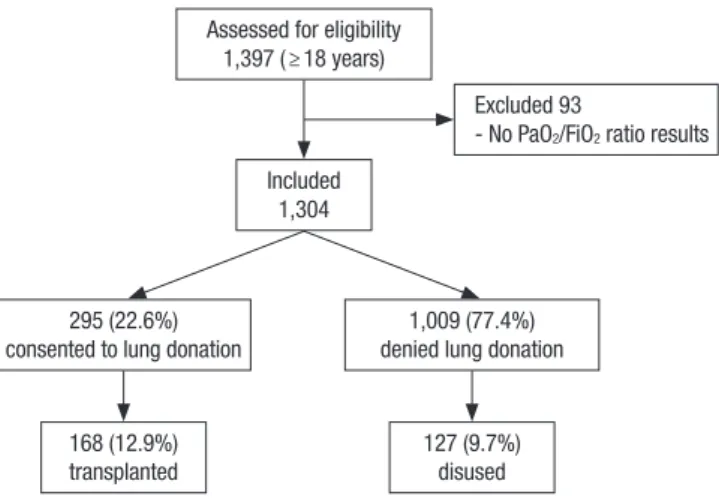
During the study period, 1,397 brain-dead donors registered in the KONOS (≥ 18 years). However, the results of PF ratio were missing in 93 patients. A total of 1,304 donors (41 ideal donors, 128 standard donors, 468 marginal donors, and 667 unusable donors) were included in this study (Fig. 1; Table 1). Donors consisted of 888 males (68.1%) and 416 females (31.9%) of age
ranging from 18 to 83 years (mean age: 47.9 years). The cause of brain death was: cerebrovascular system/stroke in 686 (52.6%), traumatic head injury in 266 (20.4%), hypoxic brain damage in 343 (26.3%), central nervous system tumor in 8 (0.6%), and oth- er miscellaneous causes in 1 (0.1%). The most common mech- anism of brain injury was intracerebral hemorrhage/stroke in 955 (73.2%); hanging in 213 (16.3%), cardiovascular disease in 98 (7.5%), drowning in 9 (0.7%), seizure in 4 (0.3%), drug intoxi- cation in 6 (0.5%), and other miscellaneous causes in 19 (1.5%).
The characteristics of donors according to the acceptability cri- teria are shown in Table 1.
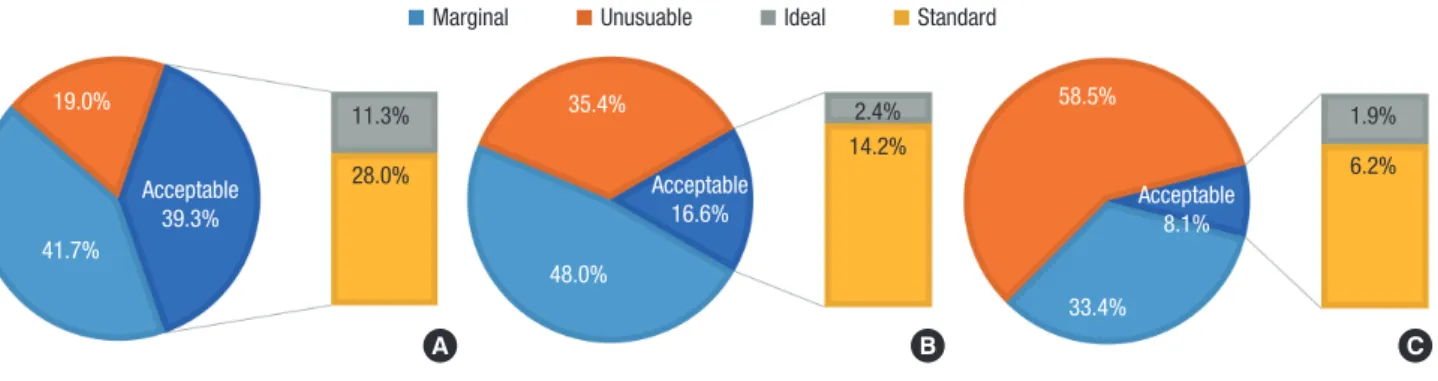
Of those, 295 brain-dead donors (22.6%) were consented to lung donation. Among these consented lung donors, 168 (12.9%) were finally transplanted to allocated recipients (ideal 19, stan- dard 47, marginal 70, and unusable 32; Fig. 2A). Otherwise, 127 (9.7%) lungs of consented donors were disused due to no final recipient (n = 105), medical ineligibility (n = 20), and unknown
Table 1. Comparison of the potential donors according to the acceptability criteria
Variables Ideal (n = 41) Standard (n = 128) Marginal (n = 468) Unusable (n = 667)
Age, yr 34.4 ± 7.6 42.0 ± 10.2 47.4 ± 11.6 50.3 ± 14.7
Male 17 (41.5) 86 (67.2) 326 (69.7) 459 (68.8)
Height, m 1.7 ± 0.1 1.7 ± 0.1 1.7 ± 0.1 1.7 ± 0.1
Body weight, kg 63.9 ± 13.5 63.0 ± 11.2 65.8 ± 11.1 67.1 ± 12.6
PF ratio 542.6 ± 390.2 425.6 ± 111.9 374.9 ± 512.7 217.0 ± 130.6
PO2, mmHg 349.2 ± 214.8 285.3 ± 159.9 208.7 ± 153.7 140.2 ± 95.6
PCO2, mmHg 36.1 ± 8.6 35.9 ± 8.2 36.2 ± 7.1 41.4 ± 25.8
Pack-years 0 5.6 ± 7.0 9.6 ± 13.5 7.4 ± 12.0
X-ray abnormalities 0 0 165 (35.3) 348 (52.2)
Purulent secretions on bronchoscopy 0 0 119 (25.4) 282 (42.3)
Data are presented as number (%) or mean ± standard deviation.
PO2= partial pressure of oxygen, PCO2= partial pressure of carbon dioxide, PaO2= partial pressure of oxygen in arterial blood, FIO2= fraction of inspired oxygen, PF ratio = PaO2/FIO2 ratio.
Fig. 1. Flowchart of donor lung utilization. During the study period, 1,397 brain-dead donors registered in the KONOS (≥ 18 years). A total of 1,304 donors were included except for 93 who had no PF ratio results. Of those, 295 brain-dead donors (22.6%) were consented to lung donation. Among these consented lung donors, 168 (12.9%) were finally transplanted to allocated recipients.
KONOS = Korea Network for Organ Sharing, PaO2 = partial pressure of oxygen in ar- terial blood, FIO2 = fraction of inspired oxygen, PF ratio = PaO2/FIO2 ratio.
Assessed for eligibility 1,397 ( ≥ 18 years)
Excluded 93
- No PaO2/FiO2 ratio results Included
1,304
295 (22.6%)
consented to lung donation 1,009 (77.4%) denied lung donation
168 (12.9%) transplanted
127 (9.7%) disused
reasons (n = 2). Disused donor lungs consisted of 3 ideal, 18 standard, 61 marginal, and 45 unusable lungs according to the acceptability criteria (Fig. 2B).
Among brain-dead patients who denied to donate lungs (n = 1,009), 82 were potentially acceptable donors (ideal 19, standard 63), 337 were marginal donors, and 590 were unusable donors (Fig. 2C). The reasons of refusal in patients who were potentially acceptable donors were withdrawn consent (n = 14) and un- known (n = 68).
Overall, 12.9% of organ donors were accepted and retrieved for lung transplant. Retrieval rate was very low compared with kidney (93.9%), liver (86.3%), and heart (27.3%) use (Fig. 3). The mean age of donors of transplanted lungs was 40.5 years (range:
18 to 63 years) compared with 49.0 years for other organs (P <
0.001, Table 2). The characteristics of utilized donor lungs were:
mean PaO2, 356.5 mmHg; mean smoking history, 5.9 pack-years;
and mean BMI, 22.6 kg/m2. It consisted of 19 ideal, 47 standard, 70 marginal, and 32 unusable donors according to the accept- ability criteria (Fig. 2A). The percent of donors with acceptable condition of the transplanted lungs was only 39.3% (n = 66).
The causes included marginal donor criteria with abnormal X-
ray (n = 31), smoking history (n = 11), abnormal sputum (n = 10), low PF ratio (n = 10), and aging (n = 8). Additionally, the causes included unusable donor criteria with abnormal X-ray (n = 28) and low PF ratio (n = 4).
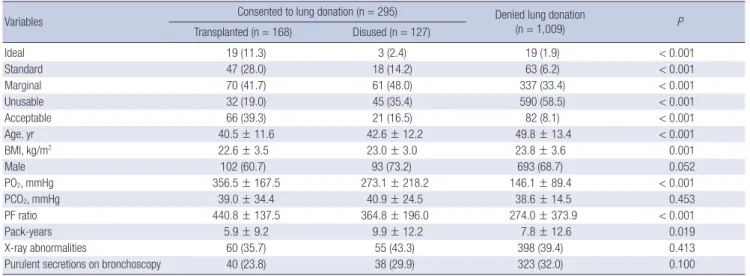
Donor composition and conditions were compared between patients who consented to lung donation and patients who did not consent to lung donation (Table 3). There were significant differences of acceptable donor rate, age, BMI, PF ratio, and amo- unt of smoking exposure between the three groups (transplant- ed vs. disused vs. denied).
Retrieval rates were compared according to the location of donors. The location was divided into three regions (region 1:
Seoul, Incheon, Gyeonggi, Gangwon, Jeju; region 2: Daejeon, Gwangju, Chungbuk, Chungnam, Jeonbuk, Jeonnam; and re- gion 3: Daegu, Gyeongbuk, Busan, Ulsan, Gyeongnam). The re- trieval rate was highest in region 1 among the 3 regions (region 1: 16.1%, region 2: 12.7%, region 3: 5.1%; P < 0.001). The rate of acceptable donor including ideal and standard criteria was high- est in the region 2 (region 1: 11.1%, region 2: 20.8%, region 3: 12.3%;
P = 0.008).
Table 2. Comparison of transplanted vs. non-transplanted donor lungs
Variables Transplanted
(n = 168)
Non-transplanted (n = 1,136) P
Age, yr 40.5 ± 11.6 49.0 ± 13.4 < 0.001
BMI, kg/m2 22.6 ± 3.5 23.7 ± 3.6 < 0.001
Male 102 (60.7) 786 (69.2) 0.028
PO2, mmHg 356.5 ± 167.5 160.3 ± 118.3 < 0.001
PCO2, mmHg 39.0 ± 34.4 38.8 ± 15.9 0.924
PF ratio 440.8 ± 137.5 284.2 ± 359.5 < 0.001
Pack-years 5.9 ± 9.2 8.0 ± 12.5 0.007
X-ray abnormalities 60 (35.7) 453 (39.9) 0.303
Purulent secretions on bronchoscopy 40 (23.8) 361 (31.8) 0.037 Data are presented as number (%) or mean ± standard deviation.
BMI = body mass index, PO2= partial pressure of oxygen, PCO2= partial pressure of carbon dioxide, PaO2= partial pressure of oxygen in arterial blood, FIO2= fraction of inspired oxygen, PF ratio = PaO2/FIO2 ratio.
Fig. 2. Classification of utilized lung donors, disused lung donors and lungs that were refused to be donated according to the donor acceptability criteria. (A) Utilized donor lungs.
(B) Disused donor lungs. (C) Denied lung donation. The percent of donors with acceptable condition of the transplanted lungs was only 39.3%. Among brain-dead patients who denied to donate lungs (n = 1,009), 82 were potentially acceptable donors, which was equal to half of actually transplanted lung donations.
A B C
19.0% 11.3% 2.4% 58.5%
1.9%
6.2%
33.4%
14.2%
28.0%
35.4%
48.0%
41.7%
Acceptable 39.3%
Acceptable
16.6% Acceptable
8.1%
Marginal Unusuable Ideal Standard
Fig. 3. Utilization rates of donor organs. Overall, 12.9% of organ donors were ac- cepted and retrieved for lung transplant. Retrieval rate was very low compared with the kidney (93.9%), liver (86.3%), and heart (27.3%) use.
(%)
100 90 80 70 60 50 40 30 20 10 0
93.9 86.3
27.3 12.9
Kidney Liver Heart Lung
Table 3. Comparison of consented vs. non-consented donor lungs
Variables Consented to lung donation (n = 295) Denied lung donation
(n = 1,009) P
Transplanted (n = 168) Disused (n = 127)
Ideal 19 (11.3) 3 (2.4) 19 (1.9) < 0.001
Standard 47 (28.0) 18 (14.2) 63 (6.2) < 0.001
Marginal 70 (41.7) 61 (48.0) 337 (33.4) < 0.001
Unusable 32 (19.0) 45 (35.4) 590 (58.5) < 0.001
Acceptable 66 (39.3) 21 (16.5) 82 (8.1) < 0.001
Age, yr 40.5 ± 11.6 42.6 ± 12.2 49.8 ± 13.4 < 0.001
BMI, kg/m2 22.6 ± 3.5 23.0 ± 3.0 23.8 ± 3.6 0.001
Male 102 (60.7) 93 (73.2) 693 (68.7) 0.052
PO2, mmHg 356.5 ± 167.5 273.1 ± 218.2 146.1 ± 89.4 < 0.001
PCO2, mmHg 39.0 ± 34.4 40.9 ± 24.5 38.6 ± 14.5 0.453
PF ratio 440.8 ± 137.5 364.8 ± 196.0 274.0 ± 373.9 < 0.001
Pack-years 5.9 ± 9.2 9.9 ± 12.2 7.8 ± 12.6 0.019
X-ray abnormalities 60 (35.7) 55 (43.3) 398 (39.4) 0.413
Purulent secretions on bronchoscopy 40 (23.8) 38 (29.9) 323 (32.0) 0.100
Data are presented as number (%) or mean ± standard deviation.
BMI = body mass index, PO2= partial pressure of oxygen, PCO2= partial pressure of carbon dioxide, PaO2= partial pressure of oxygen in arterial blood, FIO2= fraction of in- spired oxygen, PF ratio = PaO2/FIO2 ratio.
Fig. 4. Lung transplantation and wait-listing rates during the study duration. During the study period, there were 298 patients on the waiting list for lung transplantation, only 56% (n = 168) received lung transplants.
(%)
300
200
100
0
298
168
Number of patients
Wait listing Lung transplantation
DISCUSSION
In Korea, the lack of donor lungs still remains a major limitation with increasing number of patients awaiting lung transplanta- tion (1). In this study, only 12.9% of donor lungs were used, which was much lower than in other countries (3,9-12). During the study period, there were 298 patients on the waiting list for lung transplantation; only 56% (n = 168, Fig. 4) received the lung transplants. To lessen this discrepancy, the understanding of current status of lung donation in Korea is firstly required. This study showed that the majority of brain-dead donors (74%) were not evaluated for lung donation. Among these, 82 were poten- tially acceptable donors, which was equal to half of actually trans- planted lung donations. Additionally, over half (60.7%) of trans- planted lungs were categorized as coming from unacceptable donors. Therefore, current inefficient donor utilization requires to be further analyzed and corrected.
As shown in this study, the retrieval rate of lungs is generally
lower than those of other organs. It is associated with the occur- rence of major pulmonary complications such as acute respira- tory distress syndrome, ventilator associated pneumonia, and neurogenic pulmonary edema after brain injury (13). Although the pathophysiology of brain death induced lung injury remain incompletely understood, excessive release of catecholamines, and systemic inflammatory responses play an integral role in the development of pulmonary dysfunction after brain injuries (14). Catecholamine causes pulmonary edema due to increased pulmonary vascular hydrostatic pressure and increased lung capillary permeability. A systemic inflammatory reaction as a result of the primary brain injury induces an alteration in blood- brain barrier permeability, migration of neutrophils and acti- vated macrophages in alveolar spaces, and ultrastructural dam- age of type II pneumocytes. This preclinical injury makes the lungs more susceptible to the mechanical stress such as mechan- ical ventilator or transfusion.
In this study, a substantial proportion of marginal or unus- able donors was used. One main cause is that there are many potential lung donors who did not consent to lung donation.
Although overall donation rates have increased in recent years, Korea still has relatively low rates of lung donation compared with other countries (1). A decrease in the available donor pool results in the use of unusable or marginal donors. By the KO- NOS data, the rate of lung transplantation of status 0 was about 50% for the last 3 years (1). There are several potential reasons to explain this observation. First, the timing of registration or referral for transplantation was late. It is clear that late referral or enrollment has detrimental effects on post-transplant out- comes as these are affected by pre-transplant disease severity.
Second, the waiting time has become longer after registration due to shortage of donors. Long waiting time may adversely af- fect the recipient’s condition due to disease aggravation. Addi-
tionally, worsening recipient’s status inevitably leads to trans- plantation of unusable or marginal donors. For these reasons, shortage of donors may adversely affect the final outcome after transplantation.
To solve these problems, firstly, all initiatives to increase lung donation rates should be encouraged, such as public education, campaigns, and professional training programs. In this analysis, a significant number of potentially acceptable donors was not used due to obscure reasons (n = 60). Currently, the majority of organs come from patients who are certified as brain-dead and whose legal representatives agree to organ donation. All clini- cians have to encourage lung donation to legal representatives of potential multi-organ donors.
Additionally, systematic donor management strategies to im- prove the condition of marginal donors are required in Korea.
In this study, approximately 60% used donor lungs were cate- gorized into marginal or unusable donor groups. Many donor lungs have become unsuitable for transplantation at the time of offer due to catecholamine and inflammatory responses caus- ing detrimental damage to the donor lungs (14). During the pe- riod between confirmation of brain death and organ retrieval, attention to detail and optimization may improve organ func- tion, thereby increasing the utilization rate (15-19). Early donor management can reduce post brain stem death hormonal and inflammatory changes and therefore improve donor organ func- tion and increase the number of available lungs for transplanta- tion. The general principles of intensive care medicine should be applied to the management of the organ donor, and this ac- tive donor management can improve the retrieval rate (9,17).
Particularly, optimal medical management of donors with a lung protective ventilation strategy has been demonstrated to be effective in increasing eligibility and availability of lungs for transplantation (20). Clear protocol providing general and or- gan specific goals of therapy along with advice on how to achieve them should be required for all organ procurement organization service centers. Furthermore, cooperation of specialist teams dedicated to donor management provided by transplant cen- ters at government national level is required.
In conclusion, many potential donor lungs, which are cur- rently excluded, may be successfully used in lung transplanta- tion in Korea. During management of donors, lung donation prospect should be always taken into account, being aware that satisfactory results can be achieved even with marginal donors (21,22). All clinicians involved in the hard field of transplanta- tion should carefully manage lungs. One of the many efforts to improve lung transplantation prognosis and to reduce the mor- tality on current waiting lists is introduction of the efficient do- nor utilization system. To allow an appropriate maximal use of this insufficient resource, a clear and organized donor manage- ment protocol and a liberal approach on extended donor crite- ria are required. Available lung donors must be actively selected
and managed judiciously to maximize utilization of this pre- cious resource. We believe that many patients will benefit from these different approaches; the introduction of an organized donor management strategy along with new approaches of do- nation will increase lung transplantation activity. Further stud- ies are required to identify the most optimal donor management system on the basis of a national registry for increasing success- ful lung transplantation.
ACKNOWLEDGMENT
We truly appreciate Seirhan Kim, MD who had contributed in the acquisition of data from Korean Network for Organ Sharing database.
DISCLOSURE
The authors have no potential conflicts of interest to disclose.
AUTHOR CONTRIBUTION
Conceptualization: Yeo HJ, Cho WH. Data curation: Yeo HJ, Yoon SH, Lee SE. Investigation: Yeo HJ, Cho WH, Kim DH. Writing - original draft: Yeo HJ, Cho WH. Writing - review & editing: Jeon D, Kim YS, Cho WH.
ORCID
Hye Ju Yeo https://orcid.org/0000-0002-8403-5790 Seong Hoon Yoon https://orcid.org/0000-0002-2075-4702 Seung Eun Lee https://orcid.org/0000-0002-4266-7722 Doosoo Jeon https://orcid.org/0000-0002-8206-9487 Yun Seong Kim https://orcid.org/0000-0003-4328-0818 Woo Hyun Cho https://orcid.org/0000-0002-8299-8008 Do Hyung Kim https://orcid.org/0000-0002-8774-3397
REFERENCES
1. Korean Network for Organ Sharing. 2015 KONOS annual report [Inter- net]. Available at https://www.konos.go.kr/konosis/common/bizlogic.jsp [accessed on 1 July 2016].
2. Paik HC, Haam SJ, Lee DY, Yi GJ, Song SW, Kim YT, Kang CH, Kim KM, Park SI, Jheon SH. The fate of patients on the waiting list for lung trans- plantation in Korea. Transplant Proc 2012; 44: 865-9.
3. Eurotransplant International Foundation (NL). Annual report 2014 [In- ternet]. Available at https://www.eurotransplant.org/cms/mediaobject.
php?file=ar_2014.pdf [accessed on 16 October 2017].
4. United Network for Organ Sharing (US). Annual report 2014 [Internet].
Available at http://www.unos.org/data/data-resources/ [accessed on 16 October 2017].
5. Kim H, Jeon YK, Lee HJ, Kim YT, Chung DH. Clinico-pathological analy- sis of the lungs from patients with lung transplantation in a single insti-
tute in Korea. J Korean Med Sci 2015; 30: 1439-45.
6. Jhang WK, Park SJ, Lee E, Yang SI, Hong SJ, Seo JH, Kim HY, Park JJ, Yun TJ, Kim HR, et al. The first successful heart-lung transplant in a Korean child with humidifier disinfectant-associated interstitial lung disease. J Korean Med Sci 2016; 31: 817-21.
7. Yeo HJ, Lee S, Yoon SH, Lee SE, Cho WH, Jeon D, Kim YS, Kim D. Extra- corporeal life support as a bridge to lung transplantation in patients with acute respiratory failure. Transplant Proc 2017; 49: 1430-5.
8. Botha P, Fisher AJ, Dark JH. Marginal lung donors: a diminishing margin of safety? Transplantation 2006; 82: 1273-9.
9. Reyes KG, Mason DP, Thuita L, Nowicki ER, Murthy SC, Pettersson GB, Blackstone EH. Guidelines for donor lung selection: time for revision?
Ann Thorac Surg 2010; 89: 1756-64.
10. Yusen RD, Edwards LB, Kucheryavaya AY, Benden C, Dipchand AI, Gold- farb SB, Levvey BJ, Lund LH, Meiser B, Rossano JW, et al. The Registry of the International Society for Heart and Lung Transplantation: thirty-sec- ond official adult lung and heart-lung transplantation report--2015; focus theme: early graft failure. J Heart Lung Transplant 2015; 34: 1264-77.
11. NHS Blood and Transplant (US). Organ donation and transplantation activity report 2014/15 [Internet]. Available at http://nhsbtmediaservices.
blob.core.windows.net/organ-donation-assets/pdfs/activity_report_2014 _15.pdf [accessed on 16 October 2017].
12. Organ and Tissue Authority (AU). Australian donation and transplanta- tion activity report 2015 [Internet]. Available at http://www.donatelife.
gov.au/sites/default/files/Australian%20Donation%20and%20Trans- plantation%20Activity%20Report%202015.pdf [accessed on 16 October 2017].
13. Jeong JH. Brain and lung: lung injury in patients with brain injury. J Neur- ocrit Care 2017; 10: 1-6.
14. Faropoulos K, Apostolakis E. Brain death and its influence on the lungs of
the donor: how is it prevented? Transplant Proc 2009; 41: 4114-9.
15. Wood KE, Becker BN, McCartney JG, D’Alessandro AM, Coursin DB. Care of the potential organ donor. N Engl J Med 2004; 351: 2730-9.
16. Rosendale JD, Chabalewski FL, McBride MA, Garrity ER, Rosengard BR, Delmonico FL, Kauffman HM. Increased transplanted organs from the use of a standardized donor management protocol. Am J Transplant 2002;
2: 761-8.
17. Miñambres E, Pérez-Villares JM, Chico-Fernández M, Zabalegui A, Due- ñas-Jurado JM, Misis M, Mosteiro F, Rodriguez-Caravaca G, Coll E. Lung donor treatment protocol in brain dead-donors: a multicenter study. J Heart Lung Transplant 2015; 34: 773-80.
18. Abuanzeh R, Hashmi F, Dimarakis I, Khasati N, Machaal A, Yonan N, Ven- kateswaran RV. Early donor management increases the retrieval rate of hearts for transplantation in marginal donors. Eur J Cardiothorac Surg 2015; 47: 72-7.
19. NHS Blood and Transplant (US). Donation after brainstem death (DBD):
donor optimisation extended care bundle [Internet]. Available at http://
odt.nhs.uk/pdf/dbd_care_bundle. pdf [accessed on 16 October 2017].
20. Mascia L, Pasero D, Slutsky AS, Arguis MJ, Berardino M, Grasso S, Munari M, Boifava S, Cornara G, Della Corte F, et al. Effect of a lung protective strat- egy for organ donors on eligibility and availability of lungs for transplan- tation: a randomized controlled trial. JAMA 2010; 304: 2620-7.
21. Westphal GA, Garcia VD, Souza RL, Franke CA, Vieira KD, Birckholz VR, Machado MC, Almeida ER, Machado FO, Sardinha LA, et al. Guidelines for the assessment and acceptance of potential brain-dead organ donors.
Rev Bras Ter Intensiva 2016; 28: 220-55.
22. Schiavon M, Falcoz PE, Santelmo N, Massard G. Does the use of extended criteria donors influence early and long-term results of lung transplanta- tion? Interact Cardiovasc Thorac Surg 2012; 14: 183-7.