Renal Complications and Their Prognosis in Korean Patients with Middle East Respiratory Syndrome-Coronavirus from the Central MERS-CoV Designated Hospital
Some cases of Middle East Respiratory Syndrome-Coronavirus (MERS-CoV) infection presented renal function impairment after the first MERS-CoV patient died of progressive respiratory and renal failure. Thus, MERS-CoV may include kidney tropism. However, reports about the natural courses of MERS-CoV infection in terms of renal complications are scarce. We examined 30 MERS-CoV patients admitted to National Medical Center, Korea. We conducted a retrospective analysis of the serum creatinine (SCr), estimated glomerular filtration rate (eGFR), urine dipstick tests, urinary protein quantitation (ACR or PCR), and other clinical parameters in all patients. Two consecutive results of more than trace (or 1+) of albumin and blood on dipstick test occurred in 18 (60%) (12 [40%]) and 22 (73.3%) (19 [63.3%]) patients, respectively. Fifteen (50.0%) patients showed a random urine ACR or PCR more than 100 mg/g Cr. Eight (26.7%) patients showed acute kidney injury (AKI), and the mean and median durations to the occurrence of AKI from symptom onset were 18 and 16 days, respectively. Old age was associated with a higher occurrence of AKI in the univariate analysis (HR [95% CI]: 1.069 [1.013-1.128], P = 0.016) and remained a significant predictor of the occurrence of AKI after adjustment for comorbidities and the application of a mechanical ventilator. Diabetes, AKI, and the application of a continuous renal replacement therapy (CRRT) were risk factors for mortality in the univariate analysis (HR [95% CI]: diabetes; 10.133 [1.692-60.697], AKI; 12.744 [1.418-114.565], CRRT; 10.254 [1.626-64.666], respectively). Here, we report renal complications and their prognosis in 30 Korean patients with MERS-CoV.
Keywords: Middle; East Respiratory Syndrome-Coronavirus; Prognosis; Renal Complication Ran-hui Cha,1 Joon-Sung Joh,2
Ina Jeong,2 Ji Yeon Lee,2
Hyoung-Shik Shin,3 Gayeon Kim,3 Yeonjae Kim,3 and Critical Care Team of National Medical Center
1Division of Nephrology, 2Division of Pulmonary and Critical Care Medicine, Department of Internal Medicine, 3Center for Infectious Diseases, National Medical Center, Seoul, Korea
Received: 26 October 2015 Accepted: 6 November 2015 Address for Correspondence:
Ran-hui Cha, MD
Department of Internal Medicine, Seoul National University College of Medicine, 245 Eulji-ro, Jung-gu, Seoul 04564, Korea Tel: +82.2-2262-4885, Fax: +82.2-2262-4755
E-mail: [email protected]
http://dx.doi.org/10.3346/jkms.2015.30.12.1807 • J Korean Med Sci 2015; 30: 1807-1814
INTRODUCTION
An outbreak of Middle East Respiratory Syndrome-Coronavirus (MERS-CoV) swept through South Korea in 2015. A total of 186 MERS-CoV cases occurred from May 20 to Nov. 2, 2015, and 37 (19.9%) patients died of MERS-CoV infection-related complica- tions (Korea Centers for Disease Control and Prevention, http:
//www.cdc.go.kr). MERS-CoV was isolated from a Saudi Arabi- an man who died of progressive respiratory and renal failure in 2012 (1). Since then, several cases of MERS-CoV infection have shown renal function impairment (2,3), and some of those cas- es have required renal replacement therapy. In addition, a MERS- CoV outbreak was reported in a hemodialysis unit in Saudi Ara- bia (4). Therefore, MERS-CoV may include kidney tropism.
Dipeptidyl peptidase 4 (DPP 4) was identified as a functional receptor for MERS-CoV (5). Messenger RNA and protein expres- sion of DPP 4 is high in the kidneys, small intestine, and lungs (6). DPP 4, which is present on the surfaces of human noncili- ated bronchial epithelial cells, is considered a functional recep-
tor for MERS-CoV (5,7). DPP 4 is one of the major brush border membrane proteins in the kidneys (8) and is also present in glo- merular podocytes and capillaries (9).
Reports about the natural courses of MERS-CoV infection in terms of renal complications are scarce. Furthermore, there was no previous research that examined the renal pathogenesis of MERS-CoV based on the renal pathologic findings. Here, we aimed to identify renal complications and their prognosis in Korean patients with MERS-CoV in terms of acute kidney injury (AKI), proteinuria, and hematuria.
MATERIALS AND METHODS Subjects
Study subjects were 30 MERS-CoV patients admitted to the Na- tional Medical Center, Korea from May to July 2015. We followed up with each patient until expiration or discharge from the hos- pital. Patients were hospitalized in negative pressure isolation wards and received medical care under standard, contact, and Nephrology
air-borne precautions. Patients were evaluated and managed according to the general guidelines for MERS-CoV patients.
Blood pressure, temperature, respiration rate, and pulse rate were monitored regularly after admission. We performed bac- terial culture studies (blood, urine, sputum [ordinary bacteria, and acid-fast bacteria stain and culture]) and virus polymerase chain reactions (influenza, parainfluenza, rhinovirus, adenovi- rus, and MERS-CoV) using upper and lower respiratory speci- mens. Patients also underwent serial chest X-ray tests, and chest computed tomography was performed when clinically indicat- ed. Serial monitoring of laboratory tests was performed for each patient according to the patient’s clinical progress. We prescrib- ed antibiotics and anti-viral agents (interferon-alpha, ribavirin, or lopinavir/ritonavir) as directed by a physician.
Measurements and definitions
We reviewed each patient’s medical records from the National Medical Center and other hospitals where the patient was pre- viously admitted. MERS-CoV polymerase chain reaction tests were performed at the Korea National Institute of Health. MERS- CoV infection was initially diagnosed according to the criteria recommended by the WHO. All other tests were conducted at the National Medical Center.
AKI was defined as 2 consecutive increases in IDMS trace- able serum creatinine (SCr) greater than 0.3 mg/dL or 2 con- secutive decreases in isotope dilution mass spectrometry-mod- ification of diet in renal disease (IDMS-MDRD) estimated glo- merular filtration rate (eGFR) that were less than 70% of the ini- tial level during the observation period. Proteinuria and hema- turia on dipstick tests were defined as 2 consecutive results of more than trace or 1+ albumin or blood during the observation period. Proteinuria on quantitative evaluation from randomly collected urine was also defined as 2 consecutive microalbumin to creatinine ratio (ACR) or protein to creatinine ratio (PCR) val- ues more than 100 mg/g creatinine (Cr).
Statistical analysis
We conducted all statistical analyses using SPSS software (SPSS version 19.0, Chicago, IL, USA). We used the Student t-test and the Wilcoxon signed-rank test to determine means and SDs for continuous variables, and the chi-square test for categorical vari- ables. We used a mixed model to test the within- and between- individual differences of repeatedly measured IDMS traceable SCr and eGFR change. We used the Kaplan-Meier survival anal- ysis to determine the cumulative survival probability, and the log-rank test to test the survival difference. In addition, we used standard and time-dependent multivariate Cox proportional- hazards regression analyses based on the enter method. How- ever, when we performed time-dependent multivariate Cox proportional-hazards regression analysis, the application of a mechanical ventilator, continuous renal replacement therapy
(CRRT), and extracorporeal membrane oxygenator (ECMO) did not show time interactions with the occurrence of AKI or mortality. We considered P < 0.05 (2 sided) as statistically sig- nificant.
Ethics statement
The protocol was approved by the institutional review board of National Medical Center, Korea (H-1510-059-001). The informed consent was waived. We conducted this study in compliance with the principles of the Declaration of Helsinki.
RESULTS
Baseline characteristics
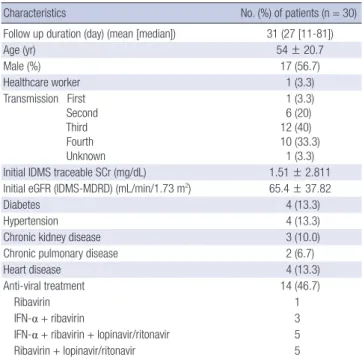
A total of 30 patients were analyzed. The mean and median fol- low up durations from symptom onset were 31 and 27 (11-81) days, respectively. The mean age was 54 yr, and 17 (56.7%) pa- tients were men. These characteristics were not different from those of the 185 MERS-CoV patients in South Korea (mean age 54 yr, men 58.9%, from WHO released data on 7 July, 2015). The transmission status was as follows: first, 1 (3.3%) patient; sec- ond, 6 (20%) patients; third, 12 (40%) patients; fourth, 10 (33.3%) patients; unknown, 1 (3.3%) patient. The mean initial IDMS traceable SCr level was 1.51 ± 2.811 mg/dL, and the mean initial eGFR was 65.4 ± 37.82 mL/min/1.73 m2. The prevalence of dia- betes, hypertension, and chronic kidney disease (CKD) was 13.3%, 13.3%, and 10%, respectively. Fourteen (46.7%) patients received anti-viral treatment (Table 1).
Table 1. The characteristics of all the analyzed patients
Characteristics No. (%) of patients (n = 30)
Follow up duration (day) (mean [median]) 31 (27 [11-81])
Age (yr) 54 ± 20.7
Male (%) 17 (56.7)
Healthcare worker 1 (3.3)
Transmission First Second Third Fourth Unknown
1 (3.3) 6 (20) 12 (40) 10 (33.3)
1 (3.3) Initial IDMS traceable SCr (mg/dL) 1.51 ± 2.811 Initial eGFR (IDMS-MDRD) (mL/min/1.73 m2) 65.4 ± 37.82
Diabetes 4 (13.3)
Hypertension 4 (13.3)
Chronic kidney disease 3 (10.0)
Chronic pulmonary disease 2 (6.7)
Heart disease 4 (13.3)
Anti-viral treatment 14 (46.7)
Ribavirin 1
IFN-α + ribavirin 3
IFN-α + ribavirin + lopinavir/ritonavir 5
Ribavirin + lopinavir/ritonavir 5
eGFR, estimated GFR; IDMS, isotope dilution mass spectrometry; IFN-α, interferon- alpha; MDRD, modification of diet in renal disease; SCr, serum creatinine.
Proteinuria and hematuria
Two consecutive results of more than trace or 1+ of albumin on dipstick test occurred during the observation period in 18 (60%) and 12 (40%) patients, respectively (trace in 6 patients, 1+ in 3 patients, 2+ in 6 patients, 3+ in 3 patients). Two consecutive re- sults of more than trace or 1+ of blood on dipstick test occurred in 22 (73.3%) and 19 (63.3%) patients, respectively (trace in 3 patients, 1+ in 4 patients, 2+ in 2 patients, 3+ in 4 patients, 4+ in 9 patients). When we performed protein quantitation from ran- domly collected urine, 15 (50.0%) patients showed a random urine ACR or PCR more than 100 mg/g Cr during the observa- tion period. Two consecutive results of ACR and PCR values more than 100 mg/g Cr occurred in 11 (36.7%) and 13 (43.3%) patients, respectively. Two consecutive results of ACR or PCR values more than 300 mg/g Cr occurred in 11 (36.7%) and 11 (36.7%), respectively. The progression of random urine ACR and PCR in all the analyzed patients is presented in Fig. 1.
Acute kidney injury (AKI)
During the observation period, 8 (26.7%) patients showed AKI according to the criteria defined in this study. The mean and median durations to the occurrence of AKI from symptom onset were 18 and 16 days, respectively. Two consecutive increases of IDMS traceable SCr greater than 0.3 mg/dL occurred in 7 (23.3%) patients and the mean and median durations were 19 and 16 days, respectively. Two consecutive decreases of eGFR that were less than 70% of initial levels occurred in 7 (23.3%) patients, and
the mean and median durations were 17 and 15 days, respec- tively. The progression of IDMS traceable SCr and eGFR in all the analyzed patients is presented in Fig. 1C and D.
We compared the AKI (n = 8) and no AKI (n = 22) groups.
Patients in the AKI group were older than patients in the no AKI group (P < 0.001). Initial IDMS traceable SCr and eGFR was not different between the two groups (P = 0.91 and 0.87, respec- tively), and the progression of those values between the two groups did not show a statistically significant time interaction during the observation period (Fig. 2A and B). The prevalence of diabetes, hypertension, and CKD was not different between the two groups. The durations to negative results of MERS-CoV polymerase chain reaction from upper or lower respiratory spec- imens were 29 days in the AKI group and 21 days in the no AKI group (P = 0.12). Random urine ACR more than 100 or 300 mg/
g Cr was more frequently observed in the AKI group than in the no AKI group (P = 0.028). The characteristics between the two groups are presented in Table 2.
Diabetes, hypertension, and CKD did not show significant differences in the cumulative rate of AKI occurrence (log-rank P = 0.14, 0.15, and 0.06, respectively). The presence of any co- morbidity showed marginal significance in the cumulative rate of AKI occurrence (log-rank P = 0.05).
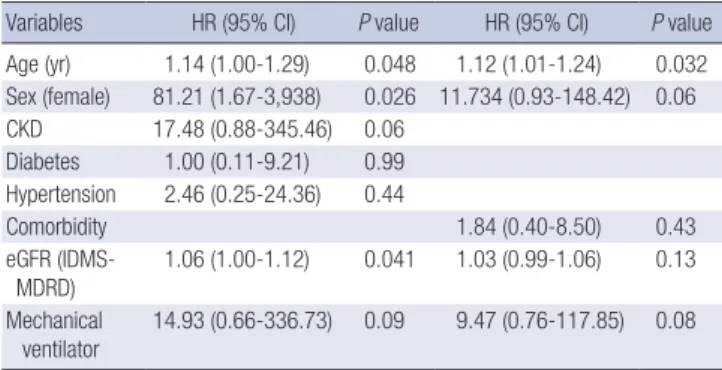
Old age was associated with a higher occurrence of AKI in the univariate analysis (HR [95% CI]: 1.07 [1.01-1.13], P = 0.016).
Other factors including sex, diabetes, CKD, and the application of a mechanical ventilator were not significant risk factors of
Fig. 1. The progression of random urine albumin to creatinine ratio, protein to creatinine ratio, serum creatinine, and estimated GFR. (A) Mean random urine albumin to creati- nine ratio. (B) Mean random urine protein to creatinine ratio. (C) Mean IDMS traceable serum creatinine. (D) Mean estimated glomerular filtration rate (eGFR) calculated by ID- MS-MDRD equation throughout the observation period. Each point stands for the mean (least square) and standard error (error bar). Gray dot line indicates day 52 from symp- tom onset and data after that day are from one patient.
mg/g Cr
Days from symptom onset
Day 1 Day 21 Day 41 Day 61 Day 1 Day 21 Day 41 Day 61 Day 81
1,500 1,200 900 600 300 0
mg/g Cr
Days from symptom onset
4,000 3,500 3,000 2,500 2,000 1,500 1,000 500 0
A B
Day 1 Day 21 Day 41 Day 61 Day 81 Day 1 Day 21 Day 41 Day 61 Day 81
mg/dL
Days from symptom onset
3.5 3.0 2.5 2.0 1.5 1.0 0.5
0 2IDMS-MDRD: mL/min/1.73 m
Days from symptom onset
160 140 120 100 80 60 40 20 0
C D
AKI. Old age remained a significant predictor of the occurrence of AKI after adjustment for comorbidities and the application of a mechanical ventilator (Table 3).
Organ replacement therapies
A mechanical ventilator was applied to 12 (40.0%) patients, and 3 (10.0%) patients underwent CRRT. An ECMO was applied to 5 Fig. 2. The comparison of IDMS traceable serum creatinine and estimated GFR according to the occurrence of AKI and mortality. (A, B) Mean IDMS traceable serum creatinine (SCr) and IDMS-MDRD estimated glomerular filtration rate (eGFR) between the AKI and no AKI group. (C, D) Mean IDMS traceable SCr and IDMS-MDRD eGFR according to the application of CRRT. (E, F) Mean IDMS traceable SCr and IDMS-MDRD eGFR between dead and alive patients. (G, H) Mean IDMS traceable SCr and IDMS-MDRD eGFR between dead and alive patients in the AKI group.
mg/dL IDMS-MDRD: mL/min/1.73 m2
Days from symptom onset Days from symptom onset
Day 1 Day 21 Day 41 Day 61 Day 81 Day 1 Day 21 Day 41 Day 61 Day 81
5 4 3 2 1 0
200
150
100
50
0
A B
AKI No AKI
AKI No AKI
mg/dL IDMS-MDRD: mL/min/1.73 m2
Days from symptom onset Days from symptom onset
Day 1 Day 5 Day 9 Day 13 Day 1 Day 5 Day 9 Day 13
8
6
4
2
0
160
120
80
40
0
C D
CRRT (−) CRRT (+)
CRRT (−) CRRT (+)
mg/dL IDMS-MDRD: mL/min/1.73 m2
Days from symptom onset Days from symptom onset
Day 1 Day 5 Day 10 Day 15 Day 1 Day 5 Day 10 Day 15
5 4 3 2 1 0
200
150
100
50
0
E F
Dead Alive
Dead Alive
mg/dL IDMS-MDRD: mL/min/1.73 m2
Days from symptom onset Days from symptom onset
Day 1 Day 5 Day 10 Day 15 Day 1 Day 5 Day 10 Day 15
8
6
4
2
0
250 200 150 100 50 0
G H
Dead in AKI Alive in AKI
Dead in AKI Alive in AKI
(16.7%) patients. Five patients received only mechanical venti- lator therapy, 2 received mechanical ventilator and CRRT ther- apies, and 4 received mechanical ventilator and ECMO thera- pies. One patient received mechanical ventilator, CRRT, and ECMO therapies. Baseline characteristics of the 3 patients who underwent CRRT were as follows: #1, 71-yr old male who had diabetes, hypertension, CKD, and heart disease; #2, 76-yr old male who had CKD, chronic pulmonary disease, and chronic liver disease; #3, 86-yr old male who had diabetes, hyperten- sion, and heart disease. The progression of IDMS traceable SCr and eGFR according to the application of CRRT did not show a statistically significant time interaction during the observation period (Fig. 2C and D).
Mortality
Five patients died of septic shock progression and multiple or- gan failure and the median duration to death from symptom onset was 15 (11-16). Among these 5 patients, 2 received me- chanical ventilator and CRRT therapies, 1 received mechanical ventilator and ECMO therapies, and 1 patient received all of mechanical ventilator, CRRT, and ECMO therapies. One patient refused all life extension therapies. Two (40.0%) patients received anti-viral treatment, whereas 12 (48.0%) of the surviving patients received anti-viral treatment (P = 1.0).
The progression of IDMS traceable SCr and eGFR between the dead and alive patients did not show a statistically signifi- cant time interaction (Fig. 2E and F). Those values between dead and alive patients in the AKI group were not statistically significant during the observation period, either (Fig. 2G and H). The occurrence of AKI showed marginal significance in the
cumulative rate of mortality analysis (log-rank P = 0.06). Diabe- tes, the occurrence of AKI, and the application of CRRT were risk factors for mortality when we performed the univariate analysis (HR [95% CI]: diabetes; 10.13 [1.69-60.70], AKI; 12.74 [1.42-114.57], CRRT; 10.25 [1.63-64.67], respectively). However, these risk factors were not statistically significant after adjust- ment for age, sex, CKD, and the application of a mechanical ventilator and ECMO.
DISCUSSION
Among the 30 patients analyzed in the present study, 60% and 73.3% showed positive results of albumin and blood on dipstick tests; 50% of patients showed a random urine ACR or PCR more than 100 mg/g Cr. Moreover, 26.7% of patients showed AKI, and the mean and median durations from symptom onset were 18 and 16 days, respectively. Old age was a predictor of the occur- rence of AKI even after adjustment for comorbidities and the application of a mechanical ventilator. Mechanical ventilator, CRRT, and ECMO therapies were applied to 12 (40%), 3 (10%), and 5 (16.7%) patients, respectively. A total of 5 patients died of septic shock progression and multiple organ failure. Diabetes, the occurrence of AKI, and the application of CRRT were risk factors predicting mortality in the univariate analysis.
The first case of MERS-CoV infection had progressive impair- ment of renal function. This was similar to what had been de- scribed in some patients with severe acute respiratory syndrome (SARS-CoV) and suggested direct infection of renal tissue by the virus (1). Some patients with MERS-CoV infection who present- ed with severe pneumonia and acute respiratory distress syn- drome have had AKI thereafter (2-4,10-12).
Kidney involvement of human coronavirus was noticed when the SARS-CoV epidemic occurred in early 2000. A report that analyzed 536 patients with SARS-CoV showed 6.7% of acute re- nal impairment and 84.6% of proteinuria by dipstick tests (13).
Acute respiratory distress syndrome and age were significant risk factors for acute renal impairment, and acute renal impair- Table 3. Cox proportional-hazard analysis of the occurrence of acute kidney injury
Variables HR (95% CI) P value HR (95% CI) P value Age (yr) 1.14 (1.00-1.29) 0.048 1.12 (1.01-1.24) 0.032 Sex (female) 81.21 (1.67-3,938) 0.026 11.734 (0.93-148.42) 0.06 CKD 17.48 (0.88-345.46) 0.06
Diabetes 1.00 (0.11-9.21) 0.99 Hypertension 2.46 (0.25-24.36) 0.44
Comorbidity 1.84 (0.40-8.50) 0.43
e GFR (IDMS- MDRD)
1.06 (1.00-1.12) 0.041 1.03 (0.99-1.06) 0.13 M echanical
ventilator 14.93 (0.66-336.73) 0.09 9.47 (0.76-117.85) 0.08 CI, confidence interval; CKD, chronic kidney disease; eGFR, estimated glomerular fil- tration rate; HR, hazard ratio; IDMS, isotope dilution mass spectrometry; MDRD, modification of diet in renal disease.
Table 2. The comparison of characteristics between the acute kidney injury (AKI) and the no AKI groups
Characteristics AKI (n = 8) no AKI (n = 22) P value
Age (yr) 73 ± 10.9 47 ± 19.2 < 0.001
Male (%) 5 (62.5) 12 (54.5) 1.0
MERS-CoV polymerase chain reaction
Negative conversion duration (day) 29 ± 14.3 21 ± 7.2 0.13 Initial IDMS traceable SCr (mg/dL) 1.60 ± 2.087 1.47 ± 3.074 0.92 Initial eGFR (IDMS-MDRD)
(mL/min/1.73 m2) 63.5 ± 34.96 66.1 ± 39.57 0.87
Diabetes (%) 2 (25) 2 (9.1) 0.28
Hypertension (%) 4 (50) 4 (18.2) 0.10
CKD (%) 2 (25) 1 (4.5) 0.17
Any morbidity (%) 5 (62.5) 5 (22.7) 0.06
Anti-viral treatment 4 (50.0) 10 (45.5) 1.0
Random urine protein quantitation ACR or PCR ≥ 100 mg/g Cr
ACR ≥ 100 mg/g Cr ACR ≥ 300 mg/g Cr PCR ≥ 100 mg/g Cr PCR ≥ 300 mg/g Cr
6 (75.0) 6 (75.0) 6 (75.0) 5 (62.5) 5 (62.5)
9 (70.9) 5 (22.7) 5 (22.7) 8 (36.4) 6 (27.3)
0.22 0.028 0.028 0.24 0.10 ACR, albumin to creatinine ratio; CKD, chronic kidney disease; eGFR, estimated GFR;
IDMS, isotope dilution mass spectrometry; MDRD, modification of diet in renal dis- ease; PCR, protein to creatinine ratio; SCr, serum creatinine.
ment was an independent risk factor predicting mortality. How- ever, kidney specimens from autopsy cases showed no viral in- clusions or electron dense deposits. Even in situ hybridization failed to demonstrate SARS-CoV. This suggested that renal in- sult occurred in the context of multiple organ failure. Another report also stated that the decrease in glomerular filtration rate was secondary to hypotension, vasoconstriction, and sepsis (14). However, another study detected SARS-CoV in distal con- voluted renal tubules (15).
SARS-CoV patients developed AKI at a median duration of 20 days from the onset of viral infection, i.e., the late viremic or the hyperimmune response phase of the infection (16). The de- tection of polymerase chain reaction fragments of coronavirus in urine from 21%-50% of SARS patients between the second and third week of the viral infection implied a possibility of kid- ney tropism of the coronavirus (14). Unfortunately, MERS-CoV polymerase chain reaction from urine was performed in only one patient 6 weeks after symptom onset in this cohort to en- sure the virus absence from various specimens, and it was neg- ative. We can conclude that the renal pathological changes as- sociated with human coronavirus may be caused directly by the cytopathic effect mediated by virus replication, as well as indirectly by a systemic toxic reaction resulting from respiratory failure or a harmful immune response and cytokine reaction induced by viral infection.
Organ tropism of human coronavirus is primarily determined by the ability of the receptor binding protein, such as spike en- try protein (MERS-CoV), to a cell surface receptor (5). Angioten- tin converting enzyme 2 is a functional receptor for SARS-CoV (17), and it is expressed in human kidneys (18). DPP 4 was iden- tified as a functional receptor for MERS-CoV (5). DPP 4 is a wide- ly expressed serine peptidase that exists on the surface of vari- ous cell types, and the expression of messenger RNA and pro- tein is high in the kidneys (6,19). DPP 4 is one of the major brush border membrane proteins of the kidney (8), but it is also pres- ent in the glomerular podocytes and capillaries (9). DPP 4, which is present on the surfaces of human bronchial epithelial cells, was previously co-stained with MERS-CoV (20) and a MERS- CoV infected human kidney cell line (21). We performed kid- ney biopsy in one patient to evaluate persistent proteinuria 8 weeks after symptom onset, which failed to reveal virus parti- cles that were co-stained with DPP 4 in compatible ultrastruc- tures. However, the interpretation for these results was limited by autolysis of the tissues and a direct involvement of the kid- neys by the MERS-CoV could not be ruled out.
More than 25% of the patients in the present study showed AKI, which is higher than the AKI incidence of SARS-CoV infec- tion (13). One explanation for the difference in AKI incidence may be the different criteria used to define AKI. In that study, AKI was defined as a SCr elevation at least 30% of the baseline value on admission (3 consecutive blood samplings) or above
1.8 mg/dL. When we adopted the same definition in the pres- ent cohort, AKI occurred in 7 patients (23.3%), which is still high- er than the AKI incidence of SARS-CoV infection. Another ex- planation may be the older age of MERS-CoV patients in the present study. The mean age was 54 yr in the present cohort and approximately 39 yr in the SARS-CoV cohort. Because age was an independent risk factor for AKI in both studies, the older age of MERS-CoV patients might explain the higher incidence of AKI in the present study. In a previous study, a patient whose viral RNA was not detected in whole blood or urine samples had a more favorable outcome than a patient who showed dissemi- nated viral infection (22). The investigators in that study con- cluded that a type-1 interferon mediated response triggered by MERS-CoV might limit the viral disease to the lung and prevent systemic dissemination and viremia. A decreased immune re- sponse in older patients may play a role in the higher occur- rence of AKI through viremia and urinary viral excretion, though we did not assess serial viral RNA in blood and urine. In addi- tion, this cohort was from central MERS-CoV designated hospi- tal and we cannot rule out that patients in this cohort had more underlying diseases than other MERS-CoV patients in Korea and that the incidence of AKI occurrence might be overestimated.
On the contrary, 58% of MERS-CoV patients underwent CRRT therapy in a previous cohort (10). In this cohort, CRRT therapy was applied to only 10% of patients. The difference in the inci- dence of patients who required renal replacement therapy can be explained by two reasons. Previous cohort was ICU admit- ted patients, and baseline characteristics between two cohorts were quite different. The prevalence of diabetes, hypertension, and renal disease were 67%, 50%, and 42%, respectively. It is much higher than that of our cohort.
The mean and median durations of AKI occurrence were ap- proximately 3 weeks from symptom onset, consistent with the values reported for SARS-CoV (13,16). One report showed that MERS-CoV PCR was positive after 3 weeks in the blood of 1 pa- tient (22). We speculate that the duration between symptom onset and AKI occurrence coincides with the late viremic or hy- perimmune response phase of the infection, as was the case for SARS-CoV did. However, we did not assess serial viremia and cytokines.
A considerable prevalence of proteinuria is also consistent with the results of a previous SARS-CoV study (13), though a quantitative assessment of urinary protein excretion was not performed in that study. The highest mean levels of random urine were 1,986 mg/g Cr for ACR, which occurred 4 days after symptom onset, and 6,105 mg/g Cr for PCR, which occurred 27 days after symptom onset. Early phase high albumin excretion may be related to fever and systemic inflammatory status, and high-level proteinuria approximately 3 weeks after symptom onset may be associated with viremia or urinary virus excre- tion, which was similar to the occurrence of AKI (16). However,
we did not assess serial viremic status, and a blood sample 6 weeks after symptom onset was negative for MERS-CoV poly- merase chain reaction. The detection rates of SARS-CoV in blood samples were only 21%-50% between the second and third weeks after viral infection (14). A direct involvement of the kid- neys by the MERS-CoV could not be ruled out, because we per- formed the blood assay 6 weeks after symptom onset.
This study has several limitations. First, there was some loss of data and evaluations of renal complications were not consis- tent between our institute and hospitals where patients were previously admitted. Second, we received only a positive status for MERS-CoV polymerase chain reaction tests, except for Ct values. Therefore, we could not assess correlations between vi- ral load and the renal complications. Third, we did not have compatible renal pathology data. Therefore, we cannot draw a conclusion about the direct effect of the virus on renal compli- cations.
In conclusion, half of the patients in the present study showed proteinuria, and more than one-fourth of the patients devel- oped AKI. The incidence of AKI was not uncommon, and AKI can be affected by factors including the virus itself, associated systemic inflammation, and hypotension. Meticulous evalua- tion and management of kidney damage such as quantitative assessment of proteinuria and frequent monitoring of eGFR is earnestly needed. Old age is an independent risk factor for the occurrence of AKI; diabetes, AKI, and the application of CRRT are negative prognostic indicators for survival with MERS-CoV.
Further studies are needed to reveal the direct effects of MERS- CoV on renal complications.
ACKNOWLEDGMENTS
We thank to our Critical Care Team colleagues from the Nation- al Medical Center, Korea who provided their insight and exper- tise when we treated MERS-CoV patients.
DISCLOSURE
The authors have no potential conflicts of interest to disclose.
AUTHOR CONTRIBUTION
Study concept and design of article: Cha R. Data collection and analysis: Cha R, Joh JS, Jeong I, Lee JY, Shin HS, Kim G, Kim Y.
Writing draft: Cha R. Revision: Cha R. Approval of final manu- script and agreement of submission: all authors.
ORCID
Ran-hui Cha http://orcid.org/0000-0003-2783-2600 Joon-Sung Joh http://orcid.org/0000-0002-5044-2742
Ina Jeong http://orcid.org/0000-0002-0937-9833 Ji Yeon Lee http://orcid.org/0000-0002-7026-8235 Hyoung-Shik Shin http://orcid.org/0000-0001-6504-3413 Gayeon Kim http://orcid.org/0000-0001-9788-9800 Yeonjae Kim http://orcid.org/0000-0003-4144-9077 REFERENCES
1. Zaki AM, van Boheemen S, Bestebroer TM, Osterhaus AD, Fouchier RA. Isolation of a novel coronavirus from a man with pneumonia in Saudi Arabia. N Engl J Med 2012; 367: 1814-20.
2. Memish ZA, Zumla AI, Al-Hakeem RF, Al-Rabeeah AA, Stephens GM.
Family cluster of Middle East respiratory syndrome coronavirus infec- tions. N Engl J Med 2013; 368: 2487-94.
3. Guery B, Poissy J, el Mansouf L, Séjourné C, Ettahar N, Lemaire X, Vuo- tto F, Goffard A, Behillil S, Enouf V, et al.; MERS-CoV study group. Clini- cal features and viral diagnosis of two cases of infection with Middle East Respiratory Syndrome coronavirus: a report of nosocomial transmission.
Lancet 2013; 381: 2265-72.
4. Assiri A, McGeer A, Perl TM, Price CS, Al Rabeeah AA, Cummings DA, Alabdullatif ZN, Assad M, Almulhim A, Makhdoom H, et al.; KSA MERS- CoV Investigation Team. Hospital outbreak of Middle East respiratory syndrome coronavirus. N Engl J Med 2013; 369: 407-16.
5. Raj VS, Mou H, Smits SL, Dekkers DH, Müller MA, Dijkman R, Muth D, Demmers JA, Zaki A, Fouchier RA, et al. Dipeptidyl peptidase 4 is a functional receptor for the emerging human coronavirus-EMC. Nature 2013; 495: 251-4.
6. Hong WJ, Petell JK, Swank D, Sanford J, Hixson DC, Doyle D. Expres- sion of dipeptidyl peptidase IV in rat tissues is mainly regulated at the mRNA levels. Exp Cell Res 1989; 182: 256-66.
7. Lu G, Hu Y, Wang Q, Qi J, Gao F, Li Y, Zhang Y, Zhang W, Yuan Y, Bao J, et al. Molecular basis of binding between novel human coronavirus MERS-CoV and its receptor CD26. Nature 2013; 500: 227-31.
8. Kenny AJ, Booth AG, George SG, Ingram J, Kershaw D, Wood EJ, Young AR. Dipeptidyl peptidase IV, a kidney brush-border serine peptidase.
Biochem J 1976; 157: 169-82.
9. Lambeir AM, Durinx C, Scharpé S, De Meester I. Dipeptidyl-peptidase IV from bench to bedside: an update on structural properties, functions, and clinical aspects of the enzyme DPP IV. Crit Rev Clin Lab Sci 2003;
40: 209-94.
10. Arabi YM, Arifi AA, Balkhy HH, Najm H, Aldawood AS, Ghabashi A, Hawa H, Alothman A, Khaldi A, Al Raiy B. Clinical course and outcomes of critically ill patients with Middle East respiratory syndrome coronavi- rus infection. Ann Intern Med 2014; 160: 389-97.
11. Drosten C, Seilmaier M, Corman VM, Hartmann W, Scheible G, Sack S, Guggemos W, Kallies R, Muth D, Junglen S, et al. Clinical features and virological analysis of a case of Middle East respiratory syndrome coro- navirus infection. Lancet Infect Dis 2013; 13: 745-51.
12. Assiri A, Al-Tawfiq JA, Al-Rabeeah AA, Al-Rabiah FA, Al-Hajjar S, Al- Barrak A, Flemban H, Al-Nassir WN, Balkhy HH, Al-Hakeem RF, et al.
Epidemiological, demographic, and clinical characteristics of 47 cases of Middle East respiratory syndrome coronavirus disease from Saudi Ara- bia: a descriptive study. Lancet Infect Dis 2013; 13: 752-61.
13. Chu KH, Tsang WK, Tang CS, Lam MF, Lai FM, To KF, Fung KS, Tang
HL, Yan WW, Chan HW, et al. Acute renal impairment in coronavirus- associated severe acute respiratory syndrome. Kidney Int 2005; 67: 698- 705.
14. Peiris JS, Chu CM, Cheng VC, Chan KS, Hung IF, Poon LL, Law KI, Tang BS, Hon TY, Chan CS, et al.; HKU/UCH SARS Study Group. Clinical progression and viral load in a community outbreak of coronavirus-as- sociated SARS pneumonia: a prospective study. Lancet 2003; 361: 1767- 72.
15. Ding Y, He L, Zhang Q, Huang Z, Che X, Hou J, Wang H, Shen H, Qiu L, Li Z, et al. Organ distribution of severe acute respiratory syndrome (SARS) associated coronavirus (SARS-CoV) in SARS patients: implica- tions for pathogenesis and virus transmission pathways. J Pathol 2004;
203: 622-30.
16. Lai KN, Tsang KW, Seto WH, Ooi CG. Clinical, Laboratory, and Radio- logic Manifestation of SARS. Curr Infect Dis Rep 2004; 6: 213-9.
17. Li W, Moore MJ, Vasilieva N, Sui J, Wong SK, Berne MA, Somasundaran M, Sullivan JL, Luzuriaga K, Greenough TC, et al. Angiotensin-convert- ing enzyme 2 is a functional receptor for the SARS coronavirus. Nature 2003; 426: 450-4.
18. Harmer D, Gilbert M, Borman R, Clark KL. Quantitative mRNA expres-
sion profiling of ACE 2, a novel homologue of angiotensin converting en- zyme. FEBS Lett 2002; 532: 107-10.
19. National Library of Medicine (US), National Center for Biotechnology Information. Dipeptidyl-peptidase 4 (DPP4). UGID:197782, UniGene Hs. 368912 Homo sapiens (human) DPP4. Available at http://www.
ncbi.nlm.nih.gov/UniGene [accessed on 15 September 2015].
20. Hocke AC, Becher A, Knepper J, Peter A, Holland G, Tönnies M, Bauer TT, Schneider P, Neudecker J, Muth D, et al. Emerging human middle east respiratory syndrome coronavirus causes widespread infection and alveolar damage in human lungs. Am J Respir Crit Care Med 2013; 188:
882-6.
21. Chan JF, Chan KH, Choi GK, To KK, Tse H, Cai JP, Yeung ML, Cheng VC, Chen H, Che XY, et al. Differential cell line susceptibility to the emerging novel human betacoronavirus 2c EMC/2012: implications for disease pathogenesis and clinical manifestation. J Infect Dis 2013; 207: 1743-52.
22. Poissy J, Goffard A, Parmentier-Decrucq E, Favory R, Kauv M, Kipnis E, Mathieu D, van der Werf S, Guery B; MERS-CoV Biology Group. Kinet- ics and pattern of viral excretion in biological specimens of two MERS- CoV cases. J Clin Virol 2014; 61: 275-8.