INTRODUCTION
Aspirin-exacerbated respiratory diseases (AERD) refers to the development of bronchoconstriction and naso-ocular manifes- tations in asthmatic individuals following the ingestion of aspi- rin or other nonsteroidal anti-inflammatory drugs (NSAIDs).1 Recently, aspirin hypersensitivity has attracted a great deal of attention because of its association with increased asthma se- verity, including life threatening asthma attacks and possible remodeling of both the upper and lower airways.2 Twenty-five percent of asthma patients who required emergency mechani- cal ventilation were aspirin intolerant.3,4 Aspirin has been the most commonly used medication for pain control or as a pro- phylactic for primary and secondary prevention of coronary ar-
Diagnostic Value of Clinical Parameters in the Prediction of Aspirin-Exacerbated Respiratory Disease in Asthma
Hun Soo Chang,
1Jong-Sook Park,
2An-Soo Jang,
2Sung-Woo Park,
2Soo-Taek Uh,
3Young Hoon Kim,
4Choon-Sik Park
2*
1Pharmacogenetic Research Center for Psychotropic Drugs, Korea University, Seoul, Korea
2Genome Research Center for Allergy and Respiratory Disease, Soonchunhyang University Bucheon Hospital, Bucheon, Korea
3Division of Allergy and Respirtorty Medicine, Soonchunhyang University Seoul Hospital, Seoul, Korea
4Division of Allergy and Respiratory Disease, Soonchunhyang University Cheonan Hospital, Cheonan, Korea
tery disease and other vascular diseases.5 However, AERD re- mains widely underdiagnosed in the asthmatic population due to insufficient awareness of the relationship of aspirin ingestion and asthma exacerbation. In a multicenter study in 10 Europe- an countries including 500 patients, 15% of patients were un- aware that they may be susceptible to aspirin intolerance and learned about it only after undergoing provocation tests.6 Allergy Asthma Immunol Res. 2011 October;3(4):256-264.
http://dx.doi.org/10.4168/aair.2011.3.4.256 pISSN 2092-7355 • eISSN 2092-7363
Purpose: Aspirin-exacerbated respiratory disease (AERD) has attracted a great deal of attention because of its association with increased asthma severity. However, oral aspirin challenge (OAC) to diagnose AERD is a time-consuming procedure, and some patients experience serious complica- tions. Thus, we evaluated diagnostic values of non-invasive clinical parameters to predict AERD in asthmatic patients. Methods: A total of 836 Korean subjects were recruited from an asthma cohort. They underwent OAC, and clinical parameters including the history of aspirin hypersensitivi- ty, nasal polyposis, and chronic sinusitis of aspirin-tolerant asthma (ATA) and AERD asthmatic patients were compared. Results: Significant differ- ences (P<0.01) were found in eight parameters: age at diagnosis, body mass index, FEV1%, PC20, history of urticaria, nasal polyps, chronic sinus- itis, and history of aspirin hypersensitivity. After logistic regression analysis based on the eight clinical parameters, nasal polyps, history of aspirin intolerance, sinusitis, and log [PC20 methacholine] remained significantly associated with AERD (P<0.05). The sensitivity and specificity of the his- tory of aspirin hypersensitivity to predict AERD were 64.7% and 92.0%, respectively, and the positive and negative predictive values were 56.9% and 94.1%, respectively. Overall, the accuracy of the test was 88.2%. The accuracy of the tests for nasal polyps and chronic sinusitis were 67.3% and 60.4%, respectively. Conclusions: Among clinical parameters associated with AERD, the history of aspirin hypersensitivity has the best positive and negative predictive values for the oral aspirin challenge test. Because the false-positive and -negative rates were still high, additional non-inva- sive methods are needed to reduce the rate of false outcomes.
Key Words: Aspirin-exacerbated respiratory disease (AERD); aspirin hypersensitivity; history; nasal polyp; chronic sinusitis; oral aspirin challenge (OAC)
This is an Open Access article distributed under the terms of the Creative Commons Attribution Non-Commercial License (http://creativecommons.org/licenses/by-nc/3.0/) which permits unrestricted non-commercial use, distribution, and reproduction in any medium, provided the original work is properly cited.
Correspondence to: Choon-Sik Park, MD, PhD, Division of Allergy and Respiratory Medicine, Department of Internal Medicine, Soonchunhyang University Bucheon Hospital, 1174 Jung-dong, Wonmi-gu, Bucheon 420-021, Korea.
Tel: +82-32-621-5105; Fax: +82-32-621-5023; E-mail: [email protected] Received: October 28, 2010; Accepted: April 4, 2011
•There are no financial or other issues that might lead to conflict of interest.
The diagnosis of aspirin hypersensitivity and AERD is usually obvious from taking a clear history. Patients often have a histo- ry of rhinosinusitis and moderate to severe asthma.7,8 AERD typically develops in individuals according to a characteristic sequence of symptoms. Following ingestion of aspirin or cer- tain NSAIDs, patients have an acute asthma exacerbation, typi- cally within 3 hours. Bronchoconstriction can be accompanied by profuse rhinorrhea and periorbital edema. This progresses to recurrent and chronic sinusitis and frequently to nasal pol- yposis.9 Thus, this syndrome is characterized by the ‘aspirin tri- ad’ syndrome of aspirin hypersensitivity, bronchial asthma, and nasal polyposis.10 Chronic hyperplastic eosinophilic sinusitis is a fourth hallmark of AERD.1 A fairly limited number of epide- miological studies have offered estimates on the prevalence of AERD. The prevalence of aspirin hypersensitivity in adult asth- matic patients was reported to vary depending on whether it was determined by clinical history alone or by challenge with aspirin.6 Thus, the identification of aspirin hypersensitivity, es- pecially cases not recognized by the patients, is essential to avoid the serious complication associated with this condition.
Diagnosis can be established with certainty only by provoca- tion tests using increasing doses of aspirin. The four commonly used types of provocation tests are defined by the route of aspi- rin administration: oral, bronchial (inhaled), intravenous, and nasal.11 Oral aspirin challenge (OAC) is the gold standard to confirm the diagnosis. Nasal or bronchial provocation with ly- sine-ASA may be a valuable alternative diagnostic tool. Both oral and bronchial tests have similar specificity, but the oral test has a somewhat higher sensitivity. However, OAC is a time-con- suming procedure, and some cases experience serious compli- cations. Thus, the development of non-invasive methods is nec- essary for easy diagnosis to prevent unexpected complications associated with aspirin use in susceptible patients. In the pres- ent study, we evaluated the diagnostic merits of clinical param- eters including the well-known manifestation of aspirin hyper- sensitivity history and nasal polyposis to predict aspirin hyper- sensitivity in asthmatic patients.
MATERIALS AND METHODS Subjects
Seven hundred two asthmatic patients without AERD and 134 subjects with AERD were recruited from the Asthma Genome Research Center, which comprises three university hospitals in Korea. All subjects were Korean and gave their informed con- sent to participate in the study. All patients were diagnosed by physicians and met the criteria for asthma according to the Global Initiative for Asthma (GINA) guidelines.12 All patients had a history of dyspnea and wheezing during the previous 12 months, plus one of the following: 1) >15% increase in forced expiratory volume in 1 second (FEV1) or >12% increase plus 200 mL following inhalation of a short-acting bronchodilator, 2)
<10 mg/mL PC20 methacholine, and 3) >20% increase in FEV1 following 2 weeks of treatment with inhaled or systemic corti- costeroids. Twenty-four commonly inhaled allergens were used for a skin-prick test. Total IgE was measured by the CAP system (Pharmacia Diagnostics, Uppsala, Sweden). Atopy was defined as a wheal reaction with a diameter of 3 mm or greater than the reaction to histamine. In the questionnaires designed to reveal the presence of aspirin hypersensitivity, questions related to five specific elements of aspirin hypersensitivity and NSAIDs (dyspnea, wheezing, nasal blockage, skin eruption, loss of con- sciousness) were incorporated. The asthmatic patients had ex- perienced no exacerbation of asthma or respiratory tract infec- tion in the 6 weeks preceding OAC. OAC was performed in all subjects with increasing doses of aspirin using methods slightly modified from those described previously.13,14 Briefly, patients having a history of aspirin hypersensitivity were given a dose of 30 mg, and those with no history were started on 100 mg of as- pirin orally. Symptoms, external signs (urticaria, angioedema, rhinorrhea), blood pressure, and FEV1 were documented every 30 minutes for a period of 2 hours. In the absence of any symp- toms or signs suggestive of adverse reaction after 2 hours, 60 mg or 100 mg of aspirin was administered and the same measure- ments were repeated every hour, with doses of 450 mg given until the patient developed a reaction. If no reaction occurred within 4 hours after the final dose, the test was deemed nega- tive. Aspirin-induced bronchospasms, as reflected by decline (%) in FEV1, were calculated as the pre-challenge FEV1 minus the post-challenge FEV1 divided by the pre-challenge FEV1.
OAC reactions were categorized into two groups as follows: 1) a 15% or greater decrease in FEV1 or naso-ocular reactions (AERD), and 2) a decrease of less than 15% in FEV1 without naso-ocular or cutaneous reactions (aspirin-tolerant asthma [ATA]).
A diagnosis of nasal polyps was made based on the presence of endoscopically visible nasal polyps arising from the middle nasal meatus. Chronic rhinosinusitis was diagnosed from pa- tients’ documented medical histories and the haziness of the ethmoidal and maxillary sinuses as visualized by a simple X-ray of the paranasal sinuses. The protocols were approved by the Ethics Committee of the Soonchunhyang University Medical Center.
Statistical analysis
Differences in the mean values or frequencies were evaluated with chi square analysis for discrete variables or by indepen- dent t-tests for continuous variables. We tested the indepen- dent effects of the parameters that showed significant (P<0.01) association with aspirin hypersensitivity using conditional back- ward logistic regression analysis. The sensitivity and specificity of the parameters were tested using receiver operating charac- teristic (ROC) curves. All statistical analyses were performed using SPSS version 10.0 (SPSS Inc., Chicago, IL, USA).
RESULTS
Comparison of clinical and laboratory parameters between AERD and ATA
A total of 836 subjects were recruited from the asthma cohort.
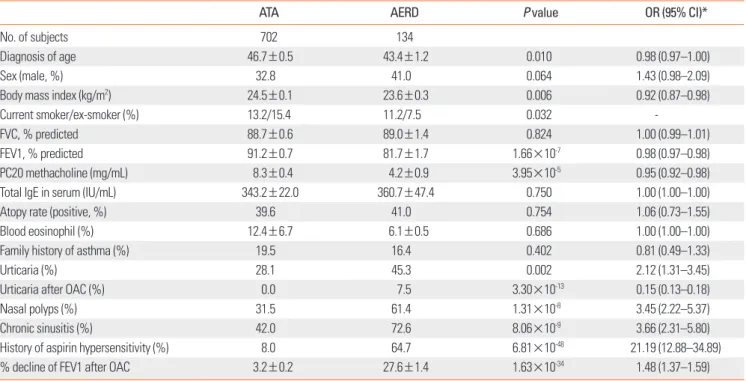
The clinical characteristics of the study subjects are summarized in Table 1. The subjects with AERD had more severe broncho- spasm following aspirin challenge as measured by percent de- cline of FEV1 after OAC (P=1.63×10⁻³⁴). Significant differences (P<0.01) were found in nine parameters (Table 1): age at diag- nosis, body mass index (BMI), FEV1%, PC20, history of urticar- ia, nasal polyps, chronic sinusitis, and history of aspirin hyper- sensitivity. Mean age and BMI were slightly lower in subjects with ATA than those with AERD (P=0.01 and P=0.006, respec- tively). FEV1 and PC20 methacholine were also significantly lower in AERD than in ATA patients (P=1.66×10⁻⁷ and P=3.95×
10-5, respectively). Subjects with AERD had nearly double the frequency of nasal polyps (61.4% vs. 31.5%, P=1.31×10⁻⁸) and
chronic sinusitis (72.6% vs. 42.0%, P=8.06×10⁻⁹) compared with those with ATA. The history of aspirin hypersensitivity was eight times higher in AERD patients compared with those with ATA (64.7% vs. 8.0%, P=6.81×10-48). The frequency of urticaria his- tory was also significantly higher in AERD patients compared with ATA patients (54.3% vs. 28.11%, P=0.002).
Evaluation of independent effects of clinical parameters on AERD using backward logistic regression analysis
To identify factors affecting the risk of aspirin intolerance, lo- gistic regression analysis with a conditional backward method was used. Among the eight clinical parameters shown to have a P value <0.01 in the comparison between AERD and ATA pa- tients, the presence of nasal polyps, a history of aspirin intoler- ance, sinusitis, and log [PC20 methacholine] remained signifi- cant, and these factors showed a significant association with AERD (P<0.05, Table 2). The ratio of individuals with nasal pol- yposis, a history of ASA intolerance, and chronic sinusitis were
Table 1. Clinical parameters of AERD and ATA
ATA AERD P value OR (95% CI)*
No. of subjects 702 134
Diagnosis of age 46.7±0.5 43.4±1.2 0.010 0.98 (0.97–1.00)
Sex (male, %) 32.8 41.0 0.064 1.43 (0.98–2.09)
Body mass index (kg/m2) 24.5±0.1 23.6±0.3 0.006 0.92 (0.87–0.98)
Current smoker/ex-smoker (%) 13.2/15.4 11.2/7.5 0.032 -
FVC, % predicted 88.7±0.6 89.0±1.4 0.824 1.00 (0.99–1.01)
FEV1, % predicted 91.2±0.7 81.7±1.7 1.66×10⁻⁷ 0.98 (0.97–0.98)
PC20 methacholine (mg/mL) 8.3±0.4 4.2±0.9 3.95×10⁻⁵ 0.95 (0.92–0.98)
Total IgE in serum (IU/mL) 343.2±22.0 360.7±47.4 0.750 1.00 (1.00–1.00)
Atopy rate (positive, %) 39.6 41.0 0.754 1.06 (0.73–1.55)
Blood eosinophil (%) 12.4±6.7 6.1±0.5 0.686 1.00 (1.00–1.00)
Family history of asthma (%) 19.5 16.4 0.402 0.81 (0.49–1.33)
Urticaria (%) 28.1 45.3 0.002 2.12 (1.31–3.45)
Urticaria after OAC (%) 0.0 7.5 3.30×10⁻¹³ 0.15 (0.13–0.18)
Nasal polyps (%) 31.5 61.4 1.31×10⁻⁸ 3.45 (2.22–5.37)
Chronic sinusitis (%) 42.0 72.6 8.06×10⁻⁹ 3.66 (2.31–5.80)
History of aspirin hypersensitivity (%) 8.0 64.7 6.81×10-48 21.19 (12.88–34.89)
% decline of FEV1 after OAC 3.2±0.2 27.6±1.4 1.63×10⁻³⁴ 1.48 (1.37–1.59)
*Odds ratios were obtained using χ2 test for discrete variables and logistic regression analysis for continuous variables.
ATA, aspirin-tolerant asthma; AERD, aspirin-exacerbated respiratory disease; OR, odds ratio; CI, confidence interval; FVC, forced vital capacity; FEV1, forced expirato- ry volume in 1 second; PC20 methacholine, provocative concentration of methacholine that causes a 20% fall in the FEV1; OAC, oral aspirin challenge.
Table 2. Statistically significant parameters after backward logistic regression analysis for AERD
Beta SE P value OR (95% CI)
Nasal polyps 0.874 0.362 1.58×10⁻² 2.40 (1.18–4.87)
History of aspirin hypersensitivity 3.174 0.378 4.80×10⁻¹⁷ 23.90 (11.39–50.16)
Chronic sinusitis 1.453 0.402 3.04×10⁻⁴ 4.28 (1.94–9.41)
log [PC20] -0.918 0.231 7.17×10⁻⁵ 0.40 (0.25–0.63)
AERD, aspirin-exacerbated respiratory disease; SE, standard error; OR, odds ratio; CI, confidence interval.
significantly higher in AERD patients than in those with ATA.
The logarithm of PC20 values for methacholine challenge was significantly lower in the AERD group than that in the ATA group. Although the FEV1 was significantly lower in AERD pa- tients than in ATA patients, the difference became non-signifi- cant after logistic regression analysis. The factor showing the highest association was a history of aspirin intolerance (odds ratio [OR]=23.9), followed by chronic sinusitis (OR=4.28), PC20 methacholine (OR=0.4), and nasal polyps (OR=2.4).
Diagnostic value of clinical parameters for the prediction of AERD in asthmatic patients
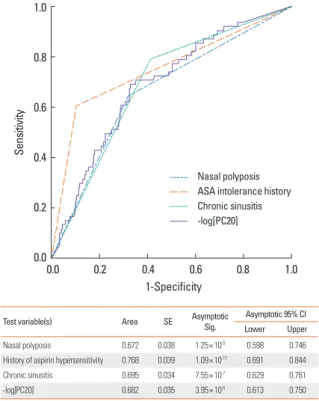
We tested the sensitivity and specificity for AERD using ROC curves (Fig. 1). The area under the curve (AUC) of the four vari- ables ranged from 0.672 to 0.768. The history of aspirin intoler- ance showed the highest AUC value (0.768). A history of aspirin hypersensitivity was observed in 50 of 628 subjects with ATA (8%) and in 66 of 102 subjects with AERD (64.7%). Thus, 15.9%
of all subjects studied had a positive history of aspirin hyper- sensitivity. In subjects having a history of aspirin hypersensitiv- ity (n=116), AERD was proven in 66 subjects (56.9%) by the oral provocation test. The other 43.1% of subjects with histories of aspirin hypersensitivity had negative OAC test results.
The sensitivity and specificity of a history of aspirin hypersen- sitivity for predicting AERD were 64.7% and 92.0%, respectively (Table 3). The positive and negative predictive values were 56.9%
and 94.1%, respectively. The overall accuracy of the test was 88.2%. When nasal polyps were present, the sensitivity and specificity to predict AERD were 61.4% and 68.5%, respectively.
The positive and negative predictive values when polyps were present were 28.1% and 89.8%, respectively. The overall accura- cy of the test was 67.3%. The presence of chronic sinusitis pre- dicted AERD with sensitivity and specificity of 72.6% and 58.0%, respectively. The positive and negative predictive values were
25.6% and 91.4%, respectively. The overall accuracy of the test was 60.4%.
Diagnostic values of the clinical parameters to predict AERD according to the presence or absence of history of aspirin hypersensitivity
To identify additional parameters affecting the development of AERD, we compared clinical parameters between four groups:
Table 3. Sensitivity and specificity of the clinical parameters to predict AERD in asthmatic patients
ATA AERD Total Diagnostic values
History of aspirin hypersensitivity (-) (+) Total
578 (79.2%) 50 (6.8%) 628 (86%)
36 (4.9%) 66 (9%) 102 (14%)
614 (84.1%) 116 (15.9%) 730 (100%)
Sensitivity=66/(36+66)=64.7%
Specificity=578/(578+50)=92.0%
+PV=66/(66+50)=56.9%
-PV=578/(578+36)=94.1%
Accuracy=(578+66)/730=88.2%
Nasal polyposis (-)
(+) Total
345 (57.0%) 159 (26.3%) 504 (83.3%)
39 (6.5%) 62 (10.2%) 101 (16.7%)
384 (63.5%) 221 (36.5%) 605 (100%)
Sensitivity=62/(39+62)=61.4%
Specificity=345/(345+159)=68.5%
+PV=62/(62+159)=28.1%
-PV=345/(345+39)=89.8%
Accuracy=(345+62)/605=67.3%
Chronic sinusitis (-)
(+) Total
309 (48.4%) 224 (35.1%) 533 (83.5%)
29 (4.5%) 77 (12.0%) 106 (16.5%)
338 (52.9%) 301 (47.1%) 639 (100%)
Sensitivity=77/(29+77)=72.6%
Specificity=309/(309+224)=58.0%
+PV=77/(77+224)=25.6%
-PV=309/(309+29)=91.4%
Accuracy=(309+77)/639=60.4%
ATA, aspirin-tolerant asthma; AERD, aspirin-exacerbated respiratory disease; +PV, positive predictive value; -PV, negative predictive value.
Test variable(s) Area SE Asymptotic
Sig.
Asymptotic 95% CI Lower Upper
Nasal polyposis 0.672 0.038 1.25×10⁻⁵ 0.598 0.746
History of aspirin hypersensitivity 0.768 0.039 1.09×10⁻¹¹ 0.691 0.844
Chronic sinusitis 0.695 0.034 7.55×10⁻⁷ 0.629 0.761
-log[PC20] 0.682 0.035 3.95×10⁻⁶ 0.613 0.750
SE, standard error; CI, confidence interval.
Fig. 1. Receiver operating characteristic curve of relative risk scores and the area under the curve of parameters.
Sensitivity
1-Specificity
0.0 0.2 0.4 0.6 0.8 1.0
1.0
0.8
0.6
0.4
0.2
0.0
Nasal polyposis ASA intolerance history Chronic sinusitis -log[PC20]
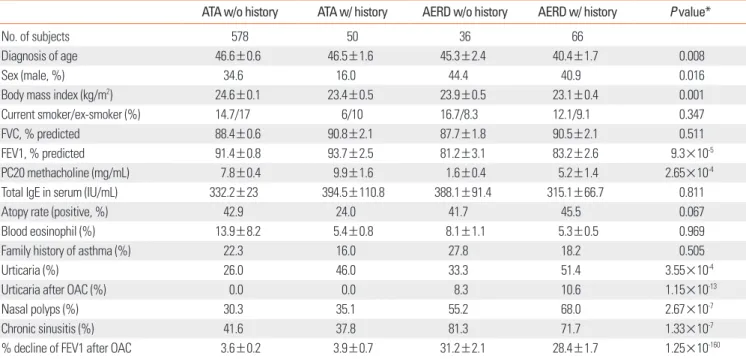
ATA groups and AERD groups with or without a history of aspi- rin hypersensitivity. As shown in Table 4, ATA subjects with a history of aspirin hypersensitivity had a higher female propor- tion, PC20 value, and FEV1% than those in the AERD group. In contrast, AERD subjects without a history of aspirin hypersen- sitivity showed lower FEV1% and PC20 values than did those in the other groups.
Additionally, we analyzed the clinical parameters related to AERD in asthmatic patients with or without a history of aspirin hypersensitivity using backward logistic regression analysis (Ta- ble 5). Among patients without a history of aspirin hypersensi- tivity, the ratio of individuals with chronic sinusitis was signifi- cantly higher in AERD patients than in ATA subjects (OR=4.95, P=0.0056). Furthermore, the logarithm of PC20 values for methacholine challenge was significantly lower in the AERD group than in the ATA group (OR=0.39, P=0.0016). In contrast, the ratio of patients with nasal polyposis was significantly high- er in AERD patients than in ATA patients without a history of aspirin hypersensitivity (OR=11.54, P=0.0019).
In the asthmatic patients without a history of aspirin hyper-
sensitivity, the sensitivity and specificity of the presence of chronic sinusitis to predict AERD were 81.3% and 58.4%, re- spectively (Table 6). The positive and negative predictive values were 11.5% and 97.9%, respectively. The overall accuracy of the test was 59.8%. When patients had a history of aspirin hyper- sensitivity, the sensitivity and specificity of the presence of na- sal polyposis to predict AERD were 68.0% and 64.9%, respec- tively. The positive and negative predictive values were 72.3%
and 60.0%, respectively. The overall accuracy of the test was 66.7% (Table 6).
Function for calculating relative risk score to predict AERD in asthmatic patients
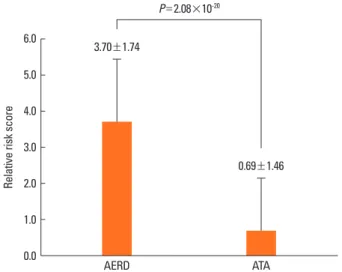
Using the beta value of each parameter, we calculated the rel- ative risk score for individual subjects as follows: Σ (beta for variables×dummy values of clinical parameter)=0.874×nasal polyp +3.174×history of aspirin hypersensitivity +1.453×si- nusitis +(-0.918)×log [PC20 methacholine]. The mean and standard deviation of this score were 3.70±1.74 and 0.69±1.46 in the AERD and ATA groups, respectively (t=12.91, df=71.84
Table 4. Comparisons of clinical parameters according to AERD status and history of aspirin hypersensitivity
ATA w/o history ATA w/ history AERD w/o history AERD w/ history P value*
No. of subjects 578 50 36 66
Diagnosis of age 46.6±0.6 46.5±1.6 45.3±2.4 40.4±1.7 0.008
Sex (male, %) 34.6 16.0 44.4 40.9 0.016
Body mass index (kg/m2) 24.6±0.1 23.4±0.5 23.9±0.5 23.1±0.4 0.001
Current smoker/ex-smoker (%) 14.7/17 6/10 16.7/8.3 12.1/9.1 0.347
FVC, % predicted 88.4±0.6 90.8±2.1 87.7±1.8 90.5±2.1 0.511
FEV1, % predicted 91.4±0.8 93.7±2.5 81.2±3.1 83.2±2.6 9.3×10⁻⁵
PC20 methacholine (mg/mL) 7.8±0.4 9.9±1.6 1.6±0.4 5.2±1.4 2.65×10⁻⁴
Total IgE in serum (IU/mL) 332.2±23 394.5±110.8 388.1±91.4 315.1±66.7 0.811
Atopy rate (positive, %) 42.9 24.0 41.7 45.5 0.067
Blood eosinophil (%) 13.9±8.2 5.4±0.8 8.1±1.1 5.3±0.5 0.969
Family history of asthma (%) 22.3 16.0 27.8 18.2 0.505
Urticaria (%) 26.0 46.0 33.3 51.4 3.55×10⁻⁴
Urticaria after OAC (%) 0.0 0.0 8.3 10.6 1.15×10⁻¹³
Nasal polyps (%) 30.3 35.1 55.2 68.0 2.67×10⁻⁷
Chronic sinusitis (%) 41.6 37.8 81.3 71.7 1.33×10⁻⁷
% decline of FEV1 after OAC 3.6±0.2 3.9±0.7 31.2±2.1 28.4±1.7 1.25×10-160
*The P values were obtained using χ2 test for discrete variables and one-way ANOVA for continuous variables.
AERD, aspirin-exacerbated respiratory disease; ATA, aspirin-tolerant asthma; FVC, forced vital capacity; FEV1, forced expiratory volume in 1 second; PC20 methacho- line, provocative concentration of methacholine that causes a 20% fall in the FEV1; OAC, oral aspirin challenge.
Table 5. Statistically significant parameters after backward logistic regression analysis for AERD according to the presence of history of aspirin hypersensitivity
Group Parameters Beta SE P value OR (95% CI)
History (-) Chronic sinusitis 1.600 0.578 0.0056 4.95 (1.60–15.38)
log [PC20] -0.932 0.295 0.0016 0.39 (0.22–0.70)
History (+) Nasal polyposis 2.446 0.787 0.0019 11.54 (2.47–53.95)
AERD, aspirin-exacerbated respiratory disease; SE, standard error; OR, odds ratio, CI, confidence interval.
and P=2.08×10⁻²⁰, Fig. 2). The ROC curve for the risk score showed an AUC of 0.9, which was the highest value among all combinations of parameters (Fig. 3).
Considering the difference and standard deviations, we de- fined a cut-off value for AERD prediction at 2.06. Then, we com- pared the ratio of AERD and ATA individuals showing risk scores above the cut-off value. As shown in Table 7, the ratio of subjects
showing a positive score was significantly higher in the AERD than that in the ATA group (OR: 16.62, P=2.19×10⁻²⁴). The sen- sitivity and specificity of the risk scores for AERD prediction were 0.787 and 0.818, respectively. The positive and negative predictive values were 0.369 and 0.966, respectively. The overall accuracy of the test was 0.814.
Table 7. Sensitivity and specificity of the relative risk score to predict AERD
Status Relative risk score
P value OR (95% CI)
<2.06 (negative) >2.06 (positive) Total
ATA 369 (81.8%) 82 (18.2%) 451 (100%) 2.19×10⁻²⁴ 16.62 (8.61–32.08)
AERD 13 (21.3%) 48 (78.7%) 61 (100%)
OR, odds ratio; CI, confidence interval; ATA, aspirin-tolerant asthma; AERD, aspirin-exacerbated respiratory disease.
Table 6. Sensitivity and specificity of the clinical parameters to predict AERD according to the presence of history of aspirin hypersensitivity
Group Parameter Status ATA AERD Total Diagnostic values
History (-) Chronic sinusitis (-) (+)
Total
282 (54.8%) 201 (39.0%)
483 (93.8%)
6 (1.2%) 26 (5.0%)
32 (6.2%)
288 (55.9%) 227 (44.1%)
515 (100%)
χ2=19.13, df=1, P value=1.21×10⁻⁵ Sensitivity=26/(6+26)=81.3%
Specificity=282/(282+201)=58.4%
+PV=26/(26+201)=11.5%
-PV=282/(282+6)=97.9%
Accuracy=(282+26)/515=59.8%
History (+) Nasal polyposis (-) (+)
Total
24 (27.6%) 13 (14.9%)
37 (42.5%)
16 (18.4%) 34 (39.1%)
50 (57.5%)
40 (46.0%) 47 (54.0%)
87 (100%)
χ2=9.25, df=1, P value=4.37×10⁻³ Sensitivity=34/(16+34)=68.0%
Specificity=24/(24+13)=64.9%
+PV=34/(13+34)=72.3%
-PV=24/(24+16)=60.0%
Accuracy=(24+34)/87=66.7%
ATA, aspirin-tolerant asthma; AERD, aspirin-exacerbated respiratory disease; +PV, positive predictive value; -PV, negative predictive value.
Fig. 2. The comparison of relative risk scores between aspirin-tolerant asthma (ATA) and aspirin-exacerbated respiratory disease (AERD). The relative risk scores were calculated using the following function: 0.874×nasal pol- yp+3.174×history of aspirin intolerance+1.453×sinusitis+(-0.918)×log [PC20 methacholine].
Relative risk score
3.70±1.74
AERD
P=2.08×10⁻²⁰
0.69±1.46
ATA 6.0
5.0 4.0 3.0 2.0 1.0 0.0
Sensitivity
1-Specificity
0.0 0.2 0.4 0.6 0.8 1.0
1.0
0.8
0.6
0.4
0.2
0.0
Relative risk score (AUC=0.880) Combination of
Nasal polyp+history+sinusitis (AUC=0.855) Nasal polyp+history (AUC=0.815) History+sinusitis (AUC=0.837) Nasal polyp+sinusitis (AUC=0.737)
Fig. 3. Receiver operating characteristic curve for relative risk score.
DISCUSSION
In the present study, we evaluated clinical parameters as diag- nostic tools to predict AERD. When clinical parameters were compared between the subjects with AERD and those with ATA, significant differences were found for eight parameters in- cluding age, BMI, FEV1%, PC20, urticaria, nasal polyps, chronic sinusitis, and history of aspirin hypersensitivity. A decline in FEV1 after aspirin provocation was not used as a covariate be- cause it is a determinant for AERD. To exclude the interactions among the factors, a logistic regression analysis using the con- ditional backward method was applied. Among the eight clini- cal parameters, the presence of nasal polyps, a history of aspi- rin hypersensitivity, chronic sinusitis, and log [PC20 methacho- line] remained significantly associated with AERD. Among these parameters, the most highly associated parameter was a histo- ry of aspirin hypersensitivity, followed by chronic sinusitis (OR=4.28), PC20 methacholine (OR=0.4), and nasal polyps (OR=2.4).
A history of aspirin hypersensitivity, chronic sinusitis, and na- sal polyps has been described as the most important pattern of clinical parameters since the initial definition of the aspirin tri- ad10 and AERD1. However, the presence of a positive clinical history varies widely across populations.6 Based on patients’
histories alone, the incidence of aspirin sensitivity in Caucasian adults with asthma is 3-5%, but this percentage doubles or tri- ples when adult asthmatic patients are prospectively challenged with aspirin.15-19 In an unselected Caucasian asthma population assessed by a meta-analysis, aspirin- and NSAID-induced hy- persensitivity was shown to be 2.7% by verbal history only, in contrast to the 21.1% shown by the oral provocation test. In a preselected population with a history of aspirin-induced asth- ma, the incidence of aspirin- and NSAID-induced hypersensi- tivity was shown to be 12.2% by verbal history only, in contrast to the 29.5% identified by oral provocation test.20 In the present study, 15.9% of the total population studied had a positive his- tory of aspirin hypersensitivity. In subjects having an aspirin hypersensitivity history (n=116), AERD was shown in 66 sub- jects (56.9%) by the OAC. These data indicated that the frequen- cy of a history of aspirin hypersensitivity was markedly higher in Korean asthmatic patients in the present study compared with Caucasians. One possible explanation for this observation is that the study subjects were all patients with asthma. Several reports suggest that the prevalence of aspirin hypersensitivity increases significantly in populations with nasal polyposis, si- nusitis, atopy, or asthma.15,19 Even in asthmatic patients, the prevalence of AERD is known to vary according to severity and subtype.21 Additionally, because the development and patho- physiology of AERD are considered to be dependent on genetic factors, the proportion of subjects with a history of AERD in a study population could be affected by genetic and racial differ- ences.
Interestingly, 43.1% of the subjects with an aspirin hypersen- sitivity history had a negative OAC test result. This relationship indicates a very high ratio of false positivity associated with a history of aspirin hypersensitivity. This finding prompted us to estimate the diagnostic values of these clinical parameters. We applied ROC curves to test the sensitivity and specificity for as- pirin hypersensitivity in asthmatic patients. Although the AUC of the four variables was statistically significant, the history of aspirin intolerance had the highest AUC value. Because the val- ue of PC20 methacholine is continuous, this parameter was not analyzed for diagnostic sensitivity and specificity.
A history of aspirin hypersensitivity has low diagnostic sensi- tivity for aspirin hypersensitivity but the highest value for diag- nostic specificity. Thus, the accuracy ratio was 88.2%. Interest- ingly, the positive predictive ratio was 56.9%. This result indi- cates that more than 40% of subjects with a history of aspirin hypersensitivity do not respond to aspirin challenge. The nega- tive predictive ratio was 94.1%. This finding indicates that more than 6% of subjects having no history of aspirin hypersensitivity positively respond to aspirin challenge. A European survey showed that 15% of provocation-test-proven AERD patients were entirely unaware that they had aspirin intolerance.6 Thus, the 6% negative predictive ratio from our results was lower than that found in European populations.
The presence of nasal polyps and chronic sinusitis showed lower positive and negative predictive values compared with a history of aspirin hypersensitivity. Thus, among the parameters we studied, a history of aspirin hypersensitivity showed the best accuracy ratio. However, there was still a 40% false-positive and a 6% false-negative rate when predictions were based on the presence of a history of aspirin hypersensitivity.
Although the FEV1 was significantly lower in AERD patients compared with ATA patients in the present study, the difference was not significant after logistic regression analysis. The hyper- reactive airway and low FEV1 associated with AERD may reflect the severity of asthma in subjects with AERD.2 A history of urti- caria was more frequently observed in AERD. However, after multiple regression analysis, the significant association with AERD disappeared. This result may reflect the effects of more strongly associated parameters including a history of aspirin in- tolerance, chronic sinusitis, nasal polyps, and PC20 methacho- line.
Comparisons between groups according to AERD status and AERD history (Table 4) showed that ATA subjects with a history of aspirin hypersensitivity had higher FEV1% values than did those in the AERD groups, which suggests that a subject with a lower FEV1% is more likely to have a positive response to the OAC test. In contrast, AERD subjects without a history showed lower PC20 and FEV1% values than those of the other groups, which suggests that a subject having airway hyperreactivity or reduced pulmonary function could be more susceptible to weak bronchospasms induced by the OAC test and therefore show a
positive OAC result. Thus, these observations suggest that bron- choconstriction induced by the OAC test may be partially de- pendent on basal FEV1% and PC20 values. We also found that chronic sinusitis could be an additional predictor of AERD in subjects without a history of aspirin intolerance, and on other hand, nasal polyposis could be an additional predictor in sub- jects with an history of aspirin hypersensitivity (Tables 5 and 6).
These results suggest that the absence of a history of a aspirin hypersensitivity and chronic sinusitis could be useful in pre- dicting negative results on an OAC test and that a history of as- pirin hypersensitivity and the presence of nasal polyposis could be helpful in identifying OAC-positive subjects.
To establish an integrating function to predict the results of OAC, we defined the relative risk score for AERD using the beta values obtained by logistic regression analysis for nasal polypo- sis, history of aspirin hypersensitivity, chronic sinusitis, and PC20 methacholine values (Figs. 2 and 3). The calculated risk score was very significantly higher in AERD patients compared with that in ATA patients, and the AUC of the score was 0.9 for each parameter. Furthermore, the sensitivity, specificity, and accuracy of the risk score for AERD prediction were 0.787, 0.818, and 0.814, respectively. These results suggest that a combina- tion of parameters could be useful for predicting results of the OAC test. However, false-positive and -negative values were rel- atively high, at 0.16 and 0.025, respectively. Although this ob- servation means that a combination of parameters is hard to apply to the prediction of AERD in clinical practice, the analysis of these parameters can provide basic information for develop- ing non-invasive methods to diagnose AERD.
Several studies have aimed to develop non-invasive methods for easier diagnosis of AERD. In peripheral blood, flow-cyto- metric determination of basophil activation has been proposed for in vitro diagnosis of NSAID hypersensitivity syndrome.22 Ga- lectin -10 mRNA23 and plasma eotaxin 224 have been shown to be elevated in subjects with AERD compared with those with ATA. Several proteomic candidates have been found to be asso- ciated with an increased risk of AERD.25 Urine leukotriene E4 and 9alpha 11beta in exhaled breath condensate showed a high sensitivity and specificity for discriminating between the two groups.26 Many genetic variants in the arachidonate pathway27-30 and immune and inflammatory pathways14,31,32 seem to be in- volved in the development of AERD. However, future studies must determine whether these biomarkers are superior to clin- ical parameters such as history of aspirin hypersensitivity.
In summary, we evaluated the diagnostic value of clinical pa- rameters including the well known manifestation of aspirin hy- persensitivity history, nasal polyposis, and chronic sinusitis to predict AERD in asthmatic patients. Among these parameters, a history of aspirin hypersensitivity has the best positive and negative predictive values for forecasting the outcome of the positive aspirin challenge test, demonstrating an overall accu- racy of 88.2%. However, false-positive and -negative rates were
still high. Thus, additional non-invasive methods are needed to reduce the errors in the use of these parameters as diagnostic tools.
REFERENCES
1. Stevenson DD, Sanchez-Borges M, Szczeklik A. Classification of al- lergic and pseudoallergic reactions to drugs that inhibit cyclooxy- genase enzymes. Ann Allergy Asthma Immunol 2001;87:177-80.
2. Mascia K, Haselkorn T, Deniz YM, Miller DP, Bleecker ER, Borish L.
Aspirin sensitivity and severity of asthma: evidence for irreversible airway obstruction in patients with severe or difficult-to-treat asth- ma. J Allergy Clin Immunol 2005;116:970-5.
3. Marquette CH, Saulnier F, Leroy O, Wallaert B, Chopin C, Demarcq JM, Durocher A, Tonnel AB. Long-term prognosis of near-fatal asthma. A 6-year follow-up study of 145 asthmatic patients who underwent mechanical ventilation for a near-fatal attack of asthma.
Am Rev Respir Dis 1992;146:76-81.
4. Picado C, Castillo JA, Montserrat JM, Agusti-Vidal A. Aspirin-intol- erance as a precipitating factor of life-threatening attacks of asth- ma requiring mechanical ventilation. Eur Respir J 1989;2:127-9.
5. Gollapudi RR, Teirstein PS, Stevenson DD, Simon RA. Aspirin sen- sitivity: implications for patients with coronary artery disease. JAMA 2004;292:3017-23.
6. Szczeklik A, Nizankowska E, Duplaga M. Natural history of aspirin- induced asthma. AIANE Investigators. European Network on Aspi- rin-Induced Asthma. Eur Respir J 2000;16:432-6.
7. Babu KS, Salvi SS. Aspirin and asthma. Chest 2000;118:1470-6.
8. Szczeklik A, Stevenson DD. Aspirin-induced asthma: advances in pathogenesis, diagnosis, and management. J Allergy Clin Immunol 2003;111:913-21.
9. Fahrenholz JM. Natural history and clinical features of aspirin-ex- acerbated respiratory disease. Clin Rev Allergy Immunol 2003;24:
113-24.
10. Samter M, Beers RF Jr. Concerning the nature of intolerance to as- pirin. J Allergy 1967;40:281-93.
11. Szczeklik A, Nizankowska E. Clinical features and diagnosis of as- pirin induced asthma. Thorax 2000;55 Suppl 2:S42-4.
12. Global Initiative for Asthma. Global strategy for asthma manage- ment and prevention. NHLBI/WHO workshop report. Bethesda:
National Institutes of Health; 1995.
13. Nizankowska-Mogilnicka E, Bochenek G, Mastalerz L, Swierczyn@ska M, Picado C, Scadding G, Kowalski ML, Setkowicz M, Ring J, Brock- ow K, Bachert C, Wohrl S, Dahlén B, Szczeklik A. EAACI/GA2LEN guideline: aspirin provocation tests for diagnosis of aspirin hyper- sensitivity. Allergy 2007;62:1111-8.
14. Kim BS, Park SM, Uhm TG, Kang JH, Park JS, Jang AS, Uh ST, Kim MK, Choi IS, Cho SH, Hong CS, Lee YW, Lee JY, Choi BW, Park HS, Park BL, Shin HD, Chung IY, Park CS. Effect of single nucleotide polymorphisms within the interleukin-4 promoter on aspirin in- tolerance in asthmatics and interleukin-4 promoter activity. Phar- macogenet Genomics 2010;20:748-58.
15. Hedman J, Kaprio J, Poussa T, Nieminen MM. Prevalence of asth- ma, aspirin intolerance, nasal polyposis and chronic obstructive pulmonary disease in a population-based study. Int J Epidemiol 1999;28:717-22.
16. Kalyoncu AF, Karakaya G, Sahin AA, Bariş YI. Occurrence of aller- gic conditions in asthmatics with analgesic intolerance. Allergy
1999;54:428-35.
17. Settipane GA, Chafee FH, Klein DE. Aspirin intolerance. II. A pro- spective study in an atopic and normal population. J Allergy Clin Immunol 1974;53:200-4.
18. Stevenson DD. Diagnosis, prevention, and treatment of adverse re- actions to aspirin and nonsteroidal anti-inflammatory drugs. J Al- lergy Clin Immunol 1984;74:617-22.
19. Vally H, Taylor ML, Thompson PJ. The prevalence of aspirin intol- erant asthma (AIA) in Australian asthmatic patients. Thorax 2002;
57:569-74.
20. Jenkins C, Costello J, Hodge L. Systematic review of prevalence of aspirin induced asthma and its implications for clinical practice.
BMJ 2004;328:434.
21. Settipane RA, Stevenson DD. Cross sensitivity with acetamino- phen in aspirin-sensitive subjects with asthma. J Allergy Clin Im- munol 1989;84:26-33.
22. De Weck AL, Sanz ML, Gamboa PM, Jermann JM, Kowalski M, Medrala W, Sainte-Laudy J, Schneider MS, Weber JM, Wolanczyk- Medrala A. Nonsteroidal anti-inflammatory drug hypersensitivity syndrome: a multicenter study. II. Basophil activation by nonste- roidal anti-inflammatory drugs and its impact on pathogenesis. J Investig Allergol Clin Immunol 2010;20:39-57.
23. Devouassoux G, Pachot A, Laforest L, Diasparra J, Freymond N, Van Ganse E, Mougin B, Pacheco Y. Galectin-10 mRNA is overex- pressed in peripheral blood of aspirin-induced asthma. Allergy 2008;63:125-31.
24. Min JW, Jang AS, Park SM, Lee SH, Lee JH, Park SW, Park CS. Com- parison of plasma eotaxin family level in aspirin-induced and aspi- rin-tolerant asthma patients. Chest 2005;128:3127-32.
25. Lee SH, Rhim T, Choi YS, Min JW, Kim SH, Cho SY, Paik YK, Park CS.
Complement C3a and C4a increased in plasma of patients with as- pirin-induced asthma. Am J Respir Crit Care Med 2006;173:370-8.
26. Sanak M, Kielbasa B, Bochenek G, Szczeklik A. Exhaled eicosanoids following oral aspirin challenge in asthmatic patients. Clin Exp Al- lergy 2004;34:1899-904.
27. Choi JH, Park HS, Oh HB, Lee JH, Suh YJ, Park CS, Shin HD. Leu- kotriene-related gene polymorphisms in ASA-intolerant asthma:
an association with a haplotype of 5-lipoxygenase. Hum Genet 2004;114:337-44.
28. Kim SH, Choi JH, Park HS, Holloway JW, Lee SK, Park CS, Shin HD.
Association of thromboxane A2 receptor gene polymorphism with the phenotype of acetyl salicylic acid-intolerant asthma. Clin Exp Allergy 2005;35:585-90.
29. Park BL, Park SM, Park JS, Uh ST, Choi JS, Kim YH, Kim MK, Choi IS, Choi BW, Cho SH, Hong CS, Lee YW, Lee JY, Park CS, Shin HD.
Association of PTGER gene family polymorphisms with aspirin in- tolerant asthma in Korean asthmatics. BMB Rep 2010;43:445-9.
30. Park JS, Chang HS, Park CS, Lee JH, Lee YM, Choi JH, Park HS, Kim LH, Park BL, Choi YH, Shin HD. Association analysis of cysteinyl- leukotriene receptor 2 (CYSLTR2) polymorphisms with aspirin in- tolerance in asthmatics. Pharmacogenet Genomics 2005;15:483-92.
31. Kim TH, Chang HS, Park SM, Nam BY, Park JS, Rhim T, Park HS, Kim MK, Choi IS, Cho SH, Chung IY, Park BL, Park CS, Shin HD. Associa- tion of angiotensin I-converting enzyme gene polymorphisms with aspirin intolerance in asthmatics. Clin Exp Allergy 2008;38:1727-37.
32. Oh SH, Park SM, Park JS, Jang AS, Lee YM, Uh ST, Kim YH, Choi IS, Kim MK, Park BL, Shin HD, Park CS. Association analysis of per- oxisome proliferator-activated receptors gamma gene polymor- phisms with asprin hypersensitivity in asthmatics. Allergy Asthma Immunol Res 2009;1:30-5.