| Abstract |
4)PURPOSE: The respiratory function and range of joint mobility deteriorate due to aging, respectively, and the respiratory function may be related to the range of joint mobility. To the best of the authors’ knowledge, there has been little research on how the deterioration of the range of joint mobility caused by aging is related directly to the respiratory function. This study investigated the relationship between the respiratory function and the range of joint motion in the cervical and lumbar regions of older adults.
METHODS: Thirty-two older adults participated in the study. The forced vital capacity (peak expiratory flow: PEF and forced expiratory volume in 1 second: FEV1) and the range of cervical joint motion were assessed in all subjects.
The results were analyzed using the Pearson`s correlation coefficient.
†Corresponding Author : Young-In Hwang
[email protected], https://orcid.org/0000-0002-7314-1678 This is an Open Access article distributed under the terms of the Creative Commons Attribution Non-Commercial License (http://creativecommons.org/licenses/by-nc/3.0) which permits unrestricted non-commercial use, distribution, and reproduction in any medium, provided the original work is properly cited.
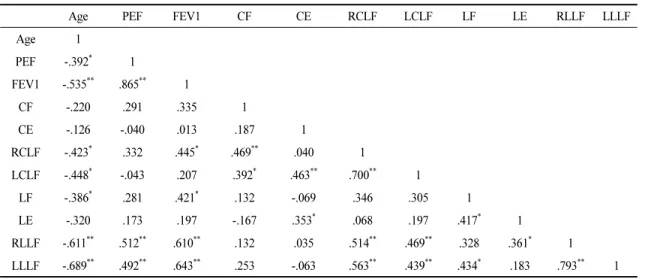
RESULTS: The respiratory function moderately correlated with age. A moderate correlation was observed between FEV1 and right cervical lateral flexion. PEF was moderately correlated with the lumbar lateral flexion. In addition, FEV1 correlated strongly with lumbar lateral flexion.
CONCLUSION: The respiratory function was correlated with the cervical and lumbar lateral flexion. Therefore, rehabilitation of the respiratory function should involve improving the limited range of motion of the joints, and a stretching program is needed for older adults.
Key Words: Elderly, Range of motion, Respiration
Ⅰ. Introduction
The respiratory function in elderly adults decreases gradually as aging progresses. With age, increased ventilator demand is accompanied by increased oxygen cost during breathing, weakness of ventilator muscles, and dyspnea, which can be a significant constraint [1,2]. In addition, the potential consequences are accompanied by a decrease in muscle strength of the respiratory muscles and an increased resistance to ventilation, leading to a decrease in the peak respiratory forces and peak effort of
Research Article Open Access
Correlations between the Respiratory Function and Cervical and Lumbar Range of Motion in Elderly People
Du-Jin Park, PT, PhD⋅Jun-Seok Kim, PT, PhD
1⋅Young-In Hwang, PT, PhD
2†Department of Physical Therapy, College of Health Sciences, Catholic University of Pusan,
1
Department of Physical Therapy, College of Biomedical Science, Kaya University,
2