• 검색 결과가 없습니다.

Intraoperative Balloon Angioplasty Using Fogarty Artertial Embolectomy Balloon Catheter for Creation of Arteriovenous Fistula for Hemodialysis: Single Center Experience

N/A
N/A
Protected

Academic year: 2021

Share "Intraoperative Balloon Angioplasty Using Fogarty Artertial Embolectomy Balloon Catheter for Creation of Arteriovenous Fistula for Hemodialysis: Single Center Experience"

Copied!
6
0
0

로드 중.... (전체 텍스트 보기)

전체 글

(1)

ISSN: 2233-601X (Print) ISSN: 2093-6516 (Online)

Department of Thoracic and Cardiovascular Surgery, Busan Paik Hospital, Inje University College of Medicine Received: August 5, 2014, Revised: November 7, 2014, Accepted: November 18, 2014, Published online: April 5, 2015

Corresponding author: Young Chul Yoon, Department of Thoracic and Cardiovascular Surgery, Busan Paik Hospital, Inje University College of Medicine, 75 Bokji-ro, Busanjin-gu, Busan 614-735, Korea

(Tel) 82-51-890-6834 (Fax) 82-51-891-1297 (E-mail) [email protected]

C

The Korean Society for Thoracic and Cardiovascular Surgery. 2015. All right reserved.

CC

This is an open access article distributed under the terms of the Creative Commons Attribution Non-Commercial License (http://creative- commons.org/licenses/by-nc/3.0) which permits unrestricted non-commercial use, distribution, and reproduction in any medium, provided the original work is properly cited.

Intraoperative Balloon Angioplasty Using Fogarty Artertial Embolectomy Balloon Catheter for Creation of Arteriovenous

Fistula for Hemodialysis: Single Center Experience

Moran Jin, M.D., Young Chul Yoon, M.D., Jin Hong Wi, M.D., Yang-Haeng Lee, M.D., Il-Yong Han, M.D., Kyung-Taek Park, M.D.

Background: The purpose of this study was to evaluate the use of a Fogarty arterial embolectomy catheter (Fogarty catheter) in intraoperative balloon angioplasty of the cephalic vein, in order to determine its effect on the patency of arteriovenous fistulas (AVFs) created for hemodialysis access. Methods: A total of 156 patients who un- derwent creation of an AVF were divided into two groups, based whether a Fogarty catheter was used during AVF creation. Group A (89 patients) comprised the patients who underwent balloon angioplasty with a Fogarty catheter during the operation. Group B (67 patients) included the patients in whom a Fogarty catheter was not used during the operation. Patient records were reviewed retrospectively and documented. The patency rate was de- termined by the Kaplan-Meier method. Results: The records of 156 patients who underwent the creation of an AVF from January 2007 to October 2011 were included. The mean follow-up duration was 40.2±19.4 months (range, 1 to 97 months). The patency rates in group A at 12, 36, and 72 months were 83.9%±3.9%, 78.3%±4.6%, and 76.3%±4.9%, respectively, while the corresponding patency rates in group B were 92.5%±3.2%, 82.8%±0.5%, and 79.9%±5.7%, respectively. The patency rates in group B were found to be slightly higher than those in group A, but the difference was not statistically significant (p=0.356). Conclusion: Intraoperative balloon angioplasty of the cephalic vein using the Fogarty catheter is a simple and easily reproducible procedure, and it can be helpful in in- creasing AVF patency in cases of insufficient runoff or a suboptimal cephalic vein.

Key words: 1. Arteriovenous fistula 2. Balloon angioplasty 3. Renal dialysis 4. Vascular patency 5. Geriatric

INTRODUCTION

Autogenous arteriovenous fistula (AVF) for hemodialysis has appeared to be better to prosthetic graft or catheter access in patient morbidity and mortality. Moreover, the maintenance

of autogenous AVF is less expensive than that of a prosthetic conduit [1,2]. However, the creation of an AVF is not always possible in patients with an insufficient cephalic vein. More- over, cephalic veins with diameters <2.5 mm have been re- ported to increase the immediate failure rate and to decrease

http://dx.doi.org/10.5090/kjtcs.2015.48.2.120

(2)

Fig. 1. Fogarty Arterial Embolectomy Catheter (Edwards Laborato- ries, Santa Ana, CA, USA).

the primary patency rate [3]. Nonetheless, promising results have recently been reported regarding several surgical proce- dures that have been employed in cases where the cephalic vein is insufficient [3-5]. The purpose of this study was to assess how the use of a Fogarty arterial embolectomy catheter (Fogarty catheter) in intraoperative balloon angioplasty affects the primary patency rate of autogenous AVFs (Fig. 1).

METHODS 1) Patients

Of the 368 patients who underwent AVF creation in the Department of Thoracic and Cardiovascular Surgery at Busan Paik Hospital from January 2007 to October 2011, we in- cluded 156 patients who subsequently came to the Department of Internal Medicine for follow-up visits and hemodialysis.

We excluded 212 patients who were dialyzed at other hospi- tal after the operation.

The 156 patients who were included in the study were div- ided into two groups, based on whether a Fogarty catheter was used during AVF creation. A Fogarty catheter (3Fr or 4Fr; Edwards Laboratories, Santa Ana, CA, USA) was used for angioplasty during the operation if the 2.5-mm coronary dilator could not be easily passed into the cephalic vein, suf- ficient backflow could not be confirmed after venotomy, or if we could not confirm the presence of the thrill after AVF creation. Such cases were included in group A (n=89). The other cases, in which we did not use a Fogarty catheter, were included in group B (n=67). The records of patients included

in this study were retrospectively reviewed until June 2014.

The mean follow-up duration was 40.2±19.4 months (range, 1 to 97 months). We collected and documented demographic data including age, gender, body mass index, and co-morbid- ities such as diabetes, hypertension, tobacco use, cerebral in- farction, coronary artery disease, and peripheral arterial ob- structive disease.

2) Surgical technique

Preoperatively, each patient was clinically assessed using standard methods, including the Allen test for arterial com- petency, and by placing a tourniquet on the upper arm while the patient clenched and released the hand several times in or- der to examine the superficial veins under visual enhancement.

If venous patency in the forearm was satisfactory, a radio- cephalic arteriovenous fistula (RCAVF) was created. Other- wise, a brachiocephalic AVF was created. If there was a pos- sibility of stenosis or obstruction in the subclavian vein, the patient underwent upper extremity venous Doppler ultra- sonography or conventional venography before surgery. Five patients underwent AVF creation using the basilic vein due to stenotic occlusion of the cephalic vein. All surgical proce- dures were performed by a single surgeon.

(1) Radiocephalic arteriovenous fistula: A 2-cm longi- tudinal incision was made after injecting the wrist with 2%

lidocaine. The radial artery and the cephalic vein were

dissected. Subsequently, arteriotomy and venotomy were per-

formed after clamping the cephalic vein and radial artery us-

ing a bulldog vascular clamp. The proximal venous runoff in

the cephalic vein was examined through the venotomy using

a 2.5-mm coronary dilator. In cases where the coronary dila-

tor could not be passed easily or backflow in the cephalic

vein was insufficient, balloon dilatation of the cephalic vein

was performed using a Fogarty catheter. A side-to-side anas-

tomosis was performed using a 7-0 prolene suture. After con-

tinuous suturing, the cephalic vein was checked for the pres-

ence of the thrill, and the anastomosis was checked for bleed-

ing and stenosis. The distal cephalic vein was then ligated and

divided. If the thrill could not be confirmed after declamping

the cephalic vein, balloon dilatation of the cephalic vein was

performed using a Fogarty catheter inserted into the distal

opening of the cephalic vein after reclamping the radial artery.

(3)

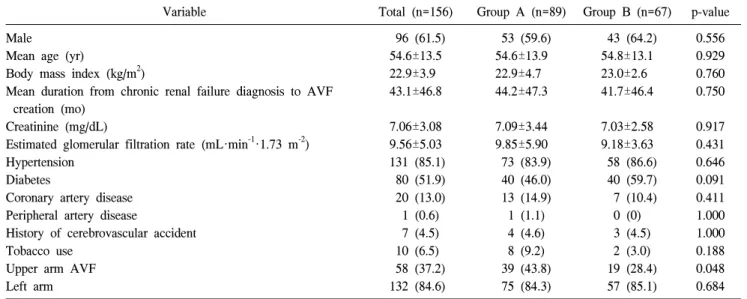
Table 1. Baseline demographic and AVF characteristics

Variable Total (n=156) Group A (n=89) Group B (n=67) p-value

Male 96 (61.5) 53 (59.6) 43 (64.2) 0.556

Mean age (yr) 54.6±13.5 54.6±13.9 54.8±13.1 0.929

Body mass index (kg/m

2

) 22.9±3.9 22.9±4.7 23.0±2.6 0.760

Mean duration from chronic renal failure diagnosis to AVF creation (mo)

43.1±46.8 44.2±47.3 41.7±46.4 0.750

Creatinine (mg/dL) 7.06±3.08 7.09±3.44 7.03±2.58 0.917

Estimated glomerular filtration rate (mL·min

-1

·1.73 m

-2

) 9.56±5.03 9.85±5.90 9.18±3.63 0.431

Hypertension 131 (85.1) 73 (83.9) 58 (86.6) 0.646

Diabetes 80 (51.9) 40 (46.0) 40 (59.7) 0.091

Coronary artery disease 20 (13.0) 13 (14.9) 7 (10.4) 0.411

Peripheral artery disease 1 (0.6) 1 (1.1) 0 (0) 1.000

History of cerebrovascular accident 7 (4.5) 4 (4.6) 3 (4.5) 1.000

Tobacco use 10 (6.5) 8 (9.2) 2 (3.0) 0.188

Upper arm AVF 58 (37.2) 39 (43.8) 19 (28.4) 0.048

Left arm 132 (84.6) 75 (84.3) 57 (85.1) 0.684

Continuous data are shown as mean±standard deviation or median (range) and categorical data as number (%).

AVF, autogenous arteriovenous fistula.

(2) Brachiocephalic arteriovenous fistula: A 3-cm trans- verse incision was made after injecting the antecubital fossa with 2% lidocaine. The brachial artery and the cephalic vein were dissected. Arteriotomy and venotomy were performed after clamping the cephalic vein and the brachial artery using a bulldog vascular clamp. The patency of the cephalic vein was then checked using a coronary dilator. Except for the side-to-end anastomosis, the other procedures were the same as those in the RCAVF procedure.

3) Statistical analysis

In order to analyze the characteristics of the two groups, continuous variables were compared using the t-test, and cate- gorical variables were compared using the chi-square test or the Fisher’s exact test. Patency rate curves were estimated with the Kaplan-Meier method. Differences between curves were compared using the log-rank test. In all of the statistical tests, statistical significance was defined as a two-tailed p-val- ue <0.05. Statistical analysis was performed with IBM SPSS ver. 20.0 (IBM Co., Armonk, NY, USA). All of the results in this study are expressed as mean±standard deviation.

RESULTS

This study included 156 out of 368 possible patients. Of the patients who were included, 89 (57%) were included in group A (use of a Fogarty catheter), and 67 (43%) were in- cluded in group B (non-use of a Fogarty catheter).

A total of 156 AVFs were created in the forearm, and 98

AVFs were created in the upper arm. The mean patient age

was 54.6±13.5 years and 61.5% were males. No significant

differences were observed between the two groups with re-

gard to gender, age, body mass index, mean duration from

chronic renal failure diagnosis to AVF creation, creatinine

levels, estimated glomerular filtration rate, hypertension, coro-

nary artery disease, peripheral artery disease, and history of

cerebrovascular accidents. The prevalence of diabetes was

slightly higher in group B, and tobacco use was slightly high-

er in group A. However, these differences were not statisti-

cally significant (diabetes: 46.0% in group A vs. 59.7% in

group B, p=0.091; tobacco use: 9.2% in group A vs. 3.0% in

group B, p=0.188). There was a statistically significant differ-

ence between the two groups regarding the number of upper

arm AVFs. Upper arm AVFs were more common in group A

(43.8% in group A vs. 28.4% in group B, p=0.048). The pa-

tient characteristics are summarized in Table 1. Primary pa-

(4)

Fig. 2. Kaplan-Meier survival curves for patency.

Table 2. Causes of fistula failure

Cause Total Group A Group B p-value Thrombotic occlusion 28 (79) 17 (85) 11 (72) 0.99 Venous hypertension 3 (9) 0 3 (21) 0.08

Poor function 2 (6) 2 (10) 0 0.16

Recurrent cellulitis 1 (3) 0 1 (7) 0.32 Cephalic vein stenosis 1 (3) 1 (5) 0 0.32

Total 35 (100) 20 (100) 14 (100)

Values are presented as number (%).

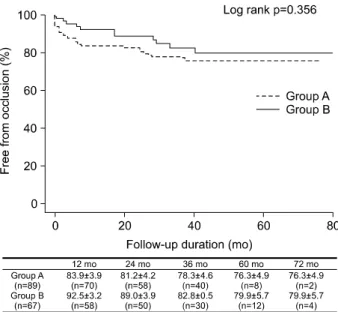
tency (intervention-free access survival) was defined as the interval from the time of access placement to the time of fis- tula failure. The patency rates at 12, 36, and 72 months in group A were 83.9%±3.9%, 78.3%±4.6%, and 76.3%±4.9%, respectively, and the corresponding rates in group B were 92.5%±3.2%, 82.8%±0.5%, and 79.9%±5.7%, respectively.

The patency rates in group B were found to be slightly high- er than those in group A, but the difference was not statisti- cally significant (p=0.356) (Fig. 2).

Fistula failure was defined as the presence of conditions preventing dialysis from being performed, such as thrombotic occlusion, venous hypertension, poor function of the fistula, recurrent cellulitis, and cephalic vein stenosis. Fistula failure occurred in 35 patients during the follow-up period. The causes of fistula failure were thrombotic occlusion (28 pa- tients total; 17 patients in group A vs. 11 patients in group B, p=0.99), ligation due to venous hypertension (3 patients in group B, p=0.08), poor function (2 patients in group A, p=0.16), recurrent cellulitis (1 patient in group B, p=0.32), and cephalic vein stenosis (1 patient in group A, p=0.32).

There were no statistically significant differences between the two groups with regard to fistula failure (Table 2). Among the cases of fistula failure, 10 cases (28.5%) showed early fistula failure (<1 month), and no complications related to using a Fogarty catheter occurred.

DISCUSSION

The National Kidney Foundation’s Kidney Disease Outcomes Quality Initiative and the FistulaFirst initiative have emphasized the importance of dialysis using native AVFs. In October 1997, the National Kidney Foundation’s Kidney Disease Outcomes Quality Initiative clinical practice guide- lines for vascular access were published, dealing with AVF placement techniques and prolonging the use of existing accesses. These guidelines recommended that when possible, autogenous AV accesses should be considered before the placement of prosthetic arteriovenous accesses [1,2]. Vascular access is achieved by an AVF, patients requiring fewer pro- cedures, suffer fewer complications, have better survival rates and pay lower costs during renal replacement therapy [1,4].

Although autogenous AVFs are considered the gold standard, it has been reported that one-year patency rates may vary from 36% to 62.5% [4,6-10]. Moreover, using smaller veins for AVFs has been shown to result in an increased number of fistula revisions and an increased rate of fistula failure [5].

Moreover, Dageforde et al. [11] have reported that AVFs cre- ated in veins with smaller minimal vein diameters have worse secondary patency. In their study, the 24-month patency rate in veins <0.28 mm in diameter was found to be only 32%

(p=0.018).

De Marco Garcia et al. and Veroux et al. [3,5] reported

that primary balloon angioplasty and balloon-assisted angio-

plasty are successful methods for increasing the patency and

maturation rate in suboptimal veins (≤2 mm in diameter)

used for AVF creation. De Marco Garcia et al. [5] reported

that the process of focal angioplasty injury to the venous en-

dothelium, along with the subsequent healing process seen af-

(5)

ter primary balloon angioplasty and balloon-assisted matura- tion, helps the venous wall reorganize into a fibrous conduit.

Veroux et al. [3] reported that they performed ballooning of the longer segment of the cephalic vein from the wrist to the elbow before AVF creation. This resulted in a well-function- ing AVF even in patients with a very small cephalic vein (≤

2 mm in diameter). Moreover, the use of this technique al- lowed them to achieve a low-resistance venous outflow, which was associated with excellent six-month primary pa- tency and working AVF rates (95% and 100%, respectively).

They also reported that dilatation of the longer segment of the cephalic vein at the time of AVF creation is highly effec- tive, avoiding the need for multiple late percutaneous trans- luminal angioplasties. The key factor affecting the patency of the AVF was high-resistance venous outflow.

In addition, Lee et al. [12] reported that in case of the ad- equate blood flow was established with the RCAVF, hemody- namic factors played a important role in vein wall remodeling on the dialysis site [12]. Therefore, they presented the hy- pothesis that the hemodynamic conditions in the draining vein could be affected in stenosed or occluded upper arm cephalic vein of RCAVF. They reported that in case of the draining venous flow was not sufficient, maturation failure developed more frequently, the rates of both primary patency and secon- dary patency were significantly poor, more endovascular in- terventions were needed [12].

Primary balloon angioplasty and balloon-assisted maturation show good results, but these procedures require a long skin incision, a hybrid procedure, heparin injection for balloon di- latation, the use of contrast enhancers, and radiation exposure.

However, intraoperative balloon angioplasty with a Fogarty catheter allows the creation of AVF with suboptimal veins or despite insufficient runoff in the cephalic vein, and increases the patency and functional maturation of AVF without requir- ing additional procedures. In this study, the seven-year AVF patency rate in patients who underwent angioplasty using a Fogarty catheter because of an insufficient cephalic vein was somewhat better (76.3%±4.9%) than the rates reported in oth- er studies [9,10,13,14]. Our results appear comparable to pa- tency rates in patients with sufficient cephalic veins who did not undergo angioplasty (p=0.356).

We suggest that our procedure has the effect of reducing

the flow resistance and widening the stenosis in the more proximal vein by balloon dilatation. The strength of our tech- nique is that it is easily reproducible, inexpensive, and avoids the need for multiple angiograms and a long skin incision.

A significant difference was found between the two groups regarding the number of upper arm AVFs. According to ex- tant guidelines, if the cephalic vein is sufficient to create an AVF, the surgeon should consider creating a forearm AVF [1]. Otherwise, the surgeon could consider creating an upper arm AVF. Hence, the creation of upper arm AVFs was more likely in patients with an insufficient cephalic vein. Therefore, we performed angioplasty using a Fogarty catheter more fre- quently when creating upper arm AVFs than when creating forearm AVFs, which explains why upper arm AVFs were more common in group A.

However, we acknowledge that our study has a number of limitations. This study was a retrospective review based on available patient information, and the results were dependent on the availability and accuracy of the information. Our re- cords show the occurrence of limited and inadequate fol- low-up in patients who needed permanent dialysis access. Our sample size was limited, since only patients with adequate follow-up were included in the analysis. We propose that a prospective randomized control study is needed to confirm the efficacy of our procedure.

In conclusion, intraoperative balloon angioplasty of the cephalic vein using a Fogarty catheter is a simple and easily reproducible procedure, which can be helpful in increasing the patency of AVFs in cases of insufficient runoff or a sub- optimal cephalic vein. This procedure has additional advan- tages, such as not requiring the use of nephrotoxic contrast enhancers, exposure to radiation, or a long skin incision.

However, the efficacy of this procedure should be confirmed by performing further studies.

CONFLICT OF INTEREST

No potential conflict of interest relevant to this article was

reported.

(6)

ACKNOWLEDGMENTS

This study was supported by a Grant of the Samsung Vein Clinic Network (Daejeon, Anyang, Cheongju, Cheonan; Fund No. KTCS04-023).

REFERENCES

1. Sidawy AN, Spergel LM, Besarab A, et al. The Society for Vascular Surgery: clinical practice guidelines for the surgi- cal placement and maintenance of arteriovenous hemodial- ysis access. J Vasc Surg 2008;48(5 Suppl):2S-25S.

2. National Kidney Foundation. Guidelines and commentaries [Internet]. New York (NY): National Kidney Foundation [cited 2011 Dec 9]. Available from: http://www.kidne- y.org/professionals/KDOQI/guidelines.cfm.

3. Veroux P, Giaquinta A, Tallarita T, et al. Primary balloon angioplasty of small (2 mm) cephalic veins improves pri- mary patency of arteriovenous fistulae and decreases re- intervention rates. J Vasc Surg 2013;57:131-6.

4. Jennings WC, Kindred MG, Broughan TA. Creating radio- cephalic arteriovenous fistulas: technical and functional success. J Am Coll Surg 2009;208:419-25.

5. De Marco Garcia LP, Davila-Santini LR, Feng Q, Calderin J, Krishnasastry KV, Panetta TF. Primary balloon angio- plasty plus balloon angioplasty maturation to upgrade small-caliber veins (3 mm) for arteriovenous fistulas. J Vasc Surg 2010;52:139-44.

6. Lauvao LS, Ihnat DM, Goshima KR, Chavez L, Gruessner AC, Mills JL Sr. Vein diameter is the major predictor of fis-

tula maturation. J Vasc Surg 2009;49:1499-504.

7. Lazarides MK, Georgiadis GS, Antoniou GA, Staramos DN.

A meta-analysis of dialysis access outcome in elderly patients. J Vasc Surg 2007;45:420-426.

8. Renaud CJ, Pei JH, Lee EJ, Robless PA, Vathsala A.

Comparative outcomes of primary autogenous fistulas in eld- erly, multiethnic Asian hemodialysis patients. J Vasc Surg 2012;56:433-9.

9. Ravani P, Palmer SC, Oliver MJ, et al. Associations between hemodialysis access type and clinical outcomes: a systematic review. J Am Soc Nephrol 2013;24:465-73.

10. Zhang JC, Al-Jaishi AA, Na Y, de Sa E, Moist LM.

Association between vascular access type and patient mortal- ity among elderly patients on hemodialysis in Canada.

Hemodial Int 2014;18:616-24.

11. Dageforde LA, Harms K, Feurer ID, Wright A, Shaffer D.

Pre-operative vein mapping predicts failure of arteriovenous fistula maturation and long-term patency. J Am Coll Surg 2013;217:S157.

12. Lee JH, Won JH, Oh CK, Jung HA. Clinical significance of upper-arm cephalic vein patency in autogenous radial-cepha- lic wrist fistulas for hemodialysis. Eur J Vasc Endovasc Surg 2012;44:514-20.

13. Huijbregts HJ, Bots ML, Wittens CH, et al. Hemodialysis arteriovenous fistula patency revisited: results of a pro- spective, multicenter initiative. Clin J Am Soc Nephrol 2008;

3:714-9.

14. Kotoda A, Akimoto T, Sugase T, Miyamoto N, Kusano E.

Balloon-assisted creation and maturation of an arteriovenous

fistula in a patient with small-caliber vasculature. Case Rep

Nephrol Urol 2012;2:65-71.

수치

Fig. 1. Fogarty Arterial Embolectomy Catheter (Edwards Laborato- Laborato-ries, Santa Ana, CA, USA).
Table 1. Baseline demographic and AVF characteristics
Fig. 2. Kaplan-Meier survival curves for patency.

참조

관련 문서

GDP impact of COVID-19 spread, public health response, and economic policies. Virus spread and public

1 John Owen, Justification by Faith Alone, in The Works of John Owen, ed. John Bolt, trans. Scott Clark, "Do This and Live: Christ's Active Obedience as the

In this study, the different codes were compared and analyzed for the research on decontamination and decommissioning waste generation by using the codes

Micro- and nano-sized pores were formed on the surface of the alloy using PEO and anodization methods, and the pore shape change according to the Zr

Thermal balloon ablation versus endometrial resection for the treatment of abnormal uterine bleeding. Thermal balloon ablation in myoma-induced menorrhagia

Data were analyzed using independent-sample t tests for checking the equivalency between the experimental and control groups at pretest and three-way analysis

Endoscopic papillary large balloon dilation(EPLBD) involves endoscopic biliary sphincterotomy followed by balloon dilation using 12-20mm balloon to remove large

Beach profiling using a VRS-GPS system and sediment sampling for grain sizes were conducted before and after the typhoon 'Chaba' that invaded Haeundae