• 검색 결과가 없습니다.

Copyright (C) 2003 NuriMedia Co., Ltd.

N/A
N/A
Protected

Academic year: 2021

Share "Copyright (C) 2003 NuriMedia Co., Ltd."

Copied!
10
0
0

로드 중.... (전체 텍스트 보기)

전체 글

(1)

CONTENTS

Ⅰ. INTRODUCTION

Ⅱ. MATERIALS AND METHODS

Ⅲ. RESULTS

Ⅳ. DISCUSSION

Ⅴ. CONCLUSIONS REFERENCES KOREAN ABSTRACT

Ⅰ. INTRODUCTION

Saliva plays a major role in the maintenance of oral health by exhibiting multiple host defense functions.

1,2)

Saliva is important for maintenance of oral hard and soft tissues, mastication, degluti- nation, digestion, tasting, control of oral microbial colonization, and speech articulation.

2)

The presence or absence of saliva impacts our daily activities.

Dry mouth (xerostomia) is a common clinical complaint with a variety of causes and compli- cations.

3)

This xerostomic condition is primarily found among the elderly

4)

, though it is now generally accepted that salivary function is well preserved throughout life in healthy individuals.

1)

A number of systemic conditions, drugs, and radiation therapies may, via their effects on the salivary glands, induce a reduction in the flow of saliva. The

systemic disorders may be of an organic or functional nature. Prominent among the organic causes are autoimmune diseases such as Sjögren's syndrome, irradiation, possibly depression, dehydration, and debilitation. Drugs and decreased mastication are examples of functional disorders.

4)

Patients suffering from xerostomia may complain of oral burning sensation, ulceration or soreness, difficulty in swallowing, and poor denture retention.

5)

These difficulties may lead to inadequate nutrition and a general decline in quality of life.

6)

Some investigators have observed a positive correlation between the perception of dryness and a reduction in the production of saliva.

4,7)

Data from previous studies indicate that dry mouth is noted that when the flow rate of unstimulated whole saliva approaches 0.1 ml/min.

4)

It is well known, however, that some patients who complain of dry mouth do not show evidence of decreased salivary flow.

8,9)

In others, the converse is true.

5,8,9)

Therefore, objective examination techniques are necessary for diagnosis and treatment of the xerostomic patient.

Objective examination techniques for quantifying saliva production/gland function include sialometry directly measuring the flow of whole saliva or saliva derived from the individual salivary glands

Quantification of Salivary Gland Scan Image and its Correlation with Salivary Flow Rate

Sung-Hun Kim, D.D.S., Youn-Joong Kim, D.D.S.,M.S.D.,Ph.D., Sung-Chang Chung, D.D.S.,M.S.D.,Ph.D.

Department of Oral Medicine and Oral Diagnosis, College of Dentistry, Seoul National University

(2)

and other tests such as sialochemistry, salivary scintigraphy, sialography, computed tomography (CT), and biopsy.

Dry mouth is a multiglandular condition wherein the overall flow of saliva is seriously impaired.

Thus, the determination of the flow rate of whole saliva is essential to confirm its diagnosis. The previous studies suggested that the subjective feeling of oral dryness was most closely correlated with the flow of unstimulated rater than stimulated saliva.

7,8,10)

Scintigraphy is primarily a function test although the method also provides some information on the structure and topography of the major salivary glands.

11)

Scintigraphy with

99m

Tc-technetium pertechnetate (Tc-99) is a readily available, minimally invasive, valuable diagnostic test used to evaluate salivary gland function. The scintigraphy has been used in the diagnosis of a variety of salivary gland dysfunctions, including Sjögren's syndrome, Bell's palsy, sialolithiasis, gland aplasia, and duct obstruction.

12-16)

However the principal limitation of the scintigraphy is the power of resolution, or lack of detail.

17)

Therefore standardized quantitative salivary gland scintigraphy is said to be essential for the reliable detection of mild parenchymal malfunction.

18)

Previous studies suggested that salivary flow rates made a correlation with scintigraphic findings.

16,19)

However, there is no sufficient literature which report the relationship between the salivary flow rate and scintiscan images by quantitative data in normal and xerostomic groups.

The purpose of this study was to investigate the relationship between salivary flow rate and salivary gland scan by quantifying the scintiscan images of major salivary glands in xerostomic patients and normosalivaters.

Ⅱ. MATERIALS AND METHODS 1. Subjects

Among patients who visited the Department of

Oral Diagnosis, Seoul National University Dental Hospital, complaining of dry mouth, 40 patients whose unstimulated whole salivary flow rates were less than 0.2 ml/min were included (Table 1). Their ages ranged from 19 to 71 years, the mean being 44 years. Eight patients were male and 32 were female. Ten male normosalivaters without xerostomic symptoms whose unstimulated whole salivary flow rates were more than 0.3 ml/min were included as controls. They had no histories of serious illness and did not take any medications known to affect salivary flow rate for the last several months. The purpose of study and procedures of experiment were explained to them and informed consents were taken.

2. Determination of whole salivary flow rate

Whole salivary flow rates were determined through use of a standard, reproducible method.

20)

Unstimulated whole salivary flow rates of the controls and patients were measured before meals or at least 2 hours after meals. During the time of measuring salivary flow rate, smoking, eating, and talking were prohibited. Unstimulated whole saliva was collected for 10 minutes through use of the spitting method (after swallowing, saliva is collected with closed lips; all saliva is then expectorated into a vessel 1 or 2 times per minute).

21)

The collection was timed so that the flow rate (mL/min) could be determined.

3. Taking salivary scintigraphy

All subjects were sent to the Department of

Nuclear Medicine, Seoul National University

Hospital for salivary gland scan. A Digitrac 7500

Orbiter Camera with a low energy, high resolution

collimator(Siemens Gammasonics Inc., Illinois,

USA) was used. Patients were positioned in supine

position with necks slightly extended prior to

intravenous injection of tracer. Each patient was

slowly injected intravenously in the antecubital

fossa with approximately 444 MBq of

99m

Tc sodium

(3)

pertechnetate. The camera gained anterior and lateral static images of 5 minutes, 20 minutes after injection. Thirty-five minutes after injection, sour lemon candy was given to the patient and then 40 minutes after injection another images were taken.

4. Analyzing scintiscan images

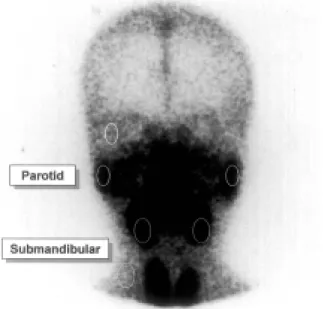
Among the images on each scintiscan, anterior view of 5 min image was used. Scintiscan images were transformed to computer file and then quantified by means of densitometer program(Tina ver 2.10, Fuji film, Tokyo, Japan). Four region of interests(ROIs) were drawn on each scintiscan image.; elliptical ROI on both parotid and submnadibular glands. Background subtraction was performed using regions superior to each parotid gland on temporal area and lateral to each submandibular gland, avoiding the subclavian vein (Fig. 1).

22)

5. Statistics

Paired t-test was used for examining side-to- side difference. Student t-test was used to compare the control and patient groups. To examine the

Fig. 1. Regions of interest in scintigraphic image.

relationship between scintiscan quantification and whole salivary flow rate, Pearson's correlation test was done. The subgroups of xerostomic patients were compared by oneway ANOVA and Duncan's multiple comparison test.

Ⅲ. RESULTS

Mean values of unstimulated whole salivary flow rates in control and patient groups are shown (Table 2). In control group unstimulated whole salivary flow rate is 0.44±0.14 ml/min and in patient group, 0.07±0.06 ml/min. The side-to-side

Table 1. Subjects included

No. of subjects Mean age (years)

Patient 40 43.6 ± 17.1

Control 10 22.7 ± 1.8

Table 2. Comparison of whole salivary flow rate between control and patient groups

Salivary

flow rate Control Patient Significance UWS

(ml/min)

0.44±0.14 (n=10)

0.07±0.06

(n=40) p=0.000

UWS : unstimulated whole salivary flow rate

Table 3. Comparison of side-to-side difference in salivary gland scintiscan quantification in control and patient groups

Group Gland Rt Lt Significance

Control n=10

P 52330±15787 49959±16921 p=0.118 S 71758±14127 71296±13772 p=0.594 Patient

n=40

P 44034±21980 43161±21300 p=0.600 S 59029±17165 59159±17558 p=0.850 P : parotid gland

S : submandibular gland

(4)

Table 5. Correlation of salivary gland scintiscan quantification and unstimulated whole salivary flow rate in control and patient groups

Gland

UWS P' S' P' + S'

Control(n=10) -0.114 -0.526 -0.325

Patient(n=40) 0.382

*

0.384

*

0.406

**

*

p<0.05,

**

p<0.01

UWS : unstimulated whole salivary flow rate P' : sum of right and left parotid glands S' : sum of right and left submandibular glands P' + S' : sum of P' and S'

differences in salivary gland scintiscan quantifi- cation were examined in control and patient groups (Table 3). There was no significant difference of parotid and submandibular gland quantification values between right and left sides in both control and patient groups. The parotid gland quantification values varies more than submandibular ones, especially in control group.

In order to compare salivary gland scintiscan quantification between control and patient groups, quantification values of parotid and submandibular

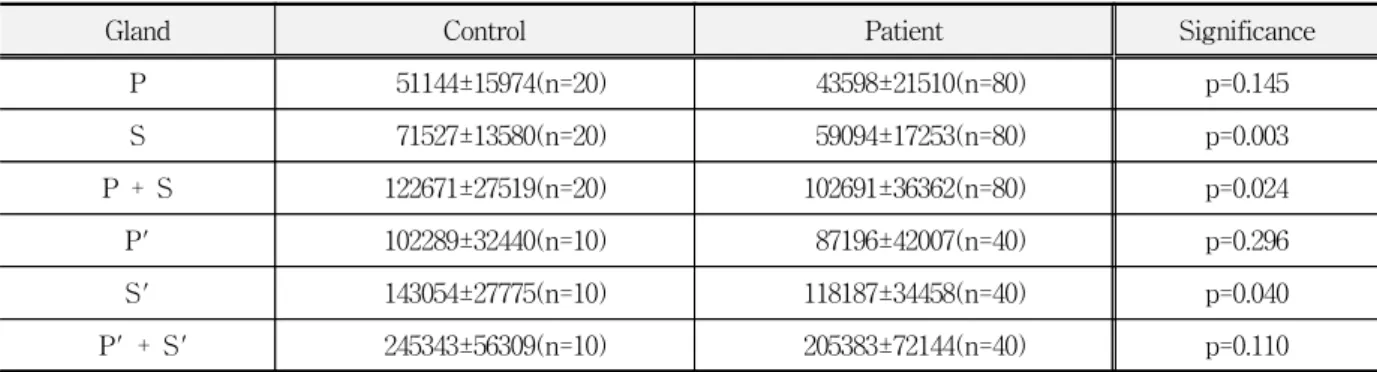
glands were compared between control and patient groups (Table 4). Quantification values of each submandibular gland, sum of each parotid and submandibular gland, and sum of both submandibular glands were significantly different (respectively, p=0.003, 0.024, 0.040). However quantification values of each parotid gland, sum of both parotid glands, and sum of both parotid and submandibular glands were not significantly different.

For investigating the relationship between salivary gland scintiscan quantification and whole salivary flow rate in control and patient groups, correlation values of salivary gland scintiscan quantification with unstimulated whole salivary flow rate are shown (Table 5). Quantification values of sum of both parotid glands, sum of both submandibular glands, and sum of both parotid and submandibular glands made positive correlation with unstimulated whole salivary flow rate in patient group, especially for those of sum of both parotid and submandibular glands. However in control group scintiscan quantification values were not significantly correlated with salivary flow rate.

The patient group was divided into three subgroups according to the level of unstimualted Table 4. Comparison of salivary gland scintiscan quantification between control and patient groups

Gland Control Patient Significance

P 51144±15974(n=20) 43598±21510(n=80) p=0.145

S 71527±13580(n=20) 59094±17253(n=80) p=0.003

P + S 122671±27519(n=20) 102691±36362(n=80) p=0.024

P' 102289±32440(n=10) 87196±42007(n=40) p=0.296

S' 143054±27775(n=10) 118187±34458(n=40) p=0.040

P' + S' 245343±56309(n=10) 205383±72144(n=40) p=0.110

P : parotid gland S : submandibular gland

P + S : sum of parotid and submandibular glands P' : sum of right and left parotid glands

S' : sum of right and left submandibular glands

P' + S' : sum of P' and S'

(5)

Table 6. Comparison of whole salivary flow rate between controls and the subgroups of patients Salivary

flow rate

Patient Control

ANOVA Significance

between groups

Ⅰ Ⅱ Ⅲ Ⅳ

UWS (ml/min)

0.00±0.00 n=10

0.06±0.03 n=21

0.15±0.03 n=9

0.44±0.14

n=10 p=0.000 * (Ⅰ,Ⅱ)(Ⅰ,Ⅲ)(Ⅰ,Ⅳ)

(Ⅱ,Ⅲ)(Ⅱ,Ⅳ)(Ⅲ,Ⅳ)

*

p<0.05

UWS : unstimulated whole salivary flow rate

Group Ⅰ: UWS ≃ 0.00 ml/min (impossible to measure) Group Ⅱ: 0.00 ml/min < UWS ≤ 0.10 ml/min

Group Ⅲ: 0.10 ml/min < UWS ≤ 0.20 ml/min Group Ⅳ: Control group, UWS > 0.30 ml/min

Table 7. Comparison of salivary gland scintiscan quantification between controls and the subgroups of patients

Gland

Patient Control

ANO VA

Significance between

groups

Ⅰ Ⅱ Ⅲ Ⅳ

P 23915±24958

n=20

49281±15693 n=42

52208±15681 n=18

51144±15974

n=20 p=0.000 *(Ⅰ,Ⅱ)(Ⅰ,Ⅲ)

(Ⅰ,Ⅳ)

S 43626±12617

n=20

62149±15008 n=42

69151±15826 n=18

71527±13580

n=20 p=0.000 *(Ⅰ,Ⅱ)(Ⅰ,Ⅲ)

(Ⅰ,Ⅳ)(Ⅱ,Ⅳ) P + S 67541±32050

n=20

111430±29555 n=42

121359±29639 n=18

122671±27519

n=20 p=0.000 *(Ⅰ,Ⅱ)(Ⅰ,Ⅲ)

(Ⅰ,Ⅳ)

P' 47830±48019

n=10

98562±31032 n=21

104416±31479 n=9

102289±32440

n=10 p=0.001 *(Ⅰ,Ⅱ)(Ⅰ,Ⅲ)

(Ⅰ,Ⅳ)

S' 87252±25065

n=10

124297±30165 n=21

138302±32514 n=9

143054±27775

n=10 p=0.000 *(Ⅰ,Ⅱ)(Ⅰ,Ⅲ)

(Ⅰ,Ⅳ) P' + S' 135082±62640

n=10

222859±59117 n=21

242718±60615 n=9

245342±56309

n=10 p=0.000 *(Ⅰ,Ⅱ)(Ⅰ,Ⅲ)

(Ⅰ,Ⅳ)

*
p<0.05

P : parotid gland S : submandibular gland

P + S : sum of parotid and submandibular glands P' : sum of right and left parotid glands

S' : sum of right and left submandibular glands P' + S' : sum of P' and S'

Group Ⅰ: UWS ≃ 0.00 ml/min (impossible to measure) Group Ⅱ: 0.00 ml/min < UWS ≤ 0.10 ml/min

Group Ⅲ: 0.10 ml/min < UWS ≤ 0.20 ml/min

Group Ⅳ: Control group, UWS > 0.30 ml/min

(6)

whole salivary flow rate. Group Ⅰ was a group of patients whose unstimulated whole salivary flow rate is too low to measure. Group Ⅱ was a group of patients whose unstimulated whole salivary flow rate is less than 0.1 ml/min. Group Ⅲ was a group of patients whose unstimulated whole salivary flow rate is less than 0.2 ml/min, but more than 0.1 ml/min. Unstimulated whole salivary flow rates of controls and these three subgroups of patients are shown (Table 6).

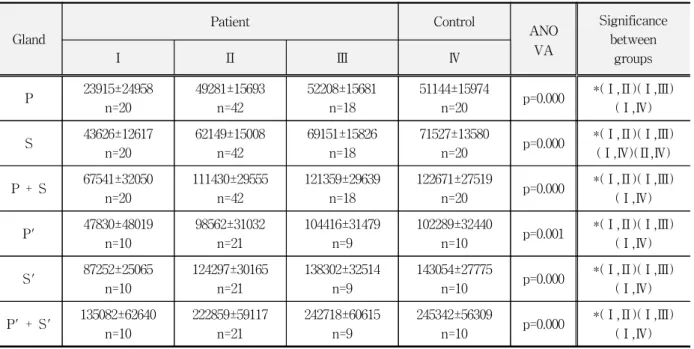
To compare salivary gland scintiscan quantifi- cation between controls and the subgroups of patients, quantification values of parotid and submandibular glands were compared between controls and the subgroups of patients (Table 7).

Group Ⅰ, in which unstimulated whole salivary flow rate is too low to measure, was significantly different from Group Ⅱ, Ⅲ and control group for all values of salivary gland scintiscan quantification.

For quantification value of each submandibular gland, Group Ⅱ was also significantly different from control group. Group Ⅱ, Ⅲ and control group were not significant different from one another for all values of salivary gland scintiscan quantification and Group Ⅲ and control group were almost the same in all measures of salivary gland scintiscan quantification.

Ⅳ. DISCUSSION

This study was designed to investigate the relationship between salivary flow rate and salivary gland scan in xerostomic patients and normal populations.

Measurement of salivary flow rate is widely used method because it is simple and does not use special equipment, although normal range is broad.

Among these flow rates, the flow rate of whole saliva rather than that of saliva derived from individual gland is useful in case of generalized decrease of salivary flow rate such as xerostomia.

4)

In fact the flow rate of saliva derived from individual gland may be impossible to measure in case of xerostomic patients whose salivary flow

rate is markedly decreased. Whole salivary flow rate is divided into unstimulated and stimulated and it is reported that feeling of dry mouth has closer relationship with unstimulated salivary flow rate than stimulated.

7,8,10)

The most commonly used techniques for measuring unstimulated salivary flow rate are the draining method, the spitting method, the suction method, and the swab method.

23)

Among these four methods more saliva tend to be collected using the swab and suction methods and the swab method is reported to be less reliable.

24)

In our study more reliable spitting method was used instead of the two convenient methods, draining and spitting.

Salivary flow rate which discriminate normal from xerostomic state is difficult to determine, however previous studies suggested that when unstimulated whole salivary flow rate is less than 0.1 ml/min, apparent xerostomic state appears.

4,25)

In fact the state of unstimulated whole salivary flow rate less than 0.1ml/min is 75% decreased state of salivary gland function

4)

, which means that extensive gland damage or dysfunction must be present before a patient would complain of dry mouth. It reflects the redundancy of salivary function.

26)

In our study mean value of unstimulated whole salivary flow rate of patient group is 0.07±

0.06 ml/min, indicating that patient group is a group of patients whose salivary function is significantly decreased. And for 31 of 40 patients (78%) unstimulated whole salivary flow rate is less than 0.1 ml/min.

Several methods to evaluate Tc-99 scintiscan

have been used in previous studies. Kohn, et al.

16)

investigated the relationships between major

salivary gland flow rates and Tc-99 scans and

developed a rating scale using scans of a control

group with normal salivary function. Semiquan-

titative method using an on-line computer with

special software has been used to study identified

regions of interest (ROI), i.e., parotid and

submandibular glands.

12)

To evaluate Tc-99

scintiscan we adopted modified method of

quantifying salivary scintiscan image using

(7)

densitometer program. This quantitative method using densitometer program is simple and practical as a new approach to evaluate scintiscan findings.

When salivary gland scintiscan quantification values were compared between control and patient groups, quantification values were lower in patient group, although quantification values of each parotid gland, sum of both parotid glands, and sum of both parotid and submandibular glands were not significantly lower. Quantification values of submandibular gland were more than those of parotid gland in control and patient groups. In patient group quantification values of parotid and submandibular glands made significant correlation with unstimulated whole salivary flow rate, especially for sum of both parotid and submandibular glands. Considering this, quantifying all the major salivary glands from scintiscan image is thought to be useful for evaluating the severity and extent of a patient's complaint of dry mouth.

27)

Some authors demonstrated correlation of salivary flow rates and scintigraphic findings in a group of Sjögren's syndrome patients.

19)

However as seen from our results we could only distinguish Group Ⅰ, in which unstimulated whole salivary flow rate was too low to measure, from the other subgroups and control group. Group Ⅱ and Ⅲ, which groups were classified by 0.1 ml/min that was suggested as criteria of apparent xerostomic state, were not significantly different in all values of salivary scintiscan quantification. And Group Ⅲ and control group were almost the same in all measures of salivary scintiscan quantification in spite of difference of unstimulated whole salivary flow rate. Moreover, there was poor correlation of unstimulated whole salivary flow rate with scintiscan quantification in control group. These findings are consistent with great variability of quantitative scintigraphic salivary indices in the scintigraphic evaluation of normal subjects.

27)

Therefore, salivary gland scan image quantification using this method may be suboptimal for detecting exquisite difference between patients. Its implication is that we should be careful in reading

salivary scintiscan and do other diagnostic tests together such as sialometry to determine the severity and extent of a patient's complaint of dry mouth.

Sequential salivary scintigraphy examines all four major salivary glands simultaneously and continuously over a period of time, thus demonstrating a proportion of secretory dynamics.

It is a safe procedure with little patient discomfort and minimal radiation exposure. But its main disadvantage is the lack of detail. In our study Group Ⅱ, Ⅲ, whose whole salivary flow rates were to some extent diminished, made no significant difference from control group in salivary scintiscan quantification, suggesting that resolution of salivary scintiscan image is low and normal quantitative values of salivary scintiscan are highly variable.

27)

Analyzing time-activity curve produced from sequential salivary scintiscan image need to be performed in relation to stimulated whole salivary flow rate as well as unstimulated whole salivary flow rate in future study.

Ⅴ. CONCLUSIONS

This study was performed for investigation of the relationship between salivary flow rate and salivary gland scan by quantifying the scintiscan images of major salivary glands in xerostomic patients and normosalivaters. For this study 40 patients whose unstimulated whole salivary flow rates were less than 0.2 ml/min and 10 normosalivaters without xerostomic symptoms were included. Unstimulated whole salivary flow rates were determined and

99m

Tc-pertechnetate salivary gland scintiscan tests were done in all subjects.

The obtained results were as follows:

1. For salivary gland scintiscan quantification in

control and patient groups, there was no

significant difference of parotid and subma-

ndibular gland quantification values between

right and left sides in both control and patient

(8)

groups.

2. For salivary gland scintiscan quantification in control and patient groups, quantification values of each submandibular gland, sum of each parotid and submandibular gland, and sum of both parotid and submandibular glands in patient group were significantly higher than those in control group.

3. In xerostomic patient group scintiscan quantifi- cation values were significantly correlated with unstimulated whole salivary flow rate, however, in control group scintiscan quantification values were not significantly correlated with salivary flow rate.

4. When the patient group was divided into three subgroups according to the level of unstimulated whole salivary flow rate, the subgroup in which unstimulated whole salivary flow rate was too low to measure was significantly different from the other subgroups and control group in salivary gland scintiscan quantification values.

REFERENCES

1. Grisius, M.M. and Fox, P.C. : Salivary gland dysfunction and xerostomia. In Linden, R.W.A. (Ed.), The scientific basis of eating. Vol. 9, Basel, Karger, 1998, pp. 156-167.

2. Mandel, I.D. : The functions of saliva. J. Dent. Res.

66(Spec Iss):623-627, 1987.

3. Navazesh, M. and Ship, I.I. : Xerostomia; diagnosis and treatment. Am. J. Otolaryngol. 4:283-292, 1983.

4. Sreebny, L.M. and Broich, G. : Xerostomia (Dry mouth) In Sreebny, L.M. (Ed.), The salivary system.

CRC Press, Boca Raton, 1987, pp. 179-202.

5. Spielman, A., Ben-Aryeh, H., Gutman, D., Szargel, R., and Deutch, E. : Xerostomia: Diagnosis and treatment. Oral Surg. Oral Med. Oral Pathol.

51(2):144-147, 1981.

6. Fox, P.C., van der Ven, P.F., Baum, B.J., and Mandel, I.D. : Pilocarpine for the treatment of xerostomia associated with salivary gland dysfunction. Oral Surg. Oral Med. Oral Pathol. 61(3):243-248, 1986.

7. Österberg, T., Landahl, S., and Hedegard, B. : Salivary flow, Salivary pH and buffering capacity in 70-year-old men and women. J. Oral Rehabil.

11:157-170, 1984.

8. von Knorring, L. and Mornstad, H. : Qualitative changes in saliva composition after short-term administration of imipramine and zimelidine in healthy volunteers. Scand. J. Dent. Res. 89:313-320, 1981.

9. Donatsky, D.J., Johnsen, T., Holmstrup, P., and Bertram, U. : Effect of "Saliment" on parotid salivary gland secretion and on xerostomia caused by Sjögren's syndrome. Scand. J. Dent. Res. 90:157-162, 1982.

10. Stuchell, R.N., Mandel, I.D., and Baurmash, H. : Clinical utilization of sialochemistry in Sjögren's syndrome. J. Oral Pathol. 13:303-309, 1984.

11. van den Akker, H.P. : Diagnostic imaging in salivary gland disease. Oral Surg. Oral Med. Oral Pathol.

66:625-637, 1988.

12. Daniels, T.E., Powell, M.R., Sylvester, R.A., and Talal, N. : An evaluation of salivary scintigraphy in Sjögren's syndrome. Arthritis Rheum. 22:809-814, 1979.

13. Arrago, J.P., Rain, J.D., Brocheriou, C., and Rocher, F.

: Scintigraphy of the salivary glands in Sjögren's syndrome. J. Clin. Pathol. 40:1463-1467, 1987.

14. Yamashita, T., Chiyonari, I., Koichi, T., and Tadami, K. : Prognostic determination and submandibular function in Bell's palsy. Arch. Otolaryngol.

111:244-248, 1985.

15. Van den Akker, H.P. and Buseman-Sokole, E. : Absolute indications for salivary gland scintigraphy with

99m

Tc-pertechnetate. Oral Surg. Oral Med. Oral Pathol. 60:440-447, 1985.

16. Kohn, W.G., Ship. J.A., Atkinson. J.C., Patton L.L., and Fox. P.C. : Salivary gland

99m

Tc-scintigraphy. a grading scale and correlation with major salivary gland flow rates. J. Oral Pathol. Med. 21:70-74, 1992.

17. Rankow, R.M. and Polayes, I.M. : Disease of the salivary glands. W.B. Saunders, Philadelphia, 1976, p.

90.

18. Bohuslavizki. K.H., Brenner. S., Lassmann. S., Tinnemeyer. S., Tönshoff. G., Sippel. C., Wolf. H., Clausen. M., and Henze. E. : Quantitative salivary gland scintigraphy in the diagnosis of parenchymal damage after treatment with radioiodine. Nucl. Med.

Commun. 16:917-922, 1995.

19. Schall. G.L., Anderson. L.G., Wolf. R.O., Herdt. J.R., Tarpley. T.M. Jr., Cummings. N.A., Zeiger. L.S., and Talal. N. : Xerostomia in Sjögren's syndrome - evaluation by sequential salivary scintigraphy.

JAMA. 216:2109-2116, 1971.

(9)

20. Söderling, E. : Practical aspects of salivary analyses.

In Tenovuo, J.O. (Ed.), Human saliva: clinical chemistry and microbiology. Vol 1, CRC Press, Boca Raton, 1989, pp. 1-24.

21. Birkhed, D. and Heintze, U. : Salivary secretion rate, buffer capacity, and pH. In Tenovuo, J.O. (Ed.), Human saliva: clinical chemistry and microbiology.

Vol 1, CRC Press, Boca Raton, 1989, pp. 25-73.

22. Cooper, R.A., Cowan, R.A., Owens, S.E., Jeans, S.P., Roberts, J.K., Hillel, P.G., Slevin, N.J., Allan, E., Gupta, N.K., and Collins, C.D. : Does salivary gland scintigraphy predict response to pilocarpine in patients with post-radiotherapy xerostomia? Eur. J.

Nucl. Med. 26:220-225, 1999.

23. White, K.D. : Salivation: a review and experimental investigation of major techniques. Psychophysiology 14:203-212, 1977.

24. Navazesh, M. and Christensen, C.M. : A composition of whole mouth resting and stimulated salivary measurement procedures. J. Dent. Res. 61:1158-1162, 1982.

25. Ben-Aryeh, H., Spielman, A., Szargel, R., Gutman, D., Scharf, J., Nahir, M., and Scharf, Y. : Sialochemistry for the diagnosis of Sjögren's syndrome in xeros- tomic patients. Oral Surg. Oral Med. Oral Pathol. 52:

487-490, 1981.

26. Levine, M.J. : Development of artificial salivas. Crit.

Rev. Oral Biol. Med. 4:279-286, 1993.

27. Hermann, G.A., Vivino, F.B., Shnier, D., Krumm, R.P., Mayrin, V., and Shore, J.B. : Variability of quantitative scintigraphic salivary indices in normal subjects. J. Nucl. Med. 39:1260-1263, 1998.

Corresponding Author : Sung-Chang Chung, Professor,

Department of Oral Medicine & Oral Diagnosis, College

of Dentistry, Seoul National University, 28 Yunkeun-

Dong, Chongro-Ku, Seoul 110-744, Korea

(10)

국문초록

타액선 스캔의 정량적 분석과 타액분비율과의 상관관계에 관한 연구

서울대학교 치과대학 구강내과․진단학 교실 김 성 헌․김 연 중․정 성 창

서울대학교 치과병원 구강진단과에 구강건조증을 주소로 내원한 환자중 비자극 전타액 분비율이 0.2ml/min이 하인 환자 40명과 구강건조증의 증상 및 징후가 없고 정상 타액분비율을 보이는 10명을 대상으로 비자극 전타액 분비율을 측정하고 타액선 스캔 검사를 실시하여 주타액선의 스캔 영상을 정량화한 후 이의 상관관계를 조사한 결과 다음과 같은 결론을 얻었다.

1. 구강건조증 환자군 및 정상 대조군에서 타액선 스캔 영상의 정량적 분석시 이하선 및 악하선 모두에서 좌우측 사이의 유의성 있는 차이가 없었다.

2. 타액선 스캔 영상의 정량적 분석시 구강건조증 환자군은 대조군에 비하여 악하선, 이하선 및 악하선의 합, 양측 악하선 합에서 유의한 차이를 보였다.

3. 대조군에서 타액선 스캔 영상의 정량적 수치와 비자극 전타액 분비율과는 유의성 있는 상관관계가 관찰되지 않았으나, 구강건조증 환자군에서는 유의성 있는 상관관계가 관찰되었다.

4. 구강건조증 환자군을 비자극성 전타액 분비율에 따라 세분하였을 때, 비자극 전타액 분비의 감소가 극심하여 그 측정이 불가능하였던 군은 대조군 및 나머지 구강건조증 환자군에 비하여 타액선 스캔 영상의 정량적 수치 에서 유의한 차이를 보였다.

주요어 : 구강건조증, 타액선 스캔, 타액 분비율

수치

Table  1.  Subjects  included
Table  5.  Correlation  of  salivary  gland  scintiscan  quantification  and  unstimulated  whole  salivary  flow  rate  in  control  and  patient  groups                 Gland   UWS P' S' P'  +  S' Control(n=10) -0.114 -0.526 -0.325 Patient(n=40)   0.382
Table  7.  Comparison  of  salivary  gland  scintiscan  quantification  between  controls  and  the  subgroups  of  patients

참조

관련 문서

The Mann-whitney U test was used to compare and analyze the salivary cortisol concentration according to the duration of symptoms in the temporomandibular disorder patient group

There was a significant increase in new bone formation in the group in which toothash and plaster of Paris and either PRP or fibrin sealants were used, compared with the groups

First, when examining the differences in body composition between judo specialists and active sports participants, the BMI index and body fat mass were lower

Results : The data was collected from 38 precocius puberty patient(17 overweight/obese group, 21 normal weight group),14 control group weight, Height, BMI, Waist

Data were analyzed using independent-sample t tests for checking the equivalency between the experimental and control groups at pretest and three-way analysis

Discrepancy between L values and theoretical oxygen Discrepancy between L values and theoretical oxygen demand values.. Discrepancy between observed rates and

Difference of microhardness values(M±SD) between control and experimental side in various groups ···

The measured values for benzene in DMF were compared with the The measured values for benzene in DMF were compared with the reference data, and