Recently, a large number of new tests for the diagnosis of bacterial infections have been devel- oped, but blood culture remains the most im- portant test for the diagnosis and treatment of infectious disease.1,2 The development of anti- microbial agents was a crucial turning point in the treatment of these infectious diseases, how-
ever, it resulted in the acquisition of natural re- sistance by bacteria and an increase in strains re- sistant to antimicrobial agents. The increase of these resistant strains led to serious medical prob- lems, including increases in hospitalization, treat- ment costs and patient mortality.3 Especially, in Asian countries, there are reports that the in-
Original Article
Changes in Antimicrobial Susceptibility Pattern of Blood Isolates at a University Hospital in the Kyungnam area during 2005-2014
Dahae Yang, Woonhyoung Lee
Department of Laboratory Medicine, College of Medicine, Kosin University Busan, Korea
Objectives: Blood culture is a one of the most important procedure for diagnosis and treatment of infectious disease, but distribution of pathogenic species and the antimicrobial susceptibility can be vary from pathogen, individual trait, regional or environmental features. In this study, we investigated the changes in frequency of occurrence and antimicrobial susceptibility pattern of blood isolates from 2005 to 2014.
Methods: Data of blood isolates from Kosin Gospel Hospital during 2005 to 2014 were analyzed retrospectively.
Blood isolates were cultured for 5 days using BACTEC Plus Aerobic/F and BACTEC lytic/10 Anaerobic/F.
Identification and antimicrobial susceptibility test was performed using VITEK 1 system, VITEK 2 XL, PHOENIX 100 and conventional method.
Results: 9,847 isolates were identified during 10 years. Among the isolates aerobic or falcutative anaerobic bacteria were isolated in 99.5% specimens, anaerobic were 0.1%, and fugi were 0.4%. Most commonly isolated bacteria were coagulase-negative Staphylococcus (CoNS) followed by Escherichia coli, Staphylococcus aureus and Klebsiella pneumoniae. Candida parapsilosis were most frequently isolated among fungi. The proportion of S. aureus, A. baumannii and E. faecium were increased, while Pseudomonas aeruginosa and Streptococcus pneumoniae decreased over decennium. Imipenem resistant K. pneumoniae were identified. Vancomycin resistant E. faecium and imipenem resistant A. baumannii were increased (7.1% in 2005 to 12.3% in 2014, 0% in 2005 to 55.6% in 2014, respectively).
Conclusions: Over the last 10 year, CoNS were the most frequently isolated pathogen. Imipenem resistant K.
pneumoniae was emerged. Vancomycin resistant E. faecium and imipenem resistant A. baumannii increased during this period.
Key Words: Antimicrobial susceptibility pattern, Bacteremia, Blood culture
Corresponding Author: Woonhyoung Lee, Department of Laboratory Medicine, College of Medicine, Kosin University, 262, Gamchen-ro, Seo-gu, Busan 49267, Korea
Tel: +82-51-990-6373 Fax: +82-51-990-3034 E-mail: [email protected]
Received:
Revised:
Accepted:
Jan. 12, 2017 Feb. 27, 2017 Mar. 15, 2017 Articles published in Kosin Medical Journal are open-access, distributed under the terms of the Creative Commons Attribution Non-Commercial License (http://creativecommons.org/licenses/by-nc/4.0/) which permits unrestricted non-commercial use, distribution, and reproduction in
Corresponding Author: Woonhyoung Lee, Department of Laboratory Medicine, College of Medicine, Kosin University, 262, Gamchen-ro, Seo-gu, Busan 49267, Korea
Tel: +82-51-990-6373 Fax: +82-51-990-3034 E-mail: [email protected]
Received:
Revised:
Accepted:
Jan. 12, 2017 Feb. 27, 2017 Mar. 15, 2017
cidence of antimicrobial resistant bacteria has in- creased rapidly due to the inappropriate use of antimicrobial agents and the spread of resistant bacteria.4 Hence, the European Community Strategy against Antimicrobial Resistance and World Health Organization recommend monitor- ing the change in antimicrobial resistance rates by identifying the pathogen and any changing patterns in antimicrobial susceptibility.5-8
The distribution of pathogen or antimicrobial susceptibility patterns in infectious disease can vary greatly depending on the pathogenic bac- teria, individual patient characteristics, the geo- graphic region and the periodic characteristics.
Therefore, investigating and analyzing the pat- terns of major pathogenic bacteria isolated from the microbiology laboratory of each hospital and changes in antimicrobial susceptibility patterns are important basic data for the diagnosis and prognosis of infectious disease and selection of appropriate empirical antimicrobial agents in that community of patients.
For this, since it is necessary to keep up-to-date information on pathogen of bacteremia occurring in each community or hospital, and antimicrobial susceptibility, this study investigated the charac- teristics of blood isolates and changes in anti- microbial susceptibility in Kosin University Gospel Hospital by analyzing the types of patho- gen isolated from patients who visited the hospital over a 10-year period from 2005 to 2014. The antimicrobial susceptibility results were analyzed retrospectively and by examining the yearly
trends of isolated strains and changes in anti- microbial susceptibility patterns.
MATERIALS AND METHODS
Subjects
Retrospective analysis was done on the results of blood culture tests performed for inpatients and outpatients of Kosin University Gospel Hospital over a 10-year period from January 2005 to December 2014. When the same bacteria were repeatedly isolated from blood culture of one pa- tient, only the initial results were included in the analysis. When the different pathogens were iden- tified, regardless of culture time, or when the same bacteria showed different antimicrobial sus- ceptibility results, each pathogen and anti- microbial susceptibility results were included in the analysis.
Methods
1) Blood Culture
Blood culture was performed by aseptically col- lecting 10 mL (1-5 mL for child) of venous blood by conventional method. Aerobic bacteria were cultured using BACTEC Plus Aerobic/F (Becton Dickinson Diagnostic Instrument Systems, Sparks, MD) medium. Anaerobic bacteria were cultured using BACTEC lytic/10 Anaerobic/F (Becton Dickinson Diagnostic Instrument Systems, Sparks, MD) medium. Culture were incubated for 5 days in the BACTEC 9240 system (Becton-Dickinson,
Sparks, Md.) from 2005 to 2011 and the BACTEC FX system (Becton-Dickinson, Sparks, Md.) from 2011 to 2015. When bacterial proliferation was detected, isolates were cultured by blind subculture.
2) Identification and Antimicrobial Susceptibility Test
Bacteria were identified by using conventional methods9 such as Gram stain and biochemical methods, and identification and antimicrobial susceptibility tests were performed by using the following automated systems: VITEK 1 system (bioMérieux SA, Marcy-l'Etoile, France) from 2005 to 2011, VITEK 2 XL (bioMérieux, 52 Hazelwood, MO, USA) from 2012 to 2014 and PHOENIX 100 (Becton Dickinson Co., Sparks, Md.) from 2006 to 2014 as needed. Some strains were inoculated on appropriate media and then the disc diffusion method was used according to CLSI (Clinical and Laboratory Standards Institute) standards.
Streptococcus pneumoniae ATCC 49619, Enterococcus faecalis ATCC 29212, Escherichia coli ATCC 25922, Staphylococcus aureus ATCC 25923, Pseudomonas aeruginosa ATCC 27853, and Candida parapsilosis ATCC 22019 were used as quality control strains for the antimicrobial sus- ceptibility tests.
3) Result Analysis
The results of blood culture tests were analyzed by strain and isolation frequency by year. Bacillus spp., Corynbacterium spp., coagulase-negative
Staphylococcus (CoNS), and Propionibacterium spp. were presented in the total isolation fre- quency results but were excluded from the yearly analysis.
To investigate the resistance rate of strains we classified the susceptibility (S), intermediate re- sistance (I) and resistance (R) of the strain using CLSI standards revised to the latest edition of the current year and analyzed the antimicrobial re- sistance rate of the strain by regarding all the re- sults except for the susceptibility as resistance from the results of the standard disk diffusion method, The formula to calculate the resistance rate for the drug is as follows:
Antimicrobial resistance rate (%) = (number of resistant strains / number of isolates) * 100
Frequency and antimicrobial resistance rate were analyzed using Microsoft Excel 2007 soft- ware (Microsoft Corporation, Redmond, WA, USA).
RESULTS
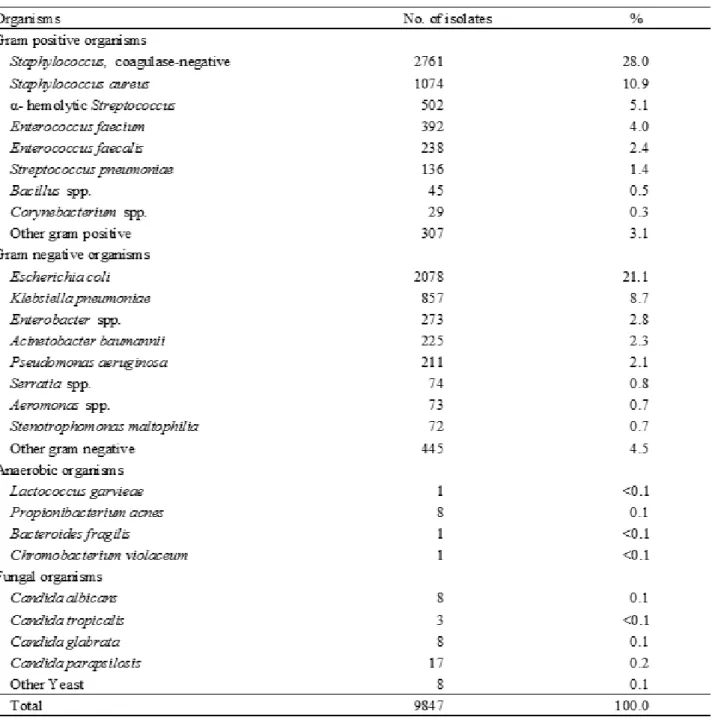
A total of 9,847 specimens were positive for blood culture in the 10-year period from January 2005 to December 2014. Among positive blood cultures, aerobic bacteria were isolated from 9,792 specimens (99.5%), including 5,408 specimens (54.9%) of Gram-positive bacteria, 5 specimens (0.1%) of Gram-negative bacteria, 76 specimens (0.8%) of Gram-positive bacilli and 4,303 specimens (43.7%) of Gram-negative bacilli.
11 specimens (0.1%) of anaerobes and 44 specimens (0.4%) of fungi were isolated (Table 1).
Of the aerobic Gram-positive strains isolated during the 10-year period, CoNS was the most commonly isolated, being found in 2,761 specimens (Table 2). The next most commonly isolated strains were S. aureus from 1,074 specimens, α-hemolytic Streptococcus from 502 specimens, and Eneterococcus faeciumfrom from 392 specimens. For Gram-negative strains, Neisseria spp. was isolated from 5 specimens, for Gram-positive bacilli, Bacillus spp. was isolated from 45 specimens and Corynebacterium spp. was isolated from 29 specimens.
Of the Gram-negative bacilli, E. coli was the most commonly isolated, being found in 2,078 specimens, followed by Klebsiella pneumoniae and Enterobactor spp. in order. For glucose non- fermenting Gram-negative bacilli, Acinetobacter baumanniiwas was isolated from 225 specimens, P. aeruginosa was isolated from 211 specimens and Stenotrophomonas maltophilia was isolated from 72 specimens.
Anaerobic bacteria were isolated from 11 specimens. Among them, Propionibacterium
acnes was the most isolated, being found in 8 specimens, and Lactococcus garvieae, Bacteroides fragilis and Chromobacterium violaceum were each isolated from 1 sample. Fungi were isolated from 44 specimens, of which C. parapsilosis was isolated from 17 specimens, C. albicans was isolated from 8 specimens and C. glabrata was isolated from 8 specimens.
The number of total isolates during the analysis period showed an increased frequency of detection until 2011 and decreased after that, and the distribution of isolates showed changes in the pattern of strains (Fig. 1).
The oxacillin resistance rate of isolated S. aureus decreased from 71.4% in 2005 to 56.5% in 2014 (Fig. 2A). Resistance rates to Ciprofloxacin, gentamycin, and trimethoprim-sulfamethoxazole were reduced in 2014 compared to 2005. Bacteria were susceptible to Vancomycin for 10 years.
Bacteria were identified showing moderate resistance to teicoplanin in 2 cases in 2010 and 1 case in 2012.
In Enterococcus, the ampicillin resistance of E. faecalis increased from 0% in 2005 to 6.3% in 2014. For vancomycin, most bacterial isolates were Table 1. Microorganisms isolated by year
susceptible but 2.4% were resistant in 2011 (Fig.
2 B). E. faecium was highly resistant to ampicillin, displaying 85.7% resistance in 2005 and 86.0%
resistance in 2014 (Fig. 2C). Resistance to a high concentration of gentamycin and streptomycin was 29.4% and 0% in 2008, but increased significantly to 42.0% and 23.6% respectively in
2014. Vancomycin resistant strains increased from 7.1% in 2005 to 36.5% in 2010 and then gradually decreased to 12.3% in 2014.
E. coli showed less than 10% of resistance to ceftazidime, cefotaxime, azetronam and levofloxacin in 2005, but the resistant strains showed a rapid increase to 51.3%, 52.0%, 52.3%
Table 2. Distribution of blood isolates
and 57.5% for each drug respectively in 2014 (Fig.
2D). No strains resistant to imipenem were observed during the 10-year period.
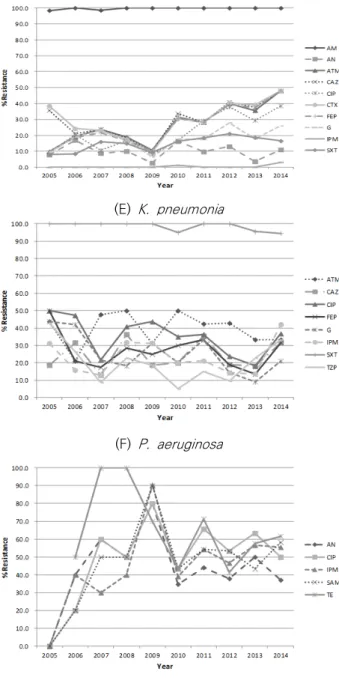
38.5% and 35.7% of isolated K. pneumonia strains were resistant to cefotaxime and ceftazidime respectively in 2005 but resistance decreased to 9.5% and 9.7% respectively in 2008 and then increased to 48.0% in 2014 (Fig. 2E).
Resistance rate for amikacin and azetroman showed an increasing trend over time, from 7.8%
and 9.8% resistance in 2005 to 11.0% and 48.0%
respectively in 2014. The resistance rate for ciprofloxacin was 9.4% in 2005 and 38.6% in 2014.
Imipenem resistant strains were reported in 1 case in 2010 and 4 cases in 2014.
In 2005, 50.0% of P. aeruginosa isolates were
resistant to ciprofloxacin but 36.8% showed resistance in 2014. The resistance rates of ceftazidime and imipenem were 18.8% and 31.3%
respectively in 2005 and increased to 31.6% and 42.1% respectively in 2014 (Fig. 2F).
The resistance rates of A. baumannii to imipenem and ciprofloxacin were sharply increased from 0% to 90.5% and 80.0%
respectively in 2009, and were 55.6% and 50.0%
respectively in 2014 (Fig. 2G).
DISCUSSION
If there is a change in the distribution and antimicrobial susceptibility of pathogens causing Fig. 1. Annual isolation of relatively common species of bacteria during 2005-2014
(A) S. aureus
(B) E. faecalis
(C) E. faecium
(D) E. coli
(E) K. pneumonia
(F) P. aeruginosa
(G) A. baumannil
*Abbreviation: AM, ampicillin; AN, amikacin; ATM, azetronam;
CAZ, ceftazidime; CIP, ciprofloxacin; CTX, cefotaxime; FEP, cefepime; G, gentamycin; IPM, imipenem; LZD, linezolid; OX, oxacillin; S, streptomycin; SAM, ampicillin- sulbactam; SXT, trimethoprim-sulfamethoxazole; TE, tetracycline ; TEC, teicoplanin; TZP, piperacillin- tazobactam ; VA, vancomycin
Fig. 2. Trends in antimicrobial resistance (%) of (A) S. aureus, (B) E. faecalis, (C) E. faecium, (D) E. coli (E) K. pneumonia (F) P. aeruginosa and (G) A. baumannii by year.
bacteremia, the methods to treat and prevent bacteremia should also be changed. Antimicrobial susceptibility patterns need to be constantly investigated and monitored as they may vary depending on region or hospital. The goal of this study was to find changes in antimicrobial resistance by analyzing the bacterial type and resistance frequency of blood isolates from 2005 to 2014, and the trends of antimicrobial susceptibility patterns.
The total number of specimens with positive blood culture was 9,847 cases over a 10-year period. The most common isolates in positive blood cultures from patients in Kosin University Gospel Hospital were CoNS, followed by E. coli, S. aureus, and K. pnuemonia in that order. These results are consistent with other reports in Korea over different study periods that also reported that CoNS was the most frequently isolated during the analysis periods, followed by E. coli, S. aureus and K.
pneumonia.10 As CoNS is one of the most common pathogens in blood culture, as well as one of the most important pathogens for hospital acquired infections occurring in immunosuppressed patients or after invasive therapy, it is very difficult to determine its clinical significance.11,12 In addition to CoNS, skin flora with high potential for contaminants include Bacillus spp., Corynbacterium spp., and Propionibacterium spp., and they represented 28.8% of total cultures in this study, showing the similar frequency to other reports in Korea.13 However, because they were isolated from the blood culture in this study, it was difficult
to determine clinical significance of antimicrobial resistance so they were therefore excluded from the analysis except for total isolation frequency rate.
Of Gram-positive strains, S. aureus accounted for 19.9% of patients with all Gram-positive isolates, Enterococcus spp. for 13.2%, and α -hemolytic Streptococcus for 9.3%. Given the isolation frequency of pathogens by year from 2005 to 2014, the isolation frequency of Enterococcus Spp. was particularly increased.
Except CoNS, E. coli was isolated most frequently and at rates higher than in other reports in Korea.10,13,14 The isolation frequency remained a constant level, repeating rising and falling for last 10 years. When looking at the trend of K.
pneumoniae for 10 years, the number of isolations increased but the isolation rate decreased somewhat. The incidence of infection caused by Salmonella typhi was 4 cases in 10 years, including 1 case in 2006, 2 cases in 2007 and 1 case in 2012, consistent with the isolation trend of other university hospitals where infection by S. typhi gradually decreased.14 The ratio of glucose non-fermenting Gram-negative bacilli showed similar results to other reports in Korea, accounting for 6.8% of aerobic bacteria.8 The major isolates were A. baumannii and P.
aeruginosa in that order. When looking at the 10-year trend of them, the isolation rate of A.
baumannii increased, whereas the isolation rate of P. aeruginosa somewhat decreased, which was consistent with the isolation rates of other
university hospitals.13
The isolation rate of anaerobic bacteria has been reported variously depending on the reporter, however, in this study, 0.1% of blood culture positive specimens (11/9847) were positive in anaerobic bacteria and P. acnes was the most isolated anaerobic bacteria. This showed different distribution pattern from other reports in Korea stating that the isolation rate of anaerobic bacteria was 2.7~3% and Bacteroides and Clostridium were the most common isolates.8,10 The low proportion of anaerobic bacteria in this study may be because their prevalence was decreased by the preoperative use of prophylactic antibiotics and the use of broad-spectrum antimicrobial agents.15-17 In addition, anaerobic infection itself is often co-infected with other bacteria, and if there is no obvious symptom, it is expected to have false negative in the isolation process.
The proportion of fungi was 0.4%, higher than that of anaerobic bacteria, but lower than that of reports in other hospitals in Korea.14 Among the isolated fungi, C. parapsilosis was the most isolated, representing 38.6% of isolated fungi, which is different from other reports in Korea in which C. albicans was the most isolated fungi.13,14 For the proportion of fungal infections, the distribution of mycetoma is known to exhibit various properties depending on the patient's personal characteristics such as the patient's nutritional status, age and immune status, geographical characteristics such as the country,
region and hospital where the patient is located, as well as the invasive procedure performed during the treatment or the use of antifungal agents.18,19 The results of this study are considered to reflect these phenomena, and also showed similar results to reports20 that C. parapsilosis infections have increased rapidly.
Identification of antimicrobial susceptibility patterns is important in selecting appropriate empirical antimicrobial agent. Oxacillin resistance of S. aureus isolated from the patient's blood showed a slight decrease from 2005 to 2014.
There were reports in Korea of a decrease in MRSA-induced bloodstream infection after training in the control of infectious diseases such as the use of appropriate antimicrobial agents and hand washing by medical staffs.21 Also, Kosin University Gospel Hospital has conducted activities such as infection prevention training and hand washing continuously since 2006.
Strains that were resistant or moderately resistant to Vancomycin were not found for 10 years.
Strains that showed moderate resistance to Teicoplanin were detected in 2 cases in 2010 and 1 case in 2012 by the disk diffusion method, however, no confirmatory test by dilution method or MIC method was performed.
The antimicrobial resistance rate of E. faecium increased to agents such as ampicillin, high concentration of gentamycin, and streptomycin.
The resistance rate to vancomycin increased rapidly in 2010 compared with 2005 and decreased again.
E. coli is known to be one of the most common pathogens in clinical practice and causes gastroenteritis, urinary tract infection, and sepsis.
During the study period, the resistance rate of E.
coli to the third generation of cephalosporin and levofloxacin increased significantly, but the trend of K. pneumoniae was not clear, consistent with other reports in Korea.10 Imipenem resistant bacteria were not observed in E. coli, however, 1 case in 2010 and 4 cases in 2014 were reported with K. pneumonia. In the United States, carbapenem-resistant Enterobacteriaceae (CRE) is occurring around the country due to the emergence of new β-lactamase, directly hydrolyzing carbapenem and overgeneration of extended-spectrum β-lactamases (ESBL) or AmPC-mediated β-lactamases.22 Among them, the generation and propagation of K. pneumonia resistant bacteria increased most rapidly,23,24 which may possibly reflect some of these trends in the results from our hospital. In case of sepsis caused by ESBL generating K. pneumonia, there was a report that the mortality rate is increased by 1.85-fold even after receiving appropriate treatment, and the mortality rate is increased by 5.56-fold when treatment is delayed.25
In this study, the resistance rates of A.
baumannii to 3rd generation and 4th generation cephalosporin, imipenem and ciprofloxacin were significantly increased. A. baumannii is a pathogen causing hospital acquired infection that is not easy to manage because it has a characteristic that it can live long on dry surfaces
as well as the general natural environment,26 and recently, there are similar reports that A.
baumannii resistant to carbapenems is increasing rapidly.10,27
The limitations of this study are: First, when CoNS, Bacillus spp., Corynbacterium spp., and Propionibacterium spp. were isolated from blood cultures, they were excluded from the analysis except for the total isolation frequency rate because it was difficult to determine the clinical significance. Second, any variables that could affect the tolerance of patients, such as demographic characteristics, disease severity, and antibiotic use were not considered separately.
In conclusion, the most common isolate from the blood culture results in one university hospital was CoNS over the entire 10-year period, and the other major isolates were E. coli, S. aureus, K.
pneumonia, and Enterococcus spp. The relative proportions of A. baumannii and Enterococus spp. increased for the last 10 years. Oxacillin resistance of S. aureus was slightly decreased. It was confirmed that imipenem-resistant K.
pneumoniae appeared, the vancomycin resistance rate of E. faecium increased and the imipenem resistance rate of A. baumannii rapidly increased over the 10-year period. It is necessary to have continuous infection control by conducting epidemiological studies on hospital acquired infection and local infection of these strains. This study is of great significance in analyzing the blood culture trend of Kosin University Gospel Hospital.
REFERENCES
1. Washington JA 2nd. Blood cultures: principles and techniques. Mayo Clin Proc 1975;50:91-8.
2. Weinstein MP, Reller LB, Murphy JR, Lichtenstein KA. The clinical significance of positive blood cultures: a comprehensive analysis of 500 epi- sodes of bacteremia and fungemia in adults. I.
Laboratory and epidemiologic observations. Rev Infect Dis 1983;5:35-53.
3. Arias CA, Murray BE. Antibiotic-resistant bugs in the 21st century--a clinical super-challenge.
N Engl J Med 2009;360:439-43.
4. Kang CI, Song JH. Antimicrobial resistance in Asia: current epidemiology and clinical implications. Infect Chemother 2013;45:22-31.
5. World Health Organization. Antimicrobial resist- ance: global report on surveillance. 2014.
6. Bronzwaer S, Lönnroth A, Haigh R. The European Community strategy against antimicrobial resistance. Euro Surveill 2004;9:30-4.
7. Murray PR, Baron EJ, Jorgensen JH, Landry ML, Pfaller MA. Manual of clinical microbiology. 9th ed. Washington, DC: American Society for Microbiology Press, 2007.
8. Kim NH, Hwang JH, Song KH, Choe PG, Park WB, Kim ES, et al. Changes in Antimicrobial Susceptibility of Blood Isolates in a University Hospital in South Korea, 1998-2010. Infect Chemother 2012;44:275-81.
9. Beekmann SE, Diekema DJ, Doern GV.
Determining the clinical significance of coagu- lase-negative staphylococci isolated from blood
cultures. Infect Control Hosp Epidemiol 2005;26:559-66.
10. Tokars JI. Predictive value of blood cultures pos- itive for coagulase-negative staphylococci: im- plications for patient care and health care quality assurance. Clin Infect Dis 2004;39:333-41.
11. Kim HJ, Lee NY, Kim S, Shin JH, Kim MN, Kim EC, et al. Characteristics of Microorganisms Isolated from Blood Cultures at Nine University Hospitals in Korea during 2009. Korean J Clin Microbiol 2011;14:48-54.
12. Kim SY, Lim G, Kim MJ, Suh JT, Lee HJ. Trends in Five-year Blood Cultures of Patients at a University Hospital (2003~2007). Korean J Clin Microbiol 2009;12:163-8.
13. Koh EM, Lee SG, Kim CK, Kim M, Yong D, Lee K, et al. Microorganisms isolated from blood cul- tures and their antimicrobial susceptibility pat- terns at a university hospital during 1994-2003.
Korean J Lab Med 2007;27:265-75.
14. Hall KK, Lyman JA. Updated review of blood culture contamination. Clin Microbiol Rev 2006;19:788-802.
15. Yang YL, Hsieh LY, Wang AH, Lo HJ: TSARY Hospitals. Characterization of Candida Species from Different Populations in Taiwan. Mycopathologia 2011;172:131–9.
16. Yapar N. Epidemiology and risk factors for in- vasive candidiasis. Ther Clin Risk Manag 2014;10:95-105.
17. Trofa D, Gácser A, Nosanchuk JD. Candida para- psilosis, an emerging fungal pathogen. Clin Microbiol Rev 2008;21:606-25.
18. Kim YC, Kim MH, Song JE, Ahn JY, Oh DH, Kweon OM, et al. Trend of methicillin-resistant Staphylococcus aureus (MRSA) bacteremia in an institution with a high rate of MRSA after the reinforcement of antibiotic stewardship and hand hygiene. Am J Infect Control 2013;41:e39-43.
19. Gupta N, Limbago BM, Patel JB, Kallen AJ.
Carbapenem-resistant Enterobacteriaceae: epi- demiology and prevention. Clin Infect Dis 2011;53:60-7.
20. Hidron AI, Edwards JR, Patel J, Horan TC, Sievert DM, Pollock DA, et al. NHSN annual update: anti- microbial-resistant pathogens associated with healthcare-associated infections: annual sum- mary of data reported to the National Healthcare Safety Network at the Centers for Disease Control and Prevention, 2006-2007. Infect Control Hosp
Epidemiol 2008;29:996-1011.
21. Sanchez GV, Master RN, Clark RB, Fyyaz M, Duvvuri P, Ekta G, et al. Klebsiella pneumoniae antimicrobial drug resistance, United States, 1998-2010. Emerg Infect Dis 2013;19:133-6.
22. Schwaber MJ, Carmeli Y. Mortality and delay in effective therapy associated with ex- tended-spectrum beta-lactamase production in Enterobacteriaceae bacteraemia: a systematic review and meta-analysis. J Antimicrob Chemother 2007;60:913-20.
23. Fournier PE, Richet H. The epidemiology and control of Acinetobacter baumannii in health care facilities. Clin Infect Dis 2006;42:692-9.
24. Dijkshoorn L, Nemec A, Seifert H. An increasing threat in hospitals: multidrug-resistant Acinetobacter baumannii. Nat Rev Microbiol 2007;5:939-51.