The Effect of Silicone Sleeve and Taping on Balance and Strength in Anterior Cruciate Ligament Reconstruction Patients
Purpose: This study was to determine the effects of before and after application of silicone sleeve on balance and muscle strength in anterior cruciate ligament (ACL) reconstruction patients.
Methods: 13 subjects who had one or more months after ACL surgery were involved. Dynamic balance, timed up and go (TUG), stair step, vertical jump, proprioception and isokinetic knee strength were measured while subjects under taped, untapped and silicone sleeve conditions.
Results: For 30 seconds one-leg standing, there was a significant improvement under silicone sleeve on operated side with eyes open and both taping and silicone sleeve revealed similar effects with eyes closed (p<0.01). Application of silicone sleeve showed significant effects in proprioceptive function on the operated side compared to both taping and none (p<0.05). For stair step test, TUG and vertical jump was a tendency to improve after application of silicone sleeve, but no significant different. Muscle strength on operated side of quadriceps and hamstring was significantly improved compared with none or taping(p<0.05).
Conclusion: Silicone sleeve application for ACL reconstruction patients was effective immediately on improving strength and balance. Therefore, depending on the intended use and the disease is considered appropriate use of silicone sleeve will be able to help prevention and functional movement.
Key Words:Anterior cruciate ligament reconstruction, Taping, Silicone sleeve, Balance, Strength Hyo-Jeoung Kwon1, Dae-Sung Park2, Ju Ri Jeong3, Kwang-Ik Jung1
1Department of Physical Medicine and Rehabilitation, Hallym University College of Medicine, 2Department of Physical Therapy, College of Medical Sciences, Konyang University, 3Department of Motor & Cognitive Function, National Rehabilitation Research Institude
The Journal of Korean Society of Physical Therapy Original articles
I. Introduction
Anterior Cruciate Ligament (ACL) limits the knee's stability in frontal and transverse plane, and limits the displacement of the tibia in sagittal plane. In addition, ACL contributes to the adjustment of the sense of motion and proprioception of knee joint.1-3 But in the case of excessive stretching, sudden stop or switching the direction, the movement that generates the
Copylight ⓒ 2014 The Korea Society of Physical Therapy
This is an Open Access article distribute under the terms of the Creative Commons Attribution Non-commercial License (Http:// creativecommons.org/license/by-nc/3.0.) which permits unrestricted non-commercial use, distribution,and reproduction in any medium, provided the original work is properly cited.
Received May 16, 2014 Revised Jun 10, 2014 Accepted Jun 13, 2014
Corresponding author Dae-Sung Park, [email protected]
twist of knee or a strong external shock happening in front of the knee joint, ACL gets injury or rupture. If the ligament become full rupture, generally ACL reconstruction will be considered. In the case of propose for returning to previous activities such as sports or mechanical stability, the surgery is performed.2 After the surgery due to the rupture of ACL, Even if there is no change in range of motion, but a significant reduction in quadriceps strength will appear.
The ratio of knee joint's flexion and extension on the surgical side compared to non-surgical side seems to decrease in the average of 85%.4 In addition, in the vertical jump compared with the nonoperative side, surgical side will be decrease about 51 to 86%.5 For patients with ACL surgery the value of the posture imbalance of standing with one leg significantly
increased in the surgical side compared to the non-surgical side.6 Therefore, ACL injury can affect the stability of the joint or sensorimotor control.2 It surveyed 40 healthy adults by applying the taping to ankles when measuring joint position sense by using a three-dimensional motion analysis equipment, there was a significant improvement in proprioception, and it is applicable for treatment after damaged ankle or effective in preventing injury.7
During the exercise, kinesio-taping is used for the purpose of preventing damages in ankle and knee, but also the early recovery of ACL surgery, or in case of patellofemoral pain syndrome (PFPS)8,9 and patients with osteoarthritis10,11 to provide the stability of knee joint. Kinesio-taping relieves pain and muscle spasms and can help patients with knee pain by enhancing the blood circulation.12 When conducting unilateral squatting and applying a taping to the patient with PFPS significant decrease in the joint reaction force was confirmed, and these results can explain the mechanism which decreases the pain to the patient with PFPS by taping.13 In general, in order to compare the immediate effect of taping the method of repeated measurement was used with the state of applying taping or did not.14
Until now, in order to increase the stability after ACL surgery, taping as well as protectors and braces are used in parallel.14,15 But in case of taping medical team's help and the knowledge of the method of attachment are needed, and some people have side effects such as skin rash. As minimizing the effects and side effects of taping the form of knee silicone sleeve has been developed in a wearable type. Knee sleeves provide warmth and mild compression. Even patients with allergies may find a knee sleeve that is tolerable.16 Knee sleeves may effectively reduce knee pain and are simple to use.
Silicone sleeves are registered as medical devices and used for patients and athletes in hospitals, but such studies are nonexistent. Especially in the case of silicone sleeves applied to the knee, it is suitable for the purpose of early rehabilitation to the ACL surgery patients whose knee is unstable.
The objective of this study was to compare the effect of silicone sleeve which is a kind of protector and taping method that used to enhance the functional ability of knee in patients
who experienced ACL surgery. In this study, after applying the silicone sleeve and taping to the knee joint of ACL surgery patients, we will measure dynamic balance, timed up and go (TUG), stair step, vertical jump, proprioception and isokinetic knee strength and then evaluate how it affect the balance, sensation, muscular strength and endurance.
Ⅱ. Methods
1. Subjects
The subjects were patients who have experience in ACL surgery, and patients with musculoskeletal damage excepting the knee joint, neurologic deficits, a limit of range of motion are excluded. After describing the all processes of study, only people who had signed the agreement participated in it, 14 patients fulfilled the eligibility criteria and were enrolled in the study.
All subjects evaluated within a week after two month from surgery date. The interval of each experimental conditions was one day. The study has been achieved in random order in the following three conditions. 1) in the state of not wearing anything, 2) applying taping (3NS TEX Tape, 3NS Inc, Korea), and 3) wearing a silicone sleeve (taping knee sleeve, Gamzi Co., Inc, Korea) One leg standing with operation side in the state of eyes-opened and eyes-closed, TUG, stair up and down, vertical jump, proprioception and isokinetic strength of knee joint on operation side were investigated.
All measurement was repeated three times for evaluation, and an average value was used for analysis. Approximately rest time of one minute between each evaluation was given.
The wearing condition and investigation were achieved by using a computer-generated randomization list.
The same physical therapist was taping to the surgical side of the knee6, and after attaching it we made patients to stand and walk for about 10 minutes repeatedly and confirmed isn't there any inconvenience or tightness. Knee silicone sleeve is a protector designed to wear in the state of taping with silicon material on the spandex fabric, and the product registered as medical device was used. The knee silicone sleeve is made of silicone in the form of tape and it is inserted in the protector (figure 1).
2. Evaluation Tool 1) Dynamic balance tests
Subjects were standing in the middle of TOGU (TOGU Gebr,
Prien-Bachham, Germany) with one foot lifted, opened their arms widely, and followed the directions of testers, their standing time was measured with a stopwatch. Measurement was recorded on operate side of feet with the state of eyes- opened and eye-closed.17
2) Timed Up and Go (TUG)
The time of starting with sitting on the chair without armrests about 50 cm height standing up without using their hands, traveling back and forth for 3.8 m and finally getting back to the chair was measured. This method is that whoever tests this way test-retest reliability was 0.99 so it has a high validity when you assess the balance, walking speed, and functional movement.18
3) Stair Step Test
Stair step test of ascending and descending stair activity include lower body strength and balance ability. The stair consist of the three step stair with 23 cm step height and handrail. The total elapsed time recorded for four climbing up and down by a stopwatch. The subjects repeated three times for average.
4) Vertical jump test
Sergeant jump was performed to stand up with both feet on the MD jump meter (DHINC-T5406, TAKEI, Japan) beat board, after posing ready to jump subjects conducted to jump as high as they can. Jump height was recorded by the sensor.
5) Proprioception test
In order to measure proprioception in the knee joint Dynamomter (Biodex Medical Systems, Inc., NY, USA) was used. It was measured in the state of sitting in a chair with covering both eyes by using an eye patch after fixing the trunk, thigh and lower leg with belt. Inspectors made subjects repeat the passive extension of knee joint for two times during 10 seconds in knee flexion 45° to 90° and remember the position of joint. After returning to 90° of the knee joint, inspectors let subjects extend the knee joint itself and stop when their judgment was reaching to 45°, then the error value of angle from 45° was measured.
6) Isokinetic thigh muscle strength tests
To measure the strength and endurance of thigh, the equipment of isokinetic muscular strength measurement, Dynamomter (Biodex Medical Systems, Inc., NY, USA) was used. Extensor and flexor of thigh muscular strength peak torque and average power of the weight was measured in 60°/sec, 180°/sec. The practice was performed in the submaximal muscular strength for three times, and evaluated after the rest. Subjects were sat on a chair while inspecting, and their shoulders, chest, and pelvis were fixed with a belt attached to the chair. Thigh was fixed with a belt and it also fixed the ankle so that the shin pad could be situated nearly 1 cm above the lateral malleolus of ankle joint. The axis of muscular strength system and movement of knee joint were matching, and knee flexion / extension tests were performed for 4 times in 60°/ sec and 12 times in 180°/ sec. Subjects were encouraged to show the maximum strength verbally during the test. The evaluation was carried out on operate side only.
3. Statistical analysis
To make a statistical analysis, SPSS for window ver 15.0 (SPSS Inc, Chicago, IL, USA) was used for the window. Statistical analyses were performed on three conditions 1) in the state of not wearing anything, 2) applying taping, and 3) wearing a silicone sleeve.
Standing with operation side leg in the state of eyes opened and eyes closed, TUG, stair step test, vertical jump, the Figure1. Each experimental conditions for knee strength evaluation.
(A) none, (B) taping on left knee, (C) silicon knee sleeve on left knee
proprioception and the changes of isokinetic strength were assessed by using a one-way repeated measured analysis of variance (ANOVA) was used to compare the average value of knee joint's maximum muscular strength measurement.
The bonferroni post hoc testing was performed in the event of statistically significant interactions. The change rates of isokinetic on operated leg were compared using the paired t-tests. Significance level was set as p<0.05.
Ⅲ. Results
The results were analyzed by 13 males. The average age was 28.27 years old, height was 175.09 cm, and body weight was 77.04 kg. Subjects' general characteristics are like as shown in Table 1.
1. Clinical variables
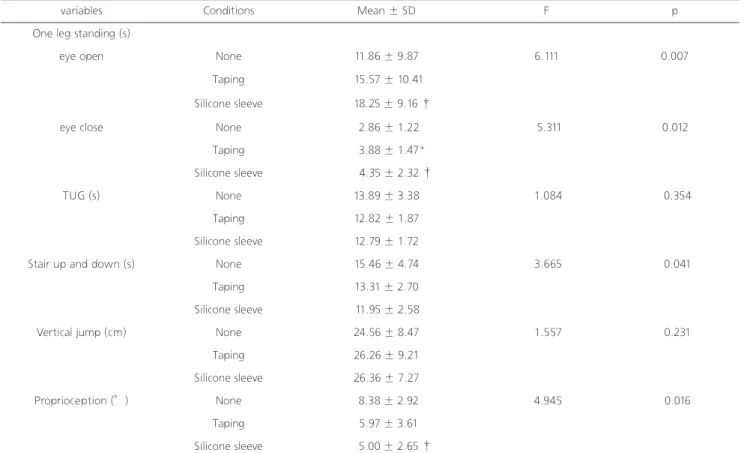
Among the clinical medical evaluation of standing with one leg for 30 seconds, the most significant effect appeared when wearing a silicone sleeve in the state of eyes-opened
with surgical side (p<0.01). In the state of eyes-closed when standing with one leg, the effects were showed both in wearing silicone sleeve and taping in the surgical side. In the evaluation of proprioception, in the surgical side wearing the silicone sleeve showed the significant effects compared to the state of non-wearing (p<0.05). In TUG, stair step test, and standing high jump silicone sleeve tended to get better compared to the state of wearing taping or nothing, but the significant differences were not appear statistically (Table 2).
2. Isokinetic thigh muscle strength
In the results of measurements of thigh muscle strength, when applying taping to the surgical side showed the significant improvement in quadriceps (extension) 180°/sec, hamstrings (flexion) 60°/sec than the state of non-wearing.
When wear silicone sleeve in the surgical side significant improvements were showed in both flexion and extension 60°/sec, 180°/sec than wearing nothing. However, silicon sleeve did not show significantly differences than applying the taping (Table 3).
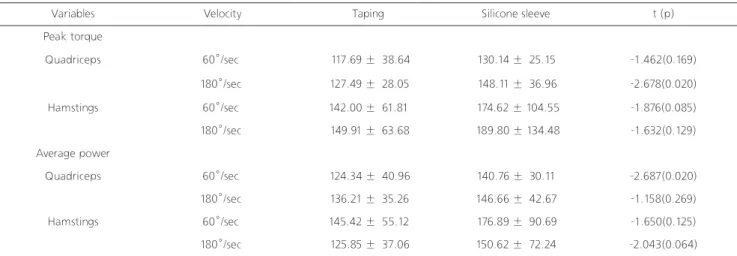
In order to compare the effect between the silicone sleeve and taping, on the basis of non-wearing the change rate of muscular strength (%) was compared when apply taping or silicone sleeve. Except for quadriceps 180°/sec on the peak torque and hamstrings 60°/sec on average power, the significant differences were not shown in the surgical side (Table 4).
Ⅳ. Discussion
In this study, 13 subjects with knee joint ACL surgical were analyzed dynamic balance test, jumping performance, proprioception, muscle strength and endurance in the state of non-wearing anything, applying taping, and wearing silicon sleeve on the knee. As a result, when wearing the taping and silicone sleeve, significant improvements in dynamic balance ability, proprioception, and muscle strength and endurance were confirmed. In addition, there was no report adverse events such as skin redness or discomfort in the subjects during the study in both taping and silicone sleeve.
The most important thing for sports athletes after the ACL surgery is to reduce the risk of re-injury. Once mechanoreceptors were damaged, it's hard to be fully restored to their original state1 so the management and rehabilitation through proper exercise are the most critical things, because the instability of knee and the after effects of atrophy and weakness of thigh muscle could be induced.19
A previous study of balance ability that applying taping to the ankle to figure out the improvements of balance, coordination and proprioceptive was not show the significant improvements when applying taping than without wearing anything. However the coordination, the results of functional
variables
Gender (male, female) 13, 0
Age (year) 28.27 ± 10.08 (17, 46) Height (cm) 175.09 ± 4.93 (165, 183) Weight (kg) 77.04 ± 8.80 (62.5, 86.0) Operation side (left, right) 3, 9
Duration (months) 2.25 ± 1.11 (1.03, 5.43) Table 1. General characteristics of the subjects
Values are mean ± SD
squat system, showed that the group with applying taping had more functional improvements than wearing nothing.14
In this study to see the ability of maintaining balance while standing with one leg, in the state of eyes-opened significant improvements were shown when wearing silicone sleeve.
In the state of eyes-closed while standing with one leg, both in wearing taping or silicone sleeve had the significant
improvements with the surgical side.
Due to wearing taping and silicone sleeve it is considered that with the physiological changes which promote the isolation of neurotransmitter which stimulates the nerve excitability of muscle and the action of visual elements to maintain the balance also affects it too. Taping and protector restrict the movement of the joints and are also the effective
TUG: timed up and go
*p<.05 : None vs Taping, †p<.05 : None vs silicone sleeve
*p<.05 : None vs Taping, †p<.05 : None vs silicone sleeve
variables Conditions Mean ± SD F p
One leg standing (s)
eye open None 11.86 ± 9.87 6.111 0.007
Taping 15.57 ± 10.41
Silicone sleeve 18.25 ± 9.16 †
eye close None 2.86 ± 1.22 5.311 0.012
Taping 3.88 ± 1.47*
Silicone sleeve 4.35 ± 2.32 †
TUG (s) None 13.89 ± 3.38 1.084 0.354
Taping 12.82 ± 1.87
Silicone sleeve 12.79 ± 1.72
Stair up and down (s) None 15.46 ± 4.74 3.665 0.041
Taping 13.31 ± 2.70
Silicone sleeve 11.95 ± 2.58
Vertical jump (cm) None 24.56 ± 8.47 1.557 0.231
Taping 26.26 ± 9.21
Silicone sleeve 26.36 ± 7.27
Proprioception (°) None 8.38 ± 2.92 4.945 0.016
Taping 5.97 ± 3.61
Silicone sleeve 5.00 ± 2.65 †
Variables Conditions Quadriceps Hamstings
60°/sec 180°/sec 60°/sec 180°/sec
Peak torque
None 84.00 ± 52.62 62.08 ± 32.80 49.62 ± 29.44 40.54 ± 23.19
Taping 94.69 ± 54.97 74.85 ± 33.16* 67.15 ± 39.00* 52.85 ± 27.03
Silicone sleeve 103.23 ± 52.21 † 84.00 ± 31.57 † 74.92 ± 40.25 † 58.31 ± 24.72 †
Average power
None 56.92 ± 36.96 88.62 ± 57.47 33.46 ± 20.42 63.15 ± 37.33
Taping 66.38 ± 38.26 113.00 ± 61.12* 46.54 ± 26.91* 74.46 ± 39.19
Silicone sleeve 74.00 ± 35.40 † 117.46 ± 58.03 † 51.69 ± 27.85 † 84.00 ± 42.07 † Table 2. Changes in balance, time up and go, stair up and down, vertical jump and proprioception on each conditions
Table 3. Changes of isokinetic on operated leg (% body weight)
tools which help to prevent patients from injuries, and perform a role of improving the ability such as coordination and proprioceptive to the damaged joints.14 The knee sleeves a significant increase in dynamic balance and provides beneficial support in more dynamic settings.20
Standing with on leg for 30 athletes who had a experience of ACL surgery and 30 healthy people were surveyed, the surgical side leg of athletes showed considerable fluctuations and asymmetry than healthy adults, and after 8 months it was reported that they still had an asymmetry in balance ability.6 From previous studies regarding 'does applying taping could bring a improvement of balance ability?', studies reporting a considerable improvement14,21,22 and the others reporting no difference4,15,23 have been showing in both. So the conclusion is still in hardness. In this study when applying taping, the significant improvements in proprioception, jump, ascending and descending stairs, TUG, and muscle endurance were not identified. On the other hand, in the case of silicone sleeve a significant improvement was confirmed in proprioception, balance, muscular strength and endurance. This improvement as taping or sleeve could make to help patients' early rehabilitation exercise.
In the measurement results that surveyed ACL surgery patients using isokinetic exercise equipment, in 60° / sec the defect rate of maximum strength showed the averages of 14%
and 6% respectively in extensor and flexor muscles of knee joint. Even after for 3.5 years of surgery, neither the defect rate in extensor muscles of the knee joint drop off to less than
10%24 nor the maximum muscular strength of muscle fully recovered to normal.25
Recently so as to complement these points, for the way to improve muscle function and abilities of performance and balance study was make by using taping26,27 or protectors.14,15
When patients with ACL injury landing after the jump, their hip joint could be inversion and internal rotation and the average of peak time had an increase. In vertical jump, knee joints were observed the reduction of flexion and inversion as well as deterioration of muscular strength and performance ability of vertical jump.2 In the study that comparing the difference between before and after of vertical jump,28 when using one's body to jump as much as possible after applying the method of spiral taping, there were no significant differences statistically either in values of ground reaction forces or muscle activity using a wireless EMG. In this study, vertical jump test did not have the significant differences in wearing nothing and wearing taping or silicone sleeve both.
In previous study, compression sleeve can improve the total integration of the balance control and muscle coordination to perform a standing drop jump and one legged balance task in patients with unilateral ACL reconstruction.29
With regard to the effect on proprioception of the knee joint, there was a study that taping did not affect the enhancement of proprioception,30 but when taping patients with PFPS whose proprioception is lower than normal, also there was a study reporting the improvement of proprioception (Callaghan, et al., 2008).
Variables Velocity Taping Silicone sleeve t (p)
Peak torque
Quadriceps 60°/sec 117.69 ± 38.64 130.14 ± 25.15 -1.462(0.169)
180°/sec 127.49 ± 28.05 148.11 ± 36.96 -2.678(0.020)
Hamstings 60°/sec 142.00 ± 61.81 174.62 ± 104.55 -1.876(0.085)
180°/sec 149.91 ± 63.68 189.80 ± 134.48 -1.632(0.129)
Average power
Quadriceps 60°/sec 124.34 ± 40.96 140.76 ± 30.11 -2.687(0.020)
180°/sec 136.21 ± 35.26 146.66 ± 42.67 -1.158(0.269)
Hamstings 60°/sec 145.42 ± 55.12 176.89 ± 90.69 -1.650(0.125)
180°/sec 125.85 ± 37.06 150.62 ± 72.24 -2.043(0.064)
Table 4. Change rates of isokinetic on operated leg (%)
The application of taping provides positive effects such as increasing the skin sensation by providing the proprioceptive signal, or shortening the time for the muscles mobilization by improving the feedback mechanism of proprioception.31,32 The improvements of proprioceptive sensibility can bring the basis of improvements of balance, and when applying taping to knee or silicone sleeve which used in this study it could bring the stability of the knee and improvements of proprioceptive sense's feedback mechanism in patients with ACL surgery, so the presence of improvements in balance ability is confirmed through this. In previous study, knee sleeve was of very small magnitude change the proprioception chronic subjects with ruptured ACL, but did not appear to be significant.33
For isokinetic equipment 60°/sec, 120°/sec, 180°/sec are commonly used, 60°/sec is for muscular strength, and 180°/sec is used as an indicator for muscular endurance to see.34 In this study, in order to investigate the muscular strength changes in hamstring and quadriceps the maximum and average muscular strength are measured by dividing the angular velocity into 60°/sec and 180°/sec. ACL induces the tensions to stabilize the extended knee joint35, in case of injury than hamstring the atrophy of quadriceps is caused easily than before damaged, about 1/3 of the value of the torque is reduced so that it would be an unstable condition.36
Studies on the effects of taping and protectors, by using the protectors involutes instability of joint could be reduced significantly and it also provide the support and stability to joint.37,38 Also when applying taping to normal adults there was a study that no immediate improvement was founded in muscular strength,26 on the other hand, in the case of taping patients with knee joint syndrome the effect of increase in muscular strength of the quadriceps was showed.39 And taping applied to quadriceps helps either to increase muscular strength or decrease muscle fatigue.27
In this study, in the state of applying silicone sleeve and none condition to surgical side of knee, the muscle strengths were evaluated on angular velocity of 60°/sec, 180°/sec. Only in the case of wearing silicone sleeve to hamstring and quadriceps both, muscular strength and endurance significantly increased (p<.001). And in the case of wearing nothing and applying taping, the hamstring
muscle in angular velocity of 60°/sec and quadriceps muscle in 180°/sec, significant improvements in muscle endurance were confirmed (p<0.001). In angular velocity of 60°/sec both in surgical, average muscular strength's change rate of quadriceps showed a significant improvement after wearing silicone sleeve (p<0.05). In addition, when wearing the silicone sleeve in the angular velocity of 180°/sec, the surgical side of quadriceps' maximum strength showed a significant increase than applying taping (p <0.05). Hamstring muscle's average strength did not show the significant differences to the side of the surgery, but tended to improve.
The mechanism of the improvement of muscular strength through taping is described by tissue movement reflection, the spatial summation, and the phenomenon of diffusion and reciprocal innervations.40 Thus, through the wearing of taping or silicone sleeve it could stimulate the muscle spindle, tendons, and capillaries, bring an increase in the muscular strength by causing muscle contraction. The taping or silicon sleeve seemed to show the improvements of muscle endurance on account of pain relief.
Also the application of taping or silicone sleeve conducted in this study, by reducing the deviation and rotation through the protection of the knee joint it can bring the improvements of stability and is considered to affect the exercise that requires the multi-joint movement control and coordination such as jumping and climbing stairs.
There are several limitations in this study. First, the subjects of this study were 13 patients, so it's difficult to generalize the effect of the silicone sleeve. It is the study that observes the patients with ACL surgery for one year in the hospital where the study was conducted, but the number of candidates who had operation was small for one year is the limitation of study. Second, protectors such as taping or silicone sleeve generally can bring the placebo effect which could reduce the risk of re-injury or make the condition to get better.15 To minimize the influence of placebo effect it was performed in a random order in every measurement condition, but in a clinical study such as medical equipment it could be a limitation that blind test couldn't be carried out to subjects.
However, even considering such effects taping or silicone sleeve could bring the potential benefits to the ACL injury
patients.
Depending on the results of this study, the silicone sleeve has the advantage of light and is easily wearable by oneself, and it minimizes the side effects such as skin rash in taping but also maintains the function of itself. In addition, it shows the movement functions, prevents the abnormal movements, and is seemed to be able to use for patients with ACL as well as knee injury as its purpose of protecting the joints and muscles. In recent years, knee sleeve in various production are easy to see for preventive purposes or functional movement.41
In this study, significant improvements of balance ability, proprioception, muscular strength and endurance are confirmed, but did not confirmed in the functional as TUG and jump height. It means that taping or silicone sleeve could affect the immediate changes to balance, proprioception, muscular strength and endurance, however, couldn't affect to functional movement. Further studies are needed to explore the improvements by applying silicone sleeve to the patients with ACL in a long-term.
Therefore, provided that you utilize the protector such as silicone sleeve properly according to the purpose of use and doctor's diagnosis, the knee silicone sleeve improved of the balance, prorioception, muscular strength and endurance by using it for patients with ACL.
References
1. Bonfim TR, Jansen Paccola CA, Barela JA. Proprioceptive and behavior impairments in individuals with anterior cruciate ligament reconstructed knees. Arch Phys Med Rehabil.
2003;84(8):1217-23.
2. Delahunt E, Sweeney L, Chawke M et al. Lower limb kinematic alterations during drop vertical jumps in female athletes who have undergone anterior cruciate ligament reconstruction. J Orthop Res. 2012;30(1):72-8.
3. Johansson H, Sjolander P, Sojka P. A sensory role for the cruciate ligaments. Clin Orthop Relat Res. 1991(268):161-78.
4. Karasel S, Akpinar B, Gulbahar S et al. Clinical and functional outcomes and proprioception after a modified accelerated rehabilitation program following anterior cruciate ligament reconstruction with patellar tendon autograft. Acta Orthop Traumatol Turc. 2010;44(3):220-8.
5. Gustavsson A, Neeter C, Thomee P et al. A test battery for evaluating hop performance in patients with an ACL injury and
patients who have undergone ACL reconstruction. Knee Surg Sports Traumatol Arthrosc. 2006;14(8):778-88.
6. Mohammadi F, Salavati M, Akhbari B et al. Static and dynamic postural control in competitive athletes after anterior cruciate ligament reconstruction and controls. Knee Surg Sports Traumatol Arthrosc. 2012;20(8):1603-10.
7. Miralles I, Monterde S, Montull S et al. Ankle taping can improve proprioception in healthy volunteers. Foot Ankle Int.
2010;31(12):1099-106.
8. Callaghan MJ, Selfe J, McHenry A et al. Effects of patellar taping on knee joint proprioception in patients with patellofemoral pain syndrome. Man Ther. 2008;13(3):192-9.
9. Herrington L. The effect of corrective taping of the patella on patella position as defined by MRI. Res Sports Med.
2006;14(3):215-23.
10. Richette P, Sautreuil P, Coudeyre E et al. Usefulness of taping in lower limb osteoarthritis. French clinical practice guidelines.
Joint Bone Spine. 2008;75(4):475-8.
11. van den Ende E. Taping reduces pain and disability in patients with knee osteoarthritis. Aust J Physiother. 2004;50(3):186.
12. Aktas G, Baltaci G. Does kinesiotaping increase knee muscles strength and functional performance? Isokinetics and Exercise Science. 2011;19(3):149-55.
13. Mostamand J, Bader DL, Hudson Z. The effect of patellar taping on joint reaction forces during squatting in subjects with Patellofemoral Pain Syndrome (PFPS). J Bodyw Mov Ther.
2009;12(3):388-92.
14. Ozer D, Senbursa G, Baltaci G et al. The effect on neuromuscular stability, performance, multi-joint coordination and proprioception of barefoot, taping or preventative bracing.
Foot (Edinb). 2009;19(4):205-10.
15. Hopper D, Samsson K, Hulenik T et al. The influence of Mulligan ankle taping during balance performance in subjects with unilateral chronic ankle instability. Phys Ther Sport.
2009;10(4):125-30.
16. Segal NA. Bracing and orthoses: a review of efficacy and mechanical effects for tibiofemoral osteoarthritis. PM 2012;4(5):89-96.
17. Stones MJ, Kozma A, Stones L. Fitness and health evaluations by older exercisers. Can J Public Health. 1987;78(1):18-20.
18. Hinman RS, Bennell KL, Crossley KM et al. Immediate effects of adhesive tape on pain and disability in individuals with knee osteoarthritis. Rheumatology (Oxford). 2003;42(7):865-9.
19. McDaniel WJ, Jr., Dameron TB, Jr. Untreated ruptures of the anterior cruciate ligament. A follow-up study. J Bone Joint Surg Am. 1980;62(5):696-705.
20. Strutzenberger G, Braig M, Sell S et al. Effect of brace design on patients with ACL-ruptures. Int J Sports Med. 2012;33(11):934- 9.
21. Broglio SP, Monk A, Sopiarz K et al. The influence of ankle support on postural control. J Sci Med Sport. 2009;12(3):388-92.
22. Barkoukis V, Sykaras E, Costa F et al. Effectiveness of taping and bracing in balance. Percept Mot Skills. 2002;94(2):566-74.
23. Delahunt E, McGrath A, Doran N et al. Effect of taping on actual and perceived dynamic postural stability in persons with chronic ankle instability. Arch Phys Med Rehabil.
2010;91(9):1383-9.
24. Natri A, Jarvinen M, Kannus P. Primary repair plus intra- articular iliotibial band augmentation in the treatment of an acute anterior cruciate ligament rupture. A follow-up study of 70 patients. Arch Orthop Trauma Surg. 1996;115(1):22-7.
25. Bin SI, Cho WS, Moon HS et al. Cybex evaluation of muscle strength following arthroscopic anterior cruciate ligament reconstruction. J of Korean Orthop Assoc. 1995;30(2):262-8.
26. Fu TC, Wong AM, Pei YC et al. Effect of kinesio taping on muscle strength in athletes-a pilot study. J Sci Med Sport.
2008;11(2):198-201.
27. Jung DI. Effect of elastic taping on muscle strength and fatigue in quadriceps femoris. Korea sport research. 2005;16(5):171-9.
28. Lee JH, Lee YS. The Effect of sports taping on lower extremity muscles in vertical jump. Korean Journal of Sport Biomechanics.
2010;20(4):407-14.
29. Kuster MS, Grob K, Kuster M et al. The benefits of wearing a compression sleeve after ACL reconstruction. Med Sci Sports Exerc. 1999;31(3):368-71.
30. Callaghan MJ, Selfe J, Bagley PJ et al. The effects of patellar taping on knee joint prioprioception. J Athl Train. 2002;37(1):19-24.
31. Refshauge KM, Kilbreath SL, Raymond J. The effect of recurrent ankle inversion sprain and taping on proprioception at
the ankle. Med Sci Sports Exerc. 2000;32(1):10-5.
32. Robbins S, Waked E, Rappel R. Ankle taping improves proprioception before and after exercise in young men. Br J Sports Med. 1995;29(4):242-7.
33. Beynnon BD, Ryder SH, Konradsen L et al. The effect of anterior cruciate ligament trauma and bracing on knee proprioception.
Am J Sports Med. 1999;27(2):150-5.
34. O'sullivan SB, Schmitz TJ. Physical Rehabilitation. Fifth edition ed, F.A. Davis, 2007:183-184.
35. Neumann DA. Kinesiology of the musculoskeletal system, Mosby, 2004:489-517.
36. Gerber C, Hoppeler H, Claassen H et al. The lower-extremity musculature in chronic symptomatic instability of the anterior cruciate ligament. J Bone Joint Surg Am. 1985;67(7):1034-43.
37. Gross MT, Everts JR, Roberson SE et al. Effect of Donjoy ankle ligament protector and aircast sport stirrup orthoses on functional performance. J Orthop Sports Phys Ther.
1994;19(3):150-6.
38. Gross MT, Batten AM, Lamm AL et al. Comparison of DonJoy ankle ligament protector and subtalar sling ankle taping in restricting foot and ankle motion before and after exercise. J Orthop Sports Phys Ther. 1994;19(1):33-41.
39. Shelton GL. Conservative management of patellofemoral dysfunction. Prim Care. 1992;19(2):331-50.
40. Gilleard W, McConnell J, Parsons D. The effect of patellar taping on the onset of vastus medialis obliquus and vastus lateralis muscle activity in persons with patellofemoral pain. Phys Ther.
1998;78(1):25-32.
41. Gerrard DF. External knee support in rugby union. Effectiveness of bracing and taping. Sports Med. 1998;25(5):313-7.