Heterotopic ossification in abdominal incisions is a rare condition occuring after abdominal surgery which has involved, typically, a midline incision toward the xiphoid process above and the symphysis pubis below.
It involves the formation of osseous, cartilaginous and occasionally myelogenous elements within an abdomi- nal wound, and may be misinterpreted as a retained for- eign body or incisional neoplastic recurrence (1-3). A few cases have been reported in the surgical literature, but radiologic reports are scarce (1, 4, 5). The authors re- port a case of heterotopic ossification occurring after ab- dominal incision; the CT findings and a review of the lit- erature are included.
Case Report
A 59-year-old man who complained of easy fatigability and had a tender, palpable, epigastric mass was referred
to our hospital. He had a clinical history of vagotomy and pyloroplasty due to gastric ulcer perforation about ten years earlier. On physical examination, a hard and fixed mass along the incision scar was palpated in the upper midabdomen.
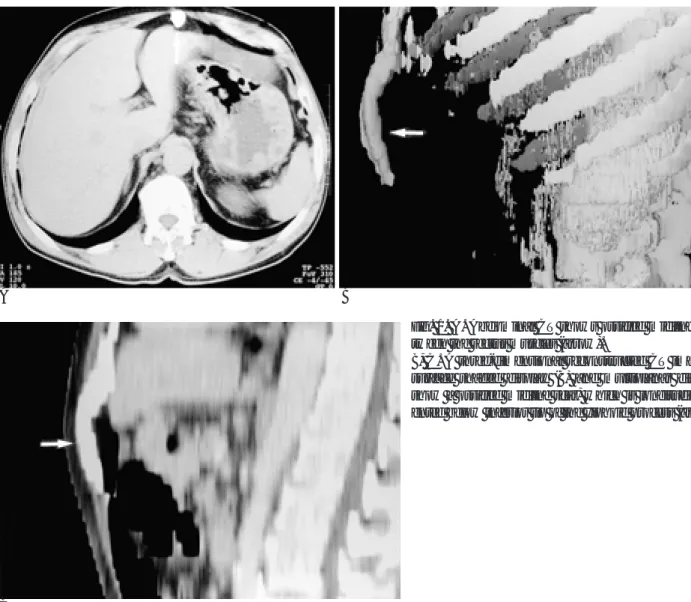
Plain abdominal radiography and abdominal CT scan- ning were performed; the former revealed a tubular, cal- cified density in the upper midabdomen. Abdominal CT (Somatom Plus-4, Siemens, Erlangen, Germany) re- vealed focal dense calcification in the properitoneal fat layer along the upper midabdominal incisional scar (Fig.
1A). A three-dimensional reconstructed image with sur- face-shaded display and multiplanar reformation showed a longitudinally oriented, dense, calcified or os- sified tubular lesion in the upper midabdominal wall that approximated to the xiphoid process (Fig. 1B, C).
Because we had never encountered a lesion of this kind in an incisional scar, we initially suggested dystrophic calcification or a foreign body reaction in the incisional scar, but then -because of the shape and location, typical of that previously described in the literature- diagnosed heterotopic ossification of a midline abdominal wall in- cision. In our case, the symptoms were mild and CT re- vealed no evidence of a soft tissue mass component sug- gesting malignancy. A conservative approach to man-
J Korean Radiol Soc 2001;45:191-193
─ 191 ─
Heterotopic Ossification in Abdominal Incision: A Case Report1
Yoon Sik Yoo, M.D., Kung Sook Nam, M.D., Im Kyung Hwang, M.D., Heung Chul Kim, M.D.
Heterotopic ossification in abdominal incision is a rare post-surgical sequala and a subtype of myositis ossificans traumatica. Recognition of this rare condition is impor- tant because it may be misinterpreted as a retained foreign body or incisional neoplas- tic recurrence. We report a case involving a 59-year-old man who presented with a pal- pable epigastric mass and pronounced fatigability.
Index words : Myositis
Abdomen, abnormalities Surgery
1Department of Radiology, College of Medicine, Hallym University, South Korea
Received February 1, 2001 ; Accepted June 20, 2001
Address reprint requests to : Sook Namkung, M.D., Department of Radiology, Chuncheon Sacred Heart Hospital, 153 Kyo-dong, Chuncheon, Kangwon-do 200-060, South Korea.
Tel. 82-33-252-9970(158), Fax. 82-33-242-7085 E-mail: [email protected]
agement, aimed at relieving the symptoms without sur- gical excision, was therefore taken.
Discussion
Heterotopic ossification of midline abdominal scars is a subtype of myositis ossificans traumatica, a condition involving calcification and subsequent ossification after trauma or surgery in which osseous, cartilaginous and occasionally myelogenous elements develop within a scar. The presence of these cartilaginous and bony ele- ments distinguishes this entity from dystrophic calcifica- tion (1, 2). Histologically, the ossified scars are com- posed of mature bone with marrow and cartilaginous el- ements surrounded by fibrous tissue (1, 4, 5). Hetero- topic ossification in abdominal scars is an uncommon sequela of abdominal surgery, having been noted only within longitudinal incisions, never within those which
are transverse. It may cause abdominal discomfort or mimic a retained foreign body or recurrence of a malig- nant condition (1, 3). In general, bone forms within a few months and almost always within one year of surgery (3). Heterotopic ossification in abdominal inci- sions is clearly male dominant but the exact cause is un- known.
There are two main theories of causation (1, 3-5). The first is that small particles from the periosteum or peri- chondrium of the xiphoid process or symphysis pubis are inoculated during surgery into the surgical wounds and subsequently lead to bone formation; the theory is supported by the fact that most cases reported in the current literature have occurred after surgery involving vertical incision either from the xiphoid process or to the symphysis pubis. Our patient, too, had undergone up- per midline incision, starting from the xiphoid process.
This theory does not, however, adequately explain why
Yoon Sik Yoo, et al: Heterotopic Ossification in Abdominal Incision
─ 192 ─ A
C
B
Fig. 1. A. Abdominal CT shows ossified midline scar be- tween the rectus muscles (arrow).
B, C. A three-dimensional reconstructed CT images with surface shaded display (B) and multiplanar display (C) show a ossified midline scar, which is longitudinally ori- ented below inferior tip of the xiphoid process (arrow).
heterotopic ossification is infrequent after orthopedic surgery, which leaves a scar exposed to large numbers of osseous particles, or why bone formation in abdomi- nal scars bears no close relation to osseous tissue.
According to the second theory, heterotopic ossification arises when immature pluripotent mesenchymal cells differentiate to osteoblasts or chondroblasts in reaction to local injury, resulting in bone formation. This theory does not, though, adequately explain the occurrence of heterotopic ossification only in vertical incisions (3, 4, 5).
Jacobs et al. made an alternative suggestion, namely that excessive suture line tension (which may lead to intra- muscular inplantation and ossification of periosteal par- ticles torn from sites of muscular insertion into bone), with or without associated fascial margin necrosis, may be responsible for a predisposition to heterotopic ossifi- cation (1). The literature appears to provide no correla- tion between wound complications such as infection, keloid, or hyperplastic scars, and the formation of het- erotopic calcification. Nor does there appear to be -ei- ther in our case or in the literature- any endocrine, meta- bolic or biochemical disorder, and nor is their apparent correlation with type of closure or any specific suture material or technique (1, 3, 4, 5).
Radiologically, heterotopic ossification typically ap- pears as a longitudinally oriented dense tubular bony structure in a midline abdominal scar between bilateral rectus abdominis muscles, and it is important to distin- guish this benign entity from other postoperative com- plications such as wound infection or a retained foreign body, from an intraincisional mass, and from a primary or metastatic neoplasm such as endometrioma,
desmoid, osteosarcoma or mucinous adenocarcinoma.
This distinction may be made by correlating clinical his- tory with the typical imaging appearance of hetrotopic scar ossification (1).
The treatment of heterotopic ossification in abdominal incisions should be restricted to patients with discom- fort. The main treatment modality is surgical excision with primary closure. Non-steroidal anti-inflammatories such as ibuprofen or indomethacin, or external radio- therapy, can be used as a preventive method after surgery involving midline abdominal incision or for the prevention of recurrence after primary excision of het- erotopic ossification (6). In conclusion, a diagnosis of heterotopic ossification in abdominal incisions should be considered if a mass is palpated in patients who have previously undergone abdominal surgery and in whom a dense vertical calcified or ossified lesion along the inci- sional scar is revealed by imaging.
References
1. Jacobs JE, Birnbaum BA, Siegelman ES. Heterotopic ossification of midline abdominal incisions: CT and MR imaging findings. AJR Am J Roentgenol 1996;166:579-584
2. Juhl JH, Crummy AB. Essentials of radiologic imaging, 6th ed.
Philadelphia: Lippincott, 1993:362-363
3. Reardon MJ, Tillou A, Mody DR, Reardon PR. Heterotopic calci- fication in abdominal wounds. Am J Surg 1997;13:145-147 4. Marteinsson BTH, Musgrove JE. Heterotopic bone formation in
abdominal incisions. Am J Surg 1975;130:23-25
5. Apostolidis NS, Legakis NC, Gregoriadis GC, Androulakakis PA, Romanos AN. Heterotopic bone formation in abdominal operation scars. Am J Surg 1981;142:555-559
6. McLaren AC. Prophylaxis with indomethacin for heterotopic bone. J Bone Joint Surg 1990;72-A:245-247
J Korean Radiol Soc 2001;45:191-193
─ 193 ─
대한방사선의학회지 2001;45:191-193
복부 절개 부위의 이소성 골화: 1예 보고1
1한림대학교 의과대학 방사선과학교실
유윤식・남궁숙・황임경・김흥철
복부 절개 부위의 이소성 골화는 술후에 드물게 발생하는 합병증으로 외상성 골화성 근막염의 일종으로 알려져 있다.
이 질환은 술후 절개 부위의 암 재발이나 술후 남겨진 이물 등과 혼동될 수 있다. 저자들은 복부 종괴와 피로감을 주소 로 내원한 59세 남자의 복부 절개 부위의 이소성 골화증 1예를 보고하고자 한다.