• 검색 결과가 없습니다.

RT-PCR Targeting rpoB mRNA for Drug Susceptibility Test of Mycobacterium tuberculosis in Liquid Culture

N/A
N/A
Protected

Academic year: 2021

Share "RT-PCR Targeting rpoB mRNA for Drug Susceptibility Test of Mycobacterium tuberculosis in Liquid Culture"

Copied!
5
0
0

로드 중.... (전체 텍스트 보기)

전체 글

(1)

Biomedical Science Letters 2016, 22(4): 215~219 http://dx.doi.org/10.15616/BSL.2016.22.4.215 eISSN : 2288-7415

RT-PCR Targeting rpoB mRNA for Drug Susceptibility Test of Mycobacterium tuberculosis in Liquid Culture

Hyunwoo Jin

Department of Clinical Laboratory Science, College of Health Sciences, Catholic University of Pusan, Busan 46252, Korea

The problems of tuberculosis and its drug resistance are very severe. Therefore, rapid and accurate drug susceptibility assay is required. Recently, there has been an increased understanding of the genetic mechanism of Mycobacterium tuberculosis (MTB) drug resistance as well as advancement of molecular technologies. While many gene mutations correlate well with drug resistance, many genes do not show a strong correlation with drug resistance. For this reason, the current study assessed the utility of rpoB mRNA as a target to detect live mycobacteria. In this study, RT-PCR targeting of rpoB mRNA in BCG treated with rifampin was performed. Conventional RT-PCR and real-time PCR targeting rpoB mRNA as well as 85B mRNA was performed to determine whether these two methods could distinguish between viable and non-viable MTB. The levels of rpoB and 85B mRNA detected by RT- PCR were compared in parallel with colony forming unit counts of BCG that were treated with rifampin for different periods of time. The data suggests that that even though both mRNA levels of rpoB and 85B decreased gradually when rifampin-treatment increased, the rpoB mRNA seemed to represent live bacteria better than 85B mRNA. This study clearly indicates that RT-PCR is a good method to monitor viable cell counts in the liquid culture treated with the anti-tuberculosis drug.

Key Words: Mycobacterium tuberculosis, mRNA, rpoB, Drug susceptibility test, RT-PCR

INTRODUCTION

Tuberculosis (TB) continues to be the leading cause of morbidity and mortality by an infectious disease worldwide (Martin et al., 2000; Raviglione, 2003; Russell, 2001; Jung et al., 2016). In recent estimates, approximately 10.4 million people have been known to develop TB and 1.8 million people have been reported to die of complications associated with the disease (WHO, 2016). In total, 3,000 deaths occur in Korea every year (Dye, 1999; Kim et al., 2014). It is also

estimated that 30% to 60% of adults in developing countries are infected, with TB being the first cause of death among people over 5 years of age (Cho et al., 2014). Moreover, the emergence of drug resistance in recent years had had a great effect on the control strategy for the treatment of TB patients (Dorman et al., 2007; Mitnick et al., 2008). The rapid spread of drug resistance, especially multidrug-resistant (MDR) TB, defined as resistance to at least rifampin and isoniazid, is of great concern. In total, 450,000 new MDR-TB cases are estimated to occur every year. Recently, reports of strains with extensively drug-resistant (XDR) TB were defined as

Brief Communication

*Received: October 24, 2016 / Revised: December 16 / Accepted: December 16, 2016

Corresponding author: Hyunwoo Jin. Department of Clinical Laboratory Science College of Health Sciences, Catholic University of Pusan, Busan 46252, Korea.

Tel: +82-51-510-0567, Fax: +82-51-510-0568, e-mail: [email protected]

CThe Korean Society for Biomedical Laboratory Sciences. All rights reserved.

CCThis is an Open Access article distributed under the terms of the Creative Commons Attribution Non-Commercial License (http://creativecommons.org/licenses/by-nc/3.0/) which permits unrestricted non-commercial use, distribution, and reproduction in any medium, provided the original work is properly cited.
(2)

MDR-TB in addition to strains resistant to any fluoro- quinolone, and to at least one of three injectable second-line drugs (amikacin, capreomycin, or kanamycin) (CDC, 2007;

WHO, 2006). XDR-TB emerged as a global health priority in 2006 and has so far been confirmed in more than 45 countries (WHO, 2008).

The most commonly used TB regimen is painful and takes a long time; it consists of isoniazid, rifampin, ethambutol and pyrazinamide administered chemotherapy daily for 8 weeks, followed by isoniazid and rifampin given daily, twice a week, or three times a week for 16 weeks (Combs et al., 1990). Therefore, it is important to test whether the chemo- therapy would be effective for patients before treatment (Desjardin et al., 1998, 1999; Hellyer et al., 1999). However, in clinical settings, it is often difficult to obtain the results from a drug susceptibility test (DST) before chemotherapy because of the slow growth rate of Mycobacterium tuber- culosis in culture (Palomino et al., 2006; Ruiz et al., 2004).

In addition, the conventional cultural DST is labor intensive and require highly trained expertise that only reference laboratories can perform the test, and this certainly requires even more time.

In this study, as an attempt to shorten the turnaround time of DST using culture, the utility of rpoB mRNA targeting by RT-PCR as a marker for counting viable M. tuberculosis in the drug-treated culture was evaluated. The rationale was that if bacteria survive in the drug treated culture, it indi- cates the bacteria are resistant to that drug, and the viability of the bacteria can be quantified using RT-PCR. This study hypothesized that RT-PCR targeting mRNA can be a useful method to monitor cell viability, as unlike bacterial DNA or rRNA, mRNA is typically short -lived, with a half-life of only a few minutes (Hellyer et al., 1996, 1999). In addition, the data showed rpoB, which encodes the β-subunit of the RNA polymerase, can be a sensitive marker, as it is one of the essential house-keeping genes of M. tuberculosis where, it is expressed if there is any viable cells remain, which can be important as a surrogate marker for cells viability.

MATERIALS AND METHODS

M. bovis BCG was cultured in 7H9 broth for 7 to 14 days

before treatment of rifampin. Subsequently, the culture was treated with 2 μg/ml of rifampin and the culture was taken at different periods of times for subsequent tests. First, to measure the viable cell numbers after rifampin treatment, colony forming unit (CFU) counts were carried out for eight dilutions in duplicate. The CFU test was done 3 times in- dependently. The method was performed a mycobacterio- phage assay using the same BCG culture previously used for CFU counts and RT-PCR. Mycobacteriophage assay was performed as previously described by Banaiee et al. In brief, MBA was performed as follows. First, 200 μl of cultured BCG was added to each 1.5 ml conical tube, and the tube was infected with 50 μl of phage phAE40, and the tube was returned to the incubator. At 2 hr post-phage infection, 100 μl aliquots of each tube were transferred to 96 well plates for quantitative luciferase assay in the luminometer. Phage phAE40 DNA contains FFlux on a cosmid inserted into a nonessential region of the parent phage TM4 (gift from William. R. Jacobs (Howard Hughes Medical Institute, Albert Einstein College of Medicine, Bronx, New York, USA).

RESULTS AND DISCUSSION

Even after treatment of rifampin at a 2 μg/ml concen-

tration, not all bacteria died. Instead, the number of bacteria

rather slowly decreased (Fig. 1). It took more than two

days for the number to reach half of the initial cell number

and took five days to kill all remaining bacteria present in

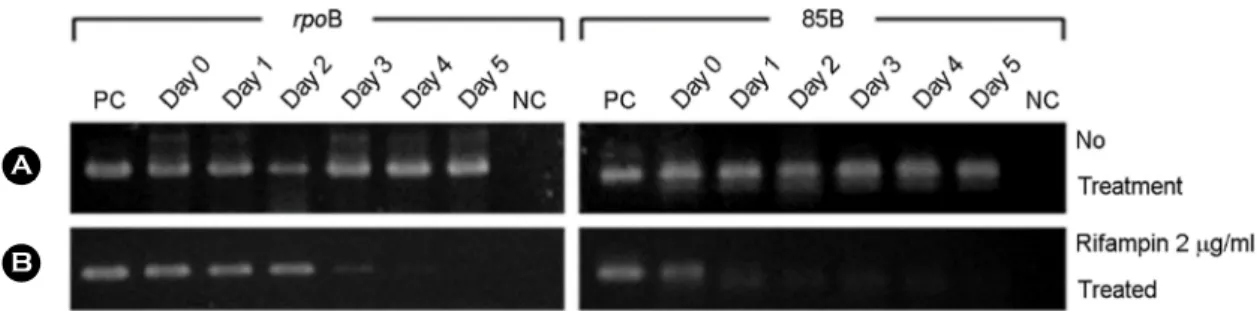
the liquid culture. The level of rpoB mRNA decreased grad-

ually and was undetectable by RT-PCR after four days of

rifampin treatment. On the other hand, the level of 85B (alpha

antigen) mRNA decreased dramatically and was undetectable

after one day of rifampin treatment, indicating different

target genes for RT-PCR could deliver different information

on the level of bacterial viability. In this case, it appeared

that the level of rpoB mRNA, which is one of the house-

keeping genes of the bacteria, persisted if viable bacteria

remained in the culture, as shown by the result of the CFU

test. On the other hand, the level of 85B mRNA which may

not be essential for the viability of the bacteria, decreased as

cell viability decreased (Fig. 2). The results from this experi-

ment seem to suggest that RT-PCR targeting rpoB mRNA

(3)

can be useful to monitor the viability of the bacteria.

In brief, the signals from the mycobacteriophage assay rapidly dropped after one day of rifampin treatment. The overall profile of the data from the mycobacteriophage assay was more similar to the RT-PCR result using 85B mRNA, which showed a rapid level decrease after one day of rifampin treatment than the CFU counts or RT-PCR results using rpoB mRNA (Fig. 3). It may be because the mycobacteriophage, which infects metabolically active cells, generates more signals than stressed bacteria by the drug;

thus, the signals from the phage may be generated when there are more metabolically active cells are present in one day of rifampin treatment. Therefore, it seems clear from

this experiment that the level of 85B mRNA represents the metabolically active cells in the culture, while the level of rpoB mRNA represents any viable bacteria in the culture.

In summary, this data seem to indicate that RT-PCR targeting rpoB mRNA can be a useful method to monitor viable cell counts in the liquid culture treated with the anti- TB drug. The combined use of liquid culture with the known inoculum size of the bacteria and the subsequent use of RT-PCR targeting rpoB mRNA would certainly reduce the length of the culture period needed for conventional DST and reduce the chance of misdiagnosing susceptible isolates to be resistant, which happen to be grown in the culture treated for an extensively long period that sometimes results

Figure 1. Mean bacterial counts of M. bovis BCG obtained by the colony forming unit (CUF) test. The results represent a slow drop in the number of viable M. bovis BCG after treatment with 2 μg of rifampin per ml of culture.

Figure 2. RT-PCR results targeting rpoB mRNA and 85B mRNA. (A) M. bovis BCG not treated with rifampin. Both rpoB and 85B mRNA appear regular. (B) M. bovis BCG treated with 2 μg of rifampin per ml for a period of days. The rpoB mRNA disappears on day 4, but the 85B mRNA vanishes on day 1. Lane PC, positive control (amplification product of PCR performed with DNA extracted from M.

tuberculosis H37Rv), NC, negative control.

Figure 3. Luciferase activity of BCG infected with phAE40.

M. bovis BCG was either not treated or treated with 2 μg of rifampin

per ml culture. The results are expressed as the mean of duplicate

experiments ± standard deviations. RLU, relative light units.

(4)

in the decreased activity of the drug. In addition, the com- bined use of liquid culture and RT-PCR can be used for testing the DST of any anti-TB drugs and is not limited to liquid-based DSTs, which are available currently.

However, contrary to expectations, even though this study used BCG, which is susceptible to rifampin, not all cells in the culture died right after rifampin treatment, and it took more than five days for all the cells to die. In this regard, it seems necessary to perform RT-PCT targeting rpoB RNA to monitor cell viability in the liquid culture for up to five days of rifampin treatment to verify whether there are any viable bacteria remain. Regardless, this method showed the possibility of the DST employing RT-PCR targeting rpoB mRNA; it also seems clear that the same types of experi- ments must be conducted with other anti-TB drugs to deter- mine when RT-PCR must be carried out, as well as the clinical specimens that may contain various proportions of resistant strains mixed with susceptible strain in the clinical specimens.

Acknowledgement

This paper was supported by RESEARCH FUND from Catholic University of Pusan.

Conflict of interest

The author declares no competing financial interests.

REFERENCES

Banaiee N, Bobadilla-Del-Valle M, Bardarov S Jr, Riska PF, Small PM, Ponce-De-Leon A, Jacobs WR Jr, Hatfull GF, Sifuentes- Osornio J. Luciferase reporter mycobacteriophages for de- tection, identification, and antibiotic susceptibility testing of Mycobacterium tuberculosis in Mexico. J Clin Microbiol. 2001.

39: 3883-3888.

Centers for Disease Control and Prevention. Extensively drug- resistant tuberculosis-United States. MMWR. 2007. 56: 250 -253.

Cho JE, Cho SN, Cho SA. RpoB peptide derived from Myco- bacterium tuberculosis is processed and presented to HLA- A*0201 restricted CD8+ T Cells via an alternate HLA-I pro- cessing pathway. Biomed Sci Lett. 2014. 20: 250-255.

Combs DL, O'Brien RJ, Geiter LJ. USPHS tuberculosis short-

course chemotherapy trial 21: effectiveness, toxicity, and acceptability. Ann Intern Med. 1990. 112: 397-406.

Desjardin LE, Chen Y, Perkins MD, Teixeira L, Cave MD, Eisenach KD. Comparison of the ABI 7700 System (TaqMan) and competitive PCR for quantification of IS6110 DNA in sputum during treatment of tuberculosis. J Clin Microbiol. 1998. 36:

1964-1968.

Desjardin LE, Perkins MD, Wolski K, Haun S, Teixeira L, Chen Y, Johnson JL, Ellner JJ, Dietze R, Bates J, Cave MD, Eisenach KD. Measurement of sputum Mycobacterium tuberculosis messenger RNA as a surrogate for response to chemotherapy.

Am J Respir Crit Care Med. 1999. 160: 203-210.

Dorman SE, Chaisson RE. From magic bullets back to the magic mountain: the rise of extensively drug-resistant tuberculosis.

Nat Med. 2007. 13: 295-298.

Dye CS, Schelle P, Dolin V, Pathania, Raviglione MC. Global burden of tuberculosis: estimated incidence, prevalence, and mortality by country. JAMA. 1999. 282: 677-686.

Hellyer TJ, Desjardin LE, Teixeira L, Perkins MD, Cave MD, Eisenach KD. Detection of viable Mycobacterium tuberculosis by reverse transcriptase-strand displacement amplification of mRNA. J Clin Microbiol. 1999. 37: 518-523.

Hellyer T, Fletcher TW, Bates JH, Stead WW, Templeton GL, Cave MD, Eisenach KD. Strand displacement amplification and the polymerase chain reaction for monitoring response to treatment in patients with pulmonary tuberculosis. J Infect Dis. 1996. 173: 934-941.

Jung D, Lee H, Park S. Mycobacterium tuberculosis DNA detection and molecular drug susceptibility test in AFB-stained sputum slides. Biomed Sci Lett. 2016. 22: 24-28.

Kim SH, Park SJ, Lee HY. Changes of cytokine and chemokine mRNA expression in whole blood cells from active pulmonary tuberculosis patients after T-Cell mitogen and Mycobacterium tuberculosis specific antigen stimulation. Biomed Sci Lett.

2014. 20: 162-167.

Martin G, Lazarus A. Epidemiology and diagnosis of tuberculosis.

Recognition of at-risk patients is key to prompt detection.

Postgrad Med. 2000. 108: 42-54.

Mitnick CD, Shin SS, Seung KJ, Rich ML, Atwood SS, Furin JJ,

Fitzmaurice GM, Alcantara Viru FA, Appleton SC, Bayona

JN, Bonilla CA, Chalco K, Choi S, Franke MF, Fraser HS,

Guerra D, Hurtado RM, Jazayeri D, Joseph K, Llaro K,

Mestanza L, Mukherjee JS, Munoz M, Palacios E, Sanchez

E, Sloutsky A, Becerra MC. Comprehensive treatment of

extensively drug-resistant tuberculosis. N Engl J Med. 2008.

(5)

359: 563-574.

Palomino JC. Newer diagnostics for tuberculosis and multi-drug resistant tuberculosis. Curr Opin Pulm Med. 2006. 12: 172 -178.

Raviglione MC. The TB epidemic from 1992 to 2002. Tuberculosis.

2003. 83: 4-14.

Ruiz M, Torres MJ, Llanos AC, Arroyo A, Palomares JC, Aznar J.

Direct detection of rifampin- and isoniazid-resistant Myco- bacterium tuberculosis in auramine-rhodamine-positive sputum specimens by real-time PCR. J Clin Microbiol. 2004. 42:

1585-1589.

Russell DG. Mycobacterium tuberculosis: here today and here tomorrow. Nat Rev Mol Cell Biol. 2001. 2: 569-577.

World Health Organization. Extensively drug-resistant tuberculosis (XDR-TB): recommendations for prevention and control. Wkly Epidemiol Rec. 2006. 81: 430-432.

World Health Organization. Global tuberculosis report 2016. World Health Organization Document. 2016.

World Health Organization. Anti-tuberculosis drug resistance in

the world. World Health Organization Document. 2008.

수치

Figure  3.  Luciferase  activity  of  BCG  infected  with  phAE40.

참조

관련 문서

_____ culture appears to be attractive (도시의) to the

 Multiplex real time RT-PCR 호흡기 바이러스 & 세균..

The index is calculated with the latest 5-year auction data of 400 selected Classic, Modern, and Contemporary Chinese painting artists from major auction houses..

To evaluate the Effect of mutant RANKL on mRNA expressions in related with osteoclastogenesis,we investigated the expression of several osteoclast- specific genes both

mRNA expression of osteonectin, Runx2 and BSP(bone sialoprotein) in MC3T3-E1 cells cultured for 24 hours on 4 different titanium surfaces.. The mRNA were analyzed

During culture, culture aliquots were withdrawn to monitor bacterial growth and to meas- ure β -galactosidase activity, and culture supernatants and

Results: The human breast cancer cell subline MCF-7/MX5 cells selected in the presence of 5 µg/ml mitoxantrone (MX) were more resistant to MX (15.7... Western blot and

(1) PCR monitoring of bphC gene of Ralstonia eutropha H850 in soil Amount of bphC gene amplification of H850 cells was not generally proportional to the cell density