Received: March 26, 2019, Revised: April 23, 2019, Accepted: May 7, 2019 eISSN 2233-7679
†Correspondence to: Mi-Jeong Kim, https://orcid.org/0000-0002-5309-1853
Department of Dental Hygiene, Vision College of Jeonju, 235 Cheonjam-ro, Wansan-gu, Jeonju 55069, Korea Tel: +82-63-220-4101, Fax: +82-63-220-4109, E-mail: [email protected]
Copyright © The Korean Society of Dental Hygiene Science.
Effect of Emotional Labor on Somatization among Dental Hygienists in an Area
Mi-Jeong Kim
†, Cha-Young Lim, and Ju-Lee Son
Department of Dental Hygiene, Vision College of Jeonju, Jeonju 55069, Korea
Background: We investigated somatization symptoms experienced by dental hygienists due to stress from emotional labor. Our aim was to provide
basic research data that could be useful in the development of efficient stress management schemes for this occupational group.
Methods: We analyzed data collected from 208 dental hygienists working in Jeollabuk-do Province, Korea. To measure the level and intensity of
emotional labor among research participants, we used the Korean Emotional Labor Questionnaire. We used the Somatization Symptom Checklist-90-Revised (SCL-90-R) to measure the level of somatization symptoms among participants.
Results:
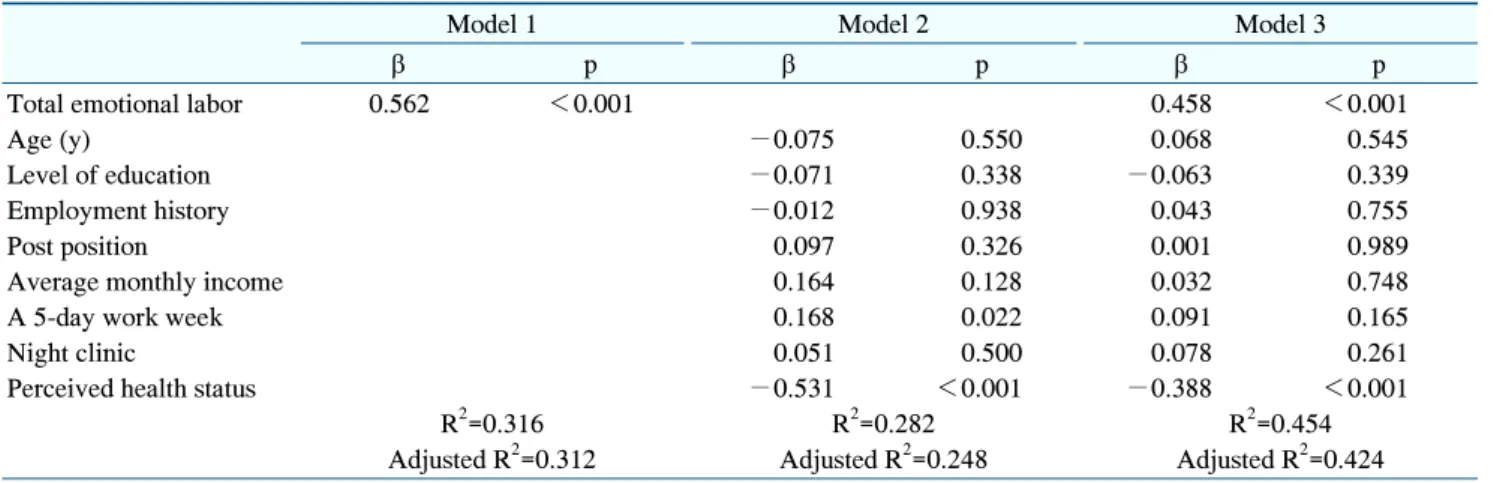
On analyzing the level of emotional labor and somatization symptoms according to general characteristics, participants aged 23∼25 years showed high scores for stress due to emotional labor (p<0.05). Working 5 days per week, subjective health status, and organizational support and protection systems were found to correlate with the level of stress due to emotional labor (p<0.05). In the analysis of correlations between emotional labor and somatization symptoms, scoring high across all domains of emotional labor was associated with scoring high for somatization symptoms in the subdomains of emotional labor. When emotional labor and demographical variables were used as independent variables, having higher scores for emotional labor and having poor subjective health status were found to be associated with having higher levels of somatization symptoms (p<0.05).
Conclusion:
Our results showed that working at night and organizational support and protection systems were correlated with emotional labor and somatization symptoms. Measures must be taken at the organizational level to reduce emotional labor and somatization symptoms.
Key Words: Dental hygienist, Emotional labor, Somatic symptom
Introduction
The improvement of medical technology and quality of life in the era of the Fourth Industrial Revolution calls for qualitative improvement of medical services for patients who visit the hospital
1). In addition, optimized convergence of health and medical care requires not only medical treatment but also professional care by people with a pleasing personality and good expertise, which are considered interpersonal services needed to ensure satisfaction among patients. As a result, dental clinics emphasize the role of the dental hygienist, who provides comprehensive dental services to patients with their expertise and skills
2). Dental hygienists are responsible for helping maintain oral health and prevent
periodontal diseases and dental caries through the application of fluoride, tooth fillings, provisional fillings, temporary attachment and removal, tooth patterning, fitting and removal of orthodontic wires, scaling, and so on.
However, dental hygienists also play a role in increasing
dental service satisfaction. Dental hygienists must often
adjust their emotions according to their patients’ feelings
when receiving medical services rather than their own
feelings, in order to increase patients’ satisfaction with the
medical services
3). It has been reported that dental
hygienists experience a lot of stress while working with
increases in emotional labor practices that emphasize
these medical services
4). Emotional labor is a feeling of
being stressed owing to expressing the emotions desired
by patients and the organization and concealing the emotions of the worker
5). Emotional labor is a factor generated in performing a job, and an increase in emotional labor leads to increased stress and lower job efficiency
6). According to a survey on emotional labor of the Korea Employment Information Service, the level of emotional labor among dental hygienists ranked 14th among 730 occupational workers in Korea. Dental hygienists were also ranked third for emotional labor among occupations that deal with patients or appealing to people
7). Dental hygienists’ emotional labor is increased due to regulating his/her feelings according to the patient’s feelings, regardless of the actual emotions they may be experiencing; this causes job stress and this stress results in somatic symptoms such as headache, stomachache, indigestion, and fatigue. If not treated properly at an early stage, somatization can lead to chronic conditions that are not easy to treat and can also cause poorer performance of dental tasks
8-10). In addition, it has been reported that stress owing to emotional labor is a main cause of health deterioration among dental hygienists as well as in their job capability and productivity at the dental clinic
11). Therefore, it is necessary to prevent and manage stress caused by emotional labor and somatization symptoms arising while dental hygienists are at work. A previous study on the emotional labor of dental hygienists has reported that turnover intention and work organization affect emotional labor in clinical dental hygienists
12), and the level of dental hygienists’ emotional labor is influenced by their personality type
13). Although many studies have examined the effects of emotional labor on job stress
14), research on the effects of emotional labor with respect to job stress and somatization among dental hygienists is lacking.
We conducted this study to provide basic data for the development of efficient management schemes, aimed at improving the mental and physical health of dental hygienists, by analyzing symptoms of stress owing to dental hygienists’ emotional labor.
Materials and Methods
1. Research participants and methods
1) Research participants
The participants in this study were dental hygienists working in Jeollabuk-do Province, selected using a convenience sampling method. The total number of participants was 204; we used the G*Power 3.1 program to calculate the minimum sample size after setting a significance level of 0.05, an effect size of 0.15, and a power of 0.95. A total of 220 participants were selected for the study, considering sample bias and a dropout rate of 10%, to reduce sampling error. We finally analyzed data for a total of 208 of 220 respondents who agreed to complete the questionnaire after receiving a verbal description of the purpose of the study. We excluded the data of 12 respondents that were inappropriate due to incomplete answers. The study period was from January 28, 2019 to February 28, 2019. This study was approved by the Wonkwang University Bioethics Committee (WKIRB-201901-SB-006).
2) Research tools
To measure the level and intensity of emotional labor among research participants, we used the Korean Emotional Labor Questionnaire
15). Emotional labor was assessed using 24 questions in 5 domains: 5 questions regarding “requirements and regulations of emotion control”, 3 questions addressing “overload and conflict related to customer service”, 6 items querying
“incongruity and impairment of emotional labor”, 3 questions on “observation and monitoring of organ- ization”, and 7 questions addressing “organizational support and protection system”. A reliability test was conducted to determine the internal consistency of the emotional labor questionnaire, resulting in a Cronbach’s value of 0.869. Cronbach’s values for the five domains of emotional labor were calculated as follows: 0.745 for
“requirements and regulations of emotion control”, 0.721
for “overload and conflict related to customer service”,
0.868 for “emotional incongruity and impairment”, 0.823
for “observation and monitoring of organization”, and
0.792 for “organizational support and protection system”.
Somatization is a physical discomfort or symptom and a tendency to appeal despite no convincing pathological causes, as well as recognizing the symptom as a physical disease and seeking medical help. We used the Symptom Checklist-90-Revised (SCL-90-R) to measure the level of somatization symptoms among participants
16). This survey tool uses a somatization scale including 12 questions. A reliability test showed a Cronbach’s value of 0.865.
The emotional labor and somatization symptom survey tool includes a 5-point Likert scale and all comprised of negative items, which means that a higher score indicates worse emotional and somatization symptoms.
The general characteristics of participants such as age, highest educational level, work experience, job position, working hours, working 5 days per week, working at night, monthly average income level, sleeping time, and subjective health status were investigated.
3) Data analysis
The independent t-test and one-way ANOVA were used to identify differences in emotional labor and somatization symptoms according to the general characteristics of participants, and the Scheffe test was conducted as a post test. The correlation between emotional labor and somatization symptoms was analyzed using Pearson’s correlation coefficient. In addition, multiple regression analysis was performed to analyze factors affecting somatization symptoms. The data collected in this study were analyzed using PASW Statistics ver. 18.0 (IBM Corp., Armonk, NY, USA). The significance level () used in the statistical test was 0.05.
Results
1. Differences between emotional labor and somatization symptoms according to general characteristics
Table 1 shows differences in emotional labor and somatization symptoms according to the general characteristics of the dental hygienists included in our study. The overall level of emotional labor was statistically significant for the characteristics of age,
working 5 days per week, and subjective health status (p<
0.05). The age group 23∼25 years showed the highest score for emotional labor (80.06) and the age group 36∼
40 years had the lowest score (66.60). In addition, the emotional labor score was high (80.92) among respondents who did not have a 5-day work week.
Regarding subjective health status, the survey score (82.74) indicated poor subjective health status.
Scores for the emotional labor subdomains according to the general characteristics of dental hygienists were statistically significant (p<0.05) for age, working at night, and subjective health status in the domain
“requirements and regulations of emotion control.” The age group 31∼35 years had the highest score (20.29). The highest score for working at night (19.6) was for the period from 8 pm to 8:30 pm. The highest score for subjective health status was 20.34.
In the domain “overload and conflict related to customer service”, a significant difference (p<0.05) was found for job position, average monthly income, and subjective health status. With a higher job position, the average monthly income was higher but subjective health status was also poorer. In the case of “emotional incongruity and impairment”, age and subjective health status were significant (p<0.05), with the highest score (21.26) among dental hygienists aged 23∼25 years and scores indicating poorer subjective health status. In the domain
“organizational support and protection system”, age, working 5 days per week, working at night, and subjective health status were statistically significant (p<0.05). The age group 41∼50 years showed the highest score at 22.71;
scores were 22.35 among respondents who did not have a 5-day work week and 22.29 among those who did not work at night. In addition, scores indicated poorer subjective health status among respondents.
Somatization symptoms according to general participant
characteristics were significant for subjective health status
(p<0.05). When dental hygienists perceived that their
subjective health status was poor, the somatization
symptom score was high, at 52.03.
Table 1. Emotional Labor and Somatization according to Demographic Variable
Item Em otio nal la bor Em otio nal de m and ing a nd reg ulatio n Ov er lo ad an d co nflict in cus tom er s er vice Em otio nal disha rm ony an d hu rt Or ga ni za ti ona l surveilla nce and m onito rin g
O rgan izatio nal supp or tive a nd protec tive system Som atiz ation n Me an ± SD n Me an ± SD n Me an ± SD n Me an ± SD n Me an ± SD n M ean ± SD n Me an ± SD Total 192 77 .77 ± 11 .54 20 4 19 .21 ± 2.79 20 6 10.35 ± 2.0 8 206 19 .93 ± 4.79 20 2 7.5 2± 2. 73 19 6 20 .88 ± 0.63 198 47.5 3± 8.0 1 Ag e (y ) 23 ∼ 25 62 80 .06 ± 11 .50
b62 19 .0 0± 3.02
ab62 10 .0 3± 2.0 4
a62 21 .26 ± 4.43
a62 8.0 3± 2.7 9
a62 21 .7 4± 4.60
b62 47.6 8± 8.3 5
a26 ∼ 30 62 75 .52 ± 11 .07
a68 18 .9 7± 2.76
ab70 10 .1 1± 1.9 2
a70 18 .69 ± 4.86
a68 7.1 8± 2.7 4
a64 20 .9 4± 4.38
b68 47.2 6± 8.3 1
a31 ∼ 35 44 80 .00 ± 11 .39
b48 20 .2 9± 2.48
b48 11 .0 4± 2.1 9
a48 20 .92 ± 5.19
a48 7.6 7± 2.6 2
a44 20 .0 9± 4.92
ab46 47.2 6± 8.4 9
a36 ∼ 40 10 66 .60 ± 7.7 9
a12 17 .8 3± 2.92
a12 10 .1 7± 2.0 4
a12 18 .00 ± 2.41
a10 5.6 0± 2.3 7
a12 16 .8 3± 2.52
a10 46.4 0± 4.3 5
a41 ∼ 50 14 78 .57 ± 11 .20
b14 18 .7 1± 1.90
ab14 10 .7 1± 2.3 3
a14 18 .57 ± 4.03
a14 7.8 6± 2.5 1
a14 22 .7 1± 4.46
b12 50.1 7± 4.6 9
ap-valu e 0. 003 0.0 21 0.0 84 0.0 05 0.07 1 0.0 04 0.8 04 Leve l of edu catio n Colle ge 126 77 .90 ± 10 .75 13 4 18 .94 ± 2.88 13 6 10.16 ± 2.0 5 136 20 .06 ± 4.76 13 4 7.4 9± 2. 62 12 8 21 .20 ± 4.78 132 47.3 5± 8.1 0 ≥ U niv ers ity 66 77 .52 ± 12 .99 70 19 .71 ± 2.57 70 10 .71 ± 2.1 1 70 19 .69 ± 4.86 68 7.5 9± 2.9 4 68 20 .2 6± 4.32 66 47.8 8± 7.8 9 p-valu e 0. 825 0.0 60 0.0 71 0.5 98 0.81 4 0.1 78 0.6 62 Em ploy m ent h isto ry (y ) 1 ∼ 3 76 76.82 ± 12 .13
a76 18 .6 1± 3.07
a76 9 .82 ± 2.08
a76 19 .45 ± 5.06
a76 7.6 3± 2.8 0
a76 21 .3 2± 4.51
a76 46.5 3± 8.4 5
a4 ∼ 6 42 78.10 ± 12 .20
a48 19 .1 3± 2.46
a48 10 .3 3± 2.3 1
a48 19 .71 ± 5.13
a46 7.7 0± 2.9 9
a42 21 .6 2± 4.39
a44 47.8 6± 9.0 0
a7 ∼ 9 22 77.18 ± 9.4 8
a24 20 .3 3± 2.37
a24 10 .5 0± 1.9 8
a24 18 .83 ± 4.17
a24 7.1 7± 2.7 0
a22 19 .6 4± 4.77
a22 46.5 5± 10 .3 7
a≥ 10 36 76 .33 ± 11 .16
a40 18 .9 0± 2.79
a40 10 .9 0± 1.8 9
a40 20 .00 ± 3.90
a38 7.2 6± 2.4 6
a38 20 .2 1± 5.19
a38 48.2 1± 4.3 3
ap-valu e 0. 917 0.0 70 0.0 59 0.8 02 0.79 6 0.2 63 0.6 77 Post position In tern, co ntract wo rk er 18 73 .33 ± 8.2 5
a20 18 .5 0± 2.69
a20 10 .3 0± 2.2 0
a20 18 .90 ± 3.91
a20 7.8 0± 1.3 6
a18 19 .5 6± 5.11
a20 44.7 0± 5.7 9
aReg ular (w orker) pe rm anen t po sitio n
124 78 .29 ± 12 .08
a13 0 19 .34 ± 2.85
a13 2 10.05 ± 2.1 1
a132 20 .09 ± 5.24
a13 0 7.48 ± 3.0 1
a12 6 21 .03 ± 4.50
a126 47.9 4± 8.5 7
aPers on in c harge hea d of a dep ar tm ent
50 78 .08 ± 11 .00
a54 19 .1 5± 2.70
a54 11 .1 1± 1.7 7
a54 19 .93 ± 3.87
a52 7.5 4± 2.3 6
a52 20 .9 6± 4.81
a52 47.6 2± 7.2 0
ap-valu e 0. 230 0.4 53 0.0 06 0.5 87 0.88 6 0.4 47 0.2 44
Table 1. Continued
Item Em otio nal la bor Em otio nal de m and ing a nd reg ulatio n Ov er lo ad an d co nflict in cus tom er s er vice Em otio nal disha rm ony an d hu rt Or ga ni za ti ona l surveilla nce and m onito rin g
O rgan izatio nal supp or tive a nd protec tive system Som atiz ation n Me an ± SD n Me an ± SD n Me an ± SD n Me an ± SD n Me an ± SD n M ean ± SD n Me an ± SD A verage m onthly incom e ≤ 20 0 86 19.02 ± 3.1 9
a84 77 .2 4± 12.8 6
a86 9 .88 ± 2.15
a86 19 .53 ± 5.40
a86 7.7 9± 3.0 6
a84 21 .3 8± 4.80
a84 46.9 8± 8.2 0
a201 ∼ 25 0 82 19.39 ± 2.6 0
a74 78 .6 2± 10.2 9
a84 10 .6 4± 2.0 2
a84 20 .74 ± 4.43
a82 7.2 7± 2.4 5
a76 20 .3 2± 4.53
a80 48.2 0± 7.7 7
a≥ 25 1 36 19.22 ± 2.1 8
a34 77 .2 4± 10.8 5
a36 10 .7 8± 1.8 7
a36 19 .00 ± 3.73
a34 7.4 7± 2.4 6
a36 20 .8 9± 4.43
a34 47.2 9± 8.2 2
ap-valu e 0. 698 0.72 3 0.023 0.1 14 0.46 1 0.3 50 0.6 12 A 5- day w or k w ee k Existenc e 140 76 .60 ± 11 .29 14 8 19 .03 ± 2.94 15 0 10.21 ± 1.9 8 150 19 .59 ± 4.61 14 6 7.5 6± 2. 67 14 4 20 .35 ± 4.44 144 46.9 7± 8.3 7 N one xistenc e 52 80 .92 ± 11 .70 56 19 .68 ± 2.34 56 10 .71 ± 2.3 0 56 20 .86 ± 5.18 56 7.4 3± 2.8 8 52 22 .3 5± 4.87 54 49.0 0± 6.8 2 p-valu e 0. 021 0.13 8 0.124 0.0 90 0.75 7 0.0 07 0.1 13 N ight c linic A bs en ce 54 78.11 ± 10 .56
a58 19 .2 4± 2.52
ab60 10 .3 3± 2.3 2
a60 19 .40 ± 5.11
a60 6.9 3± 2.7 2
a56 22 .2 9± 4.36
b58 47.5 5± 6.7 0
a8: 00 p m to 8 :3 0 p m 10 2 78 .2 4± 12 .49
a10 6 19 .62 ± 2.97
b10 6 10.60 ± 1.9 4
a106 20 .58 ± 4.81
a10 4 7.90 ± 2.8 2
a10 4 19 .81 ± 4.83
a104 47.6 5± 8.4 2
a9: 00 p m to 9 :3 0 p m 36 75 .9 4± 10 .15
a40 18 .0 5± 2.39
a40 9 .70 ± 1.98
a40 19 .00 ± 4.03
a38 7.4 2± 2.3 6
a36 21 .7 8± 3.71
ab36 47.1 1± 8.9 1
ap-valu e 0. 575 0.00 9 0.064 0.1 21 0.08 6 0.0 02 0.9 41 Perceiv ed h ealth s ta tus Poor 62 82 .84 ± 12 .27
b70 20 .3 4± 2.41
b70 10 .8 9± 2.2 4
a70 21 .49 ± 5.21
b66 8.0 3± 2.9 7
a64 22 .6 6± 4.97
b66 52.0 3± 5.7 8
cN orm al 104 75 .27 ± 10 .35
a10 6 18 .38 ± 2.80
a10 8 10.06 ± 1.9 3
a108 19 .39 ± 4.41
ab10 8 7.35 ± 2.6 0
a10 6 19 .91 ± 4.32
a104 46.2 9± 7.8 1
bG ood 26 75 .69 ± 10 .69
a28 19 .5 0± 2.71
ab28 10 .1 4± 2.0 3
a28 18 .14 ± 4.11
a28 7.0 0± 2.5 2
a26 20 .4 6± 3.81
ab28 41.5 0± 7.8 7
ap-valu e < 0.0 01 < 0. 001 0. 028 0.0 02 0.15 4 0.0 01 < 0.00 1 SD : s ta nda rd dev iation .
a,b,cThe s am e ch aracte rs are n ot significa nt by Sche ffe m ultiple c om pa rison (p < 0.0 5) .
Table 3. Effects of Emotional Labor, Demographic Variable on Somatization