Utilization of Virtual Moving Surround on Static Balance in the Patients With
Balance Dysfunction
Young-keun Woo, M.Sc., P.T.
Samsung Medical Center & Center for Clinical Medicine
Ji-hye Hwang, Ph.D., M.D.
Yun-hee Kim, Ph.D., M.D.
Peter KW Lee, Ph.D., M.D.
Dept. of Physical Medicine and Rehabilitation, Samsung Medical Center, Sungkyunkwan University School of Medicine
Nam-gyun Kim, Ph.D.
Bioengineering Research Center for the Aged, Chonbuk National University
Abstract 1)
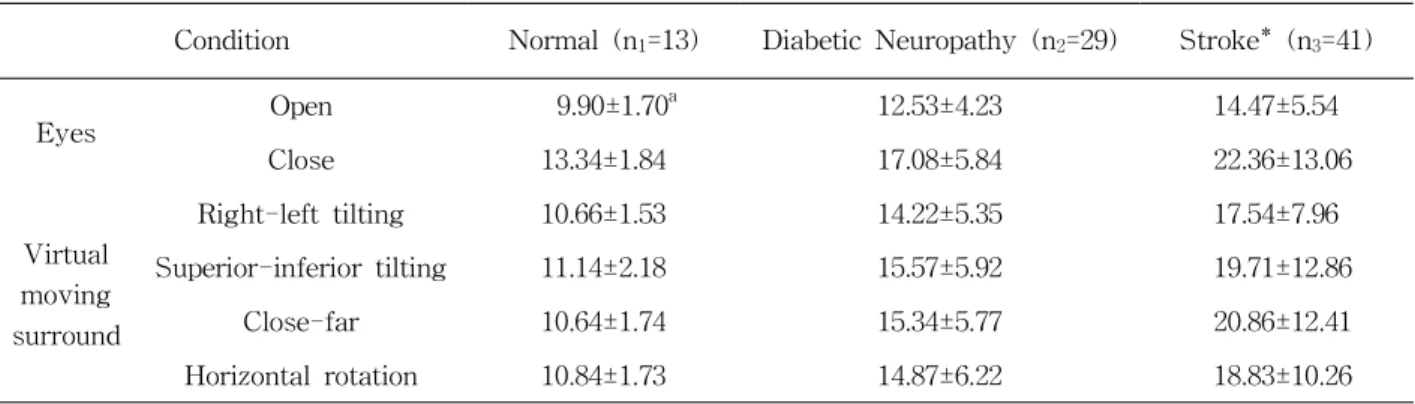
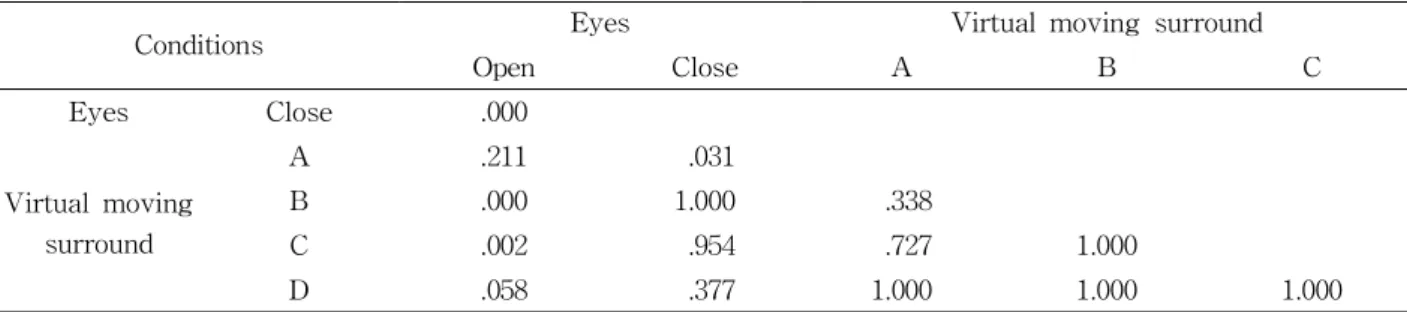
The purpose of this study was to investigate the possibility of virtual moving surround (VMS) on static balance in the patients with balance dysfunction. Eighty three subjects who were admitted or treated as an outpatient, or a family member, at the department of rehabilitation unit of university hospital were recruited to participate. Subjects were three groups based on their overall medical status: healthy, diabetic neuro- pathy and stroke. Each group was tested for static balance with a forceplate during static standing with VMS. The virtual movement was simulated with a head mounted display. The parameters for static bal- ance were total sway path. In this study, the parameters of postural control for patients with diabetic neu- ropathy and stroke subjects were significantly increased in conditions elicited with the VMS. In the healthy elderly participants, the total sway path was not significantly different under virtual movement conditions.
Therefore, VMS could be used in the evaluation and treatment of the patients with balance dysfunction.
Key Words: Balance; Postural Control; Virtual moving surround; Vision.
Introduction
The continuous use of the information from somato- sensory, proprioceptive, visual, and vestibular sources is critical for maintaining postural control in humans.
This information is analyzed and integrated in the central nervous system, which then sends efferent sig- nals to activate appropriate postural muscles (Nashner and Peters, 1990). In the presence of disease or dys- function in the relevant parts of the nervous and mus- culoskeletal system the ability to control balance may be impaired (Maki and McIlroy, 1996). In patients un-
dergoing rehabilitation, a prominent symptom of a bal- ance disorder is the increased dependency on vision for postural control (Tossavainen et al, 2003).
Visual function is commonly weakened with aging and this affects postural stability, often causing re- duced ability to perform activities of daily of living and independent mobility (Lord and Menz, 2000).
There are few reports in the medical literature that
report on the role of vision as an important compo-
nent for postural control in the elderly (Hytonen et
al, 1993; Ring et al, 1988; Stribley et al, 1974). In the
study of Peterka and Black (1990), visual dependency
This research was supported by the Korean Ministry of Commerce, Industry and Energy through development of the
core technology of medical devices for elderly.
is increased with aging and postural sway is in- creased with age, generally greater than 55. Vision provides the information that alerts to risk from envi- ronmental factors, the distance from objects as well as the contextual and surface information. With the in- formation obtained through perception of the environ- ment and then integration into central nervous system processing, humans are able to adapt and correct pos- ture to maintain stability (Galley and Forster, 1985).
The visual system also synapses with the ves- tibular and proprioceptive system, which adds to de- termination of the center of gravity and support sys- tems controlling postural stability (Umphred, 2001).
Many studies have been reported on age-related physiologic decline in multiple balance-associated systems; this leads to significant balance and func- tional impairments in older adults (Bergin et al, 1995;
Grimston et al, 1993; Rosenhall and Rubin, 1975). In addition, researches have also reported results on comparisons in decreased ability of postural control between patients, normal subjects or young people and the elderly (Laughton et al, 2003; Tinetti et al, 1988).
Currently, most evaluations for balance are done using vision with eyes opened and closed (Hageman et al, 1995; Peterka and Black, 1990). However re- cently, virtual reality technology has been utilized in the rehabilitation setting for evaluation and treatment.
It has been shown to provide stimulation that affects balance ability (Christiansen et al, 1998; Grealy et al, 1999; Rose et al, 1999). Virtual movement can affect the vestibular system for integrated balance ability by providing visual stimulation (Tossavainen et al, 2003). In the vestibular system, receptor cells are stimulated by endolymph movement during body motion. Therefore, the semicircular canal detects the rotational acceleration and the otholith perceives the linear acceleration (Lundy-Ekman, 2002). Gourlay et al (2000) reported that simulation of the environ- mental factors for activities of daily life by visual perception is an advantage for performing the real task. In addition, few researches reported that virtual reality could be applicable to physically disabled peo-
ple, especially in the rehabilitation setting during treatment sessions (Greenleaf and Tovar, 1994; Kuhlen and Dohle, 1995; Sveistrup et al, 2003; Zhang et al, 2003). One of the beneficial aspects of virtual reality is the ability to present an infinite variety of stimuli.
Using a simulation technique, creating virtual moving views on the basis of virtual reality methods for bal- ance investigation, it is possible to make effective stimuli that would be very difficult or impossible to set in the real environment (Tossavainen et al, 2001a).
There are a variety of balance tests that can be used to assess balance performance. Accepted clinical balance tests include: the Tinetti Performance-Oriented Assessment of Mobility, the Get Up and Go Test, the Berg Balance Scale and the Functional Reach Test.
Forceplate posturography is one of the most com- monly used tests for balance assessment. The pos- turography technique of sway measurement is a sen- sitive and reliable measure, particularly when used with normal stance (Cobb and Nichols, 1998). During this test, the swaying of a subject standing on a force-sensitive platform is measured and analyzed.
Forceplate posturography takes advantage of con- sistency in data collection and analysis. Virtual real- ity simulation system and the posturography techni- que of sway measurement are also useful for balance assessment and analysis.
However, few studies have investigated the correla- tion between the virtual reality technique and postural control. Therefore, we investigated the possibility that virtual moving surround could affect static balance.
Methods Subjects
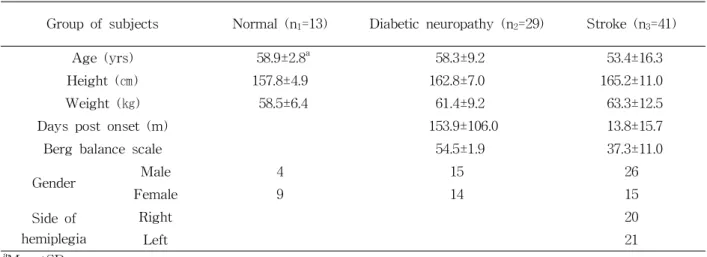
Eighty three subjects were recruited for this study
(Table 1). All subjects who were admitted or treated
as an outpatient, or a family member, at the depart-
ment of rehabilitation unit of university hospital,
were asked to participate; the study was approved
by the Institutional Review Board. Subjects were
Group of subjects Normal (n
1=13) Diabetic neuropathy (n
2=29) Stroke (n
3=41)
Age (yrs) 58.9±2.8
a58.3±9.2 53.4±16.3
Height (㎝) 157.8±4.9 162.8±7.0 165.2±11.0
Weight (㎏) 58.5±6.4 61.4±9.2 63.3±12.5
Days post onset (m) 153.9±106.0 13.8±15.7
Berg balance scale 54.5±1.9 37.3±11.0
Gender Male 4 15 26
Female 9 14 15
Side of hemiplegia
Right 20
Left 21
a
Mean±SD
Table 1. Demographic data of study subjects (N=83)
Figure 1. (A) Right-left tilting, (B) Superior-inferior tilting, (C) Close-far (D) Horizontal rotation
divided into three groups as follows: normal, diabetic neuropathy and stroke. Normal subjects were sub- sequently excluded for any of the following reasons:
they had a medical or neurologic disorder which could cause severe muscular weakness, visual dis- turbance and vestibular dysfunction by examination, history, or medical record review; they underwent medical treatment for osteoarthritis or trauma of a lower extremity during last 3 months. Patients with diabetic neuropathy were diagnosed with nerve con- duction tests. Subjects with stroke history were able to maintain an independent unsupported stance and had a unilateral hemiparesis as a result of the stroke as part of the inclusion criteria and reported no car- diac, respiratory, or neuromuscular problems (e.g., impairment of vestibular system, peripheral neuro- pathy, ankle sprain, shoulder tendinitis) that would interfere with the testing protocol. Subjects were as- sessed with the Berg balance scale.
Measures
2)Static balance assessment is the forceplate meas- ure of postural control in the quiet stance (in be- tween feet distance was 20 ㎝) was recorded for 20 seconds. To measure the change of center of pres-
sure (COP) in the movement of body mass, we
made one custom forceplate (60 ㎝ x 40 ㎝ sized)
with 4 load cells (CBES 200 ㎏ type) in the corners
of the plate. COP analog signals from the load cells
were amplified, filtered and converted to a digital
signal with a 12-bit, 8-channel A/D converter. The
subjects were asked to stand on a forceplate with
eyes opened and closed. The Virtual Moving
Surround (VMS) conditions were delivered using a
head-mounted display (HMD)
1), device with different
moving patterns (left-right tilting, superior-inferior
tilting, close-far and horizontal rotation) (Figure 1).
Condition Normal (n
1=13) Diabetic Neuropathy (n
2=29) Stroke* (n
3=41)
Eyes Open 9.90±1.70
a12.53±4.23 14.47±5.54
Close 13.34±1.84 17.08±5.84 22.36±13.06
Virtual moving surround
Right-left tilting 10.66±1.53 14.22±5.35 17.54±7.96
Superior-inferior tilting 11.14±2.18 15.57±5.92 19.71±12.86
Close-far 10.64±1.74 15.34±5.77 20.86±12.41
Horizontal rotation 10.84±1.73 14.87±6.22 18.83±10.26
a