Clinical Implications and Risk Factors of Acute Pancreatitis after Cardiac Valve Surgery
Joo Won Chung,
1Sung Ho Ryu,
1Jung Hyun Jo,
1Jeong Youp Park,
1Sak Lee,
2Seung Woo Park,
1Si Young Song,
1,3and Jae Bock Chung
11Division of Gastroenterology, Department of Internal Medicine, Yonsei Institute of Gastroenterology, Yonsei University College of Medicine, Seoul;
2Department of Thoracic and Cardiovascular Surgery, Yonsei University College of Medicine, Seoul;
3Brain Korea 21 Project for Medical Science, Severance Biomedical Science Institute, Seoul, Korea
Received: December 16, 2011 Revised: February 10, 2012 Accepted: February 24, 2012
Corresponding author: Dr. Jeong Youp Park, Division of Gastroenterology,
Department of Internal Medicine, Yonsei Institute of Gastroenterology, Yonsei University College of Medicine, 50 Yonsei-ro, Seodaemun-gu, Seoul 120-752, Korea.
Tel: 82-2-2228-1937, Fax: 82-2-2227-7900 E-mail: [email protected]
∙ The authors have no financial conflicts of interest.
© Copyright:
Yonsei University College of Medicine 2013 This is an Open Access article distributed under the terms of the Creative Commons Attribution Non- Commercial License (http://creativecommons.org/
licenses/by-nc/3.0) which permits unrestricted non- commercial use, distribution, and reproduction in any medium, provided the original work is properly cited.
Purpose: Acute pancreatitis is one of the potentially lethal complications that oc- curs after cardiac surgery. We tried to identify risk factors for and the prognosis of acute pancreatitis after cardiac valve surgery with cardiopulmonary bypass. Mate- rials and Methods: We retrospectively analyzed a database of consecutive pa- tients who underwent cardiac valve surgery with cardiopulmonary bypass between January 2005 and April 2010 at our institution. Patients were classified as having acute pancreatitis based on serum lipase concentration and clinical symptoms (li- pase ≥180 U/L or ≥60 U/L with relevant symptoms). Results: Of the 986 patients who underwent cardiac valve surgery with cardiopulmonary bypass, 58 (5.9%) pa- tients developed post-operative pancreatitis. Post-operative hospital stay was sig- nificantly longer (29.7±45.6 days vs. 12.4±10.7 days, p=0.005) and in-hospital mortality rate was higher (15.5% vs. 2.0%, p<0.001) in patients with post-opera- tive pancreatitis than those without. Hypertension, chronic kidney disease, and peri-operative use of norepinephrine were identified as independent risk factors for developing pancreatitis after cardiac valve surgery. Conclusion: We found that acute pancreatitis after cardiac valve surgery requires longer hospitalization and in- creases the in-hospital mortality rate. Clinicians should be aware that patients could develop pancreatitis after cardiac valve surgery, especially in patients with hypertension and chronic kidney disease treated with norepinephrine.
Key Words: Acute pancreatitis, cardiac valve surgery, cardiopulmonary bypass
INTRODUCTION
Gastrointestinal complications after cardiovascular surgery are important for the prognosis of patients.1-6 However, the management of gastrointestinal complica- tions is often difficult, and mortality can occur in severe cases. The most common complications are gastroduodenal ulcers, enterocolitis, and ischemic colitis. To manage these complications, procedures such as endoscopy or transfusion may be needed, and longer post-operative hospital stays and higher costs can be incurred.
In order to prevent gastrointestinal complications and decrease their associated
ylase and lipase concentrations on post-operative day 2, du- ration of CPB, presence of post-operative complications, post-operative hospital stay, and in-hospital mortality. The diagnostic criteria for post-operative pancreatitis was an el- evated serum lipase concentration (≥180 U/L) three-fold greater than the upper limit of normal concentration, or the presence of relevant symptoms and/or signs (abdominal pain, abdominal distention, nausea, vomiting and ileus) to- gether with serum lipase concentration greater than the up- per limit of normal concentration (≥60 U/L) on the second day after surgery.16 When post-operative pancreatitis was diagnosed, patients were conservatively treated with bowel rest and/or proteinase inhibitor according to the severity.
The Institutional Review Board of Severance Hospital, Yonsei University approved this retrospective study.
Statistical analysis
Continuous variables are presented as mean±standard devi- ation and were compared using the Wilcoxon rank-sum test. Intergroup comparisons of categorical variables were performed by Pearson χ2 test or Fisher’s exact test. To iden- tify independent factors associated with the development of post-operative pancreatitis, explanatory items were selected using univariate analysis, followed by multivariate logistic regression analysis. We applied a backward stepwise selec- tion procedure beginning with variables that exhibited a p value less than 0.05 in univariate analysis. Adjusted odds ratios (AOR) were calculated to measure the degree of as- sociations, and Hosmer-Lemeshow goodness-of-fit analy- ses were used to calibrate multivariate logistic regression.
We considered p values less than 0.05 as statistically signif- icant and all statistical tests were 2-sided. Statistical analy- ses were performed using SPSS 18.0 for Windows (SPSS Inc., Chicago, IL, USA).
RESULTS
Patient characteristics and clinical data
A total 986 consecutive patients, 460 males (46.7%) and 526 females (53.3%), underwent cardiac valve surgery with CPB during the study period, and their mean age was 56.9±14.8 years. Two-thirds of the patients (669 patients) underwent single valve surgery, and one-third (317 pa- tients) underwent double valve surgery. The post-operative hospital stay was 13.4±15.6 days and the in-hospital mor- tality rate was 2.8% (28 of 986 patients).
morbidity and mortality, there have been many studies re- garding their incidence, risk factors, and management.
Acute pancreatitis is an inflammatory disorder with a vari- ety of etiologies, including obstruction (gallstone, malignan- cy, surgery, and endoscopic retrograde cholangiopancreatog- raphy), vascular insufficiency, and toxic agents (alcohol, azathioprine, etc.). The widespread pathophysiological mechanisms are involved in the inflammatory process and lead to a variety of systemic complications.7 There is no ef- fective way to manage acute pancreatitis except conserva- tive treatment, and the outcome depends on its severity and the presence of organ failure. Therefore, it has been empha- sized for many years to predict disease severity at an early stage and to apply intense treatment in severe cases.7
After cardiac surgery, acute pancreatitis is a potentially fatal complication leading to high mortality.1,2,6,8,9 While the significance is well recognized, several of its indicators re- main controversial. The incidence of acute pancreatitis var- ies depending on the type of surgery and diagnostic criteria, ranging from 0.05% to 19%.5,6,8-12 Additionally, asymptom- atic hyperamylasemia is more frequently seen in 24% to 85% of patients after cardiac surgery.10,11,13-15 Even all pa- tients do not progress to symptomatic pancreatitis, hyper- amylasemia alone may be associated with higher post-oper- ative mortality.10,11 However, we do not know much about what is important in the development of symptomatic or as- ymptomatic pancreatitis and how they affect the clinical outcomes of cardiac surgery.
Therefore, we evaluated the incidence, risk factors, and clinical implications of acute pancreatitis after cardiac valve surgery with cardiopulmonary bypass (CPB) at our institu- tion.
MATERIALS AND METHODS
Patient sample and data collection
We retrospectively analyzed the database of all patients who underwent cardiac valve surgery with CPB between January 2005 and April 2010 at Severance Hospital, Yonsei Univer- sity College of Medicine, Seoul, Korea. Demographic, clini- cal, and laboratory data were collected from medical re- cords that were documented at the time of treatment. These data included gender, age, co-morbidities (hypertension, di- abetes mellitus, and chronic kidney disease), drug history, smoking history, pre-operative ejection fraction by echocar- diography, peri-operative use of norepinephrine, serum am-
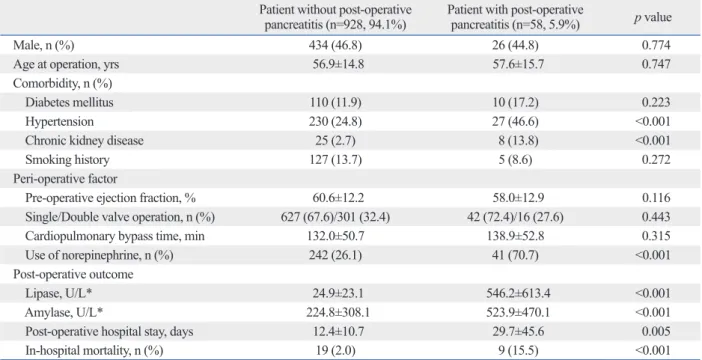
12.9%) than those without post-operative pancreatitis (60.6±12.2%), but the difference was not statistically signif- icant (p=0.116). Patients with post-operative pancreatitis were more frequently treated with norepinephrine during peri-operative period (70.7% vs. 26.1%, p<0.001). The se- rum amylase was 523.9±470.1 U/L in patients with post- operative pancreatitis and 224.8±308.1 U/L in those with- out post-operative pancreatitis (p<0.001).
Patients with post-operative pancreatitis had a longer post- operative hospital stay (29.7±45.6 days vs. 12.4±10.7 days, p=0.005) and a higher in-hospital mortality rate (15.5% vs.
2.0%; p<0.001) than those without post-operative pancre- atitis. The odds ratio of in-hospital mortality being associat- ed with post-operative pancreatitis was 8.787 [95% confi- dence interval (CI); 3.780-20.428]. Table 1 summarizes the patients’ clinical data and outcomes of cardiac valve surgery.
Risk factors for post-operative pancreatitis after cardiac valve surgery with CPB
Univariate regression analyses indicated that hypertension (p<0.001), chronic kidney disease (p<0.001), and the use of norepinephrine (p<0.001) were significantly associated with post-operative pancreatitis. According to multivariate re- gression analysis, hypertension (AOR=2.263, 95% CI;
1.290-3.969), chronic kidney disease (AOR=2.653, 95% CI;
1.080-6.516), and the use of norepinephrine (AOR=6.047, 95% CI; 3.334-10.968) were identified as independent risk Fulfilling the above-mentioned criteria in the methods
section, 58 patients (5.9%) were diagnosed with post-oper- ative pancreatitis, of whom 27 patients developed isolated hyperlipasemia and 31 patients developed symptomatic hy- perlipasemia. Alcohol or drug induced pancreatitis was ruled out by preoperative history taking, and acute pancre- atitis by gallstone or pancreatic neoplasm was not identified during the follow-up period in these patients. The most common symptoms in these patients were abdominal pain (16 of 58 patients, 27.6%) and nausea and vomiting (13 of 58 patients, 22.4%), followed by fever (11 of 58 patients, 19.0%). Pleural effusion was the most common accompa- nying complication (17 of 58 patients, 29.3%), followed by acute renal failure (15 of 58 patients, 25.9%), infection (11 of 58 patients, 19.0%) and upper gastrointestinal bleeding (6 of 58 patients, 10.3%).
Comparisons of clinical factors and outcomes with the development of post-operative pancreatitis
Comparative analysis of clinical data on the development of post-operative pancreatitis revealed that there is no signifi- cant difference in age, gender, history of diabetes, smoking history, type of surgery, or mean CPB time. Hypertension (46.6% vs. 24.8%) and chronic kidney disease (13.8% vs.
2.7%) were more common in patients with post-operative pancreatitis (p<0.001). Preoperative ejection fraction was lower in patients with post-operative pancreatitis (58.0±
Table 1. Patient Characteristics and Clinical Data
Patient without post-operative
pancreatitis (n=928, 94.1%) Patient with post-operative
pancreatitis (n=58, 5.9%) p value
Male, n (%) 434 (46.8) 26 (44.8) 0.774
Age at operation, yrs 56.9±14.8 57.6±15.7 0.747
Comorbidity, n (%)
Diabetes mellitus 110 (11.9) 10 (17.2) 0.223
Hypertension 230 (24.8) 27 (46.6) <0.001
Chronic kidney disease 25 (2.7) 8 (13.8) <0.001
Smoking history 127 (13.7) 5 (8.6) 0.272
Peri-operative factor
Pre-operative ejection fraction, % 60.6±12.2 58.0±12.9 0.116
Single/Double valve operation, n (%) 627 (67.6)/301 (32.4) 42 (72.4)/16 (27.6) 0.443
Cardiopulmonary bypass time, min 132.0±50.7 138.9±52.8 0.315
Use of norepinephrine, n (%) 242 (26.1) 41 (70.7) <0.001
Post-operative outcome
Lipase, U/L* 24.9±23.1 546.2±613.4 <0.001
Amylase, U/L* 224.8±308.1 523.9±470.1 <0.001
Post-operative hospital stay, days 12.4±10.7 29.7±45.6 0.005
In-hospital mortality, n (%) 19 (2.0) 9 (15.5) <0.001
*Serum amylase and lipase levels were obtained on the second day after surgery.
serum marker for diagnosing acute pancreatitis, it is neither specific nor sensitive for detecting pancreatic cellular injury because post-operative hyperamylasemia may result from an increased production of either pancreatic or salivary type amylase11,14,15 and decreased clearance of amylase.18 In con- trast, lipase is a more sensitive and specific biomarker that is done as a single laboratory test for acute pancreatitis.16,19-21 Lipase increased earlier and to a greater extent than total amylase, and the peak activities of lipase and pancreatic type amylase in the serum have shown significant correla- tion.14 In addition, serum lipase remains elevated for a lon- ger period of time than serum amylase.22 When the serum lipase level was elevated three times greater than the upper limit of normal level, the diagnostic accuracy of acute pan- creatitis was improved.19
Compared to previous studies, we detected a slightly high- er incidence of acute pancreatitis after cardiac valve surgery (5.9%). Perez, et al.9 reported that acute pancreatitis oc- curred in 39 of 10249 (0.6%) cardiac surgery cases, and other studies reported similar incidences.6,10,11 We may ex- plain the difference in the incidence as follows. Firstly, the diagnostic criteria of acute pancreatitis in other studies were more restrictive than those in our study. Perez, et al.9 de- fined acute pancreatitis as the presence of relevant symp- toms together with elevated serum amylase and lipase lev- el. The other studies included serum isoamylase or urine amylase to diagnose acute pancreatitis,10,11 and even com- puted tomography imaging was included to make a diagno- sis.6,11 At our hospital, we uniformly checked serum amy- lase and lipase of all patients on the second day of cardiac valve surgery and defined the criteria more extensively. We defined the criteria in this manner because acute pancreatitis may occur without symptoms or elevation of pancreatic en- zyme8 and asymptomatic pancreatic injury presenting iso- lated hyperamylasemia or hyperlipasemia can affect clini- cal outcomes after surgery. Therefore, we were able to detect more cases of post-operative pancreatitis including even asymptomatic patients.11 Secondly, the incidence of gastrointestinal complications differs depending on the type of cardiovascular surgery. This study focused on cardiac valve surgery, while other studies included various types of factors for post-operative pancreatitis (Table 2). The p value
calculated by the Hosmer-Lemeshow χ2 statistic was 0.389, and the model showed no evidence of a lack of fit.
DISCUSSION
We identified that post-operative pancreatitis adversely af- fected clinical outcomes of cardiac valve surgery by increas- ing hospital stay and mortality. Previous studies reported that splanchnic ischemia during cardiac surgery might cause pancreatic cellular injury,8-10,15 and several risk factors have also been suggested.8-10 However, there is a lack of data for the clinical implications. Patients with acute pancreatitis of- ten require one or more days of fasting for bowel rest de- pending on the severity as well as additional time in the hospital to evaluate and treat other associated complications such as pleural effusion, acute renal failure, infection, gas- trointestinal bleeding, and acute cholecystitis.9-11 Patients with post-operative pancreatitis may take more time to re- cover from surgery and sometimes do not recover because acinar cell injury results from local injury, systemic inflam- mation, and subsequent multi-organ failure. This implies that physicians should carefully monitor these patients for the development of acute pancreatitis after surgery.
Post-operative pancreatitis occurs unpredictably and may be difficult to diagnose. According to an autopsy study, the diagnosis of pancreatitis was sometimes missed because of the absence of pain, tenderness, and hyperamylasemia.8 Considering isolated hyperamylasemia may have the po- tential to deteriorate the clinical course of patients and in- crease the risk of mortality,11 careful attention to pancreatic injury should be given in asymptomatic patients, especially after cardiac surgery. Due to the diagnosis of acute pancre- atitis being largely based on clinical presentation with the assistance of laboratory findings,17 we assumed that some cases of asymptomatic pancreatitis were missed and its in- fluence on clinical progress might be ignored. To identify the existence of postoperative pancreatitis, we checked the serum lipase concentration in all patients after cardiac valve surgery. Even though amylase is the most commonly used
Table 2. Multivariate Analysis of Risk Factors for Acute Pancreatitis after Cardiac Valve Surgery
p value Adjusted odds ratio 95.0% CI
Hypertension 0.004 2.263 1.290-3.969
Chronic kidney disease 0.033 2.653 1.080-6.516
The use of norepinephrine <0.001 6.047 3.334-10.968
CI, confidence interval.
level of amylase and lipase, which meant that the possibility that patients already had hyperlipasemia before surgery could not be excluded. Furthermore, it was not clearly determined whether systemic or local complications that occurred in postoperative pancreatitis patients were caused by pancre- atitis or by other problems. However, these complications could be associated with other ischemic causes that might have induced acute pancreatitis. Further prospective studies are needed to identify the causal relationship between these complications and pancreatitis.
In conclusion, post-operative pancreatitis after cardiac valve surgery occurred frequently and affected the clinical outcome of patients. Especially, patients with hypertension or chronic kidney disease and those who were treated with norepinephrine during the peri-operative period were more susceptible to pancreatitis. Checking serum lipase is a sim- ple and reasonable method to detect acute pancreatitis in patients after cardiac valve surgery. Therefore, we suggest that clinicians assess risk factors for acute pancreatitis be- fore cardiac valve surgery and remain vigilant for signs and symptoms after surgery. Further studies regarding preven- tion and early management of acute pancreatitis in this set- ting are warranted.
REFERENCES
1. Krasna MJ, Flancbaum L, Trooskin SZ, Fitzpatrick JC, Scholz PM, Scott GE, et al. Gastrointestinal complications after cardiac surgery. Surgery 1988;104:773-80.
2. D’Ancona G, Baillot R, Poirier B, Dagenais F, de Ibarra JI, Bauset R, et al. Determinants of gastrointestinal complications in cardiac surgery. Tex Heart Inst J 2003;30:280-5.
3. Sanisoglu I, Guden M, Bayramoglu Z, Sagbas E, Dibekoglu C, Sanisoglu SY, et al. Does off-pump CABG reduce gastrointestinal complications? Ann Thorac Surg 2004;77:619-25.
4. Musleh GS, Patel NC, Grayson AD, Pullan DM, Keenan DJ, Fab- ri BM, et al. Off-pump coronary artery bypass surgery does not reduce gastrointestinal complications. Eur J Cardiothorac Surg 2003;23:170-4.
5. Mangi AA, Christison-Lagay ER, Torchiana DF, Warshaw AL, Berger DL. Gastrointestinal complications in patients undergoing heart operation: an analysis of 8709 consecutive cardiac surgical patients. Ann Surg 2005;241:895-901.
6. Achouh PE, Madsen K, Miller CC 3rd, Estrera AL, Azizzadeh A, Dhareshwar J, et al. Gastrointestinal complications after descend- ing thoracic and thoracoabdominal aortic repairs: a 14-year expe- rience. J Vasc Surg 2006;44:442-6.
7. Wu BU, Conwell DL. Update in acute pancreatitis. Curr Gastro- enterol Rep 2010;12:83-90.
8. Haas GS, Warshaw AL, Daggett WM, Aretz HT. Acute pancreati- tis after cardiopulmonary bypass. Am J Surg 1985;149:508-15.
9. Perez A, Ito H, Farivar RS, Cohn LH, Byrne JG, Rawn JD, et al.
cardiovascular surgery such as coronary artery bypass grafting, aortic surgery, or correction of congenital heart disease.2,6,8,9,13-15 Cardiac valve surgery may be more sus- ceptible to acute pancreatitis than coronary bypass surgery due to hemodynamic problems that result in splanchnic ischemia.10 Thromboemboli detached from prosthetic valves may result in vascular ischemia, which may repre- sent a common pathway for pancreatitis in patients after cardiac valve surgery.14 Another possible reason may be that CPB time in our study was rather long (132.4±50.8 min) compared with that in other studies (83.5-124 min).10,13,23 Prolonged CPB is associated with higher inci- dence of complications2,9,10 because long duration of CPB causes prolonged reduction in pancreatic blood flow, result- ing in pancreatic acinar cell injury.3 For these reasons, our data showed higher incidence of post-operative pancreatitis.
The main pathogenic mechanism for post-operative pan- creatitis may be pancreatic injury by inadequate splanchnic perfusion.24 The pancreas is particularly susceptible to hy- poxia, therefore factors including splanchnic ischemia may be predicting factors for post-operative pancreatitis. In our study, we identified that hypertension and the use of norepi- nephrine are associated with the development of acute pan- creatitis after cardiac valve surgery. Impaired homeostasis in hypertensive patients prevents proper reaction to hemo- dynamic instability during the peri-operative period and leads to splanchnic ischemia. Norepinephrine also increases sympathetic vasoconstriction of the mesenteric vascula- ture,25 and this may result directly in pancreatic cellular in- jury. Likewise, previous studies demonstrate that cardiac dysfunction and low cardiac output were significant risk factors,10 and patients with post-operative pancreatitis in our study had lower pre-operative ejection fraction than pa- tients without pancreatitis without a statistical difference.
We suggest that ejection fraction did not represent vasody- namic status as properly as cardiac output because it did not reflect the systemic volume status. Therefore, indicators properly representing vasodynamic status should be as- sessed before surgery.
Our study has several limitations. First, although the data were obtained prospectively, the analyses were performed retrospectively, which may have affected the study due to the limitations of such an investigational design. Radiologic evaluation was not routinely performed in all the patients who were suspected of having acute pancreatitis, therefore the severity of pancreatic injury could not be measured ob- jectively. Moreover, we did not check the preoperative serum
acute pancreatitis. N Engl J Med 1984;311:639-43.
18. Paajanen H, Nuutinen P, Harmoinen A, Pöyhönen M, Pitkänen O, Nordback I, et al. Hyperamylasemia after cardiopulmonary by- pass: pancreatic cellular injury or impaired renal excretion of amy- lase? Surgery 1998;123:504-10.
19. Sutton PA, Humes DJ, Purcell G, Smith JK, Whiting F, Wright T, et al. The role of routine assays of serum amylase and lipase for the diagnosis of acute abdominal pain. Ann R Coll Surg Engl 2009;91:381-4.
20. Smotkin J, Tenner S. Laboratory diagnostic tests in acute pancre- atitis. J Clin Gastroenterol 2002;34:459-62.
21. Treacy J, Williams A, Bais R, Willson K, Worthley C, Reece J, et al. Evaluation of amylase and lipase in the diagnosis of acute pan- creatitis. ANZ J Surg 2001;71:577-82.
22. Orebaugh SL. Normal amylase levels in the presentation of acute pancreatitis. Am J Emerg Med 1994;12:21-4.
23. Klar E, Messmer K, Warshaw AL, Herfarth C. Pancreatic isch- aemia in experimental acute pancreatitis: mechanism, significance and therapy. Br J Surg 1990;77:1205-10.
24. Warshaw AL, O’Hara PJ. Susceptibility of the pancreas to isch- emic injury in shock. Ann Surg 1978;188:197-201.
25. Krejci V, Hiltebrand LB, Sigurdsson GH. Effects of epinephrine, norepinephrine, and phenylephrine on microcirculatory blood flow in the gastrointestinal tract in sepsis. Crit Care Med 2006;
34:1456-63.
Risk factors and outcomes of pancreatitis after open heart surgery.
Am J Surg 2005;190:401-5.
10. Fernández-del Castillo C, Harringer W, Warshaw AL, Vlahakes GJ, Koski G, Zaslavsky AM, et al. Risk factors for pancreatic cel- lular injury after cardiopulmonary bypass. N Engl J Med 1991;325:382-7.
11. Rattner DW, Gu ZY, Vlahakes GJ, Warshaw AL. Hyperamylase- mia after cardiac surgery. Incidence, significance, and manage- ment. Ann Surg 1989;209:279-83.
12. Colon R, Frazier OH, Kahan BD, Radovancevic B, Duncan JM, Lorber MI, et al. Complications in cardiac transplant patients re- quiring general surgery. Surgery 1988;103:32-8.
13. Wan S, Arifi AA, Chan CS, Ng CS, Wan IY, Lee TW, et al. Is hy- peramylasemia after cardiac surgery due to cardiopulmonary by- pass? Asian Cardiovasc Thorac Ann 2002;10:115-8.
14. Kazmierczak SC, Van Lente F. Incidence and source of hyper- amylasemia after cardiac surgery. Clin Chem 1988;34:916-9.
15. Nys M, Venneman I, Deby-Dupont G, Preiser JC, Vanbelle S, Al- bert A, et al. Pancreatic cellular injury after cardiac surgery with cardiopulmonary bypass: frequency, time course and risk factors.
Shock 2007;27:474-81.
16. Banks PA, Freeman ML; Practice Parameters Committee of the American College of Gastroenterology. Practice guidelines in acute pancreatitis. Am J Gastroenterol 2006;101:2379-400.
17. Moossa AR. Current concepts. Diagnostic tests and procedures in