• 검색 결과가 없습니다.

Sesquiterpenoids from the heartwood of Juniperu s chinensisHee Jin Jung

N/A
N/A
Protected

Academic year: 2022

Share "Sesquiterpenoids from the heartwood of Juniperu s chinensisHee Jin Jung"

Copied!
5
0
0

로드 중.... (전체 텍스트 보기)

전체 글

(1)

23(3) : 208-212 (2017)

https://doi.org/10.20307/nps.2017.23.3.208

208

Sesquiterpenoids from the heartwood of Juniperu s chinensis

Hee Jin Jung

1

, Byung-Sun Min

2

, Hyun Ah Jung

3,

*, and Jae Sue Choi

1,

*

1

Department of Food and Life Science, Pukyong National University, Busan 608-737, Republic of Korea

2

College of Pharmacy, Catholic University of Daegu, Gyeongbuk 712-702, Republic of Korea

3

Department of Food Science and Human Nutrition, Chonbuk National University, Jeonju 561-756, Republic of Korea

Abstract – A new sesquiterpenoid, 11-hydroxy-valenc-1(10),3(4)-dien-2-one (3), two chemically synthesized but first isolate from nature, 3-oxocedran-8β-ol (1) and valenc-1(10),3(4),11(12)-trien-2-one (2) along with four known compounds, sugiol (4), (+)-nootkatone (5), 11-hydroxy-valenc-1(10)-en-2-one (6), and clovandiol (7), were isolated from the heartwood of Juniperus chinensis. All chemical structures were elucidated using extensive spectroscopic analysis including 1D and 2D NMR spectroscopy. Valenc-1(10),3(4),11(12)-trien-2-one (2) exhibited significant inhibitory activity against butyrylcholinesterase with an IC

50

value of 68.45 µM.

Keywords − Juniperus chinensis, 3-Oxocedran-8β-ol, Valenc-1(10),3(4),11(12)-trien-2-one, 11-Hydroxy-valenc- 1(10),3(4)-dien-2-one, Acetylcholinesterase, Butyrylcholinesterase

Introduction

The heartwood of Juniperus chinensis L INNE (Cupres- saceae) has been used in the East Asian region as a traditional folk medicine for the treatment of colds, urinary tract infections, dysentery, hemorrhage, leucorrhea and rheumatic arthritis.

1,2

We previously reported the isolation of two new cholinesterases and β-site amyloid precursor protein cleaving enzyme 1 (BACE1) inhibitors, α-methyl artoflavanocoumarin and 5,7,4'-trihydroxy-2- styrylchromone, together with 20 known compounds, from J. chinensis.

3

As part of our continued work on J.

chinensis, we report here the isolation of a new sesquiterpenoid, 11-hydroxy-valenc-1(10),3(4)-dien-2-one (3), two chemically synthesized but first isolate from nature, 3-oxocedran-8 β-ol (1) and valenc-1(10),3(4),11(12)- trien-2-one (2) along with four known compounds, sugiol (4), (+)-nootkatone (5), 11-hydroxy-valenc-1(10)-en-2- one (6), and clovandiol (7). Herein, we describe the isolation, structure elucidation, and inhibitory activities of these compounds against acetylcholinesterase (AChE) and butyrylcholinesterase (BChE).

Experimental

General Experimental Procedures – Optical rotations were measured with a JASCO DIP-370 digital polari- meter. UV spectra were obtained with an Ultraspec 2100pro UV/Visible spectrophotometer. HR-ESI-MS and EI-MS were performed with a JEOL JMS-700 spectro- meter (Tokyo, Japan). IR spectra (KBr) were recorded on a Perkin Elmer spectrum X spectrometer (Norwalk, CT, USA). NMR spectra were recorded in CDCl

3

, CD

3

OD, and DMSO-d

6

using a JEOL JNM ECP-600 spectrometer (Tokyo, Japan). Column chromatography was conducted using silica gel 60 (70 - 230 mesh, Merck, Darmstadt, Germany). TLC was performed on pre-coated Merck Kiesel gel 60 F

254

plates (20 × 20 cm, 0.25 mm) and RP- 18 F

254s

plates (5 × 10 cm, Merck), and visualized by heating after spraying with 50% H

2

SO

4

.

Chemicals and Reagents – Electric-eel AChE (EC 3.1.1.7), horse-serum BChE (EC 3.1.1.8), acetylthiocholine iodide (ACh), butyrylthiocholine chloride (BCh), 5,5'- dithiobis-[2-nitrobenzoic acid] (DTNB), and berberine were purchased from Sigma-Aldrich Co. (St Louis, MO, USA). All of the solvents used for column chromato- graphy were purchased from Merck, Fluka, or Sigma- Aldrich unless otherwise stated.

Plant Material – Heartwood parts of J. chinensis were purchased from Kyung-Dong medicinal market, Seoul, Korea in April 2012 and authenticated by Prof. B. W.

Kim, Dong-Eui University, Busan, Korea. A voucher

*Author for correspondence

Jae Sue Choi, Department of Food and Life Science, Pukyong National University, Busan 608-737, Republic of Korea.

Tel: +82-51-629-5845; E-mail: [email protected]

Hyun Ah Jung, Department of Food Science and Human Nutrition, Chonbuk National University, Jeonju 561-756, Republic of Korea.

Tel: +82-63-270-4882; E-mail: [email protected]

(2)

specimen (No. 20120302) was deposited in the author’s laboratory (Prof. J. S. Choi).

Extraction and Isolation – The dried heartwood (3.0 kg) of J. chinensis was extracted with 100% MeOH and concentrated to give a dark brown residue, which was partitioned as described previously to yield CH

2

Cl

2

and EtOAc fractions, respectively.

3

The CH

2

Cl

2

fraction (107 g) was subjected to chromatography on a silica gel column using CH

2

Cl

2

: MeOH (100:1 → 1:1, gradient) as the eluent to yield 24 subfractions (CF1 −CF24). Fraction CF5 (1.14 g) was subjected to chromatography on a silica gel column using n-hexane : EtOAc = 10:1 to yield compound 4 (10 mg). Fraction CF10 (2.8 g) was subjected to chro- matography on a silica gel column using n-hexane:

EtOAc = 9:1 to yield compound 1 (50 mg). The EtOAc fraction (147 g) was subjected to chromatography on a silica gel column and eluted with CH

2

Cl

2

: MeOH (20:1

→ 1:1, gradient) to yield 35 subfractions (EF01−EF35).

Fraction EF6 (700 mg) was subjected to silica gel column chromatography using n-hexane : EtOAc = 15:1 → 1:1 to yield compound 5 (10 mg). Fraction EF7 (400 mg) was separated on a silica gel column using n-hexane : EtOAc

= 8:1 to afford compound 2 (11 mg). Fraction EF10 (3 g) was chromatographed on a silica gel column and eluted with n-hexane : EtOAc=10:1 → 1:1 to obtain compound 6 (30 mg). Fraction EF14 (4 g) was subjected to chromato- graphy on a silica gel column using n-hexane : EtOAc = 2:1 to yield compound 3 (15 mg). Fraction EF15 (2 g) was subjected to chromatography on a silica gel column using n-hexane : EtOAc = 2:1 to yield compound 7 (3.1 mg).

3-Oxocedran-8 β-ol (1) – White amorphous powder, –20.50° (c = 1.0, CHCl

3

); UV (MeOH) λ

max

(log ε):

227 (2.89) nm; IR (KBr) ν

max

: 3390, 1710 cm

–1

;

1

H-NMR (400 MHz, CDCl

3

) δ : 2.44 (1H, ddd, J = 2, 11.9, 19.3 Hz, H-4 α), 2.24 (1H, dd, J = 5.5, 19.3 Hz, H-4β), 2.17 (1H, ddd, J = 1.7, 5.5, 11.9 Hz, H-5β), 2.10 (1H, dq, J = 2, 7.3 Hz, H-2α), 2.08 (1H, m, H-9), 1.88 (1H, dt, J = 5.9, 12.82 Hz, H-10), 1.74 (1H, ddt, J = 1.3, 6, 13.3 Hz, H-9), 1.57 (1H, d, J = 5 Hz, H-7α), 1.48 (1H, m, H- 10), 1.41 (3H, s, H-15), 1.39 (1H, dd, J = 5, 12.08 Hz, H- 11 α), 1.33 (1H, d, J = 12.08 Hz, H-11β), 1.30 (3H, s, H- 13), 0.98 (3H, d, J = 7.3 Hz, H-12), 0.96 (3H, s, H-14).

13

C-NMR (100 MHz, CDCl

3

) δ : 219.91 (C-3), 74.21 (C- 8), 58.19 (C-5), 52.63 (C-1), 52.34 (C-7), 48.40 (C-2), 44.10 (C-6), 37.71 (C-11), 35.84 (C-4), 35.17 (C-9), 34.40 (C-10), 30.11 (C-15), 30.04 (C-14), 27.79 (C-13), 8.91 (C-12); HR-ESI-MS m/z 259.1671 [M + Na]

+

(calcd for C

15

H

24

O

2

Na, 259.1669).

Valenc-1(10), 3(4),11(12)-trien-2-one (2) – Colorless oil, +109.10° (c = 1.0, MeOH); UV (MeOH) λ

max

nm (log ε): 244 (4.74); IR (KBr) ν

max

: 2830, 1625, 1490, 1020 cm

–1

;

1

H-NMR (600 MHz, CD

3

OD) δ : 6.09 (1H, d, J = 2.0 Hz, H-3), 6.08 (1H, d, J = 2.0 Hz, H-1), 4.76, 4.75 (each 1H, br s, H-12), 2.74 (1H, m, H-9 β), 2.59 (1H, tt, J = 3.1, 12.8 Hz, H-7), 2.46 (1H, m, H-9α), 2.15 (1H, dd, J = 3.1, 12.8 Hz, H-6α), 2.09 (1H, d, J = 1.4 Hz, H-8β), 2.07 (3H, s, H-14), 1.74 (3H, s, H-13), 1.46 (3H, s, H-15), 1.35 (1H, dd, J = 3.1, 12.8 Hz, H-8α), 1.23 (1H, d, J = 12.8 Hz, H-6β).

13

C-NMR (125 MHz, CD

3

OD) δ : 188.80 (C-2), 171.99 (C-10), 170.54 (C-4), 149.47 (C-11), 126.74 (C-3), 124.59 (C-1), 110.37 (C-12), 45.35 (C-5), 43.46 (C-6), 41.15 (C-7), 34.85 (C-8), 33.82 (C-9), 23.87 (C-15), 20.93 (C-13), 19.15 (C-14); HR-ESI-MS m/z 239.1421 [M + Na]

+

(calcd for C

15

H

20

ONa, 239.1406).

11-Hydroxy-valenc-1(10),3(4)-dien-2-one (3) – Colorless oil, +118.50° (c = 1.0, MeOH); UV (MeOH) λ

max

nm (log ε): 244 (4.78); IR (KBr) ν

max

: 3320, 2830, 1625, 1490, 1020 cm

–1

;

1

H-NMR (600 MHz, CD

3

OD) δ : 6.08 (1H, d, J = 1.4 Hz, H-3), 6.06 (1H, d, J = 2.0 Hz, H-1), 2.66 (1H, m, H-9 β), 2.45 (1H, m, H-9α), 2.27 (1H, dd, J = 2.8, 12.8 Hz, H-6α), 2.12 (1H, dd, J = 2.8, 12.8 Hz, H-8 α), 2.07 (3H, s, H-14), 1.92 (1H, tt, J = 2.8, 12.8 Hz, H-7), 1.36 (3H, s, H-15), 1.20 (1H, d, J = 1.4 Hz, H-8β), 1.18 (3H, s, H-13), 1.13 (3H, s, H-12), 1.07 (1H, d, J = 12.8 Hz, H-6β).

13

C-NMR (125 MHz, CD

3

OD) δ : 188.88 (C-2), 172.59 (C-10), 170.88 (C-4), 126.70 (C-3), 124.26 (C-1), 72.76 (C-11), 45.14 (C-5), 44.58 (C-7), 39.45 (C-6), 33.80 (C-9), 31.06 (C-8), 27.77 (C-13), 26.37 (C-12), 23.95 (C-15), 19.20 (C-14); HR-ESI-MS m/

z 257.1522 [M + Na]

+

(calcd for C

15

H

22

O

2

Na, 257.1512).

Sugiol (4) – White amorphous powder, UV (MeOH) λ

max

nm (log ε): 244 (4.24), 295 (3.56); IR (KBr) ν

max

: 3362, 2921, 2850, 1644, 1377 cm

−1

;

1

H-NMR (400 MHz, DMSO-d

6

) δ : 10.26 (1H, s), 7.65 (1H, s, H-14), 6.78 (1H, s, H-11), 3.13 (1H, sept, J = 7 Hz, H-15), 1.16 (3H, d, J = 6.9 Hz, H-16), 1.14 (3H, s, H-20), 1.12 (3H, d, J = 6.9 Hz, H-17), 0.94 (3H, s, H-19), 0.88 (3H, s, H-18).

13

C-NMR (100 MHz, DMSO-d

6

) δ : 196.47 (C-7), 160.08 (C-12), 155.79 (C-9), 132.46 (C-13), 124.94 (C-14), 122.50 (C-8), 109.29 (C-11), 49.04 (C-5), 40.80 (C-3), 40.13 (C- 10), 37.42 (C-1), 35.47 (C-6), 32.83 (C-4), 32.26 (C-18).

26.00 (C-15), 23.01 (C-20), 22.34 (C-17), 22.17 (C-16), 21.10 (C-19), 18.44 (C-2); EI-MS (m/z, %): 300 (M

+

, 71), 285 (M

+

-CH

3

, 100), 243 (26), 217 (27), 203 (23).

(+)-Nootkatone (5) – Colorless oil, +195.5 (c = 0.1, CHCl

3

); UV (MeOH) λ

max

nm (log ε): 237 (3.23); IR (KBr) ν

max

: 1672, 1620, 1415, 875 cm

–1

;

1

H-NMR (400 MHz, CD

3

OD) δ : 5.66 (1H, s, H-1), 4.64, 4.61 (each 1H, br s, H-12), 2.52 (1H, m, H-9 β), 2.31 (1H, tt, J = 2.8, 12.8 Hz, H-7), 2.30 (1H, m, H-9 α), 2.26 (1H, d, J = 16.5 Hz, α

[ ]

D25

α [ ]

D26

α [ ]

D26

α

[ ]

D20

(3)

H-3 α), 2.09 (1H, d, J = 3.2, 16.5 Hz, H-3β), 1.94 (1H, dd, J = 2.8, 12.8 Hz, H-6α), 1.91 (1H, m, H-4), 1.85 (1H, d, J = 1.4 Hz, H-8β), 1.65 (3H, s, H-13), 1.27 (1H, dd, J = 2.8, 12.8 Hz, H-8α), 1.09 (1H, d, J = 12.8 Hz, H-6β), 1.07 (3H, s, H-15), 0.90 (3H, d, J = 6.8 Hz, H-14).

13

C- NMR (100 MHz, CD

3

OD) δ : 202.40 (C-2), 174.42 (C- 10), 150.47 (C-11), 125.00 (C-1), 109.66 (C-12), 45.37 (C-9), 42.80 (C-3), 41.84 (C-7), 41.51 (C-4), 40.75 (C-5), 34.09 (C-6), 32.98 (C-8), 21.00 (C-13), 17.14 (C-15), 15.15 (C-14).

11-Hydroxy-valenc-1(10)-en-2-one (6) – Colorless oil, +112.50 (c = 0.1, CHCl

3

); UV (MeOH) λ

max

nm (log ε): 239 (4.12); IR (KBr) ν

max

: 3020, 1620, 1380 cm

–1

;

1

H-NMR (400 MHz, CD

3

OD) δ : 5.74 (1H, s, H-1), 2.54 (1H, m, H-9 β), 2.40 (1H, m, H-9α), 2.34 (1H, d, J = 17.1 Hz, H-3 α), 2.17 (1H, dd, J = 3.2, 17.1 Hz, H-3β), 2.13 (1H, dd, J = 3.2, 12.6 Hz, H-6α), 2.00 (1H, dd, J = 3.2, 12.6 Hz, H-8 α), 1.98 (1H, m, H-4), 1.77 (1H, tt, J = 3.2, 12.6 Hz, H-7), 1.17 (3H, s, H-12), 1.19 (1H, d, J = 1.4 Hz, H-8 β), 1.15 (3H, s, H-15), 1.13 (3H, s, H-13), 1.03 (1H, d, J = 12.6 Hz, H-6β), 1.00 (3H, s, J = 6.8 Hz, H- 14).

13

C-NMR (100 MHz, CD

3

OD) δ : 202.42 (C-2), 174.95 (C-10), 124.70 (C-1), 72.89 (C-11), 45.05 (C-7), 42.82 (C-3), 41.98 (C-4), 41.00 (C-6), 40.59 (C-5), 34.14 (C-9), 29.08 (C-8), 27.26 (C-12), 26.52 (C-13), 17.21 (C- 15), 15.22 (C-14).

Clovandiol (7) – White needle,

1

H-NMR (400 MHz, CDCl

3

) δ : 3.80 (1H, dd, J = 5.9, 10.2 Hz, H-10), 3.33 (1H, br s, H-2), 2.00 (1H, m, H-4 α), 1.97 (1H, m, H-3β), 1.71 (1H, m, H-11 α), 1.64 (1H, m, H-4β), 1.62 (1H, m, H-3 α), 1.56 (1H, d, J = 12.6 Hz, H-9α), 1.52 (1H, m, H- 11 β), 1.44 (1H, m, H-6), 1.41 (1H, m, H-8α), 1.37 (1H, m, H-7 α), 1.28 (1H, m, H-7β), 1.09 (1H, m, H-8β), 1.04 (3H, s, H-14), 0.97 (3H, s, H-13), 0.92 (1H, J = 13.0 Hz, H-9 β), 0.86 (3H, s, H-15).

13

C-NMR (100 MHz, CDCl

3

) δ : 80.90 (C-10), 75.11 (C-2), 50.47 (C-6), 47.54 (C-11), 44.21 (C-5), 37.14 (C-12), 35.54 (C-9), 34.72 (C-1), 31.44 (C-14), 33.13 (C-8), 28.33 (C-13), 26.35 (C-4), 26.01 (C-3), 25.42 (C-15), 20.66 (C-7).

Cholinesterase Inhibition Assay – The cholinesterase inhibitory activities of the isolated compounds were evaluated using the spectrophotometric method developed by Ellman with minor modifications.

4

Briefly, reaction mixtures containing 140 μL of sodium phosphate buffer (pH 8.0), 20 μL of test sample solution (test concentration up to 200 μM), and 20 μL of either AChE or BChE solution were mixed and incubated for 15 min at room temperature. All of the tested samples and the positive control (berberine) were dissolved in 10% analytical- grade DMSO. Reactions were initiated by adding 10 μL

of DTNB and 10 μL of either ACh or BCh. The hydrolysis of ACh or BCh was monitored by tracking the formation of the yellow 5-thio-2-nitrobenzoate anion at 412 nm for 15 min, resulting from the reaction of DTNB with thiocholine released by the enzyme. Each reaction was performed in triplicate, and results were measured in 96- well microplates using a microplate spectrophotometer (Molecular Devices, Sunnyvale, CA, USA).

Result and Discussion

The MeOH extract of J. chinensis heartwood was suspended in distilled water (H

2

O) and successively partitioned with dichloromethane (CH

2

Cl

2

), ethyl acetate (EtOAc), and n-butanol (n-BuOH) to yield CH

2

Cl

2

, EtOAc, n-BuOH fractions, and H

2

O residue, respectively.

Repeated column chromatography of the CH

2

Cl

2

and EtOAc fractions led to the isolation of a new sesqui- terpenoid, 11-hydroxy-valenc-1(10),3(4)-dien-2-one (3), two chemically synthesized but first isolate from nature, 3-oxocedran-8 β-ol (1)

5-7

and valenc-1(10),3(4),11(12)-trien- 2-one (2)

8-10

together with four known compounds, sugiol (4),

11,12

(+)-nootkatone (5),

13

11-hydroxy-valenc-1(10)-en- 2-one (6),

13,14

and clovandiol (7)

15

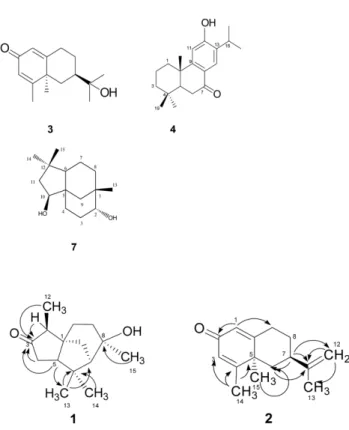
(Fig. 1).

Compound 1 was obtained as a white amorphous powder.

The molecular formula was established as C

15

H

24

O

2

based on NMR and a quasi-molecular ion peak at m/z 259.1671 [M + Na]

+

(calcd m/z 259.1669 for C

15

H

24

O

2

Na) with HR-ESI-MS. The

1

H- and

13

C-NMR spectra of 1 were similar to those of cedrol, which has previously been isolated from J. chinensis, except for the presence of a ketone group ( δ

C

219.91) at C-3 in 1. The mass spectrum of 1, which had a molecular ion peak 14 mass units higher than that of cedrol, further indicated the presence of a ketone group at the C-3 position in 1. The position of the ketone group was confirmed by HMBC experiments.

The HMBC correlations between δ 2.10 (H-2) / δ 2.44 (H-4) / δ 2.17 (H-5) / δ 0.98 (H-12) and δ 219.91 (C-3) confirmed that 1 was 3-oxocedran-8 β-ol (3-oxocedrol).

Although 1 was previously obtained from biotrans- formation of cedrol by Cephalosporium aphidicola and Curvularia lunata,

5-7

this is the first reported isolation of 1 from nature.

Compound 2 was obtained as a colorless oil. The molecular formula was determined as C

15

H

20

O based on NMR and a quasi-molecular ion peak at m/z 239.1421 [M + Na]

+

(calcd m/z 239.1406 for C

15

H

20

ONa) with HR- ESI-MS. The

1

H-NMR spectrum of 2 revealed the presence of a tertiary methyl singlet signal at δ 1.46 (3H, s), an isopropenyl group at δ 4.76, 4.75 (each 1H, br s, H- α

[ ]

D26.8

(4)

12) and δ 1.74 (3H, s, H-13), two olefinic doublet signals at δ 6.08 (1H, d, J = 2.0 Hz, H-1) and 6.09 (1H, d, J = 2.0 Hz, H-3), and a methyl singlet at δ 2.07 (3H, s), suggesting that 2 was a valencene-type sesquiterpenoid.

13,16

This observation was further supported by

13

C-NMR, which, when coupled with the distortionless enhancement by polarization transfer (DEPT) spectra, showed 15 carbon signals including one α, β-unsaturated carbonyl carbon ( δ

C

188.80), two olefinic quaternary carbons ( δ

C

170.54 & 171.99), and two olefinic methine carbons ( δ

C

124.59 & 126.74). The

1

H- and

13

C-NMR spectra of 2 were analogous to those of (+)-nootkatone (5),

13

except for the presence of a double bond at C-3 and C-4 in 2.

This assumption was further supported by an HMBC correlation between the methine proton at δ 6.09 (H-3) and methyl carbon at δ 19.15 (C-14). In addition, the relative configuration of C-7 in 2 could be deduced from the J values of H-7 (δ

H

2.59, J = 3.1, 12.8 Hz), which indicated a β-orientation of the isopropenyl group compared with 1 α-hydroxyeudesma-5,11-dien-2-one (δ

H

2.07, J = 3.7, 13.0 Hz).

18

Therefore, the structure of 2 was determined to be valenc-1(10),3(4),11(12)-trien-2-one (3,4- dehydro-nootkatone). Although there was a previous report on the chemical synthesis of racemic 3, 4-dehydro- nootkatone through dehydrogenation of 4-epi-nootkatone with 2,3-dichloro-5,6-dicyanobenzoquinone,

8-10

this is the first reported isolation of 2 from nature.

Compound 3 was obtained as a colorless oil. The molecular formula was established as C

15

H

22

O

2

based on NMR and a quasi-molecular ion peak at m/z 257.1522 [M + Na]

+

(calcd m/z 257.1512 for C

15

H

22

O

2

Na) with HR- ESI-MS. The

1

H- and

13

C-NMR spectra of 3 were similar to those of 2, except that the isopropenyl group at C-7 in 2 was replaced with a hydroxyisopropyl group in 3.

17

This assignment was further supported by HMBC corre-

lation between the methine proton at δ 1.92 (H-7) and the hydroxylated quaternary carbon at δ 72.76 (C-11). The relative configuration at C-7 was determined to be identical to 2 on the basis of J values of H-7 (δ

H

1.92, J = 2.8, 12.8 Hz). Accordingly, the structure of 3 was identified as 11- hydroxy-valenc-1(10),3(4)-dien-2-one.

Only compound 2 exhibited significant BChE inhibitory activity with an IC

50

value of 68.45 μM. This was com- pared to the positive control berberine, which had a BChE inhibitory activity with an IC

50

value of 18.75 μM. None of the other isolated compounds showed inhibitory activity against AChE and BChE up to 200 μM. From these results, it can be concluded that the BChE inhibitory activity of compound 2 might be explained by presence of 11-12 ene moiety and two double bonds at C-1-10 and C- 3-4 as well as a ketone group at C-2, which significantly enhanced activity.

Acknowledgments

This work was supported by a Research Grant from Pukyong National University (2017 Year).

References

(1) Corner, E. J. H. Wayside Trees of Malaya; Malayan Nature Society:

Malaysia, 1988, pp 396-446.

Fig. 1. Chemical structures of isolated compounds 1 - 7.

Fig. 2. Key HMBC correlations of compounds 1 and 2.

(5)

(2) But, P. P. H.; Kimura, T.; Gue, J. X.; Sung, C. K. International Collation of Traditional and Folk Medicine; World Scientific Publishing Co., Ltd.: Singapore, 1997, pp 16-17.

(3) Jung, H. J.; Jung, H. A.; Min, B. S.; Choi, J. S. Chem. Pharm. Bull.

2015, 63, 955-960.

(4) Ellman, G. L.; Courtney, K. D.; Andres, V. Jr.; Feather-stone, R. M.

Biochem. Pharmacol. 1961, 7, 88-95.

(5) Hanson, J. R.; Nasir, H. Phytochemistry 1993, 33, 835-837.

(6) Gand, E.; Hanson, J. R.; Nasir, H. Phytochemistry 1995, 39, 1081- 1084.

(7) Collins, D. O.; Reese, P. B. Phytochemistry 2001, 56, 417-421.

(8) Caine, D.; Chu, C. Y. Tetrahedron Lett. 1974, 15, 703-706.

(9) Caine, D.; Chu, C. Y.; Graham, S. L. J. Org. Chem. 1980, 45, 3790- 3797.

(10) Pesaro, M.; Bozzato, G.; Schudel, P. Chem. Commun (London).

1968, 19, 1152-1154.

(11) Kuo, Y. H.; Wu, T. R.; Cheng, M. C.; Wang, Y. Chem. Pharm.

Bull. 1990, 38, 3195-3201.

(12) Chang, C. I.; Chen, W. C.; Shao, Y. Y.; Yeh, C. R.; Yang, N. S.;

Chiang, W.; Kuo, Y. H. Nat. Prod. Res. 2008, 22, 1158-1162.

(13) Savona, G.; Piozzi, F.; De La Torre, M. C.; Servettaz, O.

Rodríguez, B. Phytochemistry 1987, 26, 571-572.

(14) Xu, J.; Su, J.; Li, Y.; Tan, N. Chem. Nat. Compd. 2013, 49, 457- 461.

(15) Zhang, C.; Zhou, A.; Zhang, M. China Journal of Chinese Materia Medica 2009, 34, 994-998.

(16) Furusawa, M.; Hashimoto, T.; Noma, Y.; Asakawa, Y. Chem.

Pharm. Bull. 2005, 53, 1513-1514.

(17) Naf, F.; Decorzant, R.; Thommen, W. Helv. Chim. Acta 1982, 65, 2212-2223.

(18) Wittayalai, S.; Mahidol, C.; Prachyawarakorn, V.; Prawat, H.;

Ruchirawat, S. Phytochemistry 2014, 99, 121-126.

Received April 5, 2017

Revised June 9, 2017

Accepted June 10, 2017

수치

Fig. 1. Chemical structures of isolated compounds 1 - 7.

참조

관련 문서

3-2-2. Intracellular tyrosinase inhibition of compounds... NO production inhibitory activities and cytotoxicities of extract and solvent layers... NO production inhibitory

The compounds were tested for their inhibitory effects on the histamine-induced smooth muscle contraction in guinea-pig ileum at 0.1 µ M and on the histamine

Antioxidant, Physiological Activities, and Acetylcholinesterase Inhibitory Activity of Portulaca oleracea Extracts with Different Extraction Methods.. Yu-Ri Kwon,

Though the number of tested compounds is too small, this result suggested that the methoxyl group and 3, 4-epxoy moiety did not affect the acetylcholinesterase inhibitory

In screening test for cholinergic activities of the extracts, acetylcholinesterase (AChE) activity was highly inhibited in Oenanthe javanica alcohol extract (OJAE, 18.76%)

Flavonoids from the leaves of Rhododendron brachycarpum. H .: Isolation and structure elucidation of triterpenoidal constituents from the leaves of Rhododondron

grase - endonucleolytic, integration, and disintegration activities. Both compounds inhibited the three enzymatic activities in a dose-dependent manner. The 50%

ABSTRACT: This study was initiated to investigate antioxidant, anti-acetylcholinesterase, and xanthine oxidase inhibitory activities and properties of fruiting bodies, mycelia,