314
한 국 균 학 회 지
The Korean Journal of Mycology
Screening of Potent Anti-dementia Acetylcholinesterase Inhibitor-containing Edible Mushroom Pholiota adiposa and the Optimal Extraction Conditions for the
Acetylcholinesterase Inhibitor
Do-Yeon Kim, Sang-Min Bae, Sang-Min Han and Jong-Soo Lee*
Department of Biomedicinal Science and Biotechnology, Paichai University, Daejeon 35345, Korea
ABSTRACT : To develop a new anti-dementia acetylcholinesterase (AChE) inhibitor from edible mushrooms, AChE inhibitory activities were determined on water and ethanol extracts of various edible mushrooms from oriental medicine markets and agriculture markets. As a result, the 70% ethanol extract from Pholiota adiposa fruiting body had the highest AChE inhibitory activity of 30.6, and its water extract also had an AChE inhibitory activity of 23.8%. Therefore, we finally selected P. adiposa as a potent anti-dementia AChE inhibitor-containing mushroom. The AChE inhibitor of P. adiposa was maximally extracted when its fruiting body was treated with water for 3hr at 70oC and 70% ethanol for 12 hr at 70oC, respectively.
KEYWORDS : Acetylcholinesterase Inhibitor, Anti-dementia, Ethanol extract, Pholiota adiposa
Introduction
Because of the significant increase in life expectancy over sixty-five years of age in Korea, dementia diseases have also increased. Some forms of dementia are caused by a lack of neurotransmitters. Acetylcholine is one of the neurotransmitters in the peripheral nervous system and central nerve system, and it is converted into choline and acetate by acetylcholinesterase (EC.3.1.1.7, AChE) [1, 2].
Therefore, AChE is a key enzyme in the pathophysiology of dementia.
Several AChE inhibitors as anti-dementia agents have been extracted and characterized from various plants or microorganisms including Umbilicaria esculenta [3], green tea [4, 5], Securinega suffruticosa [6], Onosma hispida [7],
Juglans regia [2], the Chinese herb Huperzia serrate [8], etc. However, AChE inhibitors such as Galantamine, Riv- astigmine, Donepezil, Tacrine and Memantine have been only approved by the FDA as drug therapy for dementia [9]. They also have some side effects including nausea and anorexia. Therefore, research on development of new anti-dementia agents with high efficacy and no side effects is necessary.
Meanwhile, bioactive compounds from mushrooms have been reported for their health-stimulating effects [10].
One of the edible mushroom Pholiota adiposa is classified under the genus Pholiota of the family Strophariaceae. This mushroom is cultivated in Asia including Korea, Europe, and North America. The pharmaceutical effects of P. adi- posa have been reported its antihypertension [11], chole- sterol-lowering [12], antibiotic, and antitumor activities [11]. This study describes the screening of a potent AChE inhibitor found in P. adiposa and the optimization of the extraction conditions to develop a new anti-dementia agent from edible mushrooms for application in the medicinal food industry.
Materials and Methods
Mushrooms and chemicals
Nine kinds of commercial edible mushrooms were pur- chased at local oriental medicinal markets and agriculture
Research Article
*Corresponding author E-mail: [email protected] Received December 5, 2016 Revised December 16, 2016 Accepted December 20, 2016
This is an Open Access article distributed under the terms of the Creative Commons Attribution Non-Commercial License (http://
creativecommons.org/licenses/by-nc/3.0/) which permits unrestricted non-commercial use, distribution, and reproduction in any medium, provided the original work is properly cited.
Kor. J. Mycol. 2016 December, 44(4): 314-317 https://doi.org/10.4489/KJM.2016.44.4.314 pISSN 0253-651X • eISSN 2383-5249
© The Korean Society of Mycology
Screening of Potent Anti-dementia Acetylcholinesterase Inhibitor-containing Edible Mushroom Pholiota adiposa and the~
315
markets which were cultivated in Korea between 2014~
2015. Acetylcholinesterase (AChE from Electrophorus elec- tricus), acetylcholine chloride and 5,5’-dithiobis (2-nitro- benzonic acid) were purchased from the Sigma Chemical Co. (St, Louis, MO, USA). A VERSAmax microplate rea- der (Molecular Devices, Sunnyvale, CA, USA) was used to assay the AChE inhibitory activity.
Water and ethanol extraction
Air-dried (45oC for 48 hr) fruiting bodies were finely pulverized. The sample powders were added to water and 70% ethanol each at a 1:30 w/v ratio and then kept in a shaker for 24 hr at 30oC. Each extract was filtered with Whatman 0.45 µm membrane filter (NO 7404-004;
Whatman, Piscataway, NJ, USA) and lyophilized.
Acetylcholinesterase inhibitory activity assay
The AChE inhibitory activity was measured spectropho- tometrically as follows [2, 13, 14]. A mixture of 110 µL of assay buffer (0.1 M sodium phosphate, pH 7.3), 30 µL of AChE (0.8 unit/AChE), 30 µL of substrate (2 mM acetyl- thiocholine chloride), 20 µL of 5,5’-Dithiobis (2-nitroben- zonic acid, 2 mM DTNB) and 10 µL of sample (1 mg/
mL) dissolved in the assay buffer (1 mg/mL) in a 96 well plate was kept at 37oC for 6 min. The reaction product 5- thio-2-nitrobenzate produced was measured at 415 nm.
The inhibition rate was obtained with the following equa- tion:
Inhibition (%) = [1 − {(S−S0) / (C−C0)}] × 100,
where C was the radiation of a control (enzyme, assay buffer, DTNB, and substrate) after an activation for 6 min;
C0 was the radiation of the control at time zero; S was the radiation of the tested samples (enzyme, assay buffer, DTNB, and substrate) after an activation of 6 min, and S0 was the radiation of the tested samples at time zero.
To check the quenching effect of the samples, the sam- ple was added to the reaction mixture C (control), and any reduction in radiation by the sample was investigated.
Results and Discussion
Screening of potent acetylcholinesterase inhibitor-con- taining mushrooms
To select a potent anti-dementia AChE inhibitor-contai-
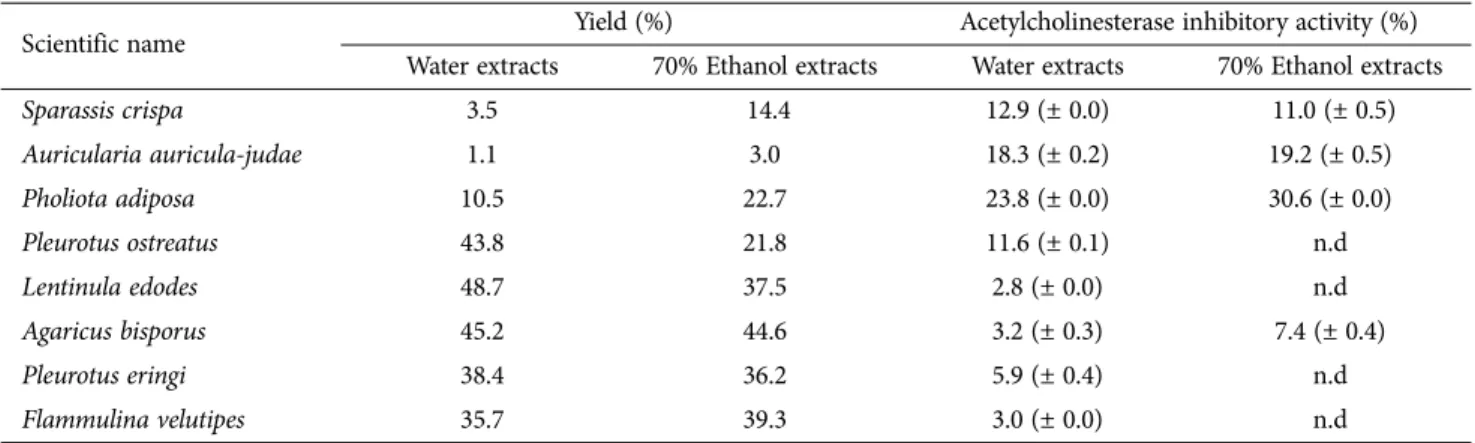
Table 1. Yield and acetylcholinesterase inhibitory activity of water and 70% ethanol extracts from various market mushrooms
Scientific name Yield (%) Acetylcholinesterase inhibitory activity (%)
Water extracts 70% Ethanol extracts Water extracts 70% Ethanol extracts
Sparassis crispa 3.5 14.4 12.9 (± 0.0) 11.0 (± 0.5)
Auricularia auricula-judae 1.1 3.0 18.3 (± 0.2) 19.2 (± 0.5)
Pholiota adiposa 10.5 22.7 23.8 (± 0.0) 30.6 (± 0.0)
Pleurotus ostreatus 43.8 21.8 11.6 (± 0.1) n.d
Lentinula edodes 48.7 37.5 2.8 (± 0.0) n.d
Agaricus bisporus 45.2 44.6 3.2 (± 0.3) 7.4 (± 0.4)
Pleurotus eringi 38.4 36.2 5.9 (± 0.4) n.d
Flammulina velutipes 35.7 39.3 3.0 (± 0.0) n.d
Extraction condition: 1:30, 30oC, 24 hr.
n.d, not detected.
Table 2. Effect of extraction temperature on the yield of water and 70% ethanol extracts from Pholiota adiposa Extraction temperature (oC)b Water extractsa (%) 70% Ethanol extracts (%)
Yield AChE inhibitory activity Yield AChE inhibitory activity
20 10.3 23.6 (± 0.0) 20.4 26.7 (± 0.0)
30 10.5 23.8 (± 0.0) 22.7 30.6 (± 0.0)
50 11.7 27.4 (± 0.7) 23.5 33.8 (± 0.2)
70 12.7 30.9 (± 0.2) 26.6 35.0 (± 0.0)
AChE, acetylcholinesterase.
aRatio of sample and solvents, 1:30.
bExtraction time 24 hr at 20oC, 30oC and 50oC, 12 hr at 70oC.
316
Do-Yeon Kim, Sang-Min Bae, Sang-Min Han and Jong-Soo Leening mushroom, water and 70% ethanol extracts from nine kinds of edible mushrooms were prepared, and their yields and AChE inhibitory activities were determined.
As shown in Table 1, the water extract from Lentinula edodes fruiting body had the highest yield of 48.7%, and the water and 70% ethanol extracts of Agaricus bisporus and the water extract of Pleurotus ostreatus also had yields over 40%.
However, the AChE inhibitory activity was the highest at 30.6% for the 70% ethanol extract of P. adiposa, and its water extract also had an AChE inhibitory activity of
23.8%. Finally, P. adiposa was selected as a good AChE inhibitor-containing edible mushroom. This inhibitory activity was lower than those from plants and fruits such as walnut (72.6%) and job’s tears (55.1%) [2, 15, 16].
Optimal conditions for the extraction of the acetyl- cholinesterase inhibitor
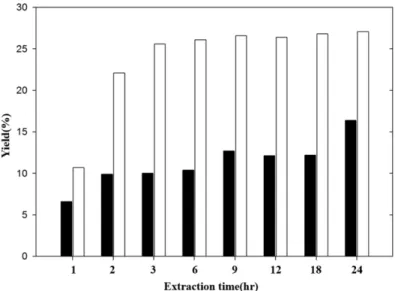
The effects of the extraction temperature on the AChE inhibitory activity and yields from Pholiota adiposa fruit- ing body were determined (Table 2). The 70% ethanol extract had about twice higher yield than that of the water Fig. 1. Effect of extraction time at 70oC on the yield of water extracts ( ) and 70% ethanol extracts ( ) from Pholiota adiposa.
Fig. 2. Effect of extraction time at 70oC on acetylcholinesterase inhibitory activity of water extracts ( ) and 70% ethanol extracts ( ) from Pholiota adiposa.
Screening of Potent Anti-dementia Acetylcholinesterase Inhibitor-containing Edible Mushroom Pholiota adiposa and the~
317
extract, and their yields were slightly increased as the ex- traction temperature was increased to 70oC.
The AChE inhibitory activity of the 70% ethanol ext- ract from the extraction at 70oC had the highest activity at 35.0%. The water extract from the extraction at 70oC also had an inhibitory activity of 30.9%. However, water extract from extraction of 100oC for 6 hr showed inhi- bitory activity less than 10% (data not shown).
The effect of the extraction time on the AChE inhibit- ory activity and yield was investigated. As seen in Figs. 1 and 2, the yields of the water and 70% ethanol extracts increased when the extraction time was increased to 3 and 6 hr, respectively. The AChE inhibitory activities also increased when the extraction time was increased. The maximum inhibitory activity was 33.7% for the water ext- ract at 3 hr and 35.0% for the 70% ethanol extract at 12 hr.
Lee et al. [2] reported AChE inhibitor of walnut (Jugl- ans regia L.) was maximally obtained from extraction at 40oC for 12 hr by 80% methanol but Seo et al. [13] rep- erted AChE inhibitor of job’s tears (Coix Lachrymajobi L.) was maximally extracted at 40oC for 6 hr with 60%
methanol.
Meanwhile, the 95% ethanol extract had lower yield and AChE inhibitory activity than that of the 70% ethanol extract (data not shown).
REFERENCES
1. Dugu M, Neugroschl J, Sewell M, Marin D. Review of dem- entia. Mount Sinai J Med 2003;70:45-53.
2. Lee EN, Song JH, Lee JS. Screening of a potent antidementia acetylcholinesterase inhibitor-containing fruits and optimal extraction conditions. Korean J Food Nutr 2010;23:318-23.
3. Lee JS, Min GH, Lee JS. Nutritional and physicochemical cha- racteristics of the antidementia Acetylcholinesterase-inhibiting methanol extracts from Umbilicaria esculenta. Mycobiology
2009;37:203-6.
4. Kwak JH, Jeong CH, Kim JH, Choi GN, Shin YH, Lee SC, Cho SH, Choi SG, Heo HJ. Acetylcholinesterase inhibitory ef- fect of green tea extracts according to storage condition. Kor- ean J Food Sci Technol 2009;41:435-40.
5. Jang CH, Eun JS, Park HW, Seo SM, Yang JH, Leem KH, Oh SH, Oh CH, Baek NI, Kim DK. An acetylcholinesterase inhi- bitor from the leaves of Securinega suffruticosa. Korean J Phar- macogn 2003;34:14-7.
6. Ahmad I, Anis I, Malik A, Nawaz SA, Choudhary MI. Cho- linesterase inhibitory constituents from Onosma hispida. Chem Pharm Bull (Tokyo) 2003;51:412-4.
7. Tang XC, Han YF. Pharmacological profile of huperzine A, a novel acetylcholinesterase inhibitor from Chinese herb. CNS Drug Rev 1999;5:281-300.
8. Li L, Tsao R, Yang R, Liu C, Zhu H, Young JC. Polyphenolic profiles and antioxidant activities of heartnut (Juglans ailanthi- folia var. cordiformis) and persian walnut (Juglans regia L.). J Agric Food Chem 2006;54:8033-40.
9. Zanabaatar B, Song JH, Seo GS, Noh HJ, Yoo YB, Lee JS.
Screening of anti-gout Xanthine oxidase inhibitor from mush- rooms. Kor J Mycol 2010;38:85-7.
10. Koo KY, Lee DH, Kim JH, Yu HE, Park JS, Lee JS. Production and characterization of antihypertensive angiotensin I-conv- erting enzyme inhibitor from Pholiota adiposa. J Microbiol Biotechnol 2006;16:757-63.
11. Yu HE, Lee DH, Seo GS, Cho SM, Lee JS. Characterization of a novel β-hydroxy-β-methyl glutaryl coenzyme A reductase- inhibitor from the mushroom, Pholiota adiposa. Biotechnol Bioprocess Eng 2007;12:618-24.
12. Ellman GL, Courtney KD, Andres V, Featherstone RM. A new and rapid colorimetric determination of acetylcholinesterase activity. Biochem Pharmacol 1961;7:88-95.
13. Seo DS, Jang JH, Kim NM, Lee JS. Optimal extraction condi- tion and characterization of antidementia acetylcholinesterase inhibitor from job’s tears (Coix lachrymajobi L.). Korean J Med Crop Sci 2009;17:434-8.
14. Fukuda T, Ito H, Yoshida T. Antioxidative polyphenols from walnuts (Juglans regia L.). Phytochemistry 2003;63:795-801.
15. Hardman WE, Ion G. Suppression of implanted MDA-MB 231 human breast cancer growth in nude mice by dietary walnut.
Nutr Cancer 2008;60:666-74.