779
©The Korean Society of Food Science and Technology
알츠하이머질병 모델동물인 Tg2576 마우스를 이용한 미나리 알코올추출물의 기억력 개선 효능
원범영·신기영1·하현지·장근아2·윤여상·김예리·박용진·이형근*
(주)브레인트로피아 기업부설연구소, 1단국대학교 자연과학대학 미생물학과,
2가천대학교 메디컬캠퍼스 약리학과
Effect of Dropwort ( Oenanthe javanica) Extracts on Memory Improvement in Alzheimer’s Disease Animal Model, Tg2576 mice
Beom Young Won,Ki Young Shin1, Hyun Jee Ha, Keun-A Chang2, Yeo Sang Yun, Ye Ri Kim, Yong Jin Park, and Hyung Gun Lee*
Research & Development Center, Braintropia Co., Ltd.
1Department of Microbiology, College of Natural Science, Dankook University
2Department of Pharmacology, Gachon University of Medicine and Science
Abstract This study was conducted to investigate the effect of herbs on memory improvement by focusing on their cholinergic functions in Tg2576 mice. Seven herbs were used to obtain extracts by using alcohol and water. In screening test for cholinergic activities of the extracts, acetylcholinesterase (AChE) activity was highly inhibited in Oenanthe javanica alcohol extract (OJAE, 18.76%) as compared with the others. The OJAE-treated Tg2576 (Tg-OJAE) groups showed the statistically significant increases of latency time in passive avoidance test. Also, it was found that the concentration of Aβ1-42 was significantly reduced in Tg-OJAE groups compared to non-treated Tg2576 groups. In the additional enzyme test, it was found that IC50 of OJAE was 991.77µg/mL and OJAE acted as an uncompetitive inhibitor of AChE. Therefore, it seemed that OJAE can be used for the development of processed foods for memory improvement.
Keywords: Oenanthe javanica, memory, acetylcholinesterase, beta-amyloid, functional food
서 론
현대인의 급변하는 생활에서 기억력은 그 중요성에 대한 관심 이 증가하고 있으며, 학습량이 많은 청소년에서부터 노년에 이르 기까지 다양한 연령대의 관심 대상이 되고 있다. 특히, 젊은 사람 들에게도 치매가 유발되고 있듯 치매와 관련된 기억력 저하는 사 회적으로 큰 문제이며(1-2), 이에 치매와 같은 뇌질환 예방과 치 료에 대한 관심이 급증하고 있다(3). 치매는 주로 뇌혈관성 치매 (cerebrovascular dementia)와 알츠하이머질환(Alzheimer disease, AD)으로 구분되며, 노인성반과 뇌신경섬유종을 주요 특징으로 한 다(4). 알츠하이머질환의 병리학적 특징은 40-42개의 아미노산으 로 이루어진 베타아밀로이드(β-amyloid, Aβ) 단백질의 과도 축적 으로 신경세포의 자연 세포 사멸 기전의 활성화와 산화적 스트레 스에 의한 세포 파괴를 증가시켜 인지기능 및 기억력을 상실하게 하는 신경퇴화를 유도한다(5-12). 또한, 뇌의 베타아밀로이드 단백 질의 축적은 아세틸콜린의 합성을 저해시킴으로써 기억 및 인지
기능 장애를 유발할 수 있다고 한다(13-15). 현재 타크린(tacrine), 도네페질(donepezil), 리바스티그민(rivastigmine) 및 갈란타민(galan- tamine) 등의 약물은 치매에 대한 치료제로 미국 식약처(U.S. Food and Drug Administration, FDA)의 승인을 받았다. 그러나, 타크린 의 경우 간독성 때문에 지금은 거의 사용되지 않고 있다(16). 또 한, 현재 시판중인 다른 약물들도 몇몇 부작용 사례들이 보고되 었기 때문에 천연물이나 약용식물을 이용하여 기존 약물들을 대 체 할 수 있는 새로운 치료 및 예방 효과를 나타낼 수 있는 보 다 안전성이 입증된 치료제 개발이 진행되고 있다(17). 천연물로 부터 얻은 물질의 신경보호 효과로 원지(Polygala tenuifolia Will- denow)추출분말, 은행(Ginko biloba)잎 추출물 및 녹차(Green tea) 추출물/테아닌(L-Theanine) 복합물, 로즈마리(Rosmarinus officinalis L) 잎 추출물 등이 보고되었다(18-22). 본 연구에서는 미나리추출 물이 기억력 개선에 효능이 있을 것이라고 가정하여 실험이 진행 되었다. 미나리(Oenanathe javanica)는 미나리과에 속하는 다년초 초본으로 한국의 농가에서 특용 작물로 재배하고 있다(23). 독특 한 향미 및 약리작용으로 인해 기능성식품 소재나 향신료로 활용 도가 높은 약용식물이며(24), 특히 혈압 강하, 진정, 보혈, 정력 강 장 등에 효과가 있다(25). 미나리에 대한 연구로는 성분에 관한 연구(26,27), 항산화 활성(28), 간기능 보호 및 해독기능에 대한 효 과(29,30) 등이 진행되었다. 이와 같이 약용 및 식용식물로서의 높 은 가치를 지닌 미나리에 대한 다양한 연구가 진행되어 왔으나 아직 미나리 추출물에 대한 기억력 개선 효과 연구는 미흡한 실
*Corresponding author: Hyung Gun Lee, Research & Development Center, Braintropia Co. Ltd, Anyang 10930, Korea
Tel: 82-031-425-3718 Fax: 82-031-425-3719
E-mail: [email protected]
Received October 12, 2015; revised November 27, 2015;
accepted December 10, 2015
정이다. 따라서 본 연구에서 7가지 식물 후보군인 미나리, 유자 (Citrus junos), 대추(Ziziphus jujube), 천년초(Opuntia ficus-indica), 석류(Punica grantum), 무화과(Ficus carica), 신선초(Angelica keiskei)를 물 또는 알코올로 추출한 후 기억력 개선 기능성 소재 로서의 가능성을 평가했다. 기억력 개선 스크리닝으로 아세틸콜 린분해효소(acetylcholinesterase, AChE) 활성억제효과를 측정하였 다. 이들 후보군 중 효능이 좋은 미나리 알코올추출물을 동물의 기억력 개선을 위한 최종 후보물질로 선택하고 Tg2576 형질전환 마우스를 사용하여 수동회피 테스트 및 베타아밀로이드1-42 단백 질 생성 억제력을 살펴보았다. 또한 아세틸콜린분해효소에 대한 50% 활성억제농도(IC50)와 Lineweaver-Burk plot을 나타내었다. 결 론적으로, 본 연구에서 미나리 알코올추출물의 기억력 개선 효과 를 규명하고 기능성 식품으로서의 가능성을 평가하고자 한다.
재료 및 방법
실험재료 및 시약
본 실험에 사용된 약용 및 식용 식물들은 미나리, 유자, 대추, 천년초, 석류, 무화과 및 신선초이며, 모두 전라남도 지역에서 재 배된 것을 구입하였다. 불순물 제거를 위하여 수세한 후 2번 열 풍 건조기(VB-200DM, Vison Biotech, Incheon, Korea)에 건조시 키고, 분쇄기(Pin Crusher-140, Korea Pulverizing Machinery Co., Incheon, Korea)를 이용하여 분쇄하였다. 이들 재료는 50% 알코 올 및 물로 75±5oC에서 4시간 2회 추출하였고, 여과지(Whatman No. 1, Whatman International Ltd., Maidstone, UK)를 이용하여 여과한 후, 농축기(vacuum rotary evaporator, N-1000, Eyela, Tokyo, Japan)를 사용하여 50oC에서 감압 농축하였다. 농축된 시 료들은 분무 건조기(PSD-10, Yoojintech Co., Pyeongtaek, Korea) 를 이용하여 건조한 후 분말 상태로 준비하여 시료로 사용하였 다. 본 실험에서 알코올(Ethanol Supplies World Co., Ltd., Korea) 과 생리식염수(JW Pharmaceutical Co., Ltd., Korea)는 국내 시약 회사에서 구입해서 사용하였다. 아세틸콜린 아이오다이드(acetyl- choline iodide), 디메틸 설폭사이드(dimethyl sulfoxide, DMSO), 베 타아밀로이드1-42 단백질 및 그 외 시약은 씨그마사(Sigma-Aldrich Co., St. Louis, MO, USA)에서 구입하였다.
실험동물
본 연구에서는 치매모델동물로서 잘 알려진 Tg2576 형질전환 마우스를 사용하였다. Tg2576 마우스와 Wild type (Wt) 마우스 (B6SJLF/J, 12주령, 20±5 g)는 각각 Taconic Farms (Germantown, NY, USA)와 (주)코아텍(Geonggido Peongtaek, Korea)으로부터 구 매하였으며, 12시간 간격으로 조명을 주고, 온도 22±2oC, 습도 50-55%의 환경에서 식이와 물은 자유롭게 섭취할 수 있게 하였 다. 실험그룹은 총 4군으로 나누었다. 즉, 생리식염수를 투여한 대조군(Wt-CTL), 미나리추출물(50 mg/kg)을 투여한 대조군(Wt- OJAE), 생리식염수를 투여한 실험군(Tg-CTL)과 미나리추출물을 투여한 실험군(Tg-OJAE)이다. 모든 동물 실험 프로토콜은 가천 대학교 동물실험윤리위원회(Gachon University Hospital Institutional Animal Care and Use Committee)의 승인을 받은 후 시행하였으 며, 전 실험 과정 동안 모든 동물은 실험 동물관리원칙(The Principles of Laboratory Animal Care National Institues of Health Publication)를 준수하였다.
아세틸콜린분해효소 활성억제력 측정
7가지 식물추출물의 아세틸콜린분해효소 활성억제효능은 Ellman
법(31)의 아세틸콜린 아이오다이드(acetythiocholine iodide)를 기질 로 사용한 비색분석법으로 측정하였다. 아세틸콜린분해효소는 다 른 실험에 사용하지 않은 7주령 랫트 뇌를 균질화하여 추출하였 다. 추출방법은 뇌 무게의 10배수 용량 완충액(12.5 mM 인산염 pH 7.0, 400 mM NaCl)에 랫트 뇌를 넣고, 뇌를 균질기(Bio-Gen Pro 200, Pro Science Inc., Oxford CT, USA)를 이용해 균질화 시킨 후 1,000×g, 10분간 원심분리(Hanil Science, Incheon, Korea)하였고, 그 상층액에 0.5% Triton X-100이 포함된 완충액 을 첨가하고, 30분 동안 반응시켜 1,000×g, 10분간 원심분리 하 였다. 모든 과정은 4oC를 유지하여 수행하였고, 상층액을 취하여 아세틸콜린분해효소로써 본 실험에 사용하였다. 모든 식물 추출 물은 5% DMSO에 용해하고, 사용 바로 전에 완충액(100 mM 인 산염, pH 8.0)에 200 µg/mL의 농도로 희석하였다. 1.5 mL의 희석 된 모든 식물 추출 실험용액은 100 µL의 아세틸콜린 아이오다이 드 용액(75 mM), 엘만시약[Buffered Ellman’s reagent; 5,5'-디티오- 비스(2-니트로벤조산) 10 mM , 탄산수소나트륨 17.85 Mm] 100 µL을 혼합하고, 25oC에서 10분간 반응시켰다. 1.2 mL 완충액(100 mM 인산염, pH 7.0)과 100 µL 효소를 첨가한 후 410 nm에서 5 분 동안 30초 간격으로 측정하였다. 모든 실험은 5회 반복 측정 하였다.
수동회피 테스트
Tg2576 마우스와 Wild type 마우스의 기억과 학습에 대한 미 나리추출물의 효과를 측정하기 위해 수동회피테스트 기구(PACS- 30, San Diego Instrument Int., San Diego, CA, USA)를 사용하 였다(32). 기구는 2개의 같은 크기 방(23.5×15.5×15.5 cm)으로 나 누어지고, 길로틴 도어(6.5×4.5 cm)에 의해 분리된다. 동물은 처음 에 불이 켜진 방에 놓여지고, 탐험적인 행동을 보이다가 어두운 방으로 들어간다. 어두운 방에 들어가자마자 길로틴 도어는 자동 적으로 닫히게 된다. 훈련은 동물이 20초 이내에 어두운 방으로 들어갈 때까지의 훈련을 반복시킨다. 동물이 어두운 방에 들어가 면 길로틴 도어는 자동적으로 닫히게 되고, 전기가 통하는 격자 바닥을 통해 3초 동안 전기충격(0.3 mA)이 가해진다. 그 동물이 어두운 방으로 들어가는 시간은 최장 300초를 기준으로 측정하 였다. 만약 동물이 300초 이내에 어두운 방으로 들어가지 않았다 면, 그것은 300초의 값으로 측정하였다.
베타아밀로이드1-42 단백질의 생성에 대한 억제 측정 Tg2576 마우스와 Wild type 마우스의 뇌에서 베타아밀로이드 1-42 단백질의 농도는 Human Ab1-42 ELISA kit (Biosource International, Camarillo, CA, USA)를 이용하여 제조회사의 권장 법에 따라 측정하였다. 먼저, 마우스의 뇌조직 100 mg에 구아니 딘 트리스 완충액(5 M guanidine Hcl/50 mM Tris-HCl, pH 8.0, 10 mL)을 첨가하여 유리 균질기(Wheaton Industries, Millville, New Jersey, USA)를 이용하여 분쇄한 후, 실온에서 3시간 동안 균질 현탁액을 분해하였다. ELISA kit의 각 well에 뇌조직 현탁 액과 항베타아밀로이드1-42를 첨가하여 12시간 이상 배양한 후 미부착 단백질은 세척용액(200 µL)을 이용하여 세척하였다. 다시 각 well에 anti-rabbit IgG HRP 반응용액(100 µL)을 첨가하여 실 온에서 30분 동안 배양한 후 세척용액으로 세척하였다. 여기에 안정화 크로모젠(100 µL)을 첨가하여 반응을 종결하였다. 반응종 결에 따라 나타난 색깔의 변화는 ELISA 측정기(Apollo 11 Absor- bance Microplate Reader LB 913, Berthold Technologies, Bad Wildbad, Germany)를 이용하여 450 nm에서 측정하였다(33).
아세틸콜린분해효소에 대한 50% 활성억제농도(IC50) 및 Lin- eweaver-Burk Plot 측정
미나리 알코올추출물에 대한 50% 활성억제농도(IC50)를 측정하 고, 미나리 알코올추출물의 첨가 유무에 따른 아세틸콜린분해효 소 활성억제를 Km, Vmax값을 Lineweaver-Burk plot으로 나타냈다.
모든 실험은 5번 반복 측정하였다.
통계 분석
실험 결과는 평균과 표준오차(SEM)으로 나타냈으며 통계분석 은 SPSS program (SPSS Version 12.0, SPSS Inc., USA)을 이용 하였고, one-way ANOVA (analysis of variation) 와 Student’s t- test로 분석하여 p<0.05 수준에서 유의성을 검정하였다.
결과 및 고찰
아세틸콜린분해효소 활성억제력 측정
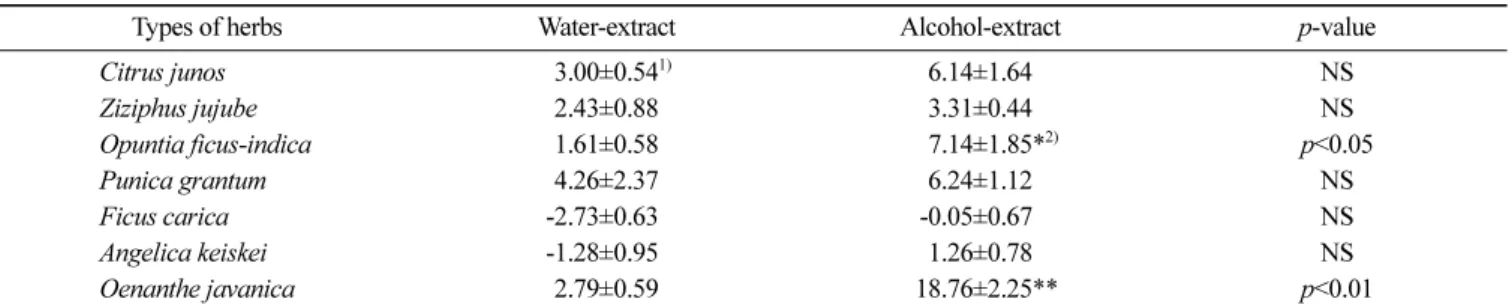
아세틸콜린분해효소는 말초신경과 중추신경계의 대표적 신경 전달물질인 아세틸콜린을 분해하는 효소로, 활성을 억제해 뇌 속 의 아세틸콜린 농도를 증가시키는 방법이 알츠하이머질환 환자 치료에 이용되고 있다(34). 따라서 본 실험에서는 모든 식물의 알 코올과 열수 추출물들이 아세틸콜린분해효소 활성에 미치는 효 과를 나타내었다(Table 1). 아세틸콜린분해효소 활성억제력은 알 코올 추출물이 열수 추출물보다 모든 식물추출물에서 높게 나타 났으며, 특히 미나리 알코올 추출물이 18.76%로 높은 억제력을 나타내었고, 각각 열수추출물과 비교하여 통계적으로 유의적인 차이를 나타냈다(p<0.01). 또한, 선인장 알코올 추출물이 열수추 출물과 비교하여 유의적으로 높은 억제력을 보였다(p<0.05). Lee 등(35)은 70% 알코올 추출물에서 사과 13.2%, 복분자 2.4%, 대 추 1.5%로 보고하였다. 미르틀(Myrtus communis L.)잎 추출물, 피 스타치오 속인 양유향(Pistacia lentiscus L.) 잎 추출물과 에린지 움(Eryngium maritimum L.) 잎 추출물은 아세틸콜린분해효소 활 성억제력이 높았으며, 플라보노이드와 페놀산, 타닌 성분 등이 반 응 효과를 증가 시켰다고 한다(36-39). 아세틸콜린분해효소 활성 억제 효과는 미나리 추출물에 함유된 플라보노이드, 페놀의 성분 이 기인한 것이라고 판단되며, 미나리 추출물은 항산화 활성이 있는 것으로 산화적 스트레스를 감소시킴으로써 기억력을 개선 할 수 있을 것으로 추정된다.
수동회피 테스트를 이용한 인지능 평가
수동회피시험은 설치류의 작업기억능력을 측정하는 방법으로 해마에서 조건화된 기억과 변연계와 연관 있는 기억에 관한 영
향을 측정하기 위해 주로 사용된다(40). Tg2576 형질전환 마우스 에서 미나리 알코올추출물이 인지능 개선에 미치는 영향을 측정 한 결과는 Fig. 1과 같다. 대조군에서 머무름 시간이 생리식염수 를 투여한 대조군(Wt-CTL) 202.70초, 미나리추출물을 투여한 대 조군(Wt-OJAE) 196.71초로 통계적으로 유의적인 차이는 없었다.
그러나 실험그룹 중 생리식염수를 투여한 실험군(Tg-CTL)은 머 무름 시간이 61.59초로 감소하여 Wt-CTL군과 통계적으로 유의 적인 차이를 나타냈다(p<0.05). 미나리추출물을 투여한 실험군(Tg- OJAE)은 181.77초로 Tg-CTL군 보다 머무름 시간이 증가하여 유 의적인 차이가 나타났다(p<0.05). 이전 보고된 연구에서는 스코폴 라민으로 유도한 기억손상 동물모델에서 머무름 시간이 증가하 였다고 보고하였으며, 기억 손상의 회복 작용은 콜린 효능성 신 경계에 작용하여 기억손상이 완화된 것이라고 하였다(41). 이를 바탕으로 미나리 알코올추출물은 콜린성 신경계를 보호하는 것 으로 기억력 손상을 효과적으로 예방 가능함을 시사하였으며, 미 나리 추출물의 지속적인 섭취는 치매질환과 같은 증상에서 나타 나는 감퇴된 기억력을 증진시켜주는 효과가 있을 것으로 판단된다.
Table 1. A comparison of AChE inhibition between water-extracts and alcohol-extracts of seven herbs (%)
Types of herbs Water-extract Alcohol-extract p-value
Citrus junos 03.00±0.541) 6.14±1.64 NS
Ziziphus jujube 2.43±0.88 3.31±0.44 NS
Opuntia ficus-indica 1.61±0.58 007.14±1.85*2) p<0.05
Punica grantum 4.26±2.37 6.24±1.12 NS
Ficus carica -2.73±0.63- -0.05±0.67- NS
Angelica keiskei -1.28±0.95- 1.26±0.78 NS
Oenanthe javanica 2.79±0.59 018.76±2.25** p<0.01
1)Data was expressed mean±SEM. All experiments were repeated five times.
2)Each value represents the *p<0.05 compared to each water-extract by Student’s t-test.
3)Each value represents the **p<0.01 compared to each water-extract by Student’s t-test.
Fig. 1. Effect of OJAE on memory impairment of Tg2576 mice.
In 12 week-old Tg2576 (Tg) and wild-type (Wt) mice, the passive avoidance test was performed after oral administration of OJAE (50 mg/kg) for 3 months. Note that latency was decreased significantly in non-treated Tg mice compared to non- and OJAE-treated Wt mice. However, latency time was increased significantly by OJAE treatment compared to non-treatment in Tg mice. Data represents mean±SEM. *p<0.05 compared with non-treated Wt mice and
†p<0.05 compared with non-treated Tg mice, one-way ANOVA with a post hoc Tukey’s test.
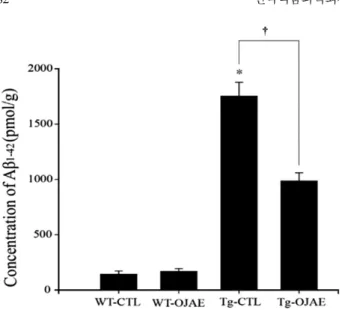
마우스 뇌의 베타아밀로이드1-42 단백질 생성 억제력 측정 알츠하이머병의 가장 핵심적 원인가설인 아밀로이드 생성설은 42개의 아미노산으로 구성된 베타아밀로이드1-42 응집체에 의해 신경세포독성 및 신경섬유종의 유발이 가장 중요한 원인이다. 베 타아밀로이드 단백질은 일반적으로 독성이 없는 수용성 펩타이드 상태로 생산되지만 뇌에서 결합하여 축척되면 노인성반(senile plaques)을 생성하여 신경세포에 독성을 나타낸다(42,43). 따라서 본 연구에서는 미나리 알코올추출물이 뇌조직의 베타아밀로이드1-42 단백질 생성 억제에 미치는 영향을 측정하여 Fig. 2에 나타내었다 . 대조군에서 생리식염수를 투여한 대조군(Wt-CTL) 142.59 pmol/
g, 미나리추출 물을 투여한 대조군(Wt-OJAE)은 168.52 pmol/g로 나 타났으며 유의적인 차이가 없었다. Wt-CTL과 비교하여 생리식염 수를 투여한 실험군(Tg-CTL)은 1751.85 pmol/g으로 베타아밀로이 드1-42 단백질 농도가 증가하여 나타났으며,미나리추출물을 투여 한 실험군(Tg-OJAE)은 985.19 pmol/g로 미나리 알코올추출물에 의 하여 베타아밀로이드1-42 펩타이드의 농도가통계적으로 유의하게 감소하였다(p<0.05). 이러한 경향은 아세틸콜린분해효소 활성억제 에 대한 결과와 일치하게 나타났으며, 미나리 알코올추출물의 효 능과 상관관계를 나타내는 것을 확인할 수 있었다. Go 등(32)은 Tg2576 형질전환 마우스 뇌에서 베타아밀로이드1-42 펩타이드의 양이 감소하는 것은 뇌조직에서 베타아밀로이드1-42 펩타이드 생 성을 억제하는 것이라고 하였다. 또한, 마우스 혈청에서 NGF의 분비를 촉진하였다고 보고하였다. 따라서 미나리 추출물은 베타아 밀로이드 펩타이드로부터 신경세포를 보호할 수 있는 천연물질로 써 기억력 개선 효과를 제시하고 있다고 판단된다.
아세틸콜린분해효소에 대한 50% 활성억제농도(IC50) 및 Lin- eweaver-Burk Plot 측정
미나리 알코올추출물의 농도에 따른 아세틸콜린분해효소 활성
억제로부터 회귀방정식을 측정한 미나리 알코올추출물의 50% 활 성억제농도(IC50)값의 결과는 Fig. 3과 같으며, 991.77 µg/mL로 나 타났다. 생강(Zingiber officinale) 종류에 따른 50% 활성억제농도 (IC50)값은백생강 2.86 mg/mL, 적생강 3.03 mg/mL로 나타났고(44), 미나리 알코올추출물은 아세틸콜린분해효소의 활성을 효과적으 로 저해시킴을 알 수 있었다. 효소 억제에 대한 경쟁적/비경쟁적 특성은 Lineweaver-Burk Plot으로 나타낼 수 있다(45,46). 미나리 알코올추출물의 효소 반응 속도연구는 아세틸콜린분해효소를 억 제하는 지표로써 사용되므로, Vmax와 Km 반응 비율 상호간에 대 한 기질 농도의 plot 그래프로 Fig. 4에 나타내었다. 미나리 알코 올추출물(1 mg/mL) 존재 하에서 2-20 µM의 농도 범위 처리 시 Vmax값(30.055 dA/min-42.857 dA/min)은 감소하는 경향을 나타냈 으며, 아세틸콜린분해효소활성을 상당히 억제하는 것으로 나타났 다. Km값 또한0.013µM부터 0.05 µM까지 뚜렷한 감소를 나타냈 다. 그러므로, 미나리 알코올추출물은 아세틸콜린분해효소 활성 Fig. 2. Effect of OJAE on soluble A1-42 production in Tg2576
mouse brains. In 12 week-old Tg2576 (Tg) and wild-type (Wt) mice, brains were isolated after behavioral tests and soluble Aβ1-42 levels of the brains were measured, using ELISA kits. The levels of soluble Aβ1-42 were highly increased in the cortex of non-treated Tg mice compared with those of non- and OJAE-treated Wt mice.
Note that the levels of Aβ1-42 were decreased by the oral administration of OJAE during 3 months. Data represents mean±SEM. *p<0.05 and ** p<0.01 compared with vehicle-treated Tg2576 mice, one-way ANOVA.
Fig. 3. Effect of OJAE on AChE activity. The concentration required for 50% enzyme inhibition (IC50) was 991.77µg/mL.
Inhibition efficacy was expressed as percent inhibition of enzyme activity compared to the control value (100%). Each value represents the mean±SEM (n =5).
Fig. 4. Lineweaver-Burk plots of AChE activity over a range of substrate concentrations (2-20µM) in the absence (F) or presence (E) of OJAE (1 mg/mL).
억제에 대하여 무경쟁적 억제(uncompetitive inhibitor)로 나타났다 . 유사한 결과로, 백나무(Chamaecyparis obtuse)로부터 분리된 quercetin-3-O-α-L-rhamnopyranoside도 아세틸콜린분해효소에 대해 무경쟁적 억제를 보였으며(47), 페퍼민트(Mentha piperita)로부터 추출한 폴리페놀옥시다아제(polyphenoloxidase)의 경우도 Km값이 감소되는 경향을 보였으며, 무경쟁 억제제인 것으로 보고되었다 (48). 또한, 디에틸 디티오가아바민산 나트륨(sodium diethyl dithio- carbamate)의 경우도 무경쟁적 억제의 형태로 나타났으며(48), 해 녀콩(Canavalia lineata)잎의 아르기닌(L-arginine)의 흡수를 억제한 아미노산 중 이소류신은 무경쟁적 억제 형태를 보였다고 하였다 (49). 양파 껍질에서 분리한 플라보노이드 중 퀘르세틴 4'-글루코 시드와 퀘르세틴에 의하여 잔틴산화효소 억제에 대하여 무경쟁 적 억제를 보였다고 하며, 이러한 경향은 플라보노이드의 영향이 라고 보고하였다(50). 미나리의 성분 중 페놀성분과 플라보노이 드의 영향으로 무경쟁적 저해활성을 나타낸 것이라고 판단된다.
요 약
본 연구는 천연 식물이 기억력 개선에 미치는 영향을 검토하 기 위하여 총 7가지 식물에 대하여 아세틸콜린분해효소 활성 억 제력을 측정하였다. 특히 미나리 알코올추출물(18.76%)의 억제력 이 가장 우수하였으며, 미나리 알코올추출물에 대한 추가 연구를 수행하였다. Tg2576 마우스의 기억력에 미치는 영향을 검토하기 위하여 미나리 알코올추출물 50 mg/kg으로 3개월간 경구투여 후 수동회피테스트로 인지기능변화를 측정하였고, 뇌 속의 아세틸콜 린분해효소 활성 억제, 베타아밀로이드1-42 단백질 생성 억제력 을 측정하였다. 그 결과, 수동회피 테스트에서 미나리추출물을 투 여한 Tg 마우스군은 181.77초로 생리식염수를 투여한 Tg 마우스 군과 비교하여 머무름 시간이 유의적으로 증가하게 나타났다.베 타아밀로이드1-42 단백질 농도 측정 시 미나리 알코올추출물에 의하여 축적 농도가 985.19 pmol/g으로 감소하였으며, 생리식염수 를 투여한 Tg 마우스군과 유의적 차이가 있었다. 추가적인 효소 억제력 실험 결과, 미나리 알코올추출물의 아세틸콜린분해효소 활성억제에 대한 50% 활성억제농도(IC50)값은 991.77 µg/mL로 나 타났으며, Lineweaver-Burk Plot 결과, 무경쟁적 저해로 나타났다.
따라서 미나리 알코올추출물은 Tg2576 형질전환 마우스의 인지 기능을 개선시키며, 콜린성 신경시스템을 보호하는 물질로 판단 된다. 미나리 알코올추출물은 기억 및 학습 증진에 효과적으로 작용하는 천연식물로써 이상의 결과를 근거로 한 미나리 소재의 다양한 기능성제품 개발과 부가가치 향상이 가능할 것으로 판단된다.
References
1. Oh SK. Neurotransmitters and Brain Disease. Shinil Books com- pany. Seoul, Korea. pp. 160, 345-364 (2005)
2. Kim DW, Kim YJ, Lee YJ, Min JW, Kim SY, Yang DC. Conver- sion of ginsenosides by 9 repetitive steamings and dryings pro- cess of Korean ginseng root and its inhibition of BACE-1 activity. J. Physiol. Pathol. Korean Med. 22: 1557-1561 (2008) 3. Kim SM, Chung MJ, Ha TJ, Choi HN, Jang SJ, Kim SO, Chun
MH, Do SI, Choo YK, Park YI. Neuroprotective effects of black soybean anthocyanins via inactivation of ASK1-JNK/p38 path- ways and mobilization of cellular sialic acids. Life Sci. 90: 874- 882 (2012)
4. Choi KG. The long-term care and demetia policy in welfare states. Soc. Welf. Policy 17: 55-75 (2003)
5. Papandreou MA, Dimakopoulou A, Linardaki ZI, Cordopatis P, Klimis-Zacas D, Margarity M, Lamari FN. Effect of a polyphe-
nol-rich wild blueberry extract on cognitive performance of mice, brain antioxidant markers and acetylcholinesterase activity. Behav.
Brain Res. 198: 352-358 (2009)
6. Selkoe DJ. Translating cell biology into therapeutic advances in alzheimer’s disease. Nature 399: A23-A31 (1999)
7. Tanzi R, Gaston S, Bush A, Romano D, Pettingell W, Peppercorn J, Paradis M, Gurubhagavatula S, Jenkins B, Wasco W. Genetic heterogenity of gene defects responsible for familial Alzheimer disease. Genet. Evol. Aging 3: 285-293 (1994)
8. Price DL, Tanzi RE, Borchelt DR, Sisodia SS. Alzheimer’ dis- ease: Genetic studies and transgenic models. Annu. Rev. Genet.
32: 461-493 (1998)
9. Selkoe DJ. The molecular pathology of alzheimer’ disease. Neu- ron 6: 487-498 (1991)
10. Harada J, Sugimoto M. Activation of caspase-3 in β-amyloid induced apoptosis of cultured rat cortical neurons. Brain Res.
842: 311-323 (1999)
11. Yan XZ, Qiao JT, Dou Y, Qiao ZD. β-amyloid peptide fragment 31-35 induces apoptosis in cutured cortical neurons. Neuroscience 92: 177-184 (1999)
12. Goodman Y, Mattson MP. Secreted forms of β-amyloid precursor protein protect hippocampal neurons against amyloid β-peptide- induced oxidative injury. Exp. Neurol. 128: 1-12 (1994)
13. Selkoe DJ. Toward a comprehensive theory for alzheimer’s dis- ease. Hypothesis: Alzheimer’s disease is caused by the cerebral accumulation and cytotoxicity of amyloid β-protein. Ann. Ny.
Acad. Sci. 924: 17-25 (2000)
14. Pedersen WA, Kloczewiak MA, Bluszatajskn JK. Amyloid beta- protein reduces acetylcholine synthesis in a cell line derived from cholinergic neurons of the basal forebrain. P. Natl. Acad. Sci.
USA 93: 8068-8071 (1996)
15. Talesa VN. Acetylcholinesterase in Alzheimer’s disease. Mech.
Aging Dev. 122: 1961-1969 (2001)
16. Lleo A, Greenberg SM, Growdon JH. Current pharmacotheraphy for alzheimer’s disease. Annu. Rev. Med. 57: 513-533 (2006).
17. Um MY, Ha TY, Seong KS, Kim YS. In vitro screening of the acetylcholinesterase inhibition, antioxidant activity, and neuronal cell protective effect of medicinal plant extracts. Korean J. Food Preserv. 20: 840-845 (2013)
18. Shin KY, Lee JY, Won BY, Jung HY, Chang KA, Koppula S, Suh YH. BT-11 is effective for enhancing cognitive functions in the elderly humans. Neurosci. Lett. 465: 157-159 (2009)
19. Mancuso C, Siciliano R, Barone E, Preziosi P. Natural substances and alzheimer's disease: From preclinical studies to evidence based medicine. BBA-Mol. Basis Dis. 1822: 616-624 (2012) 20. Walesiuk A, Braszko JJ. Gingkoselect alleviates chronic corticos-
terone-induced spatial memory deficits in rats. Fitoterapia 81: 25- 29 (2010)
21. Park SK, Jung IC, Lee WK, Lee YS, Park HK, Go HJ, Kim KS, Lim NK, Hong JT, Ly SY, Rho SS. A combination of green tea extract and l-theanine improves memory and attention in subjects with mild cognitive impairment: A double-blind placebo-con- trolled study. J. Med. Food 14: 334-343 (2011)
22. Ozarowski M, Mikolajczak PL, Bogacz A, Gryszczynska A, Kujawska M, Jodynis-Lieber J, Piasecka A, Napieczynska H, Szulc M, Kujawski R, Bartkowiak-Wieczorek J, Cichocka J, Bobkiewicz-Kozlowska T, Czerny B, Mrozikiewicz PM. Rosmari- nus officinalis L. leaf extract improves memory impairment and affects acetylcholinesterase and butyrylcholinesterase activities in rat brain. Fitoterapia 91: 261-271 (2013)
23. Rhee HJ, Jung HS, Kim YD. Componential specification of the water dropwort (Oenanthe javanica DC). J. Sci. Educ. 2: 17-31 (1993)
24. Son MJ, Cha CG, Park JH, Kim CS, Lee SP. Manufacture of dropwort extract using brown sugar, fructose syrup and oligosac- charides. J. Korean Soc. Food Sci. Nutr. 34: 1485-1489 (2005) 25. Park JC, Yu YB, Lee JH. Isolation of steroids and flavonoids
from the herb Oenanthe javanica DC. Korean J. Pharmacogn. 24:
244-246 (1993)
26. Rhee HJ, Jung HS, Kim YD. Changes on the volatile constituents of the water dropwort (Oenanthe javanica DC) according to sea- sons. J. Sci. Educ. 4: 175-187 (1995)
27. Mun SI, Joh YG, Ryu HS. Protein and amino acid composition of water cress, Oenanthe stolonifera DC. J. Korean Soc. Food Sci.
Nutr. 19: 133-142 (1990)
28. Hwang CR, Hwang IG, Kim HY, Kang TS, Kim YB, Joo SS, Lee JS, Jeong HS. Antioxidant component and activity of drop- wort (Oenanthe javanica) ethanol extracts. J. Korean Soc. Food Sci. Nutr. 40: 316-320 (2011)
29. Shin CS, Rho SN. Effect of powder of small water dropwort (Oenanthe javanica DC) and brewer’s yeast (Saccharomyces cer- evisiae) on the liver function and serum lipid metabolism in alco- hol-consumed rats. J. East Asian Soc. Dietary Life 16: 281-291 (2006)
30. Kim JG. Purification of water contaminated with synthetic deter- gent by a wild strain of Oenanthe javanica. J. Fd. Hyg. Safety 17: 1-7 (2002)
31. Ellman GL, Courtney KD, Andres jr VA, Feathertone RM. A new and rapid colorimetric determination of acetylcholinesterase activity. Biochem. Pharmacol. 7: 88-90 (1961)
32. Shen Z, Wang G, Lin SZ. Two-way shuttlebox avoidance condi- tioning and brain NADH in rats. Physisol. Behav. 48: 515-517 (1990)
33. Go J, Choi SI, Kim JE, Lee YJ, Kwak MH, Koh EK, Song SH, Sung JE, Hwang DY. Effect of reserpine on the behavioral defects, Aβ-42 deposition and NGF metabolism in Tg2576 trans- genic mouse model for alzheimer’s disease. J. Life Sci. 23: 812- 824 (2013)
34. Park HJ, Kim DI, Lee SH, Lee YM, Jeong HJ, Cho SM, Chun HK, Lillehoj HS. Supplementary effects of Lentinus edodes with different harvest period and part on neurotransmitters and lipid peroxide levels in the brain of diabetic mice. J. Korean Soc.
Food Sci. Nutr. 34: 1182-1187 (2005)
35. Lee EN, Song JH, Lee JS. Screening of potent antidementia ace- tylcholinesterase inhibitor-containing fruits and optimal extraction conditions. Korean J. Food Nutr. 23: 318-323 (2010)
36. Amessis-Ouchemoukh N, Madani K, Fal PLV, Serralheiro ML, Arajo MEM. Antioxidant capacity and phenolic contents of some mediterranean medicinal plants and their potential role in the inhibition of cyclooxygenase-1 and acetylcholinesterase activities.
Ind. Crop. Prod. 53: 6-15 (2014)
37. Hostettmann K, Borloz A, Urbain A, Marston A. Natural product inhibitors of acetylcholinesterase. Curr. Org. Chem. 10: 825-847 (2006)
38. Fawole OA, Amoo SO, Ndhlala AR, Light ME, Finnie JF, van Staden J. Anti-inflammatory, anticholinesterase, antioxidant and phytochemical properties of medicinal plants used for pain-related
ailments in South Africa. J. Ethnopharmacol. 127: 235-241 (2010)
39. Hernandez MF, Fal PLV, Arajo MEM, Serralheiro MLM. Acetyl- cholinesterase inhibition and antioxidant activity of the water extracts of several Hypericum species. Food Chem. 120: 1076- 1082 (2010)
40. van der Zee EA, Biemans BAM, Gerkema MP, Daan S. Habitua- tion to a test apparatus during associative learning is sufficient to enhance muscarinic acethylcholine receptor-immunoreactivity in rat suprachiasmatic nucleus. J. Neurosci. Res. 78: 508-519 (2004) 41. Kang SJ, Woo JH, Kim AJ. The effects of Korean ginseng on
memory loss in a rat models. J. Korean Soc. Food Sci. Nutr. 42:
1190-1196 (2013)
42. Barril X, Orozco M, Luque FJ. Towards improved acetylcho- linesterase inhibitors: A structural and computational approach.
Mini Rev. Med. Chem. 1: 255-266 (2001)
43. Lorenzo A, Yankner BA. β-amyloid neurotoxicity requires fibril formation and is inhibited by Congo red. P. Natl. Acad. Sci. USA 91: 12243-12247 (1994)
44. Oboh G, Ademiluyi AO, Akinyemi AJ. Inhibition of acetylcho- linesterase activities and some pro-oxidant induced lipid peroxida- tion in rat brain by two varieties of ginger (Zingiber officinale).
Exp. Toxicol. Pathol. 64: 315-319 (2012)
45. Khalid A, Azim MK, Parveen S, Rahman A, Choudhary MI.
Structural basis of acetylcholinesterase inhibition by triterpenoidal alkaloids. Biochem. Bioph. Res. Co. 331: 1528-1532 (2005) 46. Snape MF, Misra A, Murray TK, de Souza RJD, Williams JL,
Cross AJ, Green AR. A comparative study in rats of the in vitro and in vivo pharmacology of the acetylcholinesterase inhibitors tacrine, donepezil and NXX-066. Neuropharmacology 38: 181- 193 (1999)
47. Kim SH, Kim JK, Lee YS, Bae YS, Lim SS. Inhibitory effect of quercetin-3-O-α-L-rhamnopyranoside from Chamaecyparis obtuse on aldose reductase and sorbitol accumulation. Korean J. Medici- nal Crop Sci. 18: 305-310 (2010)
48. Kavrayan D, Aydemir T. Partial purification and characterization of polypenoloxidase from peppermint (Mentha piperita). Food Chem. 74: 147-154 (2001)
49. Lee Y, Kwon YM. L-arginine and L-canavanine uptake in the leaf protoplasts and leaf sices of Canavalia lineata. Korean Bio- chem. J. 26: 245-251 (1993)
50. Ra KS, Chung SH, Suh HJ, Son JY, Lee HK. Inhibitor of xan- thine oxidase from onion skin. Korean J. Food Sci. Technol. 30:
697-701 (1998)