Review Article Korean Circulation J 2000;;;;30((((8))))::::1045-1054
심부전증의 최신 개념과 치료
울산대학교 의과대학 서울중앙병원 심장내과
김 재 중
New Concepts and Treatment of Heart Failure
- --
- Modulation of Neurohormonal System ----
Jae-Joong Kim, MD, PhD
Asan Medical Center, College of Medicine, University of Ulsan, Seoul, Korea
심부전증의 치료는 과거 수 십년 동안 꾸준히 발달 되어왔다. 이는 새로운 약제의 개발과도 관계가 있지 만 이보다는 심부전증의 병태생리에 대한 연구가 진행 되면서 심부전증의 진행에 대한 새로운 개념이 형성됨 에 기인되는 것이 더 크다고 할 수 있다. 심부전증 치 료의 변천을 보면, 1940년대에는 심부전증은 cardio- renal disease라는 개념이 지배적이었고 따라서 치료 도 이뇨제와 dig-italis가 근간을 이루었다. 그러다가 60년대에 들어오면서 병태생리가 연구되기 시작하여 70년대까지는 심부전증은 cardio-circulatory dise- ase라는 개념이 등장하여 치료는 inotropics와 vas- odilator가 근간이 되었다. 이들 치료는 물론 현재에도 심부전증 치료의 근간이 되고 있다. 그러나 80년대 이 후부터 심부전증의 연구가 심부전증의 진행과 이에 대 한 neurohormonal system에 초점이 맞추어 지면서 치료도 neurohormonal system의 조절에 초점이 맞 추어지게 되었다.
이번 강좌에서는 심부전증에서 활성화되는 neurohor- monal system에 대하여 알아보고 이에 대한 치료에 대하여 간략하게 알아보도록 하겠다.
Activation of Neurohormnal Systems in Heart Failure
정상적으로 순환계는 서로 다른 2가지 system에 의 하여 균형을 이루고 있다. 즉 혈관확장과 natriuresis를 일으키는 natriuretic peptide system(atrial natriur- etic peptide, brain natriuretic peptide)과 ED-RF가 있고, 반대로 혈관 수축과 water, salt retention을 일 으키는 sympathetic system, renin-angiotensin- aldosterone system(RAAS), endothelin과 anginine vasopressin이 있다. 그러나 이두 system의 균형은 심부전증에서는 유지되지 못하고 변화가 오게 된다.
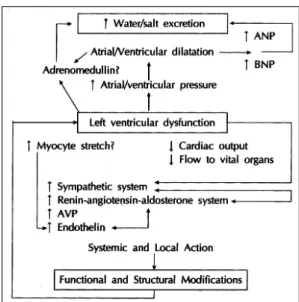
심부전증이 오게 되는 좌심실의 기능 저하는 심박출량 의 감소, 주요 장기로의 혈류량 감소, 심근의 변형(str- ech의 증가) 등을 초래하게 되고 이로 인하여 symp- athetic system, RAAS, anginine vasopressin, end- othelin등이 활성화 되어 심박출량을 증가시키고, 주요 장기로 혈류량을 증가시키려 한다. 한편으로는 심방과 심실내압의 증가로 ANP와 BNP가 증가하고, adre- nomedullin이 증가하여 수분과 염분의 체내 축적을 막고 혈관저항을 감소시키려고 한다(Fig. 1 참조). 그러나 심박 출량의 증가와 주요 장기로의 혈류량 증가가 더 우선하게되 므로 혈관저항이 증가하고 sympathetic system, RAAS, endothelin의 활성화로 인하여 심근의 손상과 심부전증 교신저자:김재중, 138-736 서울 송파구 풍납동 388-1
울산대학교 의과대학 서울중앙병원 심장내과 전화:(02) 2224-3154・전송:(02) 486-5918 E-mail:[email protected]
의 악화가 나타나게 된다. 그러한 심부전증의 진행은 지 속적인 vicious cycle을 만들게 되어 심부전증을 계속 진행시키게 된다.1)2)
Renin-Angiotensin-Aldosterone System (RAAS)
심부전증에서 RASS를 억제하는 약제를 사용 시 심 부전의 진행이 억제되고 사망률이 감소됨은 여러 연구 에서 증명되었다. 이는 심부전증에서 RAAS가 활성화 되고 이로 인한 angiotensin Ⅱ, aldosterone등의 증가 가 심부전증에 나쁜 영향을 줌을 증명하는 것이다.
심부전증의 초기에서는 이뇨제를 사용하지 않는 한 renin system은 정상이거나 억제되어 있다. 그러나 심부전증이 진행하면서 특히 이뇨제를 사용하게 되면 서 renin system은 활성화되어 혈중 angiotensin Ⅱ 와 aldosterone치의 상승을 초래하게 된다.3) 이처럼 증가된 angiotensin Ⅱ는 심부전증의 진행에 관계하게 된다(Table 1).
Angiotensin Ⅱ는 angiotensin Ⅰ으로부터 만들어지 는데 다음의 그림과 같다(Fig. 2).4)
Angiotensin Ⅱ를 생성하는데 관여하는 ACE(ang- iotensin converting enzyme)는 bradykinin의 대사에 도 관계하여 bradykinin의 파괴에 관여한다. ACE in- hibitor를 사용하게 되면 angiotensin Ⅱ의 형성이 억
제되고 bradykinin의 파괴가 억제되어 angiotensin Ⅱ 에 의한 심부전증에 나쁜 영향이 줄어들고, bradykinin 의 vasodilation, antihypertrophic and antiprolifera- tive effect등이 증가하게 된다.5)6) 이러한 효과가 심부 전증에서 ACE inhibitor를 사용 시 심부전증의 진행 억제와 사망률 감소에 기여하게 된다.
Angiotensin Ⅱ의 형성에는 Fig. 2에서 나타나듯이 ACE 외에 다른 enzyme들이 관여하고 있고, 심부전증 에서는 이들 non-ACE pathway가 더 중요하다는 연 구들이 있다. 이러한 문제를 해결하기 위하여 개발된 약제가 angiotensin receptor blocker들이다. RAAS의 final product인 aldosterone은 myocardial fibrosis에 중요한 역할을 할 뿐만 아니라 angiotensin Ⅱ가 나타 내는 심부전증에 해로운 다른 효과들도 있다. 이와 같 은 aldosterone의 효과를 차단하기 위하여 aldoster- one의 antagonist인 spironolactone이 사용되고 있으 며 새로운 약제들이 개발되고 있다.
Angiotensin con-verting enzyme (ACE) inhibitor
Trials of ACE inhibitors in patients with CHF(Table 2) 심부전증에서 ACE inhibitor의 효과를 연구한 처음 연구는 Cooperative North Scandinavian Enalapril Study(CONSENSUS-1) 였다.7) 이 연구에서는 NYHA Table 1. Adverse effects of angiotensin Ⅱ in conges- tive heart failure
Left ventricular structural and functional effects Increased transmural wall stress
Dilation caused by increase of end-diastolic and endsystolic volumes
Decreased coronary flow in epicardial and trans- mural vessels
Hemodynamic effects
Increased vascular resistance Positive Inotropic stimulation Neurohormonal and paracrine effects
Increased tissue effects of angiotensin Ⅱ
Stimulation of aldosterone production, with sodium (and volume) retention
Increase of circulatory catecholamines, impaired baroreceptor function, and abnormal
Sympathetic-parasympathetic balance Increased bradykinin degradation
Stimulate the secretion of arginine vasopressin Mitogenic and growth effects
Myocardial hypertrophy
Vascular smooth muscle hypertrophy Cell protein enhancement
Fig. 1. Activation of neurohormonal system in heart failure.
class Ⅳ 환자 253명을 대상으로 하였다. Enalapril군에 서 placebo군보다 사망률이 6개월에 26% vs 44%, 1 년에 36% vs 52%로 상대적으로 낮았다. 또한 대상 환자가 고령 층이었음에도 불구하고 ACE inhibitor에 잘 적응하였다. 이후 NYHA class Ⅱ와 Ⅲ의 환자를 대 상으로 한 Studies on Left Ventricular Dysfunction (SOLVD) Treatment Trial이 발표되었다.8) 2,569명 의 NYHA class Ⅱ, Ⅲ로 좌심실 구혈율이 35%이하인 심부전증 환자를 대상으로 하였다. 평균 41개월 추적 관찰 시 사망률이 16% 감소하였고, 사망율과 입원 빈 도의 감소는 26%였다. ACE inhibitor의 효과를 더욱 분 명히 한 연구는 V-HeFT-II trial로 enalapril과 hy- dralazine and isosorbide dinitrate의 병용투여 군 간을 비교하였다.9) NYHA class Ⅱ, Ⅲ로 좌심실 구혈율이 45% 이하인 804명의 심부전증 환자가 대상이 되었다.
1년 후 enalapril군이 사망율이 34% 더 감소되었고, 2년 뒤에는 28%가 더 감소되었다. 이 연구결과로 ACE in- hibitor의 효과는 직접적인 혈관확장 작용 외에 neuro- hormonal inhibitor로써의 작용이 중요하게 관여함이 밝 혀졌다. 이 뒤에 32개의 연구결과를 종합한 meta-an- alysis에서는ACE inhibitor 사용 시 사망률의 감소가 23%, 사망률 및 입원 빈도의 감소가 35% 임이 보고되 었다.10) 즉 심부전증에서 ACE inhibitor의 사용은 사망률 및 입원 빈도의 감소가 의미 있게 나타남을 알 수 있다.
ACE inhibitors in asymptomatic left ventricular sys- tolic dysfunction
SOLVD treatment trial과 병행하여 SOLVD prev- ention trial이 진행되었다.11) Prevention trial에서는 좌심실 구혈율이 35% 미만이고 증상이 없거나 경도인 경우를 대상으로 하였다. 그러나 4,228명의 대상환자 들 중 26%가 이뇨제나 digoxin을 복용하고 있었고, 33%가 NYHA class Ⅱ였다. 이러한 문제점이 있긴 하 나 prevention trial의 결과 사망률의 감소는 8%로 통
계적으로 유의하지는 않았으나 사망률 및 심부전증상 의 발현 빈도는 29%의 감소를 보여 ACE inhibitor가 심부전증의 진행을 더디게 한다는 것을 알 수 있었다.
이러한 결과로 현재 ACE inhibitor는 무증상의 좌심실 기능저하 환자에서도 권장이 되고 있다.
Evaluation of ACE inhibitor dose in CHF
심부전증에서 ACE inhibitor의 용량에 대한 연구로 Assessment of Treatment with Lisinopril and Su- rvival(ATLAS) study가 진행되었다.12) 3,164명의 환 자에서 lisinopril 2.5~5 mg군과 32.5~35 mg군을 비교 하였다. 고 용량 군에서 총 사망률은 8% 감소되었으나 통계적인 유의성은 없었다. 그러나 고 용량 군에서 심부 전증으로 인한 입원 및 사망률은 15%(p<0.001)가 감소 하였고, 심부전증으로 인한 입원빈도는 25%가 감소되었 다. 더욱이 양군에서 약제의 중단정도는 비슷하였다.
따라서 현재는 심부전증시 ACE inhibitor는 가능한 고용량을 사용하는 것이 적합하다고 생각된다.
Angiotensin Ⅱ receptor blocker
Fig. 2에서 알 수 있듯이 angiotensin II가 형성되는 데에는 kininase Ⅱ인 ACE와 nonACE system이 작 용한다. 심부전증시는 non ACE system이 더 강하게 작용하므로 심부전증에서 angiotensin II 형성을 효과 적으로 억제하려면 ACE와 non ACE system을 동시 에 억제해야 한다. 현재까지는 ACE는 충분히 억제가 가능하나 non ACE system을 충분히 억제 시킬 수 있 는 약제로 임상적으로 쓰이는 것은 없다. 따라서 ang- iotensin Ⅱ의 receptor에 직접적인 blocker의 필요성이 대두되었다. Angiotensin II receptor는 subtype 1과 2 로 나뉘는데 차이점은 Table 3와 같다. 즉 subtype 1 receptor는 angiotensin II의 심부전증에서의 악영향을 나타내며 subtype 2 receptor는 아직은 임상적 의미가 확실히 알려져 있지는 않다.4)
Table 2. Effects of Ace inhibitors in patients with congestive heart failure
Study No. Age CAD EF Class Drugs F/U Mortality reduction CONSENSUS 253 70 74% N/A Ⅳ Enalapril 1 88 days 27%(p=0.003) V-HeFT Ⅱ 804 61 53% 29% Ⅱ, Ⅲ Enalapril 2.5 years 28%(p=0.002) SOLVD treat. 2569 61 70% 25% Ⅱ, Ⅲ Enalapril 41.1 mos. 16%(p<0.004) SOLVD prev. 4228 59 83% 28% Ⅰ, Ⅱ Enalapril 37.4 mos. 8%(p=0.30)
이 두 가지의 Angiotensin Ⅱ receptor subtype 중 subtype Ⅰ에 대한 blocker가 개발되어 현재 고혈압 영 역에서는 사용이 인정되었고, 심부전증에서는 현재 대규 모 연구가 진행중이다. Subtype Ⅰ의 blocker인 losar- tan과 ACE inhibitor인 captopril을 비교한 연구인 EL- ITE study에선13) losartan이 captopril에 비하여 심부전 환자에서 사망률이 감소되었고, 특히 sudden cardiac death가 줄었다. ELITE study는 primary endpoint가 사망률이 아니었으므로 사망률을 primary endpoint로 하는 ELITE Ⅱ study가 진행 되었고 그 결과 losar- tan군이 captopril군에 비하여 부작용의 발현은 적었으 나 사망률은 차이가 없었다.
Angiotensin Ⅱ receptor blocker의 장점(ACE inhib- itor와 비교)
1) Greater accessibility to tissue renin-angiote-
nsin system
2) Relative lack of aldosterone escape 3) Smoother hypotensive effect 4) Reduction of sudden cardiac death 5) Lesser drug interaction with NSAIDS 6) Uricosuric effect
7) Favorable effect on diastolic dysfunction
Combination with ACE inhibitor
Fig. 2에서 알 수 있듯이 angiotensin Ⅱ를 blocking 하면 angiotensin Ⅱ의 혈중 수치가 증가되고 이는 an- giotensin Ⅲ, Ⅳ로 변환이 증가되어 plasminogen ac- tivator inhibitor-1의 증가를 초래하여 artherogenic, thrombogenic effect가 증가되고, ACE inhibitor와는 달리 bradykinin의 증가가 없으므로 bradykinin에 의 한 t-PA증가, vasodilation, natriuresis등의 효과가 나타나지 않는다. 따라서 ACE inhibitor와의 병용사용 시 angiotensin Ⅱ의 증가가 적어지고, brady-kinin의 증가가 나타나므로 더 좋을 것이라고 기대할 수 있다.
실제로 심부전증에서 병용투여시가 단독 투여 군들 보 다 단기간 추적 관찰에서 더 좋은 hemodynamics를 얻을 수 있다는 보고도 있다.14) 그러나 아직 까지는 장 기간의 임상연구가 없는 상태이며 앞으로 수년 내에 병 Table 3. Angiotensin Ⅱ receptor subtype:effect
Angiotesin Ⅱ R subtype Ⅰ Angiotensin Ⅱ R subtype Ⅱ Fibrosis Nitric oxide release
Vasoconstriction Antiproliferative effect Matrix growth Apoptosis
PA-I synthesis
Endothelial dysfunction
Fig. 2. Cascades of RAS and mechanism of action of ACE inhibitors and AT1 receptor antagonists. AT=Angiote- nsin Ⅱ receptors;t-PA=tissue plasminogen activator;SNS=sympathetic nervous system;Growth F=growth factors;PAI=plasminogen activator inhibitor.
용투여에 대한 연구 결과가 나올 예정이다.
Aldosterone antagonist
Aldosterone escape and harmful effects of aldost- erone
심부전증에서 ACE inhibitor 사용 시 혈중 ACE 효과 는 90% 이상 억제되나 혈중 aldosterone은 불과 20%
정도만이 감소한다. 이를‘Aldosterone Escape’이라 고 부르며 이는 다음의 3가지 원인에 의하여 나타난다 고 생각되고 있다.15)
1) Inactivation of aldosterone due to decreased hepatic blood flow
2) Escape of angiotensin Ⅱ during ACE inhibitor therapy
3) Generation of aldosterone from others than angiotensin Ⅱ(Fig. 3)
이러한 원인들에 의하여 ACE inhibitor 사용 중에도 aldosterone의 혈중 수치는 높게 유지되어 aldoster- one에 의한 다음의 나쁜 영향이 나타난다.16)
1) Magnesium depletion by increasing urinary output
2) Sympathetic activation
3) Parasympathetic baroreflex inhibition 4) Induction of ischemia due to sympathetic act- ivation, coronary vasoconstriction by magnesium- depletion and progression of artherosclerosis
5) Myocardial fibrosis
6) Induction of ventricular arrhythmias by mag- nesium depletion, sympathetic activation, parasy- mpathetic inhibition, myocardial fibrosis, and myo- cardial ischemia
결국 aldosterone의 증가는 심부전증을 진행시키고 sudden cardiac death를 유발시키게 되어 심부전증에 나쁜 영향을 주게 된다.
Aldosterone antagonist
현재로는 임상적으로 사용 가능한 aldosterone an- tagonist는 spironolactone 뿐이다. Spironolactone을 ACE inhibitor를 사용하고 있는 심부전증 환자에서 사 용하여 사망률 및 심부전의 진행을 본 연구가‘RA- LES' 이다.17)
이 연구에서는 1,663명의 심부전증 환자를 대상으로 ACE inhibitor에 spironolactone과 placebo의 효과를 보았다. Spironolactone 사용 시 사망률이 26%(p<
0.0001) 감소하였고, 심부전의 진행도 29.5%에서 억 제되었다(Fig. 4). 특히 sudden cardiac death가 20%
감소하였다. Spironolactone 사용 시 가장 중요한 부작 용은 남성에서 gynecomastia로 9%에서 나타났다.
이러한 연구의 결과로 보아 심부전증 환자에서 가능 하면 모든 경우에 aldosterone antagonist인 spiron- olactone을 사용하는 것이 권장된다. 현재 spirono- lactone의 부작용인 gynecomastia와 같은 부작용을 Fig. 3. Stimuli generating aldosterone.
Fig. 4. The results of RALES.
최소화 시킨 약제가 개발되어 현재 임상시험중이다.
Sympathetic System
Harmful effect of prolonged sympathetic stimulation in heart failure
심부전증시 지속적인 sympathetic system의 활성 화는 다음의 여러 가지 해로운 영향을 준다.18-21)
1) 세포 내 cAMP를 증가시켜 세포 내 calcium ion 을 증가시키게 되어 세포 내 calcium의 축적으로 인하 여 cell necrosis을 일으킨다(Fig. 5).
2) 심근 세포와 같은 terminally differentiated cell 의 growth를 유도하고, oxidative stress를 항진 시켜 apoptosis를 일으킨다(Fig. 5).
3) Vasoconstriction, 심실내경 및 내압의 증가, 심 근의 hypertrophy등을 유발하여 관상동맥 질환 유무 에 관계없이 myocardial ischemia를 일으킨다.
4) 부정맥을 유발시킨다. 이는 다음의 4가지 요인에 기인된다.
① myocardial hypertrophy and fibrosis ② incr- ease cAMP and automaticity by acting on β2-ad- renoreceptor ③ hypokalemia by acting on β2- adrenoreceptor ④ increase triggered automaticity by acting on α1-adrenoreceptor especially in my- ocardial ischemia
5) 심 박수를 증가시켜 오히려 contractility를 저하 시키고, 심근의 에너지 요구량을 증가시켜 myocardial
ischemia를 조장한다.
심부전시 sympathetic system이 해롭다는 것은 위 의 이론적이고, in vitro 결과뿐 아니라 실제로 심부전 증 치료 약들 중 세포 내 cAMP를 증가시키는 약제들, 즉 β adrenergic agonist, β adrenergic partial ag- onist(xamoterol), phosphodiesterase inhibitor(mi- lrinone), flosequinone, vesnarinone등의 약제들이 장 기간 투여 시 오히려 사망률을 증가시켰음이 중요한 증 거라 할 수 있다.
심부전증시 심근 세포 내에서는 지속적으로 증가된 sympathetic system으로부터 보호하기 위하여 β1 ad- renoreceptor를 downregulation시켜 receptor den- sity를 줄이고 β adrenoreceptor kinase(ARK)를 증 가시켜 β receptor와 G-protein의 coupling을 저해 시킨다.20) 그러나 지속적인 sympathetic system의 활 성화는 궁극적으로 심근 세포의 손상을 일으켜 심부전 증을 진행시키게 된다.
Effects of β-blockers in heart failure
심부전증시 지속적인 sympathetic stimulation의 나 쁜 영향은 위에 언급된 바와 같다. 그렇다면 심부전증에 서 β-blocker는 과연 어떠한 효과를 낼 수 있겠는가?
현재까지 알려진 β-blocker의 심부전증에서의 효 과는 다음과 같다.22-24)
1) 심근에서의 energy demand를 줄인다.
2) 다른 neuroendocrine system의 활성화를 줄인다.
이는 sympathetic system의 활성화는 RAAS(renin- angiotensinaldosterone system)를 활성화 시키기 때 문이다.
3) 심근 내에 high energy phosphate를 증가시킨다.
4) 심부전증시 나타나는 pathologic remodeling(심 실내경의 증가, myocyte stretch 증가)을 줄인다.
5) Microcirculation을 호전 시킨다.
6) 심 박수를 줄임으로써 심근의 수축력을 증가시킨 다. 이는 심부전상태에서는 심 박수가 증가하면 오히려 심근의 수축력이 감소되기 때문이다(negative Bodw- itch effect).
7) 장기적으로 SERCA(sarcoplasmic reticulum ca- lcium ATPase)의 활성도에 좋은 영향을 준다.
8) 심근 세포의 adrenergic receptor나 signal tra- nsduction을 변화시킨다.
Fig. 5. Harmful effect of prolonged sympathetic stimu- lation on cardiac myocytes.
이론적으로 심부전증에서 β-blocker의 사용은 이 러한 여러 가지 효과들로 인하여 심부전증을 개선시키 고 진행을 억제시킬 수 있다.
Clinical use of β-blocker in heart failure
History of clinical use of β-blocker in heart failure 심부전증에서의 β-blocker 사용은 1970년대 초부터 이다. 물론 이 당시는 심부전증에서 β-blocker의 사용 은 금기로 되어 있었던 시기였다. 1973년 Waagstein은 59세 된 심부전증을 앓고 있는 환자에서 심 박수를 줄 이기 위하여 β-blocker를 single bolus injection 후 환자의 증상 호전이 있어 경구로 β-blocker 투여를 지속하였음을 보고하였고, 이어서 1975년 7명의 심부 전증 환자에서 β-blocker를 사용하여 좋은 효과를 얻 었다고 보고하였다.25) 그러나 이후에도 심부전증에서의 β-blocker 사용은 인정을 받지 못하였다.
심부전증에서의 β-blocker 사용이 관심을 끌게 된 것은 Waagstein 등이 1993년 발표한 MDC(meto- prolol in dilated cardiomyopathy) trial이었다.26) 여 기서 metoprolol은 placebo에 비하여 심부전증 환자에 서 total mortality를 감소시키지는 못하였지만 need for transplantation을 줄이고, 좌심실 구혈율을 증가시 켰다. 이후 최근에 발표된 MERIT-HF study에선27) NYHA class Ⅱ-Ⅳ, 좌심실 구혈율 40% 미만인 3,991 명의 환자를 대상으로 서방형 metoprolol(metoprol- olCR/XL)을 최고 일일 200 mg까지 사용하였는데, 중 간결과 total mortality가34%(7.2% VS 11.0%m p=
0.00009), sudden death가 41%(3.9% vs 6.7%, p=
0.002), 심부전증의 악화가 42%(p=0.0023) 감소하 였다.
베타차단제 중에서 carvedilol은 α1-adrenergic bl- ocking 효과와 항산화 효과를 같이 갖고 있는 약제로 심 부전증에 사용 시 매우 좋은 효과가 발표되었다. Carv- edilol은 nonselective β-adrenergic blocker 이면서 또한 α1-adrenegic blocker이다. Adrenergic rece- ptor level에서의 친화력은 β1:α1=3 :1이다. 즉 carvedilol은 제3세대 β-blocker인 vasodilating β- blocker이다. 제3세대인 vasodilating β-blocker로는 bucindolol이 있는데 bucindolol은 α1-blocker가 아 닌 direct action으로 vasodilating property가 있다.
Carvedilol은 또한 강력한 항산화 효과를 갖고 있는데, 강력한 항산화제인 vitamin E의 10배 이상 강한 항산 화 효과가 있다. 더욱 흥미로운 것은 carvedilol의 체내 대사산물인 hydroxyl유도체는 adrenergic blocking 효과는 없으면서 항산화 효과는 더욱 강하여 vitamin E의 1000배에 해당하는 항산화 효과를 나타낸다. 이외 에 carvedilol은 angiotensin Ⅱ의 형성과 endothelin의 형성을 억제하는 효과도 있다. 이처럼 carvedilol은 통 상적인 β-blocker에 비하여 심부전증에 사용 시 이 론적으로 장점이 있다. Carvedilol을 임상에 사용한 심 부전 연구로 대표적인 2가지가 있다. 첫번째는 US carvedilol heart failure study이다. 1996년 Packer등 이 New England Journal of Medicine에 발표된 연구 로28) randomized, double blind, placebo-controlled, multicenter study이다. 좌심실 구혈율이 35% 미만이고, 3개월 이상 된 심부전증 환자 1197명을 대상으로 ca- rvedilol의 open-label phase를 거쳐 94.4%인 1,094명 이 6개월 이상 추적 관찰되었다. 연구 결과를 보면 car- vedilol 군이 placebo 군에 비하여 total mortality가 65% (3.2% vs 7.8%, p<0.001), 심부전으로 인한 사망이 82%(0.7% vs 3.3%, p<0.001), sudden death가 55%
(1.7% vs 3.8%, p<0.001), 입원 빈도가 27%(14.1%
vs 19.6%, p=0.036), 사망과 입원이 38%(15.8% vs 24.6%, p<0.001)나 감소되었다.
두 번째 study는 Bristow등이 1996년 Circulation 에 발표한 Multicenter Oral Carvedilol Heart failure Assessment(MOCHA)이다.29) 이 연구는 randomized, double-blind, placebo-controlled, dose response study로 좌심실 구혈율이 35% 미만이고 3개월 이상 된 심부전증 환자 345명을 대상으로 6개월 이상 추적 관찰 하였다. 이 연구에서는 carvedilol을 6.25 mg po bid, 12.5 mg po bid, 25 mg po bid군과 placebo군 즉 4개 군으로 연구하였다. 결론을 보면 사망률이 감소는 6.25 mg po bid부터 나타나고(감소율 61%), 25 mg po bid 군에서는 사망률 감소가 90% 이상이었다. 전체 적으로 carvedilol 사용 시 73%의 사망률의 감소가 나 타났다.
이 뒤에도 carvedilol에 대한 여러 연구가 발표되었 고, 심부전증에서 placebo에 비하여 사망률의 뚜렷한 감소가 입증되었다. 이전에 사용되었던 β1-selective β-blocker인 metoprolol과 bisoprolol이 MERIT-
HF study나 CIBIS-Ⅱ trial30)에선 사망률의 유의한 감 소 (30% 정도)가 증명되었으나 carvedilol을 사용한 연구보다는 감소정도가 적은 것으로 나타나 있다. 물론 아직은 이러한 결론을 내리기는 어렵다. 현재 NYHA class Ⅱ-Ⅳ의 심부전증 환자를 대상으로 carvedilol과 metoprolol을 비교하는 COMET 연구가 진행 중이므로 앞으로 결과가 나와보아야 결론이 날 것으로 보인다.
Meta-analysis
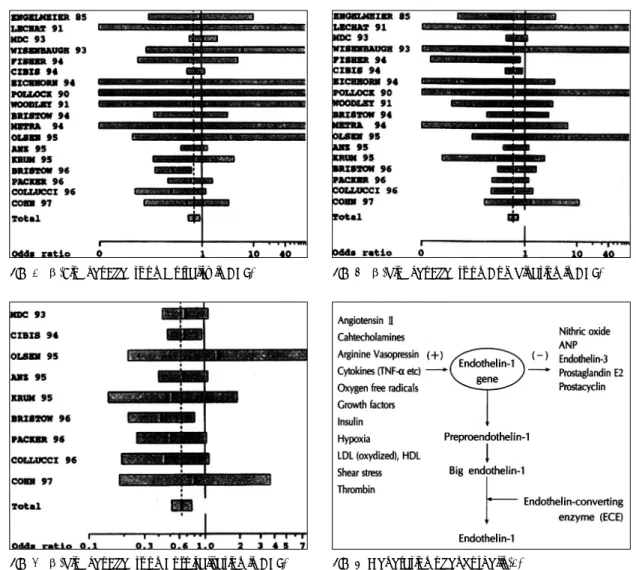
지금까지 발표된 β-blocker의 심부전증 치료에 대 한 많은 연구들을 종합하여 보면 β-blocker는 심부전 증 환자에서 total mortality를 감소시키고(Fig. 6), 입 원 빈도를 줄이며(Fig. 7), 이 둘의 combined endpo- int도 줄인다(Fig. 8).31)32)
Endothelin System
Endothelin은 여러 자극에 의하여 혈관 내피세포에 서 형성되어 분비되는 강력한 혈관수축물질이다(Fig.
9).33) 혈관내피세포에서 형성된 endothelin은 endot- helin receptor와 결합하여 G protein, phospholipase C, protein kinase C를 통하여 혈관수축, cell prolife- ration등을 일으킨다. Endothelin은 3개의 subtype이 있는데(endothelin 1, -2, -3) 이들 중 endothelin-1 이 중요하다. Endothelin receptor엔 type A와 B가 있 다. Type A receptor는 심근 세포와 혈관 평활근에 주 로 분포하여 혈관수축과 cell proliferation을 일으키고, type B receptor는 주로 혈관내피세포에 있으며 inhi-
Fig. 6. β-Blocker Effects on Mortality in CHF.
Fig. 7. β-blocker Effects on Hospitalization in CHF.
Fig. 8. β-blocker Effects on Combination in CHF.
Fig. 9. Generation of endothelin-1.
bitor G protein에 연결되어 type A receptor에 반대 되는 효과를 내고 있다.34)
심부전증에서 endothelin의 증가는 다음의 여러 가 지 나쁜 영향을 주게 된다.35)
① vasoconstriction
② cell proliferation
③ fibrosis
④ inflammation
⑤ neurohormonal stimulation:increase norepi- nephrine and aldosterone
심부전증 환자에서 혈중 enodothelin-1의 수치는 예후가 관계가 있고 특히 big endothelin-1의 혈중수 치는 심부전증 환자의 예후를 예측하는데 좋은 지표로 알려져 있다.36) 또 심부전증 환자에서 endothelin re- ceptor blocker 인 bosentan을 투여 시 좋은 hemo- dynamic effect를 얻을 수 있었다.37)
임상적으로 현재 endothelin receptor에 대한 차단 제가 개발되어서 심부전증 환자들을 대상으로 임상연 구가 진행되고 있다. 최근에 진행되고 있는 REACH- 1 연구의 초기 결과를 보면,38) endothelin receptor A 와 B의 차단제인 Bosentan을 투여 시 입원이 41% 감 소하였고 심부전의 진행도 감소되었다. 그러나 앞으로 계속 진행되는 연구결과를 더 기다려 보아야 할 것으로 생각된다.
REFERENCES
1) Elsner D. Changes in neurohumoral systems during the development of congestive heart failure: Impact on cardi- ovascular and renal function. Eur Heart J 1995;16(suppl N):52-8.
2) Colucci WS. Molecular and cellular mechanisms of my- ocardial failure. Am J Cardiol 1997;80(11A):15L-25L.
3) Bayliss J, Norell M, Canepa-Anson R, Sutton G, Poole- Wilson P. Untreated heart failure: Clinical and neuroen- docrine effects of introducing diuretics. Br Heart J 1987;
57:17-22.
4) Rocca HPBL, Vaddadi G, Elser MD. Recent insight into therapy of congestive heart failure: Focus on ACE inhibi- tion and angiotensin-Ⅱ antagonism. J Am Coll Cardiol 1999;33:1163-73.
5) Zusman RM. Effects of converting-enzyme inhibitors on the renin-angiotensin-aldosterone, bradykinin, and arac- hidonic acid-prostaglandin systems: Correlation of che- mical structure and biologic activity. Am J Kidney Dis 1987;
10:13-23.
6) Barbe F, Su JB, Guyen T, Crozatier B, Menard J, Hitti- nger L. Bradykinin pathway is involved in the acute hem- odynamic effects of enalaprilat in dogs with heart failure.
Am J Physiol 1996;270:H1985-H92.
7) The CONSENSUS Trial Study Group. Effects of enalap- ril on mortality in severe congestive heart failure: Results of the Cooperative North Scandinavian Enalapril Survival Study (CON-SENSUS). N Engl J Med 1987;316:1429-35.
8) The SOLVD Investigators. Effect of enalapril on survival in patients with reduced left ventricular ejection fractions and congestive heart failure. N Engl J Med 1991;35:283- 302.
9) Cohn JN, Johnson G, Ziesche S, et al. A comparison of enalapril with hydralazine-isosorbide dinitrate in the tre- atment of chronic congestive heart failure. N Engl J Med 1991;325:303-10.
10) Garg R, Yufuf S. Overview of randomized trials of angi- otensin-converting enzyme inhibitors on mortality and morbidity in patients with heart failure. JAMA 1995;273:
1450-6.
11) The SOLVD Investigators. Effect of enalapril on mortal- ity and the development of heart failure in asymptomatic patients with reduced left ventricular ejection fractions.
N Engl J Med 1992;327:685-91.
12) Packer M, Poole-Wilson PA, Armstron PW, Cleland JGF, Horowitz JD, Massie BM, et al. Comparative effect of low and high doses of the angiotensin-converting enzyme inhibitor, lisinopril, on morbidity and mortality in chronic heart failure. Circulation 1999;100:2312-8.
13) Pitt B, Segal R, Martinez FA, Meurers G, Cowley AJ, Thomas I, et al. Randomised trial of losartan versus cap- topril in patients over 65 with heart failure (Evaluation of Losartan in the Elderly Study, ELITE). Lancet 1997;
349:747-52.
14) Hamroff G, Katz SD, Mancini D, Blaufarb I, Bijou R, Patet R, et al. Addition of angiotensin Ⅱ receptor bloc- kade to maximal angiotensin-converting enzyme inhibition improves exercise capacity in patients with severe conge- stive heart failure. Circulation 1999;99:990-2.
15) Pitt B. Escape of aldosterone production in patients with left ventricular dysfunction treated with an angiotensin converting enzyme inhibitor: Implication for therapy. Ca- rdiovasc Drugs Ther 1995;9:145-9.
16) Young M, Fullerton M, Dilley R, Funder J. Mineraloco- rticoids, hypertension, and cardiac fibrosis. J Clin Invest 1994;93:2578-83.
17) Pitt B, Zannad F, Remme WJ, Cody R, Castaigne A, Perez A, et al. The effect of spironolactone on morbidity and mortality in patients with severe heart failure. N Engl J Med 1999;341:709-17.
18) Daly PA, Sole MJ. Myocardial catecholamine and the pat- hophysiology of heart failure. Circulation 1990;82: 135-43.
19) Bristow MR, Hershberger RE, Port JD, et al. β-Adrene- rgic pathways in nonfailing and failing human ventricular myocardium. Circulation 1990;82:I-12-I-25.
20) Ungerer M, Parruti G, Bohm M, et al. Expression of β- arrestins and β-adrenergic receptor kinases in the human heart. Cir Res 1994;74:206-13.
21) Mann DL, Kent RL, Parsons B, Cooper G Ⅳ. Adrenergic effects on the biology of the adult mammalian cardiocyte.
Circulation 1992;85:790-804.
22) Bristow MR. Mechanism of action of beta-blocking agents in heart failure. Am J Cardiol 1997;80(suppl L):26L-40L.
23) Bristow MR, Larrabee P, Muller-Beckmann B, et al. Ef-
fects of carvedilol on adrenergic receptor pharmacology in human ventricular myocardium and lymphocytes. Clin Invest 1991;70:S105-S13.
24) Tsutsui H, Spinale FG, Nagatsu M, et al. Effects of chro- nic adrenergic blockade on the left ventricular and cardi- ocyte abnormalities of chronic canine mitral regurgitation.
J Clin Invest 1994;93:2639-48.
25) Waagstein F, Hjalmarson A, Varnauskas E, et al. Effect of chronic beta-adrenergic receptor blockade in congestive cardiomyopathy. Br Heart J 1975;37:1022-36.
26) Waagstein F, Bristow MR, Swedberg K, et al. Beneficial effects of metoprolol in idiopathic dilated cardiomyopathy.
Lancet 1993;342:1441-6.
27) MERIT-HF Study Group. Effects of metoprolol CR/XL in chronic heart failure: Metoprolol CR/XL Randomised Int- ervention Trial in Congestive Heart Failure (MERIT-HF).
Lancet 1999;353:2001-7.
28) Packer M, Bristow MR, Cohn JN, et al. Effect of carved- ilol on morbidity and mortality in patients with chronic heart failure. N Engl J Med 1996;334:1349-55.
29) Bristow MR, Gilbert EM, abraham WT, et al. Carvedilol produces dose-related improvements in left ventricular function and survival in subjects with chronic heart failure.
Circulation 1996;94:2807-16.
30) CIBIS-Ⅱ Investigators and Committees. The Cardiac Insufficiency Bisoprolol Study Ⅱ (CIBIS-Ⅱ): A rando- mised trial. Lancet 1999;353:9-13.
31) Heidenreich PA, Lee TT, Massie BM. Effect of beta-blo-
ckade on mortality in patients with heart failure: A meta- analysis of randomized clinical trials. J Am Coll Cardiol 1997;30:27-34.
32) Arab T, Boissel JP. Clinical effects of β-adrenergic blo- ckade in chronic heart failure:meta-analysis of double- blind, placebo-controlled, randomized trials. Circulation 1998;98:1184-91.
33) Yanagisawa M, Kurihara H, Kimura S, et al. A novel po- tent vasoconstrictor peptide produced by vascular endot- helial cells. Nature 1988;332:411-5.
34) Levin ER. Endothelins. N Engl J Med 1995;333:356-63.
35) Love MP, McMurray JJV. Endothelin in chronic heart failure: Current position and future prospects. Cardiovasc Res 1996;31:665-74.
36) Pacher R, Bergler-Klein J, Globitis S, et al. Plasma big endothelin-1 concentrations in congestive heart failure patients with or without systemic hypertension. Am J Ca- rdiol 1993;71:1293-9.
37) Sutsch G, Kiowski W, Yan XW, Hunziker P, Christen S, Strobel W, et al. Short-term oral endothelin-receptor ant- agonist therapy in conventionally treated patients with sy- mptomatic severe chronic heart failure. Circulation 1998;
98:2262-8.
38) Packer M, Caspi A, Charlon V, et al. Multicenter, double blind, placebo-controlled study of long-term endothelin blockade with bosentan in chronic heart failure-Results of the REACH-1 trial. Circulation 1998;98:I-3.