• 검색 결과가 없습니다.

Catecholaminergic Polymorphic Ventricular Tachycardia in a Patient With Recurrent Exertional Syncope

N/A
N/A
Protected

Academic year: 2022

Share "Catecholaminergic Polymorphic Ventricular Tachycardia in a Patient With Recurrent Exertional Syncope"

Copied!
4
0
0

로드 중.... (전체 텍스트 보기)

전체 글

(1)

129 Copyright © 2012 The Korean Society of Cardiology

Korean Circulation Journal

Introduction

Catecholaminergic polymorphic ventricular tachycardia (CPVT) is an inherited arrhythmogenic disease that can cause syncope or sud- den cardiac death during emotional or physical stress in the abs- ence of detectable structural heart disease and a prolonged QT in- terval on an electrocardiogram (ECG). Mutations in two genes, the cardiac ryanodine receptor gene (RyR2) and calsequestrin 2 gene (CASQ2), have been identified in patients with CPVT. These mutations lead to an increase in intracellular Ca

++

concentration, resulting in life- threatening ventricular arrhythmias, possibly via delayed depolariz-

Case Report

http://dx.doi.org/10.4070/kcj.2012.42.2.129 Print ISSN 1738-5520 • On-line ISSN 1738-5555

Catecholaminergic Polymorphic Ventricular Tachycardia in a Patient With Recurrent Exertional Syncope

Na Young Kim, MD, Jung Kyu Kang, MD, Sun Hee Park, MD, Myung Hwan Bae, MD, Jang Hoon Lee, MD, Dong Heon Yang, MD, Hun Sik Park, MD, Shung Chull Chae, MD, Jae Eun Jun, MD, and Yongkeun Cho, MD

Department of Internal Medicine, Kyungpook National University School of Medicine, Daegu, Korea
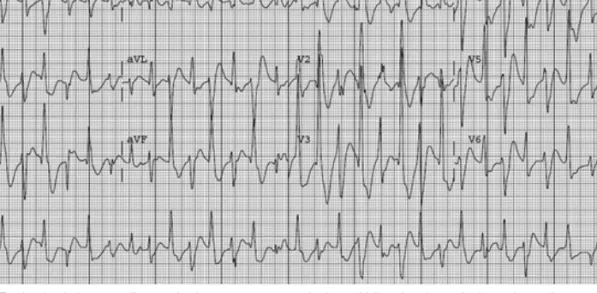
A 16-year-old male with a prior history of recurrent syncope was referred to our hospital after being resuscitated from cardiac arrest de- veloped while playing volleyball. His electrocardiogram (ECG) demonstrated ventricular fibrillation at a local emergency department. After referral, an ECG showed bidirectional ventricular tachycardia (VT) and nonsustained Torsade de Pointes. Two days later, his heart rate be- came regular, and no additional episodes of VT were observed. His ECG showed sinus rhythm with a corrected QT interval of 423 msec, and two-dimensional echocardiography was unremarkable. We made the diagnosis of a catecholaminergic polymorphic VT. However, only pre- mature ventricular complex bigeminy was induced on exercise ECG and epinephrine infusion tests, and the patient showed no episodes of syncope. His father and mother had different missense mutations in the cardiac ryanodine receptor on genetic testing. The proband had both mutations in different alleles and was symptomatic. It was recommended that the patient avoid competitive physical activities, and a β-blocker was prescribed. (Korean Circ J 2012;42:129-132)

KEY WORDS: Catecholamines; Tachycardia, ventricular; Genetics; Syncope; Exercise.

Received: June 15, 2011 Revision Received: July 3, 2011 Accepted: July 4, 2011

Correspondence: Yongkeun Cho, MD, Department of Internal Medicine, Kyungpook National University School of Medicine, 130 Dongdeok-ro, Jung- gu, Daegu 700-721, Korea

Tel: 82-53-420-5528, Fax: 82-53-426-2046 E-mail: [email protected]

• The authors have no financial conflicts of interest.

This is an Open Access article distributed under the terms of the Creative Commons Attribution Non-Commercial License (http://creativecommons.

org/licenses/by-nc/3.0) which permits unrestricted non-commercial use, distribution, and reproduction in any medium, provided the original work is properly cited.

ations. Molecular genetic testing for RYR2 and CASQ2 is clinically available. Here, we report a case of CPVT with the identified genetic mutations.

Case

A 16-year-old male, who had suffered from recurrent episodes of syncope triggered by physical exertion was referred to our hospital after undergoing defibrillation at a local emergency department (ED).

He had lost consciousness at school during a volleyball test that was

also emotionally stressful. Paramedics found him pulseless and st-

arted cardiopulmonary resuscitation. An initial ECG at a local ED re-

vealed ventricular fibrillation. Although his arrhythmia was convert-

ed to sinus rhythm after defibrillation, the patient was stuporous

and had repeated episodes of nonsustained ventricular tachycardia

(VT). After referral to our hospital, ECG monitoring in the ED and in-

tensive care unit showed intermittent nonsustained VT and bidi-

rectional VT (Fig. 1). When the patient became agitated, his heart

rate increased, and the ECG showed nonsustained polymorphic VT

despite intravenous administration of a β-blocker. He was sedated

and placed on mechanical ventilation. Two days later, his heart rate

was regular, and no additional episodes of VT were observed. Seda-

tion was stopped, and the patient was weaned from the ventilator.

(2)

130 Catecholaminergic Polymorphic Ventricular Tachycardia With Recurrent Exertional Syncope

http://dx.doi.org/10.4070/kcj.2012.42.2.129 www.e-kcj.org

His ECG showed a sinus rhythm with a corrected QT interval of 423 msec (Fig. 2). Routine laboratory findings, including electrolytes and two-dimensional echocardiography, were unremarkable. A detailed history of the patient included several episodes of syncope since the age of 8 years associated with physical activities, such as sprinting, playing football, and fighting with a sibling. His father also experienc- ed an episode of syncope associated with sprinting at the age of 9 years. No other family members had histories of syncope or sudden cardiac death. The patient and his family underwent a genetic analy- sis, and his father and mother each had one different de novo mis- sense mutation in RyR2 (exon 97 c.14009T>A p.L4670H in the father and exon 37 c.5428G>C p.V1810L in the mother). The symptomatic proband inherited both mutations. As his episodes of syncope were associated with sympathetic activation, an exercise ECG test and epinephrine infusion test (intravenous bolus of 0.1 μg/kg followed by continuous infusion at rates of 0.1 μg/kg per minute) were per- formed. However, only premature ventricular complex (PVC) bige-

miny was induced with no episodes of syncope during the exercise ECG test (Fig. 3) and epinephrine only increased his heart rate with- out an arrhythmia. With these clinical features, we made the diag- nosis of CPVT. Atenolol (37.5 mg bid; 1.9 mg/kg/day) was prescribed, and a follow-up exercise ECG test while on the β-blocker was per- formed 3 days later. During the follow-up exercise ECG test, fewer PVCs were seen at peak exercise. The patient remains on 50 mg bid atenolol (2.3 mg/kg/day) and is being followed. To date, he has been free of episodes of syncope.

Discussion

Catecholaminergic polymorphic ventricular tachycardia, arrhy- thmogenic right ventricular cardiomyopathy, and long QT syndrome are well known causes of exercise-induced syncope that commonly manifest normal baseline ECGs.

1)2)

Therefore, many provocation tests, including VT induction, an exercise ECG test, and epinephrine infu- Fig. 1. Twelve-lead electrocardiogram in the coronary care unit shows bidirectional ventricular tachycardia.

Fig. 2. Baseline electrocardiogram shows a normal sinus rhythm with a normal QT interval.

(3)

131 Na Young Kim, et al.

http://dx.doi.org/10.4070/kcj.2012.42.2.129 www.e-kcj.org

sion tests, have been used to diagnose exercise-induced syncope.

1)2)

Exercise-induced bidirectional VT has been considered the hallmark of CPVT for many years. However, recent studies

1)2)

have shown that ventricular bigeminy is the most common exercise-induced arrhy- thmia among patients with CPVT, and serious arrhythmias such as bidirectional VT and polymorphic VT are rarely induced. Therefore, exercise-induced ventricular bigeminy no longer should be consider- ed an innocent arrhythmia, at least in suspicious cases of CPVT. Th- erefore, exercise ECG testing for diagnosing CPVT may be suboptimal.

Catecholaminergic polymorphic ventricular tachycardia may have both an autosomal dominant and an autosomal recessive pattern of inheritance. The more common type 1 autosomal dominant CPVT is caused by mutations in RyR2 on chromosome 1q42-q42 and results from defective calcium release from the sarcoplasmic reticulum, which is required for myocardial contraction.

3)

A mutation in RyR2 can increase calcium release and cause life-threatening ventricular arrhythmias. Patients with RYR2 mutations become symptomatic at an early age, and men are at higher risk for cardiac events.

4)

In the autosomal recessive variant, type 2 CPVT, the causative gene is CASQ2, located on chromosome 1p13-21.

5)

CASQ2 encodes calsequestrin, a calcium buffering protein in the sarcoplasmic reticulum, which binds a large amount of calcium. While the mechanism by which this mut- ation causes ventricular arrhythmias has not been clearly establish- ed, the mutated protein may be associated with the following: loss of polymerization of CASQ monomers, loss of calcium buffering ca- pability, or indirect destabilization of the ryanodine receptor channel.

6)7)

Patients with CPVT, in which many forms of exercise are associat-

ed with catecholamine release that triggers VT, should be cautioned against virtually all forms of vigorous and/or competitive physical activity.

8)

Since the early reports on CPVT, β-blockers have been used as primary therapy for CPVT,

9)10)

and they are indicated for both ch- ronic treatment and acute therapy for sustained VT. Other antiar- rhythmic drugs such as amiodarone and class I drugs have proved to be ineffective.

11)

However, these issues were addressed in a study that evaluated both the molecular mechanisms and clinical effica- cy of flecainide in mice and humans.

12)

Implantable cardioverter de- fibrillators can be considered for primary prevention despite the potential drawbacks in young patients and concerns about provok- ing arrhythmic storms. Left cardiac sympathetic denervation has been reported effective in patients whose symptoms were not ad- equately controlled by β-blockers.

13)

This approach may also be con- sidered for individuals with intractable arrhythmic storms to reduce the number of implantable cardioverter-defibrillator shocks.

Acknowledgments

We thank Dr. Wataru Shimizu for his assistance with the genetic an- alysis of this family.

References

1. Horner JM, Ackerman MJ. Ventricular ectopy during treadmill exer- cise stress testing in the evaluation of long QT syndrome. Heart Rhy- thm 2008;5:1690-4.

2. Krahn AD, Healey JS, Chauhan V, et al. Systematic assessment of pa-

tients with unexplained cardiac arrest: Cardiac Arrest Survivors with

Fig. 3. Ventricular bigeminy was seen at the peak heart rate during exercise electrocardiogram testing after the patient was administered propranolol.

(4)

132 Catecholaminergic Polymorphic Ventricular Tachycardia With Recurrent Exertional Syncope

http://dx.doi.org/10.4070/kcj.2012.42.2.129 www.e-kcj.org

Preserved Ejection Fraction Registry (CASPER). Circulation 2009;120:

278-85.

3. George CH, Higgs GV, Lai FA. Ryanodine receptor mutations associated with stress-induced ventricular tachycardia mediate increased calci- um release in stimulated cardiomyocytes. Circ Res 2003;93:531-40.

4. Priori SG, Napolitano C, Memmi M, et al. Clinical and molecular char- acterization of patients with catecholaminergic polymorphic ventric- ular tachycardia. Circulation 2002;106:69-74.

5. Lahat H, Eldar M, Levy-Nissenbaum E, et al. Autosomal recessive cat- echolamine- or exercise-induced polymorphic ventricular tachycar- dia: clinical features and assignment of the disease gene to chromo- some 1p13-21. Circulation 2001;103:2822-7.

6. Nam GB, Burashnikov A, Antzelevitch C. Cellular mechanisms under- lying the development of catecholaminergic ventricular tachycardia.

Circulation 2005;111:2727-33.

7. di Barletta MR, Viatchenko-Karpinski S, Nori A, et al. Clinical pheno- type and functional characterization of CASQ2 mutations associated with catecholaminergic polymorphic ventricular tachycardia. Circula- tion 2006;114:1012-9.

8. Maron BJ, Chaitmann BR, Ackerman MJ, et al. Recommendations for physical activity and recreational sports participation for young pa- tients with genetic cardiovascular diseases. Circulation 2004;109;

2807-16.

9. Hayashi M, Denjoy I, Extramiana F, et al. Incidence and risk factors of arrhythmic events in catecholaminergic polymorphic ventricular tachycardia. Circulation 2009;119:2426-34.

10. Postma AV, Denjoy I, Kamblock J, et al. Catecholaminergic polymor- phic ventricular tachycardia: RYR2 mutations, bradycardia, and fol- low up of the patients. J Med Genet 2005;42:863-70.

11. Leenhardt A, Lucet V, Denjoy I, Grau F, Ngoc DD, Coumel P. Catechol- aminergic polymorphic ventricular tachycardia in children: a 7-year follow-up of 21 patients. Circulation 1995;91:1512-9.

12. Watanabe H, Chopra N, Laver D, et al. Flecainide prevents catechol- aminergic polymorphic ventricular tachycardia in mice and humans.

Nat Med 2009;15:380-3.

13. Wilde AA, Bhuiyan ZA, Crotti L, et al. Left cardiac sympathetic dener-

vation for catecholaminergic polymorphic ventricular tachycardia. N

Engl J Med 2008;358:2024-9.

수치

Fig. 2. Baseline electrocardiogram shows a normal sinus rhythm with a normal QT interval.

참조

관련 문서

Head-up tilt test is an effective diagnostic test in noncardiac syncope and EEG is a valuable test in neuropychiatric syncope, especially in seizure.. Key words

Father shared more computing communication with children, children were inclined to be strongly resistable-distrustful, dominant-superior, rival-aggressive,

In doing this, the films reflect policies of the colonial education and the children which embodied a dominant ideology representing the reconciliation

ITEM 7 : Declare destructors virtual in polymorphic base classes ITEM 7 : Declare destructors virtual in polymorphic base classes. „ Non-virtual vs

- Perform an annual test to assess urine albumin excretion in type 1 diabetic patients with diabetes duration of ≥ 5 years and in all type 2 diabetic patients starting at

Convection dominant in flow channels Diffusion dominant in electrode...

A combination of parallel translational and non-translational symmetry elements produces an interesting effect on the way in which the pattern

(c) the same mask pattern can result in a substantial degree of undercutting using substantial degree of undercutting using an etchant with a fast convex undercut rate such