Elevated Serum Homocysteine in Patients with Coronary Vasospasm
Seong-Woo Han, MD, Kyu-Hyung Ryu, MD and Yung Lee, MD Division of Cardiology, Department of Medicine, Hallym University, Anyang, Korea ABSTRACT
Background : Homocysteine is a metabolite of methionine with atherogenic properties via endothelial dysfunc- tion. Endothelial dysfunction is one of main pathophysiologic mechanisms of coronary vasospasm. We examined the relationship between the risk of patients with coronary vasospasm and serum total homocysteine (tHcy), folate, vitamin B
12, and plasma vitamin B
6. Methods : Fasting serum tHcy, folate, vitamin B
12, and plasma vi- tamin B
6concentrations were measured in 25 patients (15 men, age 52.8±10.1) with coronary vasospasm and compared with 22 healthy control subjects matching in age and sex (10 men, age 52.7±9.2). Serum tHcy con- centration was higher in the vasospasm group than in the control group (14.8±5.3 vs 10.1±2.5 μmol/L, p<0.001).
Results : Serum folate (6.3±1.0 vs 10.2±4.5 ng/mL, p<0.001) and vitamin B
12concentration (544.8±181.7 vs 1004.9±567.1 pg/mL, p<0.001) were lower in vasospasm group. There was no significant difference in plasma vitamin B
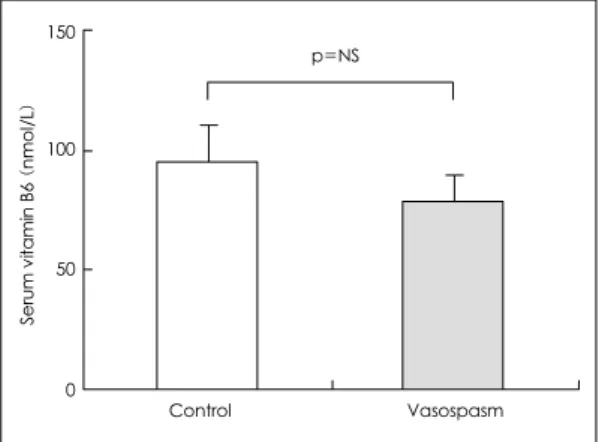
6concentration between the two groups (77.8±44.3 and 95.8±63.4 nmol/L). Conclusions : These data support the hypothesis that elevated serum tHcy is a risk factor for coronary vasospasm. Low folate and vitamin B
12levels in patients with coronary vasospasm suggest that these agents contribute therapeutically to the treat- ment of patients with coronary vasospasm. (Korean Circulation J 2004;34 (1):53-58)
KEY WORDS : Homocysteine; Coronary disease; Coronary vasospasm.
Introduction
Homocysteine is a sulfur containing amino acid derived from the metabolism of methionine and has athergoge- nic and thrombogenic properties. It is regarded as a risk factor for artherosclerotic coronary artery disease.
1-4)Ho- mocysteine is readily oxidized, leading to the formation of superoxide and hydrogen peroxide. This oxidant stress may play an important role in endothelial damage, which occurs easily before the development of overt structural changes in coronary artery disease.
5)6)Several animal and clinical studies have shown homocysteine to reduce the bioavailabilty of endothelium-derived relaxing factors
( EDRF) or endothelium derived nitric oxide (NO).
7)Increased blood homocysteine levels are associated with impaired flow-mediated vasodilation at the brachial ar- tery.
8-10)Flow-mediated vasodialtion of the brachial artery is a good indicator of endothelial function and was re- ported to correlate with coronary circulation.
11)Vasospasm of the coronary artery can cause various features of ischemic heart disease syndrome, including variant angina, myocardial infarction, and even sudden cardiac death.
12)The deficiency of endothelial nitric oxide (NO) activity plays an important role in the pathoge- nesis of coronary vasospasm.
13)Therefore, we hypothe- sized that mild to moderate elevations in the serum total homocysteine concentrations (tHcy) are associated with decreased nitric oxide bioavailability and coronary vaso- spasm. Accordingly, we compared the level of fasting serum tHcy and related substrates to the level of ho- mocysteine in patients with coronary vasospasm and in control subjects.
Received:May 30, 2003 Accepted:December 31, 2003
Correspondence:Kyu-Hyung Ryu, MD. Departmnet of Medi- cine, Hallym University Hospital, Pyungchon-dong, Dongan- gu, Anyang 431-070, Korea
Tel:82-31-380-3722, Fax:82-31-386-2269 E-mail:[email protected]
Methods
Study patients
This study included 25 patients who were diagnosed with vasospastic angina between January 1996 and De- cember 1997 at Hallym University hospital. If typical angina symptoms, focal reversible coronary vasospasms, and transient ECG changes of myocardial ischemia occurred during coronary angiogram with ergonovine or during the acetylcholine provocation test, a diagnosis of vasospastic angina was made. All angina patients, due to coronary vasospasms, had angiographically documented reversible coronary vasospasms associated with ischemic ST segment changes, with chest pain or chest discomfort, and had no visible fixed significant stenosis on coronary angiogram. With the 22 control subjects, detailed medi- cal histories were taken and physical examinations were performed. The patients and the control subjects were matched by age and sex. The exclusion criteria contained the following: impaired renal function (serum creatinine over 2.0 mg/dL), anemia, hepatic disease, current use of vitamin compositions, malignancy, and herb medication.
Measurement
Serum and plasma were obtained after overnight fas- ting and were promptly spun, separated, and frozen at - 20℃. High-performance liquid chromatography with fluorescent detection methods was used for the rapid determination of tHcy concentration.
14)Serum folate and vitamin B
12levels were measured using radioassay kits.
Plasma vitamin B
6levels were measured by radioenzyme assay. Other laboratory tests included measurements of fasting serum total cholesterol, HDL-cholesterol, trigly- ceride, lipoprotein (a), and fibrinogen. LDL-cholesterol levels were calculated by the Friedewald equation. Body mass index was calculated by dividing body weight (Kg) by the square of height (m).
Statistical analysis
Continuous variables were expressed as mean±stan- dard deviation, and the Mann-Whitney U test was used
to compare means between the two groups. Fisher’s exact test was used to compare categorical variables be- tween the groups. Variables that showed significance were included in multivariated logistic regression for evaluating intervariable correlations. P values less than 0.05 were considered statistically significant.
Results
Basic clinical characteristics
The clinical characteristics of the study populations are shown in Table 1. There was no significant dif- ference in age, sex, total cholesterol, triglyceride, HDL- cholesterol, LDL-cholesterol, and BMI between the two groups. The frequency of hypertension and diabetes were also similar between the two groups. The history of ci- garette smoking, which was higher in the vasospasm group, was the only difference (p<0.05).
Serum total homocysteine, folate, vitamin B
12, vitamin B
6concentrations
Serum concentrations of tHcy were higher in patients with coronary vasospasm than in the control subjects (14.8±5.3 versus 10.1±2.5 μmol/L, p<0.001, Figure 1).
Compared with the control group, the vasospasm group showed lower serum folate concentrations (10.2±4.5
Table 1. Basic clinical characteristics and cardiovascu- lar risk factorsCoronary spasm (n=25)
Control (n=22)
Age 052.7±09.2 052.8±10.8
Sex (male) 15 11
Hypertension 6 04
Diabetes 5 06
Smoker* 13 05
BMI (Kg/m2) 023.6±03.4 024.1±03.4 Total cholesterol (mg/dL) 182.1±31.0 199.0±73.0 Triglyceride (mg/dL) 164.0±83.9 154.8±88.9 HDL-cholesterol (mg/dL) 038.6±08.5 042.9±10.5 LDL-cholesterol (mg/dL) 115.2±25.6 124.0±10.5
*: p<0.05 by Fisher’s exact test. BMI: body mass index, HDL: high density lipoprotein, LDL: low density lipopro- tein
versus 6.3±1.0 ng/mL, p<0.001, Figure 2) and lower vitamin B
12levels (1004.9±567.1 versus 544.8±181.7 pg/mL, p<0.001, Figure 3). No significant difference was observed in plasma vitamin B
6concentration between the two groups (95.8±63.4 and 77.8±44.3 nmol/L respec- tively, Figure 4).
Serum total homocysteine concentration and conven- tional risk factors for cardiovascular disease (Table 2) The results showed that sex (13.8±5.6 μmol/L and 11.1±3.2 μmol/L in males and females, respectively),
diabetes (11.6±3.7 μmol/L and 12.9±5.1 μmol/L in diabetes and non-diabetes patients, respectively) and hypertensiveness (11.4±3.2 μmol/L and 12.5±3.9 μ mol/L in hypertensive and non-hypertensive patients, respectively) did not affect the concentration of serum tHcy. The serum tHcy level of smokers and non-smo- kers also showed no significant difference (13.5±5.1 μ mol/L and 12.1±4.6 μmol/L respectively). By lo- gistic regression analysis, cigarette smoking (odd ratio 4.777, 95% confidence interval 1.076-21.202, p<0.05) and serum tHcy concentration (odd ratio 1.302, 95%
Serum total homocysteine (mcmol/L) 25 20 15 10 05
00
Control Vasospasm p<0.001
Figure 1. Serum total homocyteine concentrations (tHcy) in control and vasospasm group. Serum tHcy concentra- tion was higher in vasospasm group (14.8±5.3 μmol/L) than that of control subjects (10.1±2.5 μmol/L, p<0.001 by Mann-Whitney U test).
Serum folate (ng/mL)
15
10
05
00
Control Vasospasm p<0.001
Figure 2. Serum folate levels in control and vasospasm group. Serum folate level was lowe in vasospasm group (6.3±0.7 ng/mL) than that of control subjects (10.2±0.7 ng/mL, p<0.001 by Mann-Whitney U test).
Serum vitamin B12 (pg/mL)
1500
1000
0500
0000
Control Vasospasm p<0.01
Figure 3. Serum vitamin B12 levels in control and vasos- pasm group. Serum vitamin B12 level was lowe in vasos- pasm group (544.8±80.7 pg/mL) than that of control subjects (1004.9±101.2 pg/mL, p<0.01 by Mann-Whitney U test).
Serum vitamin B6 (nmol/L)
150
100
050
000 Control Vasospasm p=NS
Figure 4. Serum Vitamin B6 levels in control and vasos- pasm group. There was no significant difference bet- ween two groups. In control group: 95.8±11.8 nmol/L, in vasospasm group: 77.8±11.3 nmol/L.
confidence interval 1.064-1.594, p<0.01)
Discussion
In the present cross sectional and case-control study, patients with coronary vasospasm showed higher serum total homocysteine concentration than the control pa- tients. This suggests that increased serum homocysteine is associated with coronary vasospasm.
Coronary vasospasm can cause variable clinical fea- tures of myocardial ischemia. Despite its clinical signifi- cance, the factors responsible for coronary artery hyper- sensitivity to vasoconstricting stimuli are still unknown.
From the results of several studies, cigarette smoking is the most accepted characteristic clinical risk factor for coronary vasospasm, but its association with other con- ventional risk factors is weak.
15)16)Similarly, only ciga- rette smoking showed a significant difference between the two groups in this study. Serum total homocyteine is also independently associated with coronary vasospasm.
Among the mechanisms of pathogenesis of coronary vasospasm, impaired endothelial function is regarded as one of the main pathophysiologic mechanisms. Endo- thelial dysfunction manifests an impaired bioavailability of endothelium derived relaxing factor (EDRF). EDRF is a diffusible vasodilator from vascular endothelium and causes vascular smooth muscle relaxation. Moreover, reports have suggested nitric oxide (NO) to be the sub- stance of EDRF.
17)EDRF can be released by platelet
products, thrombin, hormones, neurotransmitters, local autacoids, and by change of local blood flow.
18)The response to variations in shear stress significantly affects the change in diameter of large arteries in response to increased blood flow, which is called flow-mediated vasodilation.
19)In canine coronary arteries, acute endo- thelial injury by a balloon-tipped catheter causes enhan- ced contraction in response to serotonin.
20)Furthermore, the combination of balloon removal of endothelium with hypercholesterolemic diet caused atherosclerotic lesions and selective vasospasms where the endothelium was removed with myocardial ischemia in the porcine mo- del.
21)Some data suggest that coronary vasospasm is associated with endothelial dysfunction in human. Re- ports have also suggested genetic enzyme defects in endothelial NO synthesis to be a risk factor for coronary vasospasm.
22)Moreover, the endothelium dependent flow-mediated dilation in the brachial artery was impaired in patients with vasospastic angina.
23-25)Mild to moderate elevation of serum homocysteine is now regarded as a risk factor for thrombotic and athero- sclerotic vascular disease. Homocysteine readily oxidizes, leading to the formation of superoxide and hydrogen peroxide, and this oxidant stress may play an important role in endothelial dysfunction, which is a major patho- physiologic mechanism for artherosclerosis and coronary vasospasm. There have been several reports indicating that hyperhomocysteinemia is related with vascular en- dothelial dysfunction, which easily occurs before the development of overt structural vascular disease. Harker et al. reported that adding homocysteine to a culture medium caused endothelial injury. Furthermore, they reported that intravenous infusion of homocysteine in baboons caused patch endothelial detatchment.
5)No data has shown the association of homocysteine with coronary vasospasm. The above studies, however, demonstrated that increased homocysteine concentration is associated with impaired endothelium-dependent va- sodilation, employed at the brachial or femoral arteries to estimate flow mediated endothelium-dependent vaso- dilation. And the flow-mediated endothelium-dependent
Table 2. Serum total homocysteine concentration ac-cording to conventional cardiovascular risk factors Risk factors Serum total homocysteine
(μmol/L)
Sex Male:female 13.8±5.6:11.1±3.2
Presence of diabetes
Diabetes:non-diabetes 11.6±3.7:12.9±5.1 Presence of hypertensive
Hypertensive:
non-hypertensive 11.4±3.2:12.5±3.9
Smoking Smoker:Non-smoker 13.5±5.1:12.1±4.6
vasodilation in the brachial artery correlated well with the invasively-tested endothelial function of the coro- nary artery.
26)Therefore, we assumed increased serum homocysteine to induce endothelial dysfunction, causing coronary vasospasm. The results of this study support this assumption .
Homocystinuria is a rare inherited disorder caused by genetically impaired enzyme cystathionine-beta-synthase in homozygote and shows markedly increased homocy- steine concentration.
27)But decreased activity of methy- lenetetrahydofolate reductase (MTHFR) occurs quite frequently, and showed mild to moderately increased homocysteine levels and variable clinical features, in- cluding vascular disease.
28)Vitamin B
12, vitamin B
6and folate are essential nutritional cofactors in the metabo- lism of homocysteine.
29)30)Low levels of these vitamins may result in mild to moderate hyperhomocysteinemia;
administration of these vitamins reduces homocysteine levels. In this study, serum folate and vitamin B
12levels were lower in the vasospasm group than in the control group. Although the activity of MTHFR was not eva- luated, the results of this study suggest that relatively low levels of these vitamins are associated with increased homocyteine levels in patients with coronary vasospasm.
In conclusion, we demonstrated that serum total homo- cyteine concentration increased in patients with coronary vasospasm. Further studies are needed to explain the causal relationship by which another therapeutic moda- lity for coronary vasospasm can be expected.
■
Acknoewledgments
Main result of this study was presented at annual scientific meeting of American College of Cardiology, 1998.
REFERENCES
1)
Israelsson B, Brattstorm LE, Hultberg BL. Homocysteine and myocardial infarction. Atherosclerosis 1988;71:227-33.
2)
Stampfer MJ, Malinow MR, Willette WC, Newcomer LM, Upson B, Ullman D, et al. A prospective study of plasma homocysteine and risk of myocardial infarction in US physician. JAMA 1992;268:877-81.
3)
Pancharuniti N, Lewis CA, Sauberlich HE, Pekins LL, Go RC, Alvarez JO, et al. Plasma homocysteine, folate and vitamin B
12concentrations and risk factor for early onset coronary artery disease. Am J Clin Nutr 1994;59:940-8.
4)
Nygard O, Nordrehaug JE, Refsum H, Uerland PM, Farstad M, Vollset SE. Plasma homocysteine levels and mortality in patients with coronary artery disease. N Engl J Med 1997;
337:230-6.
5)
Harker LA, Ross R, Slichter SJ, Scott CR. Homocyteine- induced arteriosclerosis: the role for endothelial cell injury and platelet responses in its genesis. J Clin Invest 1976;58:
731-41.
6)
Wall RT, Harlan JM, Harker LA, Striker GE. Homocyteine induced endothelial cell injury in vitro: a model for the study of vascular injury. Thromb Res 1980;18:113-21.
7)
Stamler JS, Osborne JA, Jaraki O, Rabbani LE, Mullins M, Singel D, et al. Adverse vascular effects of homocyteine are modulated by endothelium-derived relaxing factor and re- lated oxides of nitrogen. J Clin Invest 1993;91:308-18.
8)
Woo KS, Chook P, Lolin YI, Cheung AS, Chan LT, Sun YY, et al. Hyperhomocysteinemia is a risk factor for arterial endothelial dysfunction in humans. Circulation 1997;96:
2542-4.
9)
Tawakol A, Omland T, Gerhard M, Wu JT, Creager MA.
Hyperhomocysteinemia is associated with impaired endothe- lium dependent vasodilation in humans. Circulation 1997;
95:1119-21.
10)
Bellamy MF, McDowell IF, Ramsey MW, Brownlee M, Bo- nes C, Newcombe RG, et al. Hyperhomocysteinemia after an oral methionine load acutely impaired endothelial func- tion in healthy adults. Circulation 1998;98:1848-52.
11)
Sorensen KE, Celemajer DS, Spiegelhalter DJ, Georgako- poulos D, Robinson J, Thomas O, et al. Non-invasive measurement of human endothelium dependent arterial response: accuracy and reproducibility. Br Heart J 1995;
74:247-53.
12)
Maseri A, Severi S, de Nes M, L’Abbate A, Chiercia S, Marzilli M, et al. “Variant” angina: one aspect of a con- tinuous spectrum of vasospastic myocardial ischemia:
pathogenetic mechanisms, estimated incidence and clinical and coronary arteriographic findings in 138 patients. Am J Cardiol 1978;42:1019-35.
13)
Vanhoutte PM, Shimokawa H. Endothelium-derived rela- xing factor and coronary vasospasm. Circulation 1989;80:
1-9.
14)
Ueland PM, Refsum H, Stabler SP, Malinow MR, Ander- sson A, Allen RH. Total homocysteine in plasma or serum:
methods and clinical applications. Clin Chem 1993;39:
1764-79.
15)
Sugiishi M, Takatsu F. Cigarette smoking is a major risk factor for coronary spasm. Circulation 1993;87:76-9.
16)
Nobuyoshi M, Abe M, Nosaka H, Kimura T, Yokoi H, Ha- masaki N, et al. Statistical analysis of clinical risk factors for coronary artery spasm: identification of the most impor- tant determinent. Am Heart J 1992;124:32-8.
17)
Furchgott RF, Zawadzki JV. The obligatory role of endo- thelial cells in the relaxation of arterial smooth muscles by acetylcholine. Nature 1980;288:373-6.
18)
Furchgott RF. Role of endothelium in responses of vascular smooth muscle. Circ Res 1983;53:557-73.
19)
Joannides R, Haefeli WE, Linder L, Richard V, Bakkali EH,
Thuillez C, et al. Nitric oxide is responsible for flow-de-
pendent dilation of human peripheral conduit arteries in vivo. Circulation 1995;91:1314-9.
20)
Brum JM, Sufan Q, Lane G, Bove AA. Increased vasocon- trictor activity of proximal coronary arteries with endo- thelial damage in intact dog. Circulation 1984;70:1066-73.
21)
Shimokawa H, Tomoike H, Nabeyama S, Yamamoto H, Ishii Y, Tanaka K, et al. Coronary artery spasm induced in miniature swine: angiographic evidence and relation to coronary atherosclerosis. Am Heart J 1985;110:300-10.
22)
Yoshimura M, Nakayama M, Shimasaki Y, Ogawa H, Kugi- yama K, Nakamura S, et al. A T-786 → C mutation in the 5’-flanking region of the endothelial nitric oxide synthase gene and coronary arterial vasomotility. Am J Cardiol 2000;85:710-4.
23)
Taragawa H, Kato M, Kurokawa J, Yamagata T, Matsuura H, Chayama K. Endothelial dysfunction is an independent factor responsible for vasospastic angina. Clin Sci 2001;
101:707-13.
24)
Hamabe A, Takase B, Uehata A, Kurita A, Ohsuzu F, Tamai S. Impaired endothelium-dependent vasodilation in the bra- chial artery in variant angina pectoris and the effect of intravenous administration of vitamin C. Am J Cardiol 2001;87:1154-9.
25)
Moriyama Y, Tsunodar R, Harada M, Miyao Y, Yoshimura
M, Kugiyama K, et al. Nitric oxide-mediated vasodilation is decreased in forearm resistance vessels in patients with coronary spastic angina. Jpn Circ J 2001;65:81-6.
26)
Anderson TJ, Uehata A, Gerhard MD, Meredith IT, Knab S, Delagrange D, et al. Close relation of endothelial function in the human coronary and peripheral circulations. J Am Coll Cardiol 1995;26:1235-41.
27)
Mudd SH, Skovby F, Levy HL, Pettigrew KD, Wilcken B, Pyeritz RE, et al. The natural history of homocystinuria due to cystathionine beta-synthase deficiency. Am J Hum Genet 1985;37:1-31.
28)
Kang SS, Passen EL, Ruggie N, Wong PW, Sora H. Ther- molabile defect of methylenetetrahydrofolate reductase in coronary artery disease. Circulation 1993;88:1463-9.
29)
Stabler SP, Marcell PD, Podell ER, Allen RH, Savage DG, Lindenbaum J. Elevation of total homocysteine in the serum of patients with cobalamine or folate deficiency detected by capillary gas chromatography mass spectrometry. J Clin Invest 1988;81:466-74.
30)