http://www.medicinalcrop.org http://dx.doi.org/10.7783/KJMCS.2014.22.5.384
차광율 및 육묘용기 크기에 따른 갯기름나물 유묘의 생장 및 뿌리 발달 특성
송기선*·전권석*†·윤준혁*·김창환*·박용배*·김종진**
*국립산림과학원 남부산림자원연구소, **건국대학교 녹지환경계획학과
Characteristics of Growth and Root Development of Peucedanum japonicum Seedling by Shading Rate and Container Size
Ki Seon Song*, Kwon Seok Jeon*†, Jun Hyuck Yoon*, Chang Hwan Kim*, Yong Bae Park* and Jong Jin Kim**
*Southern Forest Resources Research Center, Korea Forest Research Institute, Jinju 660-300, Korea.
**Department of Environmental Design, Konkuk University, Seoul 143-701, Korea.
ABSTRACT : This study was carried out in order to investigate the early growth and root development characteristics of Peucedanum japonicum container seedlings. The experiment was performed by containers (128 and 200 cavities containers) and shading levels (0%, 35%, 50% and 75% shading). Germination rate of P. japonicum seeds was getting higher in the lower shading level and the highest in the full sunlight (71.9%). Plant height was the highest under 50% shading of all containers. Fresh weight and dry weight of the shoot (leaves + stem) were the highest under 50% shading of all containers, too. Meanwhile, fresh weight and dry weight of the root per plant were the highest under the full sunlight of 128 cavities container such as 0.34 g and 0.03 g, respectively. Total root length, root project area and root surface area were higher under the full sunlight of 128 cavities container such as 234.5 ㎝, 6.6 ㎠ and 20.8 ㎠, respectively and the next higher was under 35% shading such as 201.7 ㎝, 5.9 ㎠ and 18.4 ㎠, respectively. A case of root volume was the highest with 0.15 ㎤ under the full sunlight. As a result of the surveying the whole experiment, it is concluded that the shoot and root of P. japonicum seed- ling grow nicely by maintaining 35% shading.
Key Words : Early Growth, Germination Rate, Peucedanum japonicum, Root Development
서 언
방풍은 뿌리줄기와 뿌리 (Saposhnikoviae radix)를 약용으로 쓰며 방풍류 생약에는 방풍 (진방풍, 당방풍; Saposhnikovia divaricate(Turcz.) Schischk. = Ledebouriella seseloides(Hoffm.) H. Wolff), 갯기름나물 (식방풍, 빈해전호; Peucedanum japonicum Thunb.), 그리고 갯방풍 (해방풍, 빈방풍, 북사삼;
Glehnia littoralis F. Schmidt ex Miq.) 등이 있다. 그 중 갯 기름나물은 세해살이풀 또는 여러해살이풀로써 초장은 60 ~ 100 cm 인데, 줄기는 굵고 연한 녹색이며 보랏빛의 줄이 있다. 뿌리 잎은 모여나기를 하고 줄기 잎은 23번 갈라지는 깃 꼴겹잎으로 어긋나기를 한다. 작은 잎은 보통 3갈래로 갈라지 는 3 ~ 6 ㎝의 길이로 잎 가장자리는 톱니가 있는 거꿀달걀꼴
이며 잎자루 밑에는 잎집이 있다. 꽃은 6 ~ 7월에 흰빛으로 핀 다. 열매는 길둥근꼴이며 잔털이 있고 9월에 흑갈색으로 익는 다. 기름관은 각 모서리 사이에 34개, 합생면에 8개가 있으며, 바닷가 주변에 자란다 (Chea et al., 2007).
최근 소비자의 친환경 임산물에 대한 관심이 증대되고 있어 산채와 약초의 재배면적이 확대되고 있는 추세이다. 이에 따 라 잎 (식용)과 뿌리 (약용)의 이용이 가능한 고품질 갯기름나 물의 생산을 위해 체계적인 생산 연구가 필요한 실정이다. 최 근 갯기름나물의 연구 보고는 자생지 분포 (Kim et al., 2005, 2006a, b) 와 면역 및 항암 활성 등의 성분분석 (Kim et al., 2009; Lee et al., 2004; Shin et al., 1992; Son et al., 2013; Zheng et al., 2005)에 대한 연구가 주를 이루고 있으나 재배 관련된 연구 (Park et al., 1995)는 미미한 상태
†
Corresponding author: (Phone) +82-55-760-5031 (E-mail) [email protected]
Received 2014 July 31 / 1st Revised 2014 August 11 / 2nd Revised 2014 August 25 / 3rd Revised 2014 September 1 / Accepted 2014 September 5
This is an open access article distributed under the terms of the Creative Commons Attribution Non-Commercial License (http://creativecom-
mons.org/licenses/by-nc/3.0/) which permits unrestricted non-commercial use, distribution, and reproduction in any medium, provided the original
work is properly cited.
로 이 식물의 발아율 향상 뿐만 아니라 보다 효과적인 재배방 법 구명을 위한 연구가 절실한 실정이다. 이러한 이유로 다른 여러 산채와 약초의 발아율 향상을 위한 연구도 최근 활발히 진행되고 있다 (Choi et al., 2013; Hwang et al., 2012;
Lee et al., 2014).
따라서 본 연구에서는 육묘 용기의 용적과 차광수준에 따른 갯기름나물 종자의 발아특성과 육묘단계에서 육묘 용기의 용 적별 갯기름나물 유묘의 초기 생장과 뿌리 발달 특성을 조사 하여 갯기름나물의 적정 생육환경을 구명하고자 하였다. 또한, 본 실험의 결과를 통해 앞으로 육묘 용기에 생육시킨 유묘를 노지에 이식하여 보다 높은 생산성 향상을 위한 기초자료로 활용되고자 하였다.
재료 및 방법
1. 실험재료
본 실험의 공시식물은 갯기름나물 (Peucedanum japonicum Thunberg) 로 종자는 강원도 인제에서 구입하였으며, 이 종자 의 품질은 Table 1과 같다.
공시 육묘 용기는 모종생산용으로 많이 사용되는 플라스틱 Tray 로, 구당 용적이 약 14 ㎖인 128구 Tray (128 cavities, L54.0 × W27.5 × H5.0, ㎝)와 약 10 ㎖ 인 플라스틱 200구 Tray (200 cavities, L54.0 × W27.5 × H4.5, ㎝)를 사용하였다.
상토는 유기물질이 포함되지 않은 원예용 상토 (Horticulture nurserymedia, Punong Co., Ltd., Korea) 를 시중에서 구입하 여 사용하였다.
2. 차광 처리
실험은 국립산림과학원 남부산림자원연구소 내 가좌 묘포장 의 비닐온실에서 실시하였으며, 차광율 35%, 50%, 75%의 차 광망을 이용하여 무차광을 포함한 총 4수준으로 처리하였다.
24 시간동안 수침 처리된 종자를 2014년 2월 19일에 128구 Tray 와 200구 Tray의 각 구마다 1립씩 파종 후 차광수준별로 3 개씩 배치하였다.
광도는 2014년 5월 2일에 Portable Photometer (LI-250 Light meter, LI-COR, Inc., Lincoln, NE, USA) 를 이용하여 각 차광처리구 내 여섯 지점에서 측정하였다. 차광처리구의 평균 광도는 각각 무차광에서 690.0 μ㏖
•m
−2•s
−1, 35% 차광에서 414.4 μ㏖
•m
−2•s
−1, 50% 차광에서 272.0 μ㏖
•m
−2•s
−1, 75%
차광에서 175.7 μ㏖
•m
−2•s
−1로 조사되었다.
3. 발아특성 조사
매일 발아된 종자 개수를 조사하여 발아율을 조사하였다.
또한, T
50(Days to 50% of germination of final germination
rates = Ti + (Tj-Ti) × (N/2-Ni)/(Nj-Ni)), 평균발아일수 (Mean germination time = Σ(Tx
•Nx)/N), 발아균일도 (Germination uniformity = Σ[(MGT-Tx)
2•Nx]/(N-1)), 발아속도 (Germination speed = Σ(Nx/Tx))를 구하였다 (Coolbear et al., 1984; Edwards, 1934; Gordon, 1971).
(N: 총 발아수, N
i: N 에 대한 50% 발아 직전까지 총 발아 수, Nj: N에 대한 50% 발아 직후까지 총 발아수, Ti: Ni 시 점까지 소요된 발아기간, Tj: Nj 시점까지 소요된 발아기간, Nx: 조사 당일 발아수, Tx: 치상 후 조사일수).
4. 생장 및 생장량 조사
2014 년 5월 19일에 차광 및 육묘 용기별 초장, 근원직경 및 근장 생장을 조사하고 지상부 (잎 + 줄기)와 지하부 (뿌리)로 분 리하여 각각 생중량을 측정하였다. 생중량 측정 후 Drying Oven (DS-80-5, Dasol Scientific Co. Ltd, Hwaseong, Korea) 에서 105℃로 72시간 건조하여 건중량을 측정하였고 S/R율 (leaf + stem/root ratio) 을 구하였다.
5. 뿌리 생장 조사
WinRhizo 프로그램 (2009 Version, Regent Instrument Inc., Quebec, Canada) 을 이용하여 전체 뿌리의 영상 분석 (root image analysis) 뿐만 아니라 전체뿌리길이 (total root length), 뿌리투영단면적 (total projected root area), 뿌리표면적 (total root surface area), 전체뿌리부피 (total root volume), 평 균뿌리직경 (average root diameter) 등을 측정
•분석하였으며, 뿌리의 직경등급별로도 전체뿌리길이, 뿌리투영단면적, 뿌리표 면적, 뿌리부피 등을 분석하였다 (Arsenault et al., 1995;
Bouma et al., 2000; Wang and Zhang, 2009).
분석 과정은 물을 채운 투명 트레이에 불순물을 제거한 뿌 리를 넣은 후 뿌리가 겹치지 않게 펼치고 스캐너 (Epson Expression 10000XL, Seiko Epson Corporation, Tokyo, Japan) 를 이용하여 스캔한 후 WinRhizo 프로그램으로 분석을 실시하였다 (Kim et al., 2010).
6. 통계분석
갯기름나물 유묘의 차광 및 육묘용기별 각각의 결과 값에 대 한 분석은 SPSS version 20을 이용하여 분산분석 (ANOVA) 을 실시하였으며, 통계적으로 차이가 유의한 경우 Duncan’s Multiple Range Test (DMRT) 를 실시하였다.
Table 1. Seed quality of P. japonicum used in this experiment.
1000 seeds weight (g)
1 liter
weight (g) Seed no./kg Seed no./L
4.59 364.2 420,100 67,300
결과 및 고찰
1. 발아 특성
차광수준별 갯기름나물 종자의 발아 조사결과, 발아율의 경 우 전체적으로는 58.3 ~ 71.9%로 조사되었으며, 모든 처리구간 유의성은 보이지 않았다. 발아율은 128구 Tray의 무차광에서 가장 높았고 128구 Tray의 75% 차광에서 가장 낮은 것으로 나타났다. T
50의 경우에는 전체적으로 32.835.8일로, 각 Tray 의 무차광에서 유의적으로 높았는데, 이는 유입되는 광량이 높 아 무차광에서 상대적으로 대사작용이 활발하였기 때문으로 생각된다 (Amen, 1967; Cho and Kim, 1993; Kang et al., 1997; Yu et al., 1995;). 평균발아일수도 128구와 200구 Tray 의 무차광에서 각각 36.8과 36.4일로 높았으며, 광수준이 높아질수록 낮아지다 다시 증가하여 T
50과 유사한 경향을 보 였다. 발아균일도의 경우, 128구 Tray에서는 50% 차광에서 가 장 낮았으며, 200구 Tray에서는 50% 차광에서 가장 높았다.
발아속도는 128구 Tray의 50% 차광에서 가장 빨랐으며, 발아 율이 상대적으로 높은 처리구에서 빠르게 나타났다 (Table 2).
Park 등 (1995)의 보고에 따르면, 포지에서 무피복, 흑색 비 닐 피복, 투명 비닐 피복으로 각각 처리한 갯기름나물 종자의 발아율은 무차광에서 가장 높은 것으로 나타나 본 실험과 동 일한 결과를 보였다. 또한, 차광시설 (무차광 및 35%, 50%, 75%, 95% 차광) 내에 수침 처리된 곰취 종자의 발아율은 50% 차광에서 가장 높게, 75%와 95% 차광에서는 낮은 것으 로 보고되어 (Jeon et al., 2013) 75% 차광에서 발아율이 가
장 낮은 본 실험의 결과와 유사한 경향을 보였다. 한편, Yoo 등 (2013)은 백수오 종자의 경우에 광조건 보다 암조건에서 평균발아일수가 빠르고 발아균일도가 높은 것으로 보고하여 50% 차광에서 낮은 값을 보인 본 실험의 갯기름나물과는 다 른 경향을 보였다. 이러한 결과를 통해 종자의 발아는 광도의 영향을 받으며, 식물에 따라 발아를 위한 적정 광환경이 다르 다는 것을 알 수 있다.
2. 생장 특성
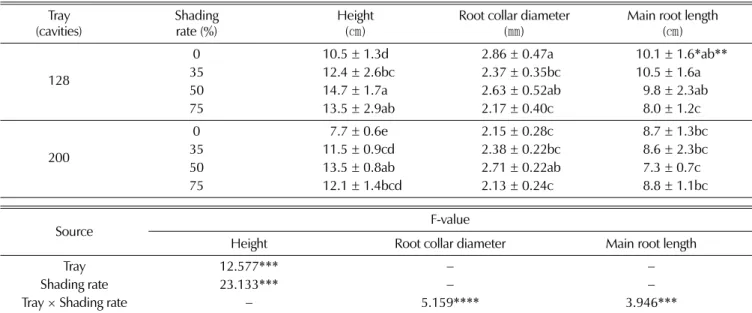
육묘 용기에서 생육된 갯기름나물을 대상으로 육묘 용기에 따른 차광수준별 초장을 조사한 결과, 128구 Tray의 50% 차 광에서 14.7 ㎝로 가장 크게 조사되었다. 그 다음은 128구 트 레이의 75% 차광과 200구 Tray의 50% 차광에서 13.5 ㎝로 컸으며, 이 세 처리구 간의 유의적 차이는 보이지 않았다. 육묘 용기별로는 모두 무차광에서 가장 작은 것으로 조사되었다.
이러한 갯기름나물의 차광수준별 초장의 생장 결과는 종자의 T
50과 평균발아일수가 50% 차광율 이상의 처리구에서 낮아 상 대적으로 발아가 빨리 진행되었기 때문으로 생각된다. 근원직 경의 경우, 모든 처리구 중에서 128구 Tray의 무차광에서 2.86 ㎜로 가장 크고 200구 Tray의 75% 차광에서 가장 작게 조사되었다. 뿌리길이의 경우, 128구 Tray의 무차광, 35%, 50% 차광에서 긴 것으로 조사되었으며, 이들 간의 유의적 차 이는 보이지 않았다. 이렇게 차광수준에 따라 생장의 차이가 발생하는 것은 식물마다 생육을 위한 적정 광환경이 다르기 때문으로 생각된다. 본 실험 또한 처리별 유입되는 광수준이
Table 2. Effects of container volume and shading rates on germination rate, T50, mean germination time, germination uniformity andgermination speed of P. japonicum seeds pre-treated with water soaking.
Tray (cavities)
Shading rate (%)
Germination rate (%)
T50
(days)
Mean germination time
(days)
Germination uniformity
Germination speed
128
0 71.9± 9.4a 35.4± 0.9a 36.8± 1.8a 30.6± 20.4b 0.64± 0.06*a**
35 69.8± 12.6a 33.8± 0.3b 36.4± 1.6a 52.0± 20.7a 0.63± 0.09ab 50 68.8± 8.3a 32.8± 0.0b 32.6± 0.1b
03.9
± 1.1c 0.68± 0.08a 75 58.3± 9.5a 33.1± 0.3b 33.4± 1.0b 11.6± 12.4bc 0.56± 0.08abc200
0 61.1± 10.7a 35.8± 0.8a 36.4± 0.1a
09.2
± 4.1bc 0.51± 0.09c 35 70.0± 3.3a 32.9± 0.8b 33.3± 0.8b05.2
± 0.4c 0.63± 0.04ab 50 58.9± 6.9a 33.5± 0.5b 33.5± 1.0b 14.7± 13.1bc 0.53± 0.06bc 75 63.3± 5.8a 33.4± 0.1b 33.6± 0.1b04.2
± 1.9c 0.57± 0.05bcSource
F-value
Germination rate T50 Mean
germination time
Germination uniformity
Germination speed
Tray − − − − −
Shading rate − 11.211*** − − −
Tray× Shading rate − − 4.197*** 5.933**** −
*Mean ± SD. **Different letters in each column indicate significant differences according to DMRT (***p < 0.05. ****p < 0.01).
달라 갯기름나물의 생장이 차이를 보인 것으로 판단된다 (Hong et al., 2006; Park et al., 2004).
갯기름나물의 생중량 중 지상부의 경우에는 128구 Tray의 50% 차광에서 1.46 g으로 유의성을 보이며 가장 높게 조사되 었고 지하부인 뿌리와 전체 생중량의 경우에는 128구 Tray의 무차광에서 각각 0.34 g과 1.73 g으로 가장 높게 조사되었다.
건중량의 경우, 지상부와 전체는 128구의 50% 차광에서 각각
0.15 g 과 0.17 g으로 가장 높은 것으로 조사되었으며, 뿌리는 무차광에서 0.03 g으로 가장 높게 나타났다 (Table 4). 특히, 뿌리의 생중량과 건중량을 살펴보면, 큰 용적을 가진 육묘 용 기인 128구 Tray의 경우, 건중량과 생중량 모두 차광수준이 높아질수록 유의적으로 낮아지는 경향을 보인 것으로 조사되 었는데, 이는 부족한 광도를 극복하기 위해 지상부에 보다 많 은 산물을 투입하여 뿌리로 분배되는 광합성 산물이 감소되었
Table 3. Effects of container volume and shading rates on height and root collar diameter of P. japonicum seedlings.Tray (cavities)
Shading rate (%)
Height
(㎝) Root collar diameter
(㎜) Main root length
(㎝)
128
0 10.5± 1.3d 2.86± 0.47a 10.1± 1.6*ab**
35 12.4± 2.6bc 2.37± 0.35bc 10.5± 1.6a
50 14.7± 1.7a 2.63± 0.52ab
09.8
± 2.3ab75 13.5± 2.9ab 2.17± 0.40c
08.0
± 1.2c200
0
07.7
± 0.6e 2.15± 0.28c08.7
± 1.3bc35 11.5± 0.9cd 2.38± 0.22bc
08.6
± 2.3bc50 13.5± 0.8ab 2.71± 0.22ab
07.3
± 0.7c75 12.1± 1.4bcd 2.13± 0.24c
08.8
± 1.1bcSource F-value
Height Root collar diameter Main root length
Tray 12.577*** − −
Shading rate 23.133*** − −
Tray× Shading rate − 5.159**** 3.946***
*Mean ± SD. **Different letters in each column indicate significant differences according to DMRT (***p < 0.05. ****p < 0.01).
Table 4. Effects of container volume and shading rates on fresh weight and dry weight of P. japonicum seedlings.
Tray (cavities)
Shading rate (%)
Shoot (g) (Leaves + Stem)
Root (g)
Total
(g) S/R
ratio Fresh weight Dry weight Fresh weight Dry weight Fresh weight Dry weight
128
0 1.21± 0.25b 0.13± 0.03a 0.34± 0.13a 0.03± 0.01a 1.73± 0.57a 0.16± 0.04a 4.7± 1.2*cd**
35 1.01± 0.26bc 0.11 ± 0.03b 0.23± 0.06b 0.02± 0.01bc 1.23 ± 0.31b 0.12± 0.03b 6.0± 1.4bc 50 1.46± 0.35a 0.15± 0.04a 0.20± 0.08b 0.02± 0.01b 1.66± 0.42a 0.17± 0.04a 7.2± 2.1b 75 1.02± 0.24bc 0.09 ± 0.02bc 0.10 ± 0.03c 0.01± 0.00d 1.12± 0.27bc 0.10 ± 0.02bcd 9.0 ± 2.5a
200
0 0.47± 0.11f 0.06± 0.01d 0.17± 0.03bc 0.02 ± 0.01bc 0.64 ± 0.12e 0.08± 0.01d 3.7± 0.9d 35 0.69± 0.08e 0.08± 0.01cd 0.16 ± 0.06bc 0.02 ± 0.01b 0.85± 0.10de 0.10 ± 0.01bcd 4.3 ± 1.1d 50 0.93± 0.23cd 0.09 ± 0.02bc 0.17 ± 0.09bc 0.02 ± 0.00bc 1.10 ± 0.30bcd 0.11 ± 0.02bc 5.1 ± 1.0cd 75 0.76± 0.09de 0.07 ± 0.01cd 0.16 ± 0.03bc 0.01 ± 0.00cd 0.92 ± 0.10cd 0.09 ± 0.01cd 5.8 ± 1.1bc
Source
F-value
Shoot Root Total
S/R ratio Fresh weight Dry weight Fresh weight Dry weight Fresh weight Dry weight
Tray 18.176*** 12.062*** − − 11.574*** − 20.681***
Shading rate − − − − − − 9.635***
Tray× Shading rate 4.564**** 5.802**** 8.899**** 5.537**** 5.929**** 6.281**** −
*Mean ± SD (n = 10). **Different letters in each column indicate significant differences according to DMRT (***p < 0.05. ****p < 0.01).
기 때문으로 생각되며, 이러한 영향으로 차광수준이 높아질수 록 건중량과 생중량이 낮아진 것으로 판단된다 (Kim, 2000).
한편, 200구 Tray의 경우 전체의 생중량과 건중량이 모두 50% 차광에서 가장 높게 조사되었고 지상부와 전체의 생중량 과 건중량 대부분은 128구 Tray 보다 상대적으로 낮은 값을 보였는데, 이는 128구 보다 200구의 생육 용적이 더 작아 뿌 리의 생장이 저조하였으며, 지상부 또한 좁은 생육 면적으로 인해 생장이 원활하지 못했기 때문으로 생각된다.
음지성 산채인 병풍쌈 (Lee et al., 2012b)의 뿌리 건중량과 약리효과가 있는 섬오가피나무 (Lee et al., 2012a)의 뿌리 생 중량의 경우, 차광율이 높아질수록 감소하는 것으로 보고하여 본 실험의 갯기름나물과 유사한 경향을 보였다. 또한, 본 실험 의 갯기름나물 뿌리의 생중량은 광투과율이 높을수록 뿌리의 생중량이 증가한다고 보고된 삽주 (Park et al., 2000a)와 동 일한 경향을 보였다.
S/R 율은 128구 Tray에서 4.7 ~ 9.0으로, 200구 Tray에서 3.7 ~ 5.8 로 각각 조사되었으며, 각 육묘 용기 모두 차광수준이 높아질수록 S/R율이 유의적으로 높아지는 경향을 보였다. 또 한, 128구와 200구 트레이의 75% 차광에서 가장 높은 것으로 조사되었는데, 이러한 결과는 각 육묘 용기에서 뿌리 건중량 이 75% 차광에서 가장 낮은 것과 부합되는 것으로 생각된다.
3. 뿌리 발달
일반적으로 식물을 고정시키고 수분과 무기영양분을 흡수하 며, 탄수화물을 저장하는 기능을 가지고 있는 뿌리는 일부 식 물의 경우 약용으로 이용되기도 하는데, 뿌리를 약용으로 이 용하는 본 실험의 갯기름나물은 상대적으로 지하부의 생장이 더 중요하다고 할 수 있다. 육묘 용기의 용적을 달리하여 차 광시설에서 생육된 갯기름나물의 뿌리는 128구와 200구 Tray
모두 차광율이 높은 75%에서 가장 저조한 생장을 한 것으로 나타났다 (Fig. 1).
한편, 육묘 용기별로는 200구 Tray 보다 용적이 큰 128구 Tray 에서 생육된 갯기름나물의 뿌리 발달이 상대적으로 더 좋 은 것으로 나타났는데, 육묘한 갯기름나물을 본포에 이식 후 장기간 생장량을 조사한다면 보다 정확한 결과가 나타날 것으 로 판단된다.
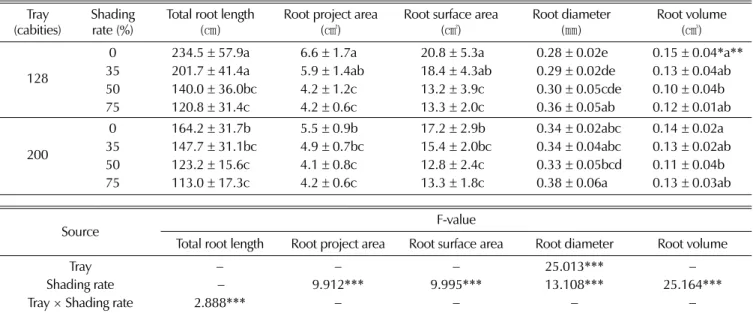
전체뿌리길이의 경우, 128구 Tray의 무차광에서 234.5 ㎝로 가장 길게 조사되었으며, 그 다음은 128구의 35%, 200구의 무차광, 200구의 35% 순으로 나타났다. 뿌리투영단면적과 뿌 리표면적도 128구 Tray의 무차광에서 각각 6.6 ㎠ 과 20.8 ㎠ 로 가장 높은 값을 보였으며, 그 다음으로 유의성을 보이며 높은 것으로 조사된 처리구는 전체뿌리길이와 동일한 경향을 보인 것으로 나타났다. 평균뿌리직경의 경우, 200구와 128구 Tray 에서 모두 75% 차광에서 가장 높은 것으로 조사되었는 데, 이는 전체뿌리길이가 짧아 세근의 발달이 저조했기 때문 으로 생각된다. 뿌리부피는 128구 Tray의 무차광에서 가장 높 았고 그 다음은 200구 Tray의 무차광에서 가장 높은 것으로 조사되었다 (Table 5). 특히, 모든 처리구에서 전체뿌리길이, 뿌리투영단면적, 뿌리표면적이 유의적으로 높게 나타난 128구 Tray 의 무차광과 35% 차광의 경우, 뿌리 생장이 가장 저조한 처리구 보다 각각 약 1.82.1배, 1.41.6배, 1.41.6배 좋은 생장 을 보인 것으로 나타났다. 육묘 용기에 따른 차광수준별로는 50% 와 75% 차광에서 상대적으로 저조한 뿌리 생장을 한 것 으로 나타났다. 또한, 전체뿌리길이를 128구 Tray에서 차광수 준별로 살펴보면, 차광율이 높아질수록 길이가 짧아지는 것으 로 조사되었으며, 뿌리의 생장량 (생중량과 건중량)과 정의 상 관관계를 보이는 것으로 나타났다.
한편, 뿌리를 약용으로 이용하는 삽주 (Song et al., 2014) 와 잔대 (Kim et al., 2012)는 상대광도 25%에서 가장 좋은 뿌리 생장을 하여 전체뿌리길이가 가장 긴 것으로 보고하였는 데, 이는 본 실험의 갯기름나물과는 다른 경향을 보인 것으로 나타났다.
전체뿌리길이를 직경 등급별로 조사한 결과, 세근으로 판단 되는 0.2 ㎜ 이하의 뿌리 직경등급에서는 128구 Tray의 75%
차광에서 70.0%로 가장 높은 비율을 차지하였으며, 0.6 ㎜ 이 상의 뿌리직경 등급에서도 17.5%로 가장 높은 비율을 보였는 데, 이는 75% 차광에서 전체뿌리길이가 유의적으로 낮게 나 타났기 때문으로 생각된다. 또한, 이는 차광수준별 전체뿌리길 이와 음의 상관관계를 보이는 것으로 나타났다. 한편, 전체뿌 리길이가 유의적으로 높게 나타난 두 처리구 (128구 Tray의 무차광과 35% 차광) 중에서는 35% 차광에서 상대적으로 높 은 비율을 보였으며, 0.6 ㎜ 이상의 뿌리직경 등급에서도 무차 광 보다 비율이 약 2.7배 더 높게 조사되었다 (Table 6).
따라서 본 실험결과를 종합적으로 살펴보면, 본포 이식을 위
Fig. 1. Root images of P. japonicum seedlings by containervolume and shading rates.
한 갯기름나물 유묘의 생산은 35% 차광을 유지하는 것이 이 식묘 생산에 보다 효과적일 것으로 생각된다. 그리고 이러한 재배 방법을 이용하여 지상부와 뿌리가 건전하게 생장한 갯기 름나물의 유묘를 본포에 이식한다면 추후 생산량 증대에 있어 서도 효과적일 것으로 생각된다. 이를 위해서는 이식 후 지속 적인 생육특성 조사를 통해 수확시기의 생장 비교 또한 필요 할 것으로 판단된다.
REFERENCES
Amen RD. (1967). The effect of gibberellic acid and stratification on the seed dormancy and germination in Luzula spicata.
Physiology Plant. 20:6-12.
Arsenault JL, Poulcur S, Messier C and Guay R. (1995).
WinRHIZO, a root-measuring system with a unique overlap correction method. HortScience. 30:906.
Bouma TJ, Nielsen KL and Koutstaal B. (2000). Sample preparation and scanning protocol for computerised analysis of root length and diameter. Plant and Soil. 218:185-196.
Chea YA, Kim SM, Kim GS, Yoo CY, Yang DC, Song CG and Kang JH. (2007). Medical botany. Hyangmoon Press. Seoul, Korea. p.1-246.
Cho SH and Kim KJ. (1993). Studies on the increase of germination percent of Angelica gigas Nakai Ⅰ. Germination characteristics and cause of lower germination percent. Korean Journal of Medicinal Crop Science. 1:3-9.
Cho YH, Seong NS, Ham IH and Choi HY. (2004). A comparative study on the immunization and anti-cancer effect of the root and the aerial part of Peucedanum japonicum Thunb. The Korea Journal of Herbology. 19:137-145.
Choi JH, Lee JG, Seong ES, Yoo JH, Kim CJ, Lee GH, Ahn YS, Park CB, Lim JD and Yu CY. (2013). The germination characteristics of seed by storage and germination temperature in Astragalus membranaceus. Korean Journal of Medicinal Table 5. Root morphological traits of P. japonicum seedlings by container volume and shading rates.
Tray (cabities)
Shading rate (%)
Total root length
(㎝) Root project area
(㎠) Root surface area
(㎠) Root diameter
(㎜) Root volume
(㎤)
128
0 234.5± 57.9a 6.6± 1.7a 20.8± 5.3a 0.28± 0.02e 0.15± 0.04*a**
35 201.7± 41.4a 5.9± 1.4ab 18.4± 4.3ab 0.29± 0.02de 0.13± 0.04ab 50 140.0± 36.0bc 4.2± 1.2c 13.2± 3.9c 0.30± 0.05cde 0.10± 0.04b 75 120.8± 31.4c 4.2± 0.6c 13.3± 2.0c 0.36± 0.05ab 0.12± 0.01ab
200
0 164.2± 31.7b 5.5± 0.9b 17.2± 2.9b 0.34± 0.02abc 0.14± 0.02a 35 147.7± 31.1bc 4.9± 0.7bc 15.4± 2.0bc 0.34± 0.04abc 0.13± 0.02ab 50 123.2± 15.6c 4.1± 0.8c 12.8± 2.4c 0.33± 0.05bcd 0.11± 0.04b
75 113.0± 17.3c 4.2± 0.6c 13.3± 1.8c 0.38± 0.06a 0.13± 0.03ab
Source F-value
Total root length Root project area Root surface area Root diameter Root volume
Tray − − − 25.013*** −
Shading rate − 9.912*** 9.995*** 13.108*** 25.164***
Tray× Shading rate 2.888*** − − − −
*Mean ± SD (n = 10). **Different letters in each column indicate significant differences according to DMRT (***p < 0.05).
Table 6. Percentage (%) total root length by different root diameter classes of Peucedanum japonicum seedlings by container volume and shading rates.
Tray (cavities)
Shading rate (%)
Root diameter classes (㎜)
< 0.1 0.1-0.2 0.2-0.3 0.3-0.4 0.4-0.5 0.5-0.6 0.6<
128
0
09.1
47.7 21.4 13.0 3.1 2.902.8
35 10.8 53.0 16.2
08.5
1.7 2.207.6
50 14.6 50.8 12.2
08.5
2.9 3.507.6
75 18.3 51.7
07.3 03.0
0.8 1.4 17.5200
0 8.4 47.1 16.0 11.3 2.9 2.9 11.4
35 11.8 54.9 10.7
05.3
1.4 1.9 14.050 14.9 48.6 10.7
07.6
2.2 2.5 13.675 11.1 50.6 12.6
04.6
1.1 2.0 18.0Crop Science. 21:461-465.
Coolbear P, Francis A and Grierson D. (1984). The effect of low temperature pre-sowing treatment on the germination performance and membrane integrity of artificially aged tomato seeds. Journal of Experimental Botany. 35:1609-1617.
Edwards TI. (1934). Relations of germinating soybeans to temperature and length of incubation time. Journal of Plant Physiology. 9:1-30.
Gordon AG. (1971). The germination resistance test-a new test for measuring germination quality of cereals. Canadian Journal of Plant Science. 51:181-183.
Hong DO, Lee CW, Kim HY, Kang JH, Ryu YS and Shin SC.
(2006). Shading effect on growth and flowering of Orostachys japonicus A. Berger. Korean Journal of Medicinal Crop Science. 14:239-243.
Hwang IS, Yoo JH, Seong ES, Lee JG, Kim HY, Kim NJ, Lee JD, Ham JK, Ahn YS, Kim NY and Yu CY. (2012) The effect of temperature and seed soaking on germination in Cynanchum wilfordii(Maxim.) Hemsl. Korean Journal of Medicinal Crop Science. 20:136-139.
Jeon KS, Song KS, Kim CH, Yoon JH and Kim JJ. (2013).
Effects of seed pre-treatment and germination environments on germination characteristics of Ligularia fischeri seeds. Protected Horticulture and Plant Factory. 22:262-269.
Kang JH, Kim DI, Yu OK, Kim US and Kim YK. (1997).
Effect of seed pretreatment with chilling, GA₃ and light on Bupleurum falcatum germination. Korean Journal of Crop Science. 42:384-391.
Kim DH, Han CS, Kim GE, Kim JH, Kim SG, Kim HK, Oh OJ and Whang WK. (2009). Biological activities of isolated compounds from Peucedani Radix. Yakhak Hoeji. 53:130-137.
Kim JJ. (2000). Studies on optimum shading for seedling cultivation of Cornus controversa and C. walteri. Journal of Korean Forest Society. 89:591-597.
Kim JJ, Lee KJ, Song KS, Cha YG, Chung YS, Lee JH and Yoon TS. (2010). Exploration of optimum container for production of Larix leptolepsis container seedlings. Journal of Korean Forest Society. 99:638-644.
Kim JW, Yoon JH, Jeon KS, Jung JM, Jung HR, Cho MG and Moon HS. (2012). Growth characteristics of Adenophora triphylla var. japonicum by shading treatments. Journal of Agriculture & Life Science. 46:19-25.
Kim SM, Shin DI, Song HS, Kim SK and Yoon ST. (2005).
Geographical distribution and habitat characteristics of Peucedanum japonicum Thunb. in Korea. The Journal of the Korean Society of International Agriculture. 17:118-123.
Kim SM, Shin DI, Song HS and Yoon ST. (2006a). Vegetation structure of Peucedanum japonicum Thunb, community in east seaside of south Korea. Korean Journal of Medicinal Crop Science. 14:347-353.
Kim SM, Shin DI, Song HS and Yoon ST. (2006b). Vegetation structure of Peucedanum japonicum Thunb, community in west seaside of south Korea. The Journal of the Korean Society of International Agriculture. 18:287-296.
Lee JJ, Lee SH, Seo PD, Park CG and Lee SC. (2012a). Effects of cutting date, shading ratio and growth regulator on rooting of Acanthopanax divaricatus var. albeofructus and Acanthopanax
koreanum Nakai. Korean Journal of Medicinal Crop Science.
20:353-358.
Lee KC, Lee HB, Park WG and Han SS. (2012b). Physiological response and growth performance of Parasenecio firmus under different shading treatments. Korean Journal of Agricultural and Forest Meteorology. 14:79-88.
Lee SG, Kim LH and Ku JJ. (2014). Effects of seed storage temperature and pre-Treatment on germination, seedling quality on wild Trichosanthes kirilowii Maxim and Trichosanthes kirilowii var. japonica Kitam. Korean Journal of Medicinal Crop Science. 22:53-59.
Lee SO, Choi SZ, Lee JH, Chung SH, Park SH, Kang HC, Yang EY, Cho HJ and Lee KR. (2004). Antidiabetic coumarin and cyclitol compounds from Peucedanum japonicum. Archives of Pharmacal Research. 27:1207-1210.
Park JM, Jang KH, Lee ST, Song GW and Kang JH. (2000).
Growth characteristics of Atractylodes japonica Koidz. in its native habitat. Korean Journal of Medicinal Crop Science.
8:327-333.
Park JM, Kang JH and Kim MB. (2004). Growth and yield of Atractylodes japonica Koidz. affected by shading and flower bud pinching. Korean Journal of Medicinal Crop Science.
12:231-236.
Park NK, Lee SH, Chung SH, Park SD, Choi BS and Lee WS.
(1995). Effects of fertilization and mulching on yield and quality of Peusedanum japonicum THUNBERG. Korean Journal of Medicinal Crop Science. 3:16-20.
Shin KH, Kang SS and Chi HJ. (1992). Analysis of the coumarin constituents in Peucedanii Radix. Korean Journal of Pharmacognosy. 23:20-23.
Son HK, Kang ST, Jung HO and Lee JJ. (2013). Change in physicochemical properties of Peucedanum japonicum Thunb.
after blanching. Korean Journal of Food Preservation.
20:628-635.
Song KS, Jeon KS, Yoon JH, Kim CH, Park YB and Kim JJ.
(2014). Growth and root development characteristics of Atractylodes japonica seedlings by different relative light intensity. Korean Journal of Medicinal Crop Science.
22:154-159.
Wang MB and Zhang Q. (2009). Issues in using the WinRHIZO system to determine physical characteristics of plant fine roots.
In Acta Ecologica Sinica. CAS. Beijing, China. 29:136-138.
Yoo JH, Seong ES, Lee JG, Kim CJ, Choi JH, Lee GH, Hwang IS, Hwang EB, Lim JD, Ahn YS, Park CB and Yu CY.
(2013). Comparison of the characteristics of seed germination and the first stage of growth in Cynanchum wilfordii(Maxim.) by different light conditions. Korean Journal of Medicinal Crop Science. 21:329-333.
Yu HS, Kang BH, Im DJ, Kim CG, Kim YG, Lee ST and Chang YH. (1995). Effects of temperature, light, GA3 and storage method on germination of Angelica gigas NAKAI.
Korean Journal of Medicinal Crop Science. 3:30-34.
Zheng MS, Jin WY, Son KH, Chang HW, Kim HP, Bae KH and Kang SS. (2005). The constituents isolated from Peucedanum japonicum Thunb. and their cyclooxygenase(COX) inhibitory Activity. Korean Journal of Medicinal Crop Science.
13:75-79.