Effects of Albizziae Cortex Extracts on the Elastase Activity and DPPH and NO Scavenging Activities
Kang Hyun Leem*
College of Oriental Medicine, Semyung University
Elastic fibers are found in the skin, lungs, arteries, veins and other structures. Elastases destroy the elastic fibers and cause the emphysema and pulmonary hypertension. Oxidative stress is needed for these pathologic changes.
Accordingly, present study was designed to investigate the effect of Albizziae Cortex extracts (ACE) on elastase activity and anti-oxidative effects of ACE. The in vitro inhibitory effects on elastase and di(phenyl)-(2,4,6-trinitrophenyl)iminoazanium (DPPH) and nitric oxide (NO) free radical scavenging activities of ACE were measured. The elastase activity was significantly inhibited by ACE. DPPH and NO free radicals were significantly scavenged as well. ACE showed the elastase-inhibiting effects and anti-oxidative activities in vitro. These results suggest that ACE may have potential roles in the treatment of pulmonary emphysema and pulmonary hypertension.
Key words : Albizziae Cortex, Albizzia julibrissin, elastase, DPPH, NO
* To whom correspondence should be addressed at : Kang Hyun Leem, College of Oriental Medicine, Semyung University, Chungbuk 390-711, South Korea
․E-mail : [email protected], ․Tel : 043-649-1341
․Received : 2011/03/17 ․Revised : 2011/04/05 ․Accepted : 2011/04/13
Introduction
Albizziae Cortex is the bark ofAlbizzia julibrissinDurazz., which is rich in tannin, saponin, sitosterol, and other elements1). It is used to treat depression, insomnia, invigorate blood circulation, reduce swelling, promote generation of flesh, and facilitate healing of bone fractures1,2).
Neutrophil elastase (or leukocyte elastase) is a serine protease in the same family as chymotrypsin and has broad substrate specificity. As with other serine proteases it contains a charge relay system composed of the catalytic triad of histidine, aspartate, and serine residues that are dispersed throughout the primary sequence of the polypeptide but that are brought together in the three dimension conformation of the folded protein. The gene encoding neutrophil elastase, ELA2, consists of five exons. It breaks down elastin, an elastic fiber that, together with collagen, determines the mechanical properties of connective tissue3). This neutrophil elastase (NE) is a potent non-specific serine protease which plays a role as bactericidal agent in the degradation of immune complexes by intraphagosomal processes. It promotes inflammation, pulmonary emphysema, and chronic obstructive pulmonary
disease4-7). The proposed pathogenesis of emphysema development involves a combination of inflammation, elastase, matrix metalloprotease imbalance, apoptosis, and oxidative stress8). It is generally accepted that pulmonary exposure to porcine pancreatic elastase (PPE), an enzyme that acts predominantly on elastin9), elicits acute lung inflammatory response with neutrophils and macrophages10-12). Clinical studies for human pulmonary hypertension (PH) and systolic left ventricular failure are now in progress as well4-7).
The production of reactive oxygen species (ROS) was induced by NE13,14). They reported that NE enhancement of MUC5AC messenger RNA levels was dependent on the production of intracellular oxidants or an alteration in the redox state of the cell. It means that ROS may play a role in elastase mediated inflammation. Nitric oxide (NO) plays an pivotal role in elastase mediated diseases as well15). In the present study, I investigated the effects of Albizziae Cortex extracts (ACE) on elastase activity. Anti-oxdative activities of ACE were also examined via measuring the di(phenyl)-(2,4,6-trinitrophenyl)iminoazanium (DPPH) free radical scavenging and nitrite scavenging activities.
Materials and Methods
1. Sample preparation
Albizziae Cortex was purchased from Omniherb (Korea).
ACE was prepared as follow. 100 g of Albizziae Cortex in
2,000 ml 70% ethanol was heated in a heating extractor for 3 hours. The extract was filtered and concentrated by using the rotary evaporator. The extracts were lyophilized by using freeze dryer (5.67 g). The lyophilized extract was dissolved in water and filtered three times through microfilter paper (Whatman no. 2, 0.45-0.2 μm). It was placed in a disinfected vial and sealed for further study.
2. Reagents
Elastase, p-nitroaniline, DPPH, and Griess reagents were purchased from Sigma-Aldrich (St. Louis, MO, USA).
3. Elastase activity inhibition
The elastase activity was evaluated by using a modification of a previously reported method of Kraunsoe et al16). In order to evaluate the inhibition of elastase activity, the amount of released p-nitroaniline, which was hydrolyzed from the substrate, N-succinyl-Ala-Ala-Ala-p-nitroanilide, by elastase, was read with a maximum absorbance at 410 nm17). In brief, 2 mM N-succinyl-Ala-Ala-Ala-p-nitroanilide was prepared in a 0.1 M Tris-Cl buffer (pH 8.0), and this solution was added to the stock sample. Each sample solution was diluted to final concentrations of 0.01, 0.1, and 1 mg/ml. The solutions were mixed thoroughly by tapping before an elastase (0.1360 unit/ml) stock solution was added. Solution was incubated for 10 min at 37°C, and the absorbance was measured at 410 nm (Synergy2, BioTek Inc., USA). The percent scavenging capability was calculated according to the following equation:
Elastase inhibitory activity (%)
= [(OD410 of control) - (OD410 of sample) / (OD410 of control)] × 100
4. DPPH free radical scavenging activity
The scavenging effect of sample on
1,1-diphenyl-2-picrylhydrazyl (DPPH) radicals was assayed according to the procedure described by Shimada et al18). The DPPH radical shows a deep violet color due to its unpaired electron, and radical scavenging capacity can be followed spectrophotometrically by the loss of absorbance at 540 nm17). In brief, sample was added to 1 ml of freshly prepared ethanolic solution containing a final DPPH radical concentration of 0.2 mM. After it stood for 30 min in the dark, the absorbance of the mixture was measured at 540 nm against an ethanol control with a ELISA reader (Synergy 2, BioTek Inc., USA). The percent scavenging capability was calculated according to the following equation:
DPPH free radical scavenging activity (%)
= [(OD540 of control) - (OD540 of sample) / (OD540 of control)] × 100
5. Nitrite scavenging activity
Nitrite scavenging activity (NSA) of sample was determined by using Griess reagent19). First, 1 ml of sample was mixed with 1 ml of 1 mM sodium nitrite. The mixture was added to 8 ml of 0.2 M citrate buffer (pH 1.2, 3.0, and 6.0) and incubated for 1 h at 37℃. Then, 1 ml aliquot was removed and added to 2 ml of 2% acetic acid and 0.4 ml of Griess reagent (1% sulfanilic acid and 1% naphthylamine in a methanol solution containing 30% acetic acid). After vigorous vortex mixing, the mixture was placed at room temperature for 15 min and the absorbance was measured at 520 nm. The NSA (%) was calculated by the following equation.
NSA (%)=[1 - (A - C) / B] × 100
A is the absorbance of treated sample, C is the absorbance of sample, and B is the absorbance of 1 mM NaNO2.
6. Statistical analysis
The results were expressed as means ± standard error of the mean (SEM). Significances of changes were determined using the one-way ANOVA with a Dunnett's post hoc test.
Values of p < 0.05 were considered statistically significant.
Results
1. Inhibition of the elastase activity
The inhibitory effect of ACE on elastase activity was determined according to the method described previously.
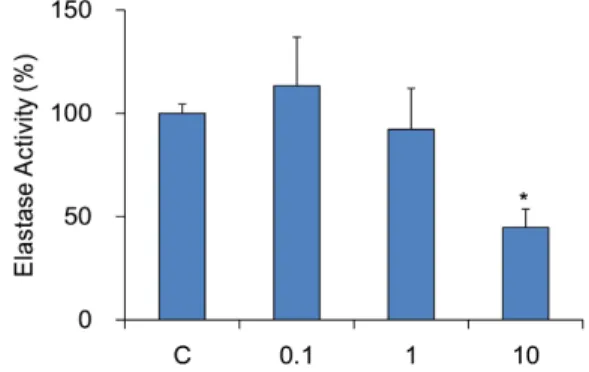
ACE significantly inhibited elastase activity at a concentration of ACE 10 mg/ml treated group (44.7 ± 8.9%, p < 0.05). Both 0.1 and 1 mg/ml did not show any significance (113.3 ± 23.6%
and 92.3 ± 19.9% compared with 100% elastase activity of control group, respectively, Fig. 1).
Fig. 1. Effect of ACE on inhibition of elastase activity. C: control, distilled water treated group. 0.1, 1, and 10: Albizziae Cortex extracts treated groups (0.1, 1, and 10 mg/ml). Data were expressed as the mean ± SEM of three experiments. *: significantly different from control (p < 0.05).
2. DPPH free radical scavenging capability
It has been reported that reactive free radicals was
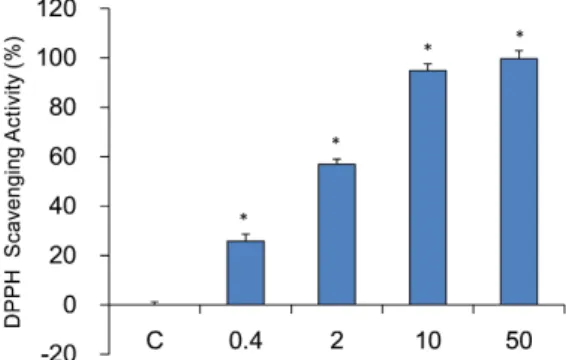
induced by elastase in neutrophil and that they play a role in inflammation. Assays of the free radical scavenging capacity were carried out by the DPPH method. The free radical scavenging capacity of sample was measured at each concentration (0, 0.4, 2, 10, and 50 mg/ml). A dose dependent free radical scavenging capability was observed in sample treated groups. ACE 10 mg/ml treated group already showed the highest scavenging capability of 94.9 ± 2.7%. Each concentration of 50, 2, and 0.4 mg/ml treated group showed 99.7 ± 3.3%, 56.9 ± 2.1%, and 25.8 ± 2.8%, respectively(Fig. 2).
Fig. 2. DPPH free radical scavenging capability. C: control, distilled water treated group. 0.4, 2, 10, and 50: Albizziae Cortex extracts treated groups (0.4, 2, 10, and 50 mg/ml). Data were expressed as the mean ± SEM of three experiments. *: significantly different from control (p < 0.05).
3. Nitrite scavenging capability at pH 1.2
Nitrite scavenging capability changes at various pH environments. Accordingly, nitrate scavenging activities at pH 1.2, 3.0, and 6.0 were measured in this study.
The nitrate scavenging capacity of sample was measured at each concentration (0, 0.4, 2, 10, and 50 mg/ml). A dose dependent nitrate scavenging capability was observed in sample treated groups. Three tested concentraions (2, 10, and 50 mg/ml) showed statistical significances (68.1 ± 1.1%, 92.3 ± 6.0%, and 100.0 ± 0.0%, respectively, Fig. 3).
Fig. 3. Nitrite radical scavenging capability at pH 1.2. C: control, distilled water treated group. 0.4, 2, 10, and 50: Albizziae Cortex extracts treated groups (0.4, 2, 10, and 50 mg/ml). Data were expressed as the mean ± SEM of three experiments. *: significantly different from control (p < 0.05).
4. Nitrite scavenging capability at pH 3.0
The nitrate scavenging capacity of sample was measured at each concentration (0, 0.4, 2, 10, and 50 mg/ml). A dose dependent nitrate scavenging capability was observed in sample treated groups. Both 10 and 50 mg/ml concentraions showed statistical significances (48.7 ± 3.3% and 89.5 ± 4.8%, respectively, Fig. 4).
Fig. 4. Nitrite radical scavenging capability at pH 3.0. C: control, distilled water treated group. 0.4, 2, 10, and 50: Albizziae Cortex extracts treated groups (0.4, 2, 10, and 50 mg/ml). Data were expressed as the mean ± SEM of three experiments. *: significantly different from control (p < 0.05).
5. Nitrite scavenging capability at pH 6.0
The nitrate scavenging capacity of sample was measured at each concentration (0, 0.4, 2, 10, and 50 mg/ml). Both 10 and 50 mg/ml concentraions showed statistical significances (48.7 ± 3.3% and 89.5 ± 4.8%, Fig. 5). However, the activities were not more effective than pH 1.2 and 3.0.
Considering data from Figure 3 to 5, nitrite scavenging capability was varied with increasing pH, suggesting pH dependent. Accordingly, low pH environments (1.2 - 3.0) could be the best environment for nitrite scavenging activity of ACE.
Fig. 5. Nitrite radical scavenging capability at pH 6.0. C: control, distilled water treated group. 0.4, 2, 10, and 50: Albizziae Cortex extracts treated groups (0.4, 2, 10, and 50 mg/ml). Data were expressed as the mean ± SEM of three experiments. *: significantly different from control (p < 0.05).
Discussion and Conclusion
Albizziae Cortex is the bark ofAlbizzia julibrissinDurazz.,
is used to treat short temper (心神不安), depression, insomnia, irritability, premenstrual syndrome, and forgetfulness. It has mild effects and is usually used as an adjunct to other tranquilizing herbs. It invigorates blood circulation (活血), reduces swelling (消腫), promotes generation of flesh (生肌), and facilitates healing of bone fractures (續骨). It has been used be one of the most important herbs for treatment of external trauma and injuries1,2).
Elastase breaks down elastin, an elastic fiber that, together with collagen, determines the mechanical properties of connective tissue. It is capable of hydrolyzing nearly all proteins, including supporting and structural proteins of the connective tissue such as collagen and elastin20). Elastin is the main component of the elastic fibers of the connective tissue and tendons. The elastic fibers in the skin, together with the collagenous fibers, form a network under the epidermis21). Elastase also plays a critical role in inflammatory processes.
The enzyme has drawn much attention, primarily because of its reactivity and non-specificity. It is able to attack all major connective tissue matrix proteins, including elastin, collagen, proteoglycans, and keratins22). However, recent observations indicate that the role of neutrophil elastase (NE) in inflammation is more complex than the simple degradation of extra-cellular matrix components.
A variety of degenerative and degradative disorders are also associated to uncontrolled proteolysis by NE (rheumatoid arthritis, glomerulonephritis, adult respiratory distress symptom, psoriasis, cancer). Recent studies suggest that NE not only plays a key role in lung destruction (emphysema) but can also modulate proliferative changes (fibrosis) in inflammatory processes. Thus, NE could be considered to have potential multiple roles in the pathogenesis of both emphysema and lung fibrosis23). Numerous inhibitors of NE have been reported. Various molecules are currently undergoing clinical trials for emphysema and other pulmonary diseases24). The defects of elastic matrix aggravate hypertension which is associated with alteration in the great arteries, arteries, and arterioles. Clinical studies for human pulmonary hypertension (PH) and systolic left ventricular failure are now in progress. An elastase inhibitor is currently being investigated in phase I clinical trials in patients with PH owing to chronic obstructive pulmonary disease4-7).
In this study, inhibitory effect of ACE on elastase activity was determined according to the previously described method.
ACE showed the elastase inhibitory effect in a dose dependent manner. ACE was found to inhibit elastase activity highly at a concentration of 10 mg/ml. The treated concentrations were not same between elastase experiment and free radical
experiments (DPPH and NO) because the effects showing concentrations did not same in the preliminary experiments.
The production of Reactive oxygen species (ROS) is induced by NE13,14). They reported that NE enhancement of MUC5AC messenger RNA levels was dependent on the production of intracellular oxidants or an alteration in the redox state of the cell. It means that ROS may play a role in elastase mediated inflammation. Accordingly, anti-oxdative activities of ACE were also examined. DPPH free radical scavenging capability of ACE was measured at each concentration (0, 0.4, 2, 10, and 50 mg/ml). A dose dependent free radical scavenging capability was observed.
Nitric oxide plays a pivotal role in elastase mediated diseases15,25). So, nitrite scavenging activities were also examined. However, nitrite scavenging capability changes at various pH environments. Accordingly, nitrate scavenging activities at pH 1.2, 3.0, and 6.0 were measured in this study.
Considering data at pH 1.2, 3.0, and 6.0, nitrite scavenging capability was varied with increasing pH, suggesting it is pH dependent. The low pH environments (1.2 - 3.0) could be the best environment for nitrite scavenging activity of ACE.
In conclusion, ACE showed the inhibiting effects on the elastase, and free radical scavenging capability of DPPH and nitrite. These results suggest that ACE might have some effects for pulmonary emphysema and pulmonary hypertension.
Certainly, further studies should be needed to unravel exactly under the evidences such as in vivo studies, clinical trial and mechanism studies.
Acknowledgements
This work was supported by a grant from the Ministry of Knowledge Economy of the Republic of Korea (RIC-07-06-01).
References
1. The Boncho-hak textbook committee. Boncho-Hak. Seoul, Young-Lim Press, pp 534-535, 2007.
2. Chen, J.L., Chen, T.T. Chinese medical herbology and pharmacology. CA, Art of Medicine Press, pp 768-769, 2004.
3. Bieth, J.G. The elastases. J Soc Biol 195(2):173-179, 2001.
4. Loukanov, T., Geiger, R., Agrawal, R. Animal models related to congenital heart disease and clinical research in pulmonary hypertension. Cardiology 116(1):18-25, 2010.
5. Dewachter, L., Dewachter, C., Naeije, R. New therapies for pulmonary arterial hypertension: An update on current bench to bedside translation. Expert Opin Investig Drugs
19(4):469-488, 2010.
6. Stenmark, K.R., Rabinovitch, M. Emerging therapies for the treatment of pulmonary hypertension. Pediatr Crit Care Med 11(2 Suppl):S85-90, 2010.
7. Huang, J.B., Liu, Y.L., Sun, P.W., Lv, X.D., Bo, K., Fan, X.M. Novel strategy for treatment of pulmonary arterial hypertension: Enhancement of apoptosis. Lung 188(3):179-189, 2010.
8. Groneberg, D.A., Chung, K.F. Models of chronic obstructive pulmonary disease. Respir Res 5: 18, 2004.
9. Mandl, I., Darnule, T.V., Fierer, J.A., Keller, S., Turino, G.M. Elastin degradation in human and experimental emphysema. Adv Exp Med Biol 79: 221-231, 1977.
10. Dubaybo, B.A., Crowell, L.A., Thet, L.A. Changes in tissue fibronectin in elastase induced lung injury. Cell Biol Int Rep 15(8):675-686, 1991.
11. Lucey, E.C., Keane, J., Kuang, P.P., Snider, G.L., Goldstein, R.H. Severity of elastase-induced emphysema is decreased in tumor necrosis factor-alpha and interleukin-1beta receptor-deficient mice. Lab Invest 82(1):79-85, 2002.
12. Hayes, J.A., Korthy, A., Snider, G.L. The pathology of elastase-induced panacinar emphysema in hamsters. J Pathol 117(1):1-14, 1975.
13. Fischer, B., Voynow, J. Neutrophil elastase induces MUC5AC messenger RNA expression by an oxidant-dependent mechanism. Chest 117(5 Suppl 1):
317S-320S, 2000.
14. Fischer, B.M., Voynow, J.A. Neutrophil elastase induces MUC5AC gene expression in airway epithelium via a pathway involving reactive oxygen species. Am J Respir Cell Mol Biol 26(4):447-452, 2002.
15. Kawai, M., Harada, N., Takeyama, H., Okajima, K.
Neutrophil elastase contributes to the development of ischemia/reperfusion-induced liver injury by decreasing the production of insulin-like growth factor-I in rats.
Transl Res 155(6):294-304, 2010.
16. Kraunsoe, J.A., Claridge, T.D.W., Lowe, G. Inhibition of human leukocyte and porcine pancreatic elastase by homologues of bovine pancreatic trypsin inhibitor.
Biochemistry 35: 9090-9096, 1996.
17. Kim, Y.H., Chung, C.B., Kim, J.G., Ko, K.I., Park, S.H., Kim, J.H., Eom, S.Y., Kim, Y.S., Hwang, Y.I., Kim, K.H.
Anti-wrinkle activity of ziyuglycoside I isolated from a Sanguisorba officinalis root extract and its application as a cosmeceutical ingredient. Biosci Biotechnol Biochem 72(2):303-311, 2008.
18. Shimada, K., Fugikawa, K., Yahara, K., Nakamura, T.
Antioxidative properties of xanthan on the autoxiation of soy gean oil in cyclodextrin emulsion. J Agric Food Chem 40: 945-948, 1992.
19. Kato, H., Lee, I.E., Chuyen, N.V., Kim, S.B., Hayase, F.
Inhibition of nitrosamine formation by nondialyzable melanoidins. Agric Biol Chem 51(5):1333-1338, 1987.
20. Yang, Z.Y., Guon, G.X., Lin, Z.F. Elastolytic activity from Flavobacterium odoratum. Microbial screening and cultivation, enzyme production and purification. Process Biochem 29: 427-436, 1994.
21. Wiltried, M., Klaus, N., Lin, Z.F. Elastic fibre arrangement in the skin of the pig. Arch Derm Res 270: 390-401, 1994.
22. Wiedow, O., Schroder, J.M., Christophers, E. An elastase-specific inhibitor of human skin. J Biol Chem 265:
14791-14795, 1990.
23. Lungarella, G., Cavarra, E., Lucattelli, M., Martorana, P.A.
The dual role of neutrophil elastase in lung destruction and repair. Int J Biochem Cell Biol 40(6-7):1287-1296, 2008.
24. Reboud-Ravaux, M. Elastase inhibitors. J Soc Biol 195(2):143-150, 2001.
25. Boyer, L., Plantier, L., Dagouassat, M., Lanone, S., Goven, D., Caramelle, P., Berrehar, F., Kerbrat, S., Dinh-Xuan, A.T., Crestani, B., Le Gouvello, S., Boczkowski, J. Role of nitric oxide synthases in elastase-induced emphysema. Lab Invest 91(3):353-362, 2011.