黃 의 elastase 활성과 DPPH, NO 소거능에 미치는 영향
모충정1, 이세나1, 김명규1, 김명희2, 김형준1, 조학준1, 임강현1*
1 : 세명대학교 한의과대학, 2 : 세명대학교 간호학과
Effects of Astragali Radix Extracts on the Elastase Activity and DPPH and NO Scavenging Activities
Jong-Cheng Mou
1, Sena Lee
1, Myung-Gyou Kim
1, Myoung-Hee Kim
2, Hyung-Jun Kim
1, Hak Jun Jo
1, Kang-Hyun Leem
1*1:College of Oriental Medicine, Semyung University, Jechon 390-711, Korea, 2:Department of Nursing, Semyung University, Jechon 390-711, Korea
ABSTRACT
Objectives:Elastic fibers are found in the skin, lungs, arteries, veins and other structures. The defects of elastic matrix aggravate hypertension which is associated with alteration in the great arteries, arteries, and arterioles. The elastase inhibitors were undergoing in clinical studies about emphysema and pulmonary hypertension. This study was designed to investigate the effect of Astragali Radix extracts (AR) on elastase activity and anti-oxidative effects.
Methods:The elastase inhibitory activity and DPPH (1,1-diphenyl-2-picrylhydrazyl) and NO free radical scavenging activities of AR were measured.
Results:The elastase activity was significantly inhibited by AR. The significant DPPH and NO free radical scavenging activities were observed in AR as well.
Conclusion:AR showed the anti-elastase effects and anti-oxidative activities in vitro. These results suggest that AR may be a possible drug for the treatment of pulmonary emphysema and pulmonary hypertension.
Key words:Astragali Radix, elastase, DPPH, NO
INTRODUCTION
Astragali Radix (AR), the roots of
Astragalus membranceus, riches in polysaccharides, saponins, flavonoids, amino acids, and trace elements
1). It is used to tonify defensive qi and raise yang. It is also used to regulate water circulation and reduce edema
1,2).
Elastase is an enzyme from the class of proteases (peptidases) that breaks down a kind of proteins. It breaks down elastin, an elastic fiber that, together with collagen, determines the mechanical properties of connective tissue
3). This neutrophil elastase (NE) is a potent non specific serine protease which plays a role
as bactericidal agent and in the degradation of immune complexes by intraphagosomal processes. It promotes inflammation, pulmonary emphysema, and chronic obstructive pulmonary disease
4-7). Clinical studies for human pulmonary hypertension (PH) and systolic left ventricular failure are now in progress as well
4-7).
The production of Reactive oxygen species (ROS) was induced by NE
8,9). They reported that NE enhancement of MUC5AC messenger RNA levels was dependent on the production of intracellular oxidants or an alteration in the redox state of the cell. It means that ROS may play a role in elastase mediated inflammation. Nitric oxide plays an pivotal role in
*교신저자:임강현. 충북 제천시 세명대학교 한의과대학 본초학교실.
․ Tel:043-649-1341. ․ E-mail:[email protected].
․ 접수:2011년 2월 15일 ․ 수정:2011년 3월 4일 ․ 채택:2011년 3월 10일
elastase mediated diseases as well
10).
In the present study, we investigated the effects of AR on elastase activity. Anti-oxdative activities of AR were also examined via measuring the DPPH free radical scavenging and nitrite scavenging activities .
MATERIALS AND METHODS
1. Sample preparation
Astragali Radix was purchased from Omniherb (Korea). Astragali Radix extracts (AR) was prepared as follows. 100 g of AR in 2,000 ml distilled water was heated in a heating extractor for 3 hours. The extract was filtered and concentrated by using the rotary evaporator. The extracts were lyophilized by using freeze dryer (13.4 g). The lyophilized extract was dissolved in water and filtered three times through microfilter paper (Whattman no. 2, 0.45-0.2 μm). It was placed in a disinfected vial and sealed for further study.
2. Reagents
All reagents were purchased from Sigma-Aldrich (St. Louis, MO, USA).
3. Elastase activity inhibition
The elastase activity was evaluated by using a modification of a previously reported method of Kraunsoe et al
11). In order to evaluate the inhibition of elastase activity, the amount of released p-nitroaniline, which was hydrolyzed from the substrate, N-succinyl-Ala-Ala-Ala-p-nitroanilide, by elastase, was read with a maximum absorbance at 410
nm
12). In brief, 2 mM
N-succinyl-Ala-Ala-Ala-p-nitroanilide was prepared in a 0.1 M Tris-Cl buffer (pH 8.0), and this solution was added to the stock sample. Each sample solution was diluted to final concentrations of 0.01, 0.1, and 1 mg/ml. The solutions were mixed thoroughly by tapping before an elastase (0.1360 unit/ml) stock solution was added. Solution was incubated for 10 min at 37°C, and the absorbance was measured at 410 nm. The percent scavenging capability was calculated according to the following equation:
Elastase inhibitory activity (%)
= [(OD410 of control) - (OD410 of sample) / (OD410 of control)] × 100
4. DPPH free radical scavenging activity
The scavenging effect of sample on 1,1-diphenyl-2-picrylhydrazyl (DPPH) radicals was assayed according to the procedure described by Shimada et al
13). The DPPH radical shows a deep violet color due to its unpaired electron, and radical scavenging capacity can be followed spectrophotometrically by the loss of absorbance at 540 nm
12). In brief, sample was added to 1 ml of freshly prepared ethanolic solution containing a final DPPH radical concentration of 0.2 mM. After it stood for 30 min in the dark, the absorbance of the mixture was measured at 540 nm against an ethanol control with a spectrophotometer. The percent scavenging capability was calculated according to the following equation:
DPPH free radical scavenging activity (%)
= [(OD540 of control) - (OD540 of sample) / (OD540 of control)] × 100
5. Nitrite scavenging activity
Nitrite scavenging activity (NSA) of sample was determined by using Griess reagent
14). First, 1 ml of sample was mixed with 1 ml of 1 mM sodium nitrite.
The mixture was added to 8 ml of 0.2 M citrate buffer (pH 1.2, 3.0, and 6.0) and incubated for 1 h at 37°C. Then, 1 ml aliquot was removed and added to 2 ml of 2% acetic acid and 0.4 ml of Griess reagent (1% sulfanilic acid and 1% naphthylamine in a methanol solution containing 30% acetic acid). After vigorous vortex mixing, the mixture was placed at room temperature for 15 min and the absorbance was measured at 520 nm. The NSA (%) was calculated by the following equation.
NSA (%)=[1 - (A - C) / B] × 100
Where, A is the absorbance of treated sample, C is the absorbance of sample, and B is the absorbance of 1 mM NaNO
2.
6. Statistical analysis
The results were expressed as means ± standard error of the mean (SEM). Significances of changes were evaluated using the Students' t-test. Values of p
< 0.05 were considered significant.
RESULTS
1. Elastase inhibitory activity
The inhibitory effect of AR on elastase activity was determined according to the method described previously. AR showed the elastase inhibitory effect.
AR was found to inhibit elastase activity highly at a concentration of 1 mg/ml (75.3 ± 4.4%). AR 0.1 mg/ml and AR 0.01 mg/ml treated groups showed 65.9 ± 0.6% and 111.2 ± 14.5% of elastase activities, respectively (Figure 1).
Figure 1. Effect of AR on elastase inhibitory activity. C: control, distilled water treated group. 0.01, 0.1, and 1: Astragali Radix extracts treated group (0.01, 0.1, and 1 mg/ml). Data are expressed as the mean ± SEM of three experiments. *:
significantly different from control, p < 0.05.
2. DPPH free radical scavenging capability
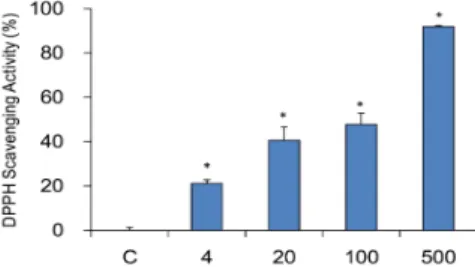
It has been reported that reactive free radicals was induced by elastase in neutrophil and that they play a role in inflammation. Assays of the free radical scavenging capacity were carried out by the DPPH method. The free radical scavenging capacity of sample was measured at each concentration (0, 4, 20, 100, and 500 mg/ml). A dose dependent free radical scavenging capability was observed in sample treated groups. AR 500 mg/ml treated groups had the highest scavenging capability, of 91.9 ± 0.5%, while 100, 20, and 4 mg/ml treated groups had 47.8 ± 5.0%, 40.6
± 6.0%, and 21.2 ± 0.5%, respectively (Figure 2).
Figure 2. DPPH free radical scavenging capability. C: control, distilled water treated group. 4, 20, 100, and 500: Astragali Radix extracts treated group (4, 20, 100, and 500 mg/ml). Data are expressed as the mean ± SEM of three experiments. *:
significantly different from control, p < 0.05.
3. Nitrite scavenging capability at pH 1.2
Nitrite scavenging capability changes at various pH environments. Accordingly, nitrate scavenging
activities at pH 1.2, 3.0, and 6.0 were measured in this study.
The nitrate scavenging capacity of sample was measured at each concentration (0, 0.4, 2, 10, and 50 mg/ml). A dose dependent nitrate scavenging capability was observed in sample treated groups. AR 50 mg/ml treated groups had the highest scavenging capability, of 102.5 ± 0.0%, while 10, 2, and 0.4 mg/ml treated groups had 99.7 ± 0.0%, 82.3 ± 0.0%, and 12.9 ± 0.2%, respectively (Figure 3).
Figure 3. Nitrite radical scavenging capability at pH 1.2. C:
control, distilled water treated group. 0.4, 2, 10, and 50: Astragali Radix extracts treated group (0.4, 2, 10, and 50 mg/ml). Data are expressed as the mean ± SEM of three experiments. *:
significantly different from control, p < 0.05.
4. Nitrite scavenging capability at pH 3.0
The nitrate scavenging capacity of sample was measured at each concentration (0, 0.4, 2, 10, and 50 mg/ml). A dose dependent nitrate scavenging capability was observed in sample treated groups. AR 50 mg/ml treated groups had the highest scavenging capability, of 103.0 ± 0.5%, while 10, 2, and 0.4 mg/ml treated groups had 61.8 ± 0.1%, 26.6 ± 0.1%, and 9.0 ± 0.2%, respectively (Figure 4).
Figure 4. Nitrite radical scavenging capability at pH 3.0. C:
control, distilled water treated group. 0.4, 2, 10, and 50: Astragali Radix extracts treated group (0.4, 2, 10, and 50 mg/ml). Data are expressed as the mean ± SEM of three experiments. *:
significantly different from control, p < 0.05.
5. Nitrite scavenging capability at pH 6.0
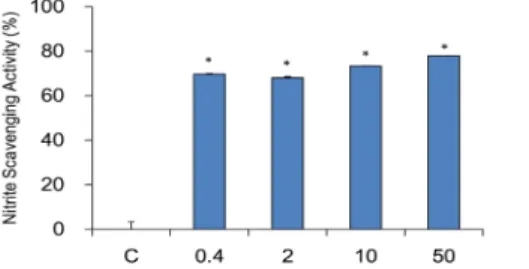
The nitrate scavenging capacity of sample was measured at each concentration (0, 0.4, 2, 10, and 50 mg/ml). A dose dependent nitrate scavenging capability was not observed at pH 6.0 environment.
All concentrations of AR treatment (0.4, 2, 10, and
50 mg/ml) showed the significant effects. These
scavenging effects are 69.7 ± 0.3%, 68.1 ± 0.5%,
73.3 ± 0.1%, and 78.0 ± 0.0%, respectively (Figure
5). Considering data from figure 3 to 5, nitrite scavenging capability was varied with increasing pH, suggesting it is pH dependent. Accordingly, pH 6.0 could be the best environment for nitrite scavenging activity of AR.
Figure 5. Nitrite radical scavenging capability at pH 6.0. C:
control, distilled water treated group. 0.4, 2, 10, and 50: Astragali Radix extracts treated group (0.4, 2, 10, and 50 mg/ml). Data are expressed as the mean ± SEM of three experiments. *:
significantly different from control, p < 0.05.