• 검색 결과가 없습니다.

Effects of $Angelica$ $Gigantis$ Pharmacopuncture Extracts on the Elastase Activity and DPPH and NO Scavenging Activities

N/A
N/A
Protected

Academic year: 2021

Share "Effects of $Angelica$ $Gigantis$ Pharmacopuncture Extracts on the Elastase Activity and DPPH and NO Scavenging Activities"

Copied!
8
0
0

로드 중.... (전체 텍스트 보기)

전체 글

(1)

당귀약침액의 Elastase 효소 활성과 DPPH, NO 소거능에 미치는 영향

이세민ᆞ임성철ᆞ이윤규ᆞ김재수 대구한의대학교 한의과대학 침구학교실

목적 : Elastin 섬유는 피부, 폐, 동맥, 정맥 등 조직에서 발견된다. Elastin 섬유의 손실은 대동맥, 동맥, 세동맥의 탄력 등과 연관되어 폐기종, 혈액순환 부전 및 폐동맥 고혈압을 악화시킬 수 있다. 본 연구는 당귀 약침액의 elastase 효소활성에 대한 효과와 항산화 효과에 대하여 연구하고자 계획되었다.

방법 : 당귀약침액의 elastase 억제효과와 DPPH, 및 NO 소거능을 측정하여 항산화 효과를 측정하였다.

결과 : 당귀약침액에서 통계적으로 유의한 elastase 활성 억제효과를 관찰할 수 있었다. 또한 통계적으로 강한 DPPH free radical 소거 효과가 관찰되었다. 그리고 NO 소거효과를 관찰할 수 있었으며, 그 효능은 pH 6.0에서 가장 강한 효능을 보였다.

결론 : 본 연구 결과에 의하면, 당귀약침액에는 유효한 elastase 활성 억제효과와 강한 항산화 효과가 있 어, 폐기종 및 폐동맥 고혈압 치료에 유효한 작용이 있을 것으로 사료된다.

핵심 단어 : 당귀약침액, elastase, DPPH, NO, 항산화 효과, 폐기종, 폐동맥고혈압

1)

Effects of Angelica Gigantis Pharmacopuncture Extracts on the Elastase Activity and DPPH and

NO Scavenging Activities

Lee Se-min, Lim Seong-chul, Lee Yun-kyu, and Kim Jae-soo

Dept. of Acupuncture & Moxibustion College of Oriental Medicine, Daegu Hanny University

․Acceptance : 2011. 10. 31. ․Adjustment : 2011. 11. 17. ․Adoption : 2011. 11. 28.

․Corresponding author : Kim Jae-soo, Dept. of Acupuncture & Moxibustion College of Oriental Medicine, Daegu Hanny University, 165 Sang-dong Susung-gu Daegu Republic of Korea

Tel. 82-53-770-2112 E-mail : [email protected]

국문초록

Original Article

(2)

Ⅰ. Introduction

Acute lung injury is a kind of syndrome, caused by many different factors. It manifests itself when clinical, radiological and biological disorders arise from inflammation of the lungs and increase of permeability

1)

. According to the recent studies, the core reason for actue lung injury is that elastase secreted by activated neutrophils damages vascular endothelial cell and alveolar epithelial cell. For this reason, administering a neutrophil elastase suppressant is thought to be effective in helping prevent and cure acute lung injury

2-6)

.

Elastase is an enzyme from the class of proteases (peptidases) that breaks down a kind of proteins. It breaks down elastin, an elastic fiber that, together with collagen, determines the mechanical properties of connective tissue

7)

. This neutrophil elastase is a potent non specific serine protease which plays a role as bactericidal agent and in the degradation of immune complexes by intra-hagosomal processes. It promotes inflammation, pulmonary emphysema, and chronic obstructive pul- nary disease. Clinical studies for human pulmonary hypertension and systolic left ventricular failure are now in progress as well

8-11)

.

The production of reactive oxygen species (ROS) was induced by neutrophil elastase

12,13)

. They reported that neutrophil elastase enhancement of Mucin 5, subtypes A and C (MUC5AC) messenger Ribonucleic acid (RNA) levels was dependent on the production of intracellular oxidants or an alteration in the redox state of the cell. It means that ROS may play a role in elastase mediated inflammation. Nitrite plays an pivotal role in elastase mediated diseases as well

14,15)

.

Angelicae Gigantis Radix is the root of Angelica gigas N

AKAI16)

. It’s effects are to tonify blood, invigorate blood circulation, relieve pain, moisten intestines, and unblock the bowels

16,17)

.

In the present study, I investigated the effects of Angelicae Gigantis Pharmacopuncture Extracts (AGHAE) on elastase activity. Anti-oxdative activities of

AGHAE were also examined via measuring the 1,1- iphenyl-2-picrylhydrazyl (DPPH) free radical scavenging and nitrite scavenging activities.

Ⅱ. Materials and methods

A. Sample preparation

Angelica Gigantis Radix was purchased from Omniherb (Korea). AGHAE was prepared as follow.

100g of Angelica Gigantis Radix in 2,000ml distilled water was heated in a heating extractor for 3hours.

The extract was filtered and concentrated by using the rotary evaporator. The extracts were lyophilized by using freeze dryer (12.2g). The extract was dissolved in water and filtered three times through micro-filter paper and syringe filter (Whatman #2, 0.45μm to 0.2μm). Filtered material was placed in the disinfected vial.

B. Reagents

All reagents were purchased from Sigma-Aldrich (St. Louis, MO, USA).

C. Elastase activity inhibition

The elastase activity was evaluated by using a modification of a previously reported method of Kraunsoe et al

18)

. In order to evaluate the inhibition of elastase activity, the amount of released p-nitroaniline, which was hydrolyzed from the substrate, N-succinyl-Ala-Ala-Ala-p-nitroanilide, by elastase, was read with a maximum absorbance at 410nm

19)

. In brief, 2mM N-succinyl-Ala-Ala-Ala- p-nitroanilide was prepared in a 0.1M Tris–Cl buffer (pH 8.0), and this solution was added to the stock sample. Each sample solution was diluted to final concentrations of 0.1, 1, and 10mg/ml. The solutions were mixed thoroughly by tapping before an elastase (0.1360unit/ml) stock solution was added.

Solution was incubated for 10min at 37°C, and the

(3)

absorbance was measured at 410nm. The percent scavenging activity was calculated according to the following equation:

Elastase inhibitory activity(%) = [(OD410ofcontrol) - (OD410ofsample)/(OD410ofcontrol)] × 100

D. DPPH free radical scavenging activity

The scavenging effect of sample on DPPH radicals was assayed according to the procedure described by Shimada et al

20)

. The DPPH radical shows a deep violet color due to its unpaired electron, and radical scavenging capacity can be followed spect- photometrically by the loss of absorbance at 540nm

19)

. In brief, sample was added to 1ml of freshly prepared ethanolic solution containing a final DPPH radical concentration of 0.2mM. After it stood for 30min in the dark, the absorbance of the mixture was measured at 540nm against an ethanol control with a spectrophotometer. The percent scavenging activity was calculated according to the following equation:

DPPH free radical scavenging activity (%) = [(OD540ofcontrol) - (OD540ofsample)/(OD540ofcontrol)]

× 100

E. Nitrite scavenging activity

Nitrite scavenging activity of sample was deter- mined by using Griess reagent

21)

. Firstly, 1ml of pharmacopuncture extract was mixed with 1ml of 1mM sodium nitrite. The mixture was added to 8ml of 0.2M citrate buffer (pH 1.2, 3.0, and 6.0) and incubated for 1h at 37°C. Then, 1ml aliquot was removed and added to 2ml of 2% acetic acid and 0.4ml of Griess reagent (1% sulfanilic acid and 1%

naphthylamine in a methanol solution containing 30% acetic acid). After vigorous vortex mixing, the mixture was placed at room temperature for 15min and the absorbance was measured at 520nm. The nitrite scavenging activity (%) was calculated by the following equation:

Nitrite scavenging activity (%) = [1 - (A - C) / B] × 100

Where, A is the absorbance of treated sample, C is the absorbance of pharmacopuncture, and B is the absorbance of 1mM NaNO

2

.

F. Statistical analysis

The results were expressed as means±standard error of the mean (SEM). Significances of changes were evaluated using the Students’t-test. Values of p<0.05 were considered significant.

Ⅲ. Results

A. Inhibition of the elastase activity

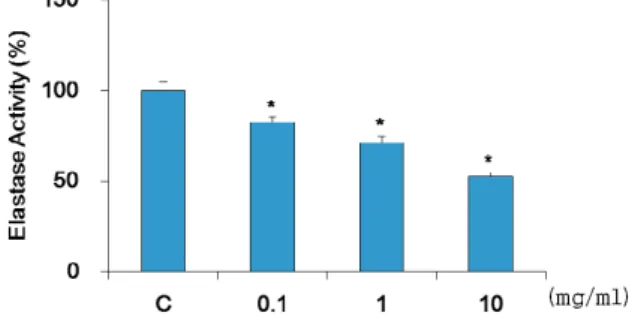
The inhibitory effect of AGHAE on elastase activity was determined according to the method described previously. AGHAE showed the elastase inhibitory effect in dose dependent manner. AGHAE was found to inhibit elastase activity highly at a concentration of 10mg/ml (52.5±2.1%). AGHAE 0.1mg/ml and AGHAE 1mg/ml treated groups showed 82.0±3.1% and 71.1±3.5% of elastase

Fig. 1. Effect of AGHAE on inhibition of elastase activity

C : control, distilled water treated group.

0.1, 1, and 10 : AGHAE treated group (0.1, 1, and 10mg/ml).

Data are expressed as the mean±SEM of three experiments.

* : significantly different from control, p<0.05.
(4)

activities, respectively (Fig. 1).

B. DPPH free radical scavenging capability

Assays of the free radical scavenging capacity were carried out by the DPPH method. The free radical scavenging capacity of sample was mea- sured at each concentration (0, 4, 20, 100, and 500mg/ml). A dose dependent free radical scavenging capability was observed in sample treated groups.

AGHAE 100mg/ml treated groups had the highest scavenging capability, of 63.0±2.1%, while 500, 20, and 4mg/ml treated groups had 52.1±23.3%, 28.0±

1.7%, and 12.9±1.7%, respectively (Fig. 2).

Fig. 2. DPPH free radical scavenging capability

C : control, distilled water treated group.

4, 20, 100, and 500 : AGHAE treated group (4, 20, 100, and 500mg/ml).

Data are expressed as the mean±SEM of three experiments.

* : significantly different from control, p<0.05.
C. Nitrite scavenging activity at pH 1.2

Nitrite scavenging activity changes at various pH environments. Accordingly, nitrite scavenging activities at pH 1.2, 3.0, and 6.0 were measured in this study.

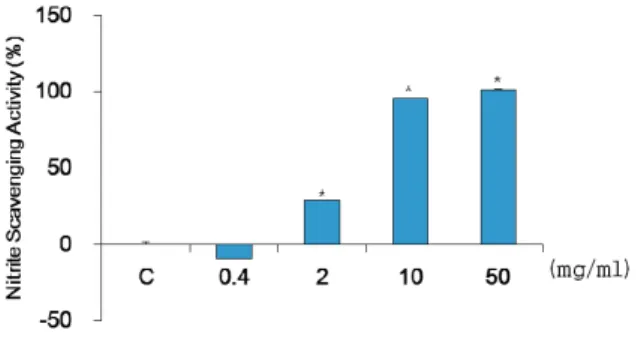
The nitrite scavenging activity of sample was measured at each concentration (0, 0.4, 2, 10, and 50mg/ml). A dose dependent nitrite scavenging activity was observed in sample treated groups.

AGHAE 50mg/ml treated groups had the highest scavenging activity, of 101.0±0.4%, while 10, 2, and 0.4mg/ml treated groups had 95.2±0.0%, 29.0±0.0%, and -9.6±0.2%, respectively (Fig. 3).

Fig. 3. Nitrite scavenging activity at pH 1.2.

C : control, distilled water treated group.

0.4, 2, 10, and 50 : AGHAE treated group (0.4, 2, 10, and 50mg/ml).

Data are expressed as the mean±SEM of three experiments.

* : significantly different from control, p<0.05.
D. Nitrite scavenging activity at pH 3.0

The nitrite scavenging activity of sample was measured at each concentration (0, 0.4, 2, 10, and 50mg/ml). A dose dependent nitrite scavenging activity was observed in sample treated groups.

AGHAE 50mg/ml treated groups had the highest scavenging activity, of 56.9±0.0%, while 10, 2, and 0.4 mg/ml treated groups had 42.1±0.0%, 22.8±1.0%, and 7.4±1.0%, respectively (Fig. 4).

Fig. 4. Nitrite scavenging activity at pH 3.0.

C : control, distilled water treated group.

0.4, 2, 10, and 50 : AGHAE treated group (0.4, 2, 10, and 50mg/ml).

Data are expressed as the mean±SEM of three experiments.

* : significantly different from control, p<0.05.

E. Nitrite scavenging activity at pH 6.0

The nitrite scavenging activity of sample was

measured at each concentration (0, 0.4, 2, 10, and

(5)

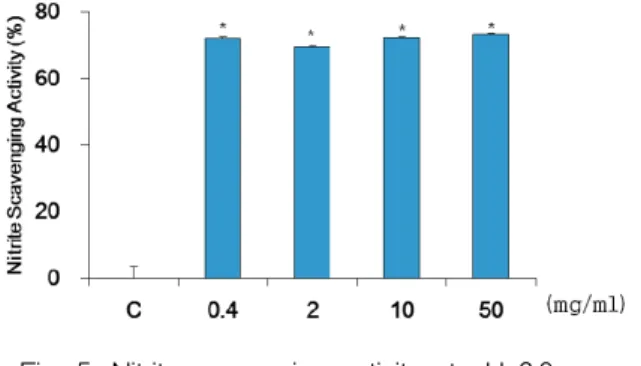
50mg/ml). A dose dependent nitrite scavenging activity was not observed at pH 6.0 environment.

All concentrations of AGHAE treatment (0.4, 2, 10, and 50mg/ml) showed the significant effects. These scavenging effects are 72.0±0.3%, 69.5±0.2%, 72.2±

0.2%, and 73.2±0.2%, respectively (Fig. 5).

Fig. 5. Nitrite scavenging activity at pH 6.0

C : control, distilled water treated group.

0.4, 2, 10, and 50 : AGHAE treated group (0.4, 2, 10, and 50mg/ml).

Data are expressed as the mean±SEM of three experiments.

* : significantly different from control, p<0.05.

Ⅳ. Discussion

Angelicae Gigantis Radix is the root of Angelica gigas N

AKAI16)

. It’s effects are to tonify blood for symptoms of heart and liver blood deficiencies including anemia, pale complexion, brittle nails, dry hair, dizziness, blurred vision, and palpitations.

Other effects are to invigorate blood circulation and relieve pain for symptoms of menstrual disorders, blood deficiency, blood stagnation or qi stagnation all result in menstrual disorders such as irregular menstrual cycle, dysmenorrhea, amenorrhea and other gynecological disorders. The last effects are to moisten intestines and unblock the bowels for symptoms of constipation due to blood deficiency when the bowels are not properly nourished by blood, constipation or dry stools result

16,17)

. Based on these effects, experimental studies were reported about Angelicae Gigantis Radix : anti-oxidant effect by Ahn

22)

, the effect on the immune-suppression by Hwang

23)

, the protective actions for toxipathic hepatitis

by Kim

24)

, the improvement of ischemic stroke by Han

25)

.

Elastase breaks down elastin, an elastic fiber that, together with collagen, determines the mechanical properties of connective tissue. The neutrophil form breaks down the Outer membrane protein A (OmpA) of E. coli and other Gram- negative bacteria, and also breaks down Shigella virulence factors. This is accomplished through the cleavage of peptide bonds in the target proteins.

The specific peptide bonds cleaved are those on the carboxy side of small, hydrophobic amino acids such as glycine, alanine, andvaline. Actually, elastase is the only enzyme that is capable of degrading elastin, an insoluble elastic fibrous protein in animal connective tissues. It is capable of hydrolyzing nearly all proteins, including supporting and structural proteins of the connective tissue such as collagen and elastin

26)

. Elastin is the main component of the elastic fibers of the connective tissue and tendons. The elastic fibers in the skin, together with the collagenous fibers, form a network under the epidermis

27)

. Elastase also plays a critical role in inflammatory processes. The enzyme has drawn much attention, primarily because of its reactivity and non-specificity. It is able to attack all major connective tissue matrix proteins, including elastin, collagen, proteoglycans, and keratins

28)

.

The serine proteinase elastase is located in the

azurophil granules of mature circulating polymor-

phonuclear neutrophils. This neutrophil elastase is a

potent non specific serine protease which plays a

role as bactericidal agent and in the degradation of

immune complexes by intraphagosomal processes. It

promotes inflammation when the granule contents

are secreted in the extracellular environment. In

certain pathological circumstances, an imbalance

between neutrophil elastase and its major plasmatic

inhibitor alpha 1-PI (formerly, alpha 1-antitrypsin)

leads to abnormal tissue destruction and disease

development. Genetic or acquired alpha 1-PI deficiency

is thought to be involved in the pathogenesis of

pulmonary emphysema. A variety of degenerative

(6)

and degradative disorders are also associated to uncontrolled proteolysis by neutrophil elastase (rheu- matoid arthritis, glomerulonephritis, adult respiratory distress symptom, psoriasis, cancer). Numerous inhi- bitors of neutrophil elastase have been reported.

Various molecules are currently undergoing clinical trials for emphysema and other pulmonary diseases

29)

. The defects of elastic matrix impair hypertension which is associated with alteration in the great arteries, arteries, and arterioles. Clinical studies for human pulmonary hypertension and systolic left ventricular failure are now in progress. An elastase inhibitor is currently being investigated in phase I clinical trials in patients with pulmonary hyper- tension owing to chronic obstructive pulmonary disease

8-11)

.

Experimental studies about elastase inhibition has been reported with various herbs : Lee

30)

revealed Rheum undulatum has elastase inhibition effect, Jung

31)

reported Rehmanniae Radix, Aurantii Immaturus Fructus, Achyranthis Bidentatae Radix, Aurantii Fructus have high elastase inhibition effect but Acanthopanacis Senticosi Radix, Chelidonium majus L., Lithospermi Radix, Acori Gramineri Rhizoma, Taraxaci Herba, Alpiniae Oxyphyllae Fructus, Uncariae Ramulus Et Uncus, Astragali Radix do not. However, there has not been a single report about elastase inhibition effect of Angelicae Gigantis Radix until now.

In this study, inhibitory effect of AGHAE on elastase activity was determined according to the method. AGHAE showed the elastase inhibitory effect in dose dependent manner. AGHAE was found to inhibit elastase activity highly at a concentration of 10mg/ml.

The production of ROS was induced by neu- trophil elastase

12,13)

. They reported that neutrophil elastase enhancement of MUC5AC messenger RNA levels was dependent on the production of intracel- lular oxidants or an alteration in the redox state of the cell. It means that ROS may play a role in elastase mediated inflammation. Accordingly, anti- oxdative activities of AGHAE were also examined.

DPPH free radical scavenging activity of AGHAE

was measured at each concentration (0, 4, 20, 100, and 500mg/ml). A dose dependent free radical scavenging activity was observed.

Nitrite plays an pivotal role in elastase mediated diseases

14,15)

. So, nitrite scavenging activities were also examined. However, nitrite scavenging activity changes at various pH environments. Accordingly, nitrite scavenging activities at pH 1.2, 3.0, and 6.0 were measured in this study. Considering data at pH 1.2, 3.0, and 6.0 nitrite scavenging activity, suggesting it is pH dependent, was increased with increasing pH. It was the best environment for nitrite scavenging activity of AGHAE situation at normal pH.

These results suggest that AGHAE may have potential effects for pulmonary emphysema and pulmonary hypertension. I think further studies will be needed to unravel exactly under the clinical trial and molecular mechanisms.

Ⅴ. Conclusion

I investigated the effects of AGHAE on elastase activity. Anti-oxdative activities of AGHAE were also examined via measuring the DPPH free radical scavenging and nitrite scavenging activities.

The results are as following :

1. AGHAE was found to inhibit elastase activity highly at a concentration of 10mg/ml (52.5±

2.1%).

2. AGHAE 100mg/ml treated groups had the highest scavenging capability, of 63.0±2.1%.

3. AGHAE 50mg/ml treated groups had the highest scavenging activity, of 101.0±0.4% at pH 1.2.

4. AGHAE 50mg/ml treated groups had the highest scavenging activity, of 56.9±0.0% at pH 3.0.

5. All concentrations of AGHAE treatment (0.4,

2, 10, and 50mg/ml) showed the significant

(7)

effects at pH 6.0.

6. Accordingly, it could be the best environment for nitrite scavenging activity of AGHAE at normal pH.

In conclusion, AGHAE showed the inhibiting effects on the elastase, and free radical scavenging activity of DPPH and nitrite.

Ⅵ. References

1. Bernard GR, Artigas A, Brigham KL, Carlet J, Falke K, Hudson L. The American-European consensus conference on ARDS. Definition, mechanism, relevant outcomes, and clinical trial coordination. Am J Respir Crit Care Med. 1994 ; 149(3 Pt 1) : 818-24.

2. Jordan S, Mitchell JA, Quinlan GJ, Goldstraw P, Evans TW. The pathogenesis of lung injury following pulmonary resection. Eur Respir J.

2000 ; 15(4) : 790-9.

3. Kawabata K, Hagio T, Matsuoka S. The role of neurophil elastase in acute lung injury. Eur J Pharmacol. 2002 ; 451(1) : 1-10.

4. Moraes TJ, Chow CW, Downey GP. Proteases and lung injury. Crit Care Med. 2003 ; 31(Suppl 4) : S189-94.

5. Ware LB, Matthay MA. The acute respiratory distress syndrome. N Eng J Med. 2000 ; 342 : 1334-49.

6. Kawabata K, Suzuki M, Sugitani M, Imaki K, Toda M, Miyamoto T. ONO-5046, a novel inhibitor of human neutrophil elastase. Biochem Biophys Res Commun. 1991 ; 177(2) : 814-20.

7. Bieth JG. The elastases. J Soc Biol. 2001 ; 195 (2) : 173-9.

8. Loukanov T, Geiger R, Agrawal R. Animal models related to congenital heart disease and clinical research in pulmonary hypertension. Cardiology.

2010 ; 116(1) : 18-25.

9. Dewachter L, Dewachter C, Naeije R. New therapies for pulmonary arterial hypertension : an

update on current bench to bedside translation.

Expert Opin Investig Drugs. 2010 ; 19(4) : 469- 88.

10. Stenmark KR, Rabinovitch M. Emerging therapies for the treatment of pulmonary hypertension.

Pediatr Crit Care Med. 2010 ; 11(2 Suppl) : 85-90.

11. Huang JB, Liu YL, Sun PW, Lv XD, Bo K, Fan XM. Novel strategy for treatment of pulmonary arterial hypertension : enhancement of apoptosis.

Lung. 2010 ; 188(3) : 179-89.

12. Fischer B, Voynow J. Neutrophil elastase induces MUC5AC messenger RNA expression by an oxidant-dependent mechanism. Chest. 2000 ; 117(5 Suppl 1) : 317-20.

13. Fischer BM, Voynow JA. Neutrophil elastase induces MUC5AC gene expression in airway epithelium via a pathway involving reactive oxygen species. Am J Respir Cell Mol Biol.

2002 ; 26(4) : 447-52.

14. Kawai M, Harada N, Takeyama H, Okajima K.

Neutrophil elastase contributes to the develop- ment of ischemia / reperfusion-induced liver injury by decreasing the production of insulin-like growth factor-I in rats. Transl Res. 2010 ; 155(6) : 294- 304.

15. Boyer L, Plantier L, Dagouassat M, Lanone S, Goven D, Caramelle P, Berrehar F, Kerbrat S, Dinh-Xuan AT, Crestani B, Le Gouvello S, Boczkowski J. Role of nitrite synthases in elastase-induced emphysema. Lab Invest. 2010 Oct 18.

16. Kim IR, Kim HC, Kuk YB, Park SJ, Park YK, Park JH, Seo BI, Seo YB, Song HJ, Shin MK, Lee YJ, Lee YC, Lee JH, Leem KH, Cho SI, Chung JK, Joo YS, Choi HY. Boncho-Hak.

Seoul : Young-Lim Press. 2007 : 629-31.

17. Chen JL, Chen TT. Chinese Medical Herbology and Pharmacology. CA : Art of Medicine Press.

2004 : 918-24.

18. Kraunsoe JA, Claridge TDW, Lowe G. Inhibition

of human leukocyte and porcine pancreatic

elastase by homologues of bovine pancreatic

trypsin inhibitor. Biochemistry. 1996 ; 35(28) :

(8)

9090-6.

19. Kim YH, Chung CB, Kim JG, Ko KI, Park SH, Kim JH, Eom SY, Kim YS, Hwang YI, Kim KH. Anti-Wrinkle Activity of Ziyuglycoside I Isolated from a Sanguisorba officinalis Root Extract and Its Application as a Cosmeceutical Ingredient. Biosci Biotechnol Biochem. 2008 ; 72(2) : 303-11.

20. Shimada K, Fugikawa K, Yahara K, Nakamura T. Antioxidative properties of xanthan on the autoxiation of soy gean oil in cyclodextrin emulsion. J Agric Food Chem. 1992 ; 40 : 945-8.

21. Kato H, Lee IE, Chuyen NV, Kim SB, Hayase F. Inhibition of nitrosamine formation by non- dialyzable melanoidins. Agric Biol Chem. 1987 ; 51(5) : 1333-8.

22. Ahn JC, Moon JY, Lim JK. Antioxidant effects of A.G.R. (Angelicae gigantis Radix) Aqua-acupuncture solution in vitro. J Korean Acupuncture &

Moxibution Society. 1996 ; 13(2) : 254-62.

23. Hwang HS, Ahn BC, Park DS. The effects of Angelicae Gigantis Radix Aqua-acupuncture by Density on immune response induced by radiation in Mice. J Korean Acupuncture & Moxibution Society. 1994 ; 11(4) : 113-29.

24. Kim GS, Song YJ. Effects of Acua-Acupuncture with Radix Angelicae Gigantis and Radix Astragali on the Blood in the Liver Damage Rats with CCl4. J Korean Acupuncture & Moxi-

bution Society. 1996 ; 13(1) : 1-10.

25. Han SG, Lee BR. Effects of Andelica Gigas Nakai pharmacopuncture into Hyolhae (SP

10

) of brain ischemic injury induced by Intraluminal Filament insertion in the rats. J Korean Acu- puncture & Moxibution Society. 2004 ; 21(2) : 1-20.

26. Yang ZY, Guon GX, Lin ZF. Elastolytic activity from Flavobacterium odoratum. Microbial screening and cultivation, enzyme production and purification.

Process Biochem. 1994 ; 29 : 427-36.

27. Meyer W, Neurand K, Radke B. Elastic fibre arrangement in the skin of the pig. Arch Dermatol Res. 1981 ; 270(4) : 391-401.

28. Wiedow O, Schroder JM, Christophers E. An elastase-specific inhibitor of human skin. Biol Chem J. 1990 ; 265(25) : 14791-5.

29. Reboud-Ravaux M. Elastase inhibitors. J Soc Biol. 2001 ; 195(2) : 143-50.

30. Lee JC. The effect of Elastase inhibition and Tyrosinase by Rheum undulatum Stokes extracts.

Dept. of Oriental Medicine Graduate School of Kyungwon University (Thesis for the degree of master). 2007.

31. Jung JH. Experimental studies about the inhibitory

effect on tyrosinase and elastase activities by

various herb medicines. Dept. of Oriental Medicine

Graduate School of Kyungwon University (Thesis

for the degree of master). 2007.

수치

Fig.  1.  Effect  of  AGHAE  on  inhibition  of  elastase  activity
Fig.  2.  DPPH  free  radical  scavenging  capability  C  :  control,  distilled  water  treated  group
Fig.  5.  Nitrite  scavenging  activity  at  pH  6.0 C  :  control,  distilled  water  treated  group

참조

관련 문서

This study aims to examine the effects of fun factors on exercise commitment and schol happiness in school sports club activity.. The population was

The objective of this study is to understand the effects of walking activity using fairy tales on the peer competence and emotional intelligence of

In this regard, this study analyzes the effect of the job characteristics and work environment of workers with physical disabilities on job satisfaction

The purpose of this study is to clarify the effect of identification affirmation according to K-Pop star image on the desire of middle school students to participate

This study was conducted to investigate the effects of 12 weeks after school physical activity program on body composition and PAPS in obese elementary

To measure antioxidant effects of the yuzu seed oil, DPPH radical scavenging and lipid peroxidation were investigated... DPPH radical scavenging

Inhibitory effects of classified methanol extracts of Smilax china L on the COX-2 and iNOS expression of human colorectal cancer cell lines... Inhibitory

The purpose of this study was to examine the effects of football on PAPS in sports club activity for 12 weeks in middle school boys.. The following