https://doi.org/10.9721/KJFST.2019.51.2.133
133
©The Korean Society of Food Science and Technology
Antioxidant activity of ethanol extracts from
the root and bark of Ulmus davidiana
Ki Hyeon Sim1 and Young Sil Han2,*
1Major in Traditional Culinary Culture, Graduate School of Arts, Sookmyung Women’s University 2Department of Food and Nutrition, Sookmyung Women’s University
Abstract Antioxidant activities of Ulmus davidiana root and bark extracts were evaluated by various antioxidant tests, including DPPH scavenging, nitric oxide-scavenging, superoxide anion scavenging, and ABTS radical-scavenging assays, and superoxide dismutase (SOD)-like activity and reducing power analysis, along with the determination of total phenolic and flavonoid contents. Both the extracts showed strong antioxidant activities by these testing methods. Ulmus davidiana root extract possessed strong reducing power and nitric oxide-scavenging activity, and high scavenging activities against free radicals including the superoxide anion, and the ABTS and DPPH radicals, but a weaker scavenging activity of SOD. In contrast, the Ulmus davidiana bark extract exhibited a strong SOD-like activity, but all the other activities were weak. It was observed that the total phenolic and flavonoid contents of the Ulmus davidiana root extract were higher than those of the Ulmus davidiana bark extract.
Keywords: Ulmus davidiana, free radical, antioxidant activity, total phenolic compounds, flavonoid compounds
Introduction
Free radicals produced by radiation, chemical reactions, and several redox reactions of various compounds may contribute to protein oxidation, DNA damage, and lipid peroxidation in living tissues and cells (Choi et al., 2006; Halliwell, 1996; Mo et al., 2011; Morrissey and O’Brien, 1998). For example, reactive oxygen species (ROS) markedly alter the physical, chemical, and immunological properties of superoxide dismutase (SOD), which further exacerbates oxidative damage in cells. This oxidative stress may be related to many disorders, such as cancer, atherosclerosis, diabetes, and liver cirrhosis (Halliwell and Gutteridge, 1984; Joseph et al., 2011; Steinberg et al., 1989).Epidemiological studies show that many phytonutrients of plants may be beneficial in protecting the human body against damage by reactive oxygen and nitrogen species (Diplock et al., 1989; Hu, 2002). Thus, it is considered important to increase the antioxidant intake in the human diet, and one way of achieving this is by enriching food with antioxidants. As some synthetic antioxidants may exhibit toxicity and require high manufacturing costs at the same time showing lower efficiency than natural antioxidants, there is a need to identify natural and possibly more economic and effective antioxidants with a potential to be incorporated into foods. Furthermore, many studies have shown that natural antioxidants from various aromatic and medicinal plants are linked to reduction
in the incidence of chronic diseases caused by DNA damage, mutagenesis, and carcinogenesis (Briskin, 2000; Reddy et al., 2003; Zhu et al., 2002).Therefore, there is a growing interest toward research on alternative active antioxidant compounds, including various plant extracts, which are relatively less damaging to human health and the environment (Zhang et al., 2006).
Ulmus davidiana is a deciduous tree, widely distributed in Korea. The root and stem bark are used in traditional oriental medicines to treat edema, mastitis, gastric cancer, and inflammation. A water extract of Ulmus davidiana was also developed based on the herb’s known functions, as described in the literature of traditional Chinese and Korean medicine (Jun et al., 1998). Recently, it has been reported that Ulmus davidiana has a strong antioxidative effect on lipid peroxidation as well as an inhibitory effect on endogenous NO-induced apoptotic cell death (Kim et al., 1996). Although Ulmus davidiana is used to treat chronic diseases, the mechanism by which it functions is not well understood. There are some scientific reports on the biologically active compounds in Ulmus davidiana as well as their biological actions. For example, catechin, catechin glycoside, tannin, quercetin, kaempferol, terpenoid, and naphthoquinone have been isolated from Ulmus davidiana (Guo and Wnag, 2007; Jung et al., 2008; Kim et al., 1996). Additionally, four lignan xylosides and two neolignan glycosides were isolated from the stem and root barks (Lee et al., 2001). A recent study reported that Ulmus davidiana extracts demonstrated strong antioxidant activity in assays for DPPH radical scavenging, hydroxyl radical scavenging, lipid peroxidation inhibition, and reducing power due to high contents of polyphenols and flavonoids (Guo and Wang, 2007; Jung et al., 2008).
In this study, the in vitro antioxidant activity of ethanol extracts from the root and bark of Ulmus davidiana were investigated, with an aim to develop a natural antioxidant from the extracts. The *Corresponding author: Young Sil Han, Department of Food and
Nutrition, Sookmyung Women’s University, Seoul 04310, Korea Tel: +82-2-2077-7475
Fax: +82-2-2077-7475 E-mail: [email protected]
Received August 16, 2018; revised October 18, 2018; accepted October 18, 2018
antioxidant activities were evaluated using assays for DPPH radical scavenging, nitric oxide scavenging, superoxide anion radical scavenging, ABTS radical scavenging, reducing power, and superoxide dismutase activity. Furthermore, the total phenolic and flavonoid contents were measured in each extract and correlated with their antioxidant activity.
Materials and Methods
Chemicals and reagents
Butylated hydroxytoluene (BHT), L-ascorbic acid, Trolox (6-hydroxy-2,5,7,8-tetramethylchroman-2-carboxylic acid), Folin-Ciocalteu’s phenol reagent, 1,1-diphenyl-2-picrylhydrazyl (DPPH), nitroblue tetrazolium (NBT), phenazine methosulfate (PMS), nicotinamide adenine dinucleotide (NADH), ABTS (2,2'-azino-bis(3-ethylbenzothiazoline-6-sulfonic acid)), potassium hexacyano-ferrate(III), trichloroacetic acid (TCA), and Trizma base were purchased from Sigma Chemical Co. (St. Louis, MO, USA). Iron(III) chloride and ethylenediaminetetraacetic acid (EDTA) were purchased from Junsei Chemical Co. (Tokyo, Japan). Pyrogallol was purchased from Yakuri Pure Chemical Co. (Osaka, Japan). All other chemicals and solvents were of analytical grade.
Plant materials and extraction procedures
The dried root and bark of Ulmus davidiana Planch var. japonica Nakai (Ulmaceae) harvested at Jungsun (Kangwon, Korea) were purchased from an oriental herb market in Seoul, Korea. Air-dried Ulmus davidiana root and bark were crushed in a grinder for 2 min, but the process was stopped at 15 s intervals for 15 s to avoid heating of the samples. The Ulmus davidiana samples (100 g) were extracted by stirring with 500 mL of 70% ethanol at 80oC for 3 h two times, and then filtered through a Whatman No. 2 filter paper (Whatman plc., Kent, UK). The solvent of the combined extracts was evaporated under reduced pressure using a rotary vacuum-evaporator (N-1000, EYELA, Tokyo, Japan) at 60oC and the remaining water was removed by freeze-drying. The obtained freeze-dried extracts were used directly to determine the total phenolic and flavonoid contents, and also for the antioxidant capacity assessments through various chemical assays. The dried Ulmus davidiana root and bark extracts were stored below −18oC.
Measurement of total phenolics and flavonoids
Total phenolic contents were determined using Folin-Ciocalteu’s phenol reagent (Yu et al., 2002).The extracts (200μL) were mixed with 400μL of Folin-Ciocalteu’s phenol reagent and 0.8 μL of 10% sodium carbonate. The mixtures were shaken thoroughly and allowed to stand for 1 h. Then, the absorbance at 750 nm was measured. The phenolic contents were determined using a standard curve obtained from various concentrations of gallic acid (GAE).
Total flavonoid contents were determined using the David deformed method (Um and Kim, 2007).The extracts (1.0 mL) were mixed with 10 mL of diethylene glycol and 0.1 mL of 1 N NaOH. The mixtures were shaken thoroughly and allowed to stand for 1 h at 37oC. Then, the absorbance at 420 nm was measured. Flavonoid contents were determined using a standard curve
obtained from various concentrations of rutin (RE).
Scavenging activity on 1,1-diphenyl-2-picrylhydrazyl (DPPH) radicals
Ulmus davidiana root and bark extracts (1-50μg/mL) in ethanol (4 mL) were individually mixed with 1 mL of ethanolic solution containing DPPH radicals, resulting in a final concentration of 0.15 mM DPPH. The absorbance was measured at 517 nm after 30 min of standing in the dark at room temperature (Lee et al., 2007). L -ascorbic acid and Trolox, the well-known antioxidant standards with strong antioxidant activities, were used as positive controls. The DPPH radical scavenging activity (%) was calculated as follows: DPPH radical scavenging activity (%)=[(Control Absorbance Sample Absorbance)/Control Absorbance]×100
The antioxidant activity of the sample was expressed as IC50. The IC50 values represent the concentration of the sample required to scavenge 50% DPPH radicals.
Nitric oxide scavenging assay
Nitric oxide was generated from sodium nitroprusside and measured by the Griess reaction, according to the method of Kato et al. (1987). Using the Griess reagent, the nitrite scavenging activities of the extracts were determined at pH 1.2 by measuring the absorbance at 520 nm. Sodium nitrite (1 mM) was mixed with various concentrations of the extracts dissolved in a suitable solvent system, incubated at 37oC for 1 h, and then reacted with the Griess reagent (1% sulfanilamide in 30% acetic acid and 0.1% naphthylethylenediamine dihydrochloride in 30% acetic acid). The absorbance of chromophore, which was formed during the diazotization of nitrite with sulfanilamide and subsequent coupling with naphthylethylenediamine, was read at 520 nm, and referenced to the absorbance of potassium nitrite standard solution similarly treated with the Griess reagent. A control sample was carried out using the same method described above, except that 0.4 mL of distilled water was added in place of the Griess reagent. Then the inhibitory effect percentages that represent differences in absorbance between the presence and absorbance of the reagent were calculated, and the nitric oxide scavenging activity was expressed as IC50. L-ascorbic acid and Trolox were used as positive controls and analyzed as described above.
Superoxide anion radical scavenging activity
The superoxide anion radical scavenging activities of the extracts were measured according to the method of Robak and Gryglewski (1988). One milliliter aliquots (prepared in 0.1 M Tris HCl buffer, pH 7.4) of 150μM NBT, 60 μM phenazine methosulfate (PMS), and 468μM nicotinamide adenine dinucleotide (NADH) were added to 1 mL of the sample containing the Ulmus davidiana root and bark extracts (100-1,000μg/mL), respectively. Tannic acid was used as a positive control. The results were calculated in percentage inhibition of the superoxide anion radicals, using a similar formula as for the DPPH radical scavenging activity. Superoxide anion radical scavenging activities of the samples were expressed as IC50.
ABTS radical scavenging assay
The total antioxidant activities of the Ulmus davidiana extracts were measured by the ABTS radical cation decolorization assay (Re et al., 1999).ABTS was dissolved in water to a 7 mM concentration, and ABTS radical cations (ABTS•+) were produced by reacting ABTS stock solution with 2.45 mM potassium persulfate (final concentration) and allowing the mixture to stand in the dark at room temperature for 12-16 h before use. The radical cation was stable in this form for more than 2 days of storage in the dark at room temperature. After the mixture had remained in the dark at room temperature for 16 h allowing the completion of radical generation, it was diluted with ethanol (99.5%) so that its absorbance was adjusted to 0.70±0.02 at 734 nm. To determine the scavenging activity, 0.9 mL of the ABTS reagent was mixed with 0.1 mL of the sample and the absorbance was measured at 734 nm after 6 min of reaction time at room temperature. Trolox was used in this experiment as a positive control for comparison. The ABTS radical scavenging activity was expressed as IC50 (the concentration required to scavenge 50% of radicals), as in the case of DPPH assay, and also as TEAC (Trolox-equivalent antioxidant capacity).
Reducing power assay
The reducing power was determined according to the method of Oyaizu (1986). Each extract (100-1,000μg/mL) in water (2.5 mL) was mixed with 2.5 mL of 200 mM sodium phosphate buffer (pH 6.6) and 2.5 mL of 10 mg/mL potassium hexacyanoferrate(III), and incubated at 50oC for 20 min. After 2.5 mL of 100 mg/mL trichloro-acetic acid was added, the mixture was centrifuged at 1,017×g for 10 min. The upper layer (5 mL) was mixed with 5 mL of deionized water and 1 mL of 1 mg/mL iron(III) chloride, and the absorbance was measured at 700 nm against a blank. L-ascorbic acid was used as a positive control. A higher absorbance indicated a higher reducing power.
Superoxide dismutase (SOD)-like activity
Superoxide dismutase (SOD)-like activity was determined according to the method of Marklund and Marklund (1974). Each extract (1-10 mg/mL) in water (0.2 mL) was mixed with 3 mL of 50 mM Tris-HCl buffer (pH 8.5) and 0.2 mL of 7.2 mM pyrogallol, and incubated at 25oC for 10 min. The reaction was stopped by adding 1 mL of 1 N HCl. The absorbance was determined at 420 nm against a blank. The SOD-like activity was determined based on the calculation of the inhibitory effect percentages that represent differences in absorbance between the presence and absence of the added sample. The activities of BHT and L-ascorbic acid were measured for positive control so as to express SOD-like activity as IC50.
Statistical analysis
All the results were obtained from triplicate measurements, and were expressed as mean and standard deviations (SD) using the SPSS program (ver. 21.0, SPSS Inc., Chicago, IL, USA). In this procedure, independent t-test of samples was carried out for the data about total phenolic and flavonoid contents and ABTS radical
scavenging activity obtained based on TEAC, while the other data about antioxidant activity were subjected to one-way ANOVA. Correlations were obtained by the Pearson correlation coefficient in bivariate correlations.
Results and Discussion
Total phenolic and flavonoid contents
The contents of total phenolic compounds in the Ulmus davidiana extracts were presented in Table 1. The phenolic content of the Ulmus davidiana root extract was found to be 168.32 mg GAE/g, whereas the phenolic content of the Ulmus davidiana bark extract was found to be 162.56 GAE mg/g. When the Ulmus davidiana root extract was evaluated, the total phenolic contents were found to be not significantly higher than those of the Ulmus davidiana bark extract. Guo and Wang (2007) reported that total phenolic contents of the Ulmus davidiana water, ethanol, 70% ethanol, methanol, 70% methanol, and chloroform extracts were 15.34, 12.43, 14.02, 15.16, 10.83, and 2.21 mg/g, respectively. In addition, Jung et al. (2008) and Jeong and Kim (2012) reported that total phenolic contents in the methanol extract of Ulmus davidiana bark and the ethanol extract of Ulmus davidiana root were 66.53 and 7.10μg/mL, respectively. The results of the DPPH radical assay and the Folin-Denis test conducted for this study indicate a strong association between antioxidant activity and the level of phenolic compounds, suggesting that phenolic compounds are responsible for antioxidant activities of Ulmus davidiana root and bark extracts. Many previous studies evaluating vegetables and fruit have also found a positive correlation between the total amount of phenolic compounds and antioxidant activity, which was shown in Table 1 (Gorinstein et al., 2004).
The total flavonoid contents of the Ulmus davidiana extracts were determined using the David deformed method and were presented as rutin equivalents (RE) in Table 1. In this study, the flavonoid contents of the Ulmus davidiana root and bark extracts were 86.85 and 72.80 RE mg/g, respectively (p<0.05). The flavonoid contents of extracts of other plant species have also been studied (Lee and Han, 2000). Flavonoids are one of the most diverse and widespread groups of natural compounds, and flavones, isoflavones, flavanones, anthocyanins, and catechins are most likely the most important natural phenolics. These compounds possess a broad spectrum of chemical and biological activities, including radical scavenging and strong antioxidant capacity. Guo and Wang (2007) reported that the flavonoid contents of the Ulmus davidiana water, ethanol, 70% ethanol, methanol, 70% Table 1. Comparative total phenolic and flavonoid content of extracts from the root and bark of Ulmus davidiana
Samples Total phenolic content (mg GAE/g)
Total flavonoid content (mg RE/g) Ulmus davidiana root 168.32±5.75 86.85±1.57* Ulmus davidiana bark 162.56±5.28 72.80±6.55*
Each value represents means±SD (n=3). Values with different letters within columns are statistically different at p<0.05 by independent t-test of samples.
methanol, and chloroform extracts were 18.49, 20.26, 19.06, 19.14, 19.67, and 6.76 mg/g, respectively. Taken together, these findings and the results of the present study indicate that the Ulmus davidiana root and bark extracts have high flavonoid contents. DPPH radical scavenging activity
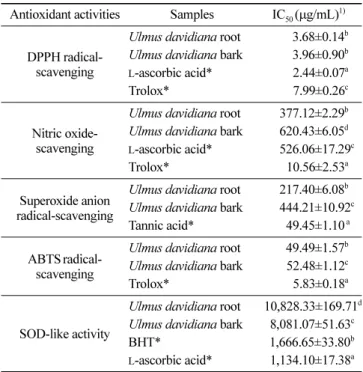
The IC50 values for the DPPH radical scavenging activity of the Ulmus davidiana root and bark extracts were shown in Table 2. The DPPH radical scavenging activities of the Ulmus davidiana root and bark extracts were IC50 3.68 and 3.96μg/mL, respectively, which were significantly lower (p<0.001) than that of L-ascorbic acid (IC50 2.44μg/mL) but less than that of Trolox (IC50 7.99μg/ mL). In addition, the DPPH radical scavenging activity increased as the total phenolics in the Ulmus davidiana extracts increased. Furthermore, each of the Ulmus davidiana extracts showed higher DPPH radical scavenging activities that were positively correlated with the total phenolic contents, which is similar to the results of many studies that have reported positive correlations between free radical scavenging activity and antioxidant compound content.
Guo and Wang (2007) reported that there were strong antioxidant activities in Ulmus davidiana extracts, with the exception of the chloroform extract, as measured by the DPPH radical (IC50 from 6.64 to 10.41μg/mL). In addition, Lee and Han (2000) reported that the DPPH radical scavenging activities of the Ulmus davidiana ethanol, methanol, and n-butanol extracts were higher compared to those of water extracts. Jung et al. (2008) also reported that the DPPH radical scavenging activity (IC50) of the methanol extract of Ulmus davidiana bark was 2.81μg/mL. Furthermore, according to Kim et al. (2005), the DPPH scavenging activity of the ethanol extract of the root of Ulmus davidiana was higher than that of the ethanol extract as well as that of the Ulmus davidiana bark. Many studies have reported that the Ulmus davidiana extract is an effective free radical scavenger. Taken together, the results of previous studies indicate that the root extract of Ulmus davidiana is an effective free radical scavenger and those effects are also contained within other Ulmus davidiana parts.
Nitric oxide scavenging activity
The IC50 values of the nitric oxide scavenging activity of the Ulmus davidiana root and bark extracts were shown in Table 2. The Ulmus davidiana root and bark extracts showed strong activities for NO. scavenging (IC50 377.12 and 620.43μg/mL respectively), and these activities were significantly (p<0.001) lower than those of Trolox (IC50 10.56μg/mL). Therefore, the Ulmus davidiana root extracts showed significantly higher activities than the L-ascorbic acid (IC50 526.06μg/mL). Taken together, these results indicate that the Ulmus davidiana extracts had high nitric oxide scavenging activity.
According to Jeong and Kim (2012), the water and ethanol extracts of Ulmus davidiana root showed the nitric oxide scavenging activities of 43.2 and 45.6%, respectively, at a concentration of 1,000 ppm. Thus, the ethanol extract had higher nitric oxide scavenging activity than the water extract. It appears that the activity of the extract was primarily related to the presence of
phenolic compounds such as flavonoids and to other phenolics in the Ulmus davidiana extract, which is similar to the findings of a study conducted by Lee and Han (2000). In this study, the Ulmus davidiana root and bark contained high levels of natural phenolics and flavonoids, and the role of these compounds as scavengers of free radicals has been emphasized in previous reports (Katalinic et al., 2006; Thériault et al., 2006). The results of the present study suggest that the root extracts of Ulmus davidiana have a more notable nitric oxide scavenging effect than the Ulmus davidiana bark extracts. This suppression of NO release may be partially attributed to direct NO. scavenging, because each of the extracts of Ulmus davidiana showed a decreased amount of nitric oxide generated from the decomposition of sodium nitroprusside in vitro. Superoxide anion radical scavenging activity
The IC50 values of the superoxide anion radical scavenging activities of the Ulmus davidiana extracts were shown in Table 2. The superoxide anion radical scavenging activity of the root extract of Ulmus davidiana (IC50 217.40μg/mL) was higher than that of the bark extract of Ulmus davidiana; however, this activity was lower than that of tannic acid (IC50 49.45μg/mL), in the case of Ulmus davidiana bark extract with a concentration of 444.21 μg/mL being required to obtain the same activity as that of tannic acid (p<0.001). These results suggest that the Ulmus davidiana root has notably superior superoxide radical scavenging effects than the bark of Ulmus davidiana.
Lee et al. (2004) reported that at 5-200μg/mL, each of the Ulmus davidiana extracts displayed more effective scavenging activities on the superoxide radical than L-ascorbic acid, and that the 80% ethanol extract of the Ulmus root cortex was most effective. Kim et al. (2005) also reported that Ulmus davidiana cortex extracts exerted scavenging activities on the superoxide anion radical, and that the water extracts showed a higher activity than the ethanol extract, with an activity of >90% being observed at concentrations as low as 50μg/mL. Furthermore, Rajapakshe et al. (2005) reported an IC50 value of 220μg/mL for fermented mussel sauce, which is similar to the value observed in this study for Ulmus davidiana root (IC50 217.40μg/mL). Taken together, these findings indicate that the Ulmus davidiana root displays strong activities for superoxide anion radical scavenging when compared to the results of other studies performed on plant extracts and would therefore be a useful functional food.
ABTS radical scavenging activity
The IC50 values of the ABTS radical scavenging activities of the Ulmus davidiana extracts were shown in Table 2. When the ABTS radical scavenging activities were measured for the Ulmus davidiana root extract (IC50 49.49μg/mL) and the Ulmus davidiana bark extract (IC50 52.48μg/mL), they were found to be lower than that of Trolox (IC50 5.83μg/mL). The TEAC values of the Ulmus davidiana root and bark extracts were significantly affected by each of the extracts (Table 3). The TEAC value for the Ulmus davidiana root extract was 2,025.12 mmol/kg in the ABTS radical scavenging assay, whereas the value for the Ulmus davidiana bark extract was 1,686.27 mmol/kg(p<0.05).
The antiradical and antioxidant activities of small phenolics, including flavonoids and phenolic acids, have been reported (Rice-Evans et al., 1996). It has also been reported that high molecular weight phenolics (tannins) have a greater ability to quench free radicals (ABTS•+), and that their effectiveness depends more on molecular weight, the number of aromatic rings, and the nature of hydroxyl group substitutions that they possess than on specific functional groups (Hagerman et al., 1998). Conversely, insoluble and soluble tannin-protein complexes that are formed as a result of conventional food processing have been shown to be potential free radical scavengers and radical sinks. Moreover, such complexes could play roles as nutraceuticals for the Prevention of free radical-mediated diseases that occur within the gastrointestinal tract (Riedl and Hagerman, 2001).
Reducing power
As shown in Table 4, each of the Ulmus davidiana extracts demonstrated very different reducing powers, with a higher scavenging activity being observed in extracts from the Ulmus davidiana root than extracts from the Ulmus davidiana bark. Although the activity of this extract was slightly lower than that of
L-ascorbic acid, the reducing power of each of the extracts was dose dependent and significant (p<0.001).
Guo and Wang (2007) reported that each of the extracts they evaluated, with the exception of the chloroform extract, had greater reducing power than α-tocopherol at the same concentration. Jung et al. (2008) further reported that at a concentration of 100μg/mL,
the reducing power of Ulmus davidiana bark extract, although varying slightly according to different extraction solvents, was in the range of 0.22-0.26 and thus always higher than that (0.19) of the positive control α-tocopherol. This result is similar to ours in showing high antioxidant activity. In addition, Zhao et al. (2006) reported that extracts of Salvia miltiorrhiza and Panax notoginseng showed very different reducing powers, and that Salvia miltiorrhiza showed a strong reducing power for Fe3+ in a dose dependent manner, with an IC50 value of 0.35 mg/mL. Furthermore, the reducing power of three extracts from Pleurotus citrinopileatus was 1.03-1.10 at 5,000μg/mL (Lee et al., 2007), while the reducing power of Ulmus davidiana root and bark extract was greater than 2.98 and 2.70 at 1,000μg/mL, indicating that it possesses excellent reducing power. The results of this study and an earlier study on the reducing power of Ulmus davidiana extracts suggest that reductones may have contributed significantly to the observed antioxidant effects.
Superoxide dismutase (SOD)-like activity
The SOD-like activities of Ulmus davidiana root and bark extracts were shown in Table 2. The IC50 of the Ulmus davidiana bark was 8,081.07μg/mL, whereas that of Ulmus davidiana root was 10,828.33μg/mL, both of which were significantly (p<0.001) lower than the activity of BHT (IC50 1,666.65μg/mL) and L -ascorbic acid (IC50 1,134.10μg/mL).
Antioxidants could be classified into the two groups of the primary chain-breaking antioxidant and the secondary preventive antioxidant. It has been reported that the SOD-like activity increased as the content of phenolic compounds increased (Azuma et al., 1999). In the case of Ulmus davidiana extracts, however, Table 2. IC50 values for radical scavenging and antioxidant
activities of extracts of Ulmus davidiana root and bark Antioxidant activities Samples IC50 (µg/mL)1)
DPPH radical-scavenging
Ulmus davidiana root 3.68±0.14b Ulmus davidiana bark 3.96±0.90b
L-ascorbic acid* 2.44±0.07a
Trolox* 7.99±0.26c
Nitric oxide-scavenging
Ulmus davidiana root 377.12±2.29b Ulmus davidiana bark 620.43±6.05d
L-ascorbic acid* 526.06±17.29c
Trolox* 10.56±2.53a
Superoxide anion radical-scavenging
Ulmus davidiana root 217.40±6.08b Ulmus davidiana bark 444.21±10.92c Tannic acid* 49.45±1.10 a ABTS
radical-scavenging
Ulmus davidiana root 49.49±1.57b Ulmus davidiana bark 52.48±1.12c
Trolox* 5.83±0.18a
SOD-like activity
Ulmus davidiana root 10,828.33±169.71d Ulmus davidiana bark 8,081.07±51.63c
BHT* 1,666.65±33.80b
L-ascorbic acid* 1,134.10±17.38a 1)IC
50 is the concentration of the sample required to scavenge 50% of radical.
Each value represents means±SD (n=3). Values with different letters (a-d) within the same column differ significantly (p<0.001) through one-way ANOVA followed by Duncan’s multiple range test. *Each compound is used as a positive control.
Table 3. ABTS radical scavenging activity of extracts of Ulmus davidiana root and bark using TEAC values
Samples TEAC (mmol kg-1)1) Ulmus davidiana root 2,025.12±1.93* Ulmus davidiana bark 01,686.27±20.21* 1)TEAC: millimolar concentration of Trolox solution having an ABTS radical scavenging activity equivalent to solutions of Ulmus davidiana root and bark extracts.
Values with different letters within columns are statistically different at p<0.05 by independent t-test of samples.
*p<0.05
Table 4. Reducing power of Ulmus davidiana root and bark extracts Concentration (µg/mL) Samples Ulmus davidiana root Ulmus davidiana
bark L-ascorbic acid* 100 0.56±0.01b 0.50±0.01a 1.04±0.03c 250 1.08±0.03b 0.95±0.03a 2.37±0.10c 500 1.78±0.04b 1.52±0.02a 2.88±0.01c 1,000 2.98±0.02b 2.70±0.05a 3.04±0.03c
Each value represents means±SD (n=3). Values with different letters (a-c) within the same row differ significantly (p<0.001) through one-way ANOVA followed by Duncan’s multiple range test.
their SOD-like activity is somewhat low for their high phenolic compounds content. In a research involving the ethanol extract and water extract of Ulmus davidiana, Jeong and Kim (2012) also showed that their SOD-like activities were 10.2-30.2 and 16.9-38.2%, respectively, at a concentration range of 100-500 ppm. Those values, although higher than the SOD-like activity determined in the present research, were lower than the values obtained by the other measurement methods of antioxidant activity. It is because Ulmus davidiana acts as the primary chain-breaking antioxidant and the mechanism of action is carried out by providing electrons to the peroxy radical to stop the chain reactions that occur at lipid and oxidation processes. Compared to the peroxy radical, relatively low reactive radicals are formed and the reaction is stopped, which consequently slows down the peroxidation process. Therefore, the root extract of Ulmus davidiana showed high activity at the nonenzymatic system of DPPH radical scavenging activity, and Ulmus davidiana bark extract showed a high effect at the enzyme system of SOD-like activity.
Correlation between the total phenolic contents and anti-oxidant activities of Ulmus davidiana extracts
When the total phenolic and flavonoid contents of Ulmus davidiana extracts and antioxidant activities were compared (Table 5), a positive correlation was observed which showed an increase of ABTS radical scavenging activity as the total phenolic content was increased (r=0.904, p<0.05), and an increase of nitric oxide scavenging (r=0.863, p<0.05), and superoxide anion radical scavenging (r=0.920, p<0.01) with the increase of flavonoid contents. However, DPPH, nitric oxide, and superoxide anion radical scavenging activities, reducing power, and SOD-like activity showed relatively low correlation. Such a result was similar to the study result of Lee et al. (2004) who studied the correlation coefficients of total phenolic contents and antioxidant activities in Ulmus davidiana and in Hemipteleae davidii P. It is especially notable that the total phenolic and flavonoid content of Ulmus davidiana extracts was revealed to have a negative correlation with their SOD-like activity. There was a report that SOD-like activity, in general, increased as phenolic compounds
content increased (Azuma et al., 1999). However, the extracts of some medicinal plants, such as Ulmus davidiana, were shown to have relatively low SOD-like activity for their high phenolic compounds content. The SOD-like activity is measured based on the principle that it inhibits pyrogallol autoxidation, in which superoxide anion radical reacts to produce browning materials. Therefore, lower absorbance due to the less production of browning materials indicates a higher antioxidant effect (Marklund and Marklund, 1974). In the case of Ulmus davidiana, its inhibitory effect on pyrogallol autoxidation was reported to be relatively low although it is rich in catechins, which belong to the flavonoid family (Hosny et al., 2014; Jung et al., 2008; Son et al., 1989). At a concentration range of 100-500 ppm, the SOD-like activities of the ethanol extract and water extract of Ulmus davidiana were shown to be 10.2-30.2 and 16.9-38.2%, respectively. Although these values are higher than the SOD-like activity determined in the present research, they are lower than the antioxidant activity measured based on DPPH radical scavenging activity (Jeong and Kim, 2012). In line with such results, there were researches reporting low SOD-like activities in some medicinal plants. For example, the extracts of Acer tegmentosum M, which is used as an ingredient for oriental herbal medicine, showed very low SOD-like activities, about 50% of that of L-ascorbic acid (Kwon et al., 2008). Only a few kinds of medicinal plants have been known to contain SOD-like activity (Jeong et al., 2004). Moreover, some researchers reported that higher concentrations of catechins, which are richly contained in Ulmus davidiana, led to less consistent results. Therefore, it was judged that catechins were not the primary substances responsible for raising SOD-like activity (Zhang et al., 2016). Further, it has been reported that besides catechin, lignin, tannin, quercetin, and kaempferol -which belong to the polyphenol and flavonoid families- Ulmus davidiana extracts also contained terpenoids and naphthoquinones (Guo and Wang 2007; Jung et al., 2008; Kim et al., 1996; Lee et al., 2001). Based on such reports, it is interpreted that Ulmus davidiana extracts contain some substances whose activities are similar to SOD-like activity and therefore to some extent can contribute to preventing oxidative stress caused by toxic oxygen species, but that such SOD-like Table 5. Correlation between the total phenolic content and antioxidant activity of Ulmus davidiana extracts1)
Total phenolic contents Antioxidant activities
TPC FC DPPH NO• O2- RP ABTS SOD
Total phenolic contents
TPC 1.000 FC 0.668 1.000 Antioxidant activities DPPH 0.650 0.453 1.000 NO• 0.642 *0.863* 0.968*** 1.000 O2- 0.699 **0.920** 0.973*** 0.981*** 1.000 RP 0.546 0.773 0.962*** 0.978*** 0.953*** 1.000 ABTS 0.904* 0.729 0.911*** 0.966*** 0.941*** 0.933*** 1.000 SOD -0.346 -0.848* 0.902*** 0.811*** 0.806*** 0.880*** 0.600** 1.000
1)The values represent the correlation coefficient (r) between total phenolic and flavonoid contents, and antioxidant activities (DPPH, NO•, O 2-, RP, ABTS, and SOD). TPC, total phenolic contents; FC, flavonoid contents; RP, reducing power.
activities are less effective compared to other antioxidant activities. Considering together the result of correlation analysis that SOD-like activity did not increase in proportion to polyphenols and flavonoids content but decreased, it is judged that some other substances other than polyphenols and flavonoids, including catechins, which are richly contained in Ulmus davidiana-are responsible for raising SOD-like activity. Such a hypothesis would have to be verified through relevant follow-up research.
Conclusions
In conclusion, the antioxidant activities of Ulmus davidiana root and bark ethanol extracts were evaluated in this study using various antioxidant assays. All the extracts showed strong antioxidant activity in the tested methods. Especially, Ulmus davidiana root extract was highly effective for the antioxidant assayed, with the exceptions of SOD-like activity. The results suggest that the ethanol extracts of Ulmus davidiana root and bark, as well as their components, may be an alternative to more toxic synthetic antioxidants as additives in food, pharmaceutical, and cosmetic preparations. A further investigation into using the antioxidant activities of these natural compounds to prevent various radical-mediated injuries in pathological situations in vivo is currently underway.
References
Azuma K, Nakayama M, Koshika M, Lppoushi K, Yamaguchi Y, Kohata K, Yamaguchi Y, Ito H, Higashio H. Phenolic antioxi-dants from the leaves of Corchorus olitorius L. J. Agric. Food Chem. 47: 3963-3966 (1999)
Briskin DP. Medicinal plants and phytomedicines: Linking plant bio-chemistry and physiology to human health. Plant Physiol. 124: 507-514 (2000)
Choi Y, Lee SM, Chun J, Lee HB, Lee J. Influence of heat treatment on the antioxidant activities and polyphenolic compounds of Shii-take (Lentinus edodes) mushroom. Food Chem. 99: 381-387 (2006)
Diplock A, Charleux J, Grozier-Willi G, Kok K, Rice-Evans C, Rob-erfroid M, Stahl W, Vina-Ribes J. Functional food sciences and defence against reactive oxidative species. Br. J. Nutr. 80: 77-82 (1998)
Gorinstein S, Cvikrova M, Machackova I, Haruenkit R, Park YS, Jung ST, Yamamoto K, Ayala ALM, Katrich E, Trakhtenberg S. Characterization of antioxidant compounds in Jaffa sweeties and white grapefruits. Food Chem. 84: 503-510 (2004)
Guo JA, Wang MH. Antioxidant and antidiabetic activities of Ulmus davidiana extracts. J Food Sci. Biotechnol. 16: 55-61 (2007) Hagerman AE, Riedl KM, Jones GA, Sovik KN, Ritchard NT,
Hartzfeld PW. High molecular weight plant polyphenolics (tan-nins) as biological antioxidants. J. Agric. Food Chem. 46: 1887-1892 (1998)
Halliwell B, Gutteridge JMC. Oxygen toxicity, oxygen radicals, tran-sition metals and disease. Biochem. J. 219: 1-4 (1984)
Halliwell B. Antioxidants in human health and disease. Annu. Rev. Nutr. 16: 33-49 (1996)
Hosny M1, Zheng MS, Zhang H, Chang HW, Woo MH, Son JK, Lee SK. (--)-Catechin glycosides from Ulmus davidiana. Arch. Pharm. Res. 37: 698-705 (2014)
Hu FB. Dietary pattern analysis: A new direction in nutritional epi-demiology. Curr. Opin. Lipidol. 13: 3-9 (2002)
Jeong KY, Kim ML. Physiological activities of Ulmus pumila L. extracts. Korean J. Food Preserv. 19: 104-109 (2012)
Jeong SJ, Lee JH, Song HN. Screening for antioxidant activity of plant medicinal extracts. J. Korean Soc. Appl. Biol. Chem. 47: 135-140 (2004)
Joseph JM, Sowndhararajan K, Rajendrakumaran D, Manian S. In vitro antioxidant potential of different parts of Solanum surattense Burm. f. Food Sci. Biotechnol. 20: 477-483 (2011)
Jun CD, Pae HO, Kim YC, Jeong SJ, Yoo JC, Lee EJ, Choi BM, Chae SW, Park RK, Chung HT. Inhibition of nitric oxide synthe-sis by n-butanol fraction of the methanol extract of Ulmus david-iana in murine macrophages. J. Ethnophar-macol. 62: 129-135 (1998)
Jung MJ, Heo SI, Wang MH. Free radical scavenging and total phe-nolic contents from methaphe-nolic extracts of Ulmus davidiana. Food Chem. 108: 482-487 (2008)
Katalinic V, Milos M, Kulisic T, Jukic M. Screening of 70 medicinal plant extracts for antioxidant capacity and total phenols. Food Chem. 94: 550-557 (2006)
Kato H, Lee IE, Chyen N, Kim SB, Hayase F. Inhibition of nitro-samine formation by nondialyzable melanoidins. Agric. Bio Chem. 51: 1333-1338 (1987)
Kim JP, Kim WG, Koshino H, Jung J, Yoo ID. Sesquiterpene O-naphthoquinones from the root bark of Ulmus davidiana. Phy-tochem. 43: 425-430 (1996)
Kim YS, Seong NS, Lee YJ. A study on the anti-oxidation effects of Ulmi cortex and Hemipteleae cortex. Kor. J. Herbology 20: 103-114 (2005)
Kwon HN, Park JR, Jeon JR. 2008. Antioxidative and hepatoprotec-tive effects of Acer tegmentosum M. extracts. J. Korean Soc. Food Sci. Nutr. 37: 1389-1394 (2008)
Lee YJ, Han JP. Antioxidant activities and nitrite scavenging abilities of extracts from Ulmus devidianan. J. Korean Soc. Food Sci. Nutr. 29: 893-899 (2000)
Lee YU, Huang GW, Liang ZC, Mau JL. Antioxidant properties of three extracts from Pleurotus citrinopileatus. LWT-Food Sci. Technol. 40: 823-833 (2007)
Lee SE, Kim YS, Kim JE, Bang JK, Seong NS. Antioxidant activity of Ulmus davidiana var. japonica N. and Hemipeleae davidii P. Korean J. Med. Crop Sci. 12: 321-327 (2004)
Lee MK, Sung SH, Lee HS, Cho JH, Kim YC. Lignan and neolig-nan glycosides from Ulmus davidiana var. japonica. Arch. Phar-macal Res. 24:198-201 (2001)
Marklund S, Marklund G. Involvement of superoxide anion radical in the oxidation of pyrogallol and a convenient assay for superoxide dismutase. European J. Biochem. 47: 469-474 (1974)
Mo EK, Kim SM, Yang SA, Oh CJ, Sung CK. Assessment of anti-oxidant capacity of Sedum (Sedum sarmentosum) as a valuable natural antioxidant source. Food Sci. Biotechnol. 20: 1061-1067 (2011)
Morrissey PA, O’Brien NM. Dietary antioxidants in health and dis-ease. Int. Dairy J. 8: 463-472 (1998)
Oyaizu M. Studies on products of browning reaction; antioxidative activities of products of browning reaction prepared from glu-cosamine. Jpn. J. Nutr. 44: 307-315 (1986)
Rajapakshe N, Mendis E, Jung WK., Je JY, Kim SK. Purification of a radical scavenging peptide from fermented mussel sauce and its antioxidant properties. Food Res. Int. 38: 175-182 (2005)
Re R, Pellegrini N, Proteggente A, Pannala A, Yang M, Rice-Evans C. Antioxidant activity applying an improved ABTS radical cat-ion decolorizatcat-ion assay. Free Radic. Biol. Med. 26: 1231-1237 (1999)
Reddy L, Odhav B, Bhoola KD. Natural products for cancer preven-tion: a global perspective. Pharmacol. Ther. 99: 1-13 (2003) Rice-Evans C, Miller, NJ, Paganda G. Structure–antioxidant activity
relationships of flavonoids and phenolic acids. Free Radic. Biol. Med. 20: 933-956 (1996)
Riedl K, Hagerman AE. Tannin–protein complexes as radical scaven-gers and radical sinks. J. Agric. Food Chem. 49: 4917-4923 (2001)
Robak J. Gryglewski RJ. Flavonoids are scavenging of superoxide anions. Biochem. Pharmacol. 37: 837-841 (1988)
Son BW, Park JH, Zee OP. Catechin qlycoside from Ulmus davidi-ana. Arch. Pharm. Res. 12: 219-222 (1989)
Steinberg D, Parthasarathy S, Carew TE, Khoo JC, Witztum JL. Beyond cholesterol. Modification of low density lipoprotein that increases its atherogenicity. N. Engl. J. Med. 320: 915-924 (1989) Thériault M, Caillet S, Kermasha S, Lacroix M. Antioxidant,
antirad-ical and antimutagenic activities of phenolic compounds present in maple products. Food Chem. 98: 490-501 (2006)
Um HJ, Kim GH. Studies on the flavonoid compositions of Elsholt-zia spp. Korean J. Food Nutr. 20: 103-107 (2007)
Yu L, Haley S, Perret J, Harris M, Wilson J, Qian M. Free radical scavenging properties of wheat extracts. J. Agric. Food Chem. 50: 1619-1624 (2002)
Zhang H, Chen F, Wang X, Yao HY. Evaluation of antioxidant activ-ity of parsley (Petroselinum crispum) essential oil and
identifica-tion of its antioxidant constituents. Food Res. Int. 39: 833-839 (2006)
Zhang QA, Wang XI, Song Ym Fan XH. Optimization of pyrogallol autoxidation conditions and its application in evaluation of super-oxide anion radical scavenging capacity for four antioxidants. J. AOAC Inter. 99: 504-511 (2016)
Zhao GR, Xian ZJ, Ye TX, Yuan YJ, Guo ZX. Antioxidant activities of Salvia miltiorrhiza and Panax notoginseng. Food Chem. 99: 767-774 (2006)
Zhu QY, Hackman RM, Ensunsa JL, Holt RR, Keen CL. Antioxida-tive activities of oolong tea. J. Agric. Food Chem. 50: 6929-6934 (2002)