A study on Korean collegians’ health perception toward Eggs contaminated with pesticide:
Will preventive behavioral intention be predicted by perceived susceptibility and severity, trust in government, evaluation of information from government, and
subjective knowledge?
Jihyuk Joo
Professor, Department of Journalism & Communication, Far East University
한국대학생의 살충제 오염 달걀에 대한 건강인식에 관한 연구:
지각한 민감성과 심각성, 정부에 대한 신뢰성, 정부 출처 정보에 대한 평가 및 주관적 지식이 예방행동의도를 예측하는가?
주지혁
극동대학교 언론홍보학과 교수
요 약 2017년 한국을 비롯한 세계 각국에서 살충제 오염 달걀이 발견되어 큰 이슈가 되었다. 본 연구는 살충제 오염 달걀 사태의 맥락에서 건강 관련 연구에서 자주 인용되는 건강신념모형의 두 가지 변인인 지각한 민감성과 심각성, 정부에 대한 지각인 정부에 대한 신뢰성과 정부 출처 정보에 대한 평가, 및 관련 지식에 대한 개인의 확신을 의미하는 주관적 지식이 예방행동의도에 영향을 미치는지를 알아보았다. 단계적 회귀분석 결과 최종적으로 지각한 심각성(
β
=.262, t=3.531, p<0.001), 정부에 대한 신뢰성(β
=.252, t=3.281, p<0.001), 정부 출처 정보에 대한 평가(β
=.226, t=2.936, p<0.01)가 예방적 행동의도를 예측하는 것으로 나타났다. 이러한 결과는 향후 유사한 사태가 발생할 때 정부가 신뢰성, 정확성, 일관성의 견지에서 정책을 시행해야 함을 시사한다.주제어 : 살충제오염달걀, 지각한 심각성, 정부에 대한 신뢰성, 정부 출처 정보에 대한 평가, 예방행동의도, 단계적 선형회귀 분석
Abstract
Found pesticide-contaminated eggs in 2017, the situation became a hot issue in many countries in the world as well as Korea. In the context of the pesticide-contaminated egg, this study explored that preventive behavioral intention would be predicted by perceived susceptibility and severity from health belief model, trust in the government and evaluation of information from the government, and subjective knowledge. We found that preventive behavioral intention was explained by perceived severity (β
=.262, t=3.531, p<0.001), trust in the government (β
=.252, t=3.281, p<0.001), and evaluation of the information from the government (β
=.226, t=2.936,p<0.01) through stepwise multiple linear regression analysis. The findings imply the government would administer
policy in terms of credibility, accuracy, and consistency for decreasing the public’s sense of unease and panic when a similar incident occurs.Key Words : pesticide-contaminated egg, perceived severity, trust in the government, evaluation of information from the government, stepwise multiple linear regression analysis
*This work was supported by 2018 Far East University research grant (FEU2018R24).
*Corresponding Author : Jihyuk Joo ([email protected]) Received October 17, 2018
Accepted December 20, 2018
Revised November 23, 2018 Published December 28, 2018
1. Introduction
Korean frequently says ‘yagsikdongwon (藥食同源)’
which refers that medicine and food are from the same root. It means that food is essential for maintaining health. Among the necessities of life, or food, clothing, and shelter, the food is the most critical requisite.
Therefore, the issue of adulterated food has a shocking effect on people and has a terrible impact on society.
Once an adulterated food outbreak occurs, at the level of an individual, the food could be avoided, whereas at the level of industry, the industry regarding the food could be ruined to disappear.
There were some adulterated food outbreaks, which Korean falls into the panic once in a while. A report[1]
described some adulterated food outbreaks which Korean have remembered. It reported that 87.6% of Korean remembered the scandal of ‘dumpling stuffed with tainted pickled radish’ in 2004; 83.1% ‘blue crabs mixed with lead and imported fish with bolts’ in 2000;
80.6% ‘adulterated school feeding’ in 2002; 78.3%
‘adulterated powdered red pepper’ in 2002; 68% ‘ramen made with beef tallow for industrial use’ in 1990, and so on. According to the report, if an adulterated food accident happened, consumers would remember the fact for a long time and be considerably influenced to take the food, or decrease the frequency to eat the food.
Latest adulterated food outbreak is concerning eggs contaminated with pesticide in 2017. BBC covered that eggs containing fipronil (C
12H
4Cl
2F
6N
4OS) were found in 15 EU (European Union) countries and Hong Kong [2]. In Korea, the Ministry of Agriculture, Food and Rural Affairs released that eggs contaminated by fipronil were found on August 14[3]. The Ministry traced all farms that breed chicken. The large discount store like E Mart, Lotte Mart, and Home Plus temporarily stopped selling eggs and the convenience store including CU, GS 25, and Seven Eleven stopped selling the products contained egg ingredient as well as eggs[4]. Immediately on pesticide eggs contamination, consumers also avoided purchasing and eating the food
including egg ingredient as well as eggs.
Eggs have been recognized as nutritionally complete foods, and inexpensive and popular as well[5].
Whenever avian influenza, or AI had broken out and slaughtered poultry in the large scale, the price of eggs used to increase. As of spring 2018, the price unusually continues to decline despite AI outbreaks, which would be due to the pesticide eggs contamination the last year [6]. Although inexpensive and nutritive, the fear of pesticide eggs contamination does not make the consumer eat eggs. If the sluggish consumption of egg continued into future, egg industry including the farm would fall down, the price would rise suddenly, and then a vicious spiral of oversupply and price collapse would be iterated[6].
Food safety is the issue which people pay sensitive attention to. Accidents regarding the food taken frequently in everyday life like eggs have an impact on many fields of the society. Especially in the context of food accidents a person worries about their health and avoid consuming the food. Accordingly, this study explores a relationship among some perception about health on pesticide egg contamination. Namely, we test how perceived susceptibility and severity from Health belief model (HBM), trust in government policy on the contamination, evaluation of information from the government and subjective knowledge toward the contamination influence preventive behavioral intention.
2. Literature Review and Hypotheses
2.1 Perceived susceptibility and severity
HBM is the most frequent applied explanatory model
to study preventive health behaviors. As the social
psychologists at the U. S. Public Health Service tried to
explain the widespread failure of people to accept
disease preventives or screening tests for the early
detection of asymptomatic disease in the early 1950s,
HBM was developed[7; 8]. HBM was later applied to
patients’ response to symptoms[8; 9], and to compliance
with prescribed medical regimens[8; 10]. The basic components of HBM originated from the elaborated psychological and behavioral theories, which hypothesized that human behaviors depend on two variables: (1) the value placed by an individual on a particular goal; and (2) the individual’s estimate of the likelihood that a given action will win the goal[8; 11].
When the two variables are conceptualized in health-related behavior, the variables correspond to: (1) the desire to avoid illness (or if ill, to get well); and (2) the belief that a specific health action will prevent (or ameliorate) illness (i.e., the individual’s estimate of the threat of illness, and of the likelihood of being able, through personal action, to reduce that threat)[8]. In other words, the traditional HBM consists of the following constructs: perceived susceptibility (one’s subjective perception of the risk of contracting a condition), severity (feelings concerning the seriousness of contracting an illness or of leaving it untreated), benefit (beliefs regarding the effectiveness of the various actions available in reducing the disease threat), and barriers (the potential negative aspects of a particular health action)[7]. Rosenstock[7] says that
“the combined levels of susceptibility and severity provided the energy or force to act and the perception of benefits (less barriers) provided a preferred path of action”(p.332). Furthermore, cue to action, or some stimulus to prompt the decision-making process, is a significant construct of HBM. It consists of internal (i.e., symptoms) and external (e.g., mass media communications, interpersonal interactions, or reminder postcards from health care providers)[8]. This study employs susceptibility and severity to predict preventive health behavior. Generally, most previous studies show consistently that perceived susceptibility and severity have an effect on health behavior. In the context of pesticide egg contamination, we predict two beliefs of HBM would have an effect on preventive behavior intention. Thus, we set up the research hypothesis 1 and 2 as the following.
H1: Perceived susceptibility will have an effect on preventive behavior intention.
H2: Perceive severity will have an effect on preventive behavior intention.
2.2 Trust in the government and evaluation of information from the government As soon as eggs contaminated with fipronil were found in Europe and Hong Kong, Korean governmental authority also announced that the pesticide-contained eggs were found in August, 2017. Since the announcement, the government has played a head role in the pesticide eggs contamination. However, the government was criticized for its incomplete coping with the happening in the early step.
People change their attitude and behavior through message process based on the evaluation of source credibility. This study employs trust in the government because people cope with the risk through the guidance from the government on risk context as like pesticide eggs contamination[12]. In persuasion communication study, it is said that same message has a different effect according to the sources[13]. Previous study says that the higher credibility of organization managing risk, the lower risk perceived. Namely, to the risk-managing organization with high credibility rather than low credibility, people perceive lower risk[14].
Specifically, in mad cow disease studies[15], distrust group to government policy and system perceives higher risk to the disease than trust group, that is, trust in government decreases worry about the mad cow disease.
People demand the sophisticated perceptional process to estimate whether a certain issue is danger or not. However, when the clue to perceptional process is uncertain, the trust in the risk subject play a role to simplify the process. Namely, when people decide unclear risk, they estimate whether it is hazardous or not in accordance with trust in the risk subject[16].
Grounded on the previous study that the trust in the
government influences risk perception, and then we
assume that the trust in the government would affect preventive behavior intention as well. Therefore, research hypothesis 3 is set up as the following.
H3: Trust in the government will have an effect on preventive behavior intention.
Korea Food and Drug Administration (KFDA) said the egg contaminated with pesticide rarely affected the human body when the authority examined the maleficence of the egg in August 2017. According to the authority, even though people take the food cooked with the egg contaminated with five kinds of pesticide prohibited using for the layer chicken, it would take one month to discharge the pesticide from the body.
Moreover, everyday taking 2.6 eggs most seriously contaminated with fipronil would be safe. However, the Korean Medical Association (KMA) and non-government organizations for environment and health contradicted against the announcement. Namely, KMA claimed that the pesticide-eggs are not as toxic as influencing the body as if KFDA announced, but it is not so safe that people take them unconditionally.
Korean Society of Environmental Health (KSEH) said because people would take eggs every day, the toxicity from taking once and acute exposure is not the only problem, the government needs not emphasize the insignificance of the toxicity and needs to check the likelihood of the chronic toxicity[17]. At the Parliamentary audit in October 2017, an Assemblyman indicated because of inconsistent communications of KFDA on the pesticide eggs contamination, the demand of eggs decreased to damage chicken farms, and people had been in fear of the pesticide eggs[18]. The inconsistent communication of policy authority would make people puzzled and feared in an adulterated food context. Accordingly, we assume that the evaluation of the information from government would have an effect on behaviors for health. Therefore, we set up research hypothesis 4 as the following.
H4: Evaluation of the information from the government will have an effect on preventive behavior intention.
2.3 Subjective Knowledge
Knowledge is a variable that represents individual competence on the audience’s response to persuasive messages. Knowledge is an significant variable for interpreting much of the audience’s behavior, such as personal learning or cognition, and has a great effect on the information processing of audience[12]. The public forms knowledge through media today. The public relies on media to satisfy their needs regarding risk information. When the information from media corresponds to their achieving goals and is perceived to help them, media dependency gets higher and then results in forming the knowledge of a certain risk through media[19]. Jin and Han[20] emphasized that the consumer’s response to food safety would be diversified according to the information acquired, and be determined by the way to how the media cover the food safety. The risk perception of the public derives from subjective judgment and for minimizing and avoiding the risk, the public would form subjective knowledge through seeking information[19].
Knowledge consists of two types: subjective knowledge and objective knowledge. Subjective knowledge indicates the degree of confidence in an individual’s knowledge, while objective knowledge merely refers to what the person knows in fact[21].
Especially, subjective knowledge refers to how much people think they know. Subjective knowledge is measured with self-reporting by which measures not the quality and amount of knowledge in a certain area but the self-confidence of the respondent[12; 22].
Accordingly, subjective knowledge is defined as a
combination of the respondent’s subjective judgment
and self-confidence on the amount of information in a
certain area. Subjective knowledge, furthermore, is
estimated to influence processing information and
performing tasks. On the perspective, we assume that
subjective knowledge about the eggs contaminated with the pesticide would influence preventive behavior intention. Research hypothesis 5 is set up as the following.
H5: Subjective knowledge will have an effect on preventive behavior intention.
3. Research Method
3.1 Sample
The respondents chosen for the present study were 145 Korean college students who live in Seoul and the metropolitan area. According to G power 3.1 software which could estimate the minimum sample size, this study would require 138 respondents. Therefore the study has 145 samples, more than the criterion to analyze the regression equation.
We used the convenient sampling to economize on time and cost. The respondents answered through a self-reported survey. The survey was administered by 10 trained interviewers who major food science and human nutrition at a university in Chungbuk Province, Korea. It took one week to administer the survey from October 5 to October 11, 2017. We distributed 150 questionnaires, withdrew them to analyze and then disqualified five questionnaires due to the incompletion.
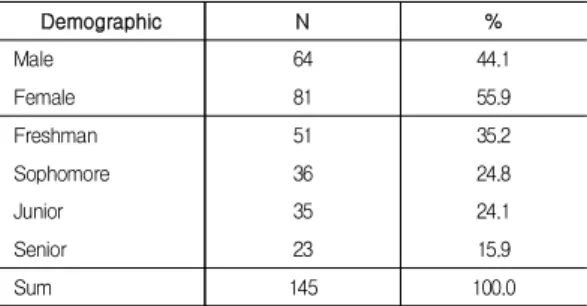
The demographic profiles appear in Table 1.
Demographic N %
Male 64 44.1
Female 81 55.9
Freshman 51 35.2
Sophomore 36 24.8
Junior 35 24.1
Senior 23 15.9
Sum 145 100.0
Table 1. Demographic Profile
As Table 1 shows, 55.9% of the respondents are female with 44.1% male. As for the grade, 35.2% of the
respondents are the freshman; 24.8% is the sophomore;
24.1% is the junior; 15.9% is the senior. The average age of respondents is 21.97 with standard deviation 2.02.
3.2 Measurement
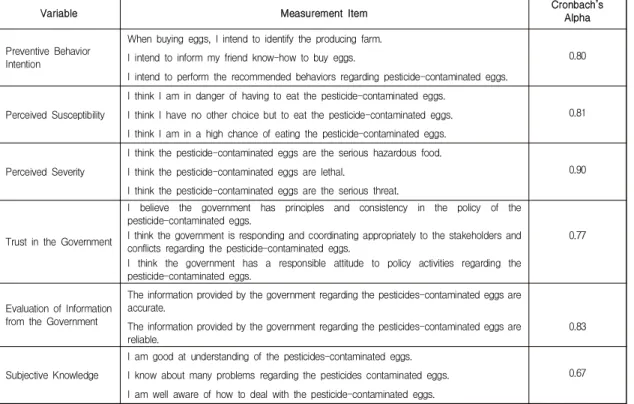
To solve research hypotheses, we employed some variables which are derived from the previous studies and modified to fit the purpose of the current study. As the dependent variable, we employed preventive behavior intention (α=0.80) which consisted of three items, used in You, Park, and Jin[12]. The independent variables consisted of perceived susceptibility (3 items, α=0.81), perceived severity (3 items, α=0.90), trust in the government (3 items, α=0.77), evaluation of information from the government (2 items, α=0.83), and subjective knowledge (3 items, α=0.67). Two variables of HBM (perceived susceptibility and severity) and trust in the government are also from You, Park, and Jin[12]. Evaluation of information from the government is measured with two items. The two items were developed in the context, in which the authority’s communications were inconsistent and confused.
Therefore, we developed the variables in term of accuracy and credibility of the information from the government. Finally, subjective knowledge was chosen from two previous studies[12; 19] and modified to fit the purpose. Individual item is measured with the five-point Likert scale ranged from strong disagreement (1 point) to strong agreement (5 point).
The following Table 2 shows the detailed items of the variables.
3.3 Analysis
We used IBM SPSS ver.22 for statistical analysis.
First, frequency analysis was performed to understand
the demographic of the respondents. Second, to resolve
the research hypotheses, this study employed multiple
linear regression analysis. As known, multiple linear
regression analysis is the statistical technique that
could estimate the effect on the dependent variable of
the independent variables. This study inputs independent variables into the regression equation through ‘stepwise’
option in SPSS easy to compare the strength of the significant predictors. In addition, the stepwise method seeks regression equation to exclude independent variables with low statistical significance. In other words, this method inputs independent variables into regression equation in order of the power of explanation and the statistical significance of the regression coefficient and then eliminates the independent variable with under 0.05 of the significance of the coefficient[23]. We measured multi-items for each variable as shown in Table 2. We input the mean of the multi-items as the variable into the regression equation.
The study considered multicollinearity and the independence of residuals to identify the assumption of multiple linear regression. We identified the multicollinearity through tolerance and VIF(Variance Inflation Factor). In case that the tolerance is less than 0.10 and VIF is more than 10, the multicollinearity is
regarded as high. We employed Durbin-Watson statistic to identify the independence of residuals.
Durbin-Watson statistic ranges zero to four. In case that Durbin-Watson statistic is close to zero or four, the independence is problematic; and when the statistic is close to two, the independence is good[24].
4. Findings
The reliability of variables appears in Table 2. The reliability of each variable is suitable to put the variable into the regression equation, that is, it is above the threshold of Cronbach’s alpha, or α>0.60[25].
We executed multiple regression analysis with the stepwise option in SPSS to solve the research hypotheses. First, for identifying whether the assumption of multiple regression would be satisfied or not, we considered tolerance, VIF, and Durbin-Watson statistics. Each model has tolerance more than 0.10 and VIF less than 10, as shown in Table 3. Thus
Variable Measurement Item Cronbach’s
Alpha
Preventive Behavior Intention
When buying eggs, I intend to identify the producing farm.
I intend to inform my friend know-how to buy eggs. 0.80
I intend to perform the recommended behaviors regarding pesticide-contaminated eggs.
Perceived Susceptibility
I think I am in danger of having to eat the pesticide-contaminated eggs.
I think I have no other choice but to eat the pesticide-contaminated eggs. 0.81 I think I am in a high chance of eating the pesticide-contaminated eggs.
Perceived Severity
I think the pesticide-contaminated eggs are the serious hazardous food.
I think the pesticide-contaminated eggs are lethal. 0.90
I think the pesticide-contaminated eggs are the serious threat.
Trust in the Government
I believe the government has principles and consistency in the policy of the pesticide-contaminated eggs.
I think the government is responding and coordinating appropriately to the stakeholders and conflicts regarding the pesticide-contaminated eggs.
0.77
I think the government has a responsible attitude to policy activities regarding the pesticide-contaminated eggs.
Evaluation of Information from the Government
The information provided by the government regarding the pesticides-contaminated eggs are accurate.
The information provided by the government regarding the pesticides-contaminated eggs are reliable.
0.83
Subjective Knowledge
I am good at understanding of the pesticides-contaminated eggs.
I know about many problems regarding the pesticides contaminated eggs. 0.67 I am well aware of how to deal with the pesticide-contaminated eggs.
Table 2. Measurement Item
multicollinearity is not problematic. In Table 3, Durbin-Watson statistics is 1.58, or close to two. The independence of residuals is not problematic as well.
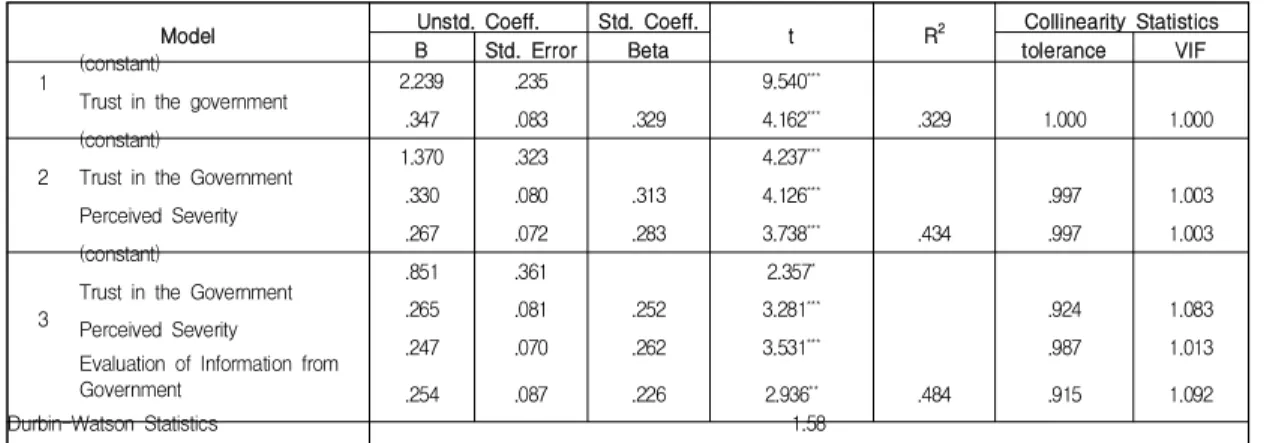
As Table 3 shows, three variables of which five independent variables put in the regression equation predicted preventive behavior intention as the dependent variable in the last model. In the first model, trust in the government predicted the dependent variable ( β =.329, t=4.162, p<0.001). The first model explained 32.9% of the dependent variable, or preventive behavior intention. The second model explained 43.4% of the dependent variable with two independent variables, or trust in the government ( β
=.313, t=4.126, p<0.001) and perceived severity ( β =.283, t=3.738, p<0.001). In the last model, three independent variables predicted the dependent variable significantly.
Three independent, or trust in the government ( β =.252, t=3.281, p<0.001), perceived severity ( β =.262, t=3.531, p<0.001), and evaluation of the information from the government ( β =.226, t=2.936, p<0.01) have 0.484 R
2statistics, namely explained 48.4% of the dependent variable.
In summary, H2, H3, and H4 were supported.
According to the standardized regression coefficient ( β , Beta) in Table 3, perceived severity had the greatest effect on preventive behavior intention, and in the following order trust in the government and evaluation of information from the government.
5. Conclusion
In 2017, the pesticide eggs contamination occurred in all over the world including Korea, some EU countries, and Hong Kong. The situation made most of Korean worried about eating eggs. Korean have experienced several adulterated food happenings and then they have fallen into confusion on eating the foods. However, this pesticide eggs contamination left a terrible memory on Korean because the egg could be cooked as itself and especially consumed as an ingredient in other foods, in other words, the egg would be eaten unconsciously. In general, food safety is the issue which attracts a lot of attention from people. The accidents regarding food frequently consumed in everyday life have a powerful effect on the society. Namely, a food safety accident would make a person avoid the food, then that would be set up as a social trend and the industry regarding the food would decrease to vanish finally. On this viewpoint, this study explored the relationship among some perception regarding health on the context of pesticide eggs contamination. Concretely, we tested how perceived susceptibility and severity from HBM, trust in government policy regarding the contamination, evaluation of information from the government and subjective knowledge toward the contamination have an influence on preventive behavioral intention. Under the above problematic consciousness, this study
Model Unstd. Coeff. Std. Coeff.
t R2 Collinearity Statistics
B Std. Error Beta tolerance VIF
1 (constant)
2.239 .235 9.540***
Trust in the government
.347 .083 .329 4.162*** .329 1.000 1.000
2
(constant)
1.370 .323 4.237***
Trust in the Government
.330 .080 .313 4.126*** .997 1.003
Perceived Severity
.267 .072 .283 3.738*** .434 .997 1.003
3
(constant)
.851 .361 2.357*
Trust in the Government
.265 .081 .252 3.281*** .924 1.083
Perceived Severity
.247 .070 .262 3.531*** .987 1.013
Evaluation of Information from
Government .254 .087 .226 2.936** .484 .915 1.092
Durbin-Watson Statistics 1.58
Note. * p<0.05, ** p<0.01, *** p<0.001
Table 3. Result of Multiple Linear Regression
proposed hypotheses and then executed the stepwise multiple linear regression analysis using IBM SPSS ver. 22 for testing the hypotheses. The following summarized the findings.
In the final model, preventive behavioral intention, or the dependent variable was predicted by perceived severity ( β =.262, t=3.531, p<0.001), trust in the government ( β =.252, t=3.281, p<0.001), and evaluation of information from the government ( β =.226, t=2.936, p<0.01). The three independent variables explained 48.4% of the dependent variable. Namely, the hypothesis 2, 3, and 4 were supported. In the findings, first we found that perceived severity of the two beliefs in HBM had an effect on preventive behavioral intention. The susceptibility had no effect on the dependent variable, which shows that people has the belief they can avoid and not eat the egg as they have the interest, and accordingly perceives less susceptible about the contaminated egg. Whereas the severity, meaning fatality, seriousness or dangerousness, and obstacle of daily life, appears to stimulate preventive behavioral intention. The second, two variables concerning the government predicted the intention. In concrete, trust in the government and information evaluation from the government had an effect on preventive behavioral intention. In other words, the general trust toward the government and the evaluation of messages from the governmental authorities have a critical effect on people’s determining whether to eat the certain food or not because of the following perceptions; the authorities have more data about agricultural and marine products than any other organizations and the authorities administer policies with responsibility which comprises credibility, accuracy and consistency. Accordingly, when the governmental authorities release impressionable policy toward the people like food closely related to everyday life, the authorities need to stand on credibility, accuracy, and consistency for decreasing public’s sense of unease or panic. In summary, we confirmed the influence of the perceptions on the government policy
in company with health belief on preventive behavior intention in the context of health risk.
Finally, the followings are some advice for future studies. This study did not consider the media which is a critical channel for people to acquire information on food safety. People have used various media to acquire information. Each media would make information from government different meaning due to its inherent to cover information. Therefore, we should understand which media have a more effect on people to acquire information. Future study should employ media variables to increase the power of explanatory.
Furthermore, the following studies need to employ structural equation modeling (SEM) which appears the structural causalities within variables. Employing SEM, we could understand not simple causality between an independent variable and a dependent variable, but multi-dimensional, structural, and sequent causalities among independent variables and dependent variables.
REFERENCES
[1] K. H. Jeong, S. M. Yoon, Y. R. Kim, & J. H. Seo. (2004).
A Study of Food Safety Index by Knowledge Attitude and Practice(KAP). Seoul, Korea: Korea Institute for
Health and Social Affairs, Korea Food and Drug Administration.[2] BBC. (August 11, 2017). Eggs containing fipronil found in 15 EU countries and Hong Kong. Retrieved from http://www.bbc.com/news/world-europe-40896899 [3] TheMinistryOfAgricultureFoodAndRuralAffairs.
(August 14, 2017). Detection of pesticide (Fipronil, etc.)
among domestic eggs. Retrieved from
http://www.korea.kr/policy/pressReleaseView.do?newsI d=156220044.
[4] J. K. Yang. (August 15, 2017). "Stop selling egg products" .... Convenience stores also joining. News 1.
Retrieved from http://news1.kr/articles/?3074816 [5] H. S. Kim. (December 19, 2011). Egg, 50 gram of
nutritionally complete food, or a herb of eternal youth on the table. Daejonilbo. Retrieved from
http://www.daejonilbo.com/news/newsitem.asp?pk_no=9 83438
[6] J. K. Lee. (March 19, 2018). Worst oversupply, egg price plunging. TJB 8 News. Retrieved from
http://www.tjb.co.kr/sub0301/bodo/view/id/30271/versio n/1
[7] I. M. Rosenstock. (1974). Historical origins of the health belief model. Health education monographs, 2(4), 328-335.
[8] N. K. Janz, & M. H. Becker. (1984). The health belief model: A decade later. Health education quarterly, 11(1), 1-47.
[9] J. P. Kirscht. (1974). The health belief model and illness behavior. Health education monographs, 2(4), 387-408.
[10] M. H. Becker. (1974). The health belief model and sick role behavior. Health education monographs, 2(4), 409-419.
[11] L. A. Maiman, & M. H. Becker. (1974). The health belief model: Origins and correlates in psychological theory.
Health education monographs, 2(4), 336-353.
[12] S. You, H. Park, & B. Jin. (2016). An application of the extended parallel process model to protective behavioral intention against the MERS: Examining the moderated effect of subjective knowledge and trust in the government. The Korean Journal of Advertising and
Public Relations, 18(2), 237-273.
[13] C. I. Hovland, & W. Weiss. (1951). The influence of source credibility on communication effectiveness.
Public Opinion Quarterly, 15(4), 635-650.
[14] J. Flynn, W. Burns, C. K. Metz, & P. Slovic. (1992).
Trust as a determinant of opposition to a high-level radioactive waste repository: Analysis of a structural model. Risk Analysis, 12(2), 417-429.
[15] J. E. Park, & A. R. Sohn. (2010). The relationship between government credibility and risk perception of the mad cow disease. Korean Public Health Research,
36(2), 27-34. ,B. H. Cho. (2009). Korean's perception of
mad cow disease. Health and Social Science, 25, 129-152.[16] M. Siegrist, & G. Cvetkovich. (2000). Perception of hazards: The role of social trust and Knowledge. Risk
Analysis, 20(5), 713-720.
[17] J. T. Oh. (September 4, 2017). Eating eggs, or not? "not influencing the body" vs. "worry about side effect". Asia
Economy. Retrieved from
http://www.asiae.co.kr/news/view.htm?idxno=201709040 9132358283
[18] I. S. Hwang. (October 17, 2017). "The Ministry hiding behind KFDA"...one voice through KFDA. Food Today.
Retrieved from
http://www.foodtoday.or.kr/news/article.html?no=151223 [19] H. R. Song, C. W. Kim, & W. J. Kim. (2014). Effects of public's Media dependency, risk severity, and subjective knowledge on preventive behavior intention of cyber crime. Crisisonomy, 10(5), 83-100.
[20] H. J. Jin, & D. H. Han. (2014). Interaction between message farming and consumers' prior subjective knowledge regarding food safety issues. Food Policy,
44, 52-60.
[21] M. Brucks. (1985). The effect of product class knowledge on information search behavior. Journal of
Consumer Research, 12(1), 1-16.
[22] C. W. Park, & V. P. Lessig. (1981). Familiarity and its impact on consumer decision biases and heuristics.
Journal of Consumer Research, 8(2), 223-231.
[23] J. K. Suh. (2014). Health Statistical Analysis Using IBM
SPSS 21: Bomungak.
[24] J. Joo. (2012). Differences of purchasing luxury brand between female and male : Focusing on conspicuous consumption and influence of reference group.
Advertising Research, 94, 70-93.
[25] S. Han, & S. Lee. (2010). Nursing & Health Statistical