․교신저자: 방옥선 대전시 유성구 엑스포로 한국한의학연구원 뇌질환센터 Tel: 042-868-9353
E-mail: [email protected]
․본 연구과제는 한국한의학연구원(K09200)의 연구비 지원으로 수행되었습니다.
한의 중풍 변증 표준화 연구에서 어혈증에 관한 고찰
이정섭, 김소연, 강병갑, 고미미, 김정철, 오달석, 김윤식1, 이 인2, 조기호3, 전찬용4, 한창호5, 방옥선
한국한의학연구원 뇌질환센터, 1대전대학교 한의과대학 내과학교실,2원광대학교 한의과대학 내과학교실
3경희대학교 한의과대학 내과학교실, 4경원대학교 한의과대학 내과학교실, 5동국대학교 한의과대학 내과학교실
A Review of Static Blood Pattern in Stroke Pattern Diagnosis
Jung-sup Lee, So-yeon Kim, Byoung-kab Kang, Mi-mi Ko, Jeong-cheol Kim, Dal-seok Oh, Yoon-sik Kim1, In Lee2, Ki-ho Cho3, Chan-yong Chen4, Chang-ho Han5, Ok-sun Bang
Brain Disease Research Center, Korea Institute of Oriental Medicine
1Dept. of Internal Medicine, College of Oriental Medicine, Dae-Jeon Univ.
2Dept. of Internal Medicine, College of Oriental Medicine, Won-Kwang Univ.
3Dept. of Internal Medicine, College of Oriental Medicine, Kyung-Hee Univ.
4Dept. of Internal Medicine, College of Oriental Medicine, Kyung-Won Univ.
5Dept. of Internal Medicine, College of Oriental Medicine, Dong-Guk Univ.
ABSTRACT
Background :
Static blood is a kind of etiological factor including stagnated blood and blood overflowed out of the vessels. It is one of the causes of stroke in oriental medicine.
Objectives :
The purpose of this study was to evaluate the static blood pattern and its indicators in stroke pattern diagnosis.
Methods :
For the standardization of pattern diagnosis in stroke, we set 5 patterns (Fire-heat, Dampness-phlegm, Static blood, Qi deficiency, Yin deficiency) and developed 61 indicators. Patients with a first-ever stroke, within 1 month after the onset of stroke. Two physicians checked the indicators independently. They then performed pattern diagnosis and rechecked the indicators which were referred to pattern diagnosis. If pattern identifications were diagnosed the same, it would confirm pattern identification. We examined the frequency of all indicators and referred indicators in static blood pattern patients.
Results :
In 859 patients, static blood pattern was shared by 24(2.8%). The indicators which affect static blood pattern were mainly rough pulse and bluish purple tongue, other indicators were not major effectors.
Conclusion :
This result shows that it is inconsistent to set up static blood pattern as a major pattern in stroke.
Nevertheless, static blood is still a valuable concept in the clinical field. Other study methods will be required to establish the pattern diagnostic indicators for static blood pattern.
Key words : Pattern identification, Stroke, Static blood
Ⅰ. 서 론
중풍은 뇌혈관의 순환장애로 인해 국소적인 신
경학적 결손을 나타내는 뇌혈관 질환을 포함하는
것으로 인사불성, 수족탄탄, 구안와사, 언어건삽,
편신마목 등의 임상증상을 나타내는 병증이다
1. 변 증이란 사진의 방법을 통해 환자의 임상 증상, 징 후를 수집하여 종합적인 분석을 통해 병의 원인, 병위, 병태를 파악하는 과정이다. 그러나 변증은 한가지로 통일되지 않고 다양한 관점에서 팔강변 증, 기혈진액변증, 오장변증, 내생오사변증 등 다양 한 형태로 적용된다. 2005년부터 시작된 한의학연 구원의 중풍 변증 표준화 연구는 기존 한의학의 생리, 병리지식을 바탕으로 풍, 화열, 허, 습담, 어 혈 등의 병인과 한국의 임상현실을 고려하여 변증 형과 이를 설명하는 임상지표를 개발하고 있다. 이 에 따라 2006년에는 5개 변증별로 61개의 임상지표 를 제정하고 한의과대학 한방병원을 통해 자료를 수 집하여 변증표준안에 접근하려는 노력을 지속하고 있다. 이 논문에서는 여러 한방병원에서 수집된 중 풍환자에 대한 증상, 징후 정보와 전문가의 변증정 보를 바탕으로 중풍 변증형의 하나로 설정된 어혈증 을 재평가 하고 향후 연구방향을 제시하고자 한다.
Ⅱ. 연구방법
1. 연구대상
본 연구는 2006년 12월 1일부터 2009년 6월 30일 까지 31개월간 전국 13개 한방병원에 입원한 중풍 환자 중 정상적인 의사소통이 가능하고 신경학적 결손증상과 CT, MRI 등 영상의학적 진단이 일치 하거나 영상의학적 확진 없이도 두 명의 전문가가 임상적으로 중풍이라고 판단된 경우, 신경학적 결 손증상이 24시간 이상 지속되고 발병일이 1개월 이 내인 환자를 대상으로 하였으며 외상성 중풍은 제 외하였다.
2. 변증자료 수집
2005년부터 중풍임상전문가들의 토의와 합의 및 이를 뒷받침하는 임상연구를 통해 개발된 5개 변 증(화열증, 습담증, 어혈증, 기허증, 음허증)과 변 증별 세부 지표로 구성된 증례기록지를 사용하여
임상자료를 수집하였다
2. 증례기록지의 각 세부 지 표는 ‘매우 그렇다’-‘그렇다’-‘아니다’의 3단계 척도 를 사용하여 표기하였고, 2008년 10월 1일 부터는 환자에게서 나타난 지표들 중 조사자가 변증을 하 는데 중요하게 고려한 지표를 추가적으로 강조하 여 표기하였다. 증례기록지의 지표 항목을 모든 연 구자들이 정확하고 일관된 기준으로 작성하게 하 기 위하여 표준작업지침서를 제정하였으며 연 2회 정기적인 교육을 실시하였다.
3. 변증의 확정 및 어혈증의 기초임상자료 분석 변증을 확정하기 위한 방법으로 본 연구에 참여 하는 연구자들의 합의에 의해 한방병원에서 2년 이상 중풍을 진료한 임상전문가 2인이 서로 독립 적으로 사진과정을 거쳐 5개 변증 중 하나로만 변 증하고, 그 변증이 일치하는 환자를 해당 변증군으 로 설정하였다. 본 연구에서는 전문가에 의해 확정 된 5개 변증군의 빈도와 이 중 어혈증 환자에게서 나타나는 지표의 빈도, 조사자가 어혈증 환자를 판 단하게 된 근거지표의 빈도를 알아보고 이를 분석 하였다.
4. 분석방법
환자군의 일반적 분포에서는 성별에 따른 나이 를 비교하기 위해 Two sample T-test, 변증별 분 포와 어혈증에서 지표의 분포를 확인하기 위해 빈 도분석을 실시하였으며, 모든 분석은 SAS 9.1을 이 용하였다.
Ⅲ. 결 과
1. 총 연구대상자의 변증 분포
2006년 12월부터 2009년 6월까지 수집된 자료 중
임상 전문가 2인의 변증이 일치하면서 단일 변증
인 임상 자료 859례를 대상으로 분석한 결과, 여성
의 평균 나이는 68.02세로 남성보다 약 5.02세 정도
많았다(Table 1). 변증별 분포는 습담증이 31.9%로
Indicators
Static blood pattern patients (n=11) Total patients (n=353) Frequency (Strong positive) Frequency (Strong positive)
Indicators reffered to ststic blood pattern
Bluish purple tongue* 9(1) 9(1) 16(1) 4.50%
Rough pulse* 8 7 28(1) 7.90%
Sallow complexion 7 1 101(3) 28.60%
Strong pulse 6 1 146(9) 41.40%
Fatty figure 5(1) 152(19) 43.10%
Sunken pulse 5 1 103(7) 29.20%
White fur 4 1 173(8) 49.00%
Turbid urine 4(1) 98(5) 27.80%
Slender figure 4 98(11) 27.80%
Heat vexation and aversion to heat 3 181(26) 51.30%
Dry mouth* 3 2 174(27) 49.30%
Thick fur 3(2) 121(27) 34.30%
Yellow fur 3 119(9) 33.70%
Frequent urination 3 101(0) 28.60%
Weak pulse 3 94(5) 26.60%
Heavy headness 3 65(11) 18.40%
Purple lip* 3 2 37(2) 10.50%
Purple spots on the tongue* 3 2 5(0) 1.40%
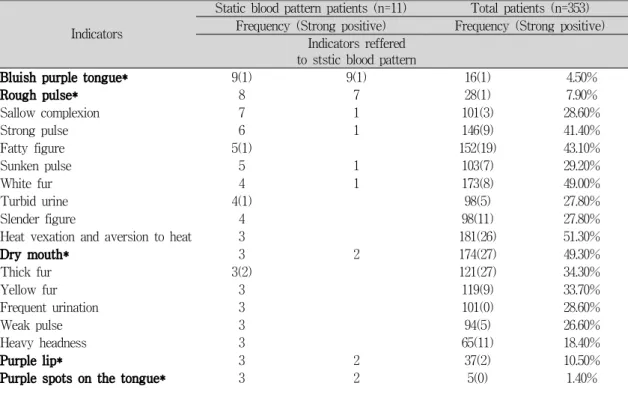
Table 3. Distribution of Indicators for Static Blood Pattern Patients and Total Patients 가장 많았으며, 화열증, 기허증, 음허증 순으로 나타
났고 어혈은 2.8%로 매우 적게 나타났다(Table 2).
Sex N (Mean±SD) p*
female male 426(68.02±11.14) 433(62.98±12.37) <.0001
*Independant t-test
Table 1. Average Age of Total Patients according to Sex
Pattern Identification N (%) Fire-heat Pattern 242 (28.2) Dampness phlegm Pattern 274 (31.9) Static Blood Pattern 24 (2.8) Qi Deficiency Pattern 179 (20.8) Yin Deficiency Pattern 140 (16.3)
Total 859 (100.00)
Table 2. Distribution of Pattern Identifications in Stroke Patients
2. 변증 판단 근거 항목이 추가된 임상자료에서 어 혈증 환자의 지표 빈도
의사의 변증 판단 근거 항목이 추가된 2008년 10월 1일부터 2009년 6월 30일 까지의 임상자료 중 변증이 확정된 증례는 총 353례로 이 중 11례 (3.1%)가 어혈증으로 변증되어 전체 임상자료에서 의 어혈의 빈도 2.8%와 비슷한 결과를 나타내었다.
어혈증 환자 11례에서 ‘청자설’ 9례, ‘삽맥’ 8례, ‘얼
굴이 누렇게 뜬 것 같다’ 7례, ‘유력맥’ 6례 순으로
나타났으나 실제 어혈증 변증에 참고한 지표는 ‘청
자설’, ‘삽맥’을 제외하고는 어혈환자에게 나타나는
지표들의 빈도와 다른 패턴을 보였다. 또한 표준안
에서 어혈의 지표로 개발된 11개의 지표 중 ‘청자
설’과 ‘삽맥’을 포함한 6개의 지표는 전체 빈도의
10% 미만으로 나타났다(Table 3).
Look powerless and lazy 2 167(12) 47.30%
Slippery pulse 2 104(6) 29.50%
Thirst 2 1 101(19) 28.60%
Floationg pulse 2 90(3) 25.50%
Slow pulse 2 62(4) 17.60%
Dark inferior palpebra* 2 58(4) 16.40%
Surging pulse 2 36(2) 10.20%
Pale red tongue 1 152(2) 43.10%
Feel powerless and lazy 1 151(18) 42.80%
Red tongue 1 1 132(10) 37.40%
Reddened complexion 1 118(15) 33.40%
Rapid pulse 1 103(3) 29.20%
Constipation 1 100(18) 28.30%
Dry eyes 1 99(6) 28.00%
Spontaneous sweating 1 85(16) 24.10%
Dry fur 1(1) 82(21) 23.20%
Solid stool 1 78(17) 22.10%
Fine pulse 1 78(4) 22.10%
Drowsiness, like to lie 1 74(10) 21.00%
Night sweationg 1 69(9) 19.50%
Wheezing in throat with sputum 1 65(8) 18.40%
Heat in the palms and soles 1 62(6) 17.60%
Fetid mouth odor 1 60(11) 17.00%
Headache of fixed location* 1 1 51(0) 14.40%
Dizziness with nausea 1(1) 50(8) 14.20%
Tidal fever 1 42(4) 11.90%
Palpiation 1 37(3) 10.50%
Reversal cold of the extremities 1 36(3) 10.20%
Nausea 1(1) 33(5) 9.30%
Stabbing headache* 1 1 14(2) 4.00%
Headache with nausea 1(1) 11(1) 3.10%
Darkish complexion* 1(1) 1(1) 5(3) 1.40%
Bitter taste in the mouth 0 95(17) 26.90%
Reluctance to speak 0 82(17) 23.20%
Enlarged tongue 0 55(3) 15.60%
Heat vexation in the chest 0 54(8) 15.30%
Pale face and malar flush 0 51(2) 14.40%
Blood shot eyes 0 51(3) 14.40%
Vexing heat in the extremities 0 48(3) 13.60%
Pale face 0 47(2) 13.30%
Pale tongue 0 44(3) 12.50%
Purpura in derma* 0 43(5) 12.20%
Splashing sound borborygmus 0 43(5) 12.20%
Heat vexation and aversion to heat 0 36(13) 10.20%
Teeth marked tongue 0 33(2) 9.30%
Aphtha or tongue sore 0 26(7) 7.40%
Headache like flush 0 25(3) 7.10%
Bare and red tongue like mirror 0 21(4) 5.90%
Stabbing chest pain* 0 10(0) 2.80%
* Indicators which were developed for static blood pattern