Effect of Cell Size on Growth and Development of Plug Seedlings of Three Indigenous Medicinal Plants
Hye Jin Oh1, Yoo Gyeong Park1,Ji Eun Park1, and Byoung Ryong Jeong1,2,3*
1Department of Horticulture, Division of Applied Life Science (BK21 Plus), Graduate School of Gyeongsang National University, Jinju 660-701, Korea
2Institute of Agriculture and Life Science, Gyeongsang National University, Jinju 660-701, Korea
3Research Institute and Life Science, Gyeongsang National University, Jinju 660-701, Korea
Abstract. There have not been many studies conducted on the seedling production, especially in plug trays, of traditional medicinal plant species. In an effort to establish guide lines for seedling production, this study investigated the effect of plug cell size on the growth and development of plug seedling of three medicinal plant species. Seeds were sown in either 128, 200, or 288-cell plug trays, containing a commercial medium. Growth and development of individual seedling was generally promoted with increasing size of a plug cell in all of the three species. The greatest biomass of the seedlings gained in a plug tray was obtained in the 288-cell trays in Perilla frutescens var. acuta Kudo and Sophora tonkinensis, and the 200-cell trays in Angelica gigas Nakai. Overall growth and development of the shoot and root of a single seedling of Perilla frutescens var. acuta Kudo, except total chlorophyll and anthocyanin contents, was the greatest in the 128-cell tray.
However, length of the longest root, length, width and area of the leaf, internode length, root fresh weight, and root ball for- mation in the 200- and 288-cell trays were not significantly different each other. In Sophora tonkinensis, although length of the longest root, stem diameter, leaf width, leaf area, shoot fresh weight, and root ball formation were not significantly dif- ferent among the treatments, length of the longest root and root ball formation of a single seedling were the greatest in the 128-cell tray. Overall shoot and root growth, except total chlorophyll content, of a single seedling of Angelica gigas Nakai was the greatest in the 128-cell tray. Based on the total biomass, it is concluded that 288-cell trays are recommended for production of plug seedlings of medicinal plant species P. frutescens var. acuta Kudo and S. tonkinensis. In A. gigas Nakai, it would be more economical to use the 200-cell trays than 128-cell trays due to total biomass.
Additional key words : Angelica gigas Nakai, medium volume, Perilla frutescens var. acuta Kudo, planting density, Sophora tonkinensis
Introduction
The World Health Organization (WHO) has emphasized the importance of the traditional indigenous medicines, since majority of rural people in the developing countries still use these medicines as the first defense in health care (Golenio- wski et al., 2006). There are about 4,200 plant species grow- ing wild in Korea, and about 1,000 of them are cultivated and used as medicinal plants which have medical effects on human bodies to some extents (Rural Development Admin- istration, 2011).
The P. frutescens has been used as an important tradi- tional herbal medicine for treating various diseases includ- ing depression, anxiety, tumor, cough, antioxidant, allergy, intoxication, and some intestinal disorders (Ha et al., 2012;
Makino et al., 2003; Yang et al., 2012) in East Asian coun- tries such as Korea, China, and Japan. Sophora is a genus of the Fabaceae family, and contains about 52 species, nineteen varieties and seven forms (Krishna et al., 2012). They are widespread in warm and dry habitats, including Asia, North and South Americas, and New Zealand (Jana et al., 2013;
Lai et al., 2003). The root of A. gigas Nakai (Umbelliferae), popularly known as Korean “Dang Gui”, has been used to treat female afflictions and anemia in traditional oriental herbal medicine since ancient times in Korea (Konoshima et al., 1968; Son et al., 2010).
However, if weather condition is not suited for cultivation of medicinal plants, it will bring about difficultly in cultiva- tion and problems of having low contents of medicinal prop- erties. Another issue is not sufficient supply of these herbal materials to meet the steadily increasing demand. Therefore, it is necessary to have a mass production system be estab- lished to solve such problems as lack of stable supplies, dis-
*Corresponding author: [email protected]
*Received November 19, 2013; Revised April 14, 2014;
*Accepted April 23, 2014
proportional contents of medicinal properties, and safety issues caused by uncertain sources.
Plug seedling production technology was introduced to Korea in the early 1990s and has been widely used in recent years especially for vegetable crops because it saves labor for raising seedlings, facilitates mass production of uniform seedlings, and allows division of production labor (Jeong, 1998, 2000). The advantages of using quality trans- plants include: (1) higher quality and yield; (2) greater uni- formity; (3) reduction of the growers’ propagation cost of producing their own transplants, and thus (4) reduction of the overall cost for the plant production (Jeong, 1998, 2000).
Many commercial transplant producers tend to choose more cells per tray (smaller cell sizes) to increase the number of plants produced, and to reduce transplant production space (Vavrina, 1995). This also reduces propagation cost per plant, since production costs are directly related to container size and type (Dufault and Waters, Jr., 1985).
With such advantages as year-round production, seed sav- ing, fast growth, and feasibility of producing uniform seed- lings, utilizing the plug seedling production system is expected to meet the need for stable supply of propagated seedlings to the growers and hence, demand for mass production of medic- inal plants in the country. Domestic plug seedling system has been used mainly in wide ranges of seed-propagated vegeta- bles and growers to facilitate seedling supply to growers.
Improved standard of living of citizens and increased level of interest toward health caused increasing demand for medici- nal plants. Thus, more research is needed to establish a plug seedling production system for medicinal plants for the stable supply of medicinal plants. The objective of this study was to investigate the effect of cell size on the growth and develop- ment of plug seedlings to provide a guideline for production of plug seedlings to be supplied to growers of most commonly grown traditional medicinal plant species.
Materials and Methods
Three indigenous medicinal plant species were used. Seeds of Perilla frutescens var. acuta Kudo were collected from Gyeongsangnam-do Agricultural Resources Management Institute, Miryang, Korea in April 2011. And seeds of Sophora tonkinensis and Angelica gigas Nakai were col- lected from a medicinal crop farm, Sancheong, Korea in Nov. 2011. Seeds of P. frutescens var. acuta Kudo, S. tonkin- ensis, and A. gigas Nakai were sown in either 128, 200 or
288-cell plug trays, containing a commercial medium (Tosi- lee Medium, Shinan Grow Co., Jinju, Korea), on Apr. 21, Apr. 13, and Sep. 8, 2012, respectively.
The experiment was carried out in a glasshouse at Gyeo- ngsang National University. The volume of each cell in 128, 200, and 288 plug cell trays were 23.3, 11.4, and 7.6cm2, respectively. Seedlings were fed with a nutrient solution [containing in mg·L−1 436.6 Ca(NO3)·4H2O, 232.3 KNO3, 272.0 KH2PO4, 209.1 MgSO4·7H2O, 80.0 NH4NO3, 15.0 Fe-EDTA, 17.4 K2SO4, 1.4 H3BO3, 0.2 CuSO4·5H2O, 2.1 MnSO4·4H2O, 0.12 NaMoO4·2H2O, 0.8 ZnSO4·7H2O]
with pH 5.96 and EC 1.2-1.6mS·cm−1 once a day. Plants were grown with RH and temperature of the glasshouse air of 70% and 18-25oC, respectively.
The growth of seedlings of P. frutescens var. acuta Kudo, S. tonkinensis, and A. gigas Nakai were measured at 45, 53, and 75 days after sowing, respectively when the seedlings filled the plug trays. Growth parameters measured were plant height, length of the longest root, stem diameter, leaf length, leaf width, leaf area, internode length, no. of leaves, fresh weight, dry weight, total chlorophyll and anthocyanin con- tents, and root ball formation. Internode length was mea- sured at the closest node to the top with the full-grown leaf.
Dry weight was measured after drying the plant for 72h in a dry oven (JSOF-150, JSR Micro, Gongju, Korea) at 70oC.
Total chlorophyll content was estimated by grinding 10mg of fresh leaf sample in 1 mL of 80% acetone, and filtered using Whatman #1 filter paper and brought up to 10mL using the same solution. The absorbance of the extracted solution was recorded at 663 and 645 nm, and contents of total chloro- phyll were calculated according to the method described by Dere et al. (1998). Anthocyanin content was measured using the method described by Fuleki and Francis (1968). Root ball formation was rated on a 1 to 5 scale, where 1 being the worst and 5 being the best.
The experiment was carried out in 3 replicates per treat- ment in a completely randomized design. Data collected were analyzed for statistical significance with the SAS (Sta- tistical Analysis System, V. 9.1, Cary, NC, USA) program.
The experimental results were subjected to an analysis of variance (ANOVA) and Duncan’s multiple range tests at 5%.
Results and Discussion
Percent seed germination of P. frutescens var. acuta Kudo taken after 7 days in 128, 200, and 288-cell trays was 78, 85,
and 84%, respectively. Twenty days after sowing, leaf began to change its color from green to purple. Growth of the shoot and the root in the 128-cell trays observed just prior to trans- planting was better than that in other treatments (Fig. 1).
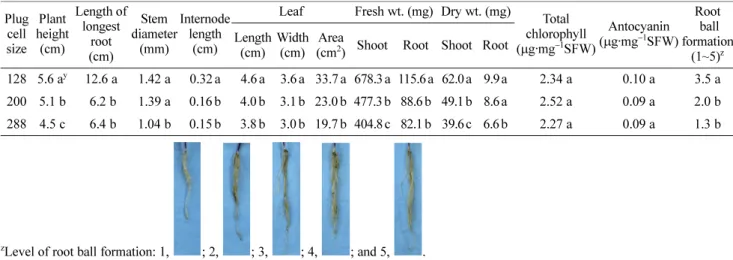
Quality characteristics of plug seedlings of P. frutescens var.
acuta Kudo as affected by plug cell size are shown in Table 1. The growth of seedlings of P. frutescens var. acuta Kudo was measured at 45 day after sowing. Overall shoot and root growth, except total chlorophyll and anthocyanin contents, were the greatest in the 128-cell tray. Similar results were reported by Cantliffe (1993) that as container size increases the leaf area, and shoot and root biomass increase. However, length of the longest root, leaf length, width and area, intern- ode length, root fresh weight, and root ball formation in the 200 and 288-cell trays were not significantly different each other. Therefore, it would be more economical to use the 288-cell trays than 200-cell trays. However, to prevent leaf rolling problems in the 288-cell trays caused by high plant- ing density, it would be desirable to transplant seedlings ear-
lier than 45 days after sowing in 288-cell trays.
Root growth of S. tonkinensis was obviously greater in the 128-cell trays than other cell sizes (Fig. 1). Shoot and root growth in the 128-cell trays observed just prior to transplanting was greater than that in other treatments.
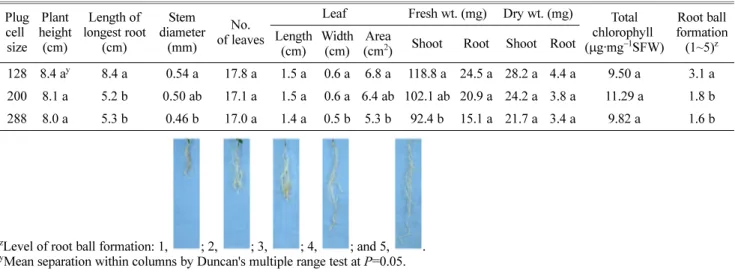
Green color of the mature leaves was deeper than the newly-formed young leaves. Quality characteristics of plug seedlings of S. tonkinensis measured at 53 day after sow- ing as affected by plug cell size are shown in Table 2.
Overall shoot and root growth, except length of the longest root, stem diameter, leaf width and area, shoot fresh weight, and root ball formation, was not significantly affected by the plug cell size. Length of the longest root and root ball formation were the greatest in the 128-cell trays, indicating potential benefits of larger volume cell trays for production of medicinal plant species for the root is used for medicinal purpose. The greatest biomass of the seedlings gained in a plug tray was obtained in the 288-cell trays in Sophora tonkinensis. Shoot growth was greatly
Fig. 1. Effect of plug cell size on shoot and root growth of three indigenous medicinal plant species: A, P. frutescens var. acuta Kudo; B, S. tonkinensis; and C, A. gigas Nakai.
Table 1. Plug seedling quality of P. frutescens var. acuta Kudo measured at 45 days after sowing as affected by plug cell size.
Plug cell size
Plant height (cm)
Length of longest
root (cm)
Stem diameter
(mm)
Internode length
(cm)
Leaf Fresh wt. (mg) Dry wt. (mg)
Total chlorophyll (µg·mg−1SFW)
Antocyanin (µg·mg−1SFW)
Root ball formation
(1~5)z Length
(cm) Width
(cm) Area
(cm2) Shoot Root Shoot Root
128 5.6 ay 12.6 a 1.42 a 0.32 a 4.6 a 3.6 a 33.7 a 678.3 a 115.6 a 62.0 a 9.9 a 2.34 a 0.10 a 3.5 a 200 5.1 b 6.2 b 1.39 a 0.16 b 4.0 b 3.1 b 23.0 b 477.3 b 88.6 b 49.1 b 8.6 a 2.52 a 0.09 a 2.0 b 288 4.5 c 6.4 b 1.04 b 0.15 b 3.8 b 3.0 b 19.7 b 404.8 c 82.1 b 39.6 c 6.6 b 2.27 a 0.09 a 1.3 b
zLevel of root ball formation: 1, ; 2, ; 3, ; 4, ; and 5, .
yMean separation within columns by Duncan's multiple range test at P=0.05.
impacted by container size and root restriction. Effect of container size and root restriction on leaf growth was docu- mented for bell pepper (NeSmith et al., 1992; Weston, 1988), marigold (Latimer, 1991), euonymus (Dubik et al., 1992), soybean (Krizek et al., 1985), cabbage (Csizinszky and Schuster, 1993), tomato (Weston and Zandstra, 1986), watermelon (Liu and Latimer, 1995), and salvia (van Ier- sel, 1997). Generally, larger container volumes have greater water and nutrients availability, along with more space for root development (McConnughay and Bazzar, 1991). Hall (1989) also noted that the rate of vine growth of water- melon was greater in plants grown in larger cells than in smaller ones once transplanted to the field. Shoot height and biomass reduction in small containers have been reported for tomato (Peterson et al., 1991), marigold (Latimer, 1991), muskmelon (Maynard et al., 1996), and watermelon (Hall, 1989; Liu and Latimer, 1995).
Root growth of A. gigas Nakai measured at 75 days after sowing was the greatest in the 128-cell trays. Shoot and root growth in the 128-cell trays observed just prior to transplant- ing was better than that in other treatments (Fig. 1). Quality characteristics of plug seedlings of A. gigas Nakai measured at 75 day after sowing as affected by plug cell size are shown in Table 3. Overall shoot and root growth, except total chlorophyll content, was the greatest in the 128-cell trays. However, length of the longest root, stem diameter, no.
of leaves, and shoot and root fresh weights in the 200 and 288-cell trays were not significantly different each other.
Total biomass of the shoot and root was the greatest in 200- cell trays (9,340g), followed by 288-cell trays (8,985.6g), and 128-cell trays (7,475.2g). Therefore, it would be more economical to use the 200-cell trays than 128-cell trays.
Plants grown in small cells are less expensive to produce than those in large cells because less greenhouse space is Table 2. Plug seedling quality of S. tonkinensis measured at 53 days after sowing as affected by plug cell size.
Plug cell size
Plant height (cm)
Length of longest root
(cm)
Stem diameter
(mm)
No.
of leaves
Leaf Fresh wt. (mg) Dry wt. (mg) Total chlorophyll (µg·mg−1SFW)
Root ball formation
(1~5)z Length
(cm) Width
(cm) Area
(cm2) Shoot Root Shoot Root
128 8.4 ay 8.4 a 0.54 a 17.8 a 1.5 a 0.6 a 6.8 a 118.8 a 24.5 a 28.2 a 4.4 a 9.50 a 3.1 a 200 8.1 a 5.2 b 0.50 ab 17.1 a 1.5 a 0.6 a 6.4 ab 102.1 ab 20.9 a 24.2 a 3.8 a 11.29 a 1.8 b 288 8.0 a 5.3 b 0.46 b 17.0 a 1.4 a 0.5 b 5.3 b 92.4 b 15.1 a 21.7 a 3.4 a 9.82 a 1.6 b
zLevel of root ball formation: 1, ; 2, ; 3, ; 4, ; and 5, .
yMean separation within columns by Duncan's multiple range test at P=0.05.
Table 3. Plug seedling quality of A. gigas Nakai measured at 75 days after sowing as affected by plug cell size.
Plug cell size
Plant height (cm)
Length of longest root
(cm)
Stem diameter
(mm)
No.
of leaves
Leaf Fresh wt. (mg) Dry wt. (mg) Total chlorophyll (µg·mg−1SFW)
Root ball formation (1~5)z Length
(cm) Width
(cm) Area
(cm2) Shoot Root Shoot Root
128 6.8 ay 10.2 a 2.59 a 9.3 a 2.2 a 2.0 a 11.81 a 446.5 a 174.7 a 39.5 a 18.9 a 0.79 a 3.6 a 200 6.5 a 7.9 b 2.00 b 7.6 b 2.0 ab 2.0 a 8.53 ab 325.8 b 113.1 b 36.0 b 10.7 b 0.85 a 2.6 b 288 5.6 b 7.4 b 1.86 b 7.1 b 1.8 b 1.6 b 5.56 b 259.2 b 78.0 b 24.8 c 6.4 c 0.80 a 1.3 c
zLevel of root ball formation: 1, ; 2, ; 3, ; 4, ; and 5, .
yMean separation within columns by Duncan's multiple range test at P = 0.05.
required for each plant (Weston and Zandstra, 1986).
In conclusion, based on the total biomass, it is con- cluded that 288-cell trays are recommended for production of plug seedlings of medicinal plant species P. frutescens var. acuta Kudo and S. tonkinensis. In A. gigas Nakai, it would be more economical to use the 200-cell trays than 128-cell trays due to total biomass.
Acknowledgements
This study was carried out with the support of ‘On-Site Cooperative Agriculture Research Project (Project No.
9070222013)’, RDA, Republic of Korea. Hye Jin Oh, Yoo Gyeong Park, and Ji Eun Park were supported by a scholar- ship from the BK21 Plus Program, the Ministry of Educa- tion, Korea.
Literature Cited
Cantliffe, D.J. 1993. Pre- and postharvest practices for improved vegetable transplant quality. HortTechnology 3:415-417.
Csizinszky, A.A. and D.J. Schuster. 1993. Impact of insecti- cide schedule, N and K rates, and transplant container size on cabbage yield. HortScience 28:299-301.
Dere, S., T. Genes, and R. Sivaci. 1998. Spectrophotometric determination of chlorophyll-a, b and total carotenoid con- tents of some algae species using different solvents. Turkish J. Bot. 22:13-17.
Dubik, S.P., D.T. Krizek, D.P. Stimart, and M.S. McIntosh.
1992. Growth analysis of spreading euonymus subjected to root restriction. J. Plant Nutr. 15:469-486.
Dufault, R.J. and L. Waters, Jr. 1985. Container size influ- ences broccoli and cauliflower transplant growth but not yield. HortScience 20:682-284.
Fuleki, T. and F.J. Francis. 1968. Quantitative methods for anthocyanins. J. Food Sci. 33:72-77.
Goleniowski, M.E., G.A., Bongiovanni, L. Bongiovanni, C.O.
Palacio, and J.J. Cantero. 2006. Medicinal plants from the
‘Sierra de Comechingones’. Argentina J. Ethnopharmacol.
107:324–341.
Ha, T.J., J.H. Lee, M.H. Lee, B.W. Lee, H.S. Kwon, C.H.
Park, K.B. Shin, H.T. Kim, I.Y. Baek and D.S. Jang. 2012.
Isolation and identification of phenolic compounds from the seeds of Perilla frutescens (L.) and their inhibitory activi- ties against a-glucosidase and aldose reductase. Food Chem.
135:1397-1403.
Hall, M.R. 1989. Cell size of seedling containers influences early vine growth and yield of transplanted watermelon.
HortScience 24:771-773.
Jana, S., I. Sivanesan, and B.R. Jeong. 2013. Effect of cytoki- nins in vitro multiplication of Sophora tonkinensis. Asian Pac. J. Trop. Biomed. 3:549-553.
Jeong, B.R. 1998. Technology and environment management for the production of plug transplants of flower crops. Kor.
J. Hort. Sci. Technol. 16:282-286.
Jeong, B.R. 2000. Advances and current limitations of plug transplant technology in Korea. p. 102-107. In: Kubota, C.
and C. Chun (eds.). Transplant production in the 21st cen- tury. Springer. Dordrecht. The Netherlands.
Konoshima, M., H.J. Chi and K. Hata. 1986. Courmarins from the root of Angelica gigas. Chem. Pharm. Bull. 16:1139- 1140.
Krishna, P.M., S. Sandhya, and B. David. 2012. A review on phytochemical, ethnomedical and pharmacological studies on genus Sophora, Fabaceae. Rev. Bras. Farmacogn. Braz.
J. Pharmacogn. 22:1145-1154.
Krizek, D.T., A. Carmi, R.M. Mirecki, F.W. Snyder, and J.A.
Bruce. 1985. Comparative effects of soil moisture stress and restricted root zone volume on morphogenetic and physio- logical responses of soybean (Glycine max L. Merr.). J.
Expt. Bot. 36:25-38.
Lai, J.P., X.W. He, Y. Jiang, and F. Chen. 2003. Preparative separation and determination of matrine from the Chinese medicinal plant Sophora flavescens Ait by molecularly imprinted solid-phase extraction. Anal. Bioanal. Chem. 375:
264-269.
Latimer, J.G. 1991. Container size and shape influence growth and landscape performance of marigold seedlings. Hort- Science 26:124-126.
Liu, A. and J.G. Latimer. 1995. Root cell volume in the planter flat affects watermelon seedling development and fruit yield. HortScience 30:242-246.
Makino, T., Y. Furata, H. Wakushima, H. Fuji, K. Saito and Y.
Kano. 2003. Antiallergic effect of Perilla frutescens and its active constituents. Phytother. Res. 17:240-243.
Maynard, E.T., C.S. Vavrina, and W.D. Scott. 1996. Container- ized muskmelon transplants: Cell volume effects on pre- transplant development and subsequent yield. HortScience 31:58-61.
McConnughay, K.D.M. and F.A. Bazzar. 1991. Is physical space a soil resource? Ecology 72:94-103.
NeSmith, D.S., D.C. Bridges, and J.C. Bardour. 1992. Bell pepper responses to root restriction. J. Plant Nutr. 15:2763- 2776.
Peterson, T.A., M.D. Reinscl, and D.T. Krizek. 1991. Tomato (Lycopersicon esculentum Mill. cv ‘Better Bush’) plant response to root restriction. J. Expt. Bot. 42:1241-1249.
Rural Development Administration (RDA). 2011. Evolution of herbage industry. RDA, Suwon, Korea.
van Iersel, M. 1997. Root restriction effects on growth and development of salvia (Salvia splendens). HortScience 32:1186-1190.
Son, S.H., K.K. Park, Y.C. Kim and W.Y. Chung. 2010.
Decursin and decursinol from Angelica gigas inhibit the lung metastasis of murine colon carcinoma. Phytother. Res.
25:959-964.
Vavrina, C.S. 1995. An introduction to the production of con- tainerized vegetable transplants. Univ. of Florida Coop. Ext.
Serv., Bul. 302. Gainesville, FL, U.S.A.
Weston, L.A. 1988. Effect of flat cell size, transplant age, and production site on growth and yield of pepper transplants.
HortScience 23:709-711.
Weston, L.A. and B.H. Zandstra. 1986. Effect of root con- tainer size and location of production on growth and yield of tomato transplants. J. Amer. Soc. Hort. Sci. 111:498-501.
Yang, S.T., C. Hong, H. Lee, S. Park, B. Park and K.W. Lee.
2012. Protective effect of extracts of Perilla frutescens treated with sucrose on tert-butyl hydroperoxide-induced oxidative hepatotoxicity in vitro and in vivo. Food Chem.
133:337-343.
플러그 셀 크기가 세 가지 자생 약용식물 묘 생육에 미치는 영향
오혜진1 · 박유경1 · 박지은1 · 정병룡1,2,3*
1경상대학교 대학원 응용생명과학부(BK21 Plus),
2경상대학교 농업생명과학연구원,
3경상대학교 생명과학연구원
적 요. 약용식물을 플러그 트레이를 이용하여 공정육묘를 한 연구결과는 거의 없는 실정이다. 세 종류 약용식 물 묘의 생산을 위한 기준을 마련하기 위해 플러그셀 크기가 플러그묘의 생장에 미치는 영향을 구명하기 위하 여 본 연구를 수행하였다. 상업용 상토가 들어있는 128, 200, 288구 플러그셀 트레이에 종자를 파종하였다. 세 종류 약용식물은 플러그 셀 크기가 커질수록 생육이 우수하였다. 하나의 플러그 트레이에서 얻어진 총 바이오 매스는 차조기와 산두근은 288구에서 가장 높았고, 참당귀는 200구에서 가장 높았다. 총 엽록소와 안토시아닌 함량을 제외한 차조기의 지상부와 지하부 생장은 128구에서 가장 우수하였다. 하지만 최대근장, 엽장, 엽폭, 엽 면적, 절간장, 뿌리 생체중, 근군형성은 200구와 288구에서 유의한 차이가 없었다. 산두근은 최대근장, 경경, 엽폭, 엽면적, 지상부 생체중, 근군형성을 제외한 모든 생장에서 처리간에 유의한 차이가 없었다. 그러나 최대 근장, 경경, 엽폭, 엽면적, 지상부 생체중, 근군형성은 128구에서 가장 우수하였다. 엽록소 함량을 제외한 참당 귀의 지상부와 지하부의 모든 생장이 128구에서 우수하였다. 경제적인 부분과 총 바이오매스를 고려했을 때 차조기와 산두근은 288구에서 육묘하는 것이 좋고, 참당귀는 200구에서 육묘하는 것을 권장한다.
추가주제어 : 참당귀, 배지용량, 차조기, 재식밀도, 산두근