The Present State of Physiotherapy and the Development Direction of a Curriculum for Physiotherapy Educational Program in Swaziland
Ji-whan Park
Dept. of Physiotherapy, Daejeon Health Institute of Technology
Master Class
Swaziland의 물리치료 현황과 물리치료 교육프로그램 개발방향
박지환1)
대전보건대학교 물리치료과
Key Words:
Curriculum, Orthopedic manual therapy, Physiotherapy, Swaziland,
ABSTRACT
Background: The purpose of this study was to search the present state of physiotherapy and
the development direction of a curriculum for physiotherapy educational program, especially in field of orthopedic manual therapy, in Swaziland. Methods: The developed curriculum is as follows: 1. Disease and Health State in Swaziland. 2. Medical Human Resources State of Swaziland. 3. Physiotherapy Services State in Swaziland. 4. Higher Education State in Swaziland.
5. Development Direction of a Curriculum for Physiotherapy Educational Program in Swaziland.
Conclusions: There is no a physiotherapist in Swaziland and Swaziland government which has
not a physiotherapy education programme in any university of whole country. So we need to the development direction of a curriculum for physiotherapy educational program for the future of Swaziland, especially in field of orthopedic manual therapy. The reason is firstly, most of people are obesity in this country, so many people complained a lot of joint and muscle pain.
And secondly, also there are many musculoskeletal disease patients now a day in Swaziland because of HIV/AIDS. Lastly, Swaziland country is in a poor and developing state, so physiotherapist it is hard to make a purchase and setting physiotherapy modalities apparatus at Swaziland country.
I. Introduction
Officially the Kingdom of Swaziland, is a sovereign state in Southern Africa. Swaziland is between Mozambique and South Africa around north and south. Swaziland was free from the England during from 1903 until 1967. It regained its independence on 6 September 1968 (Gillis, 1999).
Swaziland is a developing country with a small economy. Its GDP per capita of $7,917 (International
교신저자: 박지환(대전보건대학교, [email protected]) 논문접수일: 2015.11.04, 논문수정일: 2015.11.30, 개재확정일: 2015.12.09.
Monetary Fund, 2015). The majority of the country's employment is provided by its agricultural and manufacturing sectors. Swaziland is a member of African Union.
Swaziland population has got HIV/AIDS (The World Bank, 2014), and tuberculosis are serious challenges (Swaziland Gover, 2010). As of 2013, Swaziland has an estimated life expectancy of 50 years (The World Factbook, 2014, Swaziland Demographics Profile, 2014). The present population growth rate is 1.19%
(United Nations, 2014; Wikipedia, 2015).
So we need to search the present state of
physiotherapy and to the development direction of a
curriculum for physiotherapy educational program,
Educational Program in Swaziland
especially in field of orthopedic manual therapy, in Swaziland. Because all universities of the Swaziland has not a physiotherapy education programme in the whole country until now.
Ⅱ. Medical human resources state of Swaziland
Medical human resources remain the biggest challenge as there were fewer across all cadres when the 100,000 per population ratio was used. Doctors, physiotherapist, laboratory, pharmacy and medical imaging personnel were particularly low when compare to nurses. The 100,000 population ratio for medical officers was found to be 23.1, an increase of 0.1 when compared to 2010; there were 102 nurses per 100,000 and 100.9 midwives per same population (SAM, 2013). But medical human resources physiotherapist including doctor that is a very serious problem in this country, because of there is no medical school or physiotherapy school in Swaziland, on present 2015 year now.
Ⅲ. Physiotherapy service state in Swaziland
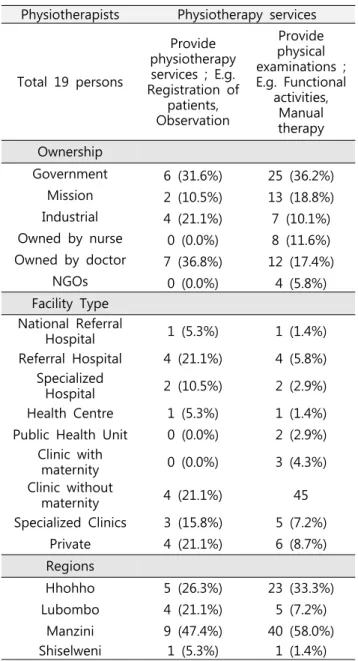
There is no physiotherapist in this country, but there are total 19 physiotherapists who service physiotherapy to the Swaziland’s patient in here.
Therefore most of physiotherapists are foreigner comes from the another country, for example South Africa, Kenya etc (SAM, 2013).
According to the EHCP (essential health care package) (SAM, 2013) physiotherapy services include registration of patients, observation and also provision of physical examinations E.g. functional activities (physiological movements). SAM 2013 found that the service, like all the allied health services, were mostly provided by privately owned physiotherapy facilities and specialist facilities and were in Manzini and Hhohho regions.
Among the 19 foreign country physiotherapist in this country, the most of work place is a owned by doctor 7 (36.8%) persons, second place is a government hospital 6 (31.6%) persons (Table 1).
Availability state of physiotherapy services in this
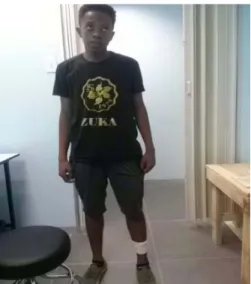
country is a provide physical examinations, functional activities, manual therapy (Fig 1, 2).
Ⅳ. Development direction of a curriculum for physiotherapy educational program in Swaziland
Physiotherapists Physiotherapy services
Total 19 persons
Provide physiotherapy services ; E.g.
Registration of patients, Observation
Provide physical examinations ; E.g. Functional
activities, Manual therapy Ownership
Government 6 (31.6%) 25 (36.2%) Mission 2 (10.5%) 13 (18.8%) Industrial 4 (21.1%) 7 (10.1%) Owned by nurse 0 (0.0%) 8 (11.6%) Owned by doctor 7 (36.8%) 12 (17.4%)
NGOs 0 (0.0%) 4 (5.8%)
Facility Type National Referral
Hospital 1 (5.3%) 1 (1.4%)
Referral Hospital 4 (21.1%) 4 (5.8%) Specialized
Hospital 2 (10.5%) 2 (2.9%)
Health Centre 1 (5.3%) 1 (1.4%) Public Health Unit 0 (0.0%) 2 (2.9%)
Clinic with
maternity 0 (0.0%) 3 (4.3%)
Clinic without
maternity 4 (21.1%) 45
Specialized Clinics 3 (15.8%) 5 (7.2%)
Private 4 (21.1%) 6 (8.7%)
Regions
Hhohho 5 (26.3%) 23 (33.3%)
Lubombo 4 (21.1%) 5 (7.2%)
Manzini 9 (47.4%) 40 (58.0%) Shiselweni 1 (5.3%) 1 (1.4%)
All physiotherapists in Swaziland comes from outside countries.Swaziland government has no physiotherapy school in higher education.
SAM (service availability mapping) report in Swaziland essential health care package, 2013.
Table 1. Availability state of physiotherapy services in
Swaziland (N=19)
Code LEVEL-Ⅰ SEMESTER 1 Point GEC100 English Communication Skills 3T 0 GEC101 Introduction to Computing
Literacy 2T 1
GEC102 Introduction to Psychology 2T 0 GEC103 Introduction to Health 2T 0 GEC104 Clinical Music therapy 2T 1
PTS100 Primary Health Care 2T 0
PTS101 Human Anatomy and
Physiology I 3T 1
Code LEVEL-Ⅰ SEMESTER 2 Point
PTS102 Foundations of Physiotherapy 3T 0
PTS103 Biology 2T 0
PTS104 Surface Anatomy 3T 2
PTS105 Human Anatomy and
Physiology II 3T 1
PTS106 Neuro Anatomy 2T 1
GEC105 Medical terminology 2T 0
PTS107 Pathology 2T 0
GEC : General Education Courses, PTS : Physiotherapy Subjects
Table 2. First year programme structure for the
Bachelor of physiotherapy science degree in Swaziland
Code LEVEL Ⅱ SEMESTER 3 Point
GEC200
PTS200 Physiotherapy Ethics
Clinical Kinesiology 1T
2T 0
0 PTS201 Practice of Community Based
Rehabilitation 2T 0
PTS202 Foundations of Therapeutic
Exercise 2T 1
PTS203 Movement Science 2T 0 PTS204 Physiotherapy Evaluation 3T 2 PTS205 Physical Agents in
Physiotherapy I 2T 2
GEC201 Professional Practice and Law 2T 0
Code LEVEL Ⅱ SEMESTER 4 Point
PTS206 Physiotherapy Intervention for 3T 2
Table 3. Second year programme structure for theBachelor of physiotherapy science degree in Swaziland programme of physiotherapy
Fig. 1. Functional activities for Left
knee instability
Fig. 2. Manual therapy for
Left patellar-femoral syndrome patient
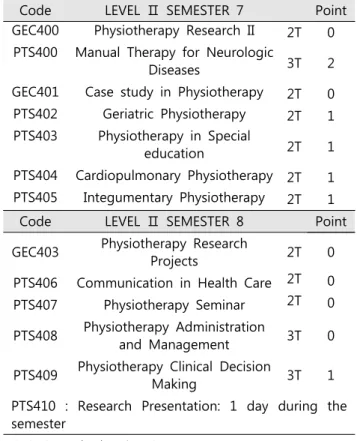
As a mention above physiotherapy service state in Swaziland, there is no a department of physiotherapy in all universities in this country. So we need to the development direction of a curriculum for physiotherapy educational program, especially in field of orthopedic manual therapy for the future of Swaziland (Table 2-5). The developed curriculum is as follows reason; Firstly, most of people are obesity in this country, so many people complained a joint and
muscle pain. And secondly, also there are many
musculoskeletal disease patients now a day in
Swaziland because of HIV/AIDS. Lastly, Swaziland
country is in a poor and developing state, so
physiotherapist it is hard to make a purchase and
setting physiotherapy modalities apparatus at
Swaziland country.
Educational Program in Swaziland
Code LEVEL Ⅱ SEMESTER 5 Point
GEC300 Research Methodology 2T 0 PTS300 Physiotherapy Intervention for
Musculoskeletal Diseases II 3T 2 PTS301 Physiotherapy Diagnosis for
Neurologic Diseases 2T 1
PTS302 Sports Physiotherapy 2T 1
PTS303 Physiotherapy Intervention for
Neurologic Diseases I 3T 2 PTS304 Introduction of Manual
Therapy 2T 1
PTS305 Therapeutic Exercise for
Neurologic Diseases 3T 2
Code LEVEL Ⅱ SEMESTER 6 Point
GEC301 Physiotherapy Research I 2T 0 PTS306 Physiotherapy Intervention for
Neurologic Diseases II 3T 2 PTS307 Psychiatric Physiotherapy 2T 1 PTS308 Manual Therapy for
Musculoskeletal Diseases 3T 2 PTS309 Pain Management in
Physiotherapy 2T 1
PTS310 Gynecology Physiotherapy 2T 1 PTS311 Physiotherapy Leadership and
Communication 2T 0
PTS312 Pediatric Physiotherapy 2T 1 PTS313 Field Attachment: 6 weeks during the
vacation
GEC: General Education Courses PTS: Physiotherapy Subjects
Table 4. Third year programme structure for the
Bachelor of physiotherapy science degree in Swaziland of physiotherapy
Musculoskeletal Diseases I PTS207 Physiotherapy Diagnosis for
Musculoskeletal Diseases 2T 1 PTS208 Therapeutic Exercise for
Musculoskeletal Diseases 3T 2 PTS209 Physical Agents in
Physiotherapy II 3T 2
PTS210 Activities of Daily Living 3T 2
PTS211 Clinical Orthopedics 2T 0
PTS212 Rehabilitation Medicine 2T 0 PTS213 Field Attachment: 6 weeks during the
vacation
GEC : General Education Courses, PTS : Physiotherapy SubjectsCode LEVEL Ⅱ SEMESTER 7 Point
GEC400 Physiotherapy Research II 2T 0 PTS400 Manual Therapy for Neurologic
Diseases 3T 2
GEC401 Case study in Physiotherapy 2T 0 PTS402 Geriatric Physiotherapy 2T 1 PTS403 Physiotherapy in Special
education 2T 1
PTS404 Cardiopulmonary Physiotherapy 2T 1 PTS405 Integumentary Physiotherapy 2T 1
Code LEVEL Ⅱ SEMESTER 8 Point
GEC403 Physiotherapy Research
Projects 2T 0
PTS406 Communication in Health Care 2T 0 PTS407 Physiotherapy Seminar 2T 0 PTS408 Physiotherapy Administration
and Management 3T 0
PTS409 Physiotherapy Clinical Decision
Making 3T 1
PTS410 : Research Presentation: 1 day during the semester
GEC: General Education Courses, PTS: Physiotherapy Subjects
Table 5. Fourth year programme structure for the
Bachelor of physiotherapy science degree in Swaziland programme of physiotherapy
V. Conclusion
In present now 2015, there is no a physiotherapist in Swaziland and Swaziland government which has not a physiotherapy education programme in any university of whole country. So we need to the development direction of a curriculum for physiotherapy educational program for the future of Swaziland, especially in field of orthopedic manual therapy.
1. The reason is firstly, most of people are obesity in this country, so many people complained a lot of joint and muscle pain.
2. And secondly, also there are many musculoskeletal disease patients because of HIV/AIDS now a day in Swaziland .
3. Lastly, Swaziland country is in a poor and
developing state, so physiotherapist it is hard to make a purchase and setting physiotherapy modalities apparatus at Swaziland country.
Therefore we search the present state of physiotherapy in Swaziland and next to the development direction of a curriculum for physiotherapy educational program, especially in field of orthopedic manual therapy, suitable to in this country.
References
Gillis DH. The kingdom of Swaziland: Studies in Political History. Greenwood Publishing Group.
1999.
International Monetary Fund. "Swaziland",
http://www .imf.org. 2015. (Retrieved on Dec 5, 2015).SAM (service availability mapping). Report in
Swaziland Essential Health Care Package, World Bank for which the Ministry of Health and indeed the Government of the Kingdom of Swaziland, 2013;19:35-37.
Swaziland Demographics Profile. Swaziland Demo graphics,
http://www.indexmundi.com.2014.
(Retrieved on Feb 16. 2014).
Swaziland Gover. Dual HIV and Tuberculosis Epidemic Demands Urgent Action. 2010;11:18.
The World Bank. "Projects: Swaziland Health, HIV/AIDS and TB Project".
http://www.world bank.org/projects/P110156/swaziland-health.2014. (Retrieved on Sep 8. 2014).
The World Factbook. Life Expectancy, https://
www.cia.gov 2014. (Retrieved on Feb 2015).
United Nations. Swaziland Population Prospects.
https://www.un.org. 2014. (Revision. On July 29